#RPGaDay2015: Favourite Game I No Longer Play

Day 28 of RPGaDay asks what was my favourite game that I no longer play?

RPG-a-day-2015-Twitter-2

There are so many games that I no longer play to pick from, this is again a very tough choice. As I think over the various games though, the one that I come back to that I miss the most would have to be Mouse Guard. Although I never played the actual game system, I loved the setting and had a great time playing it. I’d love to go back to it one day. Continue reading “#RPGaDay2015: Favourite Game I No Longer Play”

#RPGaDay2015: Favourite Idea for Merging Two Games Into One

On day 27 of RPGaDay, the question is what is my favourite idea for merging two games into one?

x-wingame-gAlthough pretty much my whole gaming life has been spent merging ideas from different games together, the most recent one that has intrigued me the most was combining the tactical fun of the X-Wing Miniatures Game and a Star Wars RPG for the ground action and intrigue.

Continue reading “#RPGaDay2015: Favourite Idea for Merging Two Games Into One”

#RPGaDay2015: Favourite Inspiration for My Game

Day 26 of RPGaDay asks, what is my favourite inspiration for my game?

RPG-a-day-2015-Twitter-2

As others have pointed out here, here and here, there’s no one favourite inspiration that anyone has, as there are so many sources for different times and different games. The question doesn’t make much sense and even if I narrow it down to what is my favourite source of inspiration for my games, this is still too broad a question. Continue reading “#RPGaDay2015: Favourite Inspiration for My Game”

#RPGaDay2015: Favourite Revolutionary Game Mechanic

Day 25 of RPGaDay asks, what is my favourite revolutionary game mechanic?

RPG-a-day-2015-Twitter-2

Just as I listed the other day, I would say that four revolutionary game mechanics that I really like would be: Apocalypse Engine’s task resolution system, Gumshoe’s Skill Point Spends, D&D 5e’s Advantage/Disadvantage and Savage World’s card-based Initiative system.

My favourite of these would have to be the Apocalypse Engine’s task resolution system. I’ve raved about it before, but there’s a good reason it’s being used in game after game, hacked to death in every way possible. It works.

Unknown

For those of you who haven’t played an Apocalypse Engine game, it works like this: you roll 2d6, add the dice together to your stat modifier (-1 to +2 usually). Then, for each move, there’s a results table with three options: 10+, you succeed in the way you describe; 7-9, you succeed, but at a cost or not fully, usually your choice; 6-, the GM describes what happens – maybe you fail or maybe you succeed spectacularly, but put in motion a terrible disaster.

This mechanic gives you three possibilities, one which the player narrates, one which (generally) gives the player a hard choice and one which the GM narrates. There’s no default, “you fail/you succeed” paradigm that was endemic to most games up to that point. And, the best part of it, is the 7-9 result, which statistically, is the most common.

As any player of an Apocalypse Engine game will tell you, the 7-9 result is dreaded. You have to make that hard decision, do I get everything I want, but pay that high price or barely do what I set out to do and put myself in further danger? The choices for the 7-9 rolls are never easy (or rather they shouldn’t ever be) and they bring the drama alive in the game and in the player’s mind in a way that I’ve never seen a game mechanic do so simply before.

This game mechanic has revolutionized games and although many people bemoan all the Apocalypse Engine hacks, the reality is that people are adopting it widely because it is so revolutionary.

#RPGaDay2015: Favourite House Rule

Day 24 of RPGaDay asks, what is my favourite house rule?

RPG-a-day-2015-Twitter-2

I’ve experimented with various ways to determine initiative over the years, including not using initiative at all (as per the Apocalypse Engine), but my preferred method is dealing cards as per Savage Worlds. It changes things up every round, so that sometimes someone gets to go twice in a row and predictability is out the window, but at the same time it’s fast enough to keep the action moving. It’s easy to look at the cards and count down as the turn progresses. As an added bonus, I try to find card decks that reflect the theme of the game, to further add some atmosphere.

In the standard Savage Worlds, a joker counts as the highest possible card (possibly in relation to their logo – Smilin’ Jack) and you gain +2 to all rolls you make that action. It’s a nice way of reflecting a sudden surge in the middle of combat. But, in Deadlands (the original), where most of Savage Worlds rules come from, there was a differentiation between red and black jokers. Red jokers had the above effect, but if you drew a black joker, you went last and suffered -2 to all actions.

JackBigMasked

I’m not sure why this rule was dropped for Savage Worlds, perhaps to simplify things, but I really like the red/black distinction for jokers because it means on every draw, there is as much a chance that you rock it as that you trip or stumble. Also, it doesn’t mean that you have two chances of drawing something awesome, only one and one chance of drawing something that sucks. A nice balance.

So my favourite house rule is that whenever we use the card deck to determine initiative, there is the red and the black joker effect, balancing each other out.

#RPGaDay2015: Perfect Game for Me

RPGaDay asks for day 23, what is my perfect game?
RPG-a-day-2015-Twitter-2

The perfect game for me doesn’t exist and I hope never will.

Ever since my earliest gaming days, I have been designing my own games and can’t help tinkering with game systems when I run them. I don’t think I’m unique in that and believe that game masters should adjust games to best reflect their own and their players’ styles of play.

There are however a few favourite mechanics that I keep trying to incorporate into my games. Here are some of my current favourites:

Apocalypse World Engine’s Task Resolution: My current favourite mechanic in games is the “Powered by the Apocalypse” engine, which is so simple, yet so effective. Roll 2d6 and on a 6 or less, the GM says what happens (generally not good for you); on a 7-9 you get a partial success and on a 10+, you succeed fully. Many game systems have tried the range of success (including Pacesetter’s house game system from 1984!), but none are so simple as this and so fast. As a result, it’s one mechanic that I keep going back to and add into every game system that I can.

Part of what makes it so effective is not just the variable possible results, but the 2d6 aspect. Two dice are faster to add together than three or more, but they’re more fun to roll than two. Somehow, it just seems to work. Right now I’m experimenting with using different dice added together, a la Savage Worlds.

Gumshoe’s Investigation Point Spend: In Gumshoe, the idea that you need randomness in a game to decide whether the PCs find information or know something is thrown out of the window and instead you have a pool of points assigned to different areas of knowledge or abilities and you as the player can choose to spend these points to find the clue or know something. It’s simple and works spectacularly well in games, so much so that now whenever I hear in a game, “roll your notice” to find a clue or “roll your knowledge/intelligence” to see if you know something, I cringe inside. It’s another mechanic that I’m bringing to other games now regularly.

D&D 5e’s Advantage/Disadvantage: The fifth edition of D&D has recaptured the imagination and interest of the gaming community. Part of the appeal is the simplification of the game and in particular, the streamlining of modifiers. If you are in a good position or have something positive affecting your roll, you have “advantage” and roll 2d20 and take the higher of the two rolls. Similarly, if you have negative effects, you have “disadvantage” and roll 2d20 and take the lower of the two rolls. So simple again it’s a wonder I hadn’t seen this before. It speeds things up tremendously and is very effective. When you have advantage or disadvantage, you feel it when you see the rolls.

Savage Worlds Combat & Character Creation: It’s no accident that my game design experiments invariably circle back to Savage Worlds. It’s an elegantly simple system that has a fast and furious combat system that nevertheless allows some tactical options to make the fight more interesting. I also like the different dice for different levels of ability, allowing you to use almost all your polyhedrals (we all love rolling dice after all) and the character generation involving edges and hindrances. It’s a core that I often build off of, like in my current game design.

My current game design, Warhammer World, incorporates all of the above game systems into one, using the Warhammer Fantasy setting, to make what is closest to my current perfect game, but no doubt it will be supplanted in the future when a new innovation in games comes along or I discover a game that I haven’t tried before.
#RPGaDay2015: Favourite Horror RPG

Day 20 of RPGaDay asks what is my favourite horror RPG?

RPG-a-day-2015-Twitter-2Easily, Trail of Cthulhu is my current favourite. I like how the Gumshoe system works, and it fits perfectly with the genre. I grew up with Call of Cthulhu adventures, but never felt fully comfortable with the game system, so it was a delight to find a game with mechanics that mesh so well with the setting. It remains a strong favourite.

ELD-Trail-of-Cthulhu

#RPGaDay2015: Favourite Supers RPG

For day 19 of RPGaDay, the question is what is my favourite Supers RPG?

RPG-a-day-2015-Twitter-2This isn’t a tough one because of so many options, it’s difficult to answer because I really haven’t played many Supers RPGs through the years, nor do I own very many. It’s just not a genre I play or run much.

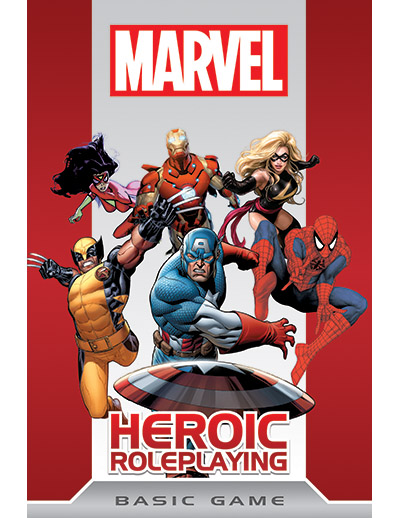
As mentioned before, I did get really excited about Marvel Heroic a couple years ago, ran it several times and for the first time in decades, started reading comics again. It was an excited heady time, but then two things happened: 1) I became disenchanted with the game system (for the reasons explained here) and 2) the game lost its license with Marvel. So, that ended that.

Marvel_heroic_cover

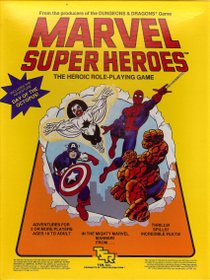
Back in the early 1990s, while in college, I played a fair bit of Marvel Super Heroes and had fun with it, but once the group broke up, I never picked up the game myself and never played again. I still have fond memories of it, but not enough to run it again.

mshbasicset

Between those two events, Supers games have pretty much been absent from my gaming world. So, to pick a favourite doesn’t make a lot of sense. If I have to, I’ll go with Marvel Heroic, but really, I don’t have one.