If you are an adventurer, you are literally a Walking Economy

Despite being god-awful at math, I like to try to make sense of the D&D Economy.

So, assuming tenday weeks (as per Forgotten Realms), and according to the PHB, a skilled laborer makes 2gp a day, and unskilled 2sp a day. Both are variable with these as minimum wages, but we know from Tomb of Annihilation that jungle guides into literal death itself equates to about 5gp a day. We also know that spending 1gp a day is required for a modest lifestyle, and 10gp a day for an aristocratic lifestyle.

Looked it up on SageAdvice and Greenwood says the average family business works daily with the exception of holidays or festivals and what have you. So, on average, skilled employees for these businesses are making at least 2gp a day. I doubt this ever gets higher than 3 or 4gp if we’re seeing that life-threatening situations are 5gp a day. However, we’re not accounting for inflation, so it’s possible that places like Waterdeep have a much higher rate of income, but if we’re meant to take the PHB advice as the average, I can think of no place better than the Sword Coast and Waterdeep to be displaying of this average.

Large amounts of unskilled labor are making somewhere between 2-7sp per day, so about 6-21gp per month. Skilled labor is making between 2-4gp a day, so about 60-120gp per month. A modest lifestyle, which is below comfortable, so probably lower middle class or working class, is spends 1gp a day just to exist. For those that are unskilled labor, that means you’re living a “squalid” or “wretched” lifestyle of 1sp a day or less. Essentially, you’re working class poor, or a college student.

Aristocrats are reasonably making anywhere from 20-40gp+ a day, only going higher and higher the further they are up the chain, for a minimum of making 600gp a month, something along the lines of 1,200gp a month, with no actual limit on this.

So with this frame in mind: Adventurers.

A group of adventurers goes out for maybe a tenday or so and returns with several hundred bags of gold, gems worth several hundred bags of gold, paintings and other valuables worth several hundred bags of gold, and magical items worth potentially far more than that. Essentially, putting their lives on the line, an adventurer literally catapults to the top 1% within a month’s time of gathering loot and other forms of wealth. Really just a single +1 sword is a month’s wage for an Aristocrat at the “upper bounds” of the average and potentially almost 5x that, depending on the buyer (as rare magical items cost 500-5000gp).

What does THAT mean?

If you are an adventurer, you are literally a Walking Economy. Every leader, king, president, what have you, is going to want you on their good side, and is going to want to insure you somehow. Likely, the moment you return to civilization, you are pressured to invest virtually all of your wealth in case you die on your next outing. Suddenly, you’re not only the economic lifeblood of a region after a few years, but you’re someone special. You have museums that hold all your art pieces, jewelers who are making special rings out of the Blood Diamonds of the 7-Headed Lich’s crown jewels, and you are routinely bringing enough wealth back to make up anywhere from 1-10 aristocrats every month or two.

And there’s more than just you. The entirety of the Sword Coast absolutely crawls with adventurers. Wealth is being mined from the veins of the earth and looted from the bodies of other civilizations and routinely brought back. The highest form of wealth, magic items, are circulated around routinely, and those that hold them are essentially the richest, baddest, and most socially capable people at this point. That +2 sword you found in some goblin’s asshole three days ago, by mere virtue of having it, makes you a noble because of how much it’s worth. Say “This sword now belongs to the city,” and suddenly you have 5,000-50,000gp owed to you by the city–enough to live off of for the rest of your life. And, of course, you can still use the sword if you need to “protect the city” or whatever the day’s excuse is.

I imagine when adventurer’s die, all their assets are quickly liquidated. Some people go broke, other’s cash out–it’s like a failing company and selling your stocks and reinvesting. Only the stocks are Tom (the level 12 Halfling Wizard) who is capable of plane-hopping on demand. Kind of fickle, if you think about it. I guess that’s why no city’s main trade is “Adventuring”–gotta have a backup in case Tom fucks off to the Plane of Fire and never comes back.

My Kickstarter Process, Revisited

I’ve just completed my 13th Kickstarter. It’s a location-based adventure called Gamma Turquoise: Santa Fe Starport. So, just wanted to dispense a little more wisdom from my wealth of crowd-funding experience. You can read my previous article here.

The following is a checklist of things you should keep in mind before you kickstart an RPG project of your very own…

  • Assuming you’ve created an outline for what your gaming thing entails, break the parts down into bite-sized chunks. For instance, if you know that you’re going to need a random table for determining exotic uses of guano, set a day aside for that. The introduction? That’s going to need a day. Same thing with every new monster, magic item, piece of high-tech gear, spell, etc. By “day” I mean at least a solid hour of uninterrupted writing time. If you can’t devote at least an hour of time to your project each weekday, then maybe you shouldn’t be launching a new project?
  • Find art early! Sometimes, I wait until the last minute and that can be a painful, stressful prospect. More and more these days, I’m getting out there ahead of time, looking for artists and artwork. Since I’ve been doing this awhile, I have 3 or 4 artists I regularly use. I’ll usually send them an email a month or two before I need their illustrations, asking their availability with some general notes about what I’m looking for, art-wise. Above and beyond that, I’ll lurk on artist hangouts like DeviantArt.com where there’s tons and tons of galleries full of interesting stuff. If I find something I like, I’ll contact the artist and ask if they’re willing to license a specific piece for $25, $50, or even $100 if it’s something super special or full-color.
  • Towards the project’s end, get feedback! This could be in the form of playtesting, proofreading, reviews, or gaming friends. If I’m in unfamiliar territory (like when I was writing my vampire RPG Blood Dark Thirst), playtesting is a necessity. If it’s a one-shot scenario, playtesting is merely a good idea. Typos happen to the best of us, so I ask Kickstarter backers if anyone wants to look the document over before I send it off to layout. Invariably, I get a few people who offer their (free) proofreading services. Even if they only find one little mistake, that’s a win. I also try to showcase bits of content on my Draconic Magazine site. These little previews give me a chance to see what people think of a particular random table, NPC write-up, optional rule, or whatever it is I’m trotting out for the gaming public.

Hope this helps! I look forward to hearing from you. So, if you’re about to launch a new crowd-funded project, keep your old pal Venger in the loop. And good luck! 😉

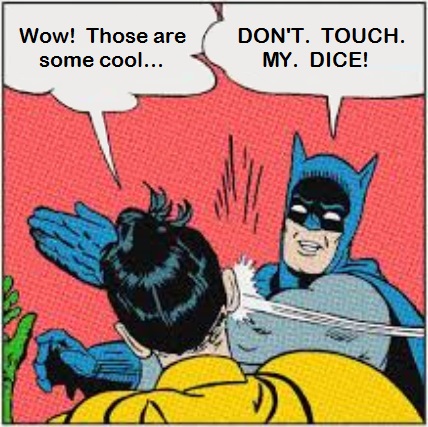
Don’t Touch My Dice!

Across the folding table John tossed his d20, this was an important roll. It caught on his finger and went high into the air. The die came down, hit the edge of the Player’s Handbook open in front of him, and shot across the table towards me. Reflexively, I dropped my forearm along the edge of the table to keep it from continuing its runaway path across the room. It bounced back to the center of the table and end its path with an 18 on top.

“You touched my dice!” Continue reading “Don’t Touch My Dice!”

Layout in RPG Design… making it GREAT

Editor’s Note: This article by Brad Murray was originally posted here.  I loved it so much that I asked to repost it on Stuffer Shack.  Thanks, Brad!

+Cam Banks got me thinking about layout and thinking about it from my usual location, 10,000 meters above looking down. So I think there are three things layout serves and hitting any one of them is probably enough to be good layout. To qualify as great layout, I think it needs to hit all three. And let’s take legibility as given — if the layout makes the text hard to read, nothing saves it — it goes in the bin. Rule zero is: the layout serves the text. Continue reading “Layout in RPG Design… making it GREAT”

What Made D&D a Genre-Defining Classic?

Ever since the creation of such board games as Mice and Mystics and Gloom that utilize aspects of tabletop roleplaying games, the line between roleplaying game and board game has become murkier and murkier. However, where the line should be drawn can be found in the distinction between the original roleplaying game, Dungeons and Dragons, and its predecessor, Chainmail. For some background, Chainmail was a miniature wargame designed heavily by Gary Gygax, one of the creators of Dungeons and Dragons. The seeds planted in Chainmail’s Fantasy Supplement were the basis of Dungeons and Dragons. Despite the inspiration drawn from Chainmail, Original Dungeons and Dragons had three clear distinctions from previous games that set it apart as a genre-defining classic in the making: character change, unique characters, and cooperative and compulsory roleplaying… Continue reading “What Made D&D a Genre-Defining Classic?”

Truly Terrifying Vampire LAIRS

The Stuffer Shack Press book Truly Terrifying Vampires is full of a lot of really interesting ways of creating horrific monsters – completely unlike the overused tropes of today.  One refreshing way it achieves this is be making their behaviour, their origin story, and even their appearance and mannerisms unsettling, disturbing, and creepy, NOT by simply giving them cool new abilities or super-destructive powers. Continue reading “Truly Terrifying Vampire LAIRS”

Closeout Sale! Get’em before they’re gone!

Horse MinisWe’ve had a great run, but it’s time for our store to come to a close.

We have a few horses left (including some that we’ve never sold before, and their price was been slashed by 50%

There are plenty of Exotic Mounts and Monster Minis (again, including things we’ve never sold before – like Gorillas!).  Also, I found a Unicorn!  Most of the Exotic Mounts and Monsters are marked 75% off.

We still have Number Tokens!  Wood tokens painted black, with number stickers on both sides.  They come with a case, and are highly useful.  We pull them out for our game almost every session.

So, get’em before they’re gone, ’cause when they’re gone, they’re gone for good!

p.s. In the next week or so, I’ll be posting a couple of tutorials on how to make your own Mini Counters and Horse Minis.

More on Equipment: Following Up Conversations

I didn’t know how the tracking of a character’s equipment was affecting the roleplaying games people were playing. My article, Do You Have That On Your Character Sheet, generated a number of comments and discussions. There are different ways of handling the equipment issue: some game masters (GMs) are strict about how items are recorded while others are more fluid with their game (and, by-the-way, this covered the spectrum of wanting detailed lists to I don’t give a frack). Neither is a problem. How the game runs is part of the agreement between the GM and the rest of the players in the gaming group. Continue reading “More on Equipment: Following Up Conversations”

Why I love Savage…

Not too long ago, the player characters went up against Paramour, a cyber-assassin that outclassed them in every way. She had been a thorn in their side for several weeks, and they finally took the bait. This was a fight in which the players knew that I would not be pulling any punches.

To start it off, they shot a grenade that she was holding – and of course it blew up, because that’s cool. She ended up being Shaken, but with a destroyed cyberarm. I gave her a -2 Parry, but she still had cool cyberware and a bad-ass heavy pistol. The PCs were almost Seasoned, while she was Legendary +3 extras.

The fight was intense. In attempting to escape, she took out half of the PCs (incapacitated). This turned the tide in her favor, so she maliciously decided to press the attack against the rest of the group. Double taps, Bennies, wild attacks, sniping, full-auto, Bennies, explosions, single-shot, more Bennies, acrobatics, blood-n-wires… you name it, it happened, and it was glorious. In the end, the PCs beat her, but just barely (and they certainly had the injuries to show for it). In that fight we didn’t stop to look up rules, but we weren’t winging it, either. It just… worked. Continue reading “Why I love Savage…”

The Right Tool for the Campaign

Most role players have a favorite system. For many, it’s Dungeons and Dragons. Sometimes it’s Shadowrun. Hopefully, it’s never FATAL. Regardless of the specifics, it might seem that a favorite system is simply perfect. The system may follow the exact philosophy you have for gaming, it may be balanced, and it might use setting material for your favorite series. Why ever use any other system? Unfortunately, no matter how good a game may be, it can never be the best system for every campaign idea. Continue reading “The Right Tool for the Campaign”