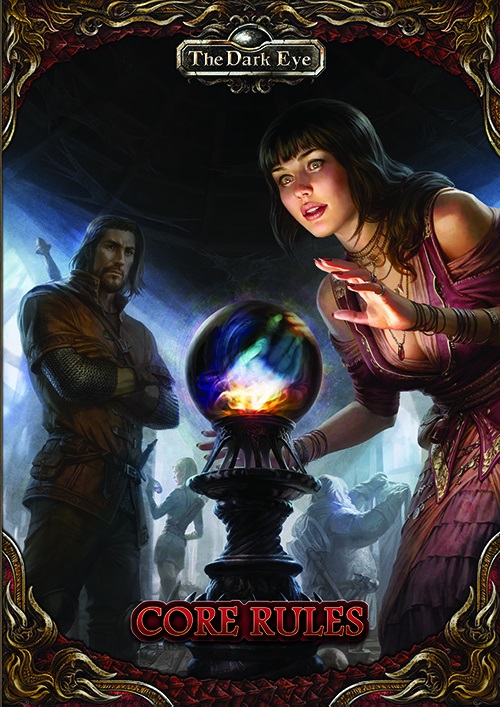
 Many refer to The Dark Eye as Germany’s Dungeons and Dragons. It is a fantasy RPG featuring elves, mages, dwarves, and all the typical things one might expect from a fantasy RPG, and until recently, it was only offered in German. In November of 2016, however, the 5th edition of the game was translated into English, allowing thousands to finally dig in to the system that has captivated the gamers of Germany. Continue reading “A Brand New 30 Year Old Franchise: The Dark Eye”
Author: Jacob Blackard
Jacob Blackard loves RPGs in nearly all forms, and loves to spout his RPG philosophies whenever given the slightest opportunity. Video game preferences include all of them. Favorite RPGs include Legend from Rule of Cool, D&D, and Interface Zero.
Interview with Venger Satanis. Also, a $500 Contest!
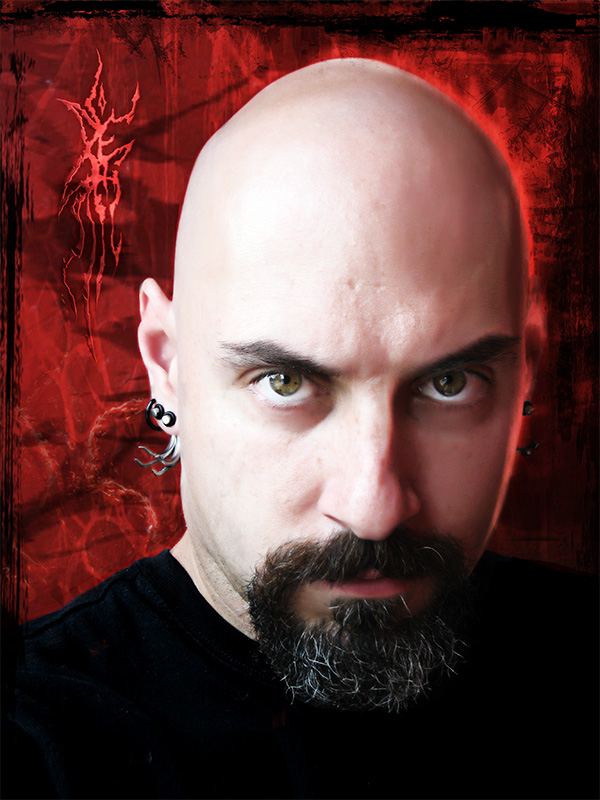 Venger Satanis does not shy away from the controversial… He is the author of Alpha Blue, an RPG that places sexual themes into a spotlight, and his new Adventure Writing Like a Fucking Boss puts an expletive directly into the title of each book. Regardless, his distinctive style provides content for a niche in the RPG industry that most RPG authors leave empty, and Venger has recently released Adventure Writing Like a Fucking Boss to empower fellow writers in creating their own unique creations.
To help motivate writers to put his tips to use, Venger is running an adventure writing contest. Winners receive $500, and their adventure will be published for free on OneBookShelf (art, editing, and layout provided by Kort’Thalis Publishing). To learn more about this contest and the man behind it, I went straight to the source for an interview. Continue reading “Interview with Venger Satanis. Also, a $500 Contest!”
When is a Pair of Scissors a Dagger?
 A longsword does a d8, right? A greataxe does a d12, a dagger does a d4, and longbows can fire arrows accurately at
  a distance of 100 feet. That’s just how it is. Using the default D&D weapon chart, at least. Really, though, why does a slashing and piercing weapon that does a d4 need to be a dagger? Wouldn’t it be just as reasonable to say that the d4 damage comes from a pair of scissors that a tailor uses to defend himself? No need to say it’s an improvised weapon. After all, this tailor knows those scissors better than any cutpurse knows a dagger. Continue reading “When is a Pair of Scissors a Dagger?”
The Right Tool for the Campaign
Most role players have a favorite system. For many, it’s Dungeons and Dragons. Sometimes it’s Shadowrun. Hopefully, it’s never FATAL. Regardless of the specifics, it might seem that a favorite system is simply perfect. The system may follow the exact philosophy you have for gaming, it may be balanced, and it might use setting material for your favorite series. Why ever use any other system? Unfortunately, no matter how good a game may be, it can never be the best system for every campaign idea. Continue reading “The Right Tool for the Campaign”
Olympus, Inc. – Urban Fantasy with that cool Cyberpunk feel
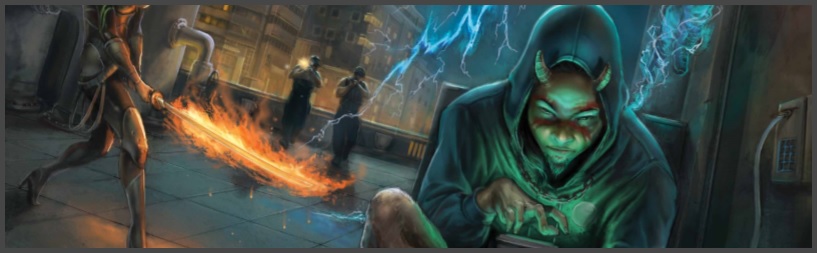
Olympus Inc., a modern day setting for Savage Worlds written by Gilbert Gallo and Charles White (produced by Fabled Environments), is a setting in which the world is controlled by shadow groups. These groups are very powerful, and exert their influence to further their own goals. Unlike most worldwide corporate conglomerates, however, this power does not simply come from significant wealth and connections. In Olympus Inc, the power comes from the deities of the Ancient Greek pantheon. Continue reading “Olympus, Inc. – Urban Fantasy with that cool Cyberpunk feel”
On letting heroes be heroic…
A figure clad in heavy full plate overlooks a cliff. Below, the plague of orcs swarms toward yet another defenseless city. The figure’s companion, a thin young man sporting a bow on his back, walks up to the knight. “We should probably find a secluded way down. Don’t want the whole army to see us.”
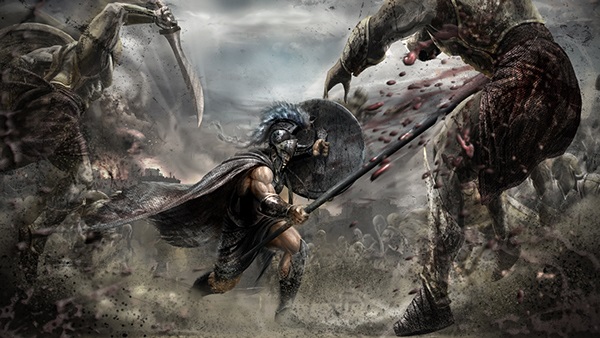
The figure remains fixed on the army. “You’re wrong. That’s exactly what we want.” He then proceeds to leap off the cliff, leaving a crater where he lands. A few unfortunate orcs below are crushed by the knight’s weight. The remaining orcs in the vicinity let out cries of surprise as a streak of metal rushes from the spot their friends used to be…
About an hour later, the figure is taking off his helmet, walking towards the city he just saved from the orc onslaught. His friend finally catches up to him. The hunter smirks, “Showoff.”
The knight merely shrugs “Hey. If you’re going to be a hero, why not be heroic?”
GMing Lessons I Learned from Dark Souls
This article takes a look at the unique ways in which the Dark Souls series tells its story, and how the ideas can be applied to add some variety to the way in which a tabletop RPG can be told…
 Spoiler warning: Some details of the story of Dark Souls will be discussed in this article.
Recently, I’ve been playing a game called Dark Souls 2. For those who are not familiar with the game , it is an action RPG for the Playstation 3, Xbox 360, and PC. The series is primarily known for its tough-but-fair difficulty and well-designed combat. For those who really delve into the Dark Souls games, however, it can be seen that the designers have put together a complex plot filled with ambition, tragedy, and the manipulation of the main character… and thus, the player.
It’s a pretty cool story. What is more interesting, though, is how the story is told. Most games and game masters tend to inform players of the world’s backstory through narration, NPCs, or an out-of-game information dump. In Dark Souls, however, direct information is scarce. Discounting the introductory cut-scene, there is no real narration of the state of the world or the people in it. Those who want to know what is going on need to pay attention to the world around them. Is this character trustworthy? Why did I find this item here, and why does this corpse have it? For that matter, what is this item? Every item has a short description. Some of them only describe the item’s function and provide a physical description. Other items, however, have a few lines that are related to their origin, such as the “Armor of Artorias:”
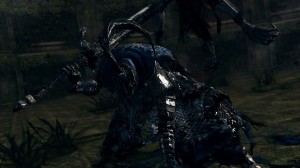 “Armor of Artorias the Abysswalker, one of Gwyn’s four knights. The death of the armor’s owner can be surmised from the corrosive Dark of the Abyss, and the tattered azure-blue cape, once a symbol of pride and glory.”
By itself, this doesn’t mean much. Artorias was apparently some proud knight of this Gwyn. However, by discovering other artifacts, exploring environments, and applying some critical thinking, players can learn who Artorias and Gwyn are, their significance to the world, how the armor came to be left behind, and what happened to that pair of NPCs.
Dark Souls has a unique storytelling style, but how could this be used as a GM? At the very least, it can inspire new ideas for giving information to players. When a party finds a new item, it can be more than just a new toy to play with or fancy doodad to sell. After a knowledge roll from the party’s lore master, it can be fun to give a little more than just the item’s function. Rather than “You rolled a 23? That necklace is a necklace of natural armor +1, it adds +1 to your AC,” some clue or detail of the world could be thrown in.
To illustrate: “A 23, huh? That is the Rhino’s Ring. It was worn by Urul the Stout, who overthrew the bandit king in the Westerlands. It gives a +1 natural armor.” By throwing in this bonus info, it can make the world seem more developed and alive, while adding a sense of mystery or even a future plot hook if the players want to know more about Urul. It’s also a nice way to tell players info that wouldn’t be relevant otherwise. Every DM has background details that they want to show off, right?
Another lesson that can be picked up from Dark Souls is the direct opposite of giving information. Instead, it can be useful to make information a bit more obscure. Instead of saying “Urul overthrew the bandit king in the Westerlands,” it could be more intriguing to only hint at Urul’s importance. “That is the Rhino’s Ring. Worn by Urul the Stout, it protected him in his most heroic moments.” By doing so, it is possible that the party will want to know more. By controlling the flow of information through such means, it might be easier to direct the plot or guide the players toward hooks that might be otherwise ignored.
Another nontraditional storytelling technique is through the placement of the items. Finding a shield on a dead body can just be a way to deliver a useful item in a convenient way. However, in Dark Souls, that body and the items on it can act as vital clues and help determine who the person was. At the beginning of Dark Souls, players are given a choice of numerous archetypes for starting stats and equipment. These archetypes are theorized to be more than stat blocks, however. Some players believe that each archetype is actually a separate character with a different backstory. Evidence for the theory exists in the game, primarily in the form of equipment found on dead bodies. Specifically, the armor of each archetype can be found as a set, typically in the area in which the archetype should have lived. It can be surmised that each archetype attempts to travel to Firelink Shrine (the central area of the game), but sadly, dies on the way. As the player character goes through their journey, they find what remains of the other, less fortunate adventurers.
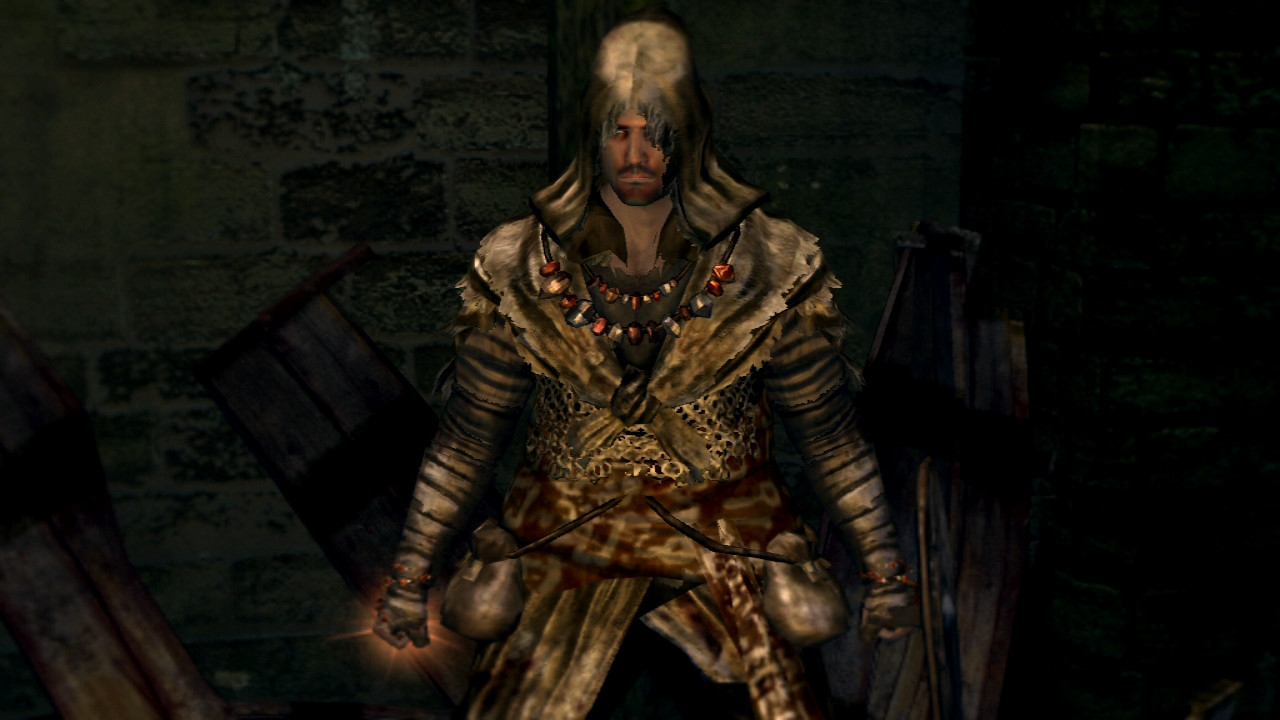 Careful placement of items, ruins, or monsters can mean many things. As a GM, consider the history of your world. It can be easy to toss the party a random encounter with goblins and give them whatever stolen shinies are left after the goblins are (likely) slain. Take that encounter and place it in the context of the world. That loot had to have come from somewhere. Perhaps it is passed down through the goblin generations when they were a powerful empire. If that doesn’t fit, maybe there is a down-on-his-luck adventurer who won’t be happy when he sees some halfling wearing his hard-earned boots of speed (or that Rhino Ring that he inherited from Urul). Basically, if a GM has a chance to consider the details, it can add to the game if every encounter has a reason for existing. Bags of experience in the form of hungry wolves can be fun, but if every enemy is just there to slow down the party’s progress, it can leave the game a bit hollow.
It is likely easier and more convenient for GMs to use the tried-and-true methods of delivering information throughout a session. There are good reasons that such methods are used so ubiquitously. However, to add some variety, it might be fun to take a look at other ways that stories have been told. Dark Souls has an unorthodox plot delivery, but the quality of the story is not diminished as a result. Rather, it has served to draw players in and immerse them in the world. If the same ideas are used for a tabletop RPG, it can certainly have the same effect.
Review: Wreck Age RPG
Wreck Age, released in 2013 by Hyacinth games, is a surprisingly effective hybrid of tabletop RPGs and miniature war games. Although it isn’t perfect, it should satisfy those who are fans of both, and have longed for a more story-driven wargaming experience…
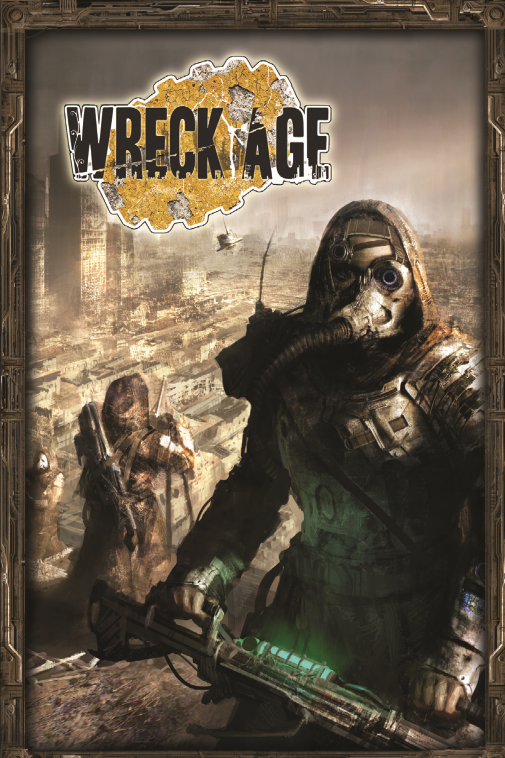 Wreck Age, released in 2013 by Hyacinth games, is a surprisingly effective hybrid of tabletop RPGs and miniature war games. Although it isn’t perfect, it should satisfy those who are fans of both, and have longed for a more story-driven wargaming experience.
Wreck Age written by Anton Zaleski,
Softcover 247 pages
The World of Wreck Age
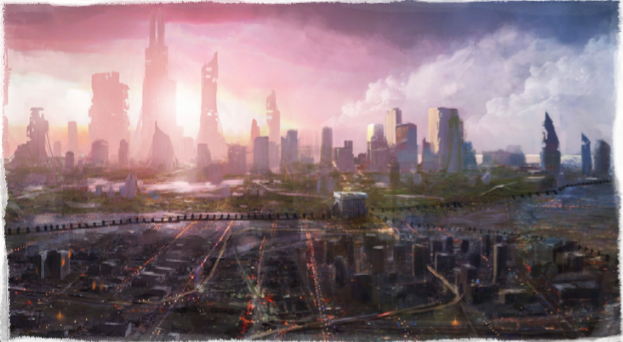
Wreck Age takes place, as you might expect, after the End of the World as We Know It. The world has been ravaged by pollution and natural disasters, and there have been centuries of ruin, misery, and failure to rebuild. However, the Resurgence is beginning, and real hope is finally at hand.
The setting uses many of the expected tropes of a post-apocalyptic environment, but that isn’t to say that there are no fresh ideas. Rather, a healthy balance between tried-and-true story elements and new ideas is struck. The bulk of the setting’s identity comes from the ten factions included in the core rules, which are used to construct the communities the player characters come from. Ranging from the survivalist Stakers to the mentally unhinged and virtually immortal Stitchers, each faction has its own history, motivations, and desires. For me, merely reading through each faction’s description set off a dozen possible plot hooks ideas in my head. The setting remains familiar enough to build scenarios and characters, but maintains a unique identity that sets it apart from other takes on the end of the world.
Characters, and the Communities They Come From
By trying to meld war games and RPGs together, Wreck Age has created a system that streamlines characters to function in large battles, but still allows for a surprising amount of customization. Character-building is something of a hybrid between a class system and a point-buy system. Archetypes provide basic information (such as limits on attributes and starting equipment), but further customization is available through selection of traits and investing points into increasing stats.
Thanks to the incorporation of war game ideas and rules, the system provides a relatively painless way for a player to control multiple characters. Each player is limited to one player character (who gains special immunities), but it is possible for a whole group of battle-ready units to be under a player’s command. In combat, one character is “activated” at a time, which allows them to take actions. After this activation, a different player or the Narrator activates one of their characters. The cycle continues until every player and the Narrator has run out of actions for all of their characters, at which point a new turn starts. This allows for manageable mass combat scenarios between warring factions or communities (such as a siege on a small Staker settlement by Drifters). In addition, this system reinforces the importance of cooperation if one is to survive in the bleak world of Wreck Age. The number of units controlled by a player is meant to be limited by “resource units” that are spent according to how powerful an archetype is, and how much training a character has.
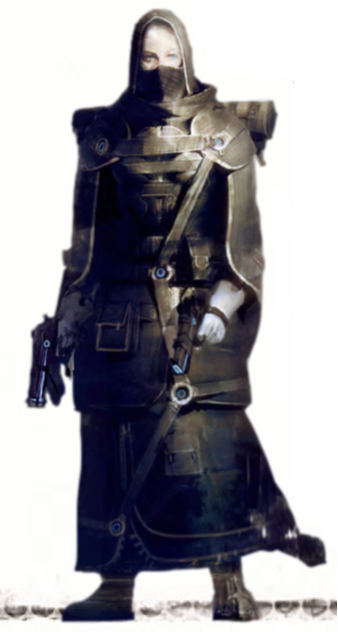 Resource units, however, is one of the problems of the game. Throughout most of the book, it is emphasized how important the Community is to every character. The community a character comes from and the factions within it are meant to inform ideologies, outlook, and even how powerful the character can be. Sure enough, the story of each faction is interesting enough to build a character around, and the settlements in the world are reasonably varied and compelling.
However, as far as mechanics for Communities go, Wreck Age is lacking. Although it does provide ideas for how a town may form a character’s personality, it doesn’t give any guidelines for the limits of a Community’s resources. It is difficult to estimate the resource units that a community should have based on its population, level of technology, etc. A Narrator has to merely guess how much a small town would have versus a large, militant settlement. It is possible that resource units are only meant to be used if the group is playing Wreck Age strictly as a war game, but it would have been nice to at least provide optional rules for building a community mechanically, perhaps by looking at the house-building rules in the Song of Ice and Fire RPG.
Rules of the Apocalypse
The rules for actions both in and out of combat are easy to understand. Outcomes are determined by rolling several six-sided dice and counting how many have a result above a certain threshold. It’s nothing revolutionary, but it is an effective and easy way to run the game.
When it comes to combat, it should be noted that the game seems incredibly lethal. There are only four categories of lethal damage. The first makes the injured character perform worse at nearly every combat relevant test. The rest render a character incapable of acting for varying degrees of time. The fourth means death. Wreck Age maintains a gritty, deadly feel, which is fitting for a depressing post-apocalyptic world. It also works to emphasize the game’s focus on community and teamwork. If a character is traveling alone, they better be prepared to die if they decide to try fighting.
Summary
Although Wreck Age had to make compromises in order to make war games and RPGs coexist in the same system, it still presents a functional, enjoyable ruleset for both. Characters are easy to make, but always unique, and exploring the intricacies should provide plenty of plot hooks and character backgrounds. If you are looking for an interesting take on the post-apocalyptic world, or a way to play both war games and RPGs at the same time, give Wreck Age a try. It shouldn’t disappoint.
Wreck Age is available for download at DrivethruRPG for $12.50.
Or you can get the softcover at Wreck-Age.net for $20.00.