Class-Based Thoughts on Gnomes

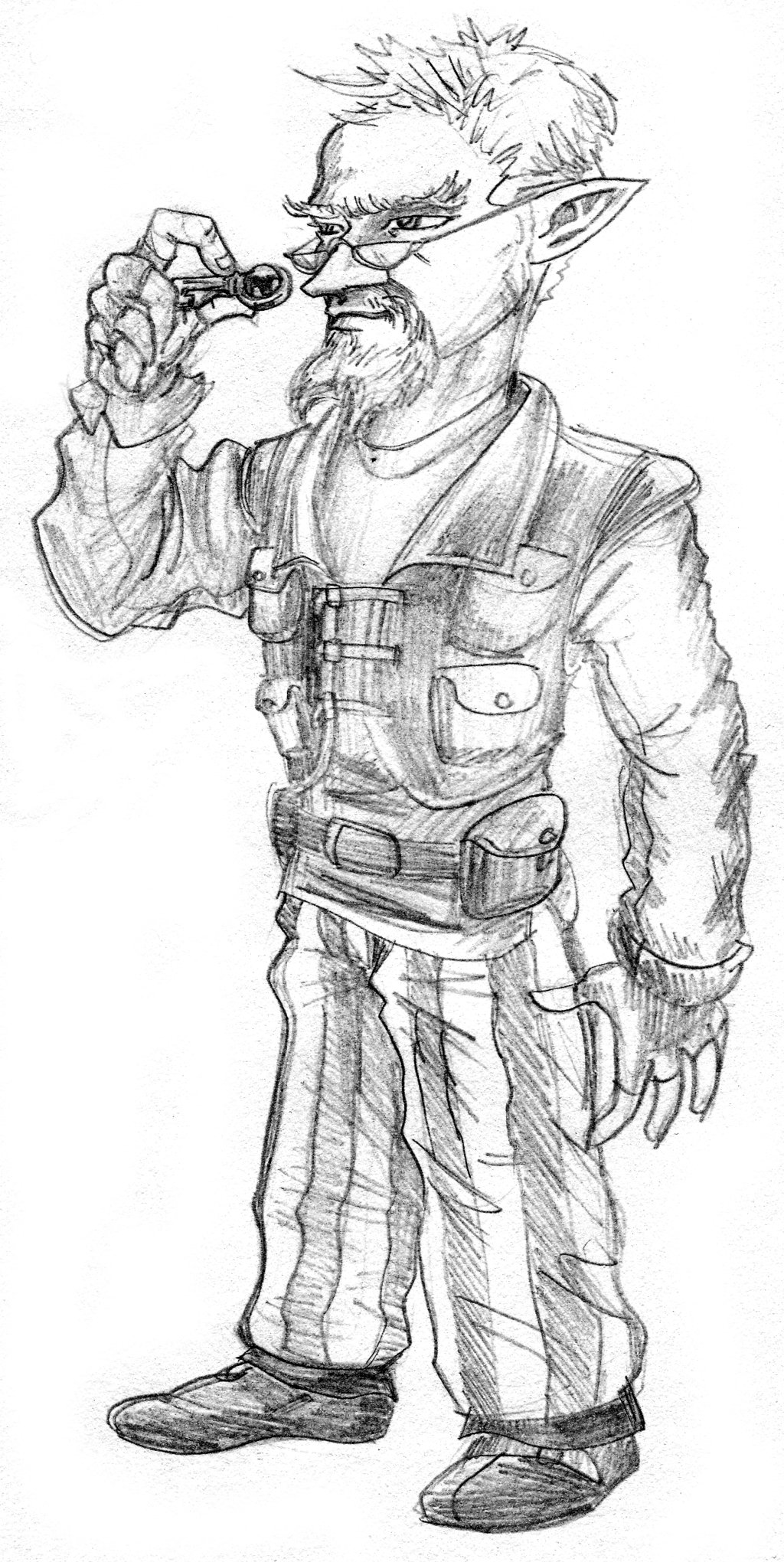
Gnomes have been present in mythology since the 16th century. Their roots can be seen in several mythologies, among which are the type of domestic fey that resided in people’s homes fixing broken items, gnomes that played pranks on people, gnomes that made deals in exchange for something, a type earth elemental, and the subterranean type of creatures that were used synonymously with such creatures as dwarves, goblins, brownies, kobolds, and the like.

Many times these creatures were depicted as being ugly or deformed in some way. These ideas coalesced into the gnomes that we know today in RPGs where they’re often depicted as being either mad scientists/ crafty inventors or illusionist specialists. Unfortunately these ideas as to what gnomes are can be unnecessarily shoehorn them into only these roles. But by looking at the roots of the character, examining their strengths, and seeing what various games have to say about them, a more complex depiction of these creatures can be derived. Continue reading “Class-Based Thoughts on Gnomes”
Class-Based Thoughts on Different Types of Elves

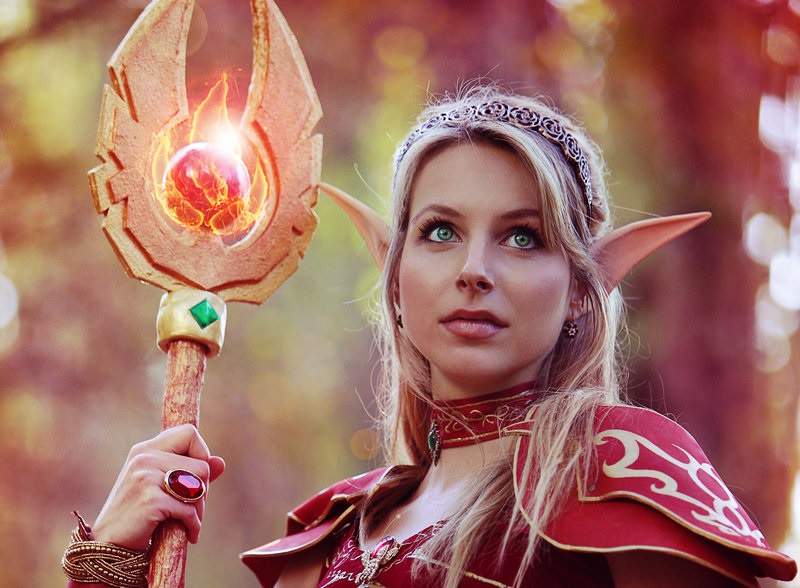
Elves are often depicted as guardians of the wilderness, be it forests, plains, mountains, desert, swamps or tundra in RPG games. In the case of the Drow/ dark elves, they would be living in the Underdark, or other such underground areas in your gaming world. Although these stereotypes as to what elves are may be a starting point, in and of themselves they are, quite frankly, boring. What if these ideas could be refreshed, made alive by combining ideas of class into the mix by showing how the different classes would fit into their everyday lives? Read on: Continue reading “Class-Based Thoughts on Different Types of Elves”

When is a Pair of Scissors a Dagger?

A longsword does a d8, right? A greataxe does a d12, a dagger does a d4, and longbows can fire arrows accurately at a distance of 100 feet. That’s just how it is. Using the default D&D weapon chart, at least. Really, though, why does a slashing and piercing weapon that does a d4 need to be a dagger? Wouldn’t it be just as reasonable to say that the d4 damage comes from a pair of scissors that a tailor uses to defend himself? No need to say it’s an improvised weapon. After all, this tailor knows those scissors better than any cutpurse knows a dagger. Continue reading “When is a Pair of Scissors a Dagger?”
Class-Based Thoughts on Different Types of Dwarves

Dwarves are typically viewed as masters of mining, crafting, and warfare in RPGs. Although these stereotypes may be a starting point, in and of themselves they are, quite frankly, boring. What if these ideas could be refreshed, made alive by combining ideas of class into the mix by showing how the different classes would fit into daily life? Read on: Continue reading “Class-Based Thoughts on Different Types of Dwarves”

Making Undead Scarier, Part 4: The Lich!

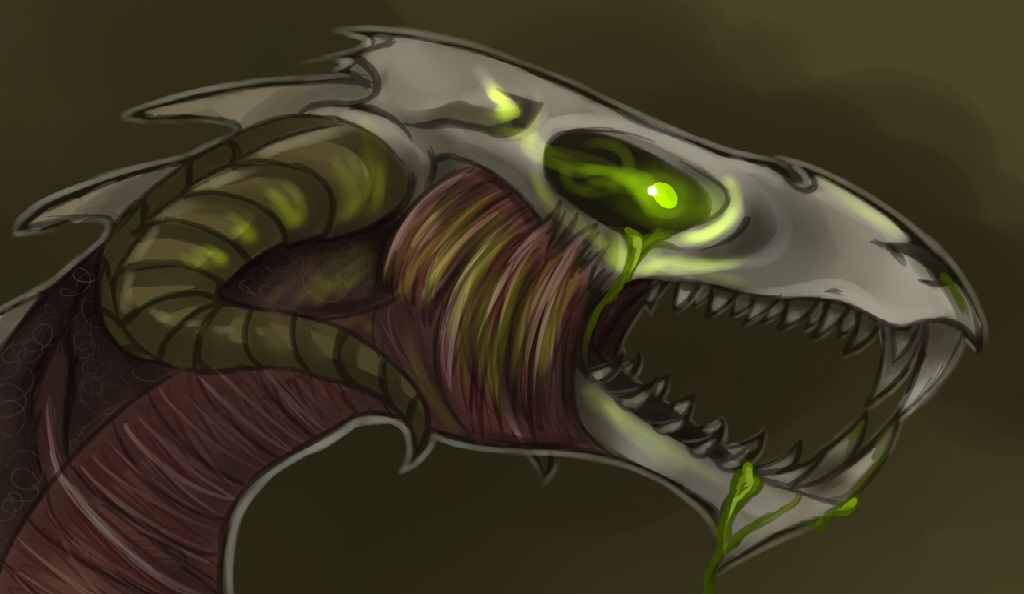
The Dracolich… all kinds of cool

Liches are common threats found in many types of RPG games. Unfortunately, it’s far too easy for the GM to roleplay them in a simplistic manner, as simple monsters to vanquish, giving them no backstory or interest, and an opportunity for world building is lost. But by making them unique, giving them unfamiliar and difficult to destroy phylacteries, giving them unique places to find them, giving them individual motivations and (fill in the blank) they can truly become the threats they should be. Continue reading “Making Undead Scarier, Part 4: The Lich!”

Character Connection = Player Satisfaction

It’s throwback-time, where we revisit an awesome article from years ago…

I don’t think I’m being overly presumptuous when I say that most, if not all gamers want to play a great character.  I’m not necessarily talking about playing some super powerful, mega bad-ass; I’m talking about a character that is something more than just a collection of stats and abilities running around doing stuff.  I’m referring to a character brought to life for everyone at the table in some unique, interesting, and memorable ways and whose individual story enhances the unfolding group story.  Great because the character inspires and challenges us to become better roleplayers, while simultaneously remaining exciting and fulfilling for the individual player throughout the campaign.  We want to play a character that truly has Character. Continue reading “Character Connection = Player Satisfaction”

What’s the Opposite of Optimized?

It’s Throwback-Thursday, where we revisit an awesome article from years ago…

I find devoted (read as, crazy) power gamers perfectly adorable.  It’s funny how they will spend so much time reading rules, seeking synergy, and comparing characters on message boards.  The goal, as far as I can tell, is to make sure that the stats, attacks, damage, and checks are all as humongous as possible.  If you were to ask about their favorite gaming memories, I can almost–ALMOST–guarantee that they will talk about numbers:  “I did 107 damage against this nightwalker once” or “We were fighting an iron golem and I hit four times in a row:  42, 37, 40, and 38” or “At first level, I rolled a 30 Athletics check and easily jumped the chasm.”

Now, I’m not saying there’s anything wrong with this.  Honestly I’m not.  I don’t mind the numbers game.  I’m not going to pass judgment on anyone else, either passively or aggressively.  Sure, people who declare things like, “I’m not saying there’s anything wrong with this,” usually ARE saying there’s something wrong with this, but I’m speaking truth here, hallelujah, testify! Continue reading “What’s the Opposite of Optimized?”

College of the Tree Singers, for the D&D 5e Bard Class

College of the Tree SingersBards that join the College of the Tree Singers [PDF] have an affinity for both music and nature. They seek to learn the ancient and sacred stories and songs of the forests, as well as to preserve these tales and melodies for future generations. Most of the bards who are drawn to this college are elves and half-elves, but the college discriminates against no one and will allow any interested bard to join.

Tree Singers are completely unlike bards from the College of Lore, who spend most of their time in dusty old libraries and such. Bards from the College of the Tree Singers spend many hours outside in the forests and very little time in towns.

Playing in the forestAlso, unlike many other sorts of bards, Tree Singers do not commonly perform in taverns for drunken revelers. They are often circumspect about their songs and stories, choosing NOT to share them with any except other Tree Singers, druids, and elves. This is not to say that they cannot perform other songs, just that the special songs of the forest that they can hear and draw inspiration from are sacred to them, and they do NOT waste sacred music on the unenlightened. Continue reading “College of the Tree Singers, for the D&D 5e Bard Class”

All-Star Player Characters, the making of

All-Star Player CharacterWhat is an All-Star Player Character? It’s a character that has all the tools needed to make him or her as interesting and fun to play as possible. It’s not necessarily an overload of information; just the right amount of information.

When a player writes up a character, it could be just a single sheet with a few numbers on it, several pages of a short story, or somewhere in between. What’s important is that a player gathers just enough information about their character to maximize their enjoyment. Too little information can make the character vanilla bland. Too much information can make the character too complicated to remember.

Continue reading “All-Star Player Characters, the making of”

Savage Worlds Character Creation Checklist, v2!

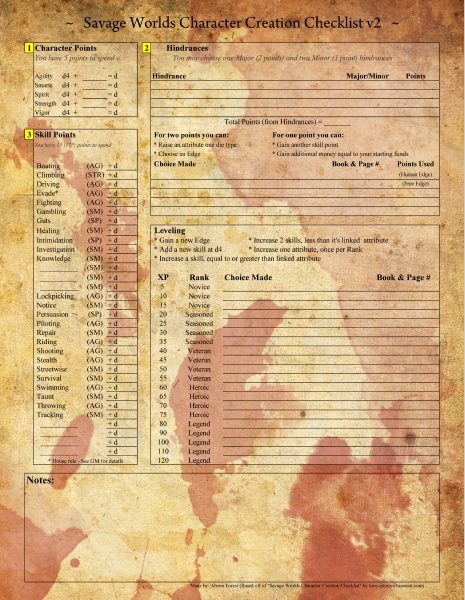
Savage Worlds Character Creation Checklist v2So… With the expectation to always find better tools for gaming, and with more Savage Worlds on the horizon, I have decided to do a thing.

When I was first learning Savage as a whole (which happened to be the last time we all played Rippers), I found a sheet that the GM printed out (and has continued to make available) has been immeasurably helpful. This sheet is the “Savage Worlds Character Creation Checklist,” by Terry Whisenant.  It is something that the players in our group have been using for years, but (for my tastes) there have been just a few simple things that I always wished for.  So… I added them.

I now present to you… the Character Creation Checklist v2 – (white background) and… the Rippers version!