A “Who am I?” Quicksheet for memorable & unique characters

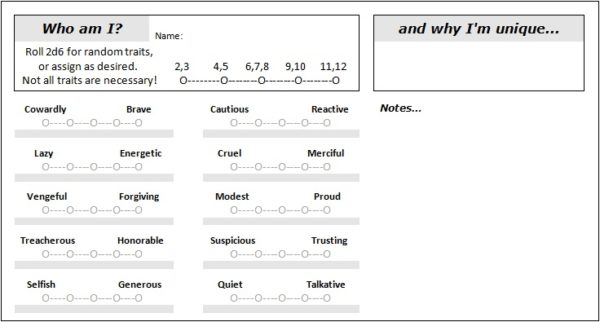
So I was hanging out over at Guild Master Gaming, and I saw that Daniel had posted “A Tip to Help Create Player Characters and Non-Player Characters.”  I liked the idea and whipped up a quick character trait sheet for my own games  You can hand this to players and tell them to fill it out as they desire, or you can use it for quick NPC creation.

I like it for both uses for obvious reasons, but for NPCs especially.  NPCs can really solidify a setting, and I think a lot of players get a lot of appreciation from running into recognizable, memorable, and unique NPCs from time to time.

Click here to download the PDF.

Who am I QuicksheetThanks go to Dan Yocom.

Villainy Unbound: The Quick and Easy Guide for the Making of a Master Villain!

What makes for a great Villain? Three things immediately leap to mind…

VillainsA few years ago I was asked to sit on a panel discussion at a local convention in the Bay Area of Northern California. The topic of the panel was “What Makes a Great Villain?” The forum went amazingly well and it got me to thinking about the ideology of villainy as a whole…

What makes for a great Villain (notice I use the capital “V”)? Three things immediately leap to mind:

  • Intelligence,
  • Etiquette, and
  • Style.

What is better than a Master Villain who stands there gloating while the hero is descending into his Boiling Deathtrap of Doom™? Absolutely nothing. In every culture there is opposition where Good pits itself against the forces of Evil and often times it is the Villain who gets his (or her, let’s not be biased) just reward in the end, but it’s during that interim BEFORE they get caught that is the most pleasurable for us, as game masters.

What makes playing the bad guy so much fun is the sheer audacity that you can conjure by taking the mantle of Villain. Not just villain, but “Master Villain”. The imagery invokes a force that simply must be reckoned with by our heroes for they have no choice in the matter. Since the weight of playing the Master Villain falls upon the shoulders of Game Masters, and in the rare occasion Players, I have taken this opportunity to compile a ‘quick and easy’ guide in the formation of a Master Villain, along with a few reference books to get you pointed in the right direction for World Domination.

Making the Grade

As stated above, I find that the three elements in capturing the essence of a Master Villain are having the intelligence to concoct (and carry out) diabolical schemes, the etiquette to ensure that even when being faced with your most hated enemy the icy composure you have so diligently constructed is never compromised, and finally having the style and grace to look good while doing the most heinous of deeds. Remember, just because you’re a Master Villain doesn’t mean that you still can’t get the girl.

In the end, what makes for a memorable villain is the ability to breathe life into the villainous persona. Anyone can accomplish gratuitous violence and gore, but it takes a cool hand (and even cooler head) to cause the Hero to look foolish in front of his comrades, and that is what the villain really wants.

I briefly discussed the elements of Master Villainy, but let’s delve into each to give us a better understanding of what makes our bad guys so bad.

Intelligence

Perhaps the ultimate weapon in the Master Villain’s arsenal is the vast resource of knowledge that is obtained and absorbed during the Master Villain’s rise to power. Let nothing go to waste and be sure to retain the slightest bit of information that can be used in a future endeavor. Who knows when it might come of use? The weak link in the Hero’s armor is the fact that they think themselves immune to anything the Master Villain throws against them. While that may be true, it cannot be said for those that the Hero associates with; colleagues, relatives and even lovers make for grand bargaining chips when the fate of the Free World is on the line.

Tips and Tactics:

1.) Make hiring subordinates ensure they can hit the broad side of a barn. There is nothing worse than shelling out good money to the local mook union only to hire the dregs from the gene pool.

2.) Fight Dirty. Why stick around in the middle of a fight when you have your villainous mob to handle things for you? Dog pile on the Hero, it’s only fair.

3.) Think before acting. Nothing disrupts a well-laid plan like letting your emotions take control. In order to stay on top and not get caught you must weigh every action against the possible reaction from your opposing force.

Etiquette

Another great tactic in the fight against Good is making the Hero look like a buffoon. Like in the Bond movies of old, the master villain knew how to handle the suave, debonair Englishman spy. They simply invited him into their midst. The mistake that James Bond’s nemesis made was the fact that they became complacent and overconfident; two sure-fire ways to get caught or killed, thus ending their grand scheme for world conquest. There is nothing wrong with being sociable with the Hero; after all he is just like you, only he’s working for the ‘other’ side. Be pleasant, inviting and warm. Being a hero doesn’t have the perks that a Master Villain does: good food, fine wine and drop-dead gorgeous women, so be sure to pamper your opponent. Once he’s lulled into a false sense of security and thinking that you’re not “evil, just misunderstood” that’s when you stomp him in the dirt like a narc at a biker rally.

Tips and Tactics:

1.) Always treat your opponent with Respect. Even though the two of you may not like each other, you have to admire the tenacity of the Hero for continuing the fight, futile though it may be.

2.) Treat the Hero’s companions better than the Hero does. The quickest way to gain an upper hand is by having the Hero’s own people side with you. Treat them like real people, not like ornaments. Sidekicks need love too.

3.) Never be blatant. Innuendo and subtly are the two keys to ensuring that your point is made without becoming insulting. Let the Hero resort to vulgarities, it only shows how beneath you he really is.

Style

The development of the Master Villain could not be complete without making sure that he stands out from every other nasty piece of work that the hero (or heroes) have faced beforehand. What sets him apart from them? Simple, how he presents himself. It’s evident in the way he walks, talks, looks and carries about his plans for the complete and utter subservience of mankind. The Master Villain is witty and charming while still being able to convey his lethality in a passing glance. Do not mistake grace for foppishness, or a genial attitude for friendship. Technique and refinement give the Master Villain yet another useful weapon against the forces of Good. As the old maxim says, you attract more flies with honey than with vinegar.

Tips and Tactics:

1.) Be daring. There is nothing that says you have to be boring, so make your mark! Evil for Evil’s sake is a crutch, find a goal and carry out your plans in style. Never be predictable, that leads to capture.

2.) Never be afraid of going ‘too far’. Some of the best Master Villains are known for their sense of style. Moriarty, Grand Moff Tarkin and the Joker each had a distinct stylization to their personas. Find what works for you and go for it.

3.) Always leave a good-looking corpse. One of the greatest lines ever used was: “No one could have possibly survived THAT!!” And much to the surprise of the hero group, several months later the main villain returned to wreak revenge upon those that would have killed him. The reoccurring villain theme is a staple in any game; the trick is pulling it off in style.

Evil Encapsulated

After everything is said and done with, and the hero and villain punch the time clock at the end of the day, one thing remains the same: The Master Villain is what You make of him. There is nothing greater than having your PCs build up the reputation of your own creation, turning him (or her, again, let’s be fair) into their very own ‘boogeyman’. Just remember to keep notes of what they say, who knows when it might come in handy.

The books that follow are staples of my personal library, if you do not own them, I urge you to at least hit the web and research them. Enjoy…. and good luck ruling the World!

Suggested Reading:

Sun Tzu; The Art of War; Shambhala Dragon Edition (Wikipedia, Amazon)
Machiavelli; The Prince; Penguin Classics Edition (Wikipedia, Amazon)
Shakespeare; Richard III, Othello, The Tempest; Oxford Edition (Wikipedia, Amazon)
Greene & Elffers; The 48 Laws of Power; Penguin (Wikipedia, Amazon)

Modern Assembly: Wingman Theme

“I’ve got your back. Always.” The Wingman (or woman) values their team over individual talents.

Partners at Home by Express Monorail

Wingman

“I’ve got your back. Always.”

The Wingman (or woman) values their team over individual talents. They might be part of a military unit, a paranormal team or half of a close partnership. Whether through training, a shared history, or natural synergy, a wingman increase the effective of their allies, protects them and knows how to save things when they inevitably screw up.

That doesn’t mean they’re not their own person. Quite the contrary, these characters often compliment or contrast highly with the rest of their team. They’ve got a unique past and set of abilities, but they’re almost always willing to put their team first.

Examples include Robin, Dr. Watson, and Chewbacca.

Starting Feature

You’ve got your friends back, and sometimes that means making sure people focus on you while they get their butts out of the way. Whether you prefer to blast with a gun or swing a huge sword, it should draw your enemies ire, giving your allies a moment to flee.
Benefit:
You gain the Cover Fire power.

Cover Fire Wingman Attack
You unleash a wide, but weak attack, to anger as many foes as possible.
Encounter * Martial, Weapon
Standard Action Close blast 4 or Close burst 1
Target:
Each creature in blast or burst
Attack:
Highest ability modifier vs. Reflex
Hit:
Highest ability modifier damage and the target is marked until the end of your next turn.
Special:
This attack is a close blast when used with a melee weapon or a close burst when used with a melee weapon.

Additional Features

Level 5 Feature
Your experience with your allies has made it clear you need to look out for them. Your always looking over their shoulders and ready to step in if they need you to loom nearby.
Benefit:
You gain a +2 bonus to Intimidate and Perception.

Level 10 Feature
Your allies represent a wealth of skills and knowledge but everyone needs a little help now and then. You’re always willing to lend a hand, and have gotten adept at assisting even in areas where you don’t normally shine.
Benefit:
When you successfully use Aid Another the bonus increases to +3, instead of the usual +2.

Optional Powers

Level 2 Utility Power
Your allies are always getting themselves into trouble. If they’re not pointing their guns where they don’t belong, then they’re probably running their mouths. It’s up to you to smooth things over.

Quick Save Wingman Utility 2
I think what my associate meant to say was. . .
Encounter * Martial
Immediate Interrupt Close burst 5
Trigger:
An ally in the burst makes a bluff or diplomacy check
Effect:
The ally can reroll the check with a +2 bonus.

Level 6 Utility Power
Sometimes a missed opportunity opens up options for another person. You’ve learned to work in concert with your allies so that when they fail, you can respond doubly quick.

Sudden Opening Wingman Utility 6
As the enemy ducks under the magical bolt he twists, revealing to you the hole in his armor.
Encounter * Martial, Weapon
Immediate Reaction Close burst 10
Trigger:
An ally in the burst misses with an attack
Effect:
You make a basic attack against the missed enemy. You have combat advantage against the enemy for this attack.

Level 10 Utility Power
Even though it seems like you’re always cleaning up after your allies you wouldn’t trade this team for another. Your allies inspire you. When they succeed, your chances to succeed raise in response.

Call to Glory Wingman Utility 10
You see a spray of blood fly across the battlefield and you surge forward to finish the job.
Daily * Martial, Stance, Weapon
Minor Action Personal
Effect:
Until the stance ends, whenever an ally you can see scores a critical hit, the critical hit range of your weapon doubles until the end of your next turn.

Modern Assembly: Mechanic Theme

Sure, I can fix that. In fact, I’ve got a few ideas on how to make it better…

Mechanic by Slagheap

Mechanic

Sure, I can fix that. In fact, I’ve got a few ideas on how to make it better.

The mechanic is the first person you turn to when you have something that needs fixing. They’re the guy that’s going to fix your armor, the scientist that will find the hidden aliens, and the genius who can build a plane out of some junk in your garage.

Mechanics can be found in all settings, whether they’re scrounging in a post apocalyptic wasteland, hidden away in a government facility, or sweating in a space shuttle’s engine room. When they’re in the field, they’re the first people to think outside the box or make something out of nothing.

Examples include MacGuyver, Forge or Kaylee from Firefly.

Starting Feature

When pressed for resources your mind spins and you soon start breaking down whatever around you into its component parts. With a few minutes and handful of common items, you can come up with exactly what you need.
Benefit:
Once a day, you can create a piece of Mundane Equipment worth 100 gp per your level. At 11th level you can choose to instead create a magic item of your level -10. Creating the item takes one minute for every 50 gp of its value.

Additional Features

Level 5 Feature
You have a basic understanding of the world works. As you constantly disassemble and rebuild things, you learn more and more that was never found in any textbook.
Benefit:
You gain a +2 bonus to Mechanics and Science.

Level 10 Benefit
Magic is just science that people don’t understand. You’re beginning to unlock what makes all these wizards tick. With a bit of time, you can mimic any of their effects.
Benefit:
You can cast Arcane Rituals and make Alchemical items of your level -2 or lower. You use mechanical parts for your components.You use Mechanics instead of Arcana for Rituals and Alchemical recipes.

Optional Powers

Level 2 Utility Power
Sometimes armor just needs a quick patch in the right place to keep your allies safe. You’ve always got a little bit of kevlar or leather to make things right.

Quick Patch                      Mechanic Utility Power 2
You quickly tie down some spare material over the tear in your ally’s armor until you can fix it properly later.
Encounter * Martial
Minor Action                      Melee 1
Target:
One ally
Effect:
The target gains temporary hit points equal to 5 + your highest ability modifier.

Level 6 Utility
You always keep a few chemical compounds on you for field repairs. Some of them also make powerful lubricants and solvents.

Release Bonds   Mechanic Utility 6
You reach into your pocket and pour a vial of acid on your allies webbed boots. The webbing melts away, leaving your allied unscathed.
Daily * Martial
Minor Action Melee 1
Target:
One ally who is restrained or immobilized.
Effect:
The target is no longer restrained or immobilized.

Level 10 Utility
Hitting enemies consistently is one the fastest way to end an armed conflict quickly. To meet this end you’ve developed a sensitive targeting sensor that makes aiming easier. Any sudden movement can knock it out of alignment, unfortunately.

Targeting Sensor Mechanic Utility 10
You line up a small optic unit with a laser target and then balance it with your weapon. Your allies can follow its aim to keep their trajectory.
Encounter * Martial, Stance
Minor Action Close burst 10
Effect:
Until this stance ends, you and any ally in the burst gains a +1 power bonus to attack rolls. This stance ends if you move.

Modern Assembly: Analyst Theme

One possible theme for 4e Modern Fantasy… The analyst is constantly examining a situation. They know what’s out of place, what looks weak, and notice when things change…

Detective by ollarte.ollie

Analyst

“What’s this bit of cloth here? This shouldn’t be here. It’s different, that makes it important.”

The analyst is constantly examining a situation. They know what’s out of place, what looks weak, and notice when things change. They can be a detective, an interrogator or even an archaeologist – there are a number of fields that would develop these skills.

Of course, as a hero, you stand high above your peers. You see things nobody else sees, and have learned to apply your skills in combat, taking out opponents with intelligence and tact.

Modern Examples include Batman, Dick Tracy and Indiana Jones.

Starting Feature

Your mind is your most powerful tool. Every action has some consequence, and every mystery a trail. You’ve known how to find the important clues, and you rarely make mistakes.
Benefit:
Whenever you make an active Perception check to search, roll twice and take the highest result.

Additional Features

Level 5 Feature
You’ve become so used to finding the hidden truth, you often notice things when you’re not even actively searching. Even a person’s face tells you more about what’s really going on.
Benefit:
You gain a +2 bonus to Insight and Perception.

Level 10 Feature
You’ve becoming more accustomed to fighting as a unit with your allies, and they’ve learned to follow your lead when you find an enemy’s weakest point. You strike hard, leading the way for a succession of blows.
Benefit:
Whenever you have Combat Advantage against an enemy, any allies adjacent to you also have Combat Advantage against that enemy.

Optional Powers

Level 2 Utility Power
Your enemy announces their attacks to you with every step and reflex. You’ve learned how to predict their next blow to stay mobile in combat with minimal risk to opening yourself up to enemy counters.

Predict Blows Analyst Utility 2
Left hook, step forward, thrust with the knife. I see the pattern now.
Encounter * Martial, Stance
Immediate Reaction Personal
Trigger:
You are missed by an attack.
Effect:
Until this stance ends, you gain a +2 power bonus to defenses against Opportunity Attacks.

Level 6 Utility Power
Your skills at targeting the enemy’s weak points are improving. You know that when you really focus on the task at hand, it’s near impossible to stop you. Even when the enemy takes you by surprise, you get your shot.

Never Miss Analyst Utility 6
You take your shot and the enemy dodges at the last moment. Even though you didn’t hit them dead on, the attack still grazes their arm.
Daily * Martial, Stance
Minor Action Personal
Effect:
Until this stance ends, when you miss with an attack power you deal your Highest Ability Modifier damage to the target.

Level 10 Utility
It can be hard to read the supernatural and the abominable. Certain enemies can get into your head or try to keep you out of the action. You’re the master of your own body, and can logic yourself out of many situations.

Force of Will Analyst Utility 10
This doesn’t make sense. This is my ally, not my enemy. I will not allow myself to be controlled!
Daily * Martial
Immediate Reaction Personal
Trigger:
You fail a save vs Dazed, Domination or Stunned.
Effect:
You reroll your saving throw with a +2 power bonus.

Creating a Memorable Villain – philosophy behind the work…

Hello again Stuffer Shack. I’m back with my regular dosage of irregular philosophical waxing…

Hello again Stuffer Shack. I’m back with my regular dosage of irregular philosophical waxing. See, Tourq was a nice man recently and ran a contest that I was allowed to help judge. The contest, as you may have heard, was about your most memorable villains. I figured with the contest done I’d chime in on what I think makes for a good villain for a table top role playing game. As usual, this is more the philosophy behind the workthat I think gets the most mileage. It may also, in a way, help to explain the thought process I used when I – I can’t speak for the other judges – sent in my voting for the most memorable villain.

The Villain Is An Antagonist
One of the first pieces of advice someone gave me when I started to get serious about both storytelling and GMing was that a good villain should be an antagonist. As an antagonist, the character has one real job: to force the protagonist (read: the PCs) to change. Keep this in mind as you are plotting the story out and working on the encounters. The Villain should be challenging the PCs on a number of fronts. Yes, maybe there will be physical challenge – we all love a little action – but the truly great villains also challenge the protagonists in other areas, as well. To use Batman as a reference (he is generally a good place to look for good villains), look to the Joker. Would the Joker be anywhere near as engaging as a villain if he didn’t constantly force the question of just how far Batman will have to go to stop him? Joker isn’t a physical challenge for Batman, nor do we love Joker for his physical prowess. He is a psychological villain that challenges the hero in his soul, his mind, and his sanity. He has forced Batman to change – which is saying something considering how comic books work – and that is why he gets the respect he does.

The Villain Is Actually The Hero
Another bit of good storytelling advice is to approach the villain as if they were the hero from their own point of view. Maybe they are going to extreme measures, but very few characters that aren’t cardboard cutouts do evil or sew chaos for no reason. From the villain’s perspective, they are the hero. They are trying to accomplish something for some reason and the PCs/Heroes are the antagonists that are trying to prevent them from reaching this goal. By doing this, you give your villain motivations, and those motivations may even be things that the player/PC could agree with, even if they dislike the means that the villain is using. Most importantly, it gives the villain depth and humanizes them in a very real way. A well-humanized villain can make a very lasting impression.

A good example of this is the Empire from the Star Wars films. While we are shown that they are the villains (dark side of the force, super weapon known as a death star, ruling via fear) ultimately all of this information is presented to us with the intention of us rooting for the heroes who are rebels. Look at it more objectively and the “heroes” are a violent resistant group to the established government who, among other things, destroy two very large military installations (obligatory Clerks contractor reference) and in one case use their position as a member of the Senate to cover up their acts of treason. It would be very easy to run a game in the Star Wars universe with the Empire as the good guys and the rebels as the bad guys. Someone who truly believed in the Empire would think themselves the hero trying to put down a rebellion and restore order and peace to the galaxy.

Player Experience Is King
Enough about storytelling tactics, let’s talk about GM style. When it comes to a truly good villain you need to remember that the players’ experience with the villain is going to be key. This is why good storytelling technique can be fundamental to a good villain, because the storytelling technique should – if done right – increase the player experience. This is also why I dislike villain write ups that come across as “look how clever I am for developing this monster!” and love villains where the monster/villain itself may not be so special but the player experience would be much stronger.Don’t get me wrong, a cleverly made villain is great and can be fun, but when your villain has the players staring at you with mouths agape in horror, realization, awe, or some combination of the above… yeah, that’s one of the best feelings in the world. A villain tied in to the world, tied in to the character’s history – especially if it was something they did in game – can be an amazing experience.

No matter what though, if you want your players to remember the villain, then do something to make the experience from the players’ side, memorable. The villain that was all battle rolls and beaten by dice mechanics alone is easily forgotten. The villain who kills the barbarian’s people, sacrifices the elf mage’s wife to a demon, and then is beaten after the bard manages to convince them that they’ve been led down the wrong path and reminds the villain of their humanity?  That one is a lot more memorable.

Repeated Conflict Is Good
So now we know that player experience is king. Want to know one of the best ways to make that experience more worth it? Repeated conflict. This can be done a couple of ways. The two favorite ways I have for it are “the three-fight conflict” and “the one who got away.”

In the ‘three fight conflict’ there are three encounters between the PCs and the villain. The first time, the PCs get schooled by the villain. You need to do this carefully to keep it fun, but the villain should win it handily. Some fun ways to do it can be the villain not using a weapon they have on them or something of that nature. The second fight should be a much closer fight, maybe even a fight where the PCs and villain are on equal footing. This fight gets interrupted before any real resolution can happen, but the point is that the PCs get a chance to see how far they’ve grown (maybe they make the villain pull that weapon this time). The third fight is the one the PCs win. At this point it has been built up, and when the PCs win they get the feeling they’ve been looking for.

In “the one who got away” the villain is generally not a match for the PCs as a group, at least not physically. This works great with schemer/cerebral villains. How it works is this: the PCs stumble across some plot that is going on. The PCs shut down the plot, but the ring leader gets away. Later – a story or two down the road – the person pops up again with more going-ons. The point is that over multiple stories this villain keeps getting away. It will start to harass the players that they can’t catch him/her and that gives you the hook. This one is a lot trickier though for a very simple reason: if the PCs keep shutting down the villain’s plots, they may start to think of the villain as a joke. To counter this I recommend heavily employing Xanatos Gambits. Let the players win the day, but make it clear that the villain still got what they were after, too. Things like large sums of money going to fund “something” can work well for this. As can hidden excavation sites that have already been emptied. You need to show that the villain is a threat, constantly, even while letting the players’ win. Otherwise, the villain becomes a joke, and no one wants that. Right?

Just As Capable
The last thing that I want to go over, and this is both a GM technique and storytelling technique is that often the best villains are just as capable as the hero. They are equals, and in that equality they are dangerous and lethal to behold. This is the Moriarty to Holmes situation here. A villain with all the capabilities of the hero and, perhaps, none of the restrictions. This can be fun because it gives the players something hard to go against that is beatable, but in working for that victory they also have to expose how vulnerable they themselves are. Often times I’ve found that making the villain just as powerful as the PC has a much larger impact than when the villain is in fact stronger. Strong things are surmounted by heroes all the time. Someone who is their equal and just as capable? That is someone to fear.

Modern Assembly: the Academic Theme

Knowledge drives these characters, and its their knowledge that makes them feel safe and strong.

remember to thank all the books you haven’t read over the past three years by osiatynska on Flickr

Academic

Books are the light that warms the human race. Whether paper or electronic, it is our shared knowledge that allows us to stand among gods.

Knowledge drives these characters, and its their knowledge that makes them feel safe. They may be ordinary people – such as a scholarly student or brilliant professor. Others still are linked to the fantastic, such as a paranormal expert or a sage of the occult.

While they might start out as introverted and bookish, they soon find themselves flung into adventure where they put their learning to good use.

Examples include Rupert Giles, Henry Jones Sr., and Temperance “Bones” Brennan.

Starting Feature

Research is the key to your success. You’re always reading when you have the chance, and find the best resource is from the source. To that end you’ve committed yourself to learning new languages, a task that you continue to work at throughout your career.

Your skills at research also help you find the most helpful pieces of information quickly. Using what books you have on hand, and your vast stores of knowledge, you come up with a quick tip to give your allies the advantage they need.

Benefit: You gain a new language. In addition, whenever you make a successful Monster Knowledge check against a creature, you and your allies gain combat advantage against that creature until the end of your next turn.


Additional Features

Level 5 Feature
Your continuous studies have gained you a wealth of knowledge, even picking up bits and pieces from the fields that are not your focus.

Benefit: You gain a new language. In addition, you gain a +2 to bonus to all of the following skills if they are untrained: Arcana, Dungeoneering, History, Mechanics, Nature, Religion, Science and Streetwise.


Level 10 Feature
Using knowledge to fight the strange and fantastic has become second nature to you now. While things may seem frightening at first, you know the only fear is the unknown. A little knowledge makes things much more manageable.

Benefit: You gain a new language. In addition, whenever you make a successful Monster Knowledge check against a creature, you and your allies gain +2 versus Fear attacks and saves from that creature.


Optional Powers

Level 2 Utility Power
You have a knack for figuring things out. When things are at their most critical, and failure seems imminent, that is often when you get your true inspiration.

Applied Knowledge                                                    Academic Utility 2
You pour over the clues, straining your mind to get the answers you need. In your distracted state you spill a vial of acid, and all seems lost until the chemical reaction takes you in a surprisingly new direction.
Encounter * Martial
Free Action                                                                      Personal
Trigger:
You roll a skill check and dislike the result.
Effect:
You roll the check again taking the new result.

Level 6 Utility Power
In your pursuit of knowledge social skills were not often prioritized. You recognize the power of words however and can showcase your knowledge to win people over.

Confounding Facts                                                    Academic Utility 6
When the chief investigator finally turned to you, you turned to science, spilling out a list of information that bewilders the inspector into respecting you.
Encounter * Martial
Standard Action                                                           Personal
Effect:
You make either an Arcana, Dungeoneering, History, Mechanics, Nature, Religion, Science or Streetwise Check and use the result in place of a Diplomacy check.

Level 10 Utility Power
Your allies really should read more. Instead, they depend on you to shout out that they’re doing it wrong when trying to ward off the latest ill effect via flailing their arms.

Insightful Suggestion                                             Academic Utility 10
“Stop! Drop! And Roll!”
Daily * Martial, Reliable
Immediate Reaction                                                Close
burst 10
Trigger:
An ally in the burst fails a save against an effect.
Effect:
Make a Monster Knowledge check against the creature who applied the effect. If successful, your ally rerolls the save with a bonus equal to your highest ability score modifier.

How to Tame your Dragon Mount

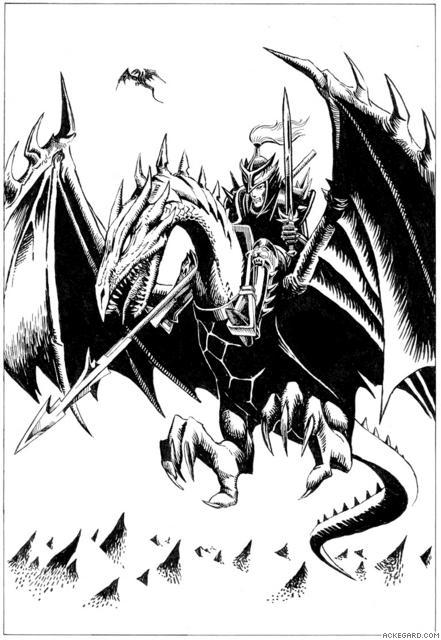
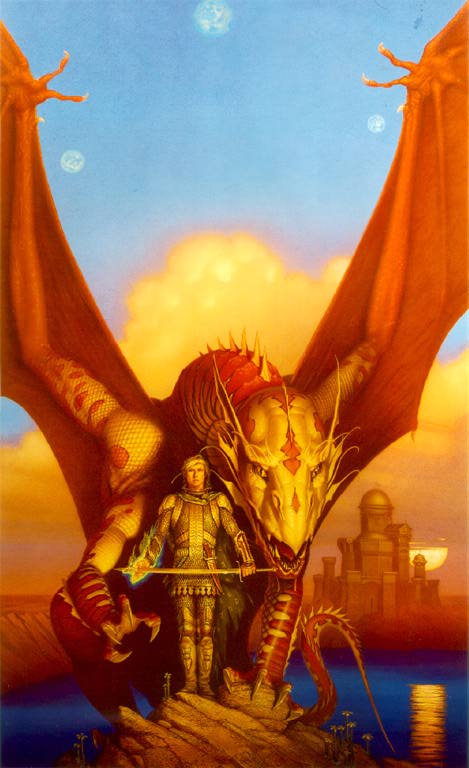
Riding dragons is one of those ultimate staples of fantasy, but tabletop gamers with a little experience may view it as unrealistic. Dragons are intelligent, proud and very powerful. It would be very difficult to convince one to serve as your mount for a short time, and likely require a very dire situation. To gain one as a companion seems practically impossible, not to mention game-breaking (balance wise). These creatures are some of the toughest foes in the game – how could they join your party?

Despite all this, doesn’t it just sound really cool? That’s enough for me, especially if this is what’s going to hook a new player. Media has shown us that riding dragons is possible and totally awesome – movies like ‘How to Train your Dragon’, the ‘Dragon Rider’s of Pern’ novel series, and even comic books. Luckily, the fine folks at Wizards of the Coast have given us several options for making this a reality, though it may be hard to spot under the mountain of available content.

Protector Druid

Druids who follow the Primal Guardian path got a new set of options in Heroes of the Feywild. The Protector Druid continues the trend to take the earlier classes and update them in the essentials style. One of its feature’s is Summon Natural Ally as a Daily power. For one encounter a day, Roc, Tiger, Giant Cobra and so on. Though they’re not intended as mounts, many of them are large enough to ride into battle.

At level 29, you can summon a Blue Dragon Wyrmling. Don’t let the name fool you, this beast is large-sized and hits hard. Since it’s a summoned creature it can move as a minor action once a round. It comes equipped with a breath weapon, a fly speed and an at-will attack that marks, so it should have a pretty iconic dragon feel. The most obvious downside is that you have to wait until 29 to get it, though there are cool other creatures to play with in the meantime. The other downside is that it’s attached to the Daily, and you can only use it for one encounter a day. No flying across the country side on this mount.

Cavalier

The Cavalier is the Essentials version of the Paladin. It’s a pretty cool class and Dragon 393 introduced the Summon Celestial Steed power as a replacement to Pace of the Virtuous Charger, bringing back the Paladin’s mount as a key piece of what makes this character unique. This power allows you to summon a Celestial Warhorse, but instead of lasting for an encounter, the summoned creature will stay with you until the end of your next extended rest. Feats allow you to summon celestial mounts including a tiger, behemoth and pegasus.

At level 21 you can take the Improved Steed (Silver Dragon) feat to swap that horse out for a Silver Dragon Steed. This mount doesn’t hit as hard as the Blue Dragon Wyrmling. but you can access it nearly a tier earlier. It also comes with an Immediate Reaction that lets you knock enemies prone when they come into melee.

Arcane Familiar

This one is cheating a bit, but I think it’s my favorite option. The Arcane Familiar feat can be taken at level 1 by any arcane character, you even get it for free if you play a witch. Arcane Power also introduced the Dragonling familiar, which is basically a small-sized dragon, with no attacks. It has a fly speed and hover, but is basically too small to ride. . . unless you’re a fairy! You may be reading this with raised eyebrows. Fairies can already fly, they don’t need a cool dragon mount to get around, that may be the case, but at level 1 this is still a pretty cool image. Plus, if you can fly as well as your mount, you can jump off, split directions, and come back together in mid air!

For those who don’t love the fairy route there’s another option. The Familiar Mount Ritual from Dragon 382 is available at level 4. It allows you to increase the size of your familiar to large for twelve hours with a component cost of 25 gp. That’s a pretty good deal, and now everyone can ride a dragon! Sure it doesn’t breathe fire or use its claws but its still awesome! There are a number of feats that can make your familiar even more resilient or give it nifty little abilities.

I’m a little surprised I couldn’t find a ranger option for the dragon riders, but remember anyone can multi-class into an arcane class and pick up the familiar options. Maybe there’s a ranger-specific option right around the corner.

You can even pick up a Golden Dragon Mount mini in the Stuffer Shack store!

See, I told you there’d be dragons.

Steal This Character: Alara’Zen vas Citadel nar Neema

Concept

Quarian engineer.

A bit about the quarians

Quarians are a race of interstellar nomads, long since driven from their home planet by a race of Artificial Intelligence known as the geth, originally created by the quarians as a servant race. The quarians attempted to destroy the Geth when they became fearful of their creation’s growing intelligence, and the geth responded naturally to preserve their existence. Since that time the galaxy at large has become fearful of the geth threat after an army of the A.I. units acted in support of the rogue turian Spectre known as Saren Arterius.

For more information, click any of the above links or play through Mass Effect.

Alara’Zen

Alara’Zen vas Citadel nar Neema (crew of the Citadel, child of the Neema) is one of the small population of quarians who consider the Citadel their permanent home. When asked, she tells people that she’s on an “extended pilgrimage.” She left the Migrant Fleet voluntarily and does her best to look out for other quarians who visit the Citadel on their pilgrimage, trying to ensure that they don’t have the same difficulties she did.

Unfortunately, C-Sec policy is to treat quarians as a nuisance. They often suffer from unfair treatment and are threatened with charges of vagrancy or falsly accused of theft. Without representation on the Citadel Council, this situation is likely to continue.

Luckily, though, not everyone feels that way. Alara’Zen has met Alexander Bourne on several occasions, usually after he injured himself looking out for one of the “duct rats,” and helps him out with equipment or medigel on occasion.

She keeps her combat drone (nicknamed, “G’enni”) active most of the time, using it to help her with the repairs she does at her junk shop, and has been known to speak to it on occasion. Alara has toyed with the idea of installing a V.I. in the drone’s program so it could speak back, but something has thus far stayed her hand.

Alara’Zen vas Citadel nar Neema is a power level 8 character for Mutants and Masterminds 3E. Her character sheet was created using Hero Lab.

Hero Lab – Alara’Zen vas Citadel nar Neema.

For those of you who would rather just see the character, her statblock is below. Enjoy!

Alara’Zen vas Citadel nar Neema – PL 8


Abilities

Strength 0, Stamina 0, Agility 2, Dexterity 2, Fighting 2, Intellect 3, Awareness 1, Presence 0

Advantages

Benefit, Cipher, Eidetic Memory, Equipment 6, Favored Foe: Synthetics, Improvised Tools, Inventor, Leadership, Ranged Attack 4, Second Chance: Technology Checks, Skill Mastery: Technology, Teamwork, Well-informed

Skills

Acrobatics 4 (+6), Athletics 2 (+2), Expertise: Artificial Inteligence 1 (+6/+4), Insight 6 (+7), Investigation 1 (+4), Perception 6 (+7), Persuasion 4 (+4), Ranged Combat: Guns 4 (+6), Sleight of Hand 2 (+4), Technology 7 (+12/+10), Treatment 1 (+4), Vehicles 2 (+4)
Powers

Advanced Omnitool Programs (Removable)

Combat Drone: Burst Area Summon 4 (hologram, light, technological; Active, Burst Area: 30 feet radius sphere)

Heavy Overload: Affliction 5 (1st degree: Dazed, 2nd degree: Defenseless, 3rd degree: Incapacitated, Resisted by: Fortitude, DC 15; Affects Objects Only, Increased Range 2: perception)

Advanced A.I. Hacking: Affliction 7 (Alternate; 1st degree: Dazed, 2nd degree: Compelled, 3rd degree: Controlled, Resisted by: Will, DC 17; Increased Range 2: perception; Limited: Synthetic Targets Only)

Incinerate: Burst Area Blast 4 (Alternate; fire, technological, DC 19; Burst Area: 30 feet radius sphere)

Containment Suit: Immunity 7 (Disease, Environmental Condition: Vacuum, Environmental Condition: Radiation, Environmental Condition: Cold, Poison, Suffocation (All))

Helmet (Notes: This WOULD be removable, but Quarian complications suggest that this would be a very bad idea.)

Heads up display: Senses 4 (Analytical: Sight, Danger Sense: Radio, Direction Sense, Radio)

Medigel: Healing 2

Quarian Affinities

Low-light vision: Senses 1 (Low-light Vision)

Technologist: Enhanced Trait 3 (Traits: Technology +2 (+12), Expertise +2 (+6), Advantages: Second Chance: Technology Checks; Permanent)

Shield Generator (Removable)

Force Field: Force Field 6 (technological, +6 Toughness)

Translation Circuit: Comprehend 2 (Languages – Understand All, Languages – You’re Understood)

Equipment

Containment Suit [Containment Suit: Immunity 7, Disease, Environmental Condition: Vacuum, Environmental Condition: Radiation, Environmental Condition: Cold, Poison, Suffocation (All)], Medigel [Medigel: Healing 2], Omnitool (Audio Recorder, Cell Phone (Smartphone), Flashlight, Multi-tool), Universal Translator [Translation Circuit: Comprehend 2, Languages – Understand All, Languages – You’re Understood], Weapons (Combat Knife, M-5 Phalanx Heavy Pistol)

Offense

Initiative +2

Advanced A.I. Hacking: Affliction 7 (DC Will 17)

Combat Knife, +2 (DC 16)

Grab, +2 (DC Spec 10)

Heavy Overload: Affliction 5 (DC Fort 15)

Incinerate: Burst Area Blast 4 (DC 19)

M-5 Phalanx Heavy Pistol, +12 (DC 19)

Throw, +6 (DC 15)

Unarmed, +2 (DC 15)

Complications

Dextro-amino race: Like the Turians, Quarians cannot eat the same foods as most species. They can, however, eat turian cuisine.

Disability: Quarian Immune System: Quarians wear their containment suits for a good reason; nearly ANY foreign substance or germ causes an alergic reaction, with symptoms like fever or nausia or worse, depending on the severity. Under the wrong circumstances, a containment breach can be fatal.

Hatred: Like many Quarians, Alara feels a strong hate and fear of the Geth, the synthetic race of artificial inteligence that drove the Quarians from their home world.

Prejudice: Quarians and their traditions (like Pilgrimage) are often misunderstood by the galaxy at large, and they are sometimes treated as vagrants or worse.

Languages

Quarian
Defense

Dodge 10, Parry 7, Fortitude 3, Toughness 6, Will 7

Power Points

Abilities 20 + Powers 39 + Advantages 19 + Skills 20 (40 ranks) + Defenses 22 = 120
Hero Lab® and the Hero Lab logo are Registered Trademarks of LWD Technology, Inc. Free download at http://www.wolflair.com
Mutants & Masterminds, Third Edition is ©2010-2011 Green Ronin Publishing, LLC. All rights reserved.

For more articles on Mass Effect RPG, go here.
Mass Effect: Quick and Dirty NPC Creation

One of the reasons I opted to use Mutants and Masterminds 3e for my Mass Effect conversion is that it offers a very flexible set of tools that allow for a number of approaches to GMing, and particularly to building NPCs.

Approach 1: The Detailed (“Official”) method

M&M handles NPCs pretty much the same way it handles PCs, with a couple of differences: 1) NPCs can be whatever PL you want, and 2) they aren’t required to abide by the “15 power points per PL” rule that PCs have. So basically they have whatever traits you need them to have for the story. If you have a program like Hero Lab (which I do and cannot recommend highly enough), it’s a simple matter to build the NPC you need and export it as a neat statblock. Use it as many times as you need it.

Because this method is the most time consuming method, however, I recommend it solely for “named NPCs” who are intended to appear in multiple sessions.

Approach 2: The “Lazy GM” method

This approach, by the way, works equally well for any application of the M&M game engine, whether you’re working with sci-fi, post apocalyptic, super-heroic, or low PL dungeon crawls. By way of giving credit where credit is due, my approach is due largely to the influence of Greywulf and his series on the lazy gm. Read it!

1) Establish PL. Rate offense and defense separately because they may be different. IE Offensive 7, Defensive 6. For minions especially it makes sense to have defensive PL a bit lower; tougher foes might be equal or have better defenses. This obviously varies, though, depending on what sort of fight you’re looking for.

Actually balancing an encounter in M&M is more art than science, and shouldn’t worry you too much. When you get to that point, just provide what makes sense for the story, and if you think it’ll be especially tough than just make sure your players have a chance to earn the Hero Points they’ll need to take it on.

1a) Note the key concept of the NPC – race, basic role, profession, whatever. This is just meant for fluff and provides a guideline that you can refer to later. Let’s say, “Blue Suns Mercenary.” Really, this step should be first, but as long as it happens at some point you’ll be fine.

2) Establish trade offs the same way that PCs do. Say you want to give the above NPC an assault rifle or a sniper rifle. That gives you ranged offense: Damage 5, which leaves 9 for accuracy (total: 14, twice PL). We also want the NPC to be heavily armored and not terribly agile. Let’s make it defenses: Toughness 8, Dodge 4, Parry 3. Will and Fortitude trade off as well. If the enemy is synthetic, just make them immune to Fortitude and cap Will at the defensive PL.

Technically, at this point it’s entirely possible to start using the NPC immediately and flesh out the next few details only when they actually become important to the game.

3) Pick out an effect or two. Any special movement modes? What is that attack? Add Multiattack if it’s an automatic weapon (e.g., the aforementioned assault rifle). Area attacks are capped at PL. How does it defend itself? Armor, shields, a combination of the two? Dodging? Species suggest powers too (Asari attractiveness and (potentially) biotic power, Turian radiation immunity and claws, Krogan or Vorcha regeneration), but only if it becomes important. Until then, leave it blank.

4) Grant Advantages if appropriate when it makes tactical sense to use them. Don’t bother fleshing out the sheet too much more than this.

5) Only flesh out the NPC in detail if they survive the fights and become important to the story. Don’t bother listing Abilities unless they’re needed later. Note skills that are covered by their Aspect. Give a total bonus to these checks equal to 5 if it’s directly related to their role. Most of the time minions take 10 outside of combat. Give a bonus of 8 if it’s a non-minion and their aspect covers it. Otherwise rate it a 0.

The idea is that when you’re done, the resulting NPC has all the information you need to run a fight using them with less than half of the work. Put it on a 3×5 card or a page with notes and use it for as many fights as you want. I’ve done NPCs this way for at least one game (a manga style martial arts game), and been ready to start the fight after writing down about 3 lines of text (concept, then a short line each for the tradeoffs ). I just added more notes as the fight went on and invented more details on the fly. It worked perfectly well, and the players didn’t even notice.

Approach 3: The REALLY Lazy GM method

This approach has 3 simple steps.

1) Find something in the back of the book that looks like it functions sort of like what you need for your next fight – like, say, for Mercenaries you could use the Soldier, SWAT officer, or Militant (or, alternatively, buried in the Roll Call forum on Atomic Think Tank).

2) Steal it. It is, after all, the Stuffer Shack way.

3) Add a trait or two to make it match the idea in your head closer, and refluff to taste. Modify them later if they survive.

Any of the above methods will work, and can be used interchangeably depending on your current needs.

For more articles on Mass Effect RPG, go here.