What’s the Opposite of Optimized?

It’s Throwback-Thursday, where we revisit an awesome article from years ago…

I find devoted (read as, crazy) power gamers perfectly adorable.  It’s funny how they will spend so much time reading rules, seeking synergy, and comparing characters on message boards.  The goal, as far as I can tell, is to make sure that the stats, attacks, damage, and checks are all as humongous as possible.  If you were to ask about their favorite gaming memories, I can almost–ALMOST–guarantee that they will talk about numbers:  “I did 107 damage against this nightwalker once” or “We were fighting an iron golem and I hit four times in a row:  42, 37, 40, and 38” or “At first level, I rolled a 30 Athletics check and easily jumped the chasm.”

Now, I’m not saying there’s anything wrong with this.  Honestly I’m not.  I don’t mind the numbers game.  I’m not going to pass judgment on anyone else, either passively or aggressively.  Sure, people who declare things like, “I’m not saying there’s anything wrong with this,” usually ARE saying there’s something wrong with this, but I’m speaking truth here, hallelujah, testify! Continue reading “What’s the Opposite of Optimized?”

Conventionally Speaking, Part 2

As I mentioned in Part 1, I had never really played any of these games, and I loved them all. I say “never really played” because I had already dipped my toe into the D&D Next waters, and had, along with countless other gamers, submitted one or two opinions on the whole endeavor…

ConnectiCon Introduction
As it happens, it’s a lot easier to drone on and on about the logistics of a convention (see Conventionally Speaking, Part 1) than the games you play at a convention. At least, it’s easier for me. In Part 1, all I had to do was tell you what happened: how I got there, what I saw, what it was like. All of that is extremely subjective, and I can be wildly inaccurate while servicing the needs of the narrative. Nobody can say, “That’s not what really happened!” or “That’s not the order it happened in!”, since nobody was there experiencing it from my point of view.

But now I want to talk about the games I actually played in, games with rules, rules that you people can look up and say, “No, you’re wrong, that’s not the way this game works!” It’s far too easy to share way too much about the game (“Drogonilithuz Smorgle-Borgle, a Zed-Alpha level half-troll splatterpunk elementalyte, played by Ernest K. Bindlehopper, a 26-year old database modulator who was sitting on my right, picked up his scarlet 30-sided dice, shook it four times, rolled a 13, applied his Specialty Convergence, his Tantric Positioning, and his Mortgage Prime Rating, for a total of 27.459, and compared that against the rigger pirate clown clone’s Life Protection Soaking Score, adjusted for the heights of all players at the table, and then…”), or share way too little (“Played cool game it was good I liked it”).

Confronted with these daunting challenges, I elected not to do anything, and time passed and Editor-in-Chief Mr. Chris seethed and silently plotted my death. Unfortunately, my strategy of inaction didn’t make the writing job any easier or more finished, so I’ve elected to apply Nose A to Grindstone B and just write the bloody article. We’ll see if that works.

[editor’s note: Mr. Chris was not seething; he was waiting with +5 patience…]

What Dice Do I Roll?
As I mentioned in Part 1, I had never really played any of these games, and I loved them all. I say “never really played” because I had already dipped my toe into the D&D Next waters, and had, along with countless other gamers, submitted one or two opinions on the whole endeavor. Of course, this was before its Creators had received, processed, and instituted those opinions, resulting in many, many changes to the system. This was my first time playing the fer-realz D&D 5E, which meant that this particular savant (who had been playing Dungeons & Dragons since puberty) was transformed into a total noob, with no clear idea of what was going on, in this or any of the games.

My befuddlement can’t be blamed on the game systems or the Game Masters or the other players or the convention setting or the dice I rolled or even the chair I was sitting in. The reason I never knew what was going on is entirely my own fault. I have grown complacent in my RPG life, resistant to new systems for the single simple sin of being new. Instead of coming to any of these tables with a freshly formatted brain, I tend to view every game through the cloudy filter of GAMES-I-ALREADY-KNOW. This has proven to be a severe disability with every new game I’ve played, including the games below and my other forays into Shadowrun, Call of Cthulhu, Savage Worlds, Eclipse Phase, and Death Race Z.

The Games in Common
As different as my three convention games were constructed, there were a few notable and delightful similarities. First of all, there was nary a grid to be found in any of the three. I have been spoiled / ruined by 1” square battle maps, leaving my “theater of the mind” abandoned, rundown, and very dusty. I had actually come to believe that I was unable to play games that lacked a scaled map, a million miniatures, and lots of space counting (“I’m going to move over here… 1, 2, 3—no wait, I’m going to move over here… 1, 2, 3, 4—hold on, I’m going to move over here…”). Playing inside a shared imagination resulted in more vivid memories instead of fewer, as I was forced to picture the settings, and wound up filling in parts that a flat map could never convey: the swish-swash of ocean waves, the sugary aroma of a mug full of honey mead, the agony of my bard’s skin cooking and cracking in roiling fire.

Secondly, all three games featured Game Masters of the “say yes” variety, which means that no matter how ludicrous our character’s plans or plots were, these GMs rolled along with them. To be sure, this was typically a “yes but” situation, allowing us to perform our silly heroics, but with a complication or two thrown in for flavor. If you’ve never heard of this style of gamemastering before, it’s probably because your GM sounds like this: “Can I—?” NO. “What if I—?” NO. “I’d like to—“ NO. I’m about to make a wildly unfounded generalization, so please buckle your seatbelts. I believe these newer games are being specifically created to encourage, if not actively enforce, these “say yes” GMs, and that is a very good thing.

The Games, in Practice

ICONS

Without question, doubt, or feather torturing, ICONS was my favorite of all three games, and that’s not just because it was run by the guy who freaking wrote it, Steve Kenson (who also, by the way, wrote Mutants & Masterminds). ICONS is a superhero game, requiring a couple 6-sided dice and a great heaving pile of imagination. We five players created our characters right at the table (magnificently randomized, similar to Gamma World but with capes), got a crash course in the way the game runs (roll 1d6, add stuff to it, and beat a target number for success), and were off and playing in about half an hour.

Built right into the body of the game is a mechanic called Qualities, which are three descriptive phrases that define and describe your character. You can call upon these Qualities to accomplish something particularly cool and superhero-ey, but be careful, because the GM can call upon these Qualities as well, to bring a little trouble your way.

For example, in our game, one character had the quality “Arrogant son of a god.” When we players were confronted with an obvious danger, we quite naturally hung back, evaluating and considering. The GM suggested that Mr. Arrogance should probably charge straight ahead, so that’s exactly what he did, and by the way, what he HAD to do. A game mechanic that enforces roleplaying, how cool is that?

13th AGE

Jonathan Tweet and Rob Heinsoo were booted from Wizards of the Coast during consecutive Christmas layoffs (Tweet in ’08, Heinsoo in ’09), a cheery Wizards’ tradition, and they decided to channel their inner Bender and declare, “We’ll go build our own game, with blackjack and hookers. In fact, forget the game and the blackjack. Ahh, screw the whole thing!” Only they didn’t screw the whole thing, they actually wrote it, and it’s really good. It’s what happens when two people who are very passionate about different versions of the same game get together without engaging in a stupid slap-fight about “whose is better.”

It has ability scores and classes and races and rolling dice and adding numbers and just enough bits that you’re familiar with that the violently unfamiliar bits—specifically the Icons and Icon Relationships—don’t cause your brain to abruptly leak out of your ears. At least, it didn’t have that effect on anyone else at the table. I had no idea what was going on. I probably should have read some more or asked some questions.

Even so, I experienced enough in the game to 1) have a lot fun, even with a fairly complex character, and 2) want to play again. And again. And again.

It’s immediately clear that the game is a result of its creators playing it and other games, and then asking the one question you’re never supposed to ask: “You know what really sucks about RPGs?” 13th Age is packed with answers to this question, but my two favorite answers are the following:

  • Escalation Die. Instead of letting battles drag on endlessly and needlessly in a series of miss-miss-miss-miss-miss-misses, this mechanic makes the characters (and sometimes the monsters, oh no!) more dangerous as the fight progresses. This turned the cleric in our party into an UNSTOPPABLE GODBLADE OF VENGEANCE, which really started to annoy the barbarian.
  • Fight in Spirit. You know what’s great? A thrilling, roller-coaster of a battle. You know what’s not great? When this fight happened, your character happened to be at the library reading. As a player, you have to sit there and watch of all your so-called friends have a great time. Jerks. But this “fight in spirit” actually lets you participate! It’s not automatic; you do have to roleplay yourself into the moment, explaining how you’re boosting morale. But you do get to play.

DUNGEONS AND DRAGONS

.

.

For a more thorough take on D&D 5E, please see Jonathan Baldwin’s article, “What Comes Next: The Future of D&D,” which has covered many of the things I was already thinking about. Still, I have all this white space, so I probably should say something.

I absolutely love what they’ve done with Advantage / Disadvantage. Someone deserve a kiss full on the lips for coming up with this, though probably from a person more attractive than me. It is one of those rare rules that covers nearly every circumstance, but is single-celled organism simple. If you’re in a good spot (enemy is blinded, you are blessed, DM likes the cut of your jib), you have advantage and so you roll twice and take the better roll. If you’re in a bad spot (sneaking in heavy armor, you’re cursed, DM just found out what you did to his dog), you have disadvantage and so you roll twice and take the worse roll.

While I was initially concerned about the significant shrinkage in numbers across the game (bonuses are down, defenses are down, hit points are way, WAY down), I only recently realized that I had fallen for the trick of the Millionaire Monopoly game, that by adding zeroes to everything increases the enjoyment by an order of magnitude. In fact, it just makes the math harder (“Okay, I rolled an 8, I have a +35, so that’s… wait… uh… okay, 43! Hit! Now I roll six 12-sided dice, add 26, and it’s… hmmm… a really big number.”).

Conclusion
These were three very different games, with very different rules and mechanics, but they resulted in 12 hours of lotza joy, and not a single moment of my checking the time and wondering when we’d be done. I got caught up in the games, in the story and excitement of them, and yes, credit goes to the GMs and to the setting and to my fellow players, but I don’t dare forget about the games themselves. I would recommend each of them. Go, spend money. The creators deserve it. Tell them I sent you. Don’t be surprised if their immediate response is, “Who?”
Conventionally Speaking, Part 1

Lock Up Your Daughters!

A few weeks ago, my wife drove me and my 15-year old daughter, Rachel, to attend the mega-monster-sprawling gaming-anime-cosplay cradle of chaos called ConnectiCon. This would be my third consecutive year, but it was Rachel’s first, and by the way, her first convention of any kind, ever…

ConnectiCon Lock Up Your Daughters!
A few weeks ago, my wife drove me and my 15-year old daughter, Rachel, to attend the mega-monster-sprawling gaming-anime-cosplay cradle of chaos called ConnectiCon. This would be my third consecutive year, but it was Rachel’s first, and by the way, her first convention of any kind, ever. Through her tween years, she had developed an appreciation for many things nerdy, including anime, manga, and video games. This was the year that she told me, with no room to wiggle, “I’m going to ConnectiCon.”

In fact, she had also made this declaration last year, but it just didn’t happen, because I’m a terrible father and a monstrous human being. But this time, firmly in the center of her teeniness, adamantly convicted that she knew exactly what she wanted and also that she deserved to have it, she made it clear that it would happen, that she would be going, and that she would be wearing a costume.

As I suggested above, ConnectiCon is not a small event. We’re not talking about a bunch of bespectacled buds who take over the multipurpose room at the local motel and play Risk and Munchkin all weekend. No, this is more like many thousands of people, many of them in elaborate costumes from TV, movies, comics, and warped imaginations, swarming all over the city center like nerdy ants over a brownie. This is the crucible into which I was dragging my daughter, or more accurately, into which she was dragging me.

Something Screwy
There is an indisputable law in the universe that says, “No matter how carefully you plan, something will go gonad-crushingly wrong at a convention.” It could be something fairly small like, “I can’t believe I forgot my dice.” Or it could be something less-small like, “What do you mean you have no record of me registering for the convention?” Whether small or large, whether a minor inconvenience or incontrovertible proof of a Prankster God, it will always happen.

For me, it was a hotel reservation that went missing.

This goes back several months when the convention’s pre-registration first opened, and there was a strong indication that there would be Thursday activities. Being the obsessive lunatic that I am, I immediately booked my hotel for Wednesday to Sunday, with plans of arriving bright and early at the convention Thursday morning.

As time went by, it became irritatingly clear that the activities planned for Thursday were as follows:

  1. Pick up badges at 6 PM
  2. Leave
ConnectiCon
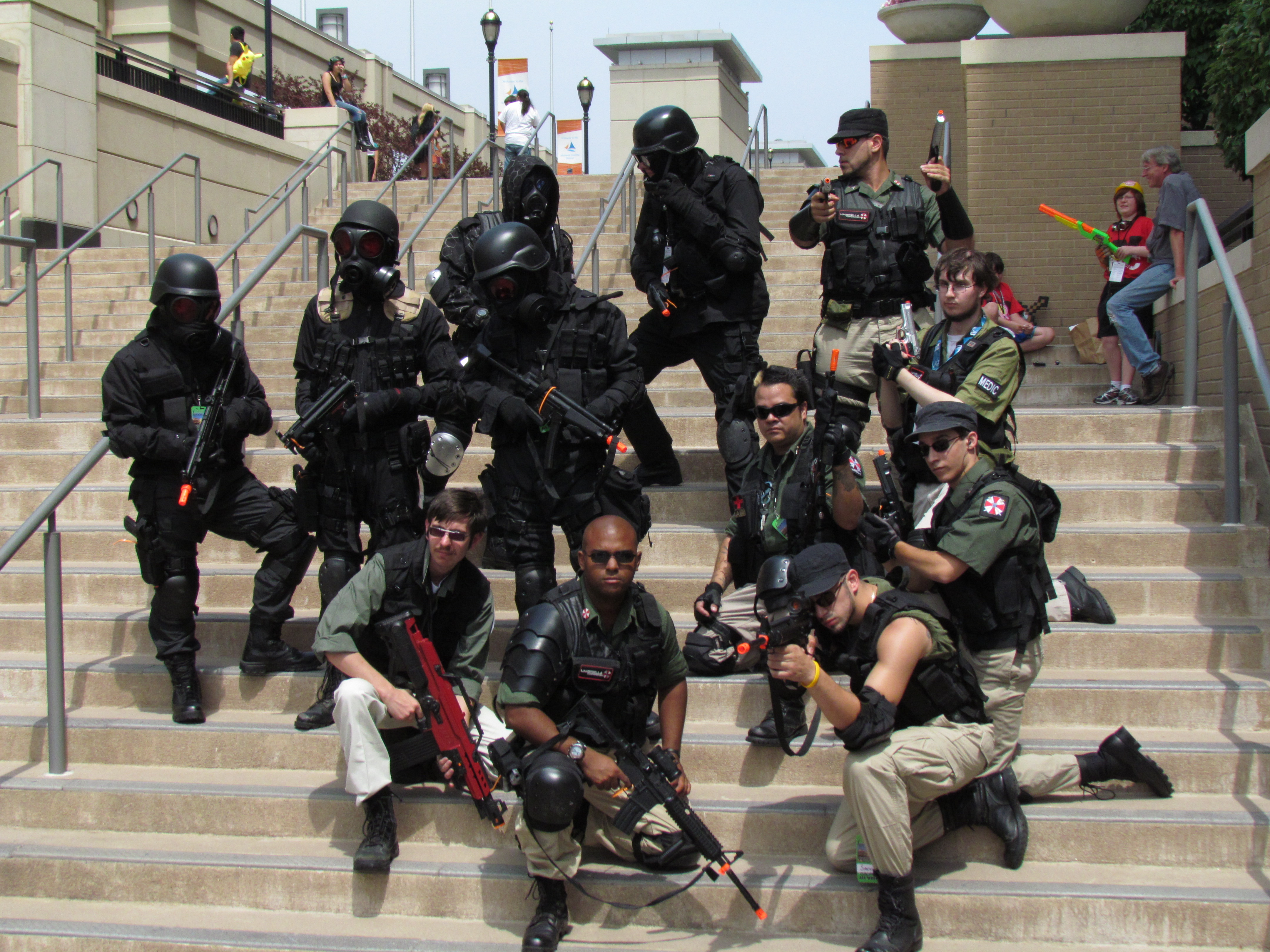
Do you like the color of my eye shadow?

Because I had booked my hotel through a travel site, I couldn’t just cancel Wednesday night. So I called the hotel and asked if it was okay for me to come in on Thursday instead of Wednesday. They said yes, but I wouldn’t get a refund for Wednesday because of the travel site booking. I said I wanted to be sure they wouldn’t cancel my reservation if I didn’t come on Wednesday. They said that wouldn’t be a problem, and suggested I call the week of the reservation to remind them. I did. They made a note of it. Everything was perfectly fine until Rachel and I arrive on Thursday afternoon.

“Sorry,” the front desk regretfully told me. “When you didn’t come in yesterday, we canceled your reservation. And now our hotel’s completely full. And because of that travel site, you won’t get a refund.”

ConnectiCon
TAKE THE ELEVATOR.

The front desk did eventually sort me out, finding me a room and apologizing profusely, but that was after an interval long enough for me to spin up into a vortex of rage and panic, and consider all sorts of absurd alternatives: I’ll stay with friends, I’ll stay with strangers, I’ll sleep on the streets, I’ll rent another room at another hotel several miles from the convention and pay five times as much. The point isn’t that I got my hotel room, but rather that it was the bit that went wrong. For one tiny eternity, my stress, already hovering in the sweaty panic zone because of the impending convention, had spiked up into, “I can’t feel my legs, what’s this pain in my chest, why does this ALWAYS HAPPEN TO ME, DAMMIT DAMMIT DAMMIT!!!” Not a great place to be, emotionally speaking.

Cosplay, Cosplay, Everywhere
For a microscopic sample of the costumes at ConnectiCon, take a look at a blog I created with my daughter: Rachel @ Connecticon 2014.

Occasionally, it felt like I was the only person not in costume. These people were everywhere, all over the convention center, in and through the hotel, out and about in the city. A life-sized Oscar statuette, a crowd of varied Doctor Who incarnations, a John Stewart Green Lantern with gleaming green eyes, uncountable Spider-men and Batmen and Deadpools and Wolverines, armies of Browncoats, and representatives from every video game ever imagined, most of which I didn’t recognize.

Actually, I didn’t recognize a lot of characters or costumes there. It started to frustrate Rachel. “Who’s that?” I would say, and she would roll her eyes, and say, “That’s [multisyllabic] from [incomprehensible],” and I would ask, “What is that, an anime?” And she would only shake her head.

It’s the oldest I’ve ever felt at a convention, and this is coming from someone who’s really quite old. On the other hand, it felt kind of wonderful, knowing that Rachel knew all of these characters. It felt like coolness by association, like I knew somebody who knew people, somebody who could get me past the bouncer and into the club, somebody who would be recognized upon entering and told, “Your table is right over here.” Of course, this is Gaming Convention Coolness, not, Real World Coolness. I’ll never have that, no matter who I know.

Speaking of costumes I didn’t recognize, Rachel went as Yuki Cross from the manga and anime, Vampire Knight. Rachel’s outfit was perfect, which is what happens when you buy it online. This is a despicable sin in the world of cosplayers, where you are expected to create everything from scratch. I kept suggesting that she tell people that she worked with her mother and grandmother to make it, which is technically true—her mother located it on eBay and her grandmother fitted it using needle and thread. Unfortunately, Rachel learned honesty at some point in her life (it certainly wasn’t from me), and refused to massage the truth even a little.

Vampire Knight
Pssst… there are people behind us…

It turns out that this was the perfect costume, not so obvious that she was lost in a crowd of clones, and not so obscure that she was ignored out of fear of ignorance: “So what are you supposed to be?” The right people reacted in exactly the right way, with delirious enthusiasm: “Oh, I LOVE Vampire Knight!” They’d come charging over from across the convention hall, calling her character name: “Yuki! Yuki! Yuki!” They’d beg for her picture. They’d gush over her costume. Rachel was simultaneously pleased and overwhelmed, though she did get better at striking poses for the pictures.

For the record, nobody asked for my picture.

Accruing Experience Points
I knew that this would be a different sort of convention for me, attending with my daughter. She was not interested in roleplaying games or sitting quietly for four hours while I enjoyed them. We worked out a compromise where she would head back to the safety of the hotel room while I played a couple games here and there, and then on Sunday, she agreed to play one game with me.

I’ll go into more detail about the games in Part 2, but let me say here that they were all new to me, and I loved them all.

Men in dresses, at the gaming table…

Let’s face it, men dressing as women is darned funny. But why? It’s because men are so very much not women, and it’s uproarious to see their absurd and overwrought parody of an impression.

However…

Jerry: I have a suspicion that he’s converted to Judaism just for the jokes.
Father Curtis: And this offends you as a Jewish person?
Jerry: No, it offends me as a comedian!

Let’s face it, men dressing as women is darned funny. From Shakespeare to Milton Berle to Flip Wilson to Barry Humphries to Martin Laurence to Tyler Perry, from Monty Python to Saturday Night Live to The Kids in the Hall, from Tootie to Mrs. Doubtfire, there have been men willing, even enthusiastic, to pull on dresses and pitch their voices into the exosphere of falsetto, and we have laughed and laughed and laughed.

But why is this funny? It’s because men are so very much not women, and it’s uproarious to see their absurd and overwrought parody of an impression. Look at me, I’m both touchy and feely. Get a load of this, I’m proper and rigid. Uh oh, that man finds me irresistible, what do I do now? And to cap it all off, here’s a lot of screechy screaming. What fun.

I’m pleased to report that this sidesplitting trope has sashayed its way into roleplaying games as well, with exactly the same level of hilarity. Occasionally this is because a Game Master seeks diversity in his sausage party, or a player’s interested in running something a little different, but more often it’s part of some dreary practical joke (“Ha ha, you’re a girl!”). As in the various media, the roleplaying game affords us firework bursts of austerity or over-emotion or (fingers crossed) high cracking voices, but it also introduces a new and delightful characteristic: hypersexuality.

Given the range and maturity of the typical male gamer, it’s not uncommon that a female (male) character will sleep with absolutely everybody, from the lordliest king to the lowliest stable boy (and maybe one or two horses in the stable), all in the interest of manipulation, negotiation, or plain old copulation. Of course, this trait stems from the conviction that, “If I had one of THESE, I would own everything,” which is usually because the enlightened player has no familiarity with one of THOSE beyond the internet.

I have encountered these girly imitations in every Fiasco game I’ve played, and afterward, during one game’s post-mortem, I expressed my frustration about it, and only managed to come off as a psychotic, closeted homophobe. “Sure,” one of the other players said carefully, “you’re uncomfortable with two men at the table pretending to be intimate.” No, no, no, that’s not my point or my problem at all, but the more I tried to clarify, the more it seemed like I was protesting too much.

My issue was and always has been that the joke here, a man pretending to be a woman, is too easy and too obvious, quite literally low-hanging fruit. “You’re never home for dinner!” the shrew shrieks. Or, “Now that my husband’s gone, it’s me, you, and the whole hockey team,” the kitten purrs. Or, “For a cultured woman, it’s pinky out and knees together,” the nun nasals. These aren’t characters, they’re caricatures, and even worse, they’re not terribly funny.

In two different Dungeons & Dragons games, I watched a Girdle of Femininity, mistaken for a Girdle of Giant Strength, dropped onto an unsuspecting male PC, and we all hooted with joy as this paragon of masculinity suddenly developed manga breasts and an overwhelming appreciation for shoes. In the interest of full disclosure, I must admit that I was one of the highbrow Dungeon Masters that did the dropping, but it’s nothing I’m proud of now.

I’m not proposing some kind of draconian moratorium on players having characters of the opposite sex. How boring would that be? What I am asking for–pleading really, for the sake of my sense of humor–is that the opposite sex be treated in the same way as all the parts of the character. I have seen male players wrestle with, “What would my dwarf paladin do in this situation?” or, “What would my cyborg zombie say?” And yet, those same male players never even pause to consider, “How would my female character react?”, unless it’s to follow that up with, “Slutty or shrill?”

With these sorts of characters, we male gamers have an opportunity to see through the eyes of that alien and mystical species, THE FEMALE, and genuinely act and react as we believe a real woman would. And don’t hide behind the excuse of excessive masculinity (“How could my muscles and body hair know the first thing about what a chick is thinking?”), not when many of us have mothers and sisters and girlfriends and wives as a touchstone. If you want to imagine a real reaction to a circumstance, try to imagine a real woman reacting.

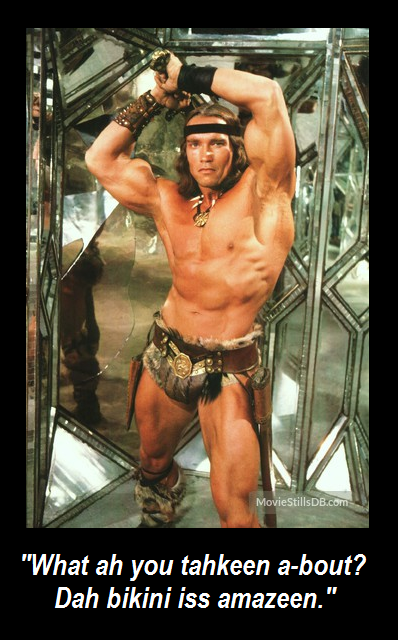
Plus, it might offer a painful dose of reality when the male gamer realizes his female character’s defenses are considerably lower than the other party members. You know, because of the bikini armor.

Arnold

Diss Organized Play

When I review the event listings at the conventions, there are always games that catch my attention, sometimes by the title, sometimes by the blurb, and sometimes by the level (when I foolishly decide I’d really like to play in a 27th level game). Then I realize this game that caused a lovely tingle in my lobes is all kinds of RPGA (Living Forgotten Realms, Living Divine, Ashes of Athas), and I do my best impression of Eeyore: “Looks like a good game. Guess I can’t play in it…”

eyeoreAs D&D 4th Edition reluctantly shuffles towards the wings and this brash new D&D NEXT with its fancy sunglasses and latest smartphone comes striding onto the stage, we can expect a new iteration of the RPGA organized play to rise up at home and convention tables alike. Depending on whom you ask, this definitely will be or definitely won’t be set in that classic world of Greyhawk, with Iuz and Furyondy and the Grand Duchy of Geoff and the monk-infested Scarlet Brotherhood, among much, much else. After years of Living Forgotten Realms, the prospect of a new gaming world (hey, what about Eberron!?!) probably excites the organized play devotees, but frankly, it leaves me a little cold.

Since you follow my every move with your high-tech spy satellites, you already know that I fulfill most of my gaming needs at regional conventions, previously in the Northern Virginia / DC area and currently in New England, which, despite being saddled with several seasons (most of them winter) and several unfortunate accents (most of them H-less), has a thriving gaming community. All of these enthusiastic gamers crammed into one location means lots of conventions, ranging from the tiny (“Just sit there on the couch, my Mom will get you something to drink”) to the cataclysmically gigantic (“Sir, it appears we’ve lost Hartford to the cosplayers”). And at every one of these conventions, the roleplaying schedules are always loaded, packed, fairly clogged with Living This or RPGA That.

And I hate it.

Now look, I get the appeal of organized play. You, the organized player, want to live with the same character over the course of many actual years, building a history, developing a background, weaving your story into a grand tapestry so much bigger than you. There are events unfolding, world-shaking, government-changing, god-killing events. And there you are, right in the middle of them all, despite having started life as an anonymous sheepherder from the little hamlet of Bumrump. When you raised your father’s rusty sword against the wolf attacking your flock, you had no idea that you were taking your first step into an epic tale that would culminate, game decades later, on the deck of a githyanki void cruiser, speeding backwards through time as you battled the Nameless Horror from Beyond.

It’s great fun to live and grow with the same character, to wield a weapon that would shame Stormbringer, to accumulate treasure that would stun a dragon, to develop stories that would silence a bard. I feel nothing but blinding envy listening to RPGA members telling stories about previous experiences:

“Were you able to save the paladin?”
“No, we didn’t get there in time, but we did still get credit for trying. Did your party trigger that necrotic wall?”
“Oh, that wall, I hated that wall! Every round we took damage, and the enemies were those stupid invisible teleporters!”
“I forgot about them, that was so awful.”

These are players who are participating in genuine long-running campaigns, when I’m lucky to shoehorn my deva psion into a handful of one-shots, and maybe even get to see a single level rise.

However, there is a dark side to the RPGA, and that dark side is that it’s a closed society, written by and for people on the inside, as exclusive as a yacht club but with fewer ascots. Obviously, this isn’t the intention, since you can’t exactly grow a community by locking the doors and surrounding the compound with landmines. You want a stream of new people (“fresh blood”) coming in every year, spreading your brand and, subsequently, buying your products.

When I review the event listings at the conventions, there are always games that catch my attention, sometimes by the title, sometimes by the blurb, and sometimes by the level (when I foolishly decide I’d really like to play in a 27th level game). Then I realize this game that caused a lovely tingle in my lobes is all kinds of RPGA (Living Forgotten Realms, Living Divine, Ashes of Athas), and I do my best impression of Eeyore: “Looks like a good game. Guess I can’t play in it.”

You see, I am very much a “go by the rules” kind of person and player, and I know that I don’t have an RPGA-approved character that has fought and bled through all the previous RPGA-approved adventures. This means I’ll have to either skip the game (which I don’t like) or fudge up a character (which I also don’t like). If I decide to scrap my paladin-like ethics and fudge a character, that’s when I find the character creation rules to be hopelessly complex and opaque, like an instruction manual to build a quantum computer written by an insane alien. Essentially, though not explicitly, they say this: “You really should create a 1st level character, play through a string of RPGA-approved games, until you are at the desired level.”

So I scrap my ethics and I fudge my character, because I really want to play in this game. When I arrive at the table, I’m inevitably authenticated by the RPGA-approved Dungeon Master, forcing me to lie to this kind and generous stranger, saying, “Yes, absolutely, I’ve played this character before, through every one of the previous adventures.” And I hate doing that. For one thing, it would really bug me if I were ever caught in my grotesque lie, but for another, I don’t want to feel like I’m cheating. All I want to do is play a character, roll some dice, kill some monsters, and have some fun.

I understand the reason for all the rules. In this carefully constructed adventure series, I’m playing a fudged shifter seeker that I’ll never play again, so who really cares if he dies horribly? Meanwhile, there you are, across the table, playing your half-elf warlock (actually a tiefling in disguise), who you’ve brought up from 1st level, who has a rich and involved storyline, complete with allies and enemies spread across the lands. And because I don’t care, maybe I set off deadly trap or insult the exposition wizard, just to see what’ll happen. Or even worse, maybe when I fudged my character, I ignored or shattered several character creation rules, and now you and I are no longer on the same power plane. How is any of this fair to you?

When the RPGA network decides on a new Living world for D&D NEXT, I can only hope that they will incorporate a set of equitable rules for the one-shot characters that I personally want to play. I’m not interested in committing years of my real life to a single character over multiple sessions, but I really would like to occasionally dip into a few of those good adventures, and not feel like I’m gaming the system to do it. This doesn’t seem unreasonable to me.

Dontcha Just Hate Us Bad Guys?

In any roleplaying game, what defines an enemy? The defense numbers? The damage numbers? The extensive and daunting power list? No, I say, and say again, no. The only characteristic that defines an enemy is the one thing that’s impossible to quantify: the personality…

In this glorious age of expensive pocket computers and free Wi-Fi and rampant megaflops, it’s become so easy to calculate the perfect villain to abuse and harass those unsuspecting player characters. Using our advanced technology, we can tweak and test and fudge and forge the foundational numbers of the foes, seeking and finding that sweetest of spots, where the enemies have clung to life long enough and have dealt enough damage that several of the PCs are down and bleeding and those remaining survivors are used up like tissues on a long weekend.

Take a triumphant bow, you Game Master Mathemagicians, and raise your arms in celebration, you Story Teller Digit-Crunchers, for together, we have moved our beloved roleplaying games that much closer to the Skynet apocalypse, where flawed flesh is finally replaced by perfect numbers. Rejoice, resistance is futile, RPGs are borg.

Please don’t misunderstand my tone: I’m not blaming any of you out there for this development. I’m leveling my accusatory finger straight back at myself, for there is no sinner greater than me. Numbers are easy and predictable, even the ones generated by multicolored polyhedrons. Do you know what’s not easy or predictable? The RP portion of our RPG.

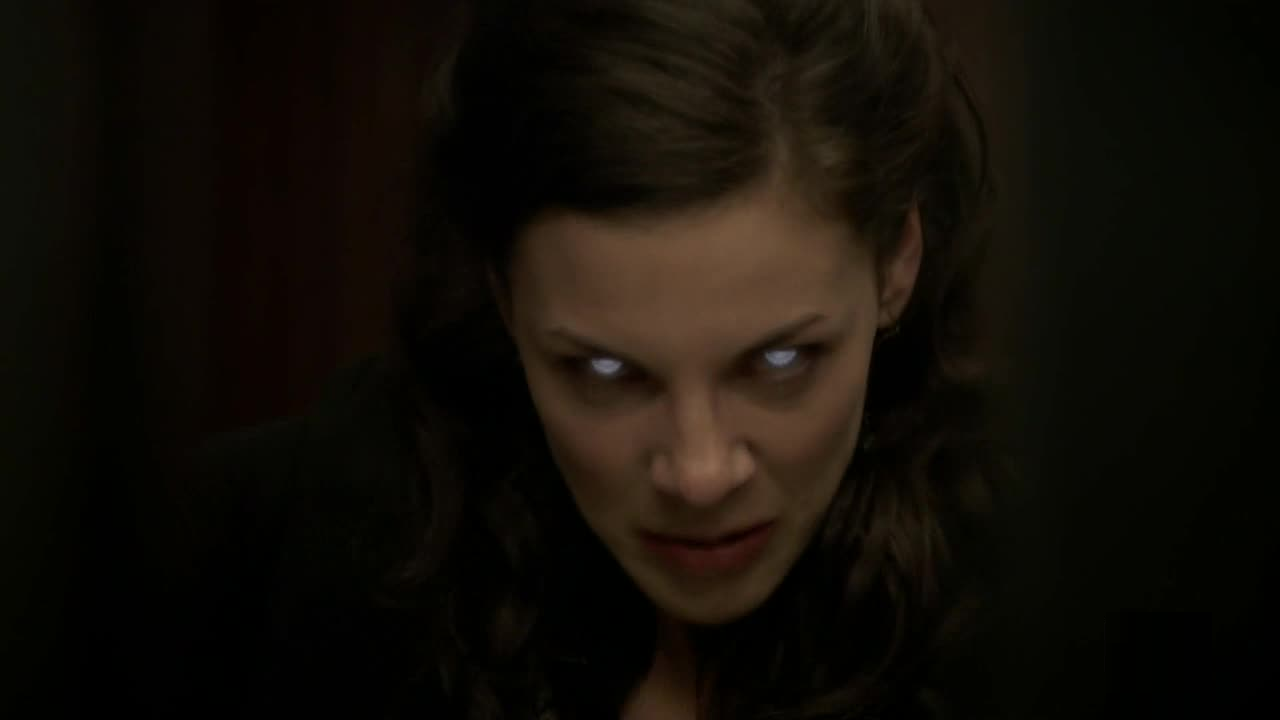
Evil

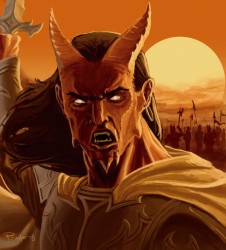
In any roleplaying game, what defines an enemy? The defense numbers? The damage numbers? The extensive and daunting power list? No, I say, and say again, no. The only characteristic that defines an enemy is the one thing that’s impossible to quantify: the personality. As the director of the RPG movie, you need to figure what drives each enemy to do the evil things he or she does. Is it greed or need? Is it badness or madness? If you can figure out the “through line” of a particular foe, then all of the numbers and mechanics stop mattering, because you’ll have a clearer idea of how Big Bad’s going to act, and more importantly, what Big Bad’s going to say in every circumstance.

I say, “more importantly,” because I feel like the art of rich RPG conversation has died. Trust me, I understand the motivation behind this (remember, biggest sinner). Time is precious and fleeting, and we can’t really afford to burn most of it up with chatter-blather when the dice are sitting right there. Enough talk, time to fight! But wait. Hold on. Take a breath. The whole point of creating an enemy who can think and speak is not to alter numbers on the character sheets of the PCs, but rather to annoy and outrage and infuriate the PLAYERS.

When your enemy attacks, let it be with words instead of blade and gun and spell. If you can inflame the players with threats and insults, the eventual (and hopefully inevitable) victory of the PCs will be that much more delicious. The players will remember that encounter and that enemy vividly, and will tell that story for years, and in the retelling, assuming you as Invisible Hand did your work correctly, the players may experience a tiny flash of the emotion they felt at the table: “Oh man, I hated that succubus so much. She just wouldn’t SHUT UP!”

I’ve given this a little thought, and have been able to come up with a few archetypes that might help illustrate my point. This list is certainly not exhaustive, but it is a first step to get you and me thinking about that enemy through line, and maybe even give all of us permission to reach for the taunt first and the dice last.

IMMORTAL
The Immortal is the easiest to misuse, so I decided to describe it first. Whether through ability or position, this enemy can’t be defeated by the PCs, much to their ongoing and mounting frustration. The Immortal keeps appearing to wreck the PCs’ day, and then he scuttles off unharmed, probably laughing while doing it. The Immortal could be a literal god, ignoring anything the PCs do. Alternately, the Immortal could be a more powerful version of the PCs themselves, not literally immortal but superior enough that any conflict will end with much weeping and gnashing of teeth in the party. Finally, the Immortal might not have any power at all, and could very well be an eminently killable child, but this brat happens to be central to something the PCs need (the son of a patron king, the witness of a crime, the hacker savant).

Because the Immortal can’t be beaten, you need to build in a handful of small “win” moments for the PCs over the life of the Immortal (for example, the PCs can’t kill the Immortal, but they can thwart one of his schemes), and also determine some kind of satisfying endgame (for example, at an appropriate moment, the circumstance that provides absolute protection to the Immortal changes, allowing the PCs to finish him). One of the best examples of this kind of endgame occurs in the climax of the original Robocop movie.

BULLY
The Bully isn’t just a standard antagonist, but rather is driven to target one or more of the PCs for a specific reason. The PC may have embarrassed the Bully at some point, knowingly or not, or perhaps the PC works for an individual or cause the Bully hates, or maybe the PC is the wrong race or sex in the wrong place. Whatever the cause, the Bully will not be content with simply winning, but will want to shame and ruin the PC.

It’s easy to imagine the Bully as an over-muscled, under-brained ape who hulks around the beach kicking sand into the faces of nerds, but there are many different kinds of bullies, and I would suggest that the bullies who are intellectual or vastly wealthy (or both) are much more dangerous. These are the ones who outwit the PCs, who set the wheels in motion to catch the PCs in political or judicial traps, all the while feigning a kind of dismissive attitude even as they seethe with hatred.

FAÇADE
The Façade is one of my favorites, if used correctly and sparingly. To understand the Façade, you’ll have to imagine the Bully in all his hateful rage, but take away all of that Bully’s power. The Façade may have lost all of his power, or maybe the Façade never actually had any, but he is weak, and he knows it. This is almost certainly the catalyst behind his antisocial behavior.

You’re probably wondering how the Façade can possibly make for a memorable enemy. After all, he does sound like an adult toddler throwing a tantrum. That’s because he is. Let me give you an example: Trinity the Sword Master was having a drink at the bar, and up stomps Oxor the Angry, backed up by his jeering cohorts (these sorts of enemies always have jeering cohorts). At first, Trinity does what he can to avoid bloodshed, even offering to buy drinks for Oxor and friends, but Oxor isn’t having any of that. Oxor wants a fight.

So Trinity finishes his drink, turns to face the big man, and snatches out his katana, quicker than an eye blink, and rests the razor sharp edge against Oxor’s throat. Oxor freezes, his friends vanish in all directions, Trinity says, “Get lost,” and Oxor does, tail firmly between legs. It was the battle that wasn’t with an opponent who couldn’t win, and yet the player remembers this moment years later, and retells the story frequently.

TRAITOR
Ah, the Traitor, a classic. And the reason it’s a classic is because when it works, it’s a beautiful thing. It might be a cambion disguised as a helpless maiden (“Help me, good sirs!”), or a government agent posing as your group’s doctor, or a Skrull assassin who has replaced the party’s government ally. The reason that this trick is so difficult to pull off is because we players have become so cynical about every stranger in every game. I don’t know you, I don’t trust you. If the librarian does something that raises suspicions, she’s as good as dead. It doesn’t matter how much she’s helped us up until now, I’m not taking chances with getting fooled.

But when it works, on those rare moments when the Game Master manages to pull it off, the air above the gaming table crackles with hatred for this deceiver, this betrayer, this snake in the grass. Usually the hatred is turned on the poor and defenseless GM, but it’s a price worth paying to flay that nerve and unleash all of that raw and red hostility.

I have fought in plenty of RPG skirmishes where the odds were heavily against me and my friends, where the numbers were definitely not in our favor, where the enemies were strategically brilliant while we PCs stumbled through our “divide and be conquered” plan. Some of those encounters, we actually won, but those triumphs were there and gone, drifting away like dust. I can’t remember the specifics of them.

But there were other moments, other combats, where the GM reached out and hooked his fingers into my emotions, and said just the right words through the mouth of the enemy, and made me, for a time, hate this imaginary person. Damn you, Tharizdun. Damn you, Iuz. Damn you, Marilith. And damn you, Pyro. We were supposed to be working together. I’ll never forget any of you.

The Oldest Gamer in the Room

Despite my best efforts to remain immature, I have not been able to stop the ravages of time…

“… but when I became a man, I put away childish things.” (1 Corinthians 13:11)
“I get older, they stay the same age.” – David Wooderson, Dazed and Confused

Gamer ShirtDespite my best efforts to remain immature, I have not been able to stop the ravages of time. The lines on my face, the pronounced swell to my belly, the unmistakable salt in all my pepper, this is the evidence that I cannot deny. They are the result of a life hard lived, and I don’t mean because of drugs and alcohol and a steady parade of women with poor vision and worse judgment. No, by any reasonable estimation, I’ve had a fairly dull life: married early, a few kids, steady work, a regular roof overhead, an occasional functioning car. But even a life that dull comes at a cost, and I’ve been paying it for long enough that I saw the original versions of all these reboots that Hollywood is burying us under.

Of course, because I’m old and irritable, I can’t help but glance around at all these little bitty toddlers running around at any of the gaming mixers (the conventions, the Game Days, the Encounter Nights), and wonder if maybe I should just grow up and hang it up. I’m just filling a seat that would be better used by someone many decades my junior, or more often, I’m off taking a nap somewhere because I was up until an unthinkable 2 AM the previous night, rolling dice and playing at childhood.

I should be doing adult things, like playing bridge or attending silent auctions or getting my prostate examined. What I shouldn’t be doing is pretending I’m a troll named Brutus with a laser-axe and an impulse control problem, or a weretiger archer who can shoot the wings off a fly using his spirit beholder, or silver-shiny Colossus being thrown in a modified “fastball special” by the Blob at an attacking Sentinel, or a cyborg rocker who jacks his B.C. Rich Warlock directly into his brain using the same port where his Glock 9000 connects.

This is kid stuff, and I have rent and bills and taxes to worry about, and a house to clean and laundry to wash and snow to shovel, and kids to protect and food to buy and meals to prepare, and middle-of-the-night trips to the emergency room, and chronic illnesses, and a car that won’t start and a bank account that is perpetually empty and too many days of unsatisfying work and too many nights of lousy sleep.

But could I stop? Could I really turn my back on my one healthy obsession? Roleplaying games kept me clean all through high school, though it did help that I was a massive nerd who never got invited to parties where my peers would routinely “get obliviated.” Roleplaying games also helped me forge some of the best friendships I’ll ever have, considering everyday real-life provides me with very few opportunities to slay a dragon and sacrifice my life to save a friend. Finally, roleplaying games allow me to live in the novels I’m reading and the movies I’m watching, and become the hero I so desperately want to be, even if it’s only for a few hours.

I’d like to think that I could bring some gravitas to the gaming stage, that I could translate all of my true life struggles into the weight of my character’s experience and reality, that I might be able to draw an emotional response from the other players around that table… but that’s just a lie I tell myself. In fact, I’m just there to roll some dice and tell some jokes and have some fun, to make some temporary acquaintances and forget about the world outside those doors. At the end of this game or at the end of this weekend, I have to go back to all that real reality, but while I’m here, I’m a child again. And there’s nothing wrong with that.

Writing a D&D 4E One-Shot

Dixon Trimline takes us through his process of creating a one-shot adventure, and concludes it with an adventure download: Faith Like Venom!

As I’ve gotten older, I’ve experienced significant shrinkage in my available time and effective attention span, so I’m unable to commit to a week-long/month-long/year-long campaign. For me, I’m all about convention games, 4-hour quick-sits at gaming stores, or “What are you doing this Saturday?” delves. Each of these has a definitive beginning and ending. Of course, the players are just getting to know their characters and each other when the game ends, but that’s a small price to pay for the mental mobility of a one-shot. Thus, here is my process:

Step 1: The Idea

Imagine bumping into a gaming superstar at a convention, and she says, “I’m interested in your 1 o’clock game. Tell me about it.” If your instinct is to say, “The year is 689 in the fog-shrouded time of the Ancient Dragons, and all the world stands silently as evil seeps from the lands below…”, you’ve just lost your superstar.

Ideas are one sentence, the less thought given to them, the better. Don’t agonize over it, don’t examine every angle, don’t figure out the logic, the setting, or the plan. Come up with a single sentence that would make a player pause and say, “Really? Tell me more about that.” If you need to, drag out the dusty old Tome of Clichés: evil twins, betraying friend, early onset amnesia, the “more than he appears” character, working for the villain, and so on.

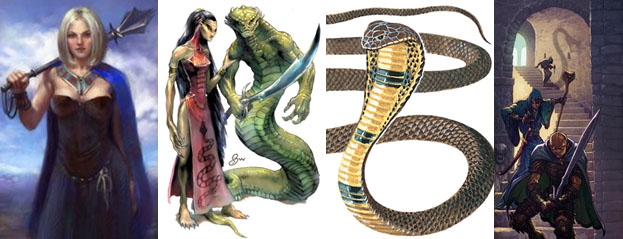
The party has to kill a lawful good high priestess and her snake servants.

Step 2: The Enemies

Using the excellent Monster Builder, make a list of the potential combat opponents, really uncorking your imagination and letting it spill all over the floor. Your goal is to have way more than you could ever use, varying the types of creature. Because the Monster Builder allows you to set the monster levels, don’t feel like you have to restrict yourself in your selection to just heroic, paragon, or epic monsters.

High Priestess, yuan-ti, giant snake, kobold, drake, kruthik, lizardfolk, snaketongue

Step 3: The Encounters

Decide on three set-piece encounters, using this pattern:

Encounter One

Use the KISYSDM method, or Keep It Simple, You Stupid Dungeon Master. You don’t know these players, they don’t know you, they don’t know their characters, and they don’t know each other. For these reasons, you should create a nice two-dimensional setting with few terrain challenges, and then insert brutes and minions. It’ll be easy on you and the players, and as a happy bonus, the players will figure out how to work together.

Use two (party level+1) brutes and 24 (party level) minions.

Note: According to Dave Noonan, minions should be worth 1/10 of a standard creature, and not the book-dictated 1/4.Trust me here, Dave’s right.

In a wide intersection, the party is attacked by two yuan-ti fangblades and their 20 snaketongue initiates.

Encounter Two

Break for roleplaying! Whether it’s a formal skill challenge or an informal wander-and-look, this offers a respite from the possibly hectic, probably grindy combat, giving the players a chance to interact with each other without the constant bleating from the DM.

The party investigates the snake-creatures and cultists that attacked them, researching the snake symbols worn and carried, talking to their back alley contacts, threatening the local priest who seems to be involved, and eventually tying the events to the high priestess, an upstanding cleric of Pelor who may be a servant of evil.

Encounter Three

As much fun as roleplaying is, many (most?) of the players may be getting antsy at this point, wanting to roll dice and hurt enemies. It’s time to give them that opportunity, in the form of an encounter that’s a good deal tougher than the first one.

Use one (party level+4) elite brute, one (party level+2) soldier or controller, two (party level) brutes, and 10 (party level) minions.

In the temple of Pelor, the party confronts the high priestess, discovering that she is, in fact, a victim, being controlled by a giant cobra who wants to RULE THE [whatever]. This battle will be against the giant cobra, the dominated high priestess, two yuan-ti abomination berserkers, and 10 spitting cobras.

Step 4: The Settings

By now, you should know the basic shape of the sites you’ll feature, so all you need to do is assemble your maps. Naturally, you can draw them yourself on Chessex Battlemats or Gaming Paper, or use the Wizards of the Coast Dungeon Tiles or Paizo Flip-Mats. Your artistic skill or your existing map items may influence the final settings, but if you approached your encounters in the broadest strokes, you can be flexible with the finished product.

For Encounter 1, I’d use my Paizo City Market Flip-Mat, and for Encounter 3, I’d use my Paizo Cathedral Flip-Mat. For Encounter 2, I’d keep it all firmly in the imagination, since the player characters should be wandering all over the city and interacting with lots of people.

Step 5: Getting Graphical

Using the jumbled expanse of the internet, locate good pictures for all the monsters and characters. This part of the process is both thrilling and infuriating, since I can often find a few great examples and several terrible ones. Make use of the Wizards of the Coast Image Archive, and, of course, the Google images site is always a fun ride, especially if you don’t mind the occasional totally naked non sequitur.


Step 6: Monster Markers

During game play, I always prefer markers over miniatures, and here’s why:

  • Multiple miniatures can clutter and confuse the board, and sure, that may seem like so much “fog of war,” but in practice, it’s just distracting.
  • Typically, DMs will have ALMOST enough miniatures for a given encounter, resulting in, “this ogre is actually an ice demon,” or, “this horse is actually a spider,” or, “this halfling is actually a dragon.”
  • If the player characters are the only three dimensional creatures on the battle map, it correctly elevates them as the most important beings present. This story is about them, not the opponents.

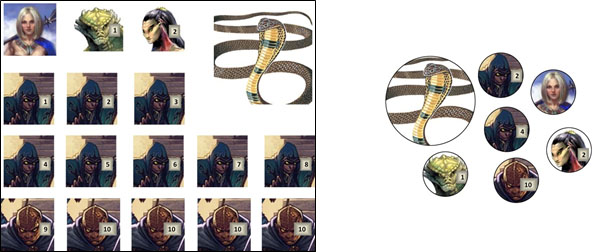
In a Microsoft Word document, lay out the monster images, cropped to the faces (small and medium creatures to 1.25″ x 1.25″, large creatures to 2.25″ x 2.25″, and so on) and numbered sequentially, and then print these pages onto white full-sheet shipping labels.

After sticking the pictures onto shoebox cardboard (good weight, and available for free at your local shoe store), cut the markers using the greatest thing to ever come out of craft stores, the sized circle punch. I use the 1″ nesting punch and the 2″ squeeze punch.


Step 7: Initiative Cards

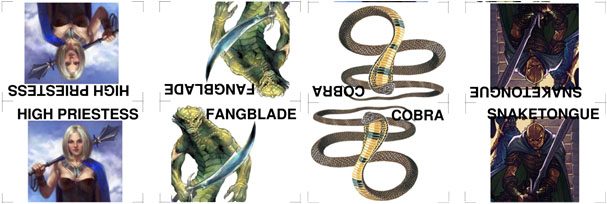
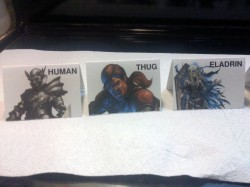
In a Microsoft Word document, lay out the character and monster images on labeled folded cards, which will sit like tents in front of the DM, tracking initiative order and also displaying images of the monsters. I’d recommend printing on cardstock, white for the monsters and bright yellow or pink for the characters, for easy identification.


Step 8: Final Touches

At this point, the one-shot is finished and ready to run, so you should take a step back, maybe see a few other adventures to cleanse your palate, and come back with a fresh perspective. You want to reread this one-shot from the point of view of the players who will be experiencing it, asking the following questions:

  1. Is there a clear through line? Does the progression through the encounters make sense, or does it feel disjointed and chaotic?
  2. Will the puzzles or riddles or mysteries be painfully obvious to even the stupidest players? Remember that this will be the very first time these players will see these elements, and they don’t actually know the answers.
  3. Are there parts of the adventure that will spotlight specific player characters? Will the thief be able to pick a lock? Will the bard be able to sing a song? Will the fighter be able to crack some skulls?
  4. Are there any parts of the adventure—the monsters, their powers, the settings—that can be exploited by the players? Is this really a bad thing?

Note: If you find any parts that can be exploited, do NOT change them. Just come to terms with them. Allow it to happen. Become a leaf on the wind.

  1. Through Line. The adventure story is quite simple, starting with an attack, moving to an investigation, and concluding with the big snake battle. The party halts the growing darkness, saves the high priestess (hopefully), and lives to fight another day (again, hopefully).
  2. Puzzles/Riddles. The investigation is freeform, merely requiring the player characters to poke around and ask questions. They’re looking for the WHYS (why were we attacked?), and then moving onto the WHAT NOWS.
  3. Spotlight. If you’re providing pregenerated characters to the game, it becomes much easier to develop spotlights, since you’ll know exactly what the characters are capable of. Even so, you can assume the party will include strikers and probably a defender or two, which explains the high-damage, low-defense brutes, and it might include a controller, so there are piles of minions. If I knew an undead-bashing cleric was coming, I might want to toss in some zombies too.
  4. Exploits. The party might decide to take prisoners in that first encounter, which could screw up my investigation during the second encounter. They could also turn the second encounter into their Traveling Torture Tour of this nameless city, “Tell me what you know or I’ll cut off another finger!” Finally, and most troubling, they might elect not to look into the attack, deciding, “We were attacked by snake-men and cultists. Weird. Let’s go to the inn and drink.”

What About Dungeons?

Maybe you read this and thought, “That’s all well and good, but I want to create a dungeon one-shot. Dungeons don’t work as encounters, but as a player-selected series of rooms. I can’t control which one they’d go to first, then second, then third.”

Except, of course, you can. You just don’t have to tell the players you’re doing it. Your first encounter might be the ORC LAIR, which covers five interconnected rooms and contains a total of 30 orcs, which lay into the characters in waves. This would still look like a dungeon but play like a one-shot.

Conclusion

Believe it or not, I’m not suggesting that every one-shot has to adhere to this structure—easy battle, non-combat, tough battle—but I’ve found it to be a reliable template for my own quick delves or convention games. In the snake example I gave, it would still work even if I shuffled the encounters a bit:

  • Encounter 1: Church representatives ask the party to investigate their high priestess who’s been acting strangely, which means we lead off the adventure with non-combat.
  • Encounter 2: During the investigation, snake men attack the party, and flee once they realize how tough and scary the party is.
  • Encounter 3: The party pursues the snake-men to the cobra lair, and fight the snake cult.

For any of these, the biggest challenge for the DM would be believably connecting the encounters, and that’s where I can load the party up onto a story-train, and click-clack, click-clack, click-clack, we’re onto the next encounter through a cut-scene. In a time-sensitive game, like at a convention, this approach always works, and the players tend to be more forgiving.

So, do you want to see how I wrote up this example adventure? I didn’t go into a whole lot of detail, but then, I rarely do.

Download Adventure-FaithLikeVenom, which sounds like a combination George Michael and Madonna song. Man, I’m old.

Using Powers

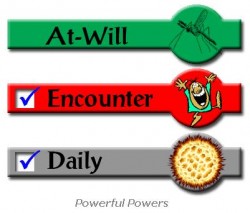
Given my obvious limitations, I can only really speak in Dungeons & Dragons 4E terms, but this may well apply to all games everywhere, especially if I’m deluded. In 4E, every character has lots and lots of powers of different types and effectiveness: some powers (At-Wills) you can use all the time and are slightly more dangerous than mosquito bites; some powers (Encounters) are cool and deadly but you can only use them once in a battle, kind of like a male “yahoo yahoo yippee” moment; finally, some powers (Dailies) can only be used once a day, tearing apart the earth in a cataclysmic nuclear explosion, laying waste and devastation in all directions, shattering hope, killing dreams, annihilating puppies, and spitting on your toothbrush when you’re not looking.

All of these are fun to varying degrees–no, seriously–but obviously it’s a stepped scale, and Encounters are usually better than At-Wills, and Dailies are usually better than Encounters. As a result of this, players become extremely reluctant to use their big’um, bad’um powers, sticking with the ones that never go away, because sure, this particular fight is going very badly,with most of the party bloodied or unconscious or dead or disintegrated, but who knows what lurks around that next corner? What if we need this particular power? I better hold onto it, just in case.

Trust me, more evil has been done in the service of just in case than any other cliched phrase, and I’m including a bird in the hand is worth two in the bush (hehe, I said bush).

Anyway, we as players need to start thinking and living in the RIGHT NOW instead of the NEXT LATER, because the RIGHT NOW is the only time we can actually do anything. I cannot store a success for an upcoming encounter, and I cannot bank a win for tomorrow’s battle. To put it in pure meta-gaming terms, if the next encounter really is super-duper, soul-rendingly difficult, the DM should probably figure out a way to throw the PCs a little sack-time to get ready for it. The point, as I’ve said one million times before, is not for the DM to “win,” but for the DM to tell an exciting and thrilling and heroic story about these characters.

Now then, does this open the door for abuse? Will the players simply burn through all their Deadly Dailies in every single encounter, and then insist the DM give them all nappy-nap time to get ready for the next one? Of course they will. The only way to really deal with this is to establish some sort of social contract between players and DM, wherein the players agree to use their powers judiciously and the DM agrees not to smash the players into unrecognizable pulp with the Vicious Mordenkrad of Ultimate Sorrow.

If I, as a player, decide to drop that Daily in Encounter #1, then I am accepting that I may not have it for Encounter #2. If I, as the DM, see an unrelenting string of natural 20’s on my side of the screen while all those beleaguered players can’t sniff a double digit on their side of the screen for six straight rounds, then I have to be willing to account for the PCs using precious resources for this “easy” battle just to survive, and should start planning for them to recoup those losses.

Just lately, I’ve been blessed with tons of gaming, and it has been both wonderful and lovely, with a creamy topping of excellent. I’ve played a full range of levels, a 5th level one-shot, a 24th level campaign, an 8th level multi-shot, and bits and pieces in between. Over the course of this span, there have been several challenging encounters, ones that pushed me and my compatriots to the absolute limit, where I wasn’t sure if all of us (or any of us) would survive.

For those battles, I’ve thrown down everything I had, furiously checking off powers on my character sheet like a deranged auditor, digging for one more thing, wondering, “Is there anything left? Did I forget an ability? Did I use that Daily on my orb? Do I still have an Encounter lurking on page 4? Wait, did I use my Action Point???” For these big old battles, I feel a sense of accomplishment when I stagger out the other side, bruised and battered and bloodied but still breathing, and I know I gave it my all. I put everything into it. I left nothing on the table.

And then I happen I glance over at the sheet of my fellow player, my ally, my comrade, my blood-brother, and I see he still has most of his powers left, and he’s happy–HAPPY!–about it. “I hardly used anything in that encounter,” he declares with an infuriating grin. And I have no choice but to kill him. It really wouldn’t be my fault. At least, that’s what I plan on telling the jury.

Azazael, Tiefling Seeker (steal this background)

By Dixon Trimline
– Azazael bides his time until he can enact his vengeance on she who betrayed him, the Lady of Torture. hoorah!

In the stinking bogs of Minauros, Lilith, the Lady of Torture, ruled her Rotted Hall in Jangling Hiter, the City of Chains, where she plied her talents on any who dared defy her lord Sagirsa. Naturally, she worked against the archdevil herself, offering reports of Sagirsa’s plots and deceptions to Mammon, the overlord of the Third Hell.

It was into this world, echoing with the shrieks of Lilith’s victims, that Azazael was born, the offspring of a succubus and a dominated paladin, another of the Lady’s countless subjects and slaves. When he was not administering–or receiving–Lilith’s tortures, Azazael stalked through the foul swamps of Minauros, hunting the Unspeakables there, first with blade and later with bow. As he grew, he learned that he could gather the twisted magicks of the place, breathing them into his barbed arrows, making them burst and making them burn.

With the right threat in the right ear, he turned his coven of slaves against their Master Torturer, slaying the chained devil and forging his bow Holocaust out of the creature’s spine. Upon hearing of this, Lilith did not punish the half-devil, as all–including Azazael–had expected, but was delighted, and laid claim to him, placing him among her consorts. He thrived in this role, menacing and manipulating all others until assuming First Consort, Lilith’s most trusted bodyguard.

Azazael served in this way for almost fifty years, putting down any rebellions in the Rotted Hall, killing assassins with swarms of flesh-eating flies or tearing them apart with clouds of razored thorns, all of this pouring out of his greatbow like in a tide of dark energies. It wasn’t long before the other consorts grew weary of Azazael’s successes, or for Lilith to grow concerned about his abilities. Working with her Second Consort, Xaphan, Lilith captured Azazael, wrapping him in Sagirsa’s unbreakable chains and shattering Holocaust, and then dragging him to Avernus, the surface of Baator, where he would burn alive for all eternity.

This is where Bel, Avernus’ pit fiend ruler, found him, and seeing a potential ally, granted Azazael access to the Lake of Despond, where the half-devil could ride the searing winds up through the funnel storm cloud and out into the Astral Sea. From there, he rode with Githyanki pirates, helping them battle a tentacled abomination with a borrowed bow, and discovered he could still harness the energies from Minauros with his shots. Grateful for his assistance and respectful of his powers, the Gith took him through a color veil into the material world, where Azazael plots his return to the Rotted Hall and his vengeance on the Lady of Torture who betrayed him.

Image by Claudio Pozas