Nowhere, the Tiefling Rogue – Steal this Enemy

Please enjoy submission #13 for our latest contest: Your Best Worst Villain!

My best (worst) villain has been a Tiefling Rogue named “Nowhere”, in my 4e Campaign. He is an agent of Nihilism and Chaos who has a long standing rivalry with one of the major plot NPC’s whose tale is intertwined with my party’s.

The two grew up together, sharing many tricks and practical jokes, owning their small city as young thieves. But as they grew, they grew apart, with the one developing a social conscience and deciding to use his gifts to change the world… while Nowhere held onto his sense of one-upsmanship and grew resentful of his former friend’s abandonment of their games in favor of larger social concerns.

In his efforts to “win” the game he and his rival began so long ago, he has become a capable Shadow Magic practitioner, but he rarely uses these skills unless physically threatened – at which point he pulls off devastating tricks designed more for misdirection and escape, than outright attack. However, it is clear to the party that, if truly threatened, he will be more than an adept opponent.

He serves Chaos, and has developed a twisted worldview that grants that there is no difference between good and evil – only events colored by the feelings of those that experience them. And who are the members of the party, to tell him that his enjoyment of their suffering is intrinsically inferior to the irrational and selfish preferences they hold?

The party first encountered Nowhere when they were to have dinner with one of the Generals who has been trying to restore stability to the dangerous land. Nowhere told the party that he was the child of one of the General’s soldiers, and begged them to let him join their party during the meeting, so that he could get “face-to-face” answers as to why his father’s stipends had stopped coming. The party, being a person short that session, assumed that he was a backup NPC, and allowed the accompaniment.

During the dinner, he staged an assassination attempt on the General’s life, and escaped, leaving the party, who had vouched for his behavior as their guest, to deal with suspicion in the aftermath.

Nowhere reappeared in Vor Rukoth, the Tiefling Capitol, attempting to sway the city’s leaders against the party as they sought to rekindle a dormant magical weapon. His meddling shed doubt on the player’s actions, though when they were vindicated by the results of their efforts, he respectfully withdrew his accusations, enjoying his protected status under his political connections.

Later on, after the players’ adventures had taken them to a new continent, he reappeared, and after a lot of grandstanding, gave each of them a feather. He told them that these feathers were enchanted with the blood of their loved ones and, should they fail to assist him in his schemes, great harm would come to those they cared for – indicated by a creep of red across the pristine white feathers. Little did they know, he was using Shadow magic to interfere with their attempts at communication to verify his claims. After they had played into his hands for a time, they called his bluff – which he readily dropped, and beat a hasty retreat, laughing all the while as the authorities closed in on the party.

He is such an effective villain at getting the party’s ire because he seems to care so little about anything, including his own goals. His only drive is to interfere with his rival, who works with the party, and create problems for them as they work to fulfill his agenda. He is collecting the same dangerous and ancient magical artifacts the party pursues, any of which would be dangerous enough in responsible hands. In his, they represent an unimaginable threat. Yet, all the while, he seems eager to convince the party that their benefactor may not be as noble as he seems…

The part that gets the party into trouble is the fact that, once you get past the malicious anarchy, Nowhere is almost a tragic, romantic figure – all he wants is an end to the game his old friend stopped, just when he was beginning to get ahead. A number of times, the party has tried to use his pain against him, or reconcile the pair, but unfortunately, Nowhere is too far gone down his dark path. It becomes increasingly clear that his game will only end when he pulls off the ultimate trick, to which there can be no rebuttal – the extinction of all existence, by one means or another.

Nowhere always seems just one step ahead, but in the end gladly reveals his hand has been empty all along. Nothing is as frustrating to the party as wondering if, each time Nowhere appears, will his boasts be empty, or will he finally back up his idle threats? They would love nothing more than to wrap their hands around his lean red neck, but know from defeat after humiliating defeat, they have a lot of growing to do before they can take him in as close to a fair fight as they can get!

Image by grandanvil

Queen Elenora Grace – Steal this Enemy

Please enjoy submission #12 for our latest contest: Your Best Worst Villain!

Queen Elenora Grace Karstark-Greatjon-Dunman, widow of Price Geoffrey Eddard Greatjon the fifth, Wife of the Rotten King, Queen of the Red Kingdoms

Cinderella

Description: Short, no more than five feet tall. Her light brown hair is corded and braided, pinned up in an elaborate way. She wears a small circlet of red gold with fire opals all around a yellow-gold eagle’s head on the front with garnet eyes and a silver fish in its beak. She doesn’t wear make-up but she’s immensely beautiful. Her skin is pale and fairly unblemished aside from deep frown-lines. She looks to be in her late twenties/early thirties. Her brown eyes are almost black, and she never smiles. She wears simple but elegant gowns in the colors of fire and soot: Reds, oranges, yellows and blacks, belted with chains of yellow and red gold medallions marked with fire opals, citrine, and garnets.

Always with her are her three servants, gifts from the Rotten King, Humpty-Dumpty. All three are completely haggard.

The youngest is a girl a few years younger than Cinderella. She is the only one who can walk upright. Her feet are bound into a pair of iron and leather shoes. Iron soles sewn to leather sides with a leather tongue.  She’s taller than Cinderella and her special shoes emphasize that her feet are deformed, missing chunks of her heels. Her head is shaved and she wears rags and an iron collar.

The next youngest is a woman slightly older than Cinderella. She cannot walk upright because of the iron shoes clad to her feet. Iron soles and tongues with leather sides. The shoes show off the fact she is missing both of her big toes. Her head is also shaved and she wears the same rags and iron collar as her younger sister.

The eldest is a woman well older than Cinderella, some say old enough to be her mother, others say old enough to be her grandmother. She wears a short leather dress and her feet have been poured over with molten iron. She is gagged and wears an iron collar with spikes that dig into her neck and shoulders if she does not keep her head completely bowed. Her hair is a tangled gray mass that is visibly crawling with lice and other vermin.

Back-story/Motivation:
Everyone thinks they know the story of Cinderella, the poor downtrodden daughter of a loving father who was tortured at the hands of her evil step mother and step sisters. This is not the case.

When Cinderella was still young, no older than six years old, her mother left in the middle of the night leaving her to the will of her sadistic father who used her to his own whims. She was old enough to know that she’d been abandoned. Her father claimed his beloved wife had died and even went through the ritual to have a funeral for her before he chose another wife.

Her father’s new wife brought with her two daughters that were close to Cinderella’s own age. She did not take to her new family though and felt even more isolated as she noticed that the presence of more women under the roof did not lessen the extent of her abuse any. Her stepmother took no pity on her and never stopped her father from laying his hands on her.

After her father’s death, her Stepmother kept her under her roof but, having grown accustomed to ordering her like a servant continued to do so, though actually paying her for her trouble. The stepsisters never grew close to the strange and isolated Cinderella and they followed their mother’s example.

When the Prince held his ball Cinderella saw it as her way to a better life that she might find her mother. She took her pay she had been saving from her Step-mother and bought herself a beautiful dress and matching pair of slippers made of glass and fur. She did not let her step-family know she was attending the ball and the rest follows the ‘official’ story fairly closely.  Her step-sisters cut of parts of their feet in turn to fit her tiny slippers and each time she told the prince’s servants to check the shoes for blood.

After she married the prince she wanted nothing to do with him. He humored her shyness in the bedchamber for a while but eventually grew fed up with this game and tried to force himself upon her. She managed to push him over the railing of their bedroom balcony to his death.

His kingdom was in uproar so she left quietly in the night. The Rotten King found her on the road and proposed a marriage simply in name. He expected nothing of her (other than for her to take his name) and in exchange he would deliver her wicked step-family and help her in any way she needed to find her real mother.

Other Notes: After years of being treated as she was, she didn’t believe there was any other way to elevate herself than marriage. She’s never considered other people to be as complex as herself. She doesn’t understand kindness – after years of being defensive she only sees a trap in it…. It’s not about eliminating kindness. It’s about making those who stood by and let her be hurt and such over and over again pay for not stopping it. Particularly her real mother whom she is convinced is still in hiding, now from her instead of her father. Once she realizes someone isn’t/doesn’t know her mother she has no use for them.

She is particularly suspicious of strangers, they’re the most likely people her mother would have fled to, those who know nothing about the kingdoms. She dislikes heroes because nobody ever saved her, she will make your life a living hell until you can find her proof that you have not a connection to her mother.

Turel the Deceiver – Steal this Enemy

Please enjoy the eleventh submission for our latest contest: Your Best Worst Villain!

The devil Turel served the evil demi-god Eldrazel in long ages past. Always the deciever, Turel excelled at slipping behind enemy lines, disguising itself, and tearing enemy forces apart from the inside out. Eventually Turel, unable to decieve a demigod of truth, was defeated in combat. The Eldrazel saw fit to tear off his late servant’s face and forge its rotting remains into a mask, binding Turel’s soul into the relic.

Turel lived again, so to speak, and was now a far more deceitful being. Able to compel any who hear the mask’s voice to pick it up and put it on. The inside of the mask bore sharp, always lashing claws and teeth that grinded into it’s victim’s skull, joining the two until the mask decided it was time to let go. Turel  found he was able to taunt and probe the minds of his victims, draining what knowledge he needed to blend into its victim’s old life.

When his master was eventually defeated, he began to hatch a millennium-long plan to resurrect his dark demi-god, collecting the relics required to rejoin the Eldrazel’s soul to its body.

The PC’s had been collecting these artifacts and piecing this legend together from levels 1-10. As the PC’s returned to their favorite city from a long adventure to the north, they found that their beloved town of Merrilea had changed. Instinctively, they went to speak with the duke, a portly and pleasant old chap who had given them handout upon handout after they saved his life. Although the duke seemed like his old self, some of his mannerisms had changed and the party got the idea that something was up.

The lovable lawful monk decided to request a solo audience with the duke which was eagerly accepted. During the meeting the doors were sealed from the outside and the duke attacked the monk revealing its true visage, in the form of a rotting demon’s face latched on to some poor soul. The monk suddenly remembered that there was a murder mystery in town that the party skipped over and one of the victims was a portly man whose face had been ripped and torn off beyond recognition, the real duke.

The mask subdued him and tortured him for two weeks in the dungeons while the rest of the adventure party decided to trudge off to an old adventure site outside of town. Eventually the party linked up with the old military commander who was staging an overthrow of the city. In the heat of a battle between rebel(good) and city guard(evil) forces they use the opportunity to storm the castle and rescue the monk who was seemingly attempting his daring escape already.

They left Merrilea by way of ship and sailed to a city containing a magical, impenetrable vault where they have been storing the relics needed to resurrect the Eldrazel. Upon reaching the city where the vault was located they met an old, trusted friend who had been researching the legends pertinent to their quest. He told them the complete history of Eldrazel’s most trusted servant, Turel. The story seemed to upset the monk and he angrily corrected a few points of the tale. The party discerned that their monk friend didn’t simply walk out of Turel’s clutches.

Believing him to be a doppelganger of sorts they attacked and killed the monk only to find his face change into a horrible cackling monster as his dead body hit the floor. Horrified at what they’ve just been tricked into doing, they attacked the mask that was clutching to his face and it stopped laughing and seemingly died. They gave the mask to their friend who ran the vault so that the mask would be sealed away forever. Eventually the party resurrected their monk, and he told them where the rest of the relics could be found. For awhile the party continued collecting the remaining artifact pieces. Once they are were all sealed away inside the vault, the PC’s assumed this adventure was over…

…Until they heard that their friend at the vault had broken out with all of the relics and was now able to complete the ritual. The PC’s realized that they had been played from the start and very begrudgingly made their way to the grave of the Eldrazel, in its own demi-plane.

Upon arriving, they found that the ritual was nearly complete and Turel had attached itself to their little gnome friend. As they hastily attempted to stop Turel, they accidently damaged the crystal formation that kept the demi-plane rooted in existence and the plane started to quake and fracture.

The room contained six gateways to their home world that started to flicker at the slow collapse of the plane. As Turel staggered out of one of the gates he looked back and mocked them, “Six heroes, five gates. I wonder which ones I’ll see again?” As soon as he touched the gate, it pulled him through and shut off. The heroes were left to decide which one would be left behind with the slowly awakening demigod on the dying plane.

The Masked One – Steal this Enemy

Please enjoy the tenth submission for our latest contest: Your Best Worst Villain!

He goes by many names, none of which are real. For he truly has no name. The party called him “The Masked One.” This man was just an unassuming prankster from North Star before he decided to break into the tomb of the Magic Academy’s head wizard with his friend. What he found there was a piece of ancient white and ruby armor, bound with the spirit of a very powerful Drow warlord from many years ago. It was a mask. A flat white mask with rubies instead of eyes. It called to the prankster and when he put it on, he was possessed by the power-hungry and murderous soul of the Drow. He killed his friend in cold blood and took up residence in the tomb, hidden from the rest of North Star. Besides a great thirst for murder and power, the mask also bestowed the prankster with powerful psychic abilities and a genius personality.

He spent the next few weeks stalking what he believed would be his next powerful allies, the PCs. He sent each of them a note with a riddle on it, leading them to another place, where a test and another note was hidden. And thus the trail continued, leading the players to be staged for murder and even to perform the lute in front of an audience that included the Masked One (none of them were bards). Eventually the players were lead to the entrance of the Masked One’s hideout, where he was going to offer the players a position of power in his new council. One of my players pretended to accept, fooling the Masked One’s psychic abilities and earning his trust. This would be his downfall, for the player set fire to his library and stole the mask, leaving the prankster confused and eventually crushed by the falling shelves (all part of the Mask’s plan).

The players then decided to make a party and pursue a life of adventure, their task – find and destroy the rest of the warlord’s armor. It wouldn’t be easy, for the armor couldn’t be destroyed by any normal means. They decided to carry the Mask in their pack, keeping it covered to protect themselves from its irresistible power. This was not enough to protect them, though. One of the PCs (who was leaving the group anyway), became the next victim of the Mask’s persona, faking her death and appearing to the players again. She left the same notes and riddles, this time to use the players to gain the final pieces of her armor. They picked up the gloves and the boots on their journey, lead by the Masked One who used death threats to motivate them.  Since the possessed PC was a druid, she also led the players with a mysterious raven, her old animal companion. The players considered the raven to be a friend, but it was only another tool of the Masked One.

The final confrontation came once again at North Star, where the identity of the new Masked One was revealed in a huge labyrinth underneath the city. The druid had regained minor control over herself and led her body to the PCs where they removed the Mask after a long battle. They discovered this Mask could only be destroyed with the sword of the Drow warlord’s rival, a human hero from North Star. Once they received this sword from the Lord they were able to smash the mask to pieces, releasing the mind of the drow warlord. Unfortunately for the PCs, the armor and the amulet of the ruby armor remain.

This is my greatest villain that none of my PCs forgot – the Masked One. The notes that he left them that seemed to predict their every action (I printed some of the notes as I sat there to respond to their actions) and the personality of the riddles and the traps made him very memorable. The Masked One was also a catalyst for many adventures for the entire campaign and a big plot twist when their druid friend became their greatest enemy.

Olethros, Necromancer of Vecna – Steal this Enemy

Please enjoy the ninth submission for our latest contest: Your Best Worst Villain!

In a world of magic, many people who master the arcane arts often attempt to help the world and make it a better place.

Olethros was not one of those people.

Olethros was a battle sorcerer who specialized in necromancy. He was a devout worshiper of Vecna, and was bent on having the God of the Undead rule the cosmos. As such, he started to search for the Hand and Eye of Vecna. To do this, he had a large portion of the Cult of Vecna scatter throughout the world and raise the dead from their graves.

At first, these undead were simply zombies who roamed the countryside, only to be put down by the PCs (who were mmembers of the Holy Order of Religious Warriors, an organization made of warriors who never became paladins, but still fought for their gods). However, after the cultists started to fall to the hands of these warriors, the terror of the undead began to spread into the cities.

Olethros created more horrifying creatures that toppled kingdoms. He always stayed one step ahead of the remaining members of the now declining Holy Order, and his quest for the unholy relics was almost unopposed. After gaining the Hand and Eye of Vecna, he sent his best lieutenant, Alucard, to eliminate the party.

After he learned of Alucard’s defeat, he decided to take matters into his own hands by fighting the party himself. He disguised himself as a powerful king and told the party to go to an ancient tower called the Moonstone Spire to investigate a large amount of undead in the area. Olethros arrived long before the party and sealed himself at the top of the spire. While here, he replaced his hand and eye with Vecna’s Hand and Eye. After the party burst open the door to the final room, Olethros immediately attacked. After three of the five party members were knocked unconscious, with the other two at 3 and 0 HP, Olethros readied a Finger of Death spell to finish them off, only to be shot seven times by the archer and fall out of the tower. After this fall, he died.

But it was not over.

Because of his tremendous service to Vecna, the God of the Undead himself revived Olethros as a Lich, with many other powers of the undead. With his new powers, he raised an army of all undead horrors imaginable. The army, called the Army of the Black King, destroyed all in it’s wake.

Eventually, the only piece of land left in the world that wasn’t raped by the undead war machine was a tiny island known as Axio. Here, the party trained the last survivors of Mortalkind to fight the undead. Olethros caught on quickly and sent legions of undead to the island every day, only for the newly revived Holy Order of Religious Warriors to smite them back to Vecna’s realm.

Finally, with his undead army reduced to half it’s numbers over a period of seven years, he decided to act. Armed with his sword, Kaegroarytevivex (draconic for Undead War Victory), he led six hundred ships made of bones, flesh, sinew, and masts made of skin to Axio. As the final 1200 warriors said their prayers, Olethros led the charge on the island stronghold. His army, however, was quickly mowed down by arrows blessed by clerics.

After the arrow barrage ended, wizards and sorcerers blasted the horrible creatures to bits. Olethros and several of his Lich servants eventually killed the spell casters, and his army then reached the stronghold gates. After heavy hand-to-hand fighting, during which a PC was killed by Olethros, his army overpowered the warriors and charged towards the keep.

Despite heavy losses from archers in the streets, Olethros reached the keep as his army continued to fight the last remnants of the Holy Order. Here, he encountered the four remaining party members. After a moment of exchanged words, he attacked first, instantly slaying the party’s ranger with a Wail of the Banshee spell. After over three hundred rounds of combat (we counted afterwords), the only ones standing were Olethros and the party’s cleric, who only had seven points left with no more healing spells. Olethros himself was at full hit points due to high damage reduction and fast healing.

His mace broken, the cleric fell to his knees, seemingly in tears. After several rounds of taunting and laughing at the broken priest, the Monster of Vecna charged. That’s when the cleric’s readied action went off. He drew out his spare weapon (was able to due to the Quick Draw feat) and moved two squares, causing Olethros to miss. The cleric then moved towards his adversary and did a full attack. He raised his blade and yelled “In the name of St. Cuthbert, by the Power of Kord, with the Light of Pelor and the Valor of Heironeous, I wield the Blade of Kas against you, cursed monster!”

Olethros cursed as he heard the words “Blade of Kas” the only weapon that could truly defeat him. The cleric then began his attacks. The first cut off the Hand of Vecna from Olethros’s body. The next pierced Olethros in his left eye, which destroyed the Eye of Vecna. Lastly the cleric thrust the Blade into the heart of the Black King. Olethros began to yell towards the sky, cursing the gods, the cleric, and all of the living as the necrotic energy that powered his accursed body left him.

After the last of his power fled, the doors to the streets blasted open as the necrotic power from Olethros’s soldiers pierced the wretched sorcerer’s body. At last, the only thing remaining of Olethros was his cloak, riddled with holes and cuts from the final battle. The cleric took the cloak and Olethros’s sword and put them both into a blessed silver plated adamantine chest along with the Blade of Kas and boarded a small wooden boat with nothing but the clothes he first wore in the campaign (when he was nothing but a simple priest), a gallon of lamp oil, and a piece of flint and steel. He bade a final farewell to the survivors of the battle, which numbered at 192, and rowed into the open sea. As he lost sight of the island, he doused the boat, the chest, and himself in oil and set it ablaze.

With all undead now banished from the world, the world slowly recovered. The names of the heroes who fought Olethros were lost to history. With nobody to tell of his legacy or his dark deeds, the name Olethros was nothing but a stain in history. However, sailors now tell of a spot in the sea where the water is dark, and when you are alone, the faint sound of raspy laughter can be heard, along with the sound of a shaking chest and two swords clinking against each other.

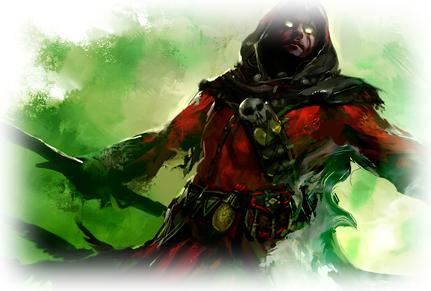
Image from GuildWars

Elona, the Elven Druid – Steal this Enemy

Please enjoy the eighth submission for our latest contest: Your Best Worst Villain!

The Best Villain in any of my D&D games was never an NPC, but a player character named Elona. Elona was an elven Druid with a cute and cuddly wolf companion. She was played by my long-time friend, and the character herself had been a long time friend to the party, stretching almost a year’s worth of games. Needless to say we all trusted her 100%.

As in almost all of our D&D games, there was some sort of over-arching war plot that our DM was reusing that had escalated to a point where the NPC’s were pulling out weapons of mass destruction. Both sides wielding every magic and relic one can think of (short of a wish spell) to destroy their enemies, and our party was somehow trying to find a balance.

I think it may have been around this time that Elona had switched sides. My DM had been hanging out with Elona’s player on non-gaming days. The rest of the party and I figured that they were dating or something, but turns out that Elona and the DM have been having secret gaming sessions behind our backs where she was raising armies of her own.

Let me drop some stats on you. Elona’s top stats were Dexterity, Charisma, and Wisdom.  She was usually known for being our Tank-like striker class, only using her charisma for minor conversations with NPCs (our bard was the voice of the group most of the time). And her wisdom seemed only useful for her spell work every now and then. The thing that the group didn’t know was that Elona had taken up the leadership feat, the awaken spell, and a sudden un-friendly disposition to the rest of the world.

It all started when the Cleric-heavy side of the war was starting to summon forth angels to the battle field and the Mage-heavy side retaliated with Demons. Our party had just got done setting up agreements with the neutral kingdoms to the south when we found ourselves caught between the fury of heaven and hell. Strobes of holy and unholy power flickered around us as the best champions of both sides claimed the forest that we were in as their arena.  We all prepared ourselves for a long fight when suddenly it was over without us even swinging a sword.

We stood there confused, waiting for something to come at us through the trees; the meat-shield dwarf cursing obscenities to the wind trying to goad on something to come at him. We didn’t see or hear anything for several hours so we figured it was safe to set up camp for the night and call the game there. When we woke up in the morning however we were no longer in a forest, but in what looked to be the middle of a battle scared field. More confusion prevailed as we tried to figure out what happened.

The confusion didn’t last long though. A game session later we had finally made it to the Cleric-heavy empire. Their whole town had been overrun with vegetation and wild animals had moved in. Elona had been awakening the forests of our planet to end war and bring peace to the world. When I say peace, I mean a world without the people to war with.

The game had completely turned around by the end of that session. It was no longer one faction warring against another, but every living thing trying to survive against a constant onslaught of sentient plants and animals. Three games later, Elona had accomplished her task of cleansing the planet, leading to a total reboot of our gaming sessions. From this whole ordeal, I learned that sometimes the worst villains are the ones trying to do the most good.

Image by Anna Christensen

Jericho Cain, Psychotic Manipulator – Steal this Enemy

Please enjoy the seventh submission for our latest contest: Your Best Worst Villain!

My players are smart, they don’t trust me. They assume everything I say has malicious intent, that every NPC has some dastardly plot and that every action they take will, in some way, lead to their inevitable doom. To be fair, they’re not wrong. But the villain who really nailed these facts home for them, was Jericho Cain.

Introducing my best villain took some doing though. Set in the Urban Fantasy world of The Dresden Files book series, my campaign has my players sitting on the sidelines of a war between the White Council of Wizards and the Red Court of Vampires in Portland, Oregon, one of the last safe bastions from the war. Enter Jerry Adamson, a minor league sorcerer from Vancouver, B.C. looking for safe harbor from vampire attacks that are getting more and more common.

Over the course of a “season” of this campaign, Jerry helped my players solve a series of gruesome murders involving low-level magical civilians where all evidence pointed to one of the party members as the killer. It took time and sacrifice, but eventually Jerry earned the trust of our heroes, saving their lives on multiple occasions. They took him as my own projection into the world, an NPC that I could use to be part of the adventure as well (as is a GM’s right). With Jerry, I could always fudge things slightly to their favor; taking care of that last bad guy, dispensing some point of exposition and even used as a basic errand boy. He was there for them when other allies abandoned them and even supported my player who was being set up, eventually helping prove his innocence.

All of this, of course, was a ruse. Jerry Adamson never made it to Portland. In the next season, doubt was cast over Jerry’s activities. Who he was and what motivated him. Slowly but surely, over the course of a year’s worth of bi-weekly adventuring, Jerry Adamson was revealed to be the heartless sociopath who called himself Jericho Cain. Once revealed, it quickly became clear that “Jerry” had been responsible for many ill moves cast against my players over the past seasons, and could even be linked to events that transpired before he arrived. Cultist attacks, demon possessions, the framing of my player for the serial killings and the murder of some of their loved ones (who my players thought they had avenged by killing high ranking members of the supernatural community).

Part Joker, part Deadpool and with just a smidgen of Green Goblin for flavoring, Jericho Cain began destroying lives with no real reason or agenda. He took psychotic glee in manipulating the emotions of my players, leveraging them against one another while mocking mortal society with his wanton slaughter. Using a combination of magic and mortal means, Cain lead my players along a path of death and destruction that had to be stopped by any means necessary.

When he was eventually cornered, Cain took one of my player’s best friends as a hostage and in the middle of negotiations, killed him in an attempt to force that player (a wizard of the White Council) to kill with magic, thus making him break one of the seven laws which bind all wizards. And he succeeded, creating a taint on my wizard player which has yet to be cleansed. Cain was destroyed in an arcane blast which wrecked the building their showdown took place in and while his body was never found, the black feeling of murder that has pervaded my wizard player’s magical senses, confirms his death.

Now though, even after another “season” of play has passed, my players are constantly attempting to ascertain whether or not the conflicts they face are simply new threats I’ve made up, or the continuing machinations of Jericho Cain.

He was my ultimate antagonistic experiment in which I figured out that a GM can’t always split the party physically, but split them emotionally and your players will do the damaging work for you. [Insert Maniacal Laughter Here]

Henric, the Maddened Bandit – Steal this Enemy

Please enjoy the sixth submission for our latest contest: Your Best Worst Villain!

My players tend to take things to the extreme. There is usually no telling what they’re going to think of next, and it is a constant struggle for me to anticipate what they will do and plan appropriately for it. Fortunately they tend to let me know outside of the game what their characters are thinking, so we make things work. Some things, however, tend to just fall into place.

Before I go into what makes the villain so memorable, it’s important to understand two of the characters, their shared background, and the events leading up to the confrontation, as this villain is a PC-backstory enemy who affected the lives of two characters before the campaign began. The human warlord, Parathorn, was the leader of a small bandit troupe, along with Guuzu, the brawling bugbear. These two PCs did their bandit thing around small villages and one large city before one of their followers staged a coup, forcing them out and taking over himself. This guy, Henric, was but one of the long laundry list of things that drove Parathorn into depression.

When I said that my PCs take things to the extreme, I wasn’t joking. The player of Parathorn decided to tell me, outside of the game, that his character had given up and didn’t see a way to make his life work and wanted to take his own life. Suicide is a pretty serious topic, but the character had rationalized it and the player had explained it to me, so we made it happen. The other PCs were none the wiser, and when they discovered his body the next morning, the player of Guuzu the bugbear had real tears in his eyes and was speechless for a good five minutes before he recovered enough to continue playing.

Parathorn was buried, and the party met the player’s new character, a paladin who ended up with his powers by accident (long, unrelated story) and who was defending a downtrodden town from a pack of ne’er-do-wells holed up in a cave complex near to the area. The party joined forces with this paladin and off they set to the bandit lair.

After dealing with the traps and twists and turns of the cave series, the PCs stumbled into a magical trap that wounded the lot of them and alerted the bandits to the characters’ presence. Revealed, the PCs charged into the room with weapons brandished and started attacking the evil-doers. Upon seeing Guuzu, some of the bandits recognized him and began taunting him, with one sprinting from the room to “inform Henric that Guuzu and Parathorn are here!” The PCs put two-and-two together, except for the new paladin; the player played it straight, and his paladin, who hadn’t been informed about Parathorn, didn’t understand why he was being called by that name.

For the enemies, it was an easy mix-up: both the paladin and the warlord wore chainmail and a helm, wielded greatswords, and palled around with Guuzu the bugbear. Who else could it be? So imagine Henric’s disappointment when, after the PCs burst into his throne room and he begins his “And this time I’ll finish you off once and for all!” speech, the paladin takes off his helm, revealing himself to be Not-Parathorn, and Guzuu reveals that Parathorn took his own life just days ago.

Henric flew into a wild rage. Parathorn was his greatest enemy; he had detested the way the other bandits looked up to him, hated how they were loyal to him, how they loved him and took his commands without question. It was like sweet music to Henric watching Parathorn’s once-loyal followers turn on him because of Henric’s lies and deceit, but it was a cruel injustice when one of the two men most devoted to the warlord held Henric and his betrayers at bay, giving his life that Parathorn and Guuzu might escape. Now fate had turned sadistic, robbing Henric of finally killing Parathorn and proving, once and for all, that Henric was the better of the two.

The maddened villain cut down his own men as they tried to flee from the enraged bugbear and his companions. He fought until the bugbear broke him entirely and spit bitterly into Guuzu’s face when offered the option of a quick death.

He did not receive it. Guuzu was not kind.

When talking about D&D and the characters that people create, I always paraphrase Goethe, who mentioned how authors cannot help but include in their writing parts of themselves. This is true of D&D characters, too; there is always some element of the player in the character.

Parathorn, his player commented after the session, was representative of a line of thought from which the player had moved on; when that sort of childish mindset installed within Parathorn died within the player, Parathorn had to follow suit. Guuzu’s player knew this, and it wasn’t easy for him to accept that part of his best friend had moved on from how things were. For him, it was a reminder of the passage of time and the ever-changing nature of things. Henric represented to him the forces that threaten to tear him apart from his best friend, and that created a very visceral response from both players. Both players were very emotional during and directly after the fight, and they both thanked me afterward for bringing out that sort of real-life drama and putting it into the game. Making their real-world fears into a D&D villain was a new kind of emotional catharsis: they literally got to slay the monster made of their fears.

My players take things to the extreme, and I couldn’t be happier about it, because not a damn one of us will ever forget that session.

The Wizard of Wizards – Steal this Enemy

Please enjoy the fifth submission for our latest contest: Your Best Worst Villain!

This particular villain was a powerful wizard whose wife suffered from a terrible illness. He had tried, and failed, to save the life of his wife with magic, and then finally turned to the divine powers.  Unfortunately, it was too late.  He had always thought divine magic was useless, and that the so-called gods were abominable.

He resolved to end them.  All the gods, everywhere.

He created an epic version of dimensional anchor, and inverted it.  Nothing extraplanar could enter the material plane.  Even going to the etherial plane was difficult.  As a result, the gods were cut off from their main power source: mortal prayers.  Even souls could not reach the afterlife.  He knew the gods would eventually weaken as they used power they could no longer regain.

He built a machine that would drain power from wizards, and did it to them all.  Every wizard, one at a time, was kidnapped and drained by the machine.  He harvested them, gathering their power to use in a ritual that would (he hoped) grant him more power than any of the weakened gods. He planned to wipe them out, seize their remaining power, and use his ultimate power over life and death to cure his wife.  Ironically, in his studies and spells, he eventually gained an effective Divine Rank (though he never realized it).

It took centuries to capture and kill all the remaining wizards, during which sorcerers became the sole arcane casters, with occasional brilliant fools venturing down the wizard’s path (only to vanish, once their powers had grown enough).  Eventually, he began taking the most powerful sorcerers as well, though he didn’t get nearly as much power from them.

As his plans neared completion, he allowed a wizard to live, growing in power, far beyond when he normally would have taken him.  He sent his apprentice (the last in a long line of apprentices, who all got fed to the machine eventually) to join the other wizard and found a new wizard’s academy, and a new crop of wizards.

The non-apprentice wizard was a PC.  Many students were found for the school, and the PC’s wizard became quite proud of their accomplishments.

Then, at a climactic moment in the campaign, which led directly into the final arc of the story, The Wizard harvested his crop.  In a single night of fire and blood, the finest accomplishment of the PCs was wiped out by the same villain who had steered them towards it in the first place.  The PCs had never even suspected his existence, and had only a cryptic clue as to who or what he was.

Farlaghn, the only god who had been on the material plane when the locking spell was cast, spent those centuries finding heroes, whisking them away to a timeless staging area seconds before their deaths.  He knew that the Academy had given The Wizard most of the remaining power he needed.  He recruited the survivors of the Academy to find several relics that could be used to create a portal to The Wizard’s stronghold.  At each step they were opposed by a lieutenant of The Wizard, all of whom were returning villains that had a close, personal tie to one of the characters.  All the lieutenants escaped with their lives, and the PCs powers grew (as, of course, both Farlaghn and The Wizard wished).

The PCs?  They ended up leading the army of legends against The Wizard and his lieutenants, so the party could face off against him.  With seconds to go before the ritual that would empower The Wizard with the strength of a million fallen wizards, and spell the downfall of all gods, the party disrupted the spell that had preserved his wife at her last moment.  She died and killed him in the process – he had linked his life force to hers to keep her alive.

Vice, Sadistic and Vile – Steal this Enemy

Please enjoy the fourth submission for our latest contest: Your Best Worst Villain!

Vice is a sadist who loves torture, especially the torturing of children. He is a recluse who lives deep within a natural labyrinth located within the heart of the nearby mountains. Vice never emerges from the caves to hunt his victims or obtain sustenance; instead, he commands a small army of wraiths and shadow fiends who do this for him.

The local legend told by villagers states that once every full moon, the ghosts of the damned come from the mountain and take the naughtiest of children where they are never heard from again. This is only partially true, however, since Vice turns the dead children into undead servants who perform mundane tasks for him and allow him to practice his art indefinitely on dead subjects.

Because of Vice’s reliance on undead minions to do his bidding, the villagers have enlisted the aid of several cleric orders to help ward off the undead. The clerics have been partially effective, in that they have been able to reduce the frequency the kidnappings occur as well as reduce the number of children taken per visit; however, Vice merely sends increasing numbers of undead to the village to keep the clerics occupied while other minions whisk away their true targets.

Sensing his prey would eventually pack up their belongings and leave, Vice was able to gain the favor of Erythnul, who in turn assisted Vice in placing a curse over the village to trap anyone who enters the area inside the region, including Vice’s mountains. Vice now has a stable supply of victims and, thanks to trade routes, a continuing supply of travelers and adventurers.

When Vice is not torturing his victims, he is perfecting his torture devices and techniques. He knows it is inevitable that adventures will locate his lair and attempt to put an end to his misdeeds, so he has created several trapping mechanisms into his torture devices.

A prime example is his “hanging rock” device. The device functions with the weight of about 8 to 10 children, all who have nooses around their necks. The nooses are all connected to a rock that is suspended on the ceiling out of view of the device in a neighboring room. If a child leaves the device, the weight of the rock becomes harder to bear for the remaining children. Once enough children have been released, the rock will become too heavy for the children to support and kill the remaining children with a combination of violent hanging and massive head trauma (from being yanked up to the ceiling).

Vice’s favorite technique is weakening his victims to the point of near starvation. Then, when the victim is in this weakened mental state, he establishes a mental link with the victim in order to manifest the person’s greatest fears. He will do this until the victim is on the verge of death, at which point he dispels the illusion and provides basic healing and nourishment for the victim, so the process can be started again until the victim literally loses their mind and becomes insane.

The few adventurers who have traveled to his lair have all met a slow but painful demise at the hands of one of his many traps. Vice has placed several “non-lethal” traps throughout his lair. These traps are not designed to kill those who stumble on them instantly; however, they are designed to, literally, trap someone within them so the person will either starve to death or die from exposure to a disease or festering wound.

Should adventurers actually make it through all of Vice’s trials and outsmart his traps, they will find him in his private chambers at the center of the labyrinth. A necromancer by trade, Vice is, surprisingly frail and is incredibly physically weak. Vice can certainly hold his own though as he is never truly alone in his chambers; his undead servants are but a summons away and his “inner demon” is always looking for an opportunity to manifest itself and taste fresh blood.

Before he became an outcast, Vice was a cleric of Pelor. During a routine exorcism, the cunning spirit he was exorcising was able to possess him. Vice, sensing the possession, fought and self-exorcised the spirit, or so he was led to believe. Slowly over the next several weeks, he began to descend into paranoia, hysteria, and madness. The evil spirit was able to convince him that he had died and everyone around him were evil spirits trying to drag him to the underworld to commit unspeakable deeds to him as payback for exorcising them. Thus, by torturing, killing, and eventually raising his victims from the dead, Vice believes he is actually destroying the evil spirits and resurrecting them as good spirits. When Vice manifests a victims fears, he believes he is making the evil spirit confront whatever horrible deed was done to them in life and conquer it, thus letting go of all of their hatred and becoming entities of peace.