Cultists of Jebus Kristo (steal this enemy group)

The Cultists of Jebus Kristo are a home-brewed religion that I often make use of for playing in D&D 3.5. They are an odd bunch. A DM might use them as a traveling people, or as a specific sect within a town with a unique role to play in the campaign. Almost always though, they are used to break up the normal monotony of the DM’s world, due to their absurd and conflicting nature.

The summarized mentality of the Cultist’s of Jebus Kristo lies within the very basics of their religion. The idea being that “Jebus Kristo sailed across the Seven Seas to the Americas, where he promptly began Crucifying the natives for his sins.” A simple concept, yes, but one often misunderstood. The Lawful Neutral Cultists believe that Atonement for one’s sins is absolutely mandatory. However, the person who atones for the sin is up for negotiation. Followers of Jebus Kristo will always make sure their sinning is paid for at the earliest possible instance after the sin is committed.  Most often, this means an innocent bystander (instead of the real sinner) will be dragged over by a few jovial and happy, smiling cultists who ask the innocent about their day and praise the glories of the weather, while simultaneously beating the individual with their Jebus Sticks (masterwork engraved club 1d6+str 20×2 crit).

One might interpret this violence as Evil in nature, and that is often a case of debate. However, the overall mentality of the Cultists of Jebus Kristo is very positive. They are the Ultimate Bible Camp. They devote themselves to the betterment of the societies around them, and attempt to help those in need whenever possible. The Cultists of Jebus Kristo do not promote sinning. Their sermons will often reflect the ideals of being good and pure. All good religions are flawed, as mistakes and sins will happen.  The main difference between the Cultists and other religions is that the Cultists of Jebus Kristo make sure that each sin is paid for in full, regardless of the sin and regardless of who pays for it.

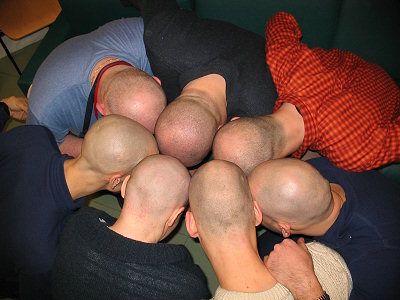
Paladin’s of Jebus Kristo will usually be seen wearing gleaming armor covered in a finely crafted cloth toga. They wield massive holy symbols to honor their God. These symbols are considered the equivalent of the Great Horn Minotaur’s Hammer (found in the Monster Manuel 4, 1d12+str and a half, 19-20×4 crit). Usually a Paladin that is high enough level will take the feats necessary to allow himself to wield the large-sized version and the feat that allows him to use double his strength modifier (2d8+x2 str 19-20×4 crit). Cleric’s of Jebus Kristo will be dressed in flowing robes, often with the tops of their heads shaved in odd fashion. These Cleric’s will devote themselves to the betterment of society. Helping those that they can and offering healing where possible, except in the instance of healing damage caused in the atonement of a sin. This is considered cheating the system, another sin which must be promptly paid for.

Cleric’s wield Double Thurible which are metal containers used to burn incense, swung from a length of chain. They are the exact equivelant of a spiked chain, and they are granted proficiency in such. Higher level Clerics will have magical Thurible with the unique ability to spin them rapidly, filling the room full of incense smoke the equivelant of a Fog spell, allowing them to make use of the Blind Fight feat and help even the odds in a fight with Fighters and other classes with high combat profficiency. Domain’s for these Cleric’s vary, a DM should make sure that the domain’s choosen by a PC make sense with the character’s mentality and purpose. In addition to the weapon proficiency, Cleric’s of Jebus Kristo are granted a +2 save against massive damage as their Domain ability. A good, dutiful Cleric of Jebus Kristo has been on the receiving end of a Jebus Stick fairly often.
Identity, the Super Villian – Steal this Enemy

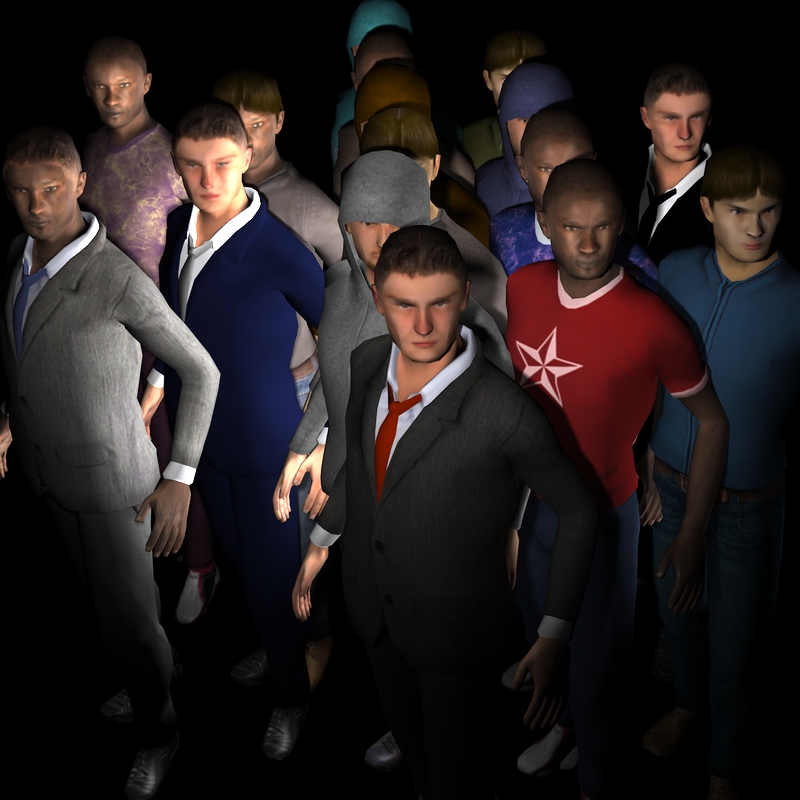
Redhawk gazed down at the rain-soaked crowd far below. “He could be anywhere,” he muttered under his breath. “Or everywhere.”

The entire crowd halted mid-step and turned their faces to him, the same expression of arrogant confidence marring their features.

“Team, weapon up,” he whispered into his comlink, “Identity has found me.”

At first, it was believed that a single man controlled the crime syndicate around Southside. In a way, that’s right – but it’s also far from the truth. One man, 2,500 bodies, and an infinite number of faces.

Identity is a single consciousness able to create bodies at will, each able to alter their appearance and operate in complete isolation of the rest. Where one gang leader gets caught, all too often another duplicate appears disguised as a cop to release him. How do you hold a person who can be in 2,500 different places at once?  Right.

Dirty little secret: Who (or what) is Identity? I ain’t tellin’ – but I know, and it’s a work of brilliance, even if I say so myself.

Notes: Morph is the ability to alter your character’s appearance. Duplication is the ability to…. well…. duplicate. Combine the two and you’ve got someone who can create multiple versions of himself that look different. That’s another example of trying to make something game-breaking in Mutants & Masterminds and you just end up with something insanely cool because the rules can take it. Oh yeah.

In this case, Identity can create up to 2,500 duplicates, each of which can alter their appearance (and clothes, thanks to the Quick Change feat) at will. They’re all in telepathic communication (Mental Link), and Horde means Identity can summon the whole cast as a Standard Action, should he wish. The Survival extra means our heroes will have to take out all of the duplicates to bring down Identity; there’s no single central controller. Yuck.

Loxar, the Spellscarred – Steal this Enemy

This is Loxar, the Spellscarred. Hailing from the Forgotten Realms, she was once a promising swordmage.  That is, until one of her missions took her to a spellplagued land. In an unfortunate accident, she gained the scar below her right eye.

At first, the scar seemed only cosmetic. But then she saw how it gave her new powers, manifesting themselves as consuming flames of blue fire. Soon after, the spellscar even erased the memories of her swordmage training. Thus, the life she once knew is all but gone.

The spellscarred are shunned by society, having forced Loxar to choose a new career. Many trade-caravans traveling from Sembia and the Thunderpeaks have come across Loxar in the western regions of Cormyr, having to offer up many of their wares to her and her bandits.

Submitted by Solo DM over at DND4E for One Player.

Elora, the Right Hand – Steal this Enemy

Elora, beaten down as a child and abused as a young woman, has since learned to fend for herself.  In truth, she has gotten revenge on almost everyone that has wronged her.  Even the duke tried to enslave her.  When two of his personal guards fell to her blade, the duke quickly realized his mistake, and then made amends with her by offering her a place among his personal guards.

Her station as a personal guard offers her many perks, and she’s keen on staying there until she loses interest.  She is afforded more leniency than the other guards, doesn’t have to work as much, and doesn’t have to wear any of their silly uniforms.  She’s quite aware of her effect on others, especially men, and is not above using that to her advantage.

Though she is loyal to the duke for now, she is ultimately self-serving.  She feels that she is above everyone, and will never submit to anything, unless it is on her terms.  Even then, she will never allow herself to lose face.


Darius Clawspawn, the Mutant – Steal this Enemy

4th Level Insectaur, of the Mutant Future
 
STR: 13 — INT: 8
DEX: 13 — WIL: 16
CON: 12 — CHA: 7
HPs: 43 — AC: 3
Mutations: venomous stinger, hard outer shell, echolocation, atrophied cerebellum

Darius Clawspawn is an outcast who has become a criminal in the Mutant Future. Born into a colony of scorpion Insectaurs, he felt his nest could easily overtake and enslave the puny humans and other mutants in his region. His colony, though, is a peaceful race, wanting nothing to do with his plans of conquest and domination. Darius has since left his colony and travelled the wastelands, attacking and destroying those he feels are weak and purposeless in the Mutant Future.

Darius has a misshapen, mutated torso of a human and the lower body of a scorpion. He has two large claws where his hands would be, giving him 3d6 of crushing damage when uses them to grasp an enemy. As an Insectaur, Darius has developed other mutations his species are known for. Taking after the pre-war species of scorpion, he has developed a hard outer shell which improves his AC to 3. He can attack with a large venomous stinger as well. When a PC is successfully hit, they will take 5d6 of poison damage unless a save vs. poison is made (half-damage). Darius’ INT score is low due to his atrophied cerebellum, so he can be easily out-thought. However, his level, DEX score , and echolocation mutation all give him a +4 to hit and +1 to damage, making him a formidable opponent in a fight.

Darius is a good local enemy to place into any Mutant Future campaign. He could easily be the leader of a bandit raider group that is terrorizing the local villagers. (Darius has recruited a local band of mants and cockroachoids to assist him in his goals). He may also be found ambushing trader caravans, or possibly trying to set himself up as a local warlord. Darius has grand plans of taking over the world, but his low INT and rash nature make that unlikely. Fortunately for him, his strength and natural weaponry make him quite dangerous when faced head-to-head.

Boresh, the Betrayer – Steal this Enemy

Boresh is an older bother to one of the player characters (in a family with three brothers), and son to a famous heroic father.  As the eldest son, it was thought that he would follow in his father’s footsteps, becoming a great fighter.  And indeed, he did grow to become strong.

However, as a young adult, he failed to protect his mother and their home while his father was away.  The intruders (supposedly enemies of his father) ransacked his home and had beaten his mother.  Boresh tried to fend them off, but fell to the invaders, sustaining horrid injuries.

Though he was never blamed for not be able to protect his mother and brothers (one of which is a player character), he none-the-less felt horrid guilt and incompetence.  He wanted nothing more than to be able to protect his family.

Soon, he was quietly approached by a vassal of a powerful entity, offering to grant him power in exchange for minor services.  At first, the services consisted of acquiring rare plants and herbs, and sacrifices of small animals (birds & rodents).  But as his “powers” were granted to him at an ever-slow pace, he asked the vassal for ways to increase it.  The vassal agreed to the request, and instructed Boresh to sacrifice his family dog.  After some contemplation, Boresh agreed.

The relationship between the vassal and Boresh continued like this for two years, culminating with Boresh sacrificing known criminals.  By this time, his Fighter skills had improved significantly, as well as gaining powerful Warlock powers (granted by the vassal).

Unfortunately, his youngest brother walked in on one of these sacrifices accidentally.  The two got into an argument, which led to a fight, and subsequently the accidental death of the brother.  Feeling ashamed, he wrote a note, claiming to be an old enemy of his father’s, and placed his brother’s body and the note in the town square in the middle of the night.  The note was written to signify hatred of Boresh’s father, signed by Lucis (a random name).

At this point, Boresh stopped associating with the vassal, and buried his warlock powers deep inside.  His father, coming out of retirement, vowed to track down this ‘Lucis’ and destroy him.  So he set off on a long journey as only a grieving father, yet famous hero, could.  After two months of traveling, word came back to Boresh and his town that his father had fallen in battle (presumably to Lucis).

Boresh then publicly announced that he would not go after his brother’s or his father’s killer, that he had a responsibility to his mother, his remaing brother (the PC) and his estate, which he now inherited.

At this point, he took on the role as head of the house.  Caring for his mother and teaching his younger brother how to be a man.  He was strong, and a good fighter, but every few months either his house or those of his neighbors would be attacked by barbaric orcs.  Boresh and his brother (the PC) fought well against these invaders, but eventually the threats became too great, so Boresh resumed contact with the vassal.

The vassal agreed to grant Boresh increased strength and speed, as long as he resumed and continued his service.  Unfortunately, the sacrifices needed for his power-gain were escalating, and he eventually succumbed to the madness of the dark lords.  Soon he was sacrificing the homeless, then farmers, and then young women.  His power had consumed him, and as a mockery to his sanity, he gained the ability to change shape into that of Lucis, becoming two people.  Part of the time he stayed at home as Boresh, and other times he ventured out as Lucis.

Through his Lucis persona, he has goals to achieve.  And yes, many people will perish as a result of his endeavors.

THE TWIST: The vassal is a succubus, employed by the likes of Mephistopheles (ruler of the 8th Plane of Hell).  Mephistopheles has plans for this Boresh, which he will slowly cultivate into fruition.  Everything that has happened to Boresh, his family, his father, and his town was instigated by the succubus.

Boresh must be presented as an NPC who makes appearances from time-to-time, often to help the players (mainly his brother).  He genuinely doesn’t want to hurt his brother or his friends, and is actually a likable guy, but as the party gets closer and closer to Lucis’s endeavor (whatever it is), he starts to become more agitated.

At first, as Lucis, he will not fight the players.  He will let his minions and soldiers do that.  Not until he becomes a level-appropriate enemy will he finally reach the end of his rope, facing off with the group (namely his brother).  When the players realize that Lucis is actually Boresh – well, that’s up to you.

Optional Twist: Have a second player use Boresh as as a Fighter-type in the group as his normal character (he will have to know everything about your plans for Lucis).  Make sure the fighter is made up using the normal rules, but otherwise let the player decide his powers (perhaps you could even give him small little bonuses or powers that may or may not be noticed by the other PCs).  At the end of your campaign, have the player character reveal that he is actually Lucis, and then he and the GM fight the other players.  Make sure that Lucis now has a nice elite or solo combination of fighter and warlock powers to throw at the group.