 The Cultists of Jebus Kristo are a home-brewed religion that I often make use of for playing in D&D 3.5. They are an odd bunch. A DM might use them as a traveling people, or as a specific sect within a town with a unique role to play in the campaign. Almost always though, they are used to break up the normal monotony of the DM’s world, due to their absurd and conflicting nature.
The summarized mentality of the Cultist’s of Jebus Kristo lies within the very basics of their religion. The idea being that “Jebus Kristo sailed across the Seven Seas to the Americas, where he promptly began Crucifying the natives for his sins.” A simple concept, yes, but one often misunderstood. The Lawful Neutral Cultists believe that Atonement for one’s sins is absolutely mandatory. However, the person who atones for the sin is up for negotiation. Followers of Jebus Kristo will always make sure their sinning is paid for at the earliest possible instance after the sin is committed. Most often, this means an innocent bystander (instead of the real sinner) will be dragged over by a few jovial and happy, smiling cultists who ask the innocent about their day and praise the glories of the weather, while simultaneously beating the individual with their Jebus Sticks (masterwork engraved club 1d6+str 20×2 crit).
One might interpret this violence as Evil in nature, and that is often a case of debate. However, the overall mentality of the Cultists of Jebus Kristo is very positive. They are the Ultimate Bible Camp. They devote themselves to the betterment of the societies around them, and attempt to help those in need whenever possible. The Cultists of Jebus Kristo do not promote sinning. Their sermons will often reflect the ideals of being good and pure. All good religions are flawed, as mistakes and sins will happen. The main difference between the Cultists and other religions is that the Cultists of Jebus Kristo make sure that each sin is paid for in full, regardless of the sin and regardless of who pays for it.
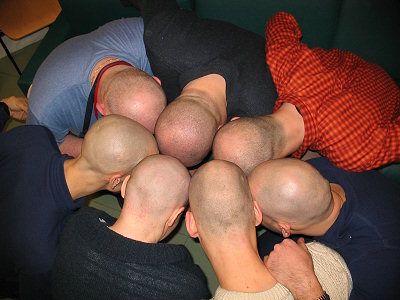
Paladin’s of Jebus Kristo will usually be seen wearing gleaming armor covered in a finely crafted cloth toga. They wield massive holy symbols to honor their God. These symbols are considered the equivalent of the Great Horn Minotaur’s Hammer (found in the Monster Manuel 4, 1d12+str and a half, 19-20×4 crit). Usually a Paladin that is high enough level will take the feats necessary to allow himself to wield the large-sized version and the feat that allows him to use double his strength modifier (2d8+x2 str 19-20×4 crit). Cleric’s of Jebus Kristo will be dressed in flowing robes, often with the tops of their heads shaved in odd fashion. These Cleric’s will devote themselves to the betterment of society. Helping those that they can and offering healing where possible, except in the instance of healing damage caused in the atonement of a sin. This is considered cheating the system, another sin which must be promptly paid for.
Cleric’s wield Double Thurible which are metal containers used to burn incense, swung from a length of chain. They are the exact equivelant of a spiked chain, and they are granted proficiency in such. Higher level Clerics will have magical Thurible with the unique ability to spin them rapidly, filling the room full of incense smoke the equivelant of a Fog spell, allowing them to make use of the Blind Fight feat and help even the odds in a fight with Fighters and other classes with high combat profficiency. Domain’s for these Cleric’s vary, a DM should make sure that the domain’s choosen by a PC make sense with the character’s mentality and purpose. In addition to the weapon proficiency, Cleric’s of Jebus Kristo are granted a +2 save against massive damage as their Domain ability. A good, dutiful Cleric of Jebus Kristo has been on the receiving end of a Jebus Stick fairly often.
