My secret weapon to getting that action movie feel

I like the hobby of RP gaming, partly because I get to hang out with friends, but mostly because I get to experience what it’s like to be in an action movie, fighting ‘real’ bad guys (and sometimes good guys). However…

In the beginning, my combat turn went something like this:

  1. I attack the orc.
  2. I rolled a 19. Does that hit?
  3. I rolled 12 damage.

Later, I moved on to games that added cool combat options and maneuvers – games that painted a more defined visual of what happens in the combat round. They added a tactical element to the game that was exciting and rewarding. But, I was looking for something a bit different, something that really helped tell the story in the combat round.
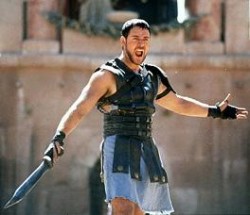
I love action movies, especially those movies with dynamic combat sequences (watch Equilibrium, Ultraviolet, Bloodsport, or Gladiator). I want my combat rounds to look like that. Well, after going through several different types of games, I’ve found that the game or system is not really going to deliver that (not to my satisfaction, anyway). So, why not create that experience on our own?

Two examples…

I was running a game in which orcs were fighting the PCs in cramped conditions. Everyone was adjacent to two or three others, and the fight was pretty hectic. One orc in particular tried to hit a PC three times, and failed each of those times. On his fourth attack, I opened up by saying, “The orc is freaking pissed off because he hasn’t been able to hit you, and you keep jabbing him for little bits of damage. He’s clearly enraged, howls an awfully angry growl, and swings at you with his axe – which you block. He then immediately follows up with an elbow across your face, busting your nose and spraying some blood on the cleric. You reel back, and the orc plants his foot into your chest, sending you back into the wall, to which you fall to one knee and drop your sword. As you look up, you see the blood-angry orc towering over you, overhanding his battle-axe downward toward your head with reckless force. Let’s see how well he attacks…”

That painted a fantastic picture, adding so much grit and realism to the combat. The player knew that regardless of what I said happened, nothing mechanical happened until I actually rolled to hit (and in fact, the orc missed for a fourth time). The player totally got into it at that point, getting angry over his busted nose and dropped sword. He said, “He missed? Ok, that’s because as his battle axe is coming down for my head, I grab his legs. He falls on his back and I end up on top of his chest. I swiftly pull out my dagger and go for the throat. I rolled a…”

Another cool visual, right? What really happened: The player simply made a normal attack using his sword, but his dynamic role-playing was so much better. Remember, nothing mechanical changes. Sure, I said that the PC dropped his sword, and the PC said he then pulled out his dagger. At no point would I allow anyone else access to his sword, unless the player wanted it that way. At any point the PC would be able to pick up his sword, even if he were a few squares away, because nothing mechanical has changed. And the orc, fallen on his back? He can get up without spending any actions, even free actions. He’s not even technically prone (unless I, as the GM, feel the player deserves this).

* * *

My Shadar-kai swordmage was able to teleport occasionally as a reaction. In combat, he liked to make charge attacks. So, whenever he did make a charge attack, I might say, “I disappear for a moment, then reappear suddenly right in front of his face. As the soldier flinches back from the surprise (giving me a +1 bonus to hit), I swing my two-handed sword up his chin with only one hand.”

Sometimes I would fluff it up by saying that I actually teleported above the target, hitting him on the way down. Of course, this is all simply a charge attack, which normally gives me a +1 bonus. The GM could veto my rendition of my PC’s attack, especially if he had something that could interrupt my charge, but that almost never happened. In the end, what matters is that we don’t skirt the system; simply follow the rules, but with your own fluff explanation. Also, I don’t do this with every action of every round of every character, but just enough to make the scene memorable, tense, and exciting.

* * *

I’ve been gaming for awhile now, and I think we (as gamers) will eventually either evolve, or simply change. Well, I’ve changed, and it’s definitely been for the better. I wanted to punch up my experience at the table, and one way I’ve done that is by transitioning into a dynamic roleplayer. I roleplay events and actions; not just my characters. And that is my secret weapon to getting that action movie feel.

Thanks for reading.

Favorite Site of the Month: August/2011

When I started reading gaming blogs a while back, I wasn’t really expecting much from them, and I thought there would be only a few of them. Boy was I wrong… on both counts! The Other Side blog was one of the first RPG blogs I visited, and I have to say that I got hooked. I can’t really explain it, but I keep finding myself heading over there to catch up on the latest that Tim Brannan has to post.

Here’s Tim:

The Other Side started as a way for me to share some of my game-related work, and hopefully improve my writing. I started the Other Side as a blog back in 2007, and then forgot about it. Eventually I remembered I had it and I began to start posting.

The blog became the reincarnation of my old website, also called the Other Side. I wrote a lot of gaming-related material, mostly horror-related and for Unisystem games by Eden Studios. Originally, I posted materials related to some of the games I had worked on: Buffy, WitchCraft RPG and Ghosts of Albion. As it progressed, I also got involved in the Old School movement, and began to expand into the OSR and Retro Clone games too, but keeping in the general theme I had established.

I also do a number of book, movie and game reviews. So on any given day I could post a new Unisystem quality, a character write-up, a new monster for Basic D&D or horror movie review. I also post a bit about the gaming community as a whole and my own point of view as a player and freelancer.

I do have a few special features I like to post. I do a lot of character write-ups of various supernatural characters, particularly witches. I have run an entire series of posts on Willow and Tara from Buffy the Vampire Slayer for about a dozen and half different game systems. I also run a weekly series called “Zananurday” where I post something about the DC Character Zatanna every Saturday.

Currently I am also using my blog to promote the Ghosts of Albion games I am running at Gen Con (ran at Gen Con), and a new book I am working for – the Basic versions of the OSR Retro-Clones, called “The Witch”.

I really enjoy the interactions I get from people replying to my posts, and seeing others talk about something I had posted on their own blogs. See you there!

Tim Brannan

The Other Side blog, check it out!

We’re back! (what REALLY happened)

Anyone can take out the lone zombie. It’s slow and stupid, and since they’re already dead, you should have no qualms about turning its head into a canoe. Just watch any of the various zombie-killing training videos (Zombies on Broadway, Shaun of the Dead, Zombieland, etc.) and you’ll see what I mean. The real problem is dealing with a zombie horde, and really, your best chance then is to just take off and nuke the site from orbit – it’s the only way to be sure.

But, for those of us without spaceships and tactical nukes, we have to rely on fortifying our position and picking those zombies off one by one until they’re all dead, again. Well, that’s what happened with Stuffer Shack. We got invaded by a zombie horde, and had to hunker down until we could get a handle on it.

And here’s the kicker: I’m responsible for it all. I tried to upgrade the Shack by re-purposing a lone zombie, but he ended up being more than I could handle (it turns out you can’t train an old zombie). Anyway, he ate through part of our site trying to get to our brains, and then created a horde for help (strength in numbers). It’s been a frustratingly long battle, but eventually we prevailed (discipline is key, rule #47).

All the zombies are dead, again, and now our focus is on rebuilding. However, it’s actually a blessing because we get to build the site back up even better than it was before.

– The Shack will have a more professional appearance and function.
– All of our articles will be more easily attainable, as you can swiftly browse by topic or writer.
– Also, readers will now have the ability to start their own column or portfolio here – for free!

The blog is now back up. Articles might not be that pretty, and various options might not yet be available, but I’ll be rebuilding on a daily basis. So stick around, because the new Stuffer Shack will definitely be worth the wait.

Thanks for reading.

Take a Break Sunday: Not your average superheroes!

A new(ish) show from the UK. I’m actually surprised that I’m enjoying it!

It’s Sunday, which means it’s time to take a break and relax!… (and watch a video).

I think I’m like most guys when I say that I like the superhero genre.  Always have, always will.  So (of course) when I saw a semi-new TV show about superheroes called “Misfits,” I started salivating.  No, not Misfits of Science from 1985 (with Courtney Cox), but a modern show from the UK.

By the way, Misfits of Science ran for only one season across four years: 1985, 1986, and 1988, and it only had 16 episodes.  I still thought it was cool.

Anyway, Misfits is a modern take on what might happen to a bunch of punks who happen upon supernatural powers.  It’s a non-kid-friendly comedy / drama from the UK, so you can expect fun accents, foul language, crude humor, breasts, and sex.  Oh, there’s also a bit of super powers in there, too.  So, it’s practically the perfect show!

Misfits is a hard-edged show that has won the BAFTA Television Award for Best Drama Series.  It focuses more on the punks in the story, as opposed to fancy super powers.  So you could say that it’s a a bit more low-key than, say, “Heroes,” but quite a bit edgier.  To be honest, I expected a failed modern take on Misfits of Science, and was instead pleasantly incorrect.   You might initially think that Misfits isn’t your kind of show (as I did), but I stuck through two or three episodes and became a fan.  So, check it out.

If the video doesn’t appear after a few seconds, click me.

Take a Break Sunday – Time to Revisit TRON GIRL

By Tourq Stevens
– Come on… It’s TRON GIRL. Need I say more?

It’s Take a Break Sunday, that day of the week when you try to just sit back and chill out.

The other day I was surfing the web and got to the end.  I figured, “Ah heck, might as well go back to the beginning and start all over again.” So I did, and that’s when I came across Tron Girl for the second time.  That’s also when I remembered that I need to start watching The Key of Awesome more.  The first video is the actual music video for Tron Girl, and the second video is a “making of, and behind the scenes” kind of thing.

And “behind the nerds”…

Favorite Site of the Month: July/2011

There are a lot of things that I look for in deciding which RPG blogs to follow, and of those things, solid and useful content would be the most important.  Well, Leonine Roar has that in spades.  Kilsek has a good grasp of 4th edition D&D, but many of his posts could apply to any game, making it all the more useful.

Here are a few words from Kilsek…

Thanks so much selecting my site, that’s awesome!  I’ve found a couple of cool blogs through this feature of yours, so I have to say – this feels pretty damn good.  Here’s a short bit about me and Leonine Roar:

I love D&D and I love to write – I always have, since grade school.  Choose Your Own Adventure Books and the King Arthur story in middle school were just the start of my inspiration for both.

Was lucky enough to win a few creative writing contests along the way, which I always entered because they, well, always got me excited.  I’ve been a D&D player since the original Red Box.  It was Choose Your Own Adventure meets theater with friends.  So unique, and simply awesome.

I fired up Leonine Roar because of my love for the game and for creative writing.  With years of primarily DMing and some playing experience (more so now in 4e, hooray!) since Basic, and a great love for games, RPGs, and the fantasy genre in general, I’ve always enjoyed talking about both the design and storytelling aspects of D&D.  Having studied both psychology and instructional design, perhaps that’s a piece of why it feels so natural for me to think and write about both?

I strongly believe that unique balance of story and game is critical to a classic and engaging D&D experience, and that’s what the articles on Leonine Roar try to bring to the table: I want to help fellow gamers amp up their D&D game, players and DMs alike.

Thank you again so much for selecting Leonine Roar for Stuffer Shack’s Site of the Month, Tourq.  You were one of the earliest sites checking me out, and I very much appreciate you for that.  There are a few common themes and styles between Leonine Roar and Stuffer Shack, and I’m quite proud of that connection.  Keep up the great work, Tourq!

Kilsek (Tony)

No sir, you keep up the great work.

Leonine Roar – in my subscription list.

Managing Party Tension: Sometimes More is Better

By Tourq Stevens
– Improving the game – Know the difference between player tension and party tension, and which one is allowed…

A while back, Charisma posted about Players vs. Players, and how that generally isn’t a good idea.  Her article got some good comments, and several gamers mentioned how it can be good for a bit of tension in the group.  For the most part, I agree, but there needs to be a clear distinction between party tension and player tension.

The basic idea is for a group of gamers to get together to enjoy a game.  Since the game is a community effort, our enjoyment isn’t simply dependent on the game being good.  To have a truly fun experience, we need to have a good game and have that game with people we enjoy sitting at the table with.  Ergo, not getting along with the other players can ruin even the absolute best of games.

Lots of things can contribute to players not getting along at the table.  This can sometimes include player characters not getting along.  I think for this reason many gamers shy away from inter-group conflict, or simply “party tension.”  These PCs may choose to ignore or allow certain behaviors in other PCs, many times in direct contradiction with their own beliefs (the good paladin deciding to “scout the perimeter” so as to not see his friends torture the enemy for info, comes to mind).

Sure, maybe the good paladin’s player likes to play this way.  That’s awesome, but that’s not the situation I’m talking about.  I’m talking about the good paladin who has vowed to NOT allow the use of torture, and then the player looking the other way to avoid conflict among the characters, because he feels it would create conflict among the players.  In essence, the player is “settling” for lesser game and character immersion, when they would rather play the character that they’ve envisioned to his or her fullest.

That was me for a long time.  I settled plenty of times to avoid character conflict, thus avoiding party tension, and thus avoiding player conflict, because I thought that it would be better for the game that way.  I mean, party tension leads to player conflict, which leads to anger, which leads to the dark… you get what I mean? I didn’t play the characters honestly, but that was ok, because I was making sure we were getting along at the table.  Well no more!

Please indulge me for two examples…

Because of how I’ve played my current character, and because of certain factors affecting Samuel Van Der Wall’s character, a little rift has grown between our two heroes.  This culminated into my character challenging his character’s devotion, to which Sam pretty much shot straight back at me.  For a moment, we were borderline yelling at each other.  I honestly felt anger, and I was sure I could feel the same from Sam.

It was weird for me because in all my gaming with Sam, this is the closest our character’s have come to fighting.  It felt like I was really yelling at Sam, and for a moment I felt like Sam I and weren’t getting along.  However, just as fast as that anger started, it ended, because I realized we had very distinct idiosyncrasies for our characters, and we were in-character the whole time.  I immediately realized how much fun I was having.

That moment in our game is what I’m going to remember vividly for a while, instead of many other encounters, NPCs, and monsters.  It was simply eye-opening that I could have that much fun with a little player character tension in the game.  The conflict only made for a much better memory of the game, because I find myself getting more and more enjoyment from the role-playing aspect of gaming.

What I’m getting at is that, for a moment, our characters weren’t getting along, but we managed to continue the game knowing that.  What didn’t happen is that our characters didn’t start throwing insults, they didn’t take actions to hinder or oppose each other, and they certainly didn’t come to blows.  Warhammer Fantasy utilizes a “Party Tension Meter,” and our meter went sky-high.  It was awesome, not because the conflict created penalties for us, but because it made the story of our campaign that much better.

And a completely flip-flop example…

A few months ago, we were all playing Deathwatch. There were seven of us, including me, John Lewis, and John’s son, Ian (father + son gaming, FTW BTW).  John was playing a marine that used magic – magic that if used irresponsibly, could endanger the group.   My character didn’t like the fact that John’s character was part of our team, and Ian’s character downright despised it.  This created some tension in the party, but it was fun.

Well, after John repeatedly abused his power over magic, he accidentally summoned a dangerously huge freaking chaos demon, which almost resulted in a TPK.  As the fight was winding down, I was seriously considering killing John’s character, when out of nowhere, Ian’s character unloaded his machine gun into John’s character’s back, splitting him in two.  Best kill e-v-e-r.  The fact that it was John’s son who killed his character, made it all the better.

At first you may call me a hypocrite, but I’m not, really.  In both instances, the only actions taken, whether they resulted in PC vs. PC combat or not, happened in-character.  Sure, you could say

  • that acting in-character is no excuse for pick-pocketing your fellow adventurer,
  • that acting in-character is no excuse for plotting against the party,
  • or that acting in-character is no excuse for attacking another PC.

You could say all of those things (and they might be true), but not if everyone knows the expectations of the game and the characters in it.  John knew what he was getting into when he (1) chose that character, and (2) continued to act recklessly with two PCs already not liking him.   He knew what he was getting into, and he loved every minute of it.  To be honest, we all did.

My character and Sam’s character may one day come to blows.  It might happen, and one of us might end up killing the other.  That will most likely not happen, though, because our characters have similar goals, and a general desire to work together.  Only if our conflict progresses because it seems to improve the campaign’s story will a battle like that ever happen.  Ultimately, that would be up to Sam and me, and only if it seemed like it would be the most fun.

* * *

The real problem happens when players take in-character conflicts personally.  A lot of times this happens when a player feels his character is getting mistreated by the other player characters.  I think this manifests most often when one PC makes demands of another – trying to take control away from another player.  This could happen by way of the Intimidate skill, lying to the character, withholding information, hiding money or treasure, or even physical restraint of a PC.  These aren’t inherently bad things, as they could make for some great role-playing, but it can just as easily create problems at the table…

Many players are not interested in taking part in this type of character interaction.  A group of players may either recognize this and adjust, or not.  Sometimes the reasons behind these aggressive in-character actions are for the sake of role-playing, and sometimes those reasons are due to immaturity, selfishness, greed, and/or a need for dominance.  It doesn’t take much to see that a player isn’t very receptive to certain kinds of character conflict, and isn’t interested in developing that story.   If that’s the case, then players need to back off, because (at that point) party tension and character conflict are only going to cause player conflict, making the game worse.

Of course, player conflict can happen when certain players simply don’t get along, don’t appreciate each others’ play styles, manipulate the group against a certain player, or even simply belittle or insult each other.  This most certainly makes it’s way from the table to the game.  And sure, some instances of player conflict are more extreme than others, but at some point you just have to ask, “Is this something we can fix, or do I need to change groups?”

* * *

To wrap this up, there is a huge difference between party tension and player tension, but there is often only a thin line separating the two.  Player tension is a huge beast that isn’t really the focus of this article.  Party tension, on the other hand, can be a great tool to enhance your role-playing, your story, and your game.  All it takes is a little maturity, and a desire to share a cooperative, fun experience.  Add a little party tension to your game, and you just might end up shooting your dad in the back – and it’s all in the name of fun.

Image from Manarama

Take a Break Sunday: Chuck Norris vs. Bruce Wayne

Superheroes, warriors, athletes, and monsters battle for a century.  My favorite part of this epic war involves Chuck Norris crushing Bruce Wayne’s head.  Of course, we can’t expect anything less.  I mean, Chuck Norris won the Professional Middleweight Karate champion title six years in a row before retiring from full contact tournaments.  With a 183–10–2 record, you know he’s the only man alive that can kick you in the back of the face.

Please enjoy a century of epic battle, condensed to three and a half minutes.

Role-Playing by the Numbers: The Easy Way

There are hundreds, if not thousands of role-playing games out there – maybe even tens of thousands.  They all look and act differently, but at their core they are all about gamers sitting around a table, taking on the roles of larger-than-life characters.  Dice and character statistics are involved to mitigate actions fairly, while the act of role-playing is largely left ungoverned.  When I say ungoverned, I’m referring to the game system’s rules – individual gaming groups (and GMs in particular) often step in to referee the act of role-playing, based on personal preferences.

In this article, I’m going to suggest a way to role-play your character, based on his inherent abilities, stats, or attributes.  If you refer to the article’s title, it says “The Easy Way.”  Nowhere today will I say what is the best, or the correct way, only what I feel to be the easiest.

I’ve been gaming for two decades, and I’ve run the gamut of play-styles from fast and loose to strict and straight.  In some games, the GM (myself included) has said that players need to play their characters according to their stat ratings, while others have said that it doesn’t matter what the numbers are – just play how you play.

You know what I’m talking about: the character with a low Intelligence or Charisma (perhaps a dump stat), played by a gamer who portrays them with exceptional Intelligence or Charisma.

“That’s a great plan, but according to your sheet, your character is dumber than stupid.”

“That’s a smooth way to convince the duke to help you, but your Charisma stat says otherwise.”

I know you’ve come across this, because I’ve seen it over and over again.  Well, I gotta say that I’ve grown pretty tired of it.  After talking with a buddy the other day, I’ve decided that from now on I’m going to handle “playing by the numbers” the easy way.

There are rules in place to show how well your character swings his sword, scales the wall, or pilots his ship.  You simply roll the dice, add your modifiers, and your numerical result determines your level of success.  Well, what about trying to convince the duke to help your cause?  Roll the dice, add your modifiers, and your numerical result determines your level of success.

Now, since this is a role-paying game, you’re going to need to actually speak (otherwise, you’re not playing a role).  Where it gets muddy is in your oration – how much and how well you actually role-play it out can (in some groups) modify your roll.  Oftentimes, a player is penalized (via house-rule) for not putting much effort into his oration, even if he has built his character to be the grandmaster bard.  Other times, the player gains a bonus to Persuasion or Diplomacy if he spits out some great soliloquy, even if he’s playing the social moronic barbarian.

When your bulky, super-strong warrior bashes through a door, all that is required is a stat roll.  By that token, the same simple process should be required to solve a puzzle, or intimidate a group of NPCs.  But it isn’t.  This is a role-playing game, and most of us want to see at least some effort of role-playing when it comes to our mental stats.  The problem is that everyone has different views on how the role-playing aspect of the game should be played.

Your version of “below average Intelligence” may be different from mine, and you simply may wish to portray that differently than I.  I may not wish to portray that at all.  Intelligence can be described many ways.  I may have sky-high SAT scores, but in actuality, be dumber than a stone.  There are simply too many character characteristics and player opinions to dictate how a stat should be played.

And that is why this part of the game is not covered in the rules.  It simply can’t be governed universally from player to player, group to group.

“So, how do you solve the puzzle so everyone is happy?”

Well, first of all, if this is not causing any kind of problem in your group, and isn’t a puzzle, then it doesn’t need to be solved.  Take the rest of this article as a flavor tool to spice up your character, and that’s it.  If this does need to be addressed in your game, then take the following idea to heart.

Some players like to role-play their stats religiously (to a scale that they feel is appropriate), while others don’t care what the number is – they’re going to play how they’re going to play, and the numbers are simply there to modify die rolls.  Neither way is right or wrong; it’s just preference.

So, here’s a compromise.  Players, pick one or more of the following aspects for your character for any mental stat that you feel is below average.  It’s completely up to you to decide on how many, as well as what stat they fall under.  Instead of playing a not-so-smart character “like an idiot,” or an uncharismatic character “like a social dipstick,” apply one or more of the following:

  1. The character has trouble with memory.  The player never writes down any game notes, so the character is forced to work off of his player’s memory.
  2. The character has trouble with math.
  3. The character has trouble with reading.
  4. The character has a twitch in his eye, one that the player shows at the table, often.
  5. The character simply dresses like he’s definitely not a local, perhaps even from another continent.
  6. The character spits in the face of authority at the slightest provocation.
  7. The character has a weak spot for beautiful women (or men!).
  8. The character is very gullible.
  9. The character sees conflict in only black and white.
  10. The character is too stubborn for his own good.
  11. The character has an irrational fear of something common.
  12. The character simply does not think in terms of strategy.  Simple and direct is the way to go.
  13. The character is rude and crass.  Good manners are beyond him (or it’s simply easier to not care).
  14. The character periodically has conversations with his invisible friend.
  15. The character is a bit snobbish, especially around “common folk.”
  16. The character is well-balanced – he has a chip on both shoulders.

I like using quirks and traits (like those above) because they’re a good compromise in how I role-play my character’s mental stats.  Also, as an added bonus, they add to my character’s character in fun and creative ways.

Wrapping it up…

If a player has the most fun role-playing his stats one way, and another player has the most fun role-playing  his stats the complete opposite way, who am I to say either is right or wrong?  For me, the stat + modifiers + die roll determines the outcome.  Let the player add whatever roleplaying correlation that he’s comfortable with.

If a player character has a low Intelligence, I don’t cry foul when his player comes up with a great idea or solution in-game – if it’s a good idea that should work, then it works.  But, for something that requires a die roll, I simply let the stats and dice figure out the results.  His low Intelligence modifier will affect what it needs to, which is the die roll.  Role-playing can certainly affect any given situation, but it’s the final number that settles any unresolved issues.

I have completely obliterated one part of gaming that has been stressful, because I no longer feel it is my job to police how others play their characters.  Understand that everyone gets enjoyment out of the game in different ways, which is why the rules really never try to govern role-playing.

What other ways can you suggest that gamers might portray their attributes?

Warhammer Fantasy Initiative – Why it Sucks Awesome

I’ve been playing a new game recently, and I’m loving it. In this article, I’m going to talk about why you might consider tweaking one little part of your game for the better…

I’ve been playing a new game recently, and I’m loving it.  It has several little (and not so little) differences that make me appreciate diversity in gaming rules.  In this article, I’m going to talk about why you might consider tweaking one little part of your game for the better…

Almost all table-top role playing games utilize the function of “Initiative” to dictate the order in which characters (players and non) take their actions.  If you’re familiar with RPGs, then I’m sure I don’t need to explain the general concept any further.  However, where it gets interesting is in the various ways this function is implemented among the different games.

Some gamers like a more realistic feel of Initiative for their combat rounds, while others prefer an easier-to-manage method, foregoing realism for ease-of-play.  Very few gamers won’t play a game because of its Initiative mechanic (a bad Initiative design is not that much of a fun killer), while most others accept the mechanic as is, or will create house-rules to change the method to their liking.

Too often when house-rules are implemented, a ripple effect begins – change one thing, it affects another, change that thing to compensate, it affects two other things, and so on.  In my opinion, Initiative is one of those parts of the system that can be tweaked without game-breaking repercussions.   I know, I know… I’m breaking my creedo of “never again making house-rules,” but in this case, tweaking Initiative rarely has game-breaking consequences.

Enter Warhammer Fantasy

This isn’t necessarily an article to get you to play Warhammer Fantasy, but a vehicle to show you a great concept that can be applied to the game that you’re already playing.

If you’ve never played Warhammer Fantasy, you should.  It’s quite a game, and definitely set apart from other fantasy RPGs.  It has several innovative or revamped ideas – ideas that help make your table time more interesting, fun, and challenging.  One of those novelties is its implementation of Initiative:

  1. Everyone rolls for Initiative (players and NPCs).  NPC ‘groups’ are counted as a single unit.
  2. If the GM and the players end up with tied scores, the players go first.
  3. Initiative results for your side of the conflict apply to all characters on that side.  This means that if the PCs got scores of 4, 2, and 1, it is up to the players to decide who goes on Initiative counts 4, 2, and 1, regardless of who actually rolled those scores.
  4. Even if a character drops out of the fight, the Initiative scores remain.
  5. Initiative scores can change as the fight goes on, depending on certain combat factors.  Otherwise, the numbers stay the same from round to round.

Rule #3 is what I want to talk about, so stay with me…

In general, Warhammer Fantasy utilizes a “Party Concept” for the player characters.  It is assumed that the PCs work together for their common benefit, and have come to know each others’ strengths and weaknesses.

The concept and benefit of the group working together is seen throughout the game in several ways, including Initiative (rule #3, above).  The PCs are a cohesive group of characters that have to work together in order to survive.  The players get to choose, as a group, who goes on which Initiative count in any given round.  This reinforces the concept of team tactics, because it helps the players think tactically.  This naturally helps the players act as a team, because they’re working together to decide what’s best for the group.

Perhaps, in the fight, your character went last in the last round, and he ends up in an advantageous position – if only he could go before his partners in the next round.  In most games, you can only do this by making your partners delay their actions.  In Warhammer Fantasy, that is not the case.  Once you roll Initiative and get a score, that score belongs to the party; not you.

Most of the time, everyone can see that it makes sense for the Priest of Sigmar to go first, so he can charge out front to block for the archer.  Other times we can easily see that the archer needs to go first, because it makes sense that ranged attacks are faster.   It all depends on the given situation, the characters, the terrain, the enemies, and even how you are currently role playing your character.

Sure, if your character rolled a high score, he might actually end up going last – that’s for you and your group to decide.  What’s important is that you look past your character’s needs, and consider what is best for your group.

“That sounds cool, but how do you handle two players who want to go on the same Initiative count?”

Inevitably, this is going to happen, perhaps in some groups more than others.  All I can say is that my gaming group has been playing Warhammer Fantasy for three months, and it has never come up.   Have faith, though, because that problem ends up being its own solution!

The game (as a whole) embraces the Party Concept.  The characters are encouraged to work together in a variety of ways, and that includes the players by default.  My group has never once fought over who goes when in a fight.  Sometimes it makes sense that someone in particular goes at a certain time, sometimes it doesn’t matter.  What’s important is that we all work together to figure that out.  In deciding (as a group) who goes on which count, communication is automatically fostering cooperation, making the game that much more enjoyable.

Putting it into your game…

Ok, I realize that Warhammer Fantasy isn’t your typical RPG (action cards, stance meter, party tension, refresh tokens, original dice, etc.), but at its core it still showcases a great concept – the concept of a group of player characters coming together to accomplish similar goals, all without killing each other.  The game really encourages working as a team, and (sneakily) uses the Initiative mechanic to help make that happen.  So, there’s no reason that this can’t be house-ruled into most other RPGs!

As I stated before, I don’t normally advocate house-rules (not anymore), but Initiative is usually one of those aspects of a game that can take the abuse without serious repercussions.  Most games have an Initiative method, and most times that method is not entirely dependent on the overall system mechanic, so a little tweak shouldn’t harm your game.

I say to all of you reading this, tweak your Initiative rules for a few sessions to allow for a house-ruled Party Initiative, especially if you have a group of players that don’t always see eye-to-eye.  Sure, in some instances this might give the players a mechanical edge that they otherwise wouldn’t get, but it adds a strategic flavor to the game that is fun to explore, and individual players (who don’t always work well with others) just may start to work as a team.

And that is why Warhammer Fantasy Initiative sucks awesome.