The History of Star Wars RPGs Part 2: Star Wars d20

This is the second in a three part series on the history of Star Wars tabletop RPGs. In each post, I’ll be exploring each of the major Star Wars RPGs and discuss how they worked and how they affected both the roleplaying game industry and the Star Wars universe…

This is the second in a three part series on the history of Star Wars tabletop RPGs. In each post, I’ll be exploring each of the major Star Wars RPGs and discuss how they worked and how they affected both the roleplaying game industry and the Star Wars universe.

Star Wars

In the last article, we talked about West End Games’ Star Wars: The Roleplaying Game, a.k.a. Star Wars d6. After thirteen years of publishing, West End Games went bankrupt and had to give up the license to create Star Wars RPGs just as it was being revitalized with the prequel trilogy. Wizards of the Coast had just purchased Dungeons & Dragons and bought the license to Pokémon (resulting in a wildly successful trading card game) and parent company Hasbro already had the license to produce Star Wars toys. Purchasing the license to make a Star Wars tabletop roleplaying game was a natural next step.

System Mechanics

Sometimes people nickname the Star Wars Roleplaying Game “D&D…in Space!” (not to be confused with the actual D&D…in Space!) because it uses essentially the same rules system as Dungeons & Dragons 3e. Characters have the standard six ability scores, a class, a few feats, and a bunch of skills. Most every roll is done with a d20 and naturally this incarnation is often referred to as Star Was d20.

The major change from Dungeons & Dragons in the first two editions was that characters have “Vitality” and “Wounds”. Vitality works exactly like Hit Points in D&D. They are easily recoverable and represent the characters’ ability to shrug off superficial harm (or more abstractly, their ability to dodge lethal blasts). Wounds are equal to the characters’ Constitution score and represent severe injuries (like getting mauled by a Wampa) that require extensive treatment to heal. The later Saga Edition simplified this by reverting to Hit Points.

It is worth noting that Star Wars d20 was largely a testing ground for new mechanics to be included in Dungeons & Dragons. This was especially true with the Star Wars Saga Edition which introduced many new elements that were later introduced in Dungeons & Dragons 4e. For instance, the long list of skills were reduced to a little over a dozen. Skill points were eliminated in favor of marking a skill as “Trained” for a +5 bonus and every skill could be used untrained, except for the Use the Force skill which required the Force Sensitive feat. Saving throws are replaced by static defenses for Reflex, Fortitude, and Will. Later supplements added more test features, such as Threats of the Galaxy adding the Skill Challenge system that later became an integral part of 4e.

Force Powers and Jedi

While the Jedi in Star Wars d6 were designed to reflect Luke Skywalker’s limited abilities, Jedi in Star Wars d20 were based on the more powerful Jedi found in the New Jedi Order books and the prequel trilogy. As such, they were a bit more showy, especially in terms of combat powers.

Force powers were granted based on the characters’ wisdom modifier and functioned more or less like a D&D wizard’s spells. However, the idea of memorizing spells doesn’t make sense in Star Wars, so the limiting factor for the first two editions was that it took out some of your Vitality. The idea was that Vitality represented abstract things like energy, focus, and resolve, not necessarily your ability to take damage, but since we don’t really see movie Jedi get exhausted from using Force powers, it’s kind of an odd mechanic. Saga Edition changed it so that each power could only be used once until there was a short rest of one minute, but powers could be purchased multiple times to allow for multiple uses in combat. In a sense, this mechanic is the precursor to “Encounter” powers in D&D 4e.

Dark Side Points are awarded for evil acts. If you have a number equal to or greater than your Wisdom score, you’ve fallen to the Dark Side and typically become an NPC villain under the GM’s control (although as in Star Wars d6, there is the possibility of redemption). In the first two versions, calling on the Dark Side of the Force while spending a Force Point (i.e. using the Force out of anger) grants you an extra die to a bonus roll (“the quick and easy path to power”) while at higher levels calling on the Light Side of the Force while spending a Force Point (i.e. using the Force in a compassionate or humane way) grants you an extra die to a bonus roll. While earning Dark Side Points for committing evil acts were retained in Saga Edition, “calling on the Dark Side” was not.

Publication History

Picking up the Star Wars RPG during the time of the prequel trilogy was a double-edged sword. On one hand, Star Wars received a resurgence in popularity which no doubt spurred on sales and brought new gamers in. On the other hand, not everyone liked the prequel trilogy meaning that they had to also produce supplements to appeal to fans of other parts of the Star Wars universe. Plus a rapidly changing canon meant that there were some things that were sensible at the time, but made little sense later on. The early depictions of Senator Palpatine and his history, for instance, don’t exactly match up with later revelations of his character.

The Original Edition had sourcebooks for Naboo and Tatooine—both of which were featured in The Phantom Menace—and for the two major eras at the time: the Original Trilogy era that most people are most familiar with and the New Jedi Order era where the novels being published at the time were set (Lucasfilm vetoed any novels set pre-Return of the Jedi until the Clone Wars multimedia project commenced following Attack of the Clones). They also released several broad concept sourcebooks covering aliens, starships, and the Dark Side.

The Revised Edition came out just after Episodes II was released and I suspect that with the Clone Wars causing sweeping changes to the canon, Wizards was reluctant to write era-based sourcebooks that might become totally wrong in a year or two. Almost all of the books released for this edition are splat books providing things like force powers and gear. The only setting-based sourcebooks that were released were Coruscant and the Core Worlds and Geonosis and the Outer Rim Worlds, both of which were more stable canon-wise.

The Saga Edition came out after the Prequel Trilogy was complete and Wizards’ main focus was on era sourcebooks (called “Campaign Guides”). This time, they included not only the Rebellion era, but also the Clone Wars era, The Force Unleashed era, the Knights of the Old Republic era, and my personal favorite, the Legacy era (detailing the amazing Legacy comic line, not the mediocre Legacy of the Force novels, thank you very much). This is one of the greatest strengths of the Star Wars d20 line in that it gave you the tools to play in whatever era of Star Wars you wanted to, rather than confining you to the Rebellion era.

Interspersed amongst these is a book each for starships and droids and several designed to provide splat for one of of the five core classes while still providing resources useful to everyone else (although there isn’t much for anybody else from the Jedi Academy Training Manual except some New Jedi Order setting info).

In 2007, Wizards of the Coast sent out a press release saying that they had decided to drop the license for creating a Star Wars RPG. Most of the RPG sites at the time speculated that it was a monetary decision. After all, the license was no doubt expensive and there wasn’t anything new on the horizon except for the Star Wars: The Clone Wars TV series. For a long time the license went unclaimed until rumors arose that another company had picked it up, which was eventually revealed to be Fantasy Flight Games.

Impact on the Expanded Universe

The major impact of Star Wars d20 was that it was the first to fill in gaps in Star Wars canon that were left by the Prequel trilogy. For instance, it was the first source of further information about planets like Geonosis and Kamino which were introduced in the Attack of the Clones. It also filled in the gaps for several other maturing eras, such as the The Knights of the Old Republic era, merging the successful video games of the same name with the earlier Tales of the Jedi comic line upon which the games were based.

Several adventures were also set during the gaps of other Expanded Universe content, such as an Old Republic adventure where the players assault Revan’s starship during the battle that the Sith Lord was first captured (although naturally they are forced to let Bastila Shan actually confront him). The related Star Wars Miniatures Game similarly revisited events such as Kyle Katarn stealing the original Death Star plans from the Imperial base on Danuta.

Some original content was created as well. The very last book, The Unknown Regions, is notable in that it expanded on several alien races that were from obscure sources, including the old Marvel comic series. (There’s an interesting article about the development of these alien species).

Availability and Gaming Legacy

Getting a copy of the Star Wars d20 core books can be a bit tricky. As of this writing, Amazon has one copy of the Original edition and it’s going for $50. Fortunately, the Revised Edition is more reasonably priced at $12. Demand for the Saga Edition, since it was the last version, puts it at $48.

The general consensus I gather about Star Wars d20 is that the Saga Edition is considered the best version, as it streamlined the system from its Dungeons & Dragons in order to better capture the feel of the setting and it had some of the best supplements. However, I still see a game of d20 Revised every once in a while at a convention, so there is still a following for that, I imagine because of the system similarity to Dungeons & Dragons 3.x and Pathfinder.

Some gamers argue that Saga Edition is what Dungeons & Dragons 4e should have been because it introduced many well-received changes, such as a simpler skill system, without creating radically different concepts, like combat powers. Indeed, several of the changes from D&D 4e that continue on in D&D Next originally appeared in Saga Edition.

I think that because Star Wars d20 was derived from Dungeons & Dragons, it works best if you’re looking for a combat heavy Star Wars game where you’re fighting Storm Troopers or Battle Droid or whatnot. If you can get a copy for a good price and that’s the sort of Star Wars game you want to play, it’s certainly worth picking up either the Revised Edition or the Saga Edition.

Next time: Our history of Star Wars RPGs concludes as we talk about Fantasy Flight Games taking a different approach to the Star Wars RPG license by splitting it into multiple games, which are occasionally referred to collectively as Star Wars FFG.
The History of Star Wars RPGs Part 1: Star Wars d6

This is the first in a three part series on the history of Star Wars tabletop RPGs. In each post, I’ll be exploring each of the major Star Wars RPGs and discuss how they worked and how they affected both the roleplaying game industry and the Star Wars universe…

This is the first in a three part series on the history of Star Wars tabletop RPGs. In each post, I’ll be exploring each of the major Star Wars RPGs and discuss how they worked and how they affected both the roleplaying game industry and the Star Wars universe.

Star Wars

Return of the Jedi came out in 1983, presenting a spectacular ending to the Star Wars saga. However, Lucasfilm had a hard time keeping the momentum going afterwards. The video game crash of 1983 meant that nobody was brave enough to create video games, and Lucasfilm put a moratorium on writing novels in the Star Wars universe. On the small screen, Star Wars hoped to capitalize on their appeal to kids by making two live action movies and a cartoon series featuring Ewoks and a cartoon series about C-3P0 and R2-D2. None of these had much of a commercial success and Star Wars was beginning to fall into the realm of Flash Gordon and other sci-fi series: full of fond memories, but with nothing new on the horizon.

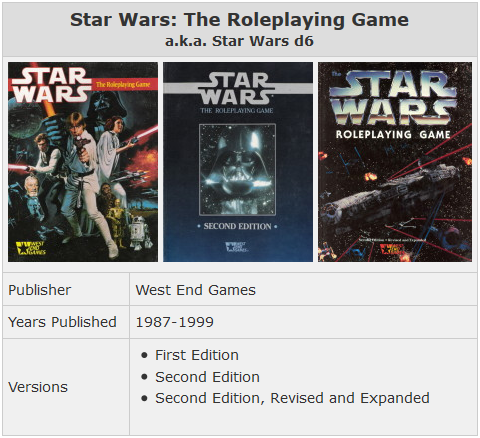
Enter a little roleplaying game company called West End Games. They had early success with Paranoia, a dystopian sci-fi RPG with a healthy dose of black comedy, and had decided to create a Ghostbusters RPG using a very simple d6-based system. It was well-received and West End Games decided to create another RPG based on a sci-fi movie series. In 1987, they purchased the rights to create Star Wars games and released Star Wars: The Roleplaying Game.

System Mechanics

Star Wars: The Roleplaying Game exclusively uses d6s, and so it is often referred to simply as Star Wars d6. The basic mechanic can be summed up in a single sentence: Describe what you want to do, pick a skill, roll a number of d6s, and try to reach or exceed a target number determined by the gamemaster (typically ranging from a 5 for something an average trained person could do, like recall what planets Rodians are from, to a nigh-impossible 30 or more for situations like blowing up the Death Star).

Along with “simple”, the other word that continuously comes up when you hear people describe this system is “cinematic.” Character skills (e.g Blaster Weapons) are improvements on their base attributes (e.g. Dexterity), so characters are generally competent in just about everything. For instance, a character’s Dexterity might be 3d6, meaning that their Acrobatics, Blaster Weapons, Dodge, and Sleight of Hand are at least a 3d6. Multiple actions can be taken per round, with a penalty to each subsequent roll. Target numbers are set by the GM depending on the situation, rather than being in a table, meaning that players are encouraged to think outside of the box and not just stand and say “I blast them”.

Characters were usually created using “templates”; partially-built characters filling typical Star Wars archetypes, such as Rebel Pilot, Failed Jedi, Minor Noble, or Wookiee. However, rules also existed to create your own character from scratch, allowing for total customization.

From time to time, the GM may award Character Points for good roleplaying, being a hero, or otherwise creating an enjoyable game (a concept expanded from Paranoia‘s Perversity Points and Ghostbuster‘s Brownie Points). These could then be spent to add dice when you need to succeed. Star Wars d6 also introduced Force Points, which double your die pool of d6s for those times that you really needed it. These are awarded much more rarely, generally for making a heroic sacrifice.

In addition to being rules-light, the books were full of fun bits that made them enjoyable to read and encouraged an atmosphere of fun. They also had excellent advice on gamemastering:

The core rulebook won the Origins Award for Best Roleplaying Rules of 1987 for its simple and innovative rule-system that captured the feel of the Star Wars universe.

Throughout the history of the Star Wars d6, the mechanics remained relatively the same. The biggest change came with Second Edition with the addition of the Wild Die. In every roll, one die was special. If it rolled a 6, it exploded and you got to roll it again. This made any task theoretically achievable. If it rolled a 1, there was some complication. The GM had several options to resolve the complication, such as removing both the Wild Die and the highest other die, or creating a “critical failure.” The latter was intended to be used sparingly, although some GMs definitely had a habit of abusing it. In general though, the Wild Die did help improve the cinematic nature of the game by letting rolls be open-ended and allowing for the chance to have things go wrong every once in a while.

Force Powers and Jedi

Jedi in Star Wars d6 are designed to reflect Luke Skywalker’s journey (which In 1987 was all they had to go on). They had a fairly small subset of things they could do, such as mind trick, force jump, and telekinesis. And most importantly, Jedi in training must have a mentor in order to learn the ways of the Force. They started out untrained and with little to no experience, but overtime may become more powerful. Essentially, they’re designed to be linear smugglers and quadratic Jedi, which depending on your view of Star Wars, may be alright.

If a character wanted to become force-sensitive, all they had to do was check a box. There was no immediate benefit to this, but it did provide access to three new skills: Control, Sense, and Alter. Force-sensitive characters could purchase force powers a la carte, each of which could be activated by one or more of a combination of these skills. This made Jedi fairly flexible and due to the Target Number system, it was possible to due all sorts of interesting stunts with only a good description. The downside to this system was that powers that required combinations of skills required multiple die rolls, which could be tedious (for instance, doing a Mind Trick required separate Control, Sense, and Alter rolls against the target).

To balance Jedi, force powers and skills were more expensive to obtain than normal skills, meaning that at least initially, non-force-sensitive characters often outclassed novice force users. Furthermore, a teacher (akin to Obi Wan or Yoda) must be found before the skills can be improved, which in the Rebellion era was a very difficult thing to do. How effective these limiting measures were depended on the GM.

Force-sensitive characters also were in danger of falling to the Dark Side. If they committed an evil act, or used their force-powers out of anger or other malice, they would get a Dark Side Point. Every time you earned one, you rolled a d6. If the number was equal to or less than the number of Dark Side Points you earned, your character had fallen to the Dark Side. This generally meant that the character had become an NPC villain under the GM’s control, although there was a bit about potentially playing a character attempting to redeem themselves.

Publication History

Creating a licensed Star Wars RPG was a fairly risky move. Return of the Jedi had come out four years earlier and a lot of the excitement for it had left. Today, you might compare it to creating an RPG for Avatar. Sure it was immensely popular at the time, but the movie was created four years ago and there has been little to continue that excitement. The creators obviously loved Star Wars enough to make it, but the question remained: would the public buy it?

The answer was a resounding yes! Star Wars: The Roleplaying Game was a resounding success and it continued to be successful in its 12 year run and three editions.

Not including adventures, Star Wars d6 books generally fall into one of three categories: sourcebooks expanding on aspects from the movies, sourcebooks summarizing info in books, comics, or other Star Wars media, and original creations expanding the Star Wars universe.

Books from the first category, including the very first book, The Star Wars Sourcebook (later reprinted as Galaxy Guide 1: A New Hope), expanded many aspects of Star Wars that have become fundamental to the Expanded Universe. For instance, the species of each denizen in the classic Catina Scene in A New Hope were identified as Rodians, Devaronians, Ithorians, and other aliens that until that point had been nameless. Similar books focused on a certain aspect of the universe, such as the Imperial Sourcebook and Creatures of the Galaxy. A twelve-part Galaxy Guide series for the Second Edition exemplifies this, having sourcebooks for each movie, locations such as Yavin, Bespin, and Mos Eisley, and miscellaneous subjects such as ships, aliens, and bounty hunters. There was some overlap between books, which helped proliferate some of these ideas.

Other sourcebooks were created for supplemental Star Wars material, such as the Thrawn Trilogy of novels, the Tales of the Jedi comics, and the Shadows of the Empire multimedia project. Data was compiled just as the movie sourcebooks were, but there was less original material in these books, since print media allowed for authors to identify new aspects themselves.

Finally, some books were completely original additions to the Star Wars universe. Cracken’s Rebel Operatives was a book that introduced a number of original Rebel field agents who might be a contact for a campaign. Of particular note is the Tapani Sector books, detailing an entire sector of the Galaxy Far, Far, Away. This was designed to be a somewhat isolated area that campaigns could take place in without fear of running into continuity issues with the larger Star Wars metaplot (although it has yet to be mentioned in any other Expanded Universe work).

Ironically, the end of the Star Wars RPG came about because West End Games started making more licensed RPGs like Star Wars, including Indiana Jones, Tales of the Crypt, Hercules & Xena, Men in Black, and DC Universe. The same gamble they took with Star Wars never paid off with other licenses and none received anywhere near the success. In the end, West End Games filed for bankruptcy and lost the rights to create Star Wars games the year before The Phantom Menace came out.

It did live on in 2003 when West End Games, under new management, released D6 Space Opera, later called D6 Space, which was essentially Star Wars d6 without the Star Wars trappings. Designed to be a more generic sci-fi RPG, some areas were revised, such as ship creation, and additional subsystems were added, such as advantages, disadvantages, and a cybernetics. This version was released for free after West End Games filed for bankruptcy a second time.

Impact on the Expanded Universe

The modern Expanded Universe began when Lucasfilm lifted the moratorium on Star Wars novels and Timothy Zahn wrote Heir to the Empire, the first of what has been called The Thrawn Trilogy. In the introduction to The Thrawn Trilogy Sourcebook, Timothy Zahn writes about how the roleplaying game affected his novels:

In early July, I got a box from West End Games. It seems that Lucasfilm had decided I ought to coordinate with their Star Wars role-playing game background stuff. Stuff which, not being a gamer, I’d never heard of… And you know what? The stuff was pretty darn good.

Many of the alien races, planets, ships, and minor characters that Zahn wrote about in his books, and which are now commonplace in the Expanded Universe, are a direct result of Star Wars d6. Essentially, this is the foundation upon which was built the Expanded Universe we know today.

Even now, almost fifteen years after it was no longer published, the Star Wars d6 still impacts new material in the Expanded Universe. For instance, the 2007 book Jedi vs. Sith: The Essential Guide to the Force provides an in-universe look at the Force. How do they classify Force powers? By dividing them into Control, Sense, and Alter, the three skills that Star Wars d6 uses for force powers!

Availability and Gaming Legacy

It’s pretty easy to find a copy of the first and second editions of Star Wars d6 on Amazon for $15 or less, but the Second Edition, Revised and Expanded runs for a bit more at $30-40. West End Games’ spiritual successor D6 Space is now a free PDF, which, speaking from personal experience, is not difficult to mix with the Star Wars-specific elements from Star Wars d6.

A sizable number of gamers strongly believe that Star Wars d6 is still the best of the three Star Wars RPGs due to its simplicity and wealth of information. A living Star Wars d6 campaign called Sparks still runs to this day at monthly conventions in the midwest. There’s even some folks who have diligently created conversions of the Star Wars d20 books to allow for them to be played with Star Wars d6!

The fact remains that it is one of the most played out-of-print RPGs, attesting to its quality and appeal to Star Wars gamers. It’s a great RPG and one that is still worth playing today.

Next time: Our history of Star Wars RPGs continues as we talk about Wizards of the Coast picking up the Star Wars license and releasing what fans have come to call Star Wars d20.