
Cheating Behavior and Prevention: Drive Out the Snakes From Your Game

The Id DM examines the “snake-like” behavior of players that cheat in roleplaying games, and provides suggestions for preventing cheating at the table.

“I rolled… umm…”

Since there are other great articles detailing snake-like characters or monsters to inhabit or terrorize your campaign, I figured it would be interesting to discuss a different type of behavior that may slither about your table – cheating. When you are busy running a game there are a great many things to monitor, and it is entirely possible that your players may on occasion be tempted to cheat in some way to get an advantage. They may lie about a die roll or conceptualize and execute their stats and abilities in “creative” ways to deceive you. Hopefully, cheating behavior is non-existent at your table or perhaps only happens when players feel they are in dire straits and need to cut some corners. Below, I talk about the motivations for cheating and some methods you can use to minimize the likelihood that it will appear at your table.

Acknowledge Cheating

Understand that cheating is a possibility at your table. Do not assume that just because you are playing with (a) adults, (b) friends or (c) family that cheating will not occur. Numerous studies have demonstrated more than 50% (sometimes as much as 80%) of college students self-report cheating, although there is certainly variation by situational and personal variables.  Collective cheating, which is lying in the name of the collective good, occurs commonly in the adult world. These lies can range in severity, and the situational factors at the gaming table can influence their presence.

For example, a five-player group of players is in the midst of a battle with several monsters. The group has dealt with a combination of poor rolls and questionable tactics that has led them to the brink of serious consequences, including possible player character death. One player, Jack, utilizes an important resource or power and all players at the table realize a good roll can change the tide of battle. In this situation, not only the player rolling the die, but all players are invested in the roll of the die. Perhaps Jack rolls a 10 on a d20, which is an average roll and gives him approximately a 50% chance of hitting. Jack may increase the result and call out “12” instead to give him a better chance of success. The players to Jack’s right or left, Tom and Jill may allow the lying to pass since their fates are also tied to the outcome. This is just one example of how collective cheating can play out at the table.

The gaming environment, which can result in player death or other negative consequences, provides pressures to cheat, rewards cheating, and may only institute a small risk for adverse outcomes for cheating. In the example above, imagine you viewed Jack’s die roll of 10 and are well aware that he is lying by saying 12. How would you react? What are the consequences for cheating at your table? You could penalize Jack by enforcing penalties to future rolls or some other type of in-game mechanic to discourage cheating. However, if you ignore the cheating or just give out a friendly warning, it may not be enough of a deterrent to prevent future cheating. Finally, even with clearly-outlined consequences for cheating, impulsive cheating, which refer to the tendency to act without considering the logical consequences of one’s cheating actions, can also appear at your table.

Purposeful Planning

If the first step is to acknowledge that cheating can occur, then the second step is to plan to prevent cheating from affecting your game. There are a variety of factors you and your game may contribute to cheating behavior. Simple matters such as seating arrangement can have a big impact on whether or not a player cheats. If the most competitive and impulsive player is the furthest from you at the table, then perhaps change the seating order to keep that player closer to your location. If you are concerned about players fudging die rolls, then encourage players to roll out in the open for all to see. There can be no question on a roll if you are able to view the player’s actions. It can also be helpful to model this behavior by rolling in the open so players know you are also not cheating them.

There are differing opinions about whether the Game Master should roll out in the open or not, but rolling in the open is one method to reduce the likelihood of your players cheating in your game. Rolling in the open will increase your level of credibility at the table. Your credibility is defined by your players’ perceptions of your competence, trustworthiness and caring. It is likely that players who perceive you as being highly credible will be less likely to engage in cheating behaviors. But the opposite is also true, if your ability to run a game is questioned by your group, then cheating is more likely. Think about your style in terms of how you organize the game. Are you late to sessions? Do you cancel sessions often or at the last minute? Do you get distracted and involved in side conversations that take away from the flow of the game? Do you not pay attention to your players when they are acting in the game?

If you answered “yes” to any of these questions, then you may be conveying a level of disrespect to your players. As a result, they may not view your level of credibility as high, and may be more likely to cheat in your game. Be mindful of how you are treating your players; if you are heavy-handed or unfair, then your players may respond by cheating.

It is also helpful to know the traits, abilities and characteristics of the player characters in the game, but this can be incredibly difficult in some game systems. For example, Dungeons & Dragons 4th Edition offers players the option of 40 races, 64 classes, 3,066 feats, 7,791 powers, 9,014 items, 547 Paragon Paths and 107 Epic Destinies. I’m not a math wizard, but I believe a 30th Level character could be any one of over a quintillion combinations.  I once joked that my players could create various powers or abilities on the fly at my table because there are so many options available and I do not have the time to ensure all of them are legal.

The good news is that you will likely play with less than 10 players, so keeping track of each character’s information is less daunting. If your game system has character sheets, request a copy of them so you can be familiar with the player’s options in and out of combat. This does not mean you should always second guess your players, but it can help you run a smoother game and it is likely to speed up play as you will have less need to check applicable rules for characters’ powers. In closing, if you are familiar with each character’s strengths and weaknesses, then you will have a better indication if any shenanigans are attempted by your players!

Summary

  • Acknowledge that players – even adults, including close family and long-time friends – may attempt to cut corners and cheat during a roleplaying game. Various situational factors can lead to collective and impulsive cheating. Be aware that it can take place at your table.
  • Actively plan to prevent cheating at your table. First, set a positive example for your players by not cheating yourself. Do not skew the results to allow yourself to get “one last cool attack” with your monster if it should already be dead. One possible solution is to make all rolls at the table in the open, including your rolls as the Game Master.
  • Second, respect your players and their time. If you are scheduling the games, be prepared to start on time. Arriving late and showing up for the session unprepared communicates to players that you may not care about the group or take the game seriously. Take steps to increase your credibility with the group of players.
  • Third, be knowledgeable of the abilities of the player characters in the game. There is no need to memorize all of the statistics for each player character at your table, but a general understanding of each character will likely speed up the action, limit potential rule discussions and prevent cheating.
  • Finally, speak openly to your group if you are worried that cheating could be taking place in your game. Ensure that all players are aware of the consequences of cheating, which can range from something light-hearted (“Your treachery has angered the gods, and you suffer -1 to all future rolls for the rest of the night”) to something more serious (“Cheating will result in a warning with the second occurrence resulting in being asked to leave the gaming group”).
  • Remind everyone that you are playing a game to have fun. If an ultra-competitive vibe develops in the group, ask yourself how you are contributing to that environment. Work to ensure that players are primarily concerned about hanging out and enjoying a good time; not solely on “winning” the game.
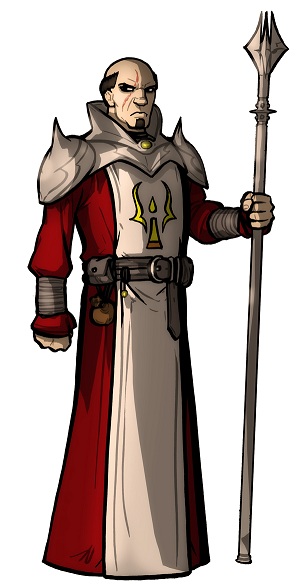
Brother Laurence of the Chizoba Sect – Steal this Major NPC (download)

Please welcome The Id DM, and his first submission at the Shack.
Download the PDF: Brother Laurence of the Chizoba Sect

History

Long before being known as Brother Laurence, the man currently a pillar of the community, he was known by his birth name, Kayin Erslad. Kayin’s mother, Dina, stayed at home most of her life caring for her five children. Kayin’s father, Laurence, was a quiet man who performed what labor he could to provide for his growing family. Kayin’s childhood was uneventful and quite normal in a small farming community. He was provided basic education and started to work in the surrounding fields as a teenager.

Around this time, a plague ravaged the countryside. The unknown source of the plague left the people of the region defenseless, and the majority of Kayin’s town was felled by illness. Kayin’s mother was the first of his family to be taken by the plague. He watched his father care for her broken body in the days leading up to her death. In the following months Kayin’s siblings departed the mortal world one-by-one. Finally, his father was struck with sickness and it was clear Kayin would soon be alone in the world.

Kayin was sitting by his father’s side during the moment of his death. Before passing on, Laurence spoke to Kayin in a weak voice, “Son, leave this place and never look back. Remember us, but you were spared for a reason. The gods must have wondrous things in store for you.” The deaths of family left Kayin a teenage orphan; not knowing what to do or where to go, he drifted throughout the kingdom surviving. Inheriting great strength from his father, he earned a meager income by performing odd jobs and challenging manual labor over the span of several years into young adulthood. He roamed the kingdom lost for approximately 15 years. It is rumored that he engaged in unsavory mercenary activities, but no proof of those actions remains on record. He does not freely speak of this time in his life, and only his first mentor knows these facts from his past.

During a cold and rainy evening, Kayin sought shelter in a local temple. Penniless, fatigued, sick and severely malnourished, Kayin’s spirits were never lower; he passed out in a pew inside the temple and was found the next morning by Abbott Ciro. Kayin was administered care and provided with hot meals throughout the next week as he was nursed back to health. Kayin was disoriented in those first days, but Abbott Ciro spoke with him when he was finally coherent.

“Son, you’ve been through so much. The gods have guided you to us. They must have wondrous things in store for you.” Even in his stupor, the words dropped like an anvil inside Kayin’s heart. They were the same words his father spoke to him the night he died. Tears rolled down Kayin’s face as he wept, lamenting the loss of his family and his directionless life. Abbott Ciro provided a listening ear, “You want a different life. We can help you find one. I offer this opportunity to you, which you can refuse without punishment.” Kayin was ready to start the next chapter of his life, and accepted Ciro’s offer to be educated at the temple.

Kayin took his father’s name, Laurence, and immersed himself in his studies. He excelled in his training to become a Cleric. His strength and compassion forged by his personal tragedy made him a natural warrior-healer. Abbott Ciro honed Laurence’s skill and guided him through his personal anguish. Laurence completed his training and became a member of the famed Chizoba Sect, a religious-military order that provides spiritual guidance, law enforcement and protection in the kingdom.

Laurence relished the opportunity to perform good works across the kingdom. He quickly made a name for himself in a variety of skirmishes. But it was not until the Battle of Fayden Hill where he found greatness. A powerful necromancer, Vilmer the Dark, terrorized the area with a growing horde of undead creatures. The Chizoba Sect responded to the crisis and sought out Vilmer’s lair. The order dispatched on the mission was quickly overrun by the sheer number of undead creatures, but Brother Laurence charged through the masses of undead warriors and delivered a killing blow to Vilmer the Dark. As Vilmer fell, so did his warriors, but Laurence bears a massive scar down the right side of his face from the conflict.

After the Battle of Fayden Hill, Laurence was honored in the Chizoba Sect and granted the title of Brother, which he hold proudly to this day. Over the years, he has elevated his status within the organization and is the leader of the Chizoba Sect in the seaside town of Poormina, a bustling community in constant need of both spiritual guidance and law enforcement.

Current Lifestyle

Brother Laurence resides in the seaside town of Poormina, and can routinely be found attending to patrons in the Temple of Dawn, a place of worship. He continues to serve the Chizoba Sect as a mentor to young members and other adventurers. He pledges allegiance to the gods and works to shine their light throughout the town of Poormina and the greater kingdom on a daily basis.

He no longer participates in military missions for the Chizoba Sect, having retired from active service years ago.  He lives in a modest room in the back of the Temple of Dawn. He has a rich history of relationships with a wide variety of characters in town, including more unsavory elements. Many of these relationships were built up during his days as a battle cleric and enforcing the kingdom’s policies in the growing town of Poormina.

He travels to the capital city once or twice each year for an audience with the leader of the Chizoba Sect for the kingdom, High Priest Adamar. Brother Laurence often has to defend Adamar and the policies of the Chizoba as they have been called into question in recent years. Many in the kingdom see the religious-military organization as unnecessary and their tactics imposing. Growing resentful of the Chizoba Sect is making the daily operations in the Temple of Dawn more difficult for Brother Laurence. His kindness and devotion to the residents of Poormina have spared him from any ugly incidents, which have been reported elsewhere in the kingdom against members of the Chizoba Sect.

Appearance

Brother Laurence is a 6’1” Human male. He remains well-built and athletic even for his age of 58. He is mostly bald and typically found in his red, yellow and white Chizoba Sect robes. His most prominent feature is the scar that runs down the right side of his face. The scar starts above his eye and slashes down the side of his face. The scar gives Brother Laurence a grizzled look, and his hawkish eyes can instill a sense of power if he is irritated and glares in someone’s direction. However, the grizzled exterior is usually softened by his gentle disposition and patient personality. His voice drips with the experience of a man that has seen many a dark day and lived to talk about it.

Personality

Brother Laurence is primarily focused on caring for the citizens of Poormina and the patrons in the Temple of Dawn. He continues to educate new members of the Chizoba Sect and mentor them along their own quests. His patience and openness can at times be his undoing, as he gives everyone – even the most unworthy – an opportunity or two to fail him. However, his compassion and empathy have gained him a countless number of allies inside Poormina and across the kingdom. Some of his most trusted allies are those that would be considered criminals by most people; there are rogues and other scoundrels that will drop their current activities in a second to respond to Brother Laurence’s call for assistance.

His loyalty and understanding makes his criticism sharp and powerful. Brother Laurence rarely raises his voice, but his tone takes on such a serious edge of disappointment when he is displeased that it cuts deeper than any outburst of yelling could match. He ignores many of the political issues that surround his position within the Chizoba Sect, dealing with High Priest Adamar only when required. He is personally conflicted about the role of the Chizoba Sect in government, but keeps these thoughts to himself as he does not wish to clutter the minds of the patrons in the Temple of Dawn or his young students. He believes that he owes his life to Abbott Ciro and the Chizoba Sect, and he will protect the institution even though he has private misgivings.

Application to Campaign World

Brother Laurence and the Chizoba Sect can be applied in multiple ways to a campaign setting. First, Brother Laurence can function as a hub for a wide variety of missions for the player characters. His veteran status of previous conflicts means he holds valuable knowledge of enemies and dangerous territories in the kingdom. When starting a new campaign, Brother Laurence can serve as the primary mentor for one or more player characters in the campaign world if they have a religious or divine background. He could also serve as an interesting mentor to a player character such a thief or rogue by trying to teach the character to change his or her way; or use that player character’s skills for a greater good. If the party develops a fondness for Brother Laurence, then he could later be placed in some danger where the party needs to act to in order to rescue him.

Second, the Chizoba Sect could be used as a constant backdrop in a campaign world. The political ramifications of a religious-military organization having such a close audience with the leader of the kingdom can unfold in many interesting directions for player characters to work through during a campaign. The Chizoba Sect is a highly structured and organized religious order spread throughout the kingdom. Each town features numerous Chizoba meeting halls and churches with extensive rituals and doctrine. Crimes are not only seen as a violation of law but also a violation of the gods, and punishments are swift and severe. The moral authority wielded by the Chizoba permeates all corners of the kingdom and assists to retain order as the population explodes.

For example, one possible thread through the campaign is increasing dissent toward the Chizoba Sect:

A cultural revolution is threatening to shatter the power of the Chizoba Sect in the kingdom. Every day, more people question the methods of the order while the growth of science and innovation has changed beliefs that were previously considered dogma. Whispers have filled the air most recently regarding the Chizoba’s response to this challenge. Leaders in art, science and other disciplines have departed the kingdom. Whether they are fleeing persecution or being silenced by an arm of the Chizoba is unknown. Members of the Chizoba have become fragmented themselves between those that hold fast to the traditional doctrine and those that are more willing to accommodate the changing times.

Final Notes

The art for Brother Laurence was a commission completed by Grant Gould, a licensed artist for Lucasfilm, Topps and other companies. I informed him of the character’s background and said, “Basically, can you give me a more badass version of Pete Postlethwaite from Romeo + Juliet?” He delivered in spades, and completely captured the look for Brother Laurence.

Last, please visit my site, The Id DM, and read the article about how to use NPCs to build the campaign world for players for more thoughts on how to utilize characters (like Brother Laurence) to bring life and flavor to your campaign.

Download the PDF: Brother Laurence of the Chizoba Sect