It wasn’t too surprising that, by the time Third Edition D&D rolled around, morale had been left by the wayside. And that’s a shame…
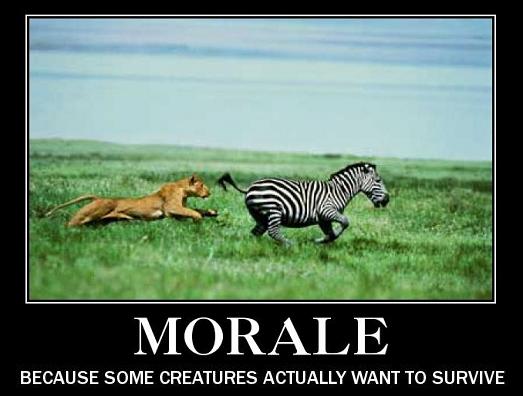
It has long since become popular sentiment that, in role-playing games, the story trumps the rules. That is, it’s more important to put together a compelling and interesting narrative than it is to slavishly adhere to the mechanics of the game system; to put it another way, it’s more important to have fun than to make sure you’re doing it “right.”
What’s interesting, however, is to see just how far this particular philosophy has taken hold of D&D through its various editions. There are multiple mechanics, in older editions, which determined the actions of an NPC – remember the old “% Lair” listing for monsters? – that have been discarded in newer iterations of the rules. Nowadays, a monster is in their lair if that’s where the GM wants them to be, or if it’s where the pre-published adventure has written them as being, not because of a die roll.
One of the big offenders in this regard is morale. For those who don’t remember, in older editions of the game monsters and NPCs in a fight would, when certain things happened, need to make a “morale check” to see if their courage failed them. If the check failed, they’d quit the fight and try to flee, otherwise they’d hang on in hopes of turning things around. PCs, of course, never needed to check morale; their actions were dictated solely by the players.
It’s fairly easy to see why this mechanic was discarded as the game reinvented itself. The idea that NPCs would make a life-or-death decision – and perhaps more relevantly, a decision that would affect the flow of a combat encounter – essentially randomly was quite unpalatable to a lot of narrative-minded GMs. Moreover, since morale was easily ignored it quickly became superfluous, something that could be overlooked entirely without the game suffering at all for it. Given that, it wasn’t too surprising that, by the time Third Edition rolled around, morale had been left by the wayside.
That’s a shame, since Third Edition’s mantra of “options, not restrictions” seems to lend itself to the idea of keeping morale on as a sub-system that can be used by those GMs that want it, and ignored by those that don’t. As such, we’ll design one here that GMs can use.
Before doing so, it’s worth noting again in the most explicit terms possible that the morale rules – unlike most, if not all, other kinds of rules – are applied by GM fiat. They are only used in a situation if the GM wants to use them, and the results are suggestions and guidelines rather than imperatives. Because this entire process is invisible to the players, and because it only affects NPCs and monsters, GMs should feel free to modify their rolls and results at will; doing so is not fudging so much as it is making a necessary ad hoc adjustment to make the system better fit a particular scenario in the game.
For 3.5/Pathfinder, we’re going to say that a morale check is a Will save, rather than coming up with a new type of check. This makes sense since Will saves are already used for related checks, such as resisting fear effects, and is simpler than creating a new value or check.
The next thing to do is break morale down into two parts: instances that would require a check, and measure how high the DC would be. In this case, we can simply create a list of events that would plausibly shake a creature’s will to keep fighting, and assign a DC value based on how severe that event seems. For example, the first time a creature is wounded in combat, it may find its courage failing…but that seems like something that would only cause the seriously cowardly to quit a fight, so we’ll assign that a DC of 5. On the other hand, bring brought below half of their hit points would be a much bigger check, since the character would now be seriously injured, to the point where death seems like a distinct possibility. As such, we’ll say that calls for a DC 20 check.
The following is a list of possible events that could cause a morale check, and how severe that check could be. Of course, GMs should feel free to tailor this list and adjust the DCs as they see fit, both in general and for a given situation (alongside the more general caveat that morale need not be used at all if the GM finds it inappropriate to do so):
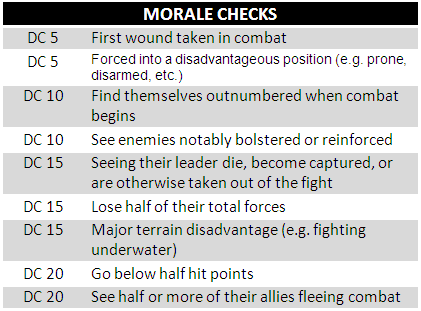
It should be noted that failing a morale check doesn’t mean that the creature immediately flees combat, though that’s a distinct possibility. Rather, a failed morale check is indicative of the creature no longer having the will to keep fighting, and taking action based on that. This may result in it quitting the battlefield, surrendering, attempting to negotiate, or otherwise trying to no longer engage in armed conflict.
One oddity that can come up when a morale check is failed is that it can make calculating XP awkward. The situation here is usually some variant of the following – the PCs battle the monster for several rounds, taking and dealing some not-insignificant damage. At some point, the monster fails a morale check and runs away, concluding the combat. Since the PCs did fight it for several rounds, and the GM isn’t sure if they’ll meet it again, XP is awarded. Later on, they do meet the creature again, and this time battle it to the death…do they get XP for fighting the same creature a second time?
There are arguments to be made either way, but I’m of the opinion that the best way to make this particular decision is by considering the following question: Would you (the GM) consider the monster to have been fought over a single combat encounter that perhaps had a brief interruption? Or would you call it two separate encounters? In the latter case, presumably enough time had passed that the consequences of the first encounter (e.g. hit points lost, spells expended, etc.) had been largely ameliorated. Naturally, if you’d say that the fight was one encounter with only a brief hiatus, then the PCs should only earn XP once. Otherwise, they deserve to gain experience for each fight separately.
Ultimately, the GM is the final arbiter of what an NPC does in combat; players should never be able to try and metagame a situation to force a morale check. With that said, hopefully these rules should give enterprising GMs a handy guideline for determining the morale of the enemies their PCs face.
 All profits from our involvement with Tabletop Day go directly to the “Are you my mummy” Vijay Copay Fundraiser.




 This week an awesome Stuffer Shack reader asked about our Camel Exotic Mount, so I decided to offer them for free when customers place an order. If you purchase any physical product(s) from