Aligning Expectations for D&D

Alignment has always been the sticky wicket of Dungeons & Dragons. It presents an objective set of labels to govern the inherently subjective nature of ethical and moral conduct. It’s adjudication – and even the value of its presence in the game – has long been debated, and will continue to be so long as it remains part of the game…

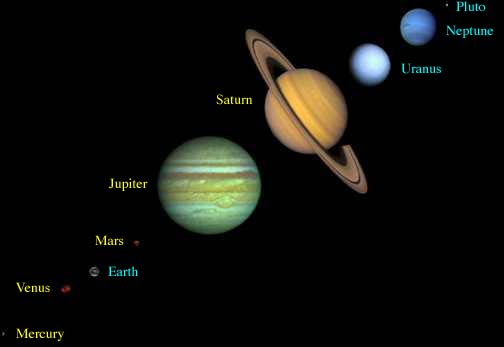
Alignment. It’s not just for planets anymore.

Alignment has always been the sticky wicket of Dungeons & Dragons. It presents an objective set of labels to govern the inherently subjective nature of ethical and moral conduct. It’s adjudication – and even the value of its presence in the game – has long been debated, and will continue to be so long as it remains part of the game.

But rather than discussing how alignment is depicted in D&D, we’re going to do something a little different: we’re going to determine the alignment of D&D itself.

The presentation of Dungeons & Dragons has varied wildly across almost forty years and half-a-dozen iterations. While these changes can be viewed in many contexts – from the role of the Dungeon Master to the random-versus-planned nature of character creation – we’re going to use alignment as a shorthand for evaluating the nature of the game’s rules, presentation, and the style of play that it (seemingly) lends itself towards.

Of course, in this regard the “moral” axis of the traditional D&D alignment grid – good, neutral, and evil – is of no help. Hence, we’re going to limit ourselves to the ethical alignments: lawful, neutral, and chaotic. There’s also a general disclaimer that needs to be made, in that these judgments are purely based on the game rules themselves, and aren’t meant to be a critique of what sort of games can be played with them. It’s entirely possible to have a freewheeling, off-the-cuff game using a “lawful” set of rules; that’s just not (how we think) the rules are presented.

So without further ado, let’s look at the alignments of D&D over the game’s lifespan!

Chaotic: OD&D and BD&D

Original D&D was the first incarnation of the game, published in 1974. It received almost a half-dozen support products before the Basic D&D game came along and replaced it. Basic was initially published in 1977, and was meant to be an introduction to OD&D, but very quickly established its own identity.

Both games can justifiably be called Chaotic in alignment. The rules in OD&D, and the early incarnations of BD&D, are notable for their abstruse nature. A large number of game-play elements are left untouched by the rules altogether, ostensibly due to their implicit assumptions that the GM will simply be able to wing it. You won’t find multiclassing or monsters-as-characters rules here, for example, and things such as underwater adventuring or domain-level play are given only superficial treatment, if they’re covered at all.

To be fair, Basic did try somewhat to round out the areas it covered as it continued to expand and evolve throughout the Basic, Expert, Companion, Master, and Immortals boxed sets (known collectively as BECMI), but the comparatively simplistic nature of the rules remained the same. The mechanics didn’t try to cover everything, and were comfortable letting the Dungeon Master and the players work out any undefined areas on their own. As Jeff Goldblum would say, “that’s chaos theory.”

Neutral: AD&D First and Second Edition

Advanced Dungeons & Dragons debuted in 1979 (the Monster Manual came out in 1977, and the Player’s Handbook in 1978; it was only with the publication of the Dungeon Master’s Guide in 1979 that the game was complete as we think of it today), and was updated to a Second Edition in 1989. These were the Neutral years of the game, as it contained both Lawful and Chaotic elements.

The nature of this mixture of law and chaos is that AD&D, in both of its incarnations, clearly expanded its area of coverage, trying to extend its rules to not only much wider areas of game-play, from detailed planar effects to running entire campaigns as rulers of kingdoms to pages and pages of random encounter tables. While trying to bring everything under its umbrella of standardization can honestly be called lawful, the overall results were themselves somewhat chaotic.

Simply put, everything was a mishmash of sub-systems, resulting in odd corner-cases and little-known rules that were all but bewildering if you attempted to bring them all into play. Polymorphing required a system shock check. You could be a bard if you started out as a fighter, dual-classed as a thief, and then received druidic training. Roll randomly to see if you had psionic wild talents, and on and on. The game wasn’t afraid to try and do everything, and each different area was its own thing, without regard for standardization.

What makes a man turn neutral? Playing AD&D.

Lawful: D&D Third and Fourth Edition

Dungeons & Dragons dropped the “Advanced” with the debut of Third Edition in 2000. After a small (but not insubstantial) revision to “3.5” in 2003, the game moved into its Fourth Edition in 2008. These were the editions that for the most part kept the scope of their predecessors, but placed a renewed emphasis on standardization.

It’s that focus on unifying the mechanisms for their various disparate elements that make these the Lawful editions. No more having some rolls that prioritized high results while others wanted low. No more odd restrictions based on class, race, or ability scores. No more using different methods of task resolution: the d20 was king now. “Balance” was the new watchword, and a premium was placed on explaining how this was to be created and maintained, even for custom material.

The use of keywords was another focus for the game’s new Lawful stance. Whereas before there was a high degree of ambiguity over how spells, special abilities, and other powers worked, now things were given descriptors (e.g. spells that were “mind-affecting” or “illusion (phantasm)”) with those definitions thoroughly detailed regarding what they did and did not do. Uncertainty, whether on its own or as a result of various parts of the game being used in conjunction, was an enemy to be defeated.

These were the editions that would glare at you and bellow “I am the law!”

D&D Next

With the release of D&D Next just over the horizon, the question of what alignment it will have remains an open one. Will it keep the Lawful focus of its immediate predecessors? Or will its much-touted modularity allow for it to have a more Neutral stance? Or will it surprise us and reach much further back, taking a Chaotic hands-off approach? An most importantly, which one would you prefer?
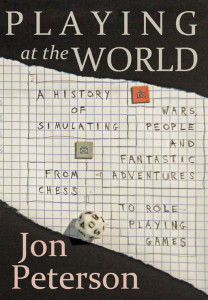

Review: Playing at the World

Playing at the World takes us on a fascinating journey to observe various factors that served to ultimately catalyze the creation of a new type of game with the creation of Dungeons & Dragons in 1974. This is the history of our hobby…

Playing-at-the-WorldWhen we think of topics that deserve a historical analysis, role-playing games aren’t considered to have much candidacy, being only forty years old. Even if we widened our scope to include the history of the various factors that influenced the creation of role-playing games, from war games to fantasy fiction, that would likely serve only to make such a study overly broad, and thus dilute the main idea…wouldn’t it?

Jon Peterson, author of Playing at the World: A History of Simulating Wars, People and Fantastic Adventures from Chess to Role-Playing Games, says no. His book takes us on a fascinating journey to observe various factors that served to ultimately catalyze the creation of a new type of game with the creation of Dungeons & Dragons in 1974. This is the history of our hobby.

…or rather, the pre-history of our hobby. While Playing at the World does discuss the immediate aftermath of Dungeons & Dragons’ debut, it is far and away more focused on the elements that led to its creation. Those looking to find a detailed examination of the growth and evolution of the role-playing hobby industry will not be completely disappointed, but they are far less favored than those who want to understand how such an industry could possibly have formed in the first place.

Before we venture deeper into that subject, however, a moment must be taken to discuss the book’s format. Simply put, Playing at the World is HUGE. The book is seven hundred pages long, and even taking into account that roughly ten percent of that is the bibliography and index, there is still a massive amount of reading material here. Beyond the page-count, part of this can be attributed to the small, densely-packed font, making for a high volume of words per page, even before the extensive footnotes are taken into account. While illustrations are to be found, they are comparatively rare.

If the above paragraph makes the book sound intimidating, then it’s doing it justice. This is not a volume for casual perusal, as it lays out its history with rigorous precision (though the author does temper his writing style to be that of a peer, albeit a didactic one, more than a professor). Fortunately, the author had the good sense to break the material in the book down into chunks. Beyond presenting the material in the form of chapters, each chapter is itself broken down into sub-sections, and a large number of those have sub-sub-sections. The effect of this is to limit each block of text to about twenty pages or so of material, allowing the reader to digest what’s here in bite-sized pieces, rather than demanding long slogs through several dozen pages all at once.

Playing at the World divides itself into five broad chapters, each covering a different area of influence for how role-playing games came to be. The first such chapter starts in medias res, as it walks us through the preceding ten years immediately prior to the advent of D&D. Here, Peterson looks at the bubbling cauldron that was the immediate time and place that created a new type of game, with a primary focus on the emerging nature of collaborative hobby-gaming. Here is where fanzines were in full swing, and historical war games were not only widespread, but were starting to make room for their fantasy-focused cousins.

It’s also here that we see the most concrete example of what makes Playing at the World so different from similar works on the history of role-playing games: this book utterly eschews contemporary interviews in favor of studying written materials from the period being observed. By restricting himself solely to what was written at the time, instead of relying on the vagaries of memory, Peterson avoids the natural inclination that historical observers have to white-wash history and pave over the details of what they might deem to be inconsequential or irrelevant. Thus do we get an uncharacteristically honest look at the details of the founding of our shared hobby.

This is a method of research that Peterson retains throughout the entirety of the book, including the second chapter, which is focused not on a particular time, but on a particular mode of inspiration for D&D. In this case, as the chapter title plainly tells us, it is the medieval fantasy genre itself that is under the proverbial microscope. As noted above, Peterson knows better than to examine the whole of fantasy fiction, instead restricting his analysis to the major works (largely from the 1930’s through the 60’s) that had clear thematic elements appearing in D&D, from the the objective forces of Law and Chaos in the works of Moorcock, to the “visitation fantasies” (a person from Earth visiting a fantastic realm, akin to how a role-player temporarily visits such a place in their game) of Burroughs and Anderson, to the unique spellcasting of Vance, among others.

Chapter three is the meatiest portion of the book, both in scope and page-count, focusing on the development of the rules of war games. Indeed, this chapter is more like two chapters that have been amalgamated, as it separates the sections that discuss the history of the development of war games over the last two centuries from those that outline the unique attributes of role-playing game rules (e.g. multiple polyhedral dice, individuated characters, and character progression). This is the section of the book that historically-minded gamers are likely to have some familiarity with, as its here that we hear familiar names such as Reiswitz, Bath, and Zocchi.

It’s only in the book’s fourth chapter that we start to see how the elements from the previous two began to mix. Here, the actual playing of roles is discussed, not in the context of the previous chapter’s focus on rules, but in how that was applied in practice throughout the nascent gaming community. Whereas chapter one discussed the manner in which war games arose as a hobby, here we see the first attempts to actually craft shared worlds, where multiple characters undertook actions that changed the landscape of the game setting for everyone playing. Notwithstanding chapter one’s discussion of Blackmoor, it’s here where we see the first proto-campaigns being attempted.

With all of the formative factors now explored, the book’s final chapter turns its gaze forward to focus on the immediate impact of Dungeons & Dragons. The period under analysis here is quite small, covering roughly the first three years of the game, but the results here are dramatic, as we begin to see how quickly the gaming community – to which sharing and modifying rules was already well-established – began to grow beyond D&D by itself, giving rise to what would eventually become a hotbed of role-playing games to try and satisfy burgeoning demand for new mechanisms for role-playing.

The book’s aim is largely fulfilled at this point, but Peterson has the acumen to present a brief (and make no mistake, compared to the remainder of the book, less than forty pages is brief) epilogue looking over the long-term impact of role-playing games. Here at last we come to the more familiar stomping grounds of role-playing history, from the “Satanic Panic” of the eighties to the Zork computer game to the birth of MMORPGs with Ultima Online. Of course, none of these get more than an overview, which grow increasingly cursory as we approach the present day, but all are acknowledged.

History is attempting to explain why things happened the way that they did, with works of historical analysis focusing on asking these questions in regards to specific times and places. Playing at the World, with its focus on role-playing games, expands on this question to ask not only why RPGs were created in the time and place that they were, but why they contained the elements that they did. It’s in asking this question that the book moves beyond a dry reading of facts (though it is still replete with them) and becomes a genuine examination of the genesis and evolution of the ideas that went on to form an entire new way to play games. It’s there that Playing at the World can be called a truly scholarly analysis of role-playing games.

More than knowing its history, Playing at the World helps us to better understand the hobby that we all enjoy so much.

Playing at the World can be found at DriveThruRPG and Amazon.

The Next Epic, part four

Tradition and innovation have always been natural opposites, as one seeks to maintain an existing set of practices while the other seeks to revise them, or even create new practices entirely. For Dungeons & Dragons, tradition had been a much stronger motivating force until the advent of Third Edition, when innovation was given a much greater role during its design.

"So then he dropped a planet on me. That's when I got angry."
“So then he dropped a planet on me. That’s when I got angry.”

Tradition and innovation have always been natural opposites, as one seeks to maintain an existing set of practices while the other seeks to revise them, or even create new practices entirely. For Dungeons & Dragons, tradition had been a much stronger motivating force until the advent of Third Edition, when innovation was given a much greater role during its design.

This isn’t to suggest that Third Edition put no importance to the game’s traditions; it quite clearly did, but was willing to change things to a much greater degree than any of its previous incarnations. Moreover, innovations to the game had been widely propagated by third-party publishers using the Open Game License.

When the Fourth Edition of Dungeons & Dragons was released in mid-2008, it was clearly mindful of these changes, and so introduced some innovations of its own. Yet at the same time, it kept a close eye on its history, and sought to reintroduce ideas from previous editions that Third Edition had eschewed, both big (different stats for monsters than for PCs) and small (the five-point alignment from the Holmes Basic D&D Set). This was particularly true where epic levels and divine ascension were concerned.

DUNGEONS & DRAGONS FOURTH EDITION

The Fourth Edition of the D&D game was, insofar as epic levels were concerned, a clear break from its immediate predecessor. Notably, epic levels were included in the Player’s Handbook. Though still referred to as “epic,” levels 21+ were now part of the core game, rather than being relegated to a separate source-book.

More striking was that a hard cap on levels was re-instituted, using the same thirty-level limit as Second Edition. Now, when a character hit 30th level, there was no further advancement to be had…with one exception. While characters of the “heroic tier” (levels 1-10) were defined solely by their class, and characters of “paragon tier” (levels 11-20) used a paragon path (a sort of sub-class) to further differentiate themselves from their fellows, “epic tier” characters (21-30) selected an epic destiny. (While Fourth Edition would pay epic tier considerably less attention than the preceding tiers, the third-party community wrote some very noteworthy materials for this level of play.)

An epic destiny, unlike a paragon path, wasn’t explicitly tied to a particular class. Rather, it was a thematic choice for what sort of larger-than-life archetype you wanted your character to become, and gave you powers to that effect. Moreover, each epic destiny had a specific “destiny quest” that your character could follow which presented a built-in option for how to retire them from the game after achieving 30th level.

Much like the Paths to Immortality of Basic D&D, the destiny quest of epic Fourth Edition characters was optional (and had no hard-and-fast mechanics associated with performing or completing it), but remained the only form of advancement once there were no more levels to gain. The nature of the quests varied, but completing them always involved your character moving beyond the game world.

Indeed, sometimes this was a literal ascent beyond the mortal realm. One of the epic destinies in the Fourth Edition Player’s Handbook was “the demigod.” Upon completion of your destiny quest, you literally became a nascent deity, heading to the dominion of a divine sponsor (or founding your own). While this particular epic destiny could be taken by any class, it’s notable for being the first time in D&D that whether or not you could try and achieve divine ascension was part of a class(-related) mechanic, as opposed to being purely orthogonal to your character’s advancement.

Likewise, the nature of divine statistics in Fourth Edition reinforced the mandatory nature of retiring a divine character. As mentioned above, monster stats and PC stats in Fourth Edition were different, unlike how Third Edition used the same statistics for both. As there were no standardized rules presented for deities in Fourth Edition – rather, what gods were presented were given unique monster stat blocks – that meant that there really were no mechanical options for presenting divine characters as anything but challenges to be fought.

With a Second Edition-inspired take on epic characters, and a method of divine ascension that was similar-yet-different from any previous iteration of the idea, Fourth Edition’s options for exceptionally high-level characters were clear and unambiguous in their presentation. That put its it in stark contrast with its major competitor…

PATHFINDER

The Pathfinder game was released in 2009, after an extensive public playtest. A revised version of D&D Third Edition (which itself had a revision almost halfway through its life-cycle) released by Paizo Publishing under the Open Game License, many gamers consider Pathfinder to be a form of D&D. This acknowledgment, along with its wide-spread popularity, is enough to earn it scrutiny here.

…unfortunately, that scrutiny, in regards to epic levels and divine ascension, finds Pathfinder to be somewhat lacking. As of the time of this writing, Pathfinder has eschewed the issue of level 21+ characters entirely. Moreover, the question of divine ascension (and the powers and abilities of gods, either as PCs or NPCs) has been left similarly unexamined.

However, this may change in the very near future. August of 2013 will see the release of Mythic Adventures sourcebook for Pathfinder. While we’ve already been told that this will not address the question of level 21+ characters per se, it will address how characters can gain (reportedly up to ten) “mythic tiers,” which are treated as being similar to levels in that they will grant characters greater powers and abilities. The difference is that mythic tiers are gained separately from levels, and can be earned at almost any point in a character’s career.

Beyond Mythic Adventures, there’s no predicting if Pathfinder will address epic and divine characters. While the game is based on D&D Third Edition, it has so far not used any of the epic or divine material from that game, likely for good reason given the unpopularity of those rules (though at least one third-party publisher has released epic-level material specifically for Pathfinder).

Of course, Pathfinder isn’t the only game for which the question of exceptionally high-level play remains an unknown.

DUNGEONS & DRAGONS NEXT

To date, it’s uncertain precisely what stance D&D Next will adopt in regards to epic levels and divine ascension. So far, the playtest packets seem to be utilizing a default cap, in that levels above 20 (and how to have characters undergo apotheosis) are simply unaddressed.

As part of a playtest, that’s not particularly surprising, as they’re still trying to work out the basics of how the game should be constructed. Once the game is released, however, these questions will need to be addressed, as they’ve been part of the game across every edition. While they’re likely to be separate modules, there’s no way of knowing what the specifics will be until then.

While some players and DMs won’t care for these levels of game-play, for others the release of these rules can’t come soon enough, as they long to take their characters to the very limits of what the rules allow…and then surpass them.

For them, the game doesn’t get any more epic than that.

The Next Epic, part three

The turn of the millennium had comparatively little impact on the world. The same could not be said for Dungeons & Dragons, however…

“I don’t care how high your attack bonus is, you can’t punch the sky!”

The turn of the millennium had comparatively little impact on the world; quasi-religious prophecies ranging from the Rapture to Y2k had failed to materialize, leaving the world untouched by dramatic upheaval. The same could not be said for Dungeons & Dragons, however.

The year 2000 marked the full results of TSR’s acquisition by Wizards of the Coast several years previous, as the Third Edition of Dungeons & Dragons debuted, along with the Open Game License. While the full scope of these events is beyond the aim of these articles, they are noteworthy for their impact on epic-level gaming.

Dungeons & Dragons Third Edition

The third edition of the D&D game had dropped the “Advanced” descriptor from its title. As the Basic game had been quietly retired during the mid-late 90’s, the thinking was that there was no need to confuse (if not intimidate) potential new customers with the implication that there was a “less complicated” version of D&D that was still in production.

In terms of its game mechanics, Third Edition was a huge break from its ancestors. Many basic assumptions were altered radically, or even discarded in their entirety. Demihuman level limits, for example, were now completely removed from the game. All classes advanced according to a single, unified experience table, rather than each class having their own. All characters could now multiclass (as opposed that being reserved for demihumans, whereas humans would dual-class), taking levels in any class they wished as they gained experience (though a control mechanism was instituted in the form of experience point penalties if your various classes had wildly differing levels; a corresponding loophole was introduced in the form of each race having a “favored class” that didn’t count against them in this regard).

One aspect of the previous edition remained the same in Third Edition, however: character advancement was capped at 20th level. As with the introduction of Second Edition, this cap was introduced implicitly, rather than explicitly – the simple lack of rules for advancing beyond 20th level was all that kept characters from going any higher, rather than a strict prohibition.

Unlike Second Edition, however, this would be a situation that would not be allowed to remain undisturbed for very long. With the transition of the D&D game came the requisite transition of many of its campaign worlds, some of which included popular characters with levels well in excess of 20. So it was that when the Forgotten Realms Campaign Setting was released in 2001, a year into Third Edition, it had to address this particular query.

Of course, that didn’t mean that it had to address it directly. In answer of levels beyond 20, the book presented only a single sidebar, largely limited to explaining the stat blocks for the “epic level” NPCs in its pages – this was the first time that the term “epic” would be used to describe level 21+ characters. It wouldn’t be the last, however, as the sidebar promised that the forthcoming Epic Level Handbook would cover this area in far greater detail.

Said handbook would debut almost exactly a year later (and had a book on deities in Third Edition precede it by only two or three months), marking the first time that a Dungeons & Dragons book had been devoted exclusively to characters that transcended the number of levels present in the game’s main rulebooks.

The credo surrounding the release of Third Edition had been “options, not restrictions,” and this was faithfully reflected in the Epic Level Handbook. Rather than the hard caps on levels found in Basic or Second Edition, Third Edition followed in the footsteps of First, placing no upper limit on how high PCs could ascend. While one could charitably say that the book’s intent, as part of the “toolkit” mantra of Third Edition, was that each Dungeon Master would use the book to determine their own hard cap on levels appropriate to their campaign, such a message was never articulated in the Epic Level Handbook itself.

No credible discussion of epic levels in Third Edition can be had without mentioning just how badly the book was received among the gamer community. Popular opinion of the book was poor, mostly due to the implementation of its game mechanics. While the specific list of complaints are many, most can be distilled down to a single charge: that the book exacerbated the deficient areas of the Third Edition rules.

Some elucidation is worthwhile here. The Third Edition game mechanics – popularly known as the d20 System – focused around a task resolution system of rolling a twenty-sided die (aka a d20) and adding relevant modifiers, with the task succeeding if the resulting score equaled or exceeded a specific target number.

The problem came from the open nature of the game’s “options, not restrictions” stance. Simply put, so many options were put into print (both from Wizards of the Coast for D&D itself, and from compatible products by third-party publishers via the Open Game License) that, presuming that a large number were allowed by the Dungeon Master, the modifiers that were added to the d20 roll would soon eclipse the 1-20 range of the die roll itself.

Because a character’s level was the natural manner of restricting the total number of options they could pick, characters that went up in level naturally gained more and more options, and so more and more ways to affect a given d20 roll (particularly among spellcasters). As such, epic-level characters were perceived as being “broken” simply for how widely they could vary in their efficacy, meaning that two characters of equal level could face a task that would be virtually impossible to accomplish for one, and impossible to fail for another. This made writing epic-level challenges more and more difficult, to say the least, as the characters’ levels climbed.

While there were complementary issues, the above goes to the heart of why epic levels in Third Edition were so poorly received. Whereas First Edition had been content to let characters gain levels infinitely, it had restricted the mechanical gains of new levels to nothing but hit points. Third Edition, by contrast, had attached much more power to each level gained, making it somewhat inevitable that – absent any kind of ceiling – that power would rapidly balloon out of control.

Divine ascension was still available for those who wanted it, of course. As with First Edition, this was a purely orthogonal choice, and was generally assumed to mean the retirement of the character. Perhaps ironically, this didn’t necessarily have to result in the character becoming an NPC; as mentioned above, a book on gods for Third Edition had come out a few months ahead of the Epic Level Handbook, this being Deities & Demigods.

Named after the First Edition book of the same name, the Third Edition Deities and Demigods was more similar to the Immortals rules of Basic D&D in that it not only had stats for a number of divine entities, but provided comprehensive rules for how to build gods, rules which (thanks to Third Edition’s using the same stats for monsters and NPCs as for PCs) could be applied to PCs with no conversions necessary. By contrast, OD&D and First Edition had portrayed gods purely as unique monsters, with no particular discussion of what (if any) powers ascended PCs would gain (Second Edition, by contrast, gave no rules for deities at all beyond some general limits to their powers; the only stats listed were for godly avatars).

Even more in vein with Basic was that, in the appendix on divine ascension, Deities and Demigods had a section on running adventures with the PCs as gods. Presumably presented in accordance with the “options, not restrictions” ethos of Third Edition, this was a complete nonstarter with Third Edition gamers.

This wasn’t to say that epic-level, and even divine, game-play were completely unrequited among the Third Edition community. Thanks to the Open Game License, instances of adventures and sourcebooks that spoke to these concepts crept up every so often (though in the case of the latter, they were just as likely to try reinventing them as they were to expand on them). None of these attempted to fix the underlying issue of power-inflation, however. How could they, after all, when the problem was expressly tied into the nature of the d20 System itself?

A fix of that magnitude would require a new edition entirely, something we’ll cover in the next article.

The Next Epic, part two

The evolution of D&D with regards to mandated end-points of character progression – and ways to bypass those end-points – was not a precise one…

“Time to see how much XP you’re worth, old man!”

The evolution of D&D with regards to mandated end-points of character progression – and ways to bypass those end-points – was not a precise one. While OD&D had largely been silent on the matter, and BD&D had gradually pulled back the curtain on higher and higher levels (save for demihumans, who were capped at comparatively low levels) all the way to playing as a deity (and subsequently evolving beyond even that), the Advanced Dungeons & Dragons game would not present quite as coherent a picture.

Advanced D&D First Edition

Advanced Dungeons & Dragons is presumably “Advanced” in relation to the Basic edition of the game. The truth of that idea, however, is somewhat murky. AD&D officially debuted in 1977, with the release of the Monster Manual. It wouldn’t be until 1978 that the Player’s Handbook was released, followed by the Dungeon Master’s Guide in 1979.

By contrast, the very first “basic” set (by Dr. J. Eric Holmes, as mentioned in the previous article) was itself only released in 1977, the same year as the Monster Manual – by contrast, the subsequent iteration of the Basic rules (which would be the first half of B/X), wouldn’t appear until 1981, by which point AD&D was well-established whereas Basic wouldn’t achieve its “final form” until the Mentzer boxed sets, which began in 1983.

This is all worth mentioning because it reminds us that AD&D wasn’t originally meant to be the next logical step up from “Basic” D&D (though it would eventually be branded that way), so much as it was taking the same basic ideas from their shared predecessor (OD&D) and running in a different direction with them. The foundation is the same, but the implementation is where things differed.

This “similar, but different” approach can be seen in the AD&D game’s approach towards upper levels and divine ascension. Whereas BD&D’s allowed only humans to pick their class, with demihumans having their class define their race (e.g. you could start the game as a 1st-level human cleric, whereas if you wanted to play an elf then you were a 1st-level member of the elf “class”), AD&D allowed for race/class combinations for all characters.

These combinations, however, were highly limited. Even leaving aside that races and classes had minimum (and maximum, for races) ability score requirements, AD&D implemented the idea of humanocentricism by including hard limits on how many levels demihumans could attain in various classes… presuming that they could take those classes at all, since each type of demihuman could only take certain classes to begin with. Humans, by contrast, could take levels in any class they wished, with no upper maximum.

Of course, even these hard-and-fast rules had their exceptions. Each demihuman race in the Player’s Handbook had one class in which they could advance without limit, just like humans (this was the thief class for all demihumans save half-orcs; for them, unlimited potential was found in the assassin class… which was rather ironic, as the next sentence will show). Likewise, no race, not even humans, could advance endlessly in classes for which only a finite number of levels existed, such as with druids or assassins – once you hit the maximum level in either of those classes, there was no further advancement to be had (unless you were already multiclassing if demihuman, or could dual-class if human).

This was the first time that the D&D game, in any incarnation, featured level advancement that was potentially unlimited. Strictly speaking, if you were of the right race/class combination, the sky was the limit for how high you could climb. Surprisingly, however, that degree of advancement made very little difference in a character’s overall power.

The reason for this is that, at a certain point, gaining new levels offered virtually nothing. Every class stopped gaining new Hit Dice around 10th level or so, after which point you gained only a small, set number of hit points, usually ranging from 1 to 3 (to which you didn’t get to add your Constitution bonus). Likewise, your saving throws and to-hit bonus tended to top out at around level 20.

In other words, your character didn’t gain very much at all by leveling past 20th level or so. You got a new hit point or three, but that was about it. So your 75th-level fighter and your 20th-level fighter weren’t going to be that much different, save that the 75th-level fighter was a better meat-shield (one notable exception to this, however, was that spells with effects based on caster level had no cap – that meant that your 75th-level wizard could unleash 38 magical blasts with a single casting of magic missile!).

Now, your character might have gained a supreme amount of magical items by that point, and possibly political powers as well if they’d chosen to dabble in rulership (the game tended to suggest that around “name level,” which was usually around 9th, that your character would begin to have a political impact on the world around them), but this wasn’t mandated by their level, being the result of the character’s in-game exploits.

One alternative goal, for those who wanted to try for it, was divine ascension. Introduced with the Deities & Demigods book in 1980 (and easily predating BD&D’s Immortals boxed set, which didn’t debut until 1986), divine ascension was highly different from how AD&D’s Basic counterpart would define it. True, both included a set of difficult conditions that had to be fulfilled before your character would be accepted into the ranks of a pantheon, but the similarities ended there.

For one thing, AD&D divine ascension was not a natural end-point for character progression. Indeed, an AD&D character that didn’t run aground of racial or class-based level limits could theoretically level-up forever (presuming that they found some way of dealing with problems of age), all the while remaining mortal.

A much more stark change between the two games was that, for AD&D characters that became gods, their apotheosis marked the end of their participation in the game, at least insofar as being a player-character went. Deities & Demigods explicitly stated that the newly-ascended deity was given non-player-character status, making them under the control of the DM.

Further, there was no option for their “removal” from the game world. Whereas BD&D’s Immortals could, through great difficulty, ascend beyond the game world and its rules, AD&D’s gods had no such lofty goal to shoot for. Once you were a god, you were pretty much an established god of the game world from that point on (unless the whims of the DM had some cosmic fate befall your divine NPC).

This formula, where your class and race combination determined if you would have unlimited potential or hit a hard cap, with divine ascendancy as an orthogonal option for character retirement, would be comparatively unchanged in AD&D Second Edition… but what changes it did have would be notable indeed.

Advanced D&D Second Edition

The Second Edition of AD&D introduced several twists on many of the ideas regarding upper-level limits for characters that its predecessor had introduced. For example, while demihuman level limits remained in the game, new rules about allowing demihumans to exceed these limits appeared (though these exceptions were dependent on having exceptional ability scores, and only allowed those limits to be pushed by a few levels). More notably was the fact that no class allowed for unlimited demihuman advancement; that was now a privilege reserved for humans alone.

Of course, that privilege was to be taken in light of a far more dramatic change: all classes were now twenty levels long. While not presented as a hard cap (the Second Edition DMG even said that advancing beyond 20th level was “theoretically possible”), it was fairly well understood to be just that; the lack of information about how many experience points were needed, and how many hit points were gained, meant that adventurers were effectively capped at 20th level.

Interestingly, this cap was first extended not by a generic rulebook, but by the Dragon Kings supplement for the Dark Sun setting. Dark Sun had, from the first, been presented as a very tough campaign world (PCs were told to make their starting characters level 3, rather than level 1), and this book was the natural conclusion to that. It showed how all types of classes (albeit with racial limitations, though ones tailored for that campaign world) extended to a new limit: 30th level.

Despite the fact that this was a campaign-specific supplement (and as such had campaign-specific aspects to these higher levels), it had impact for all Second Edition D&D characters; indeed, since the campaign settings of Second Edition AD&D were all set in the same multiverse, there was ample understanding that these rules could be used for all 21+ level characters.

This approach was eventually formalized in the generic supplement Dungeon Master Option: High-Level Campaigns. Here the 21st-through-30th-level rules were given in a generic presentation (differing from those presented in Dragon Kings), allowing them to be easily used for characters in all types of campaigns. It was also here that the hard cap on gaining levels was formalized, as the book out-and-out stated that no character could ascend beyond 30th level.

Of course, divine ascension was still possible. Indeed, divine ascension rules were presented fairly early on in Second Edition’s (in the Legends & Lore supplement, which debuted roughly a year into Second Edition), and were reiterated again in the High-Level Campaigns supplement as well. There is little to merit special attention here, however, as Second Edition’s divine ascension rules were near-totally the same as their First Edition counterpart, differing only in minor details of how to perform the act of apotheosis itself.

Indeed, the most noteworthy aspect of Second Edition’s divine ascension rules is in how they’re perceived compared to previous editions of the game. Like Basic, ascending to become a god was something that naturally seemed to follow once you ran out of available levels to gain – when there was no further advancement to be had, godhood is the only way left to go. Unlike Basic, but in the vein of First Edition, however, this is a closing chapter to a character’s career; something done as a grand send-off for your character, rather than entering a new phase of play. In this regard, Second Edition can be said to have split the difference between its predecessors.

Next time, we’ll look at how Third and Fourth Edition handled the questions of epic levels and divinity.

The Next Epic, part one

Given that D&D Next is still a little ways off, and that its module regarding epic-level game-play is likely a bit further than that, it’s worthwhile to look back at the history of the game and seeing how each version of it dealt with the concept of going beyond the upper limits.

“My epic character can beat the entire planet’s break DC.”

While there’s no official release date yet, it goes without saying that we’re getting fairly close to the formal release of D&D Next (the most likely date being August of 2014, to coincide with the fortieth anniversary of Dungeons and Dragons).

D&D Next, also known as D&D Fifth Edition, has a lot to live up to. It purports to use a series of add-ons, which it calls “modules” (not to be confused with the adventures for older editions) to allow groups to set the style of game they like, from rules-light exploration to intricately combat-focused. Moreover, these modules will purportedly cover specialized areas of game-play, such as underwater or planar adventures.

The idea here is that every niche will be spoken to with a module of its own, and that these will be – if not complementary – then at least clearly delineated so that it’s easy to mix-and-match. That’s an admirable goal, though I wonder how well it can be accomplished, but what I’m curious about is one such module in particular: epic-level play.

Epic-level play is (much like rules for gods) something of a divisive issue among D&D gamers. There’s a general consensus that the higher the game’s level goes, the more the rules “break down.” Attempts to define what that means tend to be poor, but usually vacillate between problems of administration when there’s so much information to keep track of, and bonuses that are far and away larger than the range of the die roll that they’re attached to. As such, those who want to “go epic” with their game – which is usually understood as leveling characters beyond level 20 (or whatever the basic rules’ level cap is understood to be) – tend to be something of a minority.

One of the problems with discussing epic levels, to my mind, is that there’s no real consensus on what such levels actually constitute (beyond the aforementioned definition of “going beyond what the rulebooks list”). In fact, if you look back at the history of D&D in its various editions, each version of the game has tackled this particular question in very different ways, each with their own strengths and weaknesses.

Given that D&D Next is still a little ways off, and that its module regarding epic-level game-play is likely a bit further than that, it’s worthwhile to look back at the history of the game and seeing how each version of it dealt with the concept of going beyond the upper limits.

Original D&D

Original D&D – the “woodgrain/white boxed set” and its five supplements, also called “OD&D” or “0E” – is something I’m hesitant to speak about. Of all the various versions and iterations of the game, it’s the only one I’ve never directly seen in one form or another (though I hope to change that in the future). As such, take the following with a grain of salt, as it’s based on second-hand knowledge.

Original D&D had only a few character classes (three in its original release – the fighting-man, wizard, and cleric – with the thief added in the first supplement), and the listed set of levels for these classes was quite low: in the single digits. There was no real reference to going beyond these levels, either in terms of a prohibition against doing so, or as a how-to for those who wanted to. This aspect of the game, like quite a bit of game-play using these rules, was open to the interpretation of the Dungeon Master (and his players).

It does seem safe to say, however, that at this point there wasn’t really a codified sense of “where the game wanted you to stop” and how to move past that barrier. Rather, the game rules seemed to paint a picture of taking you so far, and then leaving you to your own devices. What we’d later come to think of as “epic levels” simply wasn’t something that was fully conceived of yet.

Basic D&D

Before talking about Basic D&D, we need to clarify exactly what this term encompasses. Moreso than any other edition of the game, Basic (also called “BD&D” and interestingly not having an edition number) is made up of several different versions of the game, all superseding and reinventing each other as they went.

The first Basic Set, written by Dr. J. Eric Holmes (aka the Holmes Basic Set) was meant to be a repackaging of OD&D, but included enough changes to the rules that it’s generally considered to be its own animal. Like its predecessor, it didn’t really speak to the idea of going beyond the listed levels, more as something not considered than deliberately ignored.

It was only later, with the release of the B/X set – that is, the Basic Rules boxed set by Tom Moldvay and the Expert Rules boxed set by David “Zeb” Cook and Steve Marsh; these were another introduction to D&D that changed just enough from their predecessor to be their own animal – that the rules started to speak to strict limits on how high characters could advance. Ironically though, this series never got that far (at least, not for most characters. Demihumans, however, hit hard caps here); a third set of rules that was supposed to present the upper limits of character advancement, called the Companion set, was never released.

Or rather, it wasn’t released for B/X. Once again, the Basic D&D game was re-released as a series of boxed sets that changed enough of the rules to be considered their own thing. This time it was in the form of the five boxed sets known as BECMI – Basic, Expert, Companion, Master, and Immortals – by Frank Mentzer (though they would eventually be re-released, with some tweaks by Aaron Allston in the form of the D&D Rules Cyclopedia and the Wrath of the Immortals boxed set). The first four of these boxed sets established, for the first time, that there was a ceiling to how high a character could advance (AD&D First Edition had already been released by this point, but it didn’t have the same cap; see below), that being level 36 (save for the aforementioned demihuman level limits, which were far lower).

Notably, the game didn’t stop here. The Immortals/Wrath of the Immortals boxed set(s) showed how PCs who had reached their level limit could potentially ascend to become deities (that is, “Immortals”) in their own right, at which point they could begin ascending the Immortal hierarchy.

PCs who hit the top of the Immortal hierarchy then had only one potential method for advancing further: they could give up their immortality and start as 1st-level mortals all over again. That certainly sounded harsh, but for those who managed to once again make it to the limits of mortal experience, and then ascend to the uppermost ranks of immortality for a second time, earned a special send-off for their character: they immediately attained the status of being one of the Old Ones (beings as far above the Immortals as the Immortals are above mortals) and were taken beyond the Vortex Dimension (which is to say, being the Basic D&D game’s multiverse).

The above is notable as it not only presents a hard-cap, but does so in a way that mandates that the character be retired from play, something not seen again until D&D Fourth Edition. Moreover, unique to all forms of character retirement, this one removed the character from the game world. Every other method of retiring a character, from death to divine ascension, turned the character into an NPC that was still part of the game world (and so could conceivably be featured again at some point). A character that attained the status of Old One in Basic D&D, however, had literally moved beyond the game itself.

Next time, we’ll look at the various editions of AD&D, and its ways that PCs could (or couldn’t) surpass the common limits for characters.

Researching Spell Research, part 2

The issue of independent spell research is one of the stickier wickets of most D&D/Pathfinder games…

Spell-Research
Young Gandalf, hard at work.

The issue of independent spell research is one of the stickier wickets of most D&D/Pathfinder games. This is because it’s an area where, more so than with most areas of the game, the mechanics and the in-game rationals for how magic works need to be tightly intertwined. Instead, both the mechanics and the flavor text are almost totally absent in this area. That means we’ll need to use a combination of deductive reasoning to try to develop a framework…

Sit a Spell

In the previous article, we mentioned that there was no real in-game reason why a character couldn’t research a version of a spell that wasn’t on their spell list (e.g. a wizard researching an arcane version of entropic shield). Let’s go over that a little more here.

The basic premise here is that most of the spell lists in D&D have fairly major thematic elements to them, which can be recognized from an in-game standpoint. Now, if these resulted in strict divisions between the spell lists, there’d be reasonable grounds for saying that there was an in-game reason why these different types of magic were only able to accomplish certain things and not others.

However, that’s not the case. There’s significant overlap between most of the spell lists, both in terms of individual spells being on multiple lists and in terms of overall theme. Both the cleric and sorcerer/wizard spell lists, for example, have several divination spells on them (e.g. scrying); given that, is there really a reason why the cleric couldn’t research their own version of detect scrying? It’s clearly not a departure from the theme of clerical magic, so why not?

As noted previously, if there is a departure in theme from one spell list to another (e.g. healing magic not being arcane spellcasting…notwithstanding bards) then this is an argument that there’s an in-game reason for the difficulty of another kind of spellcaster using that kind of magic, such as how in the previous article we discussed the inherent complexity of healing spells and how they’d have a higher level on arcane spell lists.

Of course, now you get into the details of how spell research actually needs to be conducted.

Formulaic Thaumaturgy

The question of how spell research is performed is an area where greater mechanical emphasis is needed, rather than flavor text. In-game explanations are very good for why and how things work the way they do, but insofar as an actual process goes you’ll need to figure out how you want the game rules to guide the attempt.

In this case, the rules for spell research need to speak to several different needs. The first is that there needs to be to be not-insignificant disincentives to conducting this sort of research at all.

That sounds counter-intuitive, but it’s very necessary. The end result of successful spell research is that your spellcaster will have a new spell in hand, waiting to be used (though for spontaneous spellcasters, they’ll need to wait until they have an open Spells Known slot they can fill it with – that’s the problem with learning your spells intuitively, rather than as an act of procedure; knowing something instinctively means that learning it intellectually isn’t sufficient). Because of this, game balance will be severely affected if the character can perform the process quickly, cheaply, and without any sort of risk, as your character will in very short order acquire an arsenal of spells.

Given that, at least one or more of those three issues – money, time, and risk – need to be set at sufficiently high levels as to make spell research something that isn’t undertaken lightly.

Cost would presumably scale with the level of the spell being researched, but this is a difficult bar to set. Most characters tend to start out relatively poor, but quickly amass considerable sums as they level up. Even considering that most of their treasure gets tied up in their gear, they potentially have hundreds of thousands worth of gold pieces by the time they’re approaching the end of their career, so a cost of a few hundred GP per spell level, which once seemed like a massive cost, is now little more than a pittance.

Time is another issue that’s difficult to assess in terms of how much it restricts the research process. If your game is one that sets a very quick in-character pace, saying that spell research takes (for example) one week per spell level can be a daunting barrier. On the other hand, if there are plentiful opportunities for down-time, then this is no real barrier at all, as the player can easily say that his character devotes months to nothing but research, and suffers not at all for it.

Finally, there’s risk. As with cost and time, the nature of this is highly variable depending on the character making the attempt. Risk, here, can be measured in two terms – the difficulty in accomplishing the task (e.g. how high the skill DC is) and the results of failure (e.g. does he lose some of his time and money? All of the time and money? Or does a failed check result in a massive explosion that deals terrible damage to everyone within a two-block radius?).

There is, ultimately, no single right framework for any of these, as they depend on how quick, costly, and dangerous you want spell research to be in your game. I’d personally recommend erring on the side of setting these limiting factors high, as this would push independent spell research to later levels of the game, limiting the amount of time they’d have to make an impact on your campaign. All of these are guidelines, however, allowing you to tweak them as you like.

Divine Directives

There’s a particular issue that tends to come up when researching divine spells is brought into play. Oftentimes, someone will ask “why does my character need to perform all of these experiments to create a new divine spell when the spell is being granted by my character’s deity? Can’t he just pray for it and his god will make it happen?”

On its face, this is a reasonable question. One would presume that a god that’s already granting many diverse spells could just snap its fingers and make something new if it wanted to, and that’s that. So why are you being made to do all of the legwork?

As it turns out, there’s a pretty good reason why.

Recall the quote we had in part one about how, insofar as healing spells went, there was a lot of complexity to those spells that was being handled on the divine end so that your character could cast them as low-level spells? It’s basically that all over again.

Creating a spell, even a low-level one, is a complicated process. Much like building an engine, you have to make sure that all of the parts are properly connected and working correctly. Designing one from scratch, assembling the components, and performing testing are a fairly complicated process, whether you’re a humble mortal or a powerful celestial (or infernal) being. Ultimately, somebody has to do that work…and you’re the one asking for something to be made.

That’s why divine spellcasters have to do their own spell research. Their deity is basically setting up a paradigm where they tell their worshipers “Look, if you want a brand new spell, I’ll grant it to you. But YOU have to figure out the ins-and-outs of this thing. I’ll fill the order you place only if you can give me a working set of blueprints.”

That hardly seems unreasonable. Though I’m sure that if a cleric wants to complain about it overly much, there’s a divine complaint department set in one of the less comfortable regions of the afterlife.

Researching Spell Research, part 1

One of the major compromises that all role-playing games make is that at some point the rules will have to sacrifice some degree of specificity in favor of playability. No game, after all, can model reality down to the most minute detail…

Research-booksOne of the major compromises that all role-playing games make is that at some point the rules will have to sacrifice some degree of specificity in favor of playability. No game, after all, can model reality down to the most minute detail.

Indeed, one could say that the difference between RPGs is nothing more than the degree to which they balance the granularity of their model of the game world’s reality with how “game-able” their rules are.

Not all areas of this model are necessarily equal, of course. Certain things, such as combat, can be modeled to a much greater or lesser degree than others, such as economics. But perhaps the hardest things to model are those which have no analogue in our real world, a big example of that being magic.

That might sound counter-intuitive at first. After all, having no basis in reality means that we have the freedom to set it however we want in the game world, does it not? Well yes, it does…but this means that, having no existing model on which to draw (existing game systems now withstanding), we’re likely to make errors regarding its internal consistency, or worse, forget relevant parts of the system altogether.

One such forgotten element is, in D&D 3.X and Pathfinder, the ability to independently research and create new spells.

Re-Searching for Answers

The issue of (the lack of rules and guidelines, as well as in-character analogues for) spell research in D&D and Pathfinder isn’t a big deal, comparatively speaking. You can – and I suspect that many, if not most, of you have – run successful campaigns without this particular problem ever cropping up.

However, it is part of the background assumptions of the game world. Wizards, for example, are said to be researching new spells as they adventure, and that’s why they gain two new spells every time they gain a level. As a meta-game conceit, these are considered to be existing spells in the Core Rules or a supplement, but why do they have to be? Likewise, the presence of named spells (e.g. Bigby’s Interposing Hand, Mordenkainen’s Disjunction, etc.) is a pretty clear indicator that individuals have the capability to create new spells.

The problem with having these assumptions exist with no further discussion or backing is that, if a player decides to start examining them closer, they begin to fall apart. Suppose someone looked at the previous two examples, for instance, and decided that when he leveled up he wanted one of his new spells to be an original creation bearing his name, rather than a pre-existing spell. Now the problem is front-and-center, and the GM needs to figure out how to deal with it.

Now that we’ve established that spell research goes on in the game world, and that a lack of further details can be problematic, let’s look at some of the pitfalls of creating new spells, both from a meta-game and in-character view.

Balancing the Issues

From a meta-game standpoint, the issues with creating new spells seem to be twofold in nature, both of which are expressions of the fear that they’ll grant too much power to the spell-maker. The first is that the spell in question might be flat-out overpowered (e.g. “it’s a fireball spell, but it uses d12s for damage and has no saving throw. Oh, and it’s 1st-level.”). The second is that it could be used to break down the existing differences between spellcasting classes (e.g. “Yeah, it’s an arcane version of cure light wounds. Now we don’t need the cleric anymore!”).

Let’s speak to each of these in turn.

Insofar as inventing spells that are native versions of existing spells on other classes’ spell lists, this is something of a tempest in a teapot. The sheer mechanics of limited spells per day will do wonders to ensure that there’s no additional spell which, should a character acquire it from another class’s list, will turn them into an unstoppable powerhouse, or even dilute their role that much. After all, with all of the spells they need to prepare, how much will things change is a wizard prepares a single cure light wounds?

Likewise, on the issue of overpowered spells, this falls squarely within the realm of GM fiat. No matter what rules system (if any) is being used to adjudicate researching new spells, if the GM says that he or she doesn’t approve of the results, then that’s that (particularly since the GM can just come up with an in-game explanation for the failure of the research). In fact, Paizo wrote a guide for GMs to judge the power of original spells in their Ultimate Magic supplement.

From an in-game standpoint, it’s fairly easy to justify these meta-game decisions. After all, if a wizard wants to invent an arcane version of entropic shield, it’s more germane to ask “is there any reason to suggest that that’s not possible?” than for a reason to suggest that it is. Certainly, a wizard having such a spell wouldn’t be likely to unbalance the game.

Now, insofar as certain things like arcane spellcaster casting healing spells goes, there’s a section from my favorite blog that has some interesting ideas on the topic:

Also, note that what The Practical Enchanter says about spell design: it’s a combination of complexity AND power. People all too often ignore the Complexity because Power is obvious and flashy.

Now let’s look at the Cure Wounds series. Power-wise, those spells fit in at their given levels pretty closely. A given healing spell is usually weaker than a same-level attack spell, but they do scale with the spell level and somewhat with the caster level.

So now we know a more powerful caster does affect the spell. This may be important later.

Complexity-wise, healing is way overboard. That 1st-level spell can knit bones, restore organs, push leaked blood and fluid back where it does no harm, erase any chance of infection. If the individual is dying, it will erase all the ongoing damage to the nerves, brain and spine instantly.

[…]

Cure Light Wounds is at LEAST at fifth-level complexity. I’d say sixth for practical purposes. With a few hundred years of development and polishing it might be possible to get the spell down to fifth level.

So why is it so cheap? Well, remember that divine spellcasters get a hidden bonus. They have a deity, and probably an entire divine staff, processing, preparing, and weaving the spells. Druids get that same edge from nature gods or local spirits or some such. Those spellcasters may be storing and casting their healing spells, but they don’t have to do all the work.

While this is specific to the question of healing spells, it speaks to a broadly-applicable school of thought on the subject of why a spell can have different levels on different spell lists. This won’t always be the case of course (in fact, the article goes on to note that this will usually not be the case), but it helps set the tone for why the differences between arcane and divine spells are the way they are.

Given that, it seems safe to say that if the GM is involved in the process (particularly in determining the nature of the results of the research) and has some guidelines in mind for adjudicating the results of successful research, there’s comparatively little reason why researching new, original spells shouldn’t be allowed.

Next week, we’ll look at the question of actual rules for the research itself, and take in some of the differences between arcane and divine spell research.

Click here for part 2…

Modern Morale-ity

It wasn’t too surprising that, by the time Third Edition D&D rolled around, morale had been left by the wayside. And that’s a shame…

Morale

It has long since become popular sentiment that, in role-playing games, the story trumps the rules. That is, it’s more important to put together a compelling and interesting narrative than it is to slavishly adhere to the mechanics of the game system; to put it another way, it’s more important to have fun than to make sure you’re doing it “right.”

What’s interesting, however, is to see just how far this particular philosophy has taken hold of D&D through its various editions. There are multiple mechanics, in older editions, which determined the actions of an NPC – remember the old “% Lair” listing for monsters? – that have been discarded in newer iterations of the rules. Nowadays, a monster is in their lair if that’s where the GM wants them to be, or if it’s where the pre-published adventure has written them as being, not because of a die roll.

One of the big offenders in this regard is morale. For those who don’t remember, in older editions of the game monsters and NPCs in a fight would, when certain things happened, need to make a “morale check” to see if their courage failed them. If the check failed, they’d quit the fight and try to flee, otherwise they’d hang on in hopes of turning things around. PCs, of course, never needed to check morale; their actions were dictated solely by the players.

It’s fairly easy to see why this mechanic was discarded as the game reinvented itself. The idea that NPCs would make a life-or-death decision – and perhaps more relevantly, a decision that would affect the flow of a combat encounter – essentially randomly was quite unpalatable to a lot of narrative-minded GMs. Moreover, since morale was easily ignored it quickly became superfluous, something that could be overlooked entirely without the game suffering at all for it. Given that, it wasn’t too surprising that, by the time Third Edition rolled around, morale had been left by the wayside.

That’s a shame, since Third Edition’s mantra of “options, not restrictions” seems to lend itself to the idea of keeping morale on as a sub-system that can be used by those GMs that want it, and ignored by those that don’t. As such, we’ll design one here that GMs can use.

Before doing so, it’s worth noting again in the most explicit terms possible that the morale rules – unlike most, if not all, other kinds of rules – are applied by GM fiat. They are only used in a situation if the GM wants to use them, and the results are suggestions and guidelines rather than imperatives. Because this entire process is invisible to the players, and because it only affects NPCs and monsters, GMs should feel free to modify their rolls and results at will; doing so is not fudging so much as it is making a necessary ad hoc adjustment to make the system better fit a particular scenario in the game.

For 3.5/Pathfinder, we’re going to say that a morale check is a Will save, rather than coming up with a new type of check. This makes sense since Will saves are already used for related checks, such as resisting fear effects, and is simpler than creating a new value or check.

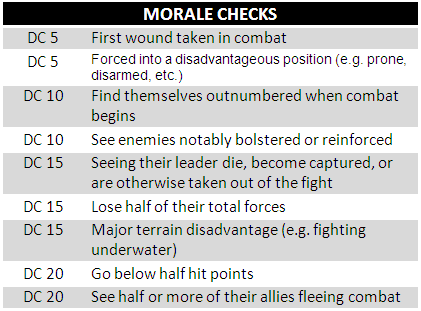
The next thing to do is break morale down into two parts: instances that would require a check, and measure how high the DC would be. In this case, we can simply create a list of events that would plausibly shake a creature’s will to keep fighting, and assign a DC value based on how severe that event seems. For example, the first time a creature is wounded in combat, it may find its courage failing…but that seems like something that would only cause the seriously cowardly to quit a fight, so we’ll assign that a DC of 5. On the other hand, bring brought below half of their hit points would be a much bigger check, since the character would now be seriously injured, to the point where death seems like a distinct possibility. As such, we’ll say that calls for a DC 20 check.

The following is a list of possible events that could cause a morale check, and how severe that check could be. Of course, GMs should feel free to tailor this list and adjust the DCs as they see fit, both in general and for a given situation (alongside the more general caveat that morale need not be used at all if the GM finds it inappropriate to do so):

MORALE-CHECKS

It should be noted that failing a morale check doesn’t mean that the creature immediately flees combat, though that’s a distinct possibility. Rather, a failed morale check is indicative of the creature no longer having the will to keep fighting, and taking action based on that. This may result in it quitting the battlefield, surrendering, attempting to negotiate, or otherwise trying to no longer engage in armed conflict.

One oddity that can come up when a morale check is failed is that it can make calculating XP awkward. The situation here is usually some variant of the following – the PCs battle the monster for several rounds, taking and dealing some not-insignificant damage. At some point, the monster fails a morale check and runs away, concluding the combat. Since the PCs did fight it for several rounds, and the GM isn’t sure if they’ll meet it again, XP is awarded. Later on, they do meet the creature again, and this time battle it to the death…do they get XP for fighting the same creature a second time?

There are arguments to be made either way, but I’m of the opinion that the best way to make this particular decision is by considering the following question: Would you (the GM) consider the monster to have been fought over a single combat encounter that perhaps had a brief interruption? Or would you call it two separate encounters? In the latter case, presumably enough time had passed that the consequences of the first encounter (e.g. hit points lost, spells expended, etc.) had been largely ameliorated. Naturally, if you’d say that the fight was one encounter with only a brief hiatus, then the PCs should only earn XP once. Otherwise, they deserve to gain experience for each fight separately.

Ultimately, the GM is the final arbiter of what an NPC does in combat; players should never be able to try and metagame a situation to force a morale check. With that said, hopefully these rules should give enterprising GMs a handy guideline for determining the morale of the enemies their PCs face.

The Invincible Enemy – spicing it up with the environment

One of the most omnipresent – and most dangerous – opponents your PCs can face isn’t found in any bestiary and is often overlooked by GMs: the environment.

Icy-RiverOne of the classic staples of fantasy role-playing games is their diverse ecology of monstrous enemies. Even the basic bestiaries for most games have hundreds of outlandish opponents for enterprising GMs to choose from, and most have supplementary books filled with additional enemies waiting to be unleashed.

However, one of the most omnipresent – and most dangerous – opponents your PCs can face isn’t found in any bestiary, and is often overlooked by GMs: the environment.

Environmental hazards are often brought out at two distinct levels of game-play. The first is when the PCs are low-level, and are usually unable to muster magic enough to defeat whatever hazards local conditions impose on them. The second is during high-level play, when adventures to alien worlds and distant dimensions present difficult terrain that catches the PCs off-guard.

In most cases, these environmental hazards tend to be fairly mild, and are often temporary conditions such as a snowstorm or a monsoon. Usually they impose some sort of movement penalty, along with perhaps a penalty to sight and, in extreme cases, mild but recurring damage. For the most part, they tend to present a mild inconvenience, but nothing that makes the PCs too concerned.

The reason that environmental effects are usually kept being nuisances, rather than major dangers, is because they possess a characteristic that sets them apart from all other obstacles the PCs face: invincibility. Unlike traps, the environment cannot be bypassed, short of leaving the area altogether. Unlike foes, the environment cannot be killed. The best the PCs can hope for is to generate an effect that ameliorates the penalties that the environment poses; otherwise their choices are reduced to leaving the area, or trying to succeed while taking recurring damage and/or persistent penalties.

Another reason that the environment is an under-utilized threat is that, more so than with monsters or traps, the environment needs to be justified against the context of the game world. Monsters tend to be itinerant, after all, and traps can remain for a very long time after being set, but you’re going to have a much harder time explaining why the gravity inside a particular dungeon is triple what it is everywhere else in the world.

However, just because environmental situations require a more thorough explanation doesn’t mean that they should be shied away from. Indeed, using a hostile environment to increase the challenge of a given adventure can make it all the more memorable when the PCs succeed (and, of course, they should be given greater rewards for their victory, since they accomplished it under unusually adverse conditions). Let’s take a look at some environmental factors and how they can be applied in your game world.

Temperature: Ambient temperature is one of the easiest ways to tweak the local environment. This can be as easy as saying that there’s an unusual, but perfectly natural, instance of freakishly warm or cold weather for a day or two. It can also be that you’re in an area where an extreme temperature is normal, such as in an arctic setting or a blasted desert. PCs in such settings will likely become fatigued much sooner than they would normally, and may even take damage if the temperature is exceptionally above or below the norm.

Pressure: Pressure is usually thought of in terms of deep-sea adventures, though it can apply if an airborne adventurer flies too high. Instances of extreme ambient pressure needn’t be limited to deep sea diving or high altitudes, though. Very low open-air areas (akin to Death Valley), for instance, will have high atmospheric pressure, whereas climbing a mountain – such as what Gandalf and the Fellowship tried to do when heading to Mordor, will bring low pressure-dangers into play.

The immediate dangers of high pressure are the crushing effect it can exert on characters, though in practice it’s rare to find such an environment without going underwater or to a place with a radically different atmosphere. Less extreme instances of high pressure are that it can trap heat, creating an area of high temperatures (see above). Low pressure, on the other hand, affects the atmospheric content, causing characters to receive less breathable air despite normal respiration, which in turn can affect cognition and stamina.

Atmosphere: Likewise, what’s in the air may be dangerous regardless of the local pressure. Many caves and sealed chambers – such as dungeons – have sealed pockets where poisonous, or flammable, gases can build up over time. When breached such chambers can make breathing difficult, to say nothing of what can happen when a fireball is thrown into such an environment.

Sudden influxes of gases may be immediately obvious if characters begin to cough and choke, but slow changes to the content of the air are much more insidious, as characters may begin to asphyxiate without realizing it. Even if the changes aren’t enough to be lethal, they can still be dangerous, as colorless and odorless toxins can have all kinds of effects on unwary characters.

Radioactivity: Radioactive dangers are often thought of as having no place in a fantasy setting. However, even in the real world there have been natural nuclear fission reactors, and high creatures that come from outer space or other planes can bring radioactive dangers with them. These are extremely dangerous simply because most characters won’t have a reliable way of detecting radioactivity, which can break down their biology, or treating it when it becomes apparent something’s wrong.

Gravity: Possibly the most obvious environmental aspect, save for temperature, is ambient gravity. Since gravity is generally uniform across a given world, PCs will generally search for a reason why it’s different in a given area. Magic will usually be the culprit here, unless they’ve accidentally wandered very far from home indeed.

Unlike pressure, changes in gravity will impact characters much more directly, as they’ll find their strength and speed increased or decreased proportionally to the change. For a good rule of thumb, increase characters’ carrying capacity by the inverse of the change in gravity (e.g. an area where gravity was three times what it normally is would result in a character only being able to carry one-third as much as normal). Likewise, characters endurance will be increased or decreased with lower or higher gravity, respectively, as their muscles have to exert lesser or greater influence to move.

It’s often said that heroes are only as great as the villains they face. That may be true, but the environment that they face them in certainly helps. The next time you’re designing an adventure for your characters, consider ways that you can tweak the environment to tweak the challenges your heroes will face. After all, which is more exciting? Facing down the Dark Lord of Evil, or facing him down on the edge of a radioactive volcano, spewing poisonous smoke as it threatens to erupt?