Gamecraft: Dealing with Metagaming

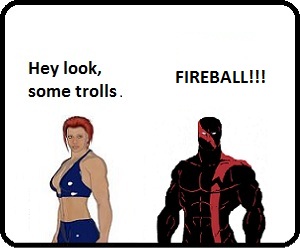
GM:      “From your vantage point you see two trolls cooking something over a fire pit.  Both wear what looks like leather armor and carry large two-handed weapons.  Two cave entrances behind them are dark but you can hear occasional noise coming from inside.  What are you guys doing?”

Player 1: “Those trolls look pretty tough, maybe we should find a way to get around them.”

Player 2: “You may be right. (To the GM) How dangerous are trolls?” (Rolls a skill check)

GM:      “Well you know that they are tough, resilient, and really strong.  These two appear to have some martial training and look VERY capable.”

Player 1: “OK, let’s create some sort of distraction to draw them off while we sneak in.”

Player 2: “Sounds good, I’ll…..”

Player 3: “I’m going in, we can take them!”

Player 1 & 2: “What!?  Are you crazy?”

Player 3: “Obviously this is a combat encounter.  We’re in good shape let’s go!”  (To the GM) “My character charges down the hill…”

Have you ever had a situation like this in your game?  If you’ve been roleplaying for any length of time, I’m sure you have.  In gaming circles this is called metagaming – justifying character actions through player assumptions and game knowledge.  It usually happens when players make in-game decisions for their characters based on out-of-game reasoning.

Metagaming can become very disruptive in your game, especially to the players who are of the immersive, roleplaying-heavy bent.  Not only does it completely break the roleplaying atmosphere, but if you play at my table it can also have disastrous consequences.  A couple of years ago one of my players led an entire party to a TPK solely based on the belief that “if the DM put them there then surely we can, and are supposed to kill them!” If you have gamers at your table that love being “in character” or who really enjoy “getting into” the story and setting, then metagaming can completely destroy their enjoyment of the game.  At the very least, it is distracting and annoying.

I classify metagaming into two broad categories: lesser and greater. Lesser metagaming tends to be more of a nuisance whereas greater metagaming can be downright destructive.  Both types can be a problem.  The following discusses each type in depth, and include suggestions as to how to manage them at the table.

Lesser Metagaming

Every gaming group has their own level of “table talk” that is acceptable.  I have no problem when my players say tactical things to each other in combat, like “Verick, push him toward me!” or even, “Verick, use Tide of Iron!” My justification for that is that any group of people who enter combat situations together on a regular basis are bound to develop certain hand signals, gestures, and short verbalizations to convey exactly that kind of combat information to one another.

For many players it is difficult enough just to keep player knowledge and character knowledge separate.  I think of this as Lesser Metagaming.  A good example of this is when a player acts on knowledge obtained during a conversation that occurred between an important NPC and a different party member, even though the first player’s character wasn’t present for the conversation.  As a DM, I usually assume that the characters share information amongst themselves when time allows.  But sometimes there just hasn’t been the opportunity for the characters to talk and catch up or the character with the information wants to withhold it for some reason.  This level of metagaming is usually pretty easy to deal with in any one of the following ways:

  • Simply remind the offending player that his character wasn’t there or doesn’t know that.  I personally hate having to break game in order to remind players of this but sometimes it’s necessary.
  • Conduct conversations and events that happen between NPC’s and a limited number of party members in private.  Step into another room or ask the players whose character isn’t present to step away from the table.
  • Share limited information by passing notes.  That way the receiving player can decide when, or if, to share the information with the rest of the party.

Greater Metagaming

The greater level of metagaming, and the one I find very frustrating to have at the table, is the player whose character repeatedly acts upon knowledge and information that the character does not, or could not possess.  This ranges from the player who “knows” the Monster Manual and confidently attacks the creatures because “They’re 5th level!” to the player that completely neglects roleplaying and refers to everything in the game by stat, number, or mechanic.

This player can be much more difficult to deal with.  The lesser metagamer is frequently just “caught up” in the story and sometimes forgets where his character is, or was, whereas the greater metagamer is usually someone who approaches roleplaying games in a board game, card game, or miniatures game fashion where more often than not you need to speak from a rules-centric point of view.  Sometimes this stems from habits acquired with a different gaming group where metagaming was acceptable or even encouraged.

Over the years it seems like I have encountered this type of gamer regardless of game, setting, or group and each time the impact is the same – other players are pulled out-of-character, I’m forced to spend valuable time performing “player management”, and the story suffers.  Dealing with this situation usually requires a two-pronged approach.  First:

  • Pull the player, or players, aside and discuss the situation.  If the metagaming habits are distracting the other players or interfering with the game let them know that.  Keep in mind you may need to give some examples.  I’ve found that many metagamers frequently have no idea that they‘re doing it or that it’s disruptive to others, especially if the player has gamed with groups where this kind of gaming is the norm.

The second part of dealing with this is usually the need to address the “gaming climate” at the table.  Every gaming group has a certain approach to the game.  If a metagamer is disruptive to your group’s approach, you can encourage behavior modification through your decisions as a DM.  Make sure metagaming isn’t rewarded and doesn’t contribute to success.  A few things that I do in my approach to campaign design that discourage metagaming include:

  • Customization.  4th edition D&D is the easiest system I’ve ever used when it comes to altering, modifying, and customizing monsters and NPC’s.  At least half of the opponents my players face are modified from their stock Monster Manual entries.  In fact, adjusting a creature up or down a few levels is easy even “on the fly”.  Customizing keeps your players guessing and downplays your metagamer’s knowledge.
  • Mix it up.  Most of the players at my table know that just because something appears to be an encounter doesn’t mean it’s a combat encounter.  Many encounters I design are socially interactive, skills-based, or even investigatory in nature.  I don’t ever restrict the players in how they deal with a situation, but I also make sure that they feel the repercussions of approaching every situation the same way or at the very least make sure they realize that other options exist, and in fact, may have been a better alternative.
  • Assumption.  Many RPG’s assume that as a gamemaster you will be designing encounters that are “level-appropriate” for your gaming group.  Although this approach is a good baseline to adventure design, your players are well aware of this and some will act based on this assumption.  Most of my players have learned (sometimes the hard way) that I don’t strictly follow this philosophy.  In the real world many people may subscribe to the thought that “god only gives you challenges you can deal with” but in my world this god is an uncaring bastard.  I won’t ambush a group of 3rd level characters with a patrol of paragon tier trolls, but when your party spots the patrol and decides to attack it you can bet the fight will be a short one.
  • Information.  I’m a detail-oriented DM.  I try to always describe the character’s surroundings in ways that they can not only “feel” the setting but also potentially glean important information from it.  Before the characters get in over their head, or make a foolish decision, I’m always sure to have dropped plenty of clues and hints as to the nature of the peoples, places, and events around them.  Some of my players pay attention while others assume that “player knowledge” will trump “character knowledge”.

Conclusion

If you are like me and find metagaming to be disruptive, remember that there are many ways to subtly, and not so subtly, influence player behavior.  But the most important thing to remember is that roleplaying is a social group activity.  Different people with different personalities, habits, and behaviors are coming together for a cooperative experience, and like any group social dynamic, everyone will approach things in their own unique way.  If a player’s methods are disruptive, always start by just talking to the individual, more often than not simple communication is the key to a more harmonious gaming environment, and therefore a less stressful gaming experience.


Gamecraft: The Stress-Free GM

Over the years my approach to running games has changed and evolved.  I used to spend the game session scribbling notes, rolling dice, consulting charts, and frantically trying to anticipate my players’ actions, and keep them on track.  Oftentimes, the players would throw me off by wanting to go somewhere that I hadn’t planned on, or by interacting with an NPC that I hadn’t fleshed-out, or by taking a totally unexpected course of action.  These are those moments of pure GM frustration, when the players go “off the map.”  Sometimes I would just wing it and hope for the best; other times I would stop the game for a while to readjust and compensate for the new direction things were going.  Both of these techniques worked to varying degrees, but not without adding stress to my life and completely disrupting the game.

These days when I run a game, I do it with the confidence that nothing is going to throw me off or derail the game.  I’m ready for whatever the players want to do and wherever they want to go.  I’m ready to tackle whatever the players throw at me.  So what’s the secret to running the stress-free game? How do you approach your game with this level of confidence and self assuredness?  Well, the answer is simple, really.  Do what I did – run games for thirty years and eventually it will get easier!  However, for those of you who’d prefer some advice that can help you tonight, I’ll let you in on the secret: relax, be flexible, and don’t stress… But since that’s easier said than done, I’m here to offer the following tips and techniques for making your life easier and for making the game as fun for you to run as it is for your players to play.

Tip 1: Change Your Focus

In the past, when I would begin laying out a campaign I found that I was very player character-focused.  My mindset had me thinking about how the PCs would do something, or when an event would happen to the PCs, or what the PCs would do.  Although it is critical to remember that the players and their characters are the focus of the story while actually playing the campaign, they are not necessarily the focus while designing the campaign.

These days when I begin designing a campaign, I start by focusing on the setting and the NPCs.  I develop a feel for the people, places and events that are going to be important during the campaign.  Even before I have a theme, a primary antagonist, or plot line in mind, it’s critical for me to know the setting, to have an understanding of how its components work together without interference.  I get a feel for the setting and then begin thinking about the people within it, more specifically, who they are, why they are there, and what they want.  Once I have some idea about the people in the setting I move on to thinking about my antagonist(s).  I don’t need to think about goals or motivations yet, just what type of antagonists the campaign will feature.  There could be power-mad despots, a criminal organization, psychotic serial killers, or even the environment itself working against the heroes.

Having an idea about the campaign’s antagonist, I beginning thinking about what they want and how they are going to get it.  In my mind I begin telling the story from the villain’s point of view.  I think about where the villain will go, who he will ally with, what he’s going to do, and what he’s already done.  I have found it is much easier to envision the antagonist’s plans at this point without thinking about how it will interact with the PCs.  In a nutshell, I imagine how the campaign will evolve for the antagonist without any influence or interference from outside sources or random factors. Enter the PCs, or as I like to call them, the random factors.

Changing your design focus makes it much less work to remain flexible and adapt to the infinite variety of unforeseeable things that your players and their characters do.  Reacting to the characters’ actions is much easier than anticipating them.  Once you begin thinking from the antagonist’s and the world’s points of view, it usually becomes self-evident what will happen in response to any course of action the PCs choose to take.  A clear understanding of what the bad guys are trying to achieve makes it easier to figure out how their plans will change when they’re interfered with.   When you eliminate the need to anticipate the actions of the player characters your life as a GM becomes much less complicated.  Remember, focus your energy on the characters you control, not the ones you don’t.

Tip 2: You Run the World, not the Other Way Around

As GMs, we continually design and create worlds – even when we use published settings we still take great liberties with the design for our individual campaigns.  However, in an effort to design a realistic and exciting setting, many GMs frequently back themselves into a corner. We do this without even realizing what we are doing every time we place a dungeon on a map, when we pick a specific location for some climactic battle, or even when we decided when an event will occur.  Once we commit to some specific time, place, or event within the campaign, we often become completely inflexible about it.

I use to do this all of the time.  I would design a great location for some fantastic encounter, make it the scene for the final confrontation with some arch-villain, and then I would place it somewhere on my map.  The only problem was the minute I placed it somewhere, whether on a physical map or in my mind’s eye, I felt committed to its location and its circumstances.  I would place myself in a position where I was forced to find a way to get my players to that location or to make those circumstances occur.  By doing this, I allowed the world to control my game and dictate the things I needed to do to make my story work.  The secret to overcoming this is for the GM to not fear having a lack of commitment. I know this goes against everything your parents, boss, and significant other has been saying to you, but it is one of the secret keys to stress-free gamemastering.  I like to think of it as the Schrodinger’s Cat Theory of campaign management.

For those of you unfamiliar with Schrodinger’s Cat (and if you call yourself a geek you should be familiar with it), it is a thought experiment in which a cat is placed into a box wherein there is a 50/50 chance of the cat being killed.  How the cat might die is irrelevant here (maybe it’s a one hit point minion) but Schrodinger suggested that until we actually look into the box we don’t know the cat’s fate, and furthermore the cat’s fate may, in fact, be undetermined until we look into the box.  So what does Schrodinger, his cat, and your lack of commitment, have to do with being a better GM?  Simple, be flexible.  Remember, only the part of your world that the characters are actually interacting with, needs to be in solid, sharp focus with a sense of permanence.   Many of the aspects of your world can be safely tucked away in the box with Schrodinger’s Cat.  They can exist in a state of flux, ready to be used when and where you need them until the characters open the box and “reality” is forced to take shape.

When I gamemaster, there are many “static” features in my campaign – most of the villages, cites, and geographic features of the world are fixed and in permanent locations.  However, there are still many aspects of the campaign area I leave “in the box.”  Say for example, I design a haunted tower. I won’t commit to it’s location until I’m forced to.  Then when I need to use it I can place it in the characters’ path.  Of course, it won’t appear in a place in which the characters have actually been and they know there has never been a tower there (unless it is some sort of “ghost-tower” or something), but it will appear when I need it and once the characters “look in the box.”  This reduces GM stress in a couple of ways – first, I don’t have to worry about how to get the characters to the tower.  I don’t have to drop a bunch of “subtle” hints or worry about “railroading” the characters.  And secondly, it helps maintain the illusion of free-will for the characters.  This approach works for events, locations, NPC’s, almost anything.  Many of the elements of your campaign are things that can remain in the box until you decide that it has been opened.  Remember: flexibility is the hallmark of the stress-free GM.

Tip 3: Just say “Yes”

One of the things that more games are stressing to GM’s is the idea of saying “yes” to players instead of saying things like “no you can’t,” or “no your character wouldn’t do that.”  I’m a huge fan of this concept.  Nothing kills the illusion of free-will like saying “NO” to the players.  Don’t be afraid to let your players attempt anything. Remember, even if success is virtually (or even completely) impossible, it doesn’t mean that some fool (I mean PC) shouldn’t be allowed to give it a try.  It’s completely fair to let the players know that the chances for success are slim to none, but never simply tell them no.  Besides running the risk of making the game less enjoyable for your players, you are missing a golden opportunity to let the game grow on its own accord, instead of you always having to be at the helm.

Why are some gamemasters unwilling to say yes?  There are a lot of reasons.  Sometimes the GM hasn’t anticipated the character’s actions, so feeling the pinch, they say no.  If this is you, go back and read the first section Change Your Focus.  Others may not feel prepared for where a “yes” may take them.  If this sounds like you, go back to the second section, You Run the World, not the Other Way Around, and read that again. But for many of the GMs I know, they are afraid to say yes because they are unsure of a game mechanic or feel they don’t know the rules well enough.  Never let the rules get in the way of a good time.  In some cases rules aren’t even necessary, but if you feel they are, keep in mind that virtually every game out there has some sort of “core mechanic.” Use it.  Pick a stat, roll against it.  When all else fails, simply assign a percentage chance for success and roll away.

The important thing to realize is that saying yes actually makes your job easier by allowing your players to exercise their character’s free-will and being able to do virtually whatever they want – players love that.  It also helps build player/gamemaster trust.  In some campaigns the GM begins to seem like an unyielding authority figure, someone who is always telling the players no and forcing the story upon them.  When a group of players has trust in their GM, he becomes a partner in the story-telling, not a dictator, and he shares in the group experience.  This kind of relationship eliminates many of the problems that can come up at the table greatly reducing GM stress, and that is the key to allowing your best game to come forward.

Tip 4: Let the Players do the Work

One of the most stressful parts of being the gamemaster is the responsibility of continually providing new, thrilling, and creative adventures that characters are emotionally invested in and players are excited to go on.  In fact, the pressure to turn out great stories and adventures can easily cause GM burnout and make running a game feel more like a job than a beloved hobby.  The key to staying fresh and keeping your creativity up is remembering that most of us GMs do a lot more work than is strictly necessary when it come to creating great stories.  As GMs, we tend to forget that our #1 resource for inspiration and motivation are the players sitting around our table.

Earlier I talked about designing the campaign without focusing on the PCs.  Although this helps reduce the frustration of anticipating the characters’ actions, it doesn’t do much to “connect” them to the story.  This is where character hooks become the bridge between your story, and the characters’ stories.  Need to motivate characters into action, use an old friend or ally.  Want the players to care about a community, make it a character’s hometown.  Need an assassin for your arch villain to send against the characters, of course it’s an old enemy with a vendetta.  All of these NPCs may seem like a lot of work, but let me share a little shortcut with you; make the players do the work.

When I’ve finished laying out a few general aspects of the campaign (see Change Your Focus above), I sit back with the players while they create their characters.  I like to help the players come up with interesting backgrounds, character hooks, and ties to each other.  Among other things, I ask players to come up with some NPCs, at least three friends or allies, three rivals, three mentors or contacts, and at least one true enemy.  These don’t have to be more than a name and a one or two sentence description, but right away I have 20 – 40 custom made NPCs for the campaign that tie directly to the characters.  This, combined with a background consisting of at least a place of birth and two or three notable life events, and I have plenty of inspiration for dozens of great adventures.

In my campaigns, I usually have one or two primary plot arcs designed for the overall story.  Oftentimes however, that isn’t enough to carry an entire campaign, or they simply don’t dominate every part of the campaign level-to-level.  Enter the character hooks; they are an excellent resource to mine for adventure ideas and sub-plots.  These act as mini-stories within the greater plot line that help to tie each individual character into the campaign and make each of the players feel like they are part of something greater.  This not only takes some pressure off the GM by giving him some ideas to work with, but also helps build verisimilitude in the world.

Using your players’ own creativity to help fuel yours goes well beyond simply assisting you as the GM; it also makes the players “connect” with the world and keep them emotionally invested in the events that transpire there.  Once your players feel that their characters are the story and not just in the story, the game truly becomes a shared experience, and that motivates the entire group to work together to produce an excellent game.  Sharing the workload is another key to stress-free gamemastery.

Tip 5: Sit Back & Enjoy the Ride

All of the ideas presented here were designed to help you, the gamemaster relax and have more fun while running the game.  By using the tips and techniques presented above you should find the stress and anxiety that sometimes comes with running a roleplaying game to be greatly reduced.  With time, you may even find yourself feeling more like a player and less like the person in charge.  Hopefully, you will be able to shift your role as gamemaster from director, needing to control everything and keep the players on track, to story participant, watching events unfold around you and being pleasantly surprised by where “your” story takes the group.

The Clock is Ticking: Motivate Your PCs with a Deadline

It’s a problem: you give your PCs an objective, a goal, and they spend most of their time pursuing every side distraction they can think of. You need to get them focused on the task at hand, but how to do that? One way to help keep the PCs moving forward is to give them a time constraint—a deadline. If the PCs don’t accomplish their objective by an appointed time, something bad will happen (or something really good, if they do make it).

Deadlines can give your adventure a sense of urgency and help keep players on track, making them less likely to take unnecessary side-trips. But they can also push players too fast. With the threat of time looming over them, PCs will be more likely to rush through the adventure, perhaps missing necessary clues and information. It can also cause them to finish the adventure well before you were ready for them to, as the adventure you’d planned to last four weeks or so gets resolved the first night.

There are many ways to impose deadlines: the villains can give the PCs a specific one, as can the PCs’ employer, if they have one. The PCs can also stumble across the deadline during the course of investigating the adventure. Perhaps their research tells them that the evil cult will perform their next blood sacrifice at the summer solstice, or something like that. Note that deadlines don’t have to be specific date; they can also be a particular event, such as needing to find a lost child before an impending blizzard begins.

Before you give your PCs a deadline, you need to know what will happen if they meet the deadline, and what will happen if they don’t. You need these to be things that will really motivate the PCs: make the rewards for success extremely mouthwatering, or the consequences of failure truly awful. These need to be things your players will find compelling, otherwise your deadline may be greeted with a yawn. And you have to be ready to follow through with the  consequences, for good or ill, or your players will never take another deadline seriously.

Even if the prepared adventure you’re using doesn’t have a deadline written into it, you can set one yourself. Figure out why your PCs would go on this adventure in the first place, then set a logical reason why it has to be completed with a particular time frame.

Not every adventure needs a deadline. In fact, this is a trick that’s easy to overuse. Deadlines are particularly appropriate for adventures that have real-world time limit, such as convention games that have to run in a specific span of time, such as four hours. Use them too often, especially for adventures that don’t really need it, and they lose their impact.

Sayin FUN to your Players

This is not the first article to be written on this subject, nor will it be the last.

In my experience, there are two kinds of DM’s.

One is concerned with “balance,” the other with “fun.”

For the record, this is not me complaining that I was never allowed to try my crazy idea for a half-orc fighter/barbarian with a spiked chain, and massively exploit the attack of opportunity rules. (Author’s note: I never actually saw the appeal in anything that full of cheese, though I gather it was popular with a certain brand of player. I was, however, sorely tempted to try a half-orc wizard, just to go against the grain.)

This is, however, the result of being long exhausted with being told ‘no’ by several DMs for no better reason than, “it isn’t in the book,” or, “Company X didn’t update that one, so it’s not allowed at my table.”

Let me illustrate my point with a story.

I’ve been invited to play in a game of Pathfinder or two. The system isn’t my favorite, but I have some small nostalgia for 3.5 edition as it was what started me off in D&D, so I went for a couple of one-shots and tried to like it. I wrestled with the character creation process for far too long, developing two concepts that I felt I could live with.

The problem was, by this point, I’d been exposed to a lengthy conversation in which one of the other players tried to explain to me why he prefers Pathfinder to 4th Edition in a failed attempt to “convert” me, and vice-versa. The more he said what he liked about the one over the other, the less likable it seemed. Building the character wasn’t fun. The concept was full of cheese. I wasn’t looking forward to the game anymore.

Finally, I threw up my hands. In an effort to salvage my chance to have fun for the evening, I went to the DM for the session and explained my position very politely; that there was really only one class that I wanted to play, and it was from a 3.5 book. I was perfectly happy to convert it using Paizo’s official 3.5 to Pathfinder conversion guide, and the work required would be minimal (it basically came down to raising the hit-die by one to match precedent with the core classes).

Were I the DM for the game, I hope I would have answered with what I believe is the correct response to something like this. “I’ll let you try it, and if it creates a problem for anyone at the table we’ll talk about it afterward and see what we can change to make it work.”

Instead, I was given a sneer, a half laugh, and told that there was “a reason” that Paizo hadn’t updated that particular class. A flat no.

The fact that they didn’t OWN it occurred to me immediately; that was why there were conversion rules, after all. It didn’t matter.

It was at this point that I gave up, and decided that I’d rather not play at his table. Maybe that was the wrong answer; I don’t know. But I wasn’t having fun anymore. I came to play a game; to have fun. Nothing about this experience was enjoyable. I was momentarily tempted to give up D&D entirely, to say nothing of Pathfinder. What is a game if it isn’t fun?

I’ll answer for you, gentle readers; it’s work. And unpaid work, on top of that.

For the record, I’ve recovered my love of the game now, though it will take a lot of placating and outright bribery to convince me to sit down at a Pathfinder table again – and never with that DM!

Now, let me tell a second story, just to make it clear what I’m not trying to say.

I was DMing a game of 3.5 edition D&D a few years ago, and one of the players showed up and informed me that his character was a 3rd Level Blood Elf Fighter who Dual Wielded Katanas.

At this point in my life, I had no idea what a “Blood Elf” was, but considering how much material for the game I’d fairly devoured, I was reasonably sure it wasn’t D&D. I also knew enough to know that dual wielding katanas was a really, REALLY bad idea in terms of game mechanics. I tried, gently, to dissuade him.

He insisted; I relented (against my better judgement). He got himself into a fight – a very angry one – with our 1st level dwarven wizard, who, after winning initiative, ended things with one spell. Knocked him out, tied him up, and sat on his head.

The game fell apart after that, and I suspect that it might have lasted longer if I’d been smart enough to put my foot down and say no in the first place.

As a DM, there is a time for yes, and a time for no. Knowing which is which can be all important. Everyone has guidelines. These are mine.

1. If a player asks to play a character of a class that I’m not familiar with – and it’s because he thought the concept sounded cool, not a mechanical reason – and there’s no philosophical reason why it can’t be made to work in a diverse and accepting group of adventurers …

I’ll say, “let’s try it out. If it turns out to be too powerful and it’s spoiling the fun for the rest of the group, we’ll talk about it afterward and see if we can fix it. But whatever I say during that discussion is the final word.”

This also applies if a player asks to convert something from a mechanically similar game system.

2. If a player asks me if he can play a half-orc spiked chain wielder or a greatsword guy with sneak attack or a Barbarian/Rogue or any number of other cheesy ideas and cites purely mechanical reasons for wanting to do so, I will say, “no. Come up with something that has a backstory and a little more character, and stop reading the Character Optimization threads online.”

3. If a player likes the fluff of one class and the mechanics of another and can’t choose, I’ll offer to let her combine them, adjusting key abilities as necessary. And I’ll probably go so far as to tell her how cool that is for thinking outside the book.

4. If I EVER hear the phrase, “dual katana’s” again, I will say, “NO. At least have the decency to get a wakizashi, and learn about samurai before you mention the word “katana” in my presence again.”

One final word: you needn’t give your players everything they ask for. But try to know when they’re already struggling to have fun, and work with them. Please. They’ll thank you for it.

Using Flashbacks in your Roleplaying Game

Flashbacks are known from movies and TV, where they can be used to reveal important moments in the past of the characters, can reveal the motives of the villains, and can be used to surprise the audience when a well-timed flashback reveals that our heroes already had taken care of the villain’s alarms. In roleplaying games, the flashback can be used in much the same manner and with great effect.

Far from Civilization

When the adventurers are traveling in the wilderness far from civilization, civilization and important NPCs are never more than a flashback away. If battling monsters in the wild needs variation, then flashbacks can be the right tool. Go back and play scenes, where the characters bid their farewell to their loved ones, or run out on their money-lenders, or to the moment when they were visiting the senile sage.

No Dangers Lurk in the Flashback

We know that the hero will not die during the flashback (or at least that he will be brought back to life again), and one might argue that a flashback becomes devoid of danger, but that is not true. The life of the character may not be at stake, but many other things will be at stake. A flashback may confront the hero with a monster, and if he does not deal successfully with it in the past, he may still be paralyzed with fear, when he confronts it now. A clue may be lost, a piece of equipment may spend one charge too many, or the villain may successfully dishonor our hero. Death is not the only danger.

How to do Flashbacks

In the following, I will cover four different types of flashbacks. They can be used on a regular basis in a campaign, or you can use them for a single session to underscore a theme. The flashbacks (as presented) are mainly used by me in D&D, but they are more or less a plug-in that can be applied to other games, such as Call of Cthulhu, GURPS and Storyteller.

Character-Background Flashbacks

In order to earn a bonus to a skill check, to reroll a failed roll, or to posses the right tool, the player sets a flashback-scene. The player describes where and when, who is present (the present NPCs are played by the other players), and what is happening in the scene.

The scene is then played out briefly, lasting a few minutes, but revealing an important fact or story about the character. These flashbacks are rarely (if ever) planned ahead, and the player may ask the rest of the group for assistance with setting up the the scene.

As a creative constraint, a flashback could be tied to the present situation – the character e.g. is battling an orc, and the flashback reveals how he (as a child) tricked a bully, or when lifting a rock to rescue a trapped friend, the flashback goes back to that one time when his pet was trapped under a log. Creative constraints can be tied to other elements.  For example, it must reveal an embarrassing moment in the character’s past, or a moment when he failed or ran in terror, and now he has the chance to once more confront his fear. And yes, this means that flashbacks can be played out in combat-scenes too, amidst attack rolls.

The amount of flashbacks available should be tied to the kind of resource the player gets. A single modifier such as a +1 or +2 in D&D to a skill check can easily handle the player doing a flashback as often as once per skill check – this may sound like much, but the players themselves will limit the use – for even though the bonus is tempting, it is not always interesting to play a flashback. Flashbacks might also be limited to two or three times per session or adventure.

In one particular game of D&D E4, our flashbacks were to a Skill Challenge, and individual players could earn bonuses to their skill checks by playing moments from their character’s past. This allowed us to expose the character’s back-story during the game, and for one character we had learned a lot about his days as a diplomat in his youth.

Important Flashbacks – Life-Changing Moments

Some moments in a character’s life are life-changing. These are truly worth playing out, even if they happened a long time ago. When a character is created, the player chooses three such events and adds one more, when a level is gained, a fate point is earned, or it can be bought for XP.

At dramatic moments, such as when a failed roll might mean the death of the character, the player chooses one of his scenes and it is played. It might be the scene where the character confronted his parents and ran away, or when she discovered her magic talent, or when she was initiated into a secret society of assassins. For one of our players, it was the moment when his character failed a skill check jumping from one enchanted airship to another. The character would have fallen to his death, had he not spent a flashback revealing to us the very moment the character realized his call to be a paladin contrary to his parents’ wishes.

Life-changing moments are longer scenes, but otherwise directed by the player. Once the scene is over, the failed roll is turned to a success, or the character miraculously survives or some such. These moments are limited, and work much like fate-, hero- or action-points in various games, but in this case, they are tied to the character.

Game Master-Controlled Flashbacks

Some flashbacks are controlled by the GM, as they are a part of the story to be played. Such a flashback may last a whole session and may reveal the origins of the PC’s (where some or most of the other players play NPCs), or there may be several flashbacks during a session, where bits of the plot are gradually revealed for the players, changing their perception of the events (and this may be due to them regaining their memories or just a narrative trick, where they slowly remember their past by playing out the events).

These flashbacks can be a handy tool to expose parts of the plot that need exposure, such as the characters visiting the sage before leaving town – before each encounter with a monster, we skip back to the meeting with the sage, where the characters are trying to get the senile sage to remember what he knows about the monsters.

A classic type of flashback is to reveal that the newly arrived NPC is an old friend. That kind of flashback is common from movies, and it is all too easy to use.

Flashbacks can also be used to place the characters in the middle of events – in media res – battling the necromancer’s zombies and then cut back to reveal how the characters took the job, and how they ended up here. Again a classic known from TV and comic books.

In RPG’s, an extra challenge can be added.  For example, informing the players that flashes can only be activated under specific circumstances (in 4E, as a part of a skill challenge to remember during the combat, or when the PC’s break the enchanted memory crystals to release the memories, or simply when they overcome certain challenges).

Plot-based Flashbacks – or The Heist Maneuver

This type of flashback is tied to a specific mission or adventure, and works very well with heists.

In movie-heists, we see the main characters meticulously plan the heist, displaying a knowledge and expertise that often can be beyond the resources of the players and the game master. It may be cool to procure blueprints of a palace and the knowledge of how a lock works, but it requires much prepping. This can be solved with flashbacks.

In this type of scenario, each player usually owns three or four flashbacks, that can be employed whenever the character is confronted with a challenge. The player then activates the flashback and either cuts back to a moment during the planning or to a moment when a certain piece of equipment or information is picked up.

A heist-scenario can begin with a short briefing, and then you skip the planning and begin the scenario at the gates of the building. The players can either confront the challenge with the immediate resources of the characters, or activate a flashback.

Each flashback is player-controlled, and can reveal several different things, Such as revealing how the character memorized the guards’ patrol schedule, stole the gatekeeper’s key and made a copy, or how they picked up meat and sedatives to handle the guard-dogs. For a group of GURPS-characters in an old campaign, this was the approach in a science fiction-scenario on infiltrating a research facility.

The heist-flashback allows you to simulate the planning of a good heist, and even though it may seem a powerful method to use flashbacks, it does not remove the dangers. The flashbacks are a resource, and the players need to carefully manage their flashbacks, or they may run out at the most dire moments, such as when the vault releases it’s poison gas.

The heist-type can be used for any type of mission, where pre-planning plays a role from infiltrating a thieves guild to stealing the treasure from a dragon’s lair. However, it is not limited to these kinds of scenarios, it can also be used for political intrigues, where flashbacks reveal the shady maneuvering performed before important meetings, where guards are bribed, and servants convinced to allow access to important files.

In the end, the flashback is simply a great tool for any roleplaying game.

Coloring Inside the Lines: How Limitations Can Improve Your Adventure Ideas

Adventure writing is often viewed as a free-form creative exercise where the “sky’s the limit”. The fantasy genre, with its emphasis on magic, can especially leave the adventure ideas open to pretty much anything our minds can imagine. Science fiction isn’t as open-ended, since it’s supposed to be at least theoretically scientifically plausible (or at least feel like it is), but even here, the adventure-writer’s options are legion, as they are with any other genre, from modern horror to steampunk to superheros.

You would think that such openness would be liberation, allowing our many ideas to flow effortlessly and for some writers, it is. But for others of us (including myself), this sense of infinite possibility actually causes us to freeze up. There are simply too many choices and our ideas run dry. How do we get around this?

There is a surprising answer: limit our choices. It seems counter-intuitive. Yet, by placing limitations–rules, if you like–on your adventure-to-be, you restrict yourself to a more limited set of choices, something you can handle more easily. The trick here is to strike a balance: too many rules and you can make your adventure feel stiff, shallow, or trite; too few and it can become unfocused and leave players wondering what they should do next.

How do you know you’ve got the right amount? I’ve found that applying rules one-by-one, I’ll reach a point where my ideas start flowing. That’s the point to stop restricting and start brainstorming. Some rules are already set for us, even if we don’t think of them that way. The first restriction we usually have to take into account is the genre we’re playing in. Unless you’re in a homebrew or cross-over game, you’re not going to want to place magical wards in your Traveller game.

Another common restriction is setting, whether you’re using your own or a published one. The worlds has some established rules, rising from how the setting “works”. Does magic come from ley lines and the further you are from them, the weaker magic is? Then you know you can’t place a magically dense area far from ley lines, unless you have a good explanation about how it can exist. Does your SF game contain alien technology? If not, then any seemingly Clarke’s Law MacGuffins* are going have to have rational explanations that fit in with the available technology of the setting.

Can you see the plot ideas developing here? With the SF idea, for example, the PCs find a piece of technology that seems way to advanced to exist. Intrigued, they track the item back to its source or set out to find someone who can analyze and explain it. Along the way, they’re shadowed by the company that created the item and want to get it back because either a) it doesn’t actually work or b) they’ve developed some proprietary new technology and don’t want anyone else getting their hands on it before they’ve developed and introduced it to the market. Or it’s a military secret and they can’t risk the PCs putting it into the wrong hands… You could probably take this adventure from here.

That’s the idea behind setting rules. You’ll want to be careful about not violating the rules of your setting without a good reason. It’s okay to look like you’re violating the rules, as long as you have an explanation that makes sense within the game setting. One note: you don’t have to give the PCs the explanation right away; make them work for it. That’s where your adventure comes from.You just need to make sure you actually have one and that your PCs can eventually find out what it is.

If setting rules aren’t enough to get the creative juices flowing, you can establish rules for this one adventure. Perhaps all the PCs are trapped in a single room for the entire adventure. This idea leads to questions:

* Why this room?
* Where is the room located?
* Why are they trapped?
* Who put them there?
* What conditions do the PCs have to fulfill to get released?

By the time you’ve answered these questions, you’ve created your adventure.

By selectively applying limitations or rules to an adventure-to-be, you can actually increase your creativity and your ideas. Take one rule at a time and explore it’s implications, thinking about the questions it raises and answering those questions. This can lead to many interesting adventures you would never have thought of otherwise.

[This article is an excerpt from rpgGM.com’s upcoming product The Adventure Creation Handbook.]


*Clarke’s Law, posited by SF writer Arthur C. Clarke, states “Any sufficiently advanced technology is indistinguishable from magic.”  A MacGuffin is a plot element that drives the action of a story.

Most Evil Utterances

Please welcome Jonathan Baldwin to the Stuffer Shack Crew…

Sometimes you really need your villains to stand out in the minds of your players. Since role-playing is, at its heart, a verbal exercise, this means spending a little extra time on your dialog.  You can describe the wicked fiend all you want, but unless you have pictures, your players are only going to remember what s/he says.

To get you started with some inspiration, here are a few of the best lines of dialog ever delivered by an antagonist.

“Welcome to my home; enter freely and of your own will.” –Dracula

The hospitable villain is a truly frightening force; if things are played right, the heroes won’t realize that they’re dealing with the Big Bad until they’ve already enjoyed his hospitality for some time.

“This is why only fools are heroes — because you never know when some lunatic will come along with a sadistic choice. Let die the woman you love… or suffer the little children. Make your choice, Spider-Man, and see how a hero is rewarded.” – The Green Goblin, Spider-Man

It’s the oldest move in the playbook, and it’s still as effective now as it was then. Two outcomes, both bad for the PC’s, and supposedly there’s only time to pick one. Of course, there’s always the possibility that the heroes will be properly heroic and come up with an out. Sometimes that’s good – especially when the villain is a monster, rather than an intellectual giant. Sometimes, however . . .

“How very predictable. I anticipated you would try to create a third, more favorable option.” –D.A.V.E., The Batman

It’s hard not to respect a good Xanatos Gambit; any villain smart enough to structure a plan in such a way that every possible outcome including failure works toward his goals is worthy of respect and recognition… or at least undying hatred on the part of the PC’s. Sometimes that’s good enough.

In a long campaign, this might work like pretty much everything Darth Sideous/Palpatine does in the Star Wars prequel trilogy.

Conveniently, as the GM, you don’t have to know all the possibilities ahead of time – you only have to be able to improvise if the players do the unexpected, and continue moving the plot forward. If you do it right, you look like a genius – or at least your villain does.

It should be noted, if you can ask, “But what if they do this?” and it would mess everything up, this is a Batman Gambit, which for villains is a plan which relies on the heroic tendency to behave in the most heroic manner, or otherwise assumes and manipulates a certain response based on known facts about the “victims.” Sometimes leaving a flaw in the plan on purpose isn’t a bad move. If the heroes find it, they feel great because they “outsmarted” the GM; if they don’t, you have something for your villain to monologue about during his getaway. Assuming he gets one.

“I can’t think of a morning I haven’t woken up with the thought of strangling you. That sanctimonious image of yours fooled everyone except me. Because I know evil.” –Lex Luthor, Public Enemies

This betrays a hatred that has completely distorted the villain’s perception of morality. To create this effect, operate from the assumption that the majority of antagonists aren’t card carrying villains and will develop some kind of rationalization that explains why they’re right and everyone else is the villain for trying to stop them. Create a villain who believes that he’s the hero of the story, trying to “save the world;” if your PCs are heroic sociopaths this can be easy, but for truly sanctimonious heroes the rationalization might take a little more work. Invariably, this kind of villain is the most interesting.

“No. I am your father.” –Darth Vader, The Empire Strikes Back

…or mother, sister, daughter, cousin, evil goatee sporting clone or alternate universe variation . . . even if the villain is lying (and let’s face it, they probably are), this is a great moment.

“You lose, Tony Stark.” –Whiplash, Iron Man 2

The villain has planned ahead so effectively that his own death is factored into an ideal condition for victory. Maybe the villain’s death is broadcast to the general populace and makes the heroes look like murderers. Maybe death unleashes the villain’s spirit to wreak havoc. Maybe death transforms him into a vampire. Alternatively, the villain’s death might just trigger the bomb and leave the hero with only seconds to evacuate the area.

“I did it thirty-five minutes ago,” –Ozymandias, Watchmen

…or any credible variation on the theme of “You’re far too late for it to make any difference.” This specific example is my all-time favorite – to this day, I can’t read this part of Watchmen without my jaw hitting the floor, even when I know that it’s coming.

There are far too many great lines to count, and these are only a few of my personal favorites. Have a favorite that I missed? Leave it in the comments!

The Gamecraft 25: Plot Complications

This time, the Gamecraft 25 is going to take a look at plot complications for your adventures.  All of these are designed to add an interesting set of circumstances to challenge your heroes in different ways.  Most of these ideas will make an adventure more difficult, so keep that in mind when using them.

  1. The party has a “tag-along.”  This could be a bard looking for epic inspiration, some wanna-be adventurer, a wealthy dilettante, the adventure’s patron, or anyone else that is more of a hindrance than a help and needs to stay alive.
  2. Non-lethal combat plays a role in the adventure, perhaps an unarmed brawl.
  3. The adventure features an extended chase scene.  The heroes may be either the pursuers or the pursued.  The chase can be run as a series of linked “mini-encounters.”
  4. A party member (or the whole party) has been poisoned, and the effects can only be countered with a specific antidote.  The heroes must recover the antidote and complete their adventure.  Maybe the party’s patron is holding the antidote until the heroes complete his mission.
  5. The heroes are caught between rivals.  This could be warring tribes, competing guilds, feuding noble houses, or even star-crossed lovers.  This circumstance could simply be background, or the heroes could find themselves trying to serve both factions.
  6. The heroes’ adventure has a serious time limitation.  This could be a count-down to disaster (the gate to the Abyss opens at sunset), or just a very limited window of opportunity in which to succeed (the Vault of Baraxis is only open for 24 hours every millennium).
  7. Severe weather complicates the adventure.  Think hurricane, blizzard, or typhoon.
  8. The general public has turned against the heroes for known or unknown reasons.  This could range from outright hostility (maybe even a bounty on the heroes) to simply refusing them access to local communities and resources.
  9. In order to succeed at the adventure, the heroes must act directly against the wishes of those in power.  This could be the government, a religious institution, powerful guilds, or even just the will of the people.
  10. The adventure features a case of mistaken identity, either PC or NPC.
  11. The heroes find themselves outsiders in a strange land where they do not speak the local language or understand local customs and religion.  The locals are suspicious and the heroes may find it alarmingly easy to violate some unknown law or local taboo.
  12. The heroes are faced with mind-controlled “civilians.”  They must rescue those being manipulated without hurting them.  Of course, the civilians are out to kill the heroes.
  13. The heroes uncover an item or information that someone powerful needs to cover up or make disappear.  This works even better if the heroes don’t have any idea about the significance of what they have or know.
  14. The adventure’s villain turns out to be some sort of good-guy and places the heroes in a difficult position of what to do with him.
  15. Turns out that the person the heroes just rescued is due to be executed, a little fact that the party’s patrons failed to mention.
  16. An adventure to recover something or rescue someone turns out to be surprisingly easy to get to the target.  The real adventure begins with the heroes’ struggle to escape with the item or person.
  17. The heroes need to return to a previous adventure site because their actions created some new situation or made an existing situation worse.
  18. The bad guy is the only one who can give the heroes access to the thing they are looking for.  He must be kept alive and protected so that the heroes can succeed.
  19. Someone associated with a defeated enemy (family, friends, minions) is looking for revenge.  This could be as simple as just trying to kill the heroes or as complex as an elaborate scheme to ruin their reputations.
  20. The arch-villain of the story turns out to be someone close to the heroes.  This could be a friend, a long-time ally, family member, or even a love interest.
  21. The heroes are faced with a situation where “adventure success” will destroy something important to them, such as their reputations or causing the death of someone they care about.
  22. Another group of adventurers has managed to take the credit for the heroes’ recent successes and are enjoying great fame and respect from the locals.  The heroes are being looked at as second-rate adventurers at best, low-life scoundrels at worse.
  23. The party has been sold some ill-prepared rations and are dealing with the effects of a stomach disorder throughout the adventure.  This could play out in two different ways: either as a dangerous plot complication or as a bit of comic relief.
  24. The heroes end up in a situation where they are damned-if-they-do, damned-if-they-don’t.  Adventure success means unleashing something worse, preventing something worse will force the heroes to fail at their adventure.  How will they decide?
  25. After a series of adventures with plot complications, the latest adventure turns out to be 100% straight forward and goes exactly as planned.

As always, I hope these ideas inspire and fuel your creative juices.

Player Responsibilities

GMs aren’t the only ones with responsibilities. The players are co-creators with the GM and that gives them certain responsibilities.

Below are lists of player do’s and don’ts:

Game Preparation

  • Be on time. If possible, try to be a little early. That will give you some time to get settled and ready to play.  If you can’t be on time or have to miss a session entirely, call your GM.
  • Be prepared for the game session. Have your character sheet, dice, or whatever else you need to play.
  • Try to create a character that will fit in the rest of the group. If everyone else in your group is playing good characters, leave your anti-paladin at home, unless the GM and group say otherwise.
  • Recognize that your GM may have to cancel a game session occasionally.  The GM has a real life, too.

During the Game

  • Be honest with the GM and other players. Your character doesn’t have to be honest (unless that would severely disrupt the game), but you, as the player, should be completely honest about die results and other game-related information.
  • Share the limelight. Don’t hog all the GM’s attention.
  • Stay focused on the game. Keep conversations about the latest movies, etc. to before, after and during breaks in the game session. Don’t play on your computer during the session. Even when your character isn’t currently involved in the action, you can be updating your sheet, taking notes, planning strategy, etc.
  • Find out your group’s policies on notes to the GM and/or pulling the GM aside for individual conferences. In my games it’s not only allowed, but is actively encouraged as long as they’re kept short; other groups absolutely hate them. Find out your group’s preferences and stick to them.
  • Don’t talk about how you could run this game better or how things would be different if you were running this game. You’re there to play, not to GM.
  • If you have a suggestion on how the GM could improve the game, bring it up to him outside of the game session. Also, be willing to accept your GM’s decision on the suggestion; he usually has valid reasons for declining your idea.
  • Similarly, accept your GM’s ruling. If you disagree with her interpretation of a rule or with an event that happened, discuss it with your GM after the game session.
  • Look for ways to involve your character in the game without trying to monopolize it. Don’t leave it completely up to the GM to tell you what to do. However, if you’re lost and don’t know what to do with your character, ask the GM and the other players. They’ll usually be happy to help.
  • Keep game events in the game; try not to take them personally.
  • Leave personal issues outside the game.
  • Don’t look at the GM’s notes/adventure/other game stuff.
  • Trust your GM or be willing to leave the game. Often the GM will have reason for something happening in the game, but may not be able to reveal that reason until several game sessions down the road.

As a Guest

  • Be a courteous and respectful guest in your host’s home.
  • Clean up after yourself.
  • Unless your host says otherwise, confine yourself to the game room, the bathroom and (with the host’s okay), the kitchen of your host’s home. Don’t go wandering into other rooms of the house and, above all, try not to disturb non-playing members of the host’s family.
  • If a member of your group is violently allergic to something, don’t bring it, unless the individual gives the okay. For example, in my group, our GM has a severe allergy to pork. Even accidental contact with pork grease on his hands can send him to the emergency room. Any pork item is barred from our gaming table. On the other hand, I’m allergic to dairy, but only if I actually eat it.  I don’t mind if other people in the group bring dairy products.
  • Asking if anyone in the group has severe allergies and then being careful of them is a great way to make yourself a player who gets invited to many games.
  • Don’t hang around the host’s home long after the game session has ended. Unless you’re invited to stay by the host, thank her for hosting and leave when the other players do or when the host asks everyone to.
  • Don’t pick up or touch things in your host’s home without his permission.

And Above All:

  • Be willing to gracefully leave a gaming group that you don’t fit in with. Don’t flame the GM or other players; recognize that everyone has different play styles. You can be friends with people you don’t like to play with.

Take the Challenge – Say Yes

Imagine the scene: You’re playing the uber-cool DEATHWATCH, more specifically, larger-than-life ultra-high-tech space marines.   You carry ultra-cool equipment, like bad-ass armor, a super-cool machine-gun, and jump-jets that help you run faster, leap over obstacles, and even fly.  Oh, and don’t forget about your ability to sustain your daily nutritional requirements from your built-in ever-efficient “Waste Recycling” system (yeah, you read that right).  You’re fighting hordes of Planetary Defense Forces – who you squash like bugs.

However, your team is under fire from all directions, including missile-fire from the top of a tower (ok, those kinda hurt).  So, you decide to scram to the inside of the base of the tower, and plant a quick explosive.  You set the timer to go off at the end of your next turn, and prepare to get the hell out of Dodge.  Unfortunately, at that moment, the tower gets surrounded by hordes, hampering your escape.  What do you do?

Well, you could probably fight your way out through the horde.  Or… you could ask your GM if you can use your jump-jets to shoot straight up through the tower floors, just as the explosive goes off.  You’d be busting through the roof (and the guys shooting the missiles) as the tower crumbles, leaving you hovering 50 meters in the air, looking like the Angel of Mother Effing Destruction.  That, would be cool.

I don’t care who you are, that would be cool (and in truth, it was).  Sure, maybe the rules don’t specifically support this action, but so what?  It’s still cool.   However, let me tell you how it would not be cool:

  • The GM says, “No.”
  • The GM says, “Let me check the rulebook.” Or,
  • The GM says, “Well, give me a hard Perception roll, a hard Agility roll, and a hard Toughness roll.”

Really?

If you’re the GM here, how should you handle this?  I’ll tell you how.  You say, “Abso-freaking-lutely.  Just give me a Tougness roll to see how roughed up you get from busting through the tower floors.” Cause that’s how it went down, making the game experience simply ultra-fun.

I know you’ve read articles before about how the GM should just say “yes.”  Maybe you agree, maybe not.  All I can say is that the game is just that much more fun for most gamers when the GM tries to find a way to say “yes.”  I’m not saying that GMs should cater to the players at the expense of game and story balance.  What I am saying is that story trumps mechanics, in any role playing game.

Miniature wargaming, on the other hand, is all about mechanics, so of course mechanics win that fight.  But this article doesn’t apply when playing Battletech or D&D Minis. By all means, play the mechanics in those games like there’s no tomorrow.

Role playing games are simply about the GM telling a story, with the players interjecting their individual character’s stories.  When the player asks to do something that the GM, or the rules, aren’t immediately ready for, or perhaps is questionable, just go ahead and try to find a way to say yes.  Skill challenges have this concept built right in.  Most of them allow for the characters to succeed, even if they fail.  They simply succeed in this manner by taking a detour of some kind, but still eventually achieving their goal.

One more thing. Players, I’m talking to you here.  When the GM introduces something that you feel affects your character in a negative way, don’t always feel that you need to fight him on it.  Chances are that he’s doing it for the story.  For instance, don’t be afraid to make your character a parent, one whose children would (of course) be kidnapped sometime in the future.  Yeah, that would be cliche, but it makes for a better story than yet another character with no outside friends or family.  Just say yes to his request – take the challenge.  Or, perhaps the GM wants to put your character under a domination spell without any kind of rolls, because it would make the story better.  Don’t fight him on it – trust that he’s trying to make a better story.

Saying “yes” can simply make a game more enjoyable.  It helps make the game run smoothly, avoids annoying hiccups, and makes both players and GMs look forward to coming back.  Take the challenge.

By the way, DEATHWATCH.  I highly recommend it.  Not only do you get to play super-cool combat monkey space marines, but there’s a lot more roleplaying opportunity than I initially thought.  Get it here,  and you save $22.00.