Designing Fantasy Cities: Residents

This article builds off the concepts presented in Designing Fantasy Cities: Purpose. When we talk about who lives in a town or city, the first thing that often comes to mind is race. This isn’t a bad thing, as that often links back to culture in fantasy. Dwarves live differently than elves. It may make us all fictional bigots to think that way, but its useful, and often a fun part of fantasy gaming. I’ll examine dwarves further, as an example.

Dwarves live underground. That means the dot on the map may not be accessible when travelling on the surface. This may be obvious to you (the DM), but can come as a surprise when the players finally get to your fantasy dwarven city and find it missing. Make sure you establish some of the basic world assumptions before your PCs get to that point. It’s likely that even a underground town has some kind of connection to the surface. It may be hidden, used only in emergencies or only used by the ruling class. I often will use a small, well-defended trade post above that, like an iceberg, only represents part of the sprawling metropolis below.

Dwarves are often associated with brewing and mining. You should establish how your dwarves get what they need to do their job. This helps create links to your other cities. Miners can likely get all they need from a mineral rich location. Beer requires ingredients however, usually farmed ones. Do they farm the fields above their city, or rely on subterranean roots? Maybe they depend on human traders for their materials but make it back in the ale they export. If the site doesn’t supply what dwarves in your world typically cherish, that’s great. That makes these dwarves interesting. Now you need to determine why these dwarves are here.

Culture doesn’t always have to be linked to race. A town of mages or devout have that same kind of cultural impact. A town of mages was likely built up around an academy, or the tower or a well-known and generous wizard. Just like a college town now, a town filled with arcanists is probably centered, mentally if not physically, on this location. Taverns may be named after spells or components, and serve drinks of strange colors and flavors. Shops favor robes over commons clothing and it may prove difficult to buy a new executioner’s axe or set of plate mail.

A town of devout may have many of the same college town qualities of the town of mages, with things centered around a single temple, monastery or holy site. There are many other reasons that a town might be devout, though. Perhaps the town historically has been the site of several wars and their devotion to the war god is part of that culture, or seen as a means to survival. A bad drought could cause severe devotion to the god of rain or agriculture. A particularly powerful divine NPC may have also been through town, having saved it, or threatened it.

Practicing faith in a god generally comes with its own laws, traditions and celebrations. Depending on how the town came to this faith, they may follow it to the letter, or if they are without official guidance of a cleric or priest, they may be making their own judgements on how they should act.

The other big influence on a town’s residents is national culture. A town that is or was part of a larger country likely has a lot of influence from that nation. This can be a particularly hard concept to make up from scratch. However a popular choice is to base these cultures on historic societies. There’s no shame in having a nation based on the ancient Egyptians, Renaissance Italians or any other real-world culture. In fact, it gives you some real advantages. These cultures are likely already familiar to your players, so you can more easily paint a vivid image in their heads with less description. A lot of fantasy gaming already comes from the myths and history of earlier civilizations, so there are natural ties to the content your already using in your game.

Fair warning, you may feel compelled to try to out-learn your players when using this tool. The fear that your players will know more about ancient Egyptians than you and use that knowledge to a greater advantage in play should not be something to worry about. Remember, these dwarves are only loosely based on the Egyptians. Should a player want to use real-world knowledge, that you haven’t established as fact in your game, encourage them to confer with you first. Say yes whenever you can, but if you had plans for something to be different then it’s different. It’s the differences that are often the most interesting.

Vampires in your game, a fleshed out, detailed look…

The following content assumes that your game includes vampires, either as monsters, enemies, or player characters. The aim here is to help give them a more defined position and purpose for both players and GMs, but without including any mechanical stats. Enjoy!

The following content assumes that your game includes vampires, either as monsters, enemies, or player characters.  The aim here is to help give them a more defined position and purpose for both players and GMs, but without including any mechanical stats.  Enjoy!

     “The vampire has a body, and his craving for blood is to obtain sustenance for that body. He is neither dead nor alive, but living in death. He is an abnormality, the androgyny of the phantom world, a pariah even among fiends. How fearful a destiny is that of the vampire who has no rest in the grave, but whose doom it is to come forth and prey upon the living.” – Leipzig, 1760.

“Throughout the whole vast shadowy world of ghosts and demons there is no figure so terrible, so abhorred, yet endowed with such fearful fascination as the vampire, who is neither ghost nor devil, but who partakes of the dark natures, and possesses the mysterious and terrible qualities of both.” – Unknown

Around the vampire have clustered the most somber superstitions, for he is a thing that belongs to no world at all. A exile even among demons, foul are his ravages, – gruesome and seemingly barbaric are the ancient and approved methods by which folk must rid themselves of this hideous pest. Even in this twenty-first century, in the more remote districts of Europe itself, in Transylvania, Slovenia, the isles and mountains of Greece, the peasant will take the law into his own hands and destroy the carrion who, as is yet firmly believed, will issue at night from his unhallowed resting place to spread the infection of vampirism throughout the countryside.

Vampire Creation

Vampires are created through the use of the slow bite.  As the vampire drinks some of the human’s blood, he gives up some of his own life force and transfers it to his victim.  This kills the human, banishes the soul, and creates an undead creature.

Afterward, the person feels sick, as if he had the flu.  He can’t stomach anything, not even water.  Not until he drinks the blood of another will the sickness subside.   Where the blood comes from does not matter.  It could be from his master, another vampire, a human, or even a rat.  The end result is always the same – the glorious satiation that blood provides.

Such bloodlust never fades; it is ever-present in all vampires.  The occasional rush of blood over a vampire’s lips is simply divine.

Master vampires create pureblood vampires for protection.  Purebloods create half-breed vampires in the same way, and many times half-breeds create more half-breeds (also using the slow bite).

 Master Vampire Creation

All pureblood vampires have the ability to become master vampires… they must simply bide their time and play their cards right.  Not until the pureblood vampire has reached a point of maturity (usually several hundred years old) may he attempt such a feat.  This undertaking involves killing several mature purebloods and drinking all of their blood… one pureblood per night, for a full moon’s entire cycle (30 nights).  Each vampire that he kills must be at least a few hundred years mature.

If he is unable to perform this ritual on any given night, the sequence is interrupted, and he must start again at the beginning of the next full moon cycle before he can attempt another ritual.

Being that master vampires are territorial (and that other purebloods prefer ‘life’ over death), this undertaking can be quite dangerous for the prospective pureblood.  When all is said and done, the vampire becomes a master vampire, bathing in Chaos.

Master Vampire

The master vampire is the unrivaled fiend of demons.  No other freely walking demon commands the fear, respect, and disdain as the master vampire.  His is strong and powerful while being elusive and cunning.  Yet, ironically, as commanding as he is, he must rely on his get to safeguard his reign, as great power is not without its costs.

There is no rule concerning when or how often a master vampire will terrorize a countryside or city.  Some go out at night, sometimes every night, and select a single target to prey upon, while most wait to do it once every couple of months.  Still others might go years without terrorizing, only to indulge in a large sadomasochistic rampage involving several ill-fated families.  The general consensus among master vampires is that they hunt rarely, and have their purebloods follow suit.  This ensures a low profile.

Master vampires spend months selecting humans or pets to become pureblood vampires.  The selection is based on the master’s view as to how beneficial of a vampire the human will become.  What kind of role the pureblood will play; his skills, aptitudes, persona, etc. are all part of the selection.  A master vampire wishes to create the most effective group of protectors, and so does not take the matter lightly…  His get has to be perfect.

Pureblood Vampire

     “The quintessential stalker of the night, the pureblood vampire.” 

Purebloods are created by masters and referred to as a master’s get, or following.  They are vampires in every sense of the word, but are bestowed the responsibility of ensuring the survival of the master and of the get itself.  A master can have as his get be anywhere from a few purebloods to over a hundred.

All purebloods are created with an innate sense of loyalty to their master (half-breeds are not always so loyal).  Purebloods understand the need for discipline and organization, and look down on other vampires that do not.  They are the ones that usually end up cleaning the messes that half-breed vampires leave behind.  While it is not impossible for a pureblood to stop respecting his master and move on, it certainly is rare.

Another distinction that purebloods have is that they are always beautiful creatures.  Even if they weren’t so comely as a mortal, their immortal self takes on an assemblage of qualities that always makes others’ heads turn.  Sometimes, this trait is too pronounced, instilling not only fascination, but a fearful fascination as well.  Their superbly elegant grace can, at times, work against them, as some mortals subconsciously become intimidated by the predator’s presence.

Pureblood vampires always feel the drive to hunt humans, but do so very rarely, lest they endanger the get and their master.    They also sometimes choose to avoid confrontation with their enemies for the same reason (to keep a low profile), only attacking them when their territory is encroached upon.

A “get” is a group of pureblood vampires that serve a master vampire, and is divided up into a few groups, or social classes.  Each has their own purpose.

  • Sentry – sentries are expected to learn as much as they can about security and combat, since their duty is to protect the lair from enemies and threats.  They do not normally leave the lair unless special circumstances dictate.
  • Socialite – socialites are responsible for all aspects of contact with others outside of the lair.  They run businesses, take care of legal issues, and otherwise interact with those that need attention (human, demon, or otherwise).
  • Pet – a pet is a human familiar, one that usually serves a socialite.  They are normal people who will do anything to please a vampire, so as to eventually become one.  Pets are used for a number of purposes, mostly when things need to be done during the day, or if the task can have no vampires associated with it.  Many times, a pet is marked with a scar or a tattoo, indicating to other vampires that he is taken.  Not until the pet has proven himself and his loyalty will he be presented to the master, and then turned.  Pets represent the majority of the purebloods’ origins.
  • Nightstalker – sentries that shine past the rest, that excel where others are merely competent, are elevated to the status of nightstalker.  Nightstalkers are the elite that go out on missions to find and kill enemies whom threaten the lair.  Of the purebloods, they are the rarest.

Half-breed Vampire

Sometimes, a pureblood vampire may find himself without a master, and may take it upon himself to start siring others.  However, the result is different from that of the master’s…

When a pureblood performs the slow bite, the end result is a half-breed vampire.  The main difference between the two is that the half-breeds do not have an innate loyalty to the one that sired them; half-breeds only follow those vampires that they fear or respect.  Another difference is that they do not take on the stunning and commanding presence of the pure-bloods (a truth that either satisfies or infuriates more than a few).

Regardless, half-breed vampires relish their new lives.  They feel empowered from day one and quickly integrate into a nest.  It seems that the only rule of half-breeds is to do what you want as long as the nest doesn’t become endangered.

Actually, few half-breeds are created by purebloods, as most are created by other half-breeds.  The only time purebloods sire others is when they try to create their own nest, and that usually only happens when they find themselves without a master.  This undertaking can be dangerous because the nest may get out of control… not something that the pureblood is used to.

When siring others, half-breed vampires do not follow the same lines with regard to the selection process.  They may sire someone based on any number of preferences.  They may even sire their enemies.  This lends itself to the creation of less organized or effective nests.  In addition, the leader of a half-breed nest may change from time to time, as some leaders die or are overthrown.

A “nest” is a group of half-breed vampires that band together, many times under the direction of another half-breed.  It is also divided up into a few groups, but the line between each one is pretty thin.  Nests tend to be less organized and a bit chaotic.

  • Bruiser – such vampires are the bulk of the nest’s fighting force.  There aren’t too many of them (about 10%), but they are incredibly fierce.  Most other half-breeds think that bruisers spend too much time worrying about threats, and in truth, such a station requires dedication far beyond what a typical half-breed is willing to commit to.  Even so, no one disrespects a bruiser, unless they’re hoping for a brutal beating.
  • Raver – the vast majority of half-breeds are ravers.  Such vampires love nothing more than relishing their existence night after night.  If they aren’t hunting, they’re having a good time.  Actually, those two usually go hand-in-hand.
  • Pet – pets are few and far between among the half-breeds.  Most half-breeds simply sire others on a whim.  They often feel that pets are a waste of time; nothing but a bunch of wannabes.  Actual pets of a nest are usually unappreciated, overworked tools, many times killed off anyway.  Only those that are in useful civilian positions or that continuously prove themselves worthy get the respect of the nest.  Such pets are also marked in some way.

Cursed Vampire (PC)

     “How tragic is it for a penitent man, that he be forced to remorse forever?”

A cursed vampire is an unfortunate one, even more so than the fiend he once was.  Some of them live out their existence with the memories of the horrors they have done, while others still have yet to kill.

Regardless of why these unusual vampires have gone vegetarian, they will still always crave the blood of others.  They will always be fearful that, in a moment of weakness, the demon caged inside will emerge to kill an innocent.  Other vampires cannot understand the plight of the cursed, which is why they have given them such a name.

A cursed vampire is always either a pureblood or half-breed.  Regardless of which, he can no longer be a member of his nest or get.  If the others don’t kill him, he’ll certainly be ostracized.  Should he ever associate with a vampire hunter, all ties are severed and he becomes the hunted.

Freeing the Demon

Under times of stress, when angered, when hostile, or when biting someone, the vampire frees the demon.  This involves his fangs growing larger and his irises becoming a different color (player choice).  This is performed as a free action, either voluntarily or otherwise.

Bloodlust

Vampires hunt to drink the blood of others, since they cannot sustain their own.  The blood of the living is the most delectable, while the blood of the dead is the most detestable.  Vampires can sustain themselves on the blood of animals, but such vegetarians will always crave the blood of humans.

For vampires that haven’t consumed any blood recently, they are in danger of going berserk and attacking the nearest human.  This is usually some sort of Willpower roll, and is based off of the Threshold (the longer you go, the more often a roll is required – depending on your game).

Threshold

The longer a vampire goes without drinking blood – the more agitated he becomes.  One’s threshold is the number of nights or weeks that applies to each stage of Bloodlust (based on your game).  So if you go a number of nights or weeks equal to your threshold without drinking blood, you fall to the next lower stage of Bloodlust.

Drinking blood until you recover all stun points, hit points, fatigue points, wounds, etc. will raise your Bloodlust stage up to Tempted or Satiated.

 Satiated

  • You are in full control of the demon and can avoid any temptations involving blood.  When at this stage, you never need to make any sort of roll against Bloodlust roll.  The only way to get to this stage is to drink fresh, flowing human blood.

Tempted

  • While tempted, you still usually remain in control of the demon.  Unless you drink fresh, flowing human blood, you cannot improve beyond this stage.  You can live on other types of blood (like animals), though it will never fully satisfy you.  Your longing for human blood never really seems to go away.

Agitated

  • Your fierce desire for human blood is almost always on your mind.  It’s difficult for you to stay focused.   Mental rolls (like Willpower or Cool) take a penalty, and you might have to make Bloodlust rolls randomly, depending on the situation.

Volatile

  • Drinking blood is pretty much the only thing on your mind.  Little else really matters.  Mental rolls (like Willpower or Cool) take a huge penalty, and you’ll definitely have to make Bloodlust rolls randomly, especially if you bare witness to spilled blood, even if only a single drop.

Making Place Names Match a Cultural Theme

Often when we name a place in a campaign setting, we pick something that “sounds cool,” whether cool is an evocative name like “Dark Skull Peak” or just a combination of sounds that sounds neat. While this will usually work fine, if you’re trying to make a given fantasy culture feel exotic or foreign, it helps to make the names of things match both the cultural theme and be consistent throughout the region. I’ve developed two simple methods which result in names that sound like they could be real, but aren’t.

First, you need a culture that the locations you’re naming are all from. I’ll leave the details of creating a fictional culture for another time, so let’s just say that the culture in question is based on Poland. Okay, we have this imaginary culture that’s “kinda like Poland” and we have say, 10 places that need names which sound Polish without being actual place names from Poland. For this I use one of two methods.

Method One : Translation

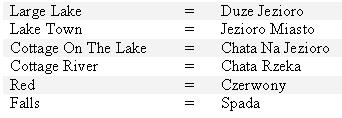
For this I use an online translation tool like Google Translate. Just type words or phrases that could be place names and translate them into Polish. Here are a few test translations.

Not everything will translate properly or look and sound good, be prepared to play around with it for a while until you get a few that you like. I usually make more than I need so that I can pick and choose afterward. From the above results, I would only pick “Chata Na Jezioro”, “Chata Rzeka” & “Czerwony” to use.

Method Two : Chop & Splice

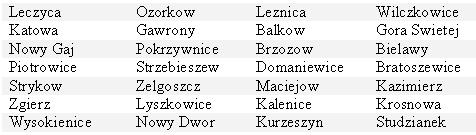
For this method, we need a map of Poland. Google Maps works well for this. Go to Poland and zoom in until you can see lots of place names for both cities and villages. Copy place names that you like into a text editor. Grab 2-3 times more than you will actually need. The more the better, really. Here’s what I grabbed.

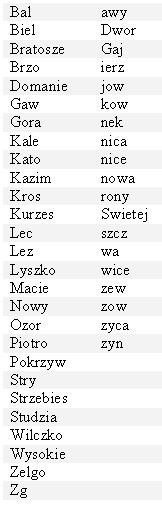
Now, the whole point is to NOT use actual place names, so we need to turn this list into a tool for generating names. Review your list and look for any patterns in how the names are assembled. From my list I note that there are several recognizable endings that are used repeatedly, “kow”, wice”, “ierz”, “erz”, & there are other endings like “owa”, “jow”, “kow”. Let’s split our names into chunks that can be repeated in different combinations. I find doing this in a spreadsheet is helpful, but not necessary. Here’s the same list chopped up into lists of beginnings and endings, with both lists sorted alphabetically and any duplicates removed.

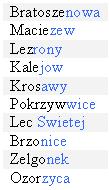
Now randomly join beginnings and endings. Here’s some that I generated just by rolling a couple of dice, I’ve coloured the two halves to show the joins.

In some cases the names are good to go, “Zelgonek” for instance, while others may need a little bit of attention to flow smoothly, “Pokrzywwice” becomes “Pokrzywice” and “Ozorzyca” becomes “Ozorizyca” for example. With minimal effort you’ll have plenty of authentic sounding place names. The more seed name you use, the better results you’ll get from this method. Also, depending on the culture you’re borrowing from, you may want to break names up into more than just two pieces. Either way, the method holds true.

How to Create Interesting Location Descriptions

I’ve been steadily expanding my campaign setting “The Isles” for years. Most recently, I’ve been filling in basic descriptions of places which were nothing more than names on a map. Here’s a technique I’ve developed for generating ideas (when I don’t already have an idea in mind) for a particular settlement.

I look at the place on my map and think about the local geography. This helps me focus on the most likely range of possibilities for this place. Obviously, a town in the middle of a barren desert will be inherently different from one on the side of a lush mountain, or in a valley next to a river, or in the middle of a rain forest, or on the shores of an ocean…

Then I go to Google maps and pick a spot roughly similar to the place I’m trying to write about, zooming in until I can see most place names – halfway to 2/3’s up the “zoom bar” seems to work for me. I’m not looking for the tiniest hamlets with just 100 people, but I don’t want to look at only cities of several million people either. Now I slowly wander about the map until a place catches my eye. It could be the name, location, or whatever. Sometimes switching back and forth between map, satellite and terrain views helps also.

Once I’ve selected a place name, I look it up in Wikipedia. Sometimes there’s no info, so go back to Google maps and pick another town. Once you have an article of a page or so, read through it and look for any ideas that jump out at you. You’re looking for things that are interesting or odd. Does the town have a wierd history? What businesses or industries are (or were) there? What customs of events take place there? Any notable personages?

Once I’ve picked two or three inspirations from the article, I go back to my campaign map. Armed with these seed ideas, I think about where the campaign town is, how it relates to the other towns nearby, what the regional politics culture or is like (etc.), and see how I could adapt my ideas to fit into this settlement. It doesn’t matter if you use the seed ideas verbatim or if you radically alter them to suit your town/village/city. The objective is to get three or four paragraphs of useful text.

One important consideration is the usefulness to adventuring that this town can have. Now I don’t mean that every hamlet needs to have a ready-made adventure built in, but you should have a few hooks that could be turned into an adventure, or connected up with any existing plots in your campaign. Sometimes it only takes a small thing to accomplish this. Perhaps the mayor is related to a prominent religious leader of the nation? Is there a valuable resource, import or export there? Maybe they have a bandit problem? Maybe the inhabitants hold an interesting annual festival. Almost anything can be a jumping off point for an adventure.

A final warning. Unless your party is currently in, or about to adventure in a given location, resist the urge to create massive amounts of setting notes. You’re only looking to create an overview of the town in question, not fully detail it. If you’re approaching half a page of text, you’ve gone too far! Stop writing and move on to the next undescribed town!

Designing Fantasy Cities: Size, Part 2

So we’ve talked about the importance of population size. When we think of city size, we generally picture a particular kind of density as well. Hamlets and villages don’t take up too much room, but their populations are a bit spread out – they’re usually managing farms, with maybe a slightly denser center. Contrary to this, the cities and metropolises are generally pictured as much denser, with two to four-storied buildings, small living areas, and rare open spaces separating living quarters.

Some of the most interesting elements of fantasy play come from the exceptions to our expectations. What happens when the small populations are right on top of each other? How does that change the way they act? Why do they live like this? What kind of adventures stem from that? And what about the reverse, when larger populations are spread out?

Let’s start with the former, the surprisingly dense populations. Cities that take up a smaller area are easier to defend. You can build walls, use gates, and have more defenders per critical point. They also generally produce a higher living standard and more specialized goods. With people living closer together, less time is spent traveling and moving resources from one point to another. This makes life much easier on craftsmen and the middle class.

So maybe the question is why are villages and hamlets so spread out? The answer is primarily one of livelihood. In villages, your primary goal is to produce enough food to feed yourself, and if things go well, others. Farms and livestock take up a lot of room. Larger towns and up generally have many villages that support them, and do very little of the food collection themselves. They also might have access to resources that help them deal with less food, like magic. So in order to have a small population living close together, we need to make it so that growing and tending food that takes up lots of space is not the most important thing.

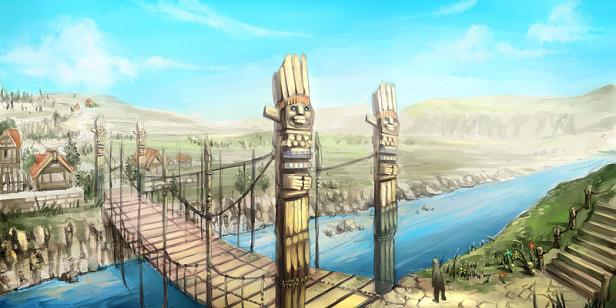
I have such a village waiting for my players in our current campaign that does such a thing. It’s only a few hundred people, and they all live within one set of walls that aren’t very wide. In order to help make due, they’ve built up with two or three story buildings, but also down into the earth. A lot of their food comes from specialized farms in underground caverns. They carved out most of the underground facilities themselves over a number of years. Obviously, this is hardly natural for human commoners, and took a great amount of effort. They did so because a plague of undead scoured the land. Being exposed (and far from others) quickly became a good way to not survive. So, they banded together and did exactly what they had to do with the resources present.

The reverse would also work. Undead don’t need to eat, sleep or breathe. A large group of intelligent undead, such as vampires, might be a thriving community of hundreds in one temple or complex. Imagine walking into living quarters, not to find one family, but rows and rows of vampire living cubes, stacked atop each other.

An especially dense population is bound to have less loyal subgroups than one that’s more spread out. These people see a lot of faces everyday, buts it’s a lot of the same faces. Cliques are bound to happen naturally, but many factions are less likely as it would lead to a frequent friction, as opposed groups don’t have space to avoid each other. Some faction forming is bound to happen regardless. These communities might be powder kegs of emotion, and a group of new heroes, with strange abilities, might be just the thing to set them off.

Small populations are likely to be suspicious of a new face. This is even more true in a dense population, where rumor and information travels fast, and a large portion of people see each other regularly.  If adventurers lie to one person, they had better keep that lie going everywhere in the community.

So why would a large population, such as a city or metropolis, be more spread out than we expect? We could take our above example in reverse. If a city doesn’t have villages to support it, then they would have to do their own farming. Such a large sized population would take up a great deal of space while also providing food for all its people individually. Spreading out increases travel time of people, resources and information. There are now less specialized citizens and less diverse goods created. Quality of life goes down, and more factions are likely. It also becomes much easier to be a new face and blend in. These people are used to seeing the same people often, but due to distance and total population would also be meeting people from other parts of the city (that they’ve never seen) on a semi regular basis. It’s also much harder to defend.

So why isn’t this city using outlying towns and villages for food production to supplement its own? Maybe there was a blight, and the only arable land is in a certain area. Maybe it is its own city state, and while not at war, does not trust those around it. Perhaps this is the Shadowfell and they can’t move beyond the mists. Maybe the city once took up this area because it used to be a super metropolis with double the population. After a major attack by demons the city’s population is now at half, but people are still living where they are used to being. This leaves areas of the city deserted or near to it comparatively and other areas still densely populated. These middle grounds are ripe with adventure opportunity and bound to be filled with cults, thieves and lingering demons. It also polarizes the city into more factions. Not only are there more people to sustain more groups, but they have natural barriers. In some extremes they may as well be separate towns.

Our next article in this series will deal with Who lives in our city.

Previous Article in Series: Designing Fantasy Cities: Size, Part 1

Designing Fantasy Cities: Size, Part 1

In our previous article we spoke about the importance of having a city’s purpose planned out in advance, even if it’s just a few sentences. Now we’ll each of our five facets of purpose, and talk about what each really means to our game.

Our first facet of purpose was size. When designing cities quickly, say at the game table while playing, this is our instinctive way to define a city. You might say it’s a small village or a large metropolis. When we’re designing cities ahead of time let’s look at it a bit more. Three different elements of size really need to be considered here: how many people are there, how much living space is available, and how much space is left to build.

The 4th edition Dungeon Master’s Guide defines size in three ways: a village (mostly farmers, maximum population around 1,000), a town (artisans and trade center, maximum population around 10,000) and a City (major trade centers surrounded by large amounts of good farmland, maximum population around 25,000). This is a slight downsizing of options from the previous edition. I still use Hamlets for really small populations, and metropolises for huge, incredible cities.

Population size affects a lot of things. The larger a town’s population, the more people there are to tax and take advantage of. The difference between the rich and poor will more naturally separate. In a village, the local leadership might be a council of elders, a town manager, trade leader or local regent. Let’s pick a slightly more extreme example and say the local noble has sent his second nephew to oversee this particular village as regent. There will be a rich poor divide. The regent will have nicer clothes, a bigger house, and his pick of certain trade goods. In the larger cities the opportunity for this is much grander. Now we’re dealing with a noble who has regents reporting from several villages and towns. Trade naturally flows here from many directions. so the upper class get their pick of a much larger selection. There are more people to hire, put to work and sell to, so even those not in the government have more opportunity to develop wealth based on numbers.

Off of the same reasoning two more important elements are likely to develop. In larger cities there’s more room in between. Professional soldiers, artisans, scholars, priests and specialists make up a middle class. These people have more respect and control of their lives than the poor, but don’t have the opulence of the wealthy. These are generally the people who create the goods, or provide the services both the nobles and the player characters needs. That makes them important.

In 3.5, the town’s size helped determine how much could be bought and sold, and the maximum level of magic items that could be found. The 4e DMG threw this idea out the window. It claims that a players’ fun should not be hindered by what town they are in. Villages are built on trade routes, and your ranger can definitely find his +5 Sword or Orc Murder in this tiny farming community.

This a choice I think you need to make for your campaign early on, and not one city at a time. Will your PCs need to travel to find their equipment as the increase in level, or will they be able to shop anywhere they please for whatever they want? There can always be exceptions. Your village might be the retirement home of an aging wizard who favors adventurers who can spin a good tale, or your metropolis might have strict laws about magic item traffic that are not government regulated. In order to have an exception, there first needs to be a known rule. Make sure your players know it too!

You probably guessed which camp I’m in. I still make my players travel to buy their uber loot when they jump into higher tiers. It just makes more sense to me, plus it gives my players a clear motivation to encounter a new area, with new plot hooks and new NPCs. It’s realistic and a gimmick!

The other element that develops from the rich poor divide and wealth from populace is a certain set of minimal expectations. The poorest of the poor in a large city assumes there will be a certain amount of protection from outside forces. It’s one of the most basic expectations from those who are taxed or live under a rule. In cities, walls are built, siege engines manned, and soldiers trained, and even the poor expect to be protected. This mentality is a distinct difference to that of the village. The village might be taxed, but it feels separate, due to distance and visible resources. The regent, if there is one, might have a small personal guard. More likely the farmers themselves form a small, informal, barely trained militia. They expect to have to rely on themselves.

This mentality reaches to other things besides protection. In a smaller community, your face is known and you’re a depended-upon resource. Everyone is that ‘one person’ that might make a big difference, and needs to be counted on in order for the community to survive the next winter.  This self reliance may eventually make a community distrustful of outsiders, since they’re not used to anything helpful or dependable coming from outside the community. It’s harder to keep a secret here, because people care more for the individual. Cults and secret societies, ironically, can work really well here. This external distrust means that the cult just needs to make itself seem intrinsic or personal to community members. As soon as a hero comes looking for followers of Bel, the heroes seem more like invading monsters, threatening what they hold dear. This cult may not be secret to any community members, and just kept from the prying eyes of outsiders.
That is not to say that a large town cannot have the purpose of the location for your cult. It will, however play out differently there. Cults are generally small by definition. In a city, they are more likely to be ignored, never found out, or have competition from rival cults and other organizations. The location of three demonic cults waging a secret underground war is a great purpose for a large fantasy city.

I have one final say today on the size of a city, and how it can shape its purpose. More so than a place to sleep and buy things, the most basic purpose of a city is to support adventure. Even if the adventure is not located in the town, this is the place that has people. The heroes are protecting these people. This is a place the Player Characters receive praise or judgment. The reaction and livelihood of the people they encounter directly reflects the consequences of their actions when dealing with cults, roaming monsters, dragons and undead. A town gives players resolution, satisfaction and a means to measure their deeds.

Size matters. A village is great for heroic players. They simply don’t have the resources that equal three level 1 PCs. Starting heroes are able to do things these people can only pray for. They could be instantly hailed as eternal heroes coming back from their first adventure. Whereas clearing out an infestation of were-rats in a large city might not even get recognized by the city watch. The location of your players deeds, and the kind of response given, is often in direct correlation to the difference between town size and player level.

That’s enough for now. Next time we’ll talk about how things change when the population doesn’t match the size of the city.

Previous Article in Series: Designing Fantasy Cities: Purpose

Next Article in Series: Designing Fantasy Cities: Size, Part2

Designing Fantasy Cities: Purpose

When you break D&D game play down, players are generally in one of three areas: the dungeon, the wilderness, or the city. Sure, the wilderness sometimes means Baator, and the dungeon sometimes means the wizard’s labyrinth, but these are rough ideas. Even if you don’t spend equal time in each area, your party is likely to spend a fair bit of time among civilization. It’s not just a place to buy and sell your loot; it’s a place of intrigue, ripe with opportunities for roleplay, skill challenges and combat.

Yet we often devote so little time to prepping these locations. Compare it to your latest dungeon. When you prepare a dungeon, you map out every square, note nearly (if not all) the monsters in the dungeon, plan encounter groups, and probably even have a rough description for each room.

Somehow cities feel more daunting than that. You’ve got the dots on the map with their names. You know what nation they do (or did) belong to, and probably the dominant race. After that, things get fuzzy. Some supplements give you rules for setting exact populations, economic limits, architecture styles, establishing distinct districts . . . the list can go on and on.

You can’t do that for every city in your world, and I feel your pain. I am certainly guilty of not prepping my towns enough to speak confidently when my players suddenly change direction. No one expects you to map each square and name every villager, but I need (and I think it would do you good as well) to have a certain amount of information for each of those dots on the map.

So what’s important?

Purpose. What is the purpose of this city? I’m not trying to get philosophical on you. I mean this quite literally. What purpose does this city serve its people and the world around it? Similarly, what purpose does this city serve you, your game and your story? The answers are tied in ways that might surprise you. In these articles I’m going to be looking at how the In-Game Purpose can feed the Out-of-Character Purpose.

There are five main ways I break down a city’s purpose:

  1. How big is the city? This is often the first thing we decide. Is it a village, a town or a metropolis? Are we talking about fifty people in a sprawling space or thousands or people pushed within a long outgrown city wall? The size of the city helps determine the economic options, the number of possible competing factions, and how easy it is to go unnoticed. The size and density helps determine the culture almost as much as the national history and racial breakdown. This brings us to the next question.
  2. Who lives in the city? The most obvious answer is that of race. If the city is predominantly filled with elves, dwarves, or shadar-kai, that’s important. Just as important though is that all the citizens are refugees from a destroyed nation, or they’re all arcane researchers, or they’re all related to one ancestor. It doesn’t have to be such a big choice for each city, though I really won’t discourage big choices. If the city is made up mostly of the affluent, or was recently part of particular empire, that’s an important bit of who these people are.
  3. Where is the city located? This may have been where you started. You’ve got a map and you started placing dots. Big and little ideas are important here. Is the city near another city, or a nation’s border? Is it on the ocean, or at the edge of a cliff? On a smaller scale, was it built near an Iron Deposit, or is it surrounded by a certain type of farm? Thinking fantastic (remember, I won’t discourage big choices) your city might be adrift in the air, at the base of a volcano, in the Astral Sea or built on an ancient sealed portal leading to an unspeakable evil.
  4. What do the people do? This ties heavily into the other questions. Is this city a group of miners that export rare ores? Is the city built around an arcane college with some of the most renowned libraries? Perhaps the people sustain themselves only on a day-to-day basis, focusing on keeping out the darkness and hoping they will do enough to survive till the morning. We’re talking about the big ideas only here and not each individual. A military town is still going to have a baker, but that baker’s attitude and personality is going to be pretty different than the baker of your small fishing village built around the Peloran Monastery.
  5. Why did people decide to live here in the first place? You may have already answered this question. Location often has a lot to do with it. Maybe people gathered because natural features make it defensible. That’s fine, but why did they need to defend themselves. Were they being terrorized by orcs, or perhaps fear a monotheistic government that did not approve of their worship? The land might be suited well for farming, but why did they feel the need for a new farming community? Did another area just get too crowded, did the crops fail somewhere else do to a curse, or did a family get kicked out of another area? Why was the seal that holds back the unspeakable evil placed here? Perhaps there are natural fey lines of power, or maybe this is where the creature once fell, the site of a great battle.

This is enough to jot quick notes for each town. It doesn’t have to be a lot, just answer each question. That way when players show up, you’ll have a feel of things and enough interesting points to riff off of that your players will think you planned this for months. Here’s a couple of examples of what I think is plenty.

Durngard is a dwarven outpost located on what was once a border between two kingdoms. The craggy steppes here made it easy for the dwarves to put up a defensible fortress quickly and then expand underground. While both kingdoms have fallen from prominence, Durngard remains a popular (and needed) stop between the cities of the once nations. Earlier military mentality has slowly given way for a desire for new trade and many warrior families have become stone workers. This welcome trade and specialty goods have increased the size to that of a small town, while its relative distance to other communities and rocky terrain keep it from growing too quickly.

Tristan was once a sprawling economic center, housing thousands of people, at a natural crossroads for the continent. After the zombie outbreak, the population dropped and many fled. The Heroes of the Silver Light cleared out the undead, but didn’t stick around to rebuild the infrastructure. Now this massive city is home to only a few hundred people, split between those families who refused to leave and those who see an opportunity to plunder what was abandoned.

In future articles we’ll explore each point a bit more, so that if you’re inspired by part of your city’s purpose, you can expand it into new adventures and scenarios.

The Devolution of Lizardfolk

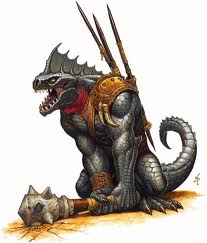
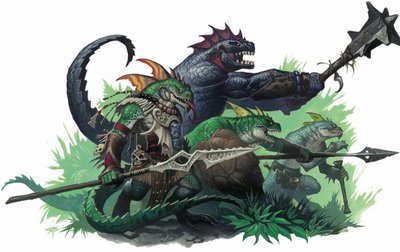
The Lizardfolk (or Lizardmen in earlier editions) have been part of Dungeon and Dragons since 1975, first appearing in the Greyhawk Supplement written by Gary Gygax and Robert Kuntz. That makes the Lizardfolk a part of D&D far longer than myself. I really got to know them when I was DMing my first campaign in 3X. Not even knowing their history, they struck me as a classic and interesting monster.

At some point between editions, the Lizardfolk went from being an aquatic creature to semi-aquatic. When I got my hands on it in 3x, it was a reptile with a bonus to swimming, that could hold its breath a really long time. This hardly equals aquatic or even amphibious any more.  I had no idea the previous versions were aquatic, but its abilities hinted strongly enough at its past that I latched onto the idea anyway. Here was a missing link in action. The fish that walked out of the sea, but never quite forgot.

I should note that an Ecology was released for the Lizardfolk in Dragon 335, that I do not own. It may build on this further or speak to something completely different.

The official books placed the Lizardfolk in the swamp – that seemed natural enough. I threw a few tribes down in my own swamps. I couldn’t settle for this alone, though. These were savage people at times, sure. I mean they eat other intelligent humanoids. However, they were certainly not unintelligent. They keep a tribal structure. They could be nomadic or village-based, depending on need. They use tools, proper weapons and armor. This all led me to believe they likely trade with other races under certain circumstances. They also used different tactics in battle, based on location, ability, and command structure. These were a people that would move based on necessity, and adapt to their environment. Naturally, I placed them in the desert.

No, no, don’t close your browser tab vowing never to return again! Would a race that thrives near water be happy in a desert? Of course not, but who wants to interact with happy people? Humans are known for settling in places that make us miserable (take Canada, for example). In the desert, Lizardfolk can maintain a nomadic, tribal structure. Nomadic desert people are a staple of fantasy and classic tales of adventure. They can trade under the right circumstances, but also act as raiders to be feared. After all, they can hold their breath for inordinate amounts of time. Think about how frightening it would be if you’re guarding a caravan through the desert and suddenly armed lizard people leap from the sand all around you, and from under your feet! As an added bonus, later that night, when your players have all gone home, they will be reminded of Star Wars, and link the encounter with even more happy thoughts.

Now, if you started with the 4th edition of Dungeons and Dragons, and stuck with me this far, you’re probably very confused. Lizardfolk are swamp people, sure, but they’re not even remotely aquatic. While there is a mention in the descriptive text of the Monster Manual of their swimming skill and ability to hold their breath, there are no mechanics to represent it. None of the Lizardfolk even get a bonus to Endurance in the stat block.

It would seem Wizards of the Coast has also been following the course of guiding the Lizardfolk away from their watery roots. You may argue that this article is mis-titled. Man was a fish once, some say, and we call that Evolution. The difference here is that man continued to acquire new traits, traits we all share, that helped guide us toward civilization. The Lizardfolk have only lost traits. They are, in fact, one of the few monsters appearing in more than one Monster Manual without any unifying racial ability. The only thing that Lizardfolk share these days is the word scale in their names and swampwalk. On top of that, they were one of the few intelligent humanoids in Monster Manual 1 that did not receive playable stats in the back of the book. These days you can easily play a kenku and bullywug, but not a proud lizardman. The wizards have marked them shamefully as monsters only, not capable of becoming an adventurer in this world. They simply don’t have it in them.

To this I say Nay! NAY!

You might be expecting playable race stats, now that I’ve preached for so long, but alas, no. I have some worked up, but in my experience such content is hardly worth bringing to the table. There’s already a wealth of races, feats and paths facing players. Anything that can’t be pulled up in the Character Builder is considered not worth the effort. I can hardly blame them –  instead I implore you to support the Lizardfolk with two practices.

  1. First, encourage your players to play Lizardfolk, by reskining existing races. I recommend the Gnoll, because it’s pack mechanics can help represent a tribal culture, you can have working claws, and WotC has added enough support in the way of feats and options to keep it engaging. The Bullywug can also work, but has nearly no options. A few other races might work as well, so use your discretion. The point should be to allow Lizardfolk players to exist!
  2. Second, remind your players that Lizardfolk are not to be taken lightly – by using engaging social and combat encounters. These are people who could be valuable allies, but will eat you if it’s in their best interest. They’re outsiders, looking in, who were cast out for unclear reasons. There’s plenty to play with.

I’ll discuss some combat tactics and introduce a few new Lizardfolk stat blocks this week with Steal this Monster articles. Keep your eyes out for it. We’ll also have a Hold Breath ability that you can add quickly to the existing Lizardfolk.

A little less Drizz’t and a lot more Conan

So, we’ve discussed the reskinning of the many races of 4th Edition D&D. We’ve talked about making monsters unique and monstrous, and we’ve talked about ways to alter the way Magic Items are used in the game. What’s left? The fun part. Actually writing a setting – thinking about what makes up “Classic Fantasy” as a genre, and extrapolating outward from there.

Let’s start with a run-through of the assumptions on which our new fantasy world will be based, using a process similar to that which D&D’s existing settings are based on. We’ll examine the assumptions used to construct “Points of Light,” and see what needs to be changed.

A Dark World

This assumption can be toyed with. D&D’s “Points of Light” setting assumes that there are no great empires left in the world; Tolkien’s “Middle Earth,” has at least one, the land of Mordor. Minor realms (like Gondor and Rohan) certainly qualify for this, and the idea that no settlement is exactly “safe,” is certainly a valid assumption. The world of Classic Fantasy, then, is A Dark World. It is Fantastic – magic is very real, monsters are very real (if sometimes rarer than other settings), and most decent fantasy settings have plenty of Ancient Mysteries lurking in the background, just waiting to be explored.

Monsters are Rare

This is the first point on which we begin our departure from the Points of Light setting. Monsters are scarce, but terrifying. They are alien, powerful, and deadly. The briefest encounter with a monster like a Dragon (Mog), a Minotaur (Jason and the Argonauts) or even a Troll (Grendel of Beowulf fame) is enough to spawn legends. Proper nomenclature for monsters might not even exist; each monster may well have its own name, and the locals might be unaware that it’s part of an entire race (the, “Grendel’s Mother” phenomenon).

The exception are the monstrous races, like Dark Elves, Orcs, Ogres, Goblinoids, and so on – pick out a selection of them and populate a few barbaric tribes or wicked civilizations beneath the earth. There are enough of these to offer a decent selection of cannon fodder, but there will typically be only be one monstrous race in a given campaign. They might use larger monsters in place of siege engines or tanks (Tolkien’s Oelephants and Cave Trolls).

A really great Classic Fantasy style setting should probably be run as a Sandbox game – the players are free to explore, and free to run away from a fight. Not everything the players will meet in this type of game will be weak enough to beat the first time.

Adventurers are Exceptional

This one stands pretty well as is, but it can be easily varied. I’d say the default assumption – that Adventurers are a hardy stock, a cut above average, and with an unfortunate tendency to have bards writing songs about them – holds up well under pressure. On the other hand, some of the defaults of the game can be adjusted for a grittier feel.

The Civilized Races Band Together

This one also survives largely unchanged; the civilized races being Dwarves, Elves, Humans, and Hobb– I mean, Halflings. While there may be some distrust between them (Humans cannot be trusted! They’re greedy and weak!), they still know who to call to get things done; each other.

Magic is Not Every Day, But …

Here’s another one that may get played with. There are two possibilities here. …

  1. But it IS Natural: People generally don’t have a problem with magic. They aren’t superstitious about it, but it’s still rare enough that it doesn’t often impact the lives of the everyday person in any but the smallest ways. Tolkien’s Middle Earth is a fair example of this kind of world, as is – in theory – the Points of Light setting. …
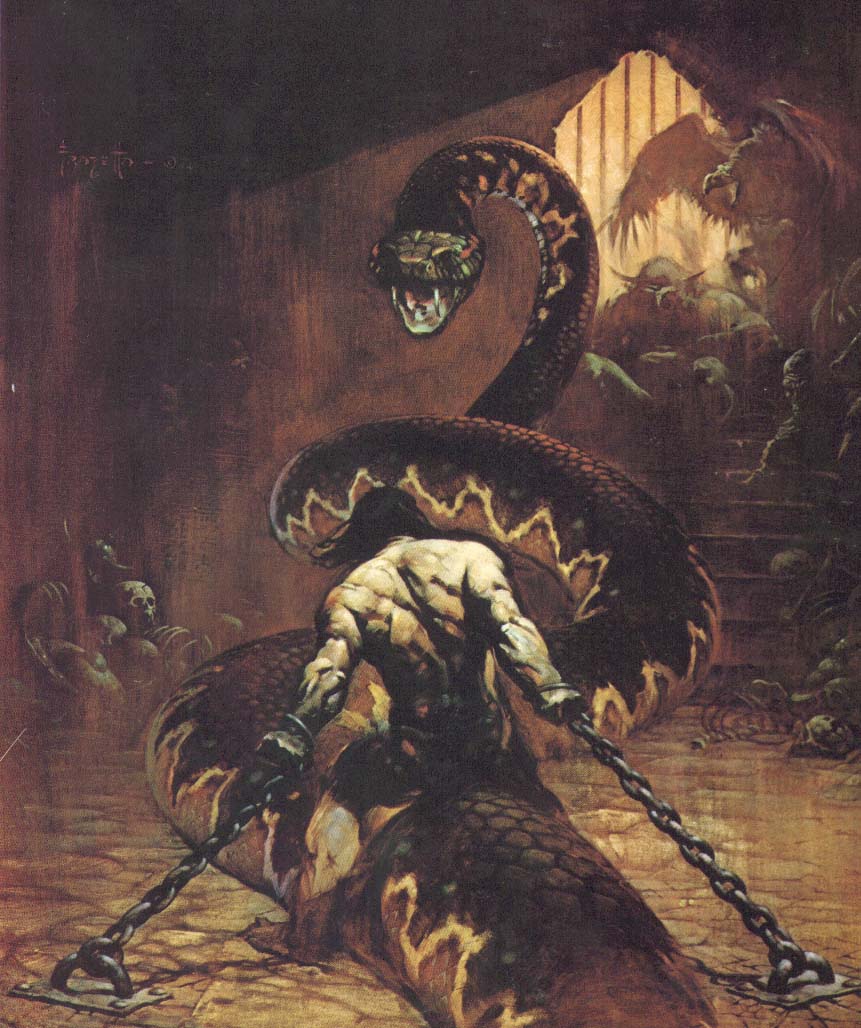
  2. But it ISN’T Natural, Either: If you look at most of the original Conan the Barbarian stories as written by Howard, you’ll find that magic is most often in the hands of the antagonist. Magic might corrupt the land around the caster the way it does in Dark Sun, or worse, it might corrupt the mind or body of the caster. This is “Swords and Sorcery,” and I would say that it’s important to consider as part of the Classic Fantasy genre – they’re closely related. Arcanist PCs in a world like this might have to hide their nature from townsfolk, and carefully control the way they cast their spells to avoid corrupting the land around them.

For ideas on how to treat magic, or attitudes toward casters, read Howard’s original Conan works, some of the newer Red Sonja comics, and the Dark Sun Campaign Setting – only without Psionics as a side-step of the issue. In fact, Dark Sun’s combination of boons and inherent bonuses provide a decent alternative to the magic item rules as well, so read them over if you’re looking for more options.

It should be noted that divine casters won’t have the same problems – miracles, while less common than in a more typical fantasy setting, don’t tend to carry the same kind of stigma as arcane magic. Party conflicts could provide excellent role-playing fodder! Of course, religious conflicts might be more pronounced, as well – people may not wish for healing from the cleric of a rival deity.

The rest of the standard assumptions (Gods vs. Primordials, and so on) vary wildly from setting to setting. Classic Fantasy worlds will often have their own very unique cosmology that isn’t necessarily related to the D&D standard at all – see Tolkien’s The Silmarillon. It might use real-world mythologies, or none at all. Or, it might use the standard set of ideas that accompanies D&D 4th Edition – it’s all up to you, the world builder.

High Fantasy vs. Heroic Fantasy

Fantasy, as a genre, is defined pretty loosely as, “stuff with magic in it,” so really, there’s a LOT of wiggle room for how you might tell stories within the boundaries of Classic Fantasy. I split Classic Fantasy into “High” and “Heroic,” but there’s plenty of room to quibble about these labels. The chief difference is what kind of stories might be told. Since High Fantasy is the most different from how D&D is normally played, I’ll talk about that first.

High Fantasy usually centers on a major struggle between Good and Evil (as absolutes, and as real-world forces); between Light and Darkness. Between Mordor, and … everyone else.

A High Fantasy Villain will probably be the closest thing to the embodiment of evil available, but usually NOT an actual devil. Sauron. The Lich King. Voldemort. Darth Vader (okay, not really, but picture a medieval fantasy version of Darth Vader and ignore everything that isn’t Star Wars: A New Hope, and you’re close to what I’m talking about). That kind of thing. They will typically have titles, like, “The Dark Lord,” or “Queen of Evil.” He will be seemingly unbeatable. Possibly even actually unbeatable.

His undoing? The One Ring. The Sword of Truth. The Hammer of Morradin; The Deathly Hallows. A Horcrux to destroy. The MacGuffin, or possibly even a proper Artifact of Doom.

The vast majority of High Fantasy villains either:

  1. Can’t be defeated without a specific weapon,
  2. Can only be killed by the subject of the prophecy (or even obvious loopholes like, “No Man can Kill Me!”), or
  3. Can be disposed of via some seemingly easy method like, “destroy the phylactory!” or, “Take the Ring to the Fires of Mount Doom, where it was Forged; only there may it be destroyed.” That kind of thing. Something that sounds easy until you remember that Mount Doom is in the heart of Mordor, and surrounded by armies of orcs and goblinoids, and that you have to get through an entirely different army of orcs and goblinoids in order to get there – oh, and did I mention that it’s going to try to turn you into a villain on the way?

Yeah. It’s kind of like that.

High Fantasy is very “Big Picture,” with lots of “End of the World as We Know It,” plots.  That sort of focus lends itself well to Paragon tier play (under normal circumstances). But this is a Classic Fantasy game. You’ll likely be focussed on the main goal from the moment you set out on your first adventure – you’ll just have to be more careful about getting there (unless the player’s do something stupid and get themselves killed right away).

Also? You’ll want a map. Your best bet is to leave large portions of it blank and let the players fill in new details as you, “discover” them – or as you, the DM, make them up.

By contrast, Heroic Fantasy is more about the struggle of the heroes as individuals toward whatever their particular goals are – revenge, power, overthrowing an evil dictator of a more mundane stripe, that sort of thing. It’s less about absolute good against evil, and more about the personal problems of the people in the party and those they encounter. Politics may be a feature, and of course Evil Wizards are stock-and-trade. You may spend a lot of time in a tavern…

Let’s be real, here: Heroic Fantasy, as a genre, was codified by quite a few things: Conan was one. Dungeons and Dragons was another. Yes, that’s right. Heroic Fantasy is basically just saying, “Hey, let’s just play some D&D – and maybe in about 10 levels, when we find out what was driving all those seemingly unrelated plot elements, we can save the world.”

Of course, there are still good sources of inspiration if you want a more heroic-fantasy feel to your Classic Fantasy setting. See Conan, Xena: Warrior Princess (and to a lesser extent, Hercules: The Legendary Journeys) the previously mentioned Red Sonja, and many others – I highly recommend The Crimson Shadow and The Highwayman, both series by R.A. Salvatore, as excellent variations on the Heroic Fantasy ideal.

Getting Things Started.  What Happens BEFORE We Get to the Tavern?

Let’s take another look at Lord of the Rings for a moment. The Fellowship of the Ring is made up of:

  • Aragorn, Ranger, master swordsman, descendant of kings and bearer of destiny
  • Boramir, another great warrior
  • Legolas, Expert archer and twin-sword style master; all around elf
  • Gimli, Axe wielding gruff dwarf
  • Gandalf the Grey/White, master of magic
  • and Mary, Pippin, Frodo and Sam, four basically ordinary hobbits fresh out of the shire.

One of these things is not like the others… but in all seriousness, which are more likely to be starting characters in a Classic Fantasy game? That’s right: all of them. It just depends.

Luke Skywalker provides a similar example: naive farm-boy fresh off the farm strikes fierce blow against Evil Empire! Put him next to Han Solo, who’s been adventuring for years, Leia, Obi-Wan . . . yeah, I know, the Five Man Band is rarely balanced in film, but there’s something odd going on here.

This is about 2 parts hand waving (except in the case of the fairly incompetent hobbits) and 1 part investment into the world. Here’s a Classic Fantasy opening:

Start the heroes out in their home town, where everything is great, peaceful, idyllic. At like, level 0. Bad things happen, an artifact is discovered, or destiny revealed, and next thing you know the villains have shown up and the place is burning down around their ears.

This is also kind of how Star Wars opens, lending credence to my personal theory that the original Star Wars trilogy wasn’t actually a Science Fiction story, but rather a Fantasy story set against a Science Fiction backdrop. But that’s a discussion for another time.

On the flip side, we have the opening of every Conan the Barbarian story ever, which basically features an extremely competent adventurer who’s happened to have a run of bad luck. Again. I have yet to read a story that doesn’t start out with something like this: Conan was on top of the world, and then bad things happened and now we have something dramatic to tell a story about!

This illustrates another style of play: give your players everything (king of the castle, lords and ladies of the realm, start them at a higher level, the works). Then take it all away from them and make them fight to get it back.

We’ve all seen Classic Fantasy done. All you really need is inspiration and players who want to make it work. The very best advice I can give you is to immerse yourself in the literature that inspires you, become familiar with the tropes, and use it all to your advantage. If you love it, your players will probably love it, too.

Happy gaming!

Making Monsters Monstrous

Monster Truisms

In classic fantasy, the following holds true almost universally: monsters are rare, monsters are either evil or instinctual (that is, operating on instincts humans cannot understand), and monsters are dangerous. Monsters do not think like humans. They have their own, alien kind of logic, or worse, no logic at all beyond the question of where their next meal is coming from. In short, monsters follow the kill or be killed (and possibly eaten) paradigm. Put simply – they should be scarce, but terrifying.

The reason for this is simple: monsters suffer from a severe case of Conservation of Ninjitsu. ONE monster is a terrifying and deadly threat; an army of them are cannon fodder. Extend this slightly, remember that familiarity breeds contempt, and the more monsters your PCs see, the more likely they are to see them as mere cannon fodder, regardless of their “phenomenal cosmic power.”

Familiarity Breeds Contempt

Monsters in classic fantasy should be rarer than monsters in other settings, depending on whether you’re leaning more toward Tolkien or Howard in your interpretation of the world. If not especially rarer, there should be fewer types with greater variation among them. See Tolkien’s army of orcs. In fact, let’s go ahead and count the number of ‘monsters’ in the Lord of the Rings. A few trolls and a dragon in The Hobbit; Hordes of Orcs and Uruk-Hai, and the Cave Trolls; a Balrog (which is basically a plot device, since only Gandalf is suited to fight it), the giant spiders, the Nazgul (Wyverns?), the Ring-Wraiths, Treents (albeit not evil, so these fall under NPCs), the ghosts from the mountain – okay, there are a few, but the point here is that while a given campaign might cover some ground, it will certainly not cover the entire Monster Manual.

More importantly, still speaking of LoTR, how many of these monsters do the PCs–I mean, Frodo and Company–even fight? They wind up running away from most of them, suggesting a more Sandbox-like feel to the game – players should be aware that not every encounter is going to be perfectly balanced to their level, and that running away is not only an option, but at times a very, very good idea.

Cherry-pick the monsters you’ll need for the world you’re creating, and spend the time necessary to polish them out to more than a stat block. If you have a horde, use them for what they’re meant to be – cannon fodder. Everything else, keep rare so that the PCs don’t get used to it. Remember the following formula: Perceived Threat = 1/F, where F is the frequency a given monster has been encountered in the current campaign or story.

In a more Conan-like setting, you might well be fighting humans for most of the game, with genuine ‘monsters’ being a truly rare event. Conveniently, this isn’t any more complicated mechanically in 4th Edition – just use anything from the monster manual that has tactics similar to those you want from your human NPCs, and refluff them accordingly. For that matter, there are entries for the human in the monster manual, so one way or another you should be able to find what you need.

The Devil in the Details

If there are fewer types of monsters, then varying their tactics and other details becomes more important. This is especially true for the rarer monsters (solos and elites), but even the more common monstrous races (if any) should receive some customization as well.  Your horde of orcs, for instance, might include goblinoids to mix things up a little, perhaps even refluffed to blend into the larger horde in some way, and different groups might develop different tactics.

While there’s only so much you can do to describe the variation in individual members of a “horde,” solo monsters and elites should be individualized as much as is sensible. A good touch of melodrama never hurts, either.

Part of this should include monstrous description as well as detail – having read a White Wolf product or two I’d suggest that there are things to learn from the way they do things. Monsters should be scary, right? And I don’t mean the way White Wolf characters are; I mean the way that the monsters are scarier than the main characters. If you haven’t picked one up, read some of the flavor text sometime (I highly recommend the OWoD book Demon: The Fallen). Remember, the players can’t read your mind, and they can’t see anything that you don’t describe to them. You’re the DM – you have an infinite special effects budget, so use it.

If you feature something really big in a classic fantasy game, like say, a demon, or a proper dragon, or a devil, then that should be a huge event. Something that malevolent cannot / should not / must not be trivialized in a classic fantasy setting.

Show, don’t tell.

I don’t mean show them a picture; that’s too easy. I mean show them with your words, like you would in a book. You’re the storyteller, the dungeon master, the whatever-your-favorite-label-is,  showing is a major part of your job.

This becomes even more important when your players have read the monster manual. Never, ever, ever – unless it’s blatantly obvious or absolutely necessary – refer to the monster by its name. Describe it instead, in as much detail as you can. Describe how the dragon’s wings blot out the sun as it rears backward, claws outstretched, white-hot flame sending ripples of heat through the surrounding air. Describe the slime that coats the many-eyed creature with the massive toothy grin. Give them legends, hints, and clues before you put them anywhere near anything that epic – if monsters are rare, then the existence of one should be a big thing worth writing about. Make it so!

A little bit makes a big difference. Examine the difference between these two scenarios:

DM: “You are attacked by a troll. Roll initiative.” Players: “Oh, gee, another troll. Cut it apart and burn the pieces.”

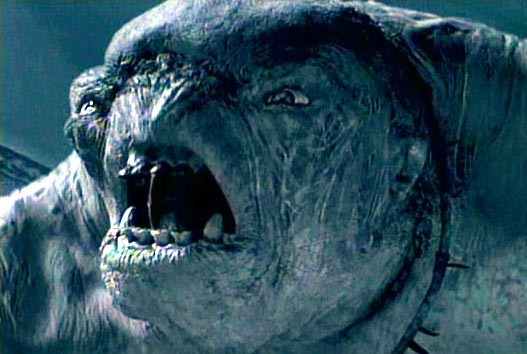
DM: “You find yourself confronted by a massive humanoid with pockmarked green skin, a wide, toothy grin revealing sharp and yellowed fangs. Acidic drool leaks from its mouth, the ground smoking where it falls, and it lurches toward you, its massive dirt-covered claws outstretched. The stench of swamp gas and mold assails your senses, and a hideous shriek issues forth from deep within the creature.” Players: “What the freak?!”

Now, obviously, this isn’t something you want to do over and over again for the same monster every time it shows up… so you don’t. This creature, whatever it happens to be, never shows up again. It gives the party a challenge, dies off, and the party probably doesn’t see another one. Unless of course it’s a named creature, then you might have to deal with its mother (See Beowulf for details. Actually, read the description of Grendel and his mother in just about any version of Beowulf – and please don’t settle for the Hollywood version. Read well, it’s an excellent piece of source material).

But this rolls into the previous point, monster rarity – you only have to describe a monster like this once, because the players probably won’t encounter another one ever again. Save your energy for describing a new creature, which will be much less ridiculous than trying to repeat the same flavor text and expecting your players to have forgotten. Unless your PCs are something like Vampire Hunters, you don’t really want them fighting the same thing often enough to learn tactics for fighting it.

There is one critical exception, and that is when the monster is something like the Ring-Wraiths – a recurring villain, or group of them. But in that case, by the second time the party meets the monster, they will have learned its name (hopefully several legends will exist and they’ll have done their research) and be able to recognize it on sight, which in this case is a good thing. Of course, its abilities may well have changed somewhat… or not. If you remember the Ring-Wraiths, the first time they were encountered was singularly bad for the heroes, and only Aragorn’s quick thinking and remembering that they were scared of fire saved the hobbits from a TPK.

Mechanical changes are far, far less important than sensory details. Sensory words, descriptors, adjectives – those are what make the game here. Mixing up your tactics a little doesn’t hurt, either – use the monster role templates to your advantage, if you need mechanical customization to back it up.

In summary:

Threat = 1/N, where N = the number of monsters in a group. This is why armies of orcs are used as cannon fodder when a single orc champion can be strong.

Perceived Threat = 1/F, where F = the frequency that the given creature is encountered. The more often the PCs have seen a creature, the less frightening it will be to them.

Describe, show – don’t tell – and use vivid language to introduce a monster. Then make sure that it doesn’t show up often enough to become old hat, unless it’s part of an army. Tolkien gets away with a lot by setting his story in a war.