King Lizard – Steal this Monster

When two Lizardfolk tribes unite, local merchants have reason to be nervous, and militia men start keeping extra watchful eyes. When all the Lizardfolk in an area suddenly fall into line, riders scour the land for heroes. The first ones on the scene are rarely the last standing.

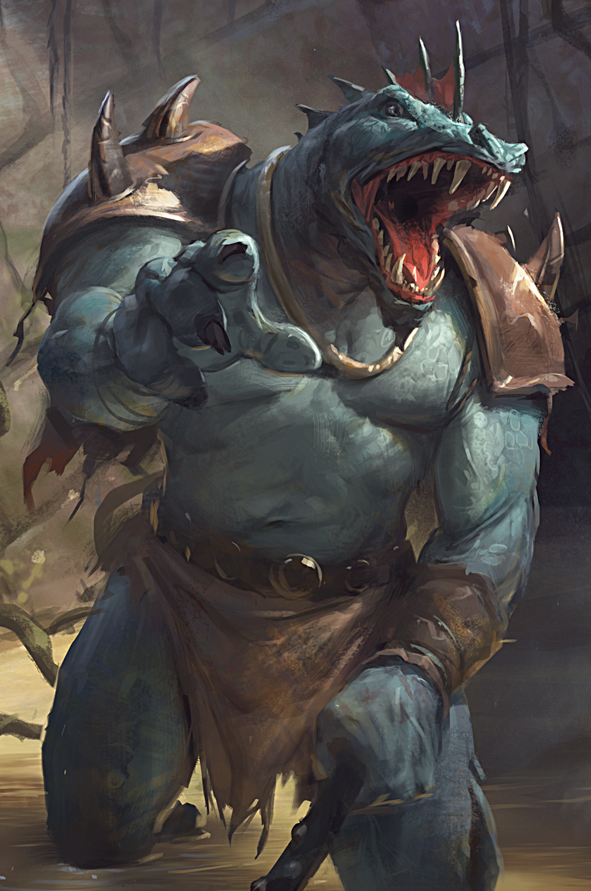
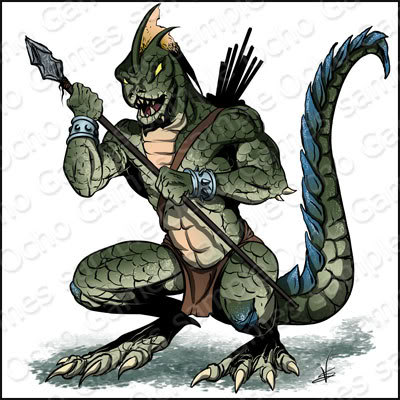
Tales abound about the King Lizard. These massive humanoids wear scales of dark green with hues deep as the earth. Their senses are as sharp as their weapons, and their accuracy well-honed. These creatures are rare indeed, and almost always lead several tribes of Lizardfolk at once.

There are three ways for a King Lizard to come into this world. The first (and most commonly told by travelling bards) is through an infusion of demonic blood. This can be an intentional act of gaining more power, where an eager Lizardfolk warrior gains the attention of the great demon Sess’Inek. Sess’Inek then infuses a bit of his power into the creature, changing his mind a bit in the process. Other times a Lizardfolk leader is kidnapped and forcibly changed in dark rites by Sess’Inek’s followers so that he might more easily gain more converts and conquer more land in his name. Such Lizard King’s are far more evil and chaotic than simply “unaligned.”

More likely, but less well known, is an ancient spiritual ritual that allows a group of Lizardfolk Mystics to infuse a well spring of divine or primal energy into one chosen champion. This act is dangerous, difficult and requires at least five mystics to complete. Due to the competitive and often aggressive relationship between separate tribes of Lizardfolk, such a grouping is strenuous to bring together. Such an occasion often starts with an obvious threat, such as an encroaching human kingdom or the appearance of other-planar creatures in the area. As such, the King Lizard comes into the picture with clear goals, but may start to seek his own rewards once the immediate threat is crushed.

The third (and least likely) method of creation is by birth. Legend tells that the King Lizard is so voracious in its sexual activities that the mate never comes out of the encounter alive. This is not true. While the King Lizard is strong, it has an abundance of control. In reality, offspring rarely survive because of the threat the idea of another King Lizard poses to the original. Youth are most often destroyed while still eggs by the King Lizards itself.

Arcana/Streetwise 12: The King Lizard is a fierce and brutal creature created by mixing the blood of Lizardfolk and demons of the abyss. In battle, the King Lizard is capable of a madness that increases its speed and turns its blood to acid.

Arcana/Nature 16: The King Lizard’s demonic power is tied directly to the demon Sess’Inek. This crazed overlord demands his subject to conquer others and destroy Lizardfolk who refuse his worship. The ritual of bloodbinding needed to create the King Lizard is a torment of pain, both physical and mental, leaving the surviving creature forever twisted.

They feed off the blood of their enemies, becoming more powerful as battles wane on, and have the ability to hurl their own blood at others, eating away at flesh.

Nature 24: While the tales of King Lizards being created by dark demonic rituals are true, they often do not apply. Lizardfolk who follow ancient tribal traditions have a means to create great champions in times of trouble. These Kings Lizards are often not bent on destruction, but trying to protect their people. They can be wise and rational leaders, often willing to barter and discuss terms of peace if it is in their interest.

If crossed, they become ferocious in battle, moving with the speed of many, and able to recover from hindering conditions more quickly than most.
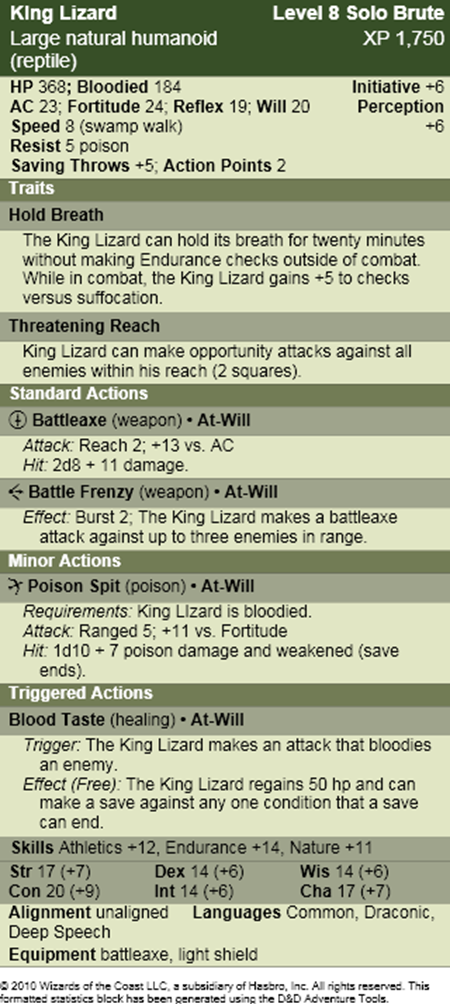
In Combat: The King Lizard, while intelligent, is often an arrogant combatant. He will often allow his lieutenants to do battle before him, even watching as they die, only to then join combat alone, as if to prove to the dead his right to lead.

He keeps in melee combat with as many enemies as possible in order to take full advantage of his Battle Frenzy ability. While above bloodied, he uses Poison Spit each round, provoking melee attacks without hesitation, in order to keep any nearby ranged attackers from doing full damage.

Lairs and Hazards: Above all other Lizardfolk, King Lizards revel in swamp combat. Their speed and swampwalk ability lets them take full advantage of others’ stagnation, to keep multiple targets in range.

King Lizards often build on this by choosing areas of the swamp to lair in, near strange phenomena that blend well with the murky waters, such as Tainted Pools (Dungeon 177) and Caustic Geysers (DMG 91).

Encounters: The King Lizard is a rare solo monster, and as such, is designed to be the star of the show. At the heroic tier he’s designed to be able to face an entire party at once, getting as many as four attacks a round. His +5 to Saving throws should be enough to shake most effects this tier, but he gets an added boost whenever he bloodies an enemy in the form of Blood Taste.

Each of these is intended to feel like a solo fight, even when the King Lizard isn’t the only creature on the field.

True Solo (Level 8 ): For his “all alone brawl,” give him a nice mix of swamptiles and hard normal squares, so that he can hinder the Players’ movements, but players still feel like they have options.

  • 1 King Lizard

Saving Wave (Level 10): In this scenario, the King Lizard values his life more than his pride. Allow the King Lizard to battle the Players around the tainted pool, with the Greenscale Warriors looking on and cheering. Once the King Lizard becomes bloodied, he orders to them to charge in.

Demonic Assault (Level 12): Here we see the King Lizard at the lead of an attack wave. Without the aid of the swampland, the Lizardfolk must simply overwhelm the enemy with brute force. Luckily, their demon allies are very good at that.

Treasure: The King Lizard’s most prized possession is its weapon. Presented here as a battleaxe, I advise DM’s to substitute in any weapon one of the PCs favor. The King Lizard is going to dish out a fair amount of damage with it before the fight is over, and it would make a memorable trophy.

Being at the seat of command, King Lizard is also often found with the tribe’s considerable wealth, whether from trade or raiding. While many of the other weapons, necklaces and sets of armor would have been distributed amongst the other fighters, the King Lizard’s lair would be laden with the more unusual objects the tribe had come across, such as capes, gloves and wondrous items, especially its own trophies stolen from previous adventurers sent to take it down.

Previous Article in Series: Blackscale Tribal Fury

Next Article in Series: Ambush on the Old Marsh Road
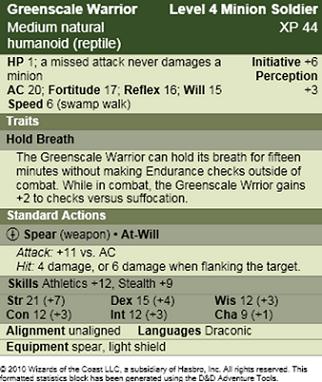
Greenscale Warrior – Steal this Monster

The traders were foolish, to say the least. Knowing the Lizardfolk to be savage, they mistakenly assumed them to be simple. With two adventurers hidden among them, the traders went to see the tribal leader. When the leader arrived with only two warriors, the adventurers attacked – thinking to take the Lizardfolk’s resources while giving nothing in return. Their arrogance was dashed away when two score warriors rose up from the marsh around them in response.

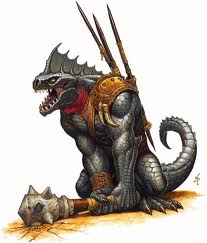
The Greenscale Warrior is the first line of defense for what is considered the most common of the lizardfolk bloodlines. These soldiers are picked out at a young age when they show weakness in their training and hunting.

Too skilled to die on their own, but not talented enough to undergo full tribal training, they learn early about the honor they will bring by dying for their tribe. They are proud of their people and will rush into battle without fear. They also know well their inferiority, having heard it most of their life. They attack, follow the basic tactics of their more skilled kin, and are quick to get out of the way for others. However, their pride and fearless attitude quickly dissipates after seeing their more powerful kin fall.  At this, they are then easier to scare into submission.

Nature 10: These warriors are the most basically trained of all the Lizardfolk. They know of some tactics, but depend upon others for leadership.

Nature 15: The Greenscale Warrior is brought up with years of lackey treatment at the hands of the strongest warriors of their tribe. They know well to clear the way for hunters. Adventurers be wary, once in flanking position, their confidence increases and their attacks dig all the deeper.

In Combat: Greenscale Warriors prefer situations where they can surprise the enemy (like ambushes).  When the surprise ends (or if surprise is not possible), they attack fearlessly as long as momentum is their side’s favor. Setting up flanking for other Lizardfolk is their top priority, but they follow orders quickly and with efficient practice.

A favorite tactic of some tribes is to have the Warriors move heedlessly through combat, even recklessly, in order to draw enemy attacks. Though they’ll die, other Lizardfolk will gain more advantageous positions.

Lairs and Hazards: All Lizardfolk favor swamps and marshes, but Greenscale Warriors fight their best when given places to fully submerge. This not only gives them a place to surprise from, but also an exit if they need to regroup or come from another angle.

Lizardfolk often try to choose areas with unusual features within their territory to stage their battles. This way they can take full advantage of their enemies’ lack of knowledge.

Areas featuring Grab Grass (DMG 68, usually found in the Fey Wild, but occasionally uprooted) make it all the easier for Warriors to get into position.

Cave Slime (DMG 67) can easily be reskinned as slippery moss or muddy terrain.

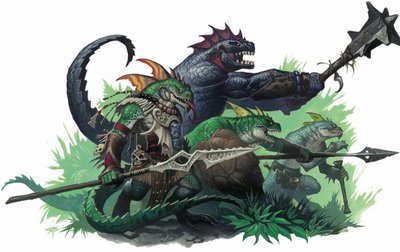
Encounters: Greenscale Warriors work best as support for more powerful Lizardfolk, but can also represent a larger horde of other Lizardfolk for players in the latter-half of the heroic tier.

Highlight the Warrior’s Flanking Bonus (Level 3): This combination allows the Warriors to get into flanking more easily, taking advantage of the Hunter’s Shifting attack and the Darter’s poison which slows.

Highlight the Warrior as part of a Tribe (Level 5): This combination showcases the Warrior as an integral and large part of the tribe, while still highlighting the fact that they are not the expert like the others. Keep the Drake near the Hunter, following his commands.

For extra fun, have the drake lash out at Warrior occasionally (losing control), especially if the hunter dies, or if a warrior gets trapped in their way.

Highlight the Warrior as Horde (Level 7): This grouping  sets the stage for a massive amount of Lizardfolk on the field of battle at once. Here the warrior can represent more than just the runts of the tribe, but the Bruisers and the Hunters now that the heroes have advanced to higher levels.

In this encounter the Warriors are meant to be fodder. They act as a distraction, and add to the damage of the Orc Chieftan (substitute any charismatic, clever or intimidating foe), while allowing the heroes to feel powerful by plowing right through them.

The Orc Chieftan takes a little explaining, but takes excellent advantage of the warrior’s with his Inspire Ferocity ability. He could be a Chieftain who lost his orc tribe already to the PCs and whipped a group of Lizardfolk into obedience to take revenge.

Alternatively, the orc chieftain could be particularly magnetic, and drew in the Lizardfolk while trying to bring together all the orcs in an area. He now keeps them as his personal guard as a symbol of his sway and ability to unite.

Treasure: In most encounters, the Greenscale Warrior’s won’t be the primary source of treasure, but rather their more powerful companions will.

In trade negotiations, they are often used as porters, and those most daring may slip trinkets and gems away from the chests when no one is looking.

As those doing the grunt work, Greenscale warriors are often found with useful mundane items like empty bags, torches and bundles of rope.

Previous Article in Series: The Devolution of Lizardfolk

Next Article in Series: Blackscale Tribal Fury

For more information on the Ecology of Lizardfolk, see the Monster Manual and Dragon Magazine 335.

The Greenscale Warrior originally appeared on Free Orcs. It has been revised and expanded upon for this republishing.

The Devolution of Lizardfolk

The Lizardfolk (or Lizardmen in earlier editions) have been part of Dungeon and Dragons since 1975, first appearing in the Greyhawk Supplement written by Gary Gygax and Robert Kuntz. That makes the Lizardfolk a part of D&D far longer than myself. I really got to know them when I was DMing my first campaign in 3X. Not even knowing their history, they struck me as a classic and interesting monster.

At some point between editions, the Lizardfolk went from being an aquatic creature to semi-aquatic. When I got my hands on it in 3x, it was a reptile with a bonus to swimming, that could hold its breath a really long time. This hardly equals aquatic or even amphibious any more.  I had no idea the previous versions were aquatic, but its abilities hinted strongly enough at its past that I latched onto the idea anyway. Here was a missing link in action. The fish that walked out of the sea, but never quite forgot.

I should note that an Ecology was released for the Lizardfolk in Dragon 335, that I do not own. It may build on this further or speak to something completely different.

The official books placed the Lizardfolk in the swamp – that seemed natural enough. I threw a few tribes down in my own swamps. I couldn’t settle for this alone, though. These were savage people at times, sure. I mean they eat other intelligent humanoids. However, they were certainly not unintelligent. They keep a tribal structure. They could be nomadic or village-based, depending on need. They use tools, proper weapons and armor. This all led me to believe they likely trade with other races under certain circumstances. They also used different tactics in battle, based on location, ability, and command structure. These were a people that would move based on necessity, and adapt to their environment. Naturally, I placed them in the desert.

No, no, don’t close your browser tab vowing never to return again! Would a race that thrives near water be happy in a desert? Of course not, but who wants to interact with happy people? Humans are known for settling in places that make us miserable (take Canada, for example). In the desert, Lizardfolk can maintain a nomadic, tribal structure. Nomadic desert people are a staple of fantasy and classic tales of adventure. They can trade under the right circumstances, but also act as raiders to be feared. After all, they can hold their breath for inordinate amounts of time. Think about how frightening it would be if you’re guarding a caravan through the desert and suddenly armed lizard people leap from the sand all around you, and from under your feet! As an added bonus, later that night, when your players have all gone home, they will be reminded of Star Wars, and link the encounter with even more happy thoughts.

Now, if you started with the 4th edition of Dungeons and Dragons, and stuck with me this far, you’re probably very confused. Lizardfolk are swamp people, sure, but they’re not even remotely aquatic. While there is a mention in the descriptive text of the Monster Manual of their swimming skill and ability to hold their breath, there are no mechanics to represent it. None of the Lizardfolk even get a bonus to Endurance in the stat block.

It would seem Wizards of the Coast has also been following the course of guiding the Lizardfolk away from their watery roots. You may argue that this article is mis-titled. Man was a fish once, some say, and we call that Evolution. The difference here is that man continued to acquire new traits, traits we all share, that helped guide us toward civilization. The Lizardfolk have only lost traits. They are, in fact, one of the few monsters appearing in more than one Monster Manual without any unifying racial ability. The only thing that Lizardfolk share these days is the word scale in their names and swampwalk. On top of that, they were one of the few intelligent humanoids in Monster Manual 1 that did not receive playable stats in the back of the book. These days you can easily play a kenku and bullywug, but not a proud lizardman. The wizards have marked them shamefully as monsters only, not capable of becoming an adventurer in this world. They simply don’t have it in them.

To this I say Nay! NAY!

You might be expecting playable race stats, now that I’ve preached for so long, but alas, no. I have some worked up, but in my experience such content is hardly worth bringing to the table. There’s already a wealth of races, feats and paths facing players. Anything that can’t be pulled up in the Character Builder is considered not worth the effort. I can hardly blame them –  instead I implore you to support the Lizardfolk with two practices.

  1. First, encourage your players to play Lizardfolk, by reskining existing races. I recommend the Gnoll, because it’s pack mechanics can help represent a tribal culture, you can have working claws, and WotC has added enough support in the way of feats and options to keep it engaging. The Bullywug can also work, but has nearly no options. A few other races might work as well, so use your discretion. The point should be to allow Lizardfolk players to exist!
  2. Second, remind your players that Lizardfolk are not to be taken lightly – by using engaging social and combat encounters. These are people who could be valuable allies, but will eat you if it’s in their best interest. They’re outsiders, looking in, who were cast out for unclear reasons. There’s plenty to play with.

I’ll discuss some combat tactics and introduce a few new Lizardfolk stat blocks this week with Steal this Monster articles. Keep your eyes out for it. We’ll also have a Hold Breath ability that you can add quickly to the existing Lizardfolk.