Larva Nethermancer – Steal this Monster

I have a confession to make. This isn’t really a new monster. Much like the designers of the Monster Vault, I’ve taken a creature’s stat block from an existing product and tried to work out its flaws. I’ve renamed the creature primarily to keep the differing stats straight, but I don’t recommend using the previous stat block.

The creature I am referring to is the Larva Mage, from the 4e Monster Manual. I ran the Larva Mage in a recent encounter. It was the last encounter in a series, and Larva Mage was supposed to be the mini boss. He was going to present an interesting threat and attempt to run away at the end. He was accompanied by two Vampires and a few Rot Harbingers.  He did succeed in standing out as important and attracting attention. However, he was quickly outclassed and dominated. The other creatures put up a much better fight. Serves me right for not updating him ahead of time.

The following will break from the normal Steal this Creature format. I’ll be talking about each power, and the changes I made. If you want to learn more about the creature itself, check out the Monster Manual or Open Grave.

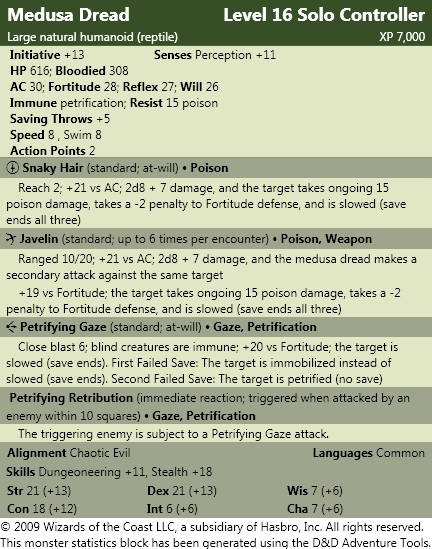
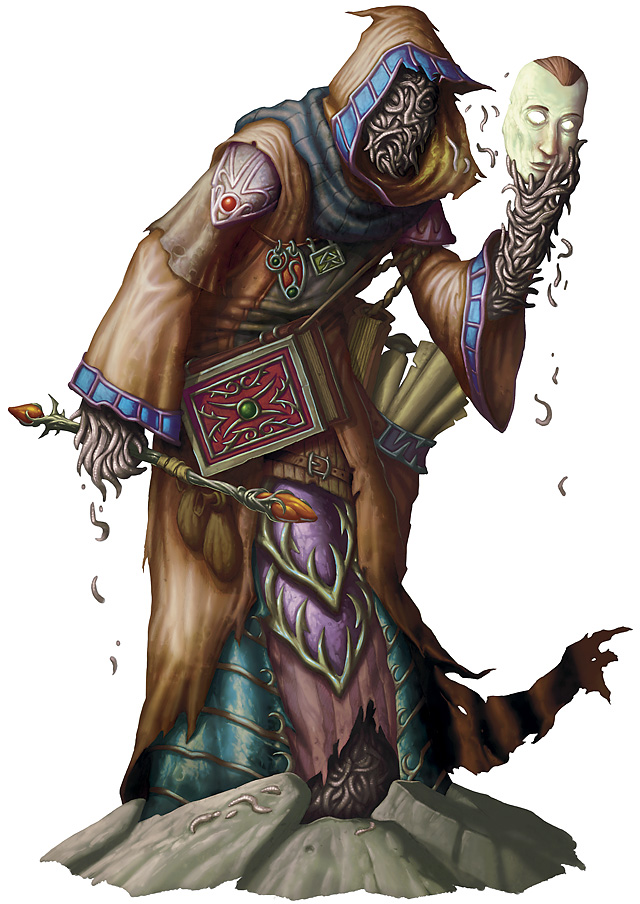
The basics that you need to know is that Larva Mage’s are evil wizards who died, and then inhabit the worms and maggots that were feasting upon their corpse. Its an intelligent swarm, with a humanoid shape. The Mage is an artillery.

————————————————————————————————————————

Corrupting Touch was the default, low damage, melee basic that most artillery have. The damage is too low for post MM3. I’ve made part of it default damage and added necrotic as a secondary type, that way Necrotic Resistance is still useful, but not everything. It also gives the creepy feeling that a small swarm of worms has drifted over to the player and is biting. I don’t see either as particularly corrupting. I called mine Soul Leech, because it deals necrotic damage, and it’s a bug theme.

Horrific Visage was supposed to help this epic level artillery avoid being locked down by defenders. The big issue here is that it’s ranged 10, and recharge 5. It’s lucky if he can use it one-third of the time, and if the defender is already in melee, he gets a free basic attack. We all know how much damage a defender can do with a basic melee. The new power is Wave of Horror. Still a minor and still recharge 5. Now it’s close burst 10, target 1. This means no opportunity attacks in melee (which is when it really needs it).

Ray of Cold Death is its main attack. Nothing wrong or even interesting here. It just does solid ranged damage. Damage increased.

Worms Feast was an illusion attack. It does a lot of damage, or produces a stun. The flavor is that the target thinks worms are devouring his flesh. This, to me, makes the enemy a bit lame. Why don’t the worms really eat the target’s flesh? Now they do.

Its now a Close Burst 3, Encounter that recharges when bloodied. It does serious damage and some of it psychic damage, to represent that this attack saps on your will. It’s freaky. If that attack doesn’t kill you, instead of a stun and no damage, the damage stays, but the target gains 10 thp and is dazed. This, to me, is more fun. The player can still do something, but he’s in shock and has built up a bit of a mental wall. Its called Rush of Worms.

Withering Flame was dropped altogether. It has enough damage powers, and Rush of Worms can now affect multiple targets (without provoking OAs). As far as I can tell, this was to make the Mage seem more Wizardly. I thinks we can do this with flavor at the table.

Squeezing Swarm – Like most swarms, the Larva Mage can squeeze through tight places. I think a mass of living vermin can do a bit more than that though. I also think an elite should have opportunities to do damage more than once a turn. Swarm Body makes it so that whenever a melee attack hits, the attacker takes damage. Very easy for the DM.

Swarm Scurry – One new power. At higher levels, I think creatures need to dip into other roles more in order to be useful. Artillery can use a little bit of skirmisher in order to ensure that they can get back into ranged once engaged. Otherwise, they get locked down and then become boring. This ability still allows OAs, but it’s a quick way to negate many defender lock-downs and give some distance. Plus, it just makes sense that it can break down into its component creatures, and reform.

In Summary

We now have an artillery that can deal with melee characters and attack more than one creature a turn. It’s creepy, and all of its abilities reflect that.  While it excels at ranged combat, Rush of Worms encourages it to get relatively close twice a fight. It can then use Swarm Scurry to reposition itself. In the end, we have a much more dynamic villain.
Sahuagin Eel Lord – Steal This Monster

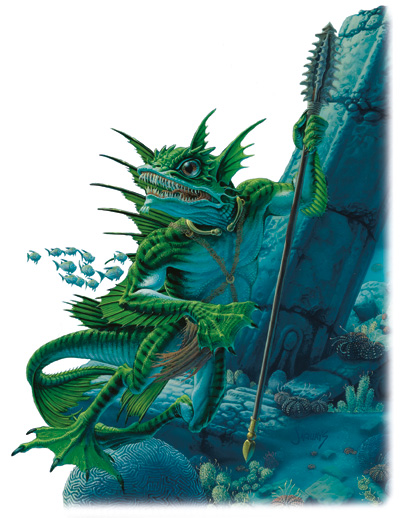
You recognize the creature in the middle of the group as a Sahuagin, like the rest. Something is different about this one, though. The others grip their tridents tightly, yet this one has none. They charge and scream in rage, and this one holds back biding its time. Then you remember the stories of those lone Sahuagin that remember the old ways, before the dark gods. It raises its hand, and a swarm of eels speed from the darker waters and surround it like a living shield. It swims toward you, wise enough to detect the dangers of an insightful enemy.

The Sahuagin Eel Lord is a Sahuagin, just like any other. The difference here is in discipline and insight. These rare creatures have found more to connect with in deep waters than fear and worship of sharks. They find power in other elements of nature, and through this find a level of control in themselves.

This does not stop them from respecting sharks or paying reverence to Sekolah. Nor does it make them any less destructive or evil. However, they are much more aware of their actions and seek out more creatures to become in tune with. They tend to have skin with tinges of lighter blue, and appear surprisingly calm in combat.

In combat, he either starts with a swarm of eels at his side, or quickly summons them. As creatures become immobilized, eels will break off to keep these enemies in place. The Eel Lord either has them rejoin his side, or calls for more as needed.

Nature/Religion 16: This creature is not the regular brand of blood crazy, demon worshiping Sahuagin. Instead, the Eel Lord has developed a primal connection to the sea. Enemies should beware – its close exposure to eels allows it not only to call the beasts, but to mimic their abilities.

Nature 24: While often accompanied by eels, the Sahuagin Eel Lord shares connections with far more creatures. Be wary of squid or sharks lurking in nearby dark waters. Eel Lords will even swim into these deeper waters as well. They may not be fleeing however. The electricity coursing through their veins enhances their eyesight.

Tactics: Unlike most controllers, the Sahuagin Eel Lord does not avoid melee. In fact, he thrives in it. At the beginning of combat he’ll stay toward the outside of the group so he can properly observe. Once a high damage dealer, or a target that thrives on being mobile is located, he switches targets. If this puts him in the thick of the fight, all the better. The Eel Lord is more effective, the more targets he can effect by his aura. He won’t hesitate to take opportunity attacks from movement, if it means more immobilized enemies are subject to his Eel Frenzy attack.

Encounters: The Eel Lord is most often found with other Sahuagin. The presence of an Eel Lord also increases the likelyhood of allied underwater predators (unfortunately, there aren’t much, apart from Sharks in the Compendium, but we shall rectify that later). Due to their spiritual connection, the presence of Eel Lords might also signal allied spirits. They pair well with Phantoms and (when avenging on land) Poltergeists.

Of all the Sahuagins, the Eel Lord is the most likely to break away from their tribal structure, and explore the world, or join up with mercenaries. They see things that other Sahuagin don’t, and may make this choice willingly or be chased out by stubborn leaders who do not wish to understand them.

Notes to DMs: Feel free to use these creatures on land, effectively. Just replace the living eels with spirit eels. Add Necrotic damage to taste.

This creature originally appeared on Free Orcs, but has been updated and expanded upon for StufferShack.com

King Lizard – Steal this Monster

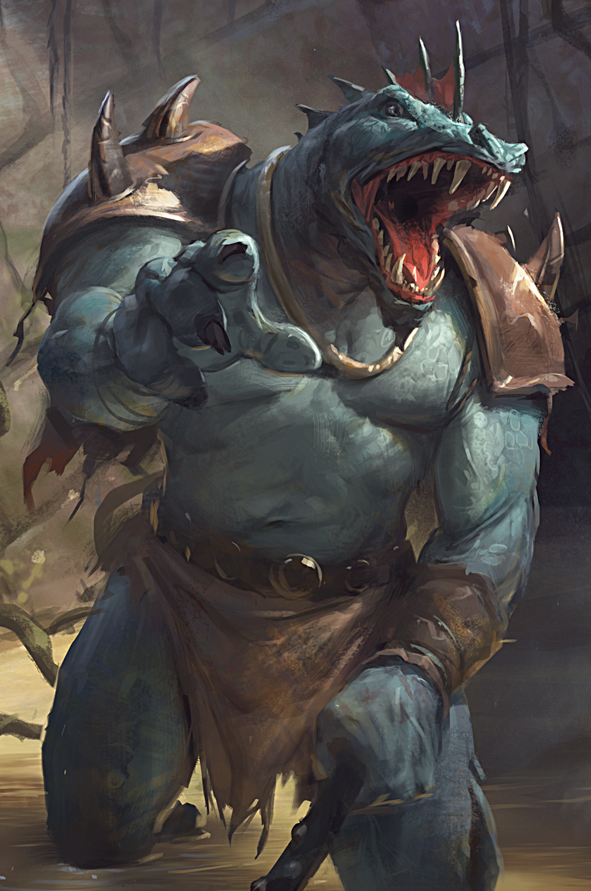
When two Lizardfolk tribes unite, local merchants have reason to be nervous, and militia men start keeping extra watchful eyes. When all the Lizardfolk in an area suddenly fall into line, riders scour the land for heroes. The first ones on the scene are rarely the last standing.

Tales abound about the King Lizard. These massive humanoids wear scales of dark green with hues deep as the earth. Their senses are as sharp as their weapons, and their accuracy well-honed. These creatures are rare indeed, and almost always lead several tribes of Lizardfolk at once.

There are three ways for a King Lizard to come into this world. The first (and most commonly told by travelling bards) is through an infusion of demonic blood. This can be an intentional act of gaining more power, where an eager Lizardfolk warrior gains the attention of the great demon Sess’Inek. Sess’Inek then infuses a bit of his power into the creature, changing his mind a bit in the process. Other times a Lizardfolk leader is kidnapped and forcibly changed in dark rites by Sess’Inek’s followers so that he might more easily gain more converts and conquer more land in his name. Such Lizard King’s are far more evil and chaotic than simply “unaligned.”

More likely, but less well known, is an ancient spiritual ritual that allows a group of Lizardfolk Mystics to infuse a well spring of divine or primal energy into one chosen champion. This act is dangerous, difficult and requires at least five mystics to complete. Due to the competitive and often aggressive relationship between separate tribes of Lizardfolk, such a grouping is strenuous to bring together. Such an occasion often starts with an obvious threat, such as an encroaching human kingdom or the appearance of other-planar creatures in the area. As such, the King Lizard comes into the picture with clear goals, but may start to seek his own rewards once the immediate threat is crushed.

The third (and least likely) method of creation is by birth. Legend tells that the King Lizard is so voracious in its sexual activities that the mate never comes out of the encounter alive. This is not true. While the King Lizard is strong, it has an abundance of control. In reality, offspring rarely survive because of the threat the idea of another King Lizard poses to the original. Youth are most often destroyed while still eggs by the King Lizards itself.

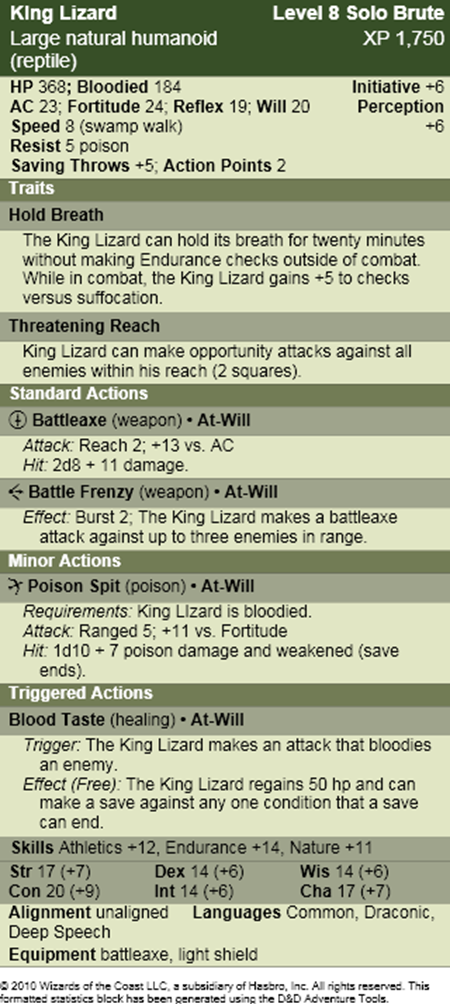
Arcana/Streetwise 12: The King Lizard is a fierce and brutal creature created by mixing the blood of Lizardfolk and demons of the abyss. In battle, the King Lizard is capable of a madness that increases its speed and turns its blood to acid.

Arcana/Nature 16: The King Lizard’s demonic power is tied directly to the demon Sess’Inek. This crazed overlord demands his subject to conquer others and destroy Lizardfolk who refuse his worship. The ritual of bloodbinding needed to create the King Lizard is a torment of pain, both physical and mental, leaving the surviving creature forever twisted.

They feed off the blood of their enemies, becoming more powerful as battles wane on, and have the ability to hurl their own blood at others, eating away at flesh.

Nature 24: While the tales of King Lizards being created by dark demonic rituals are true, they often do not apply. Lizardfolk who follow ancient tribal traditions have a means to create great champions in times of trouble. These Kings Lizards are often not bent on destruction, but trying to protect their people. They can be wise and rational leaders, often willing to barter and discuss terms of peace if it is in their interest.

If crossed, they become ferocious in battle, moving with the speed of many, and able to recover from hindering conditions more quickly than most.

In Combat: The King Lizard, while intelligent, is often an arrogant combatant. He will often allow his lieutenants to do battle before him, even watching as they die, only to then join combat alone, as if to prove to the dead his right to lead.

He keeps in melee combat with as many enemies as possible in order to take full advantage of his Battle Frenzy ability. While above bloodied, he uses Poison Spit each round, provoking melee attacks without hesitation, in order to keep any nearby ranged attackers from doing full damage.

Lairs and Hazards: Above all other Lizardfolk, King Lizards revel in swamp combat. Their speed and swampwalk ability lets them take full advantage of others’ stagnation, to keep multiple targets in range.

King Lizards often build on this by choosing areas of the swamp to lair in, near strange phenomena that blend well with the murky waters, such as Tainted Pools (Dungeon 177) and Caustic Geysers (DMG 91).

Encounters: The King Lizard is a rare solo monster, and as such, is designed to be the star of the show. At the heroic tier he’s designed to be able to face an entire party at once, getting as many as four attacks a round. His +5 to Saving throws should be enough to shake most effects this tier, but he gets an added boost whenever he bloodies an enemy in the form of Blood Taste.

Each of these is intended to feel like a solo fight, even when the King Lizard isn’t the only creature on the field.

True Solo (Level 8 ): For his “all alone brawl,” give him a nice mix of swamptiles and hard normal squares, so that he can hinder the Players’ movements, but players still feel like they have options.

  • 1 King Lizard

Saving Wave (Level 10): In this scenario, the King Lizard values his life more than his pride. Allow the King Lizard to battle the Players around the tainted pool, with the Greenscale Warriors looking on and cheering. Once the King Lizard becomes bloodied, he orders to them to charge in.

Demonic Assault (Level 12): Here we see the King Lizard at the lead of an attack wave. Without the aid of the swampland, the Lizardfolk must simply overwhelm the enemy with brute force. Luckily, their demon allies are very good at that.

Treasure: The King Lizard’s most prized possession is its weapon. Presented here as a battleaxe, I advise DM’s to substitute in any weapon one of the PCs favor. The King Lizard is going to dish out a fair amount of damage with it before the fight is over, and it would make a memorable trophy.

Being at the seat of command, King Lizard is also often found with the tribe’s considerable wealth, whether from trade or raiding. While many of the other weapons, necklaces and sets of armor would have been distributed amongst the other fighters, the King Lizard’s lair would be laden with the more unusual objects the tribe had come across, such as capes, gloves and wondrous items, especially its own trophies stolen from previous adventurers sent to take it down.

Previous Article in Series: Blackscale Tribal Fury

Next Article in Series: Ambush on the Old Marsh Road

Blackscale Tribal Fury – Steal this Monster

At the heart of temple, the Lizardfolk line suddenly flew apart as a towering Blackscale advanced. Those not quick enough were tossed away like a farmer reaping wheat.

The Blackscale Tribal Fury is tall and muscular, like the others of its bloodline, though not nearly as hulking as the Blackscale Bruiser. It has a more controlled athleticism, allowing it to make precise blows in combat.

While just as savage, once engaged, their mental capacity far outweighs their kin. They are often found leading small tribes when a spiritual leader is unavailable or not strong enough. Even while not in command of the tribe, they are often set to take charge in combat, deciding on tactics and issuing orders in the heat of battle.

Nature 16: This Lizardfolk, known by travelers as a Tribal Fury, is a quick and effective combatant. Smarter than other Lizardfolk, it generally commands the battle. Taking it out early may help turn the tide.

Nature 23: The Blackscale Tribal Fury, while intelligent, is also arrogant. In battle, he tosses allies around to get into the position most desirable for his personal success. Usually, the other Lizardfolk land in decent locations, but it’s hardly the main priority.
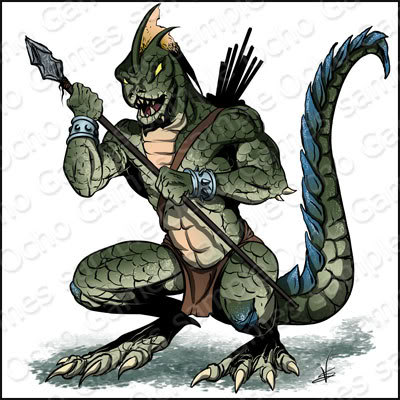
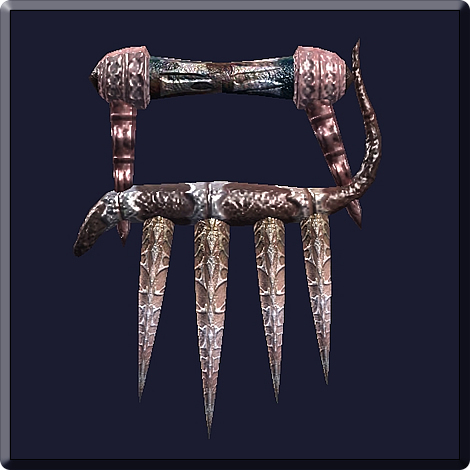
In Combat: The Tribal Fury prefers to lead from the front, using javelin attacks only when it would be unable to reach its target safely or without enough time to attack.

The Tribal Fury looks for terrain benefits and flanking from allies in order to gain combat advantage in combat, often tossing allies in order to get them on the other side of the target.

Lairs and Hazards: Lizardfolk favor swamps and Marshes, but the Blackscale Tribal Fury looks for every advantage when inspecting proper terrain for battle. They favor areas that have varying heights in order to take further advantage of their imposing height.

They rarely choose to fight in enclosed spaces due to the decrease in their own mobility, but can occasionally be found in abandoned ruins or repossessed temples. They always take time to inspect and outfit them to their needs before using it for shelter or battle.

In more open areas, they will create basic pit traps to help control enemy movements, while leaving plenty of wider paths that they can easily traverse.

Encounters: The Blackscale Tribal Fury is often the leader in combat, and sometimes finds themselves at the head of entire tribes. Other times, they represent a better level of training from one group of warriors, or they could be a champion of a single dog.

They work well when grouping with mobile or large groups of allies that can move into flanking position and increase their damage. Controllers who can keep enemies in place or off guard are also welcome. Artillery helps support one of their primary weaknesses.

Lizardfolk Scouting Party (level 6): This is a small party of strong and quick Lizardfolk. They move quietly as they travel, and start their attack with surprise if possible.

Use the Hunter’s Sidestep Attack to give the Tribal Fury combat advantage and allow the Darter to stay out of melee combat. When numbers thin, the Tribal Fury holds the party’s attention while another runs to warn the tribe.

Lizardfolk Tribe Leader (level 8 ): Here the Lizardfolk is one of the leaders of the tribe. Play with the command dynamic between the Tribal Fury and the Bog Mystic to open up interesting situations that the players may try to exploit.

Infernal Alliance (level 10): Lizardfolk have many reasons for working with more powerful races. They may be bullied into compliance, or may be lured by the promise of power. However, those situations are an offense to the pride of the tribe and may not last long if given the opportunity for rebellion.

Here we have the Lizardfolk working with a lone chain devil. Perhaps his assistance is part of a bargain made with the tribe, or he was discovered while scouting a temple and mistaken for the avatar of a tribal god.

Treasure: The Blackscale Tribal Fury is often found with a small number of gems on his person (if without magic items). The idea being that if something should befall the rest of tribe, he is more likely to live to flee and needs light liquid income valuable to whoever he comes across. He prefers weapons and neck items where magic items are considered, in order to increase his effectiveness without being weighed down by armor.

Previous Article in Series: Greenscale Warrior

Next Article in Series: King Lizard

For more information on the Ecology of Lizardfolk, see the Monster Manual and Dragon Magazine 335.

The Blackscale Tribal Fury originally appeared on Free Orcs. It has been revised and expanded upon for this republishing.


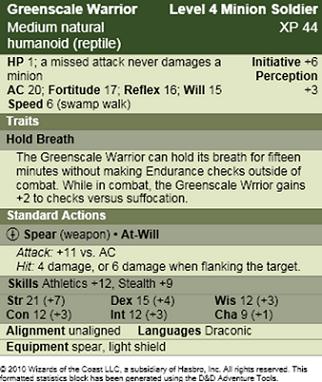
Greenscale Warrior – Steal this Monster

The traders were foolish, to say the least. Knowing the Lizardfolk to be savage, they mistakenly assumed them to be simple. With two adventurers hidden among them, the traders went to see the tribal leader. When the leader arrived with only two warriors, the adventurers attacked – thinking to take the Lizardfolk’s resources while giving nothing in return. Their arrogance was dashed away when two score warriors rose up from the marsh around them in response.

The Greenscale Warrior is the first line of defense for what is considered the most common of the lizardfolk bloodlines. These soldiers are picked out at a young age when they show weakness in their training and hunting.

Too skilled to die on their own, but not talented enough to undergo full tribal training, they learn early about the honor they will bring by dying for their tribe. They are proud of their people and will rush into battle without fear. They also know well their inferiority, having heard it most of their life. They attack, follow the basic tactics of their more skilled kin, and are quick to get out of the way for others. However, their pride and fearless attitude quickly dissipates after seeing their more powerful kin fall.  At this, they are then easier to scare into submission.

Nature 10: These warriors are the most basically trained of all the Lizardfolk. They know of some tactics, but depend upon others for leadership.

Nature 15: The Greenscale Warrior is brought up with years of lackey treatment at the hands of the strongest warriors of their tribe. They know well to clear the way for hunters. Adventurers be wary, once in flanking position, their confidence increases and their attacks dig all the deeper.

In Combat: Greenscale Warriors prefer situations where they can surprise the enemy (like ambushes).  When the surprise ends (or if surprise is not possible), they attack fearlessly as long as momentum is their side’s favor. Setting up flanking for other Lizardfolk is their top priority, but they follow orders quickly and with efficient practice.

A favorite tactic of some tribes is to have the Warriors move heedlessly through combat, even recklessly, in order to draw enemy attacks. Though they’ll die, other Lizardfolk will gain more advantageous positions.

Lairs and Hazards: All Lizardfolk favor swamps and marshes, but Greenscale Warriors fight their best when given places to fully submerge. This not only gives them a place to surprise from, but also an exit if they need to regroup or come from another angle.

Lizardfolk often try to choose areas with unusual features within their territory to stage their battles. This way they can take full advantage of their enemies’ lack of knowledge.

Areas featuring Grab Grass (DMG 68, usually found in the Fey Wild, but occasionally uprooted) make it all the easier for Warriors to get into position.

Cave Slime (DMG 67) can easily be reskinned as slippery moss or muddy terrain.

Encounters: Greenscale Warriors work best as support for more powerful Lizardfolk, but can also represent a larger horde of other Lizardfolk for players in the latter-half of the heroic tier.

Highlight the Warrior’s Flanking Bonus (Level 3): This combination allows the Warriors to get into flanking more easily, taking advantage of the Hunter’s Shifting attack and the Darter’s poison which slows.

Highlight the Warrior as part of a Tribe (Level 5): This combination showcases the Warrior as an integral and large part of the tribe, while still highlighting the fact that they are not the expert like the others. Keep the Drake near the Hunter, following his commands.

For extra fun, have the drake lash out at Warrior occasionally (losing control), especially if the hunter dies, or if a warrior gets trapped in their way.

Highlight the Warrior as Horde (Level 7): This grouping  sets the stage for a massive amount of Lizardfolk on the field of battle at once. Here the warrior can represent more than just the runts of the tribe, but the Bruisers and the Hunters now that the heroes have advanced to higher levels.

In this encounter the Warriors are meant to be fodder. They act as a distraction, and add to the damage of the Orc Chieftan (substitute any charismatic, clever or intimidating foe), while allowing the heroes to feel powerful by plowing right through them.

The Orc Chieftan takes a little explaining, but takes excellent advantage of the warrior’s with his Inspire Ferocity ability. He could be a Chieftain who lost his orc tribe already to the PCs and whipped a group of Lizardfolk into obedience to take revenge.

Alternatively, the orc chieftain could be particularly magnetic, and drew in the Lizardfolk while trying to bring together all the orcs in an area. He now keeps them as his personal guard as a symbol of his sway and ability to unite.

Treasure: In most encounters, the Greenscale Warrior’s won’t be the primary source of treasure, but rather their more powerful companions will.

In trade negotiations, they are often used as porters, and those most daring may slip trinkets and gems away from the chests when no one is looking.

As those doing the grunt work, Greenscale warriors are often found with useful mundane items like empty bags, torches and bundles of rope.

Previous Article in Series: The Devolution of Lizardfolk

Next Article in Series: Blackscale Tribal Fury

For more information on the Ecology of Lizardfolk, see the Monster Manual and Dragon Magazine 335.

The Greenscale Warrior originally appeared on Free Orcs. It has been revised and expanded upon for this republishing.

Kobold Clawscrapper – Steal this Monster

At home in the Underdark and in the City, the special lineage of Clawscrapper always takes enemies by surprise. Their metal hooks strike as an extension of their form, keeping their foes second-guessing. Whatever you do, don’t let them get the high ground.

The kobold clawscrapper may (at first) seem to be of an entirely different bloodline compared to its more common kin. Scars (from training) often turn gray and callous, over time giving them striped markings about their arms and faces. Their long, hooked claws are actually metal tools, slid over their own hands and fastened securely. In this way the kobold clawscrapper is able to mimic its tougher dragonoid cousins, fighting quickly and fiercely with deep cuts.

Cavedwelling kobolds (with their love of traps) soon decided that these tools were excellent at digging pits and climbing in caves. The most immediate benefit allows the clawscrappers to escape from combat to secret ledges, but this also works like a living trap, allowing the clawscrapper to surprise attackers from above.

Once these kobolds moved into urban environments, they quickly adapted. Their claws proved the ultimate in cheap mobility, being equally useful in navigating tight alley walls, and scaling large towers.

Dungeoneering/Nature 10: These kobolds have metal hooks, fashioned on leather gauntlets, which let them lash out at enemies.

Dungeoneering  14: The clawscrappers often attack from higher ground, in order to use momentum to supplement their strength. Beware a clawscrapper escaping up a wall, it will leap back out without warning.

Dungeoneering/Streetwise 21: The clawscrappers can sometimes be found in urban environments, incorporated into thieves guilds, where their climbing skills make them excellent at breaking and entering, as well as maneuvering tight alleys.

In Combat: The clawscrapper’s main goal in combat is to keep moving.  When pressed against a strong melee opponent, a clawscrapper will slide away with Shifty, then scurry up a nearby wall and strike at a new target with Leaping Slash.

Like most kobolds, clawscrappers will not hesitate to flee combat if things turn sour, but their cowardice often leads them to simply climb away and hide in the shadows to watch. If the tide turns they may re-enter the fray without warning.

Encounters: Clawscrappers work well with other kobolds, as well as thieves, bandits and other humanoids who could make a profit with their unique abilities.

They are best paired with soldiers, minions or brutes who can distract the enemy while they move in and out of combat. Many clawscrapper are also skilled trapsmiths, and they will set up hazards of pit traps, rock slides, and other devices that can limit the movement options of the enemy.


Dragonbone Wight – Steal this Monster

 A Dragonborn Scion drifts slowly toward from the shadows. Ever increasing light reveals not a dragonborn at all, but a sewn-together amalgamation of beast and men. Your eyes are drawn to the skeletal wings, dripping with barely a film of flesh, before you feel your soul start to be torn from your body.

The Dragonbone Wight is a powerful, imposing creature. Its flesh and bones were taken from the once living forms of many until it resembles a hulk of a rotting dragonborn. Since scions themselves are rare, wings are often torn from the fresh corpses of beasts, such as manticores, demons and dragons. The finale visage is both mighty and grisly.

Dragonbone wights often serve even more powerful undead, such as Death Knights and Vampires, and are especially favored by Dracoliches.

Nature 16: The creature before you is no longer of the natural world. While it appears to be a dragonborn, only pieces of a dragonborn exist now in its mad combination body.

Arcana/Religion 23: The dragonbone wight, like most wights, is a creature of rage. It thrives off the pain it inflicts, which allows it to slowly tear away your essence as well your physical form.

Arcana/Religion 31: The dragonbone’s acid breathe lingers on the living, an extension of the dragonbone’s own hunger for life. Heroes who feel the breathe linger would be best to shake it soon, for the wights power can only grow as long as its present.

In Combat: The dragonbone wight’s speed is one of its greatest weaknesses. Heroes who have lived long enough to face it and stand a chance, can often run or fly circles around it. The dragonbone makes up for this by making sure multiple targets are in range when it uses it’s dragon breath power. Once a target is affected by it’s lingering breath, it can use Pull the Soul to bring the furthest enemy a little closer.

For most of combat, the dragonbone focuses on one target at time, making best use of its healing surge draining ability. If another target has taken serious injury, and is trying to break from the group to recover, the dragonbone will refocus on them, taking pleasure from extinguishing a life.

Encounter: Dragonbone wights often act a personal guard for powerful creatures and are paired well with spell casters and controllers. Commanders would do well to group dragonbones sent out on tasks with creatures who fight at ranged and move nimbly in combat, to make up for their lack of speed.

In order to maximize a dragonbone’s threat potential, and create a truly dangerous encounter, group them with creatures who are able to deal ongoing necrotic damage. Such a team proves to be a deadly soul-sucking squad.


Tombsworn, Immortal Guardian – Steal this Monster

The entire temple had smelled of must, a constant on your journey to the final tomb. Around one corner you can finally see the tomb door, when from all around forms of guardians spring to life. You await the smell of rot that accompanies undead, and when it never comes, you fear.

The Tombsworn are more closely related to ancient orders than a race of monsters. They represent groups so devoted to their deity that they are selected to serve a single purpose on their god’s behalf for eternity. In order to accomplish this goal, the deity imbues each one with a small piece of their own divinity, forever changing them into immortal guardians.

Depending on where the Tombsworn serve, their appearance may change little from their mortal lives. Those who stay under ground, slowly grow an unearthly pale, so they may first appear as ghosts. Some live under extreme conditions, their hair and skin developing its own layer of ash from heat, or a slick layer of frost from colder climates. Those with highly trained senses may notice an odd, radiant glimmer around their eyes.

Nature 12: The creature you see before you was once a mortal creature, but left that life behind long ago. They still may experience the same strengths and weaknesses of their former race, though your gut tells you to trust that only so much.

Religion 17: The Tombsworn are former mortals imbued with a divine essence by their god. Gone are their mortal needs, they serve one purpose with all their will. This divine connection to their deity allows them to feed off certain energies and channel it back into their attacks.

Religion 23: Due to their immortal nature, Tombsworn slain on the material plane reappear in their deity’s realm. Depending on the nature of the god, their destruction can sometimes signal a new wave of immortal enemies. Some Tombsworn have reportedly gone rogue after defeat, hounding those who bested them in an effort at redemption.

In Combat: The Tombsworn Defender picks a spot in combat and acts as a wall using Defender’s Stand and Opportune Sweep, to knock down any that try to slip behind his line. The Tombsworn Bolter takes full advantage of this protection to reign down as much damage as possible, making use of cover when they can.

Encounters: The Tombsworn group naturally with other allies of their gods, as well as other guardians. They pair well with angels, elementals, and constructs. Due to their natural intelligence, they are easily able to command lesser creatures, and take advantage of advanced tactics.

Note to DMs: These are just two examples of potential Tombsworn. While these two were built to be useful both together, but in situations where one specific spot needs to be defended, I encourage you to customize your own.

Divine Refocus should have fire swapped for another element that better represents your god. Make sure you include this flavor in the way your Tombsworn are described. Necrotic Tombsworn may be surrounded by wisps of shadow, and Cold Tombsworn may be those frost slicked creatures mentioned before.

The other quick customization option comes from adopting existing humanoids. If you’re using the WotC Adventure Tools I suggest selecting a Heroic Level humanoid, adding Divine Refocus, and then leveling the creature up.

Amazon Spider – Steal this Monster

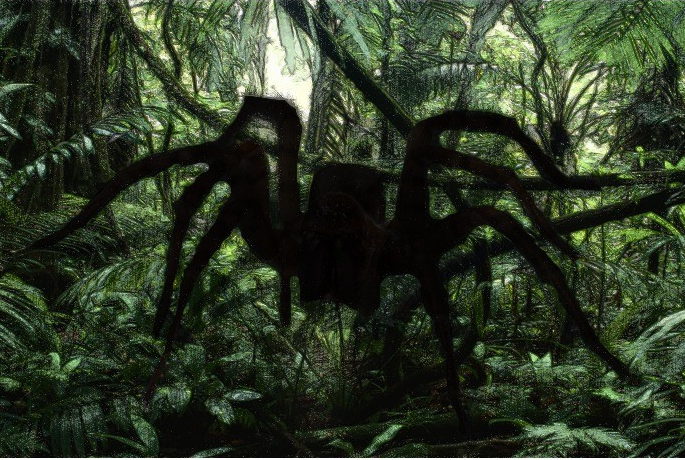
Lurking in jungles and thick caves, many eyes watch your movement – not an unusual feeling for adventurers. What is unusual is that the locals fear this creature not just because it’s deadly, but because if you survive an attack, life will never be the same again.

The Amazon Spider is an oddity among beasts. At first it seems to be like any other giant spider, but those who fall victim to its poison learn that it possesses abilities like nothing else of this world. There are those who claim that it was once an aberration that spent so much time in the wilds of the material world that it grew to be like the native inhabitants, losing most if it’s odd abilities over time. Others claim that only Lloth would usher such a fiend into this world, known for her dismissal of men. Then still some claim that a mad wizard is to blame.

None deny it is a beast to be wary of. Once it has its sights on you, your toughest challenge may be to escape with all your pieces still in the correct places.

Knowledge Nature 18: The Amazon Spider, known for many comic stories of brave knights turned damsels, will actually confront a female warrior just a quick as a male. Its poison is slow to act, but its attacks are fierce and deadly.

Nature 23: It is said that the heart of an Amazon Spider can be used by potion makers to make one single vile, which can reverse the gender back. The Amazon Spider is sometimes hunted by those wishing to remove such a curse, acquired from other sources.

In combat: The Amazon Spider likes to work on a single target at a time, using its Loose Webbing to keep enemies in direct combat with it. When multiple enemies begin focusing on it, it will use Web Swing to slide between one or two surfaces, repositioning itself to overtake a new foe.

Encounters: The Amazon Spider is sometimes found in the wild, joining up with other spiders or stealthy hunters. More often, though, they are caught and trained by savage, gender-focused tribes. It is a favored pet of drow and barbarians.

Image by Jonathan Baldwin

Medusa Dread, the Snake – Steal this Monster

Medusa Dread

No one likes dealing with a medusa dread, even other medusa.  This abomination, just before being born, burrows deeper into its mother (which is a normal medusa), and begins feasting.  Not until the mother medusa dies in the next few hours does the medusa dread eat its way out.

Medusa dread are rare, and are thought to be myth by most.  Making them even more rare is the fact that if the father is present when it is born, he kills it.  Unlike its parents, it will eat anything, even other medusa.

Medusa Dread Tactics

The medusa dread is not smart enough to make bows, but it can fashion spears and javelins.  It prefers to live in caves or dungeons where others cannot get decent range on it.  If it thinks it can win a fight without using its petrifying gaze, it will do so (so as to eat the prey later).  Otherwise, it prefers to use its javelins at first, and then move in for close combat to get the most out of its reactionary petrifying attack.

Medusa Dread Lore

A character knows the following information with a successful Nature check, in addition to what is found in the Monster Manual.

DC 15: A medusa dread is said to be the body of a person, and the tail of a snake (and rather large), though that is supposedly a myth.

DC 20: Medusa dread are not smart enough to carry out aspirations of wealth and power.  If they ever gain it, it doesn’t last long.

DC 25: All other medusa hate the medusa dread, and will either send small armies of underlings after it, or gang up on it with other medusa.  It’s gaze attack is more potent than smaller medusa, and it can use it more often.  Even after a killing blow has landed, the medusa dread can still get off one last petrifying attack on its killer.