Contest #3: Your Best NPC!

THIS CONTEST HAS NOW CLOSED

NPCs that stick in the minds of the players are simply one of the best story-telling tools you can have in your gaming tool box.  Aside from statless non-wonders to be exploited and stepped on, NPCs can and do provide so many uses in any game.  Since there are so many NPCs in the game world, I think it’s important to have a few non-vanilla types on hand, ready to spice up your story.

So, let’s keep this one simple. For this contest, I’m looking for your best NPC.  Place your entry here!

  • Your NPC can be for any game or genre.
  • You must provide at least a couple of paragraphs to describe him/her.
  • Your entry will most likely be posted, and then added to the “Steal this NPC” page.
  • Judging will be done by Stuffer Shack crew (who can’t enter).
  • This contest will end when 10 NPCs have been posted, or November 30 (whichever comes last).

1st Place

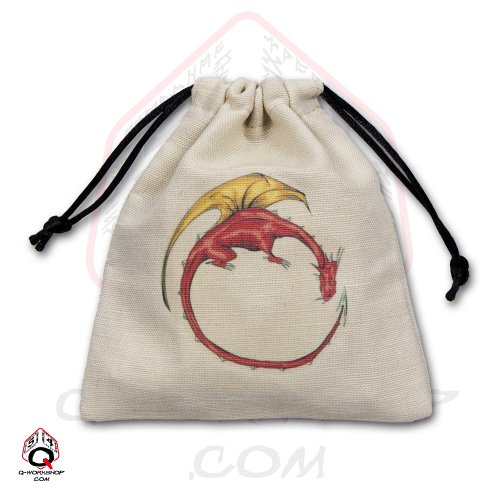
  • Dragon Dice bag
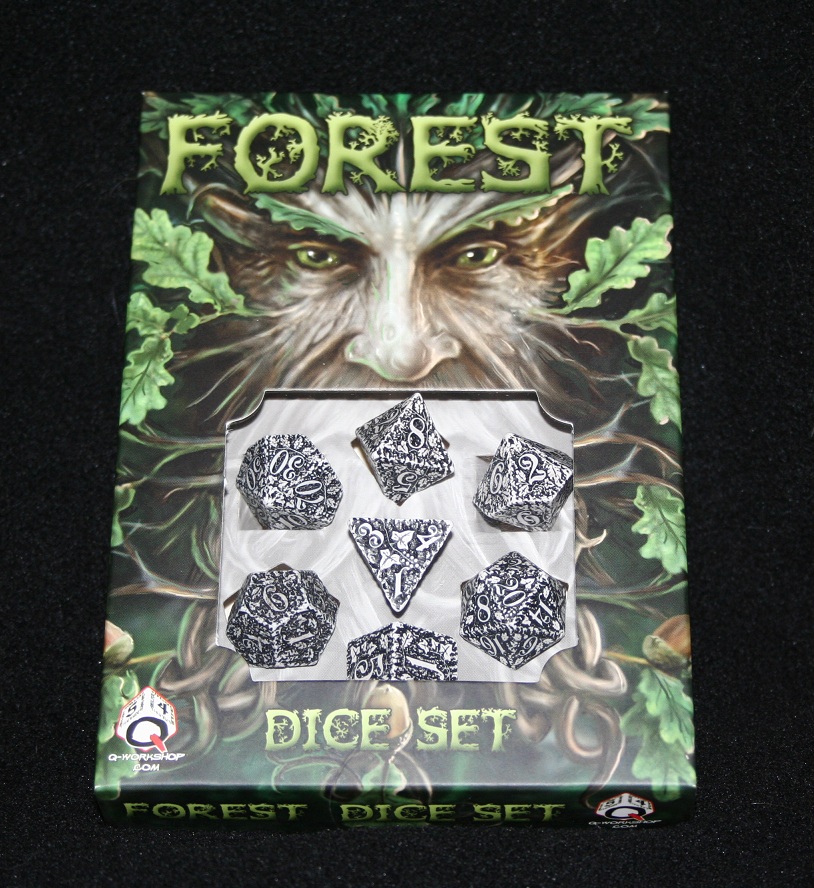
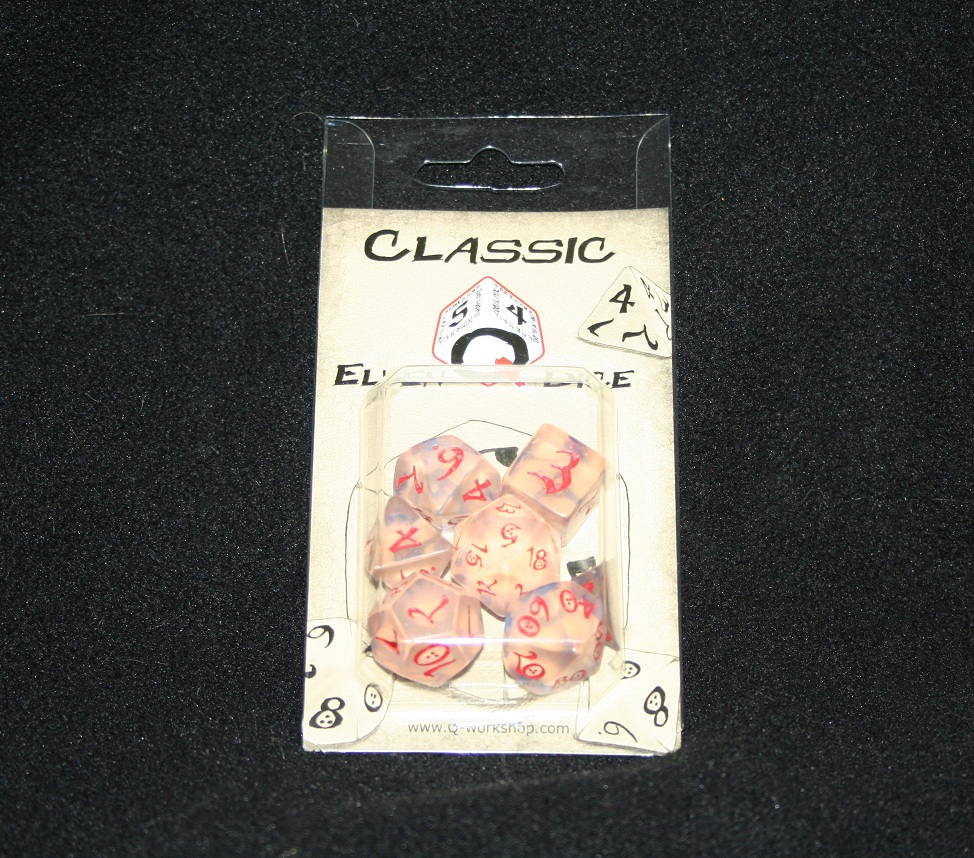
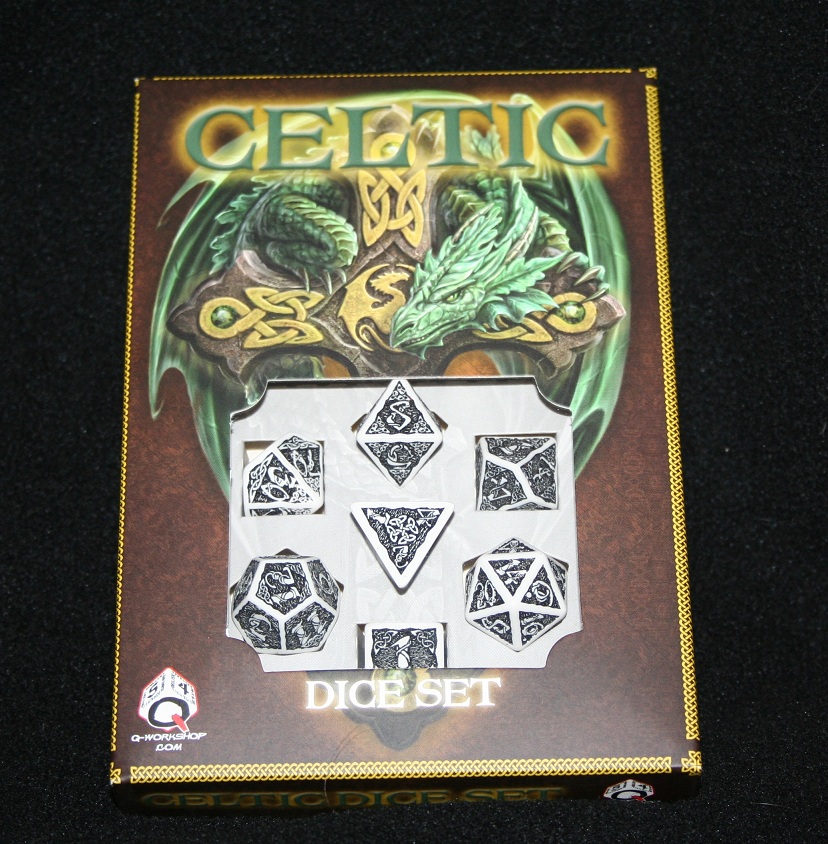
  • Your choice of the following sets of Q-Workshop dice
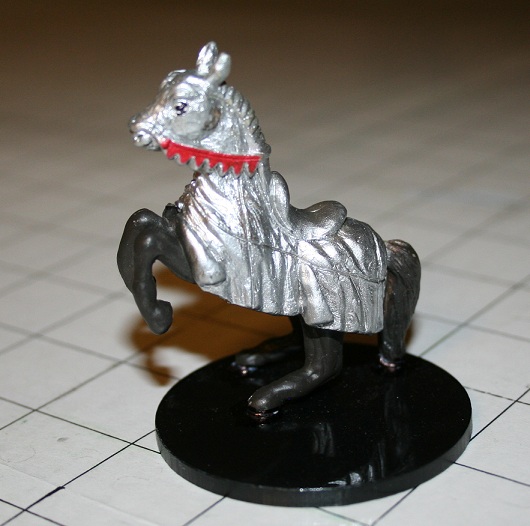
  • Your choice of the two unique Horse Minis

2nd Place

  • Your choice of the remaining three sets of Q-Workshop dice
  • The remaining Horse Mini

3rd Place

  • Your choice of the remaining two sets of Q-Workshop dice

Place your entry here!

The two Horse Minis are unique (they aren’t for sale).  The first is a charging warhorse, and the second is a very large horse (it’s still large-sized, just very large).

Most Evil Utterances

Please welcome Jonathan Baldwin to the Stuffer Shack Crew…

Sometimes you really need your villains to stand out in the minds of your players. Since role-playing is, at its heart, a verbal exercise, this means spending a little extra time on your dialog.  You can describe the wicked fiend all you want, but unless you have pictures, your players are only going to remember what s/he says.

To get you started with some inspiration, here are a few of the best lines of dialog ever delivered by an antagonist.

“Welcome to my home; enter freely and of your own will.” –Dracula

The hospitable villain is a truly frightening force; if things are played right, the heroes won’t realize that they’re dealing with the Big Bad until they’ve already enjoyed his hospitality for some time.

“This is why only fools are heroes — because you never know when some lunatic will come along with a sadistic choice. Let die the woman you love… or suffer the little children. Make your choice, Spider-Man, and see how a hero is rewarded.” – The Green Goblin, Spider-Man

It’s the oldest move in the playbook, and it’s still as effective now as it was then. Two outcomes, both bad for the PC’s, and supposedly there’s only time to pick one. Of course, there’s always the possibility that the heroes will be properly heroic and come up with an out. Sometimes that’s good – especially when the villain is a monster, rather than an intellectual giant. Sometimes, however . . .

“How very predictable. I anticipated you would try to create a third, more favorable option.” –D.A.V.E., The Batman

It’s hard not to respect a good Xanatos Gambit; any villain smart enough to structure a plan in such a way that every possible outcome including failure works toward his goals is worthy of respect and recognition… or at least undying hatred on the part of the PC’s. Sometimes that’s good enough.

In a long campaign, this might work like pretty much everything Darth Sideous/Palpatine does in the Star Wars prequel trilogy.

Conveniently, as the GM, you don’t have to know all the possibilities ahead of time – you only have to be able to improvise if the players do the unexpected, and continue moving the plot forward. If you do it right, you look like a genius – or at least your villain does.

It should be noted, if you can ask, “But what if they do this?” and it would mess everything up, this is a Batman Gambit, which for villains is a plan which relies on the heroic tendency to behave in the most heroic manner, or otherwise assumes and manipulates a certain response based on known facts about the “victims.” Sometimes leaving a flaw in the plan on purpose isn’t a bad move. If the heroes find it, they feel great because they “outsmarted” the GM; if they don’t, you have something for your villain to monologue about during his getaway. Assuming he gets one.

“I can’t think of a morning I haven’t woken up with the thought of strangling you. That sanctimonious image of yours fooled everyone except me. Because I know evil.” –Lex Luthor, Public Enemies

This betrays a hatred that has completely distorted the villain’s perception of morality. To create this effect, operate from the assumption that the majority of antagonists aren’t card carrying villains and will develop some kind of rationalization that explains why they’re right and everyone else is the villain for trying to stop them. Create a villain who believes that he’s the hero of the story, trying to “save the world;” if your PCs are heroic sociopaths this can be easy, but for truly sanctimonious heroes the rationalization might take a little more work. Invariably, this kind of villain is the most interesting.

“No. I am your father.” –Darth Vader, The Empire Strikes Back

…or mother, sister, daughter, cousin, evil goatee sporting clone or alternate universe variation . . . even if the villain is lying (and let’s face it, they probably are), this is a great moment.

“You lose, Tony Stark.” –Whiplash, Iron Man 2

The villain has planned ahead so effectively that his own death is factored into an ideal condition for victory. Maybe the villain’s death is broadcast to the general populace and makes the heroes look like murderers. Maybe death unleashes the villain’s spirit to wreak havoc. Maybe death transforms him into a vampire. Alternatively, the villain’s death might just trigger the bomb and leave the hero with only seconds to evacuate the area.

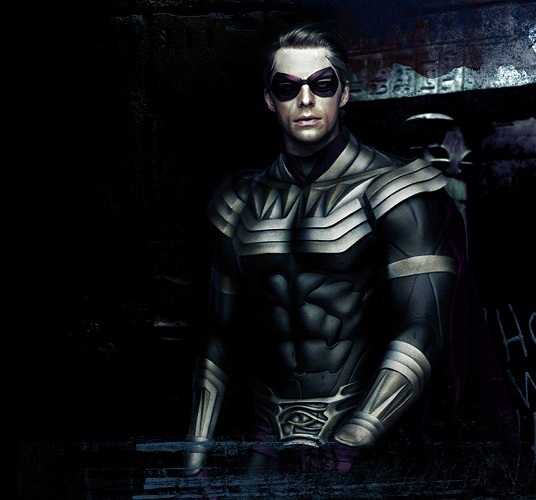
“I did it thirty-five minutes ago,” –Ozymandias, Watchmen

…or any credible variation on the theme of “You’re far too late for it to make any difference.” This specific example is my all-time favorite – to this day, I can’t read this part of Watchmen without my jaw hitting the floor, even when I know that it’s coming.

There are far too many great lines to count, and these are only a few of my personal favorites. Have a favorite that I missed? Leave it in the comments!

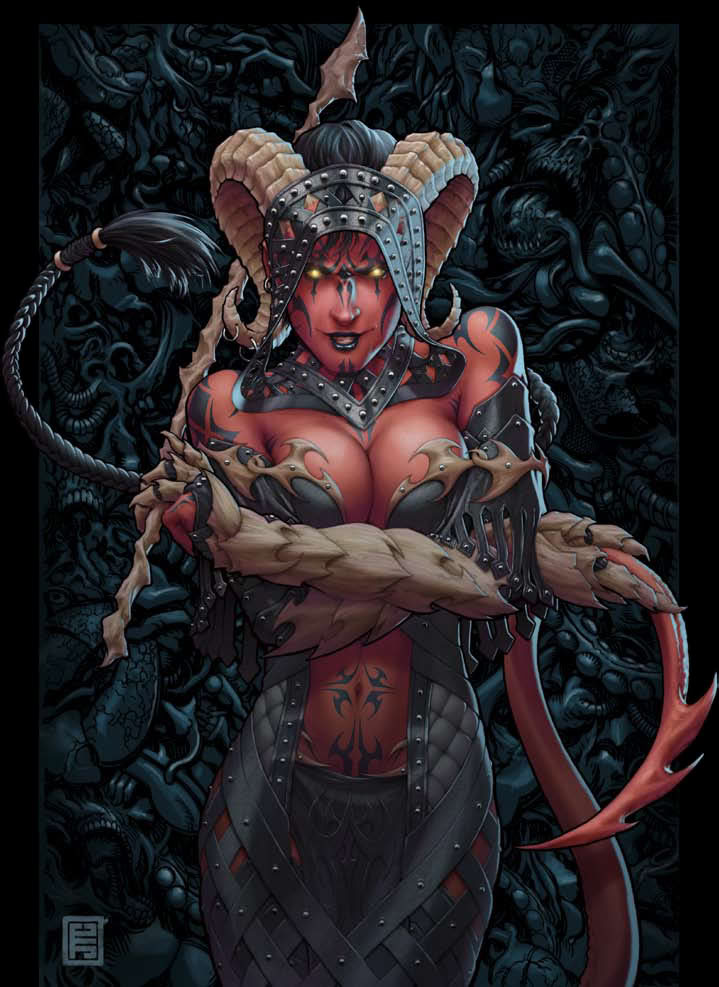
Affyria, the Tiefling Bard (steal this background)

Affyria is a descendant of one of the old houses of the great tiefling empire of Bael Turath. She’s studied the old stories closely, and is always looking to improve her knowledge concerning the old ways. This is important to her, as uncovering her legacy is needed to avoid repeating the mistakes of her ancestors.

Growing up on the streets of Wyvernfell wasn’t exactly easy, even with the help of her family. She learned to be both self-reliant and mistrustful (things she would later have to unlearn), but her natural charisma made her a leader – even when she wasn’t sure she wanted to be.

Unfortunately, members of her family started to turn up missing or dead. Affyria had to live out the last few years of her childhood almost entirely unsupported, and the murderer was never found. Why were they targeted, and are those responsible still looking for her? These are thoughts that never escape her.

When she came of age, Affyria studied the bardic arts to gain the flexibility to make her way in the world, as well as the tools she would need to uncover more of her history. As part of these efforts, Affyria has rediscovered the lost arts of the Turathi sword-masters, making them her own. Her spells, songs, and swordplay have kept her alive over the last few years, and her new friends have helped, too. Affyria hasn’t told them much of her past, or about her ambitions, but they’ve still managed to earn each other’s trust.

Crafting Your Origin Story, Part 1

  • A wall-crawling superhero with the proportionate strength of a spider…
  • A former Vietnam vet who has become a vigilante after his family was killed in a mob shootout…
  • A drow ranger who fights for approval from the surface world, although some cannot see beyond the sins of his race…
  • An alien, sent to our world by his parents before they were killed as their planet crumbled around them…
  • A boy whose initial experiences with magic cause him to live with a disapproving aunt and uncle in a cupboard under the stairs…
  • The only wizard in the Chicago yellow pages who can’t stand seeing a damsel in distress or some supernatural baddie making life miserable for mortals…

Chances are you can name at least one character from this list.  They are iconic heroes and anti-heroes that have identifiable traits, quirks, mannerisms, abilities, etc.  What brings them to life for people is their daily struggle, their “trouble” as it were. For most characters, you need look no further than their origin story to see how that defining moment forever imprinted itself on their personality and shapes their decisions.

Many of us role players relish the opportunity to create and breathe life into a character and would love to create one as iconic as a popular super hero or character with his own line of novels.  There’s plenty of advice out there for adopting quirks and mannerisms, different accents, one-liners, etc. for your character.  We even have articles related to backgrounds to help inspire you.  What I want to encourage is to have you answer the Whys.

Why can the character do the things he does? (superpowers, 4E powers, exceptional skills)

Why does the character choose this profession (adventurer, soldier, superhero, etc.)?

Why will this character continue to follow this path?

Answering the whys behind your question will allow you to always have a grasp on your character’s motivations and make changing those motivations (if necessary) have more impact and meaning.  You will know when to stay in-character (and more importantly what it means to be “in-character” for this character) and when to break from that.  If you can break from the character established with everyone at the table while being true to the character’s origin, you’ve added another dimension to the character and to your storytelling.

For instance, in the first half of the movie Spider-Man, we see Peter Parker’s origin story. His trials and troubles that help shape him into accepting the mantle of hero and why he feels he has to be the one to deal with criminals. Even after several defeats at the hands of the Green Goblin, he still returns for more. Why?  It‘s not for kewl lewt, or experience points, or because “this is the GM’s story and I’m doing my part to be a part of it.” Spidey does these things because of who he is.  This is why 37 years after he first hit comics, he is still an interesting and compelling character that feels like he has some freshness left in him, yet has never had to change his core archetype.  Instances of Peter Parker breaking from his expected behavior drove the plot of movies 2 and 3.  Regardless of how you feel about those movies, they are still good examples of character-driven story.

For maximum impact at the table, you should discuss your origin with your fellow players.  If you want to leave that cloaked in mystery, at least discuss it with your GM.  At the very least, it will allow him/her to help you defend any choices that fit your character if the party objects, and will ultimately help advance the story.  At best, it will give the DM inspiration and hooks to directly involve your character in the greater story.

Come back next time for an example of one Hiro’s rise to character greatness…

Favorite Site of the Month – Nov/2010

I have a secret.

Outside of Stuffer Shack, Critical Hits might just be my favorite gaming blog.  With a good group of writers, ranging from industry professionals to gaming enthusiasts, there is always a nice mix of articles to read.

To be fair, I have only been reading online for about a year, but I continue to find myself gravitating back toward Critical Hits – they just always seem to have the articles that interest me, or that I find useful in helping me get more out of the game (here’s my favorite).

Critical Hits just had their five-year birthday.  You can read up on it here, where you’ll find info on what they’ve accomplished (including two Ennie nominations), some cools stats, and where they’re headed.

Critical Hits, Stuffer Shack’s site of the month for November 2010.

The Gamecraft 25: Plot Complications

This time, the Gamecraft 25 is going to take a look at plot complications for your adventures.  All of these are designed to add an interesting set of circumstances to challenge your heroes in different ways.  Most of these ideas will make an adventure more difficult, so keep that in mind when using them.

  1. The party has a “tag-along.”  This could be a bard looking for epic inspiration, some wanna-be adventurer, a wealthy dilettante, the adventure’s patron, or anyone else that is more of a hindrance than a help and needs to stay alive.
  2. Non-lethal combat plays a role in the adventure, perhaps an unarmed brawl.
  3. The adventure features an extended chase scene.  The heroes may be either the pursuers or the pursued.  The chase can be run as a series of linked “mini-encounters.”
  4. A party member (or the whole party) has been poisoned, and the effects can only be countered with a specific antidote.  The heroes must recover the antidote and complete their adventure.  Maybe the party’s patron is holding the antidote until the heroes complete his mission.
  5. The heroes are caught between rivals.  This could be warring tribes, competing guilds, feuding noble houses, or even star-crossed lovers.  This circumstance could simply be background, or the heroes could find themselves trying to serve both factions.
  6. The heroes’ adventure has a serious time limitation.  This could be a count-down to disaster (the gate to the Abyss opens at sunset), or just a very limited window of opportunity in which to succeed (the Vault of Baraxis is only open for 24 hours every millennium).
  7. Severe weather complicates the adventure.  Think hurricane, blizzard, or typhoon.
  8. The general public has turned against the heroes for known or unknown reasons.  This could range from outright hostility (maybe even a bounty on the heroes) to simply refusing them access to local communities and resources.
  9. In order to succeed at the adventure, the heroes must act directly against the wishes of those in power.  This could be the government, a religious institution, powerful guilds, or even just the will of the people.
  10. The adventure features a case of mistaken identity, either PC or NPC.
  11. The heroes find themselves outsiders in a strange land where they do not speak the local language or understand local customs and religion.  The locals are suspicious and the heroes may find it alarmingly easy to violate some unknown law or local taboo.
  12. The heroes are faced with mind-controlled “civilians.”  They must rescue those being manipulated without hurting them.  Of course, the civilians are out to kill the heroes.
  13. The heroes uncover an item or information that someone powerful needs to cover up or make disappear.  This works even better if the heroes don’t have any idea about the significance of what they have or know.
  14. The adventure’s villain turns out to be some sort of good-guy and places the heroes in a difficult position of what to do with him.
  15. Turns out that the person the heroes just rescued is due to be executed, a little fact that the party’s patrons failed to mention.
  16. An adventure to recover something or rescue someone turns out to be surprisingly easy to get to the target.  The real adventure begins with the heroes’ struggle to escape with the item or person.
  17. The heroes need to return to a previous adventure site because their actions created some new situation or made an existing situation worse.
  18. The bad guy is the only one who can give the heroes access to the thing they are looking for.  He must be kept alive and protected so that the heroes can succeed.
  19. Someone associated with a defeated enemy (family, friends, minions) is looking for revenge.  This could be as simple as just trying to kill the heroes or as complex as an elaborate scheme to ruin their reputations.
  20. The arch-villain of the story turns out to be someone close to the heroes.  This could be a friend, a long-time ally, family member, or even a love interest.
  21. The heroes are faced with a situation where “adventure success” will destroy something important to them, such as their reputations or causing the death of someone they care about.
  22. Another group of adventurers has managed to take the credit for the heroes’ recent successes and are enjoying great fame and respect from the locals.  The heroes are being looked at as second-rate adventurers at best, low-life scoundrels at worse.
  23. The party has been sold some ill-prepared rations and are dealing with the effects of a stomach disorder throughout the adventure.  This could play out in two different ways: either as a dangerous plot complication or as a bit of comic relief.
  24. The heroes end up in a situation where they are damned-if-they-do, damned-if-they-don’t.  Adventure success means unleashing something worse, preventing something worse will force the heroes to fail at their adventure.  How will they decide?
  25. After a series of adventures with plot complications, the latest adventure turns out to be 100% straight forward and goes exactly as planned.

As always, I hope these ideas inspire and fuel your creative juices.

Rule #23: Zombies Don’t Like Propane. A Zombie Cataclysm Review

About a month ago I got a request to do a review for a new game, Zombie Cataclysm. I thought, “Sweet! Someone values my opinion, finally!” Then I thought, “Oh crap, what if I don’t like it? Can I do a negative review?” Then I said, “Sweet! Someone values my opinion, finally!” In the end, I just said to myself that I didn’t know the owners of this game, I don’t owe them anything, and that I could do this. Now, I don’t know the “correct” way to do a game review (or if there is correct way), so I’m just going to tell you:

  • My initial thoughts.
  • What the game offers.
  • How the game played.
  • My final thoughts.
  • Would I play it again?

So let’s get started…

This game is about killing zombies.  No, this game is about YOU killing zombies.  What would you do if your neighbors began turning into flesh eating walking dead?  Well, now you get to find out.

  • By Lance Meyer and Joe Bozlinski
  • Paperback, 76 pages
  • Color Photographs
  • PDF $15, Paperback + PDF Bundle $23
  • No ISBN

MY INITIAL THOUGHTS

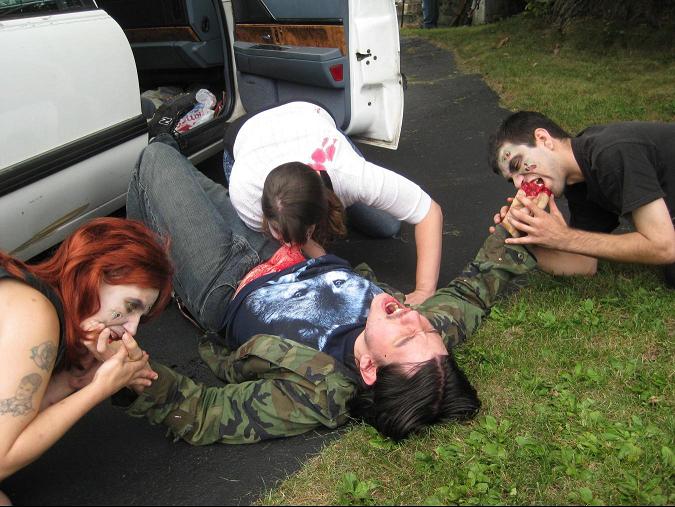
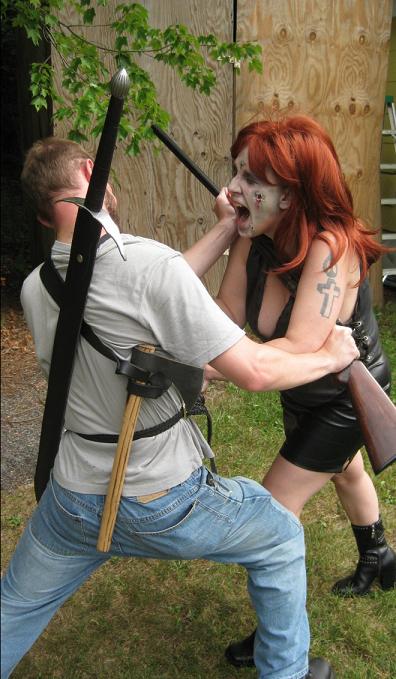
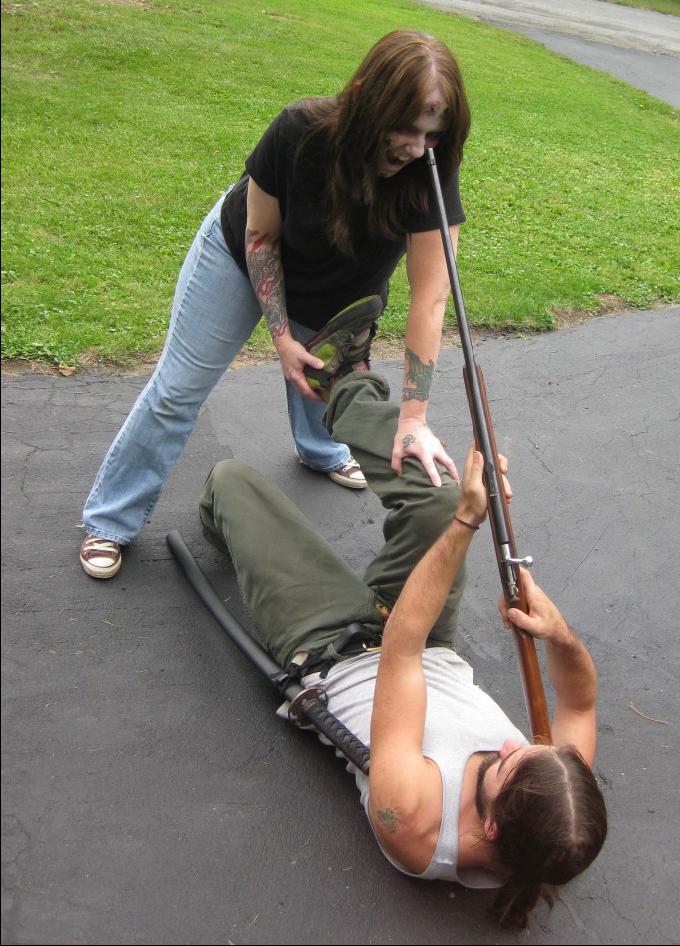
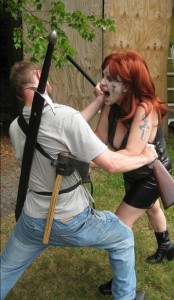
I’ve recently gotten into a lot of zombie movies, and I’ve actually wanted to try out a game of some zombie killing.  So when I got the request I was immediately stoked.  Then I was sent the PDF and was immediately disappointed.  No art.  It’s all photographs.  It looks like the writer got a few gaming buddies together, gave some of them weapons, and others some zombie make-up, and then started taking pictures.  Where’s my art, damn it?

The game was written and printed in Word, double-column, Times New Roman, left-aligned, on plain white paper.  Aside from the various photographs, there’s no other graphics.  The pages look like they were written and printed right off a home printer.  If there is ever to be a second printing, I’d like to see the text justified, and each page to have some background graphic, like a little bit of blood (or something) – plain white paper just does not look professional.

Once you start reading, you quickly see that the writer is speaking directly to you.  Most role-playing games read like a professional manual; this reads as if the writer is sitting right next to you, telling you about the game and its rules.  At first, I was a little put off by this, but my opinion eventually changed, and I’ll explain why later.

You’ll immediately realize that this is a game written by a gamer, and published on a budget.  Because of that, I felt that my play-testing of the game was going to be a bust.  To be honest, I was not looking forward to it.

  • My initial thoughts: Disappointed.

WHAT THE GAME OFFERS

I’ve said it already, and I’ll say it again.  Zombie Cataclysm is about YOU killing zombies.  Or, it’s about you getting your brains eaten.  Whichever.
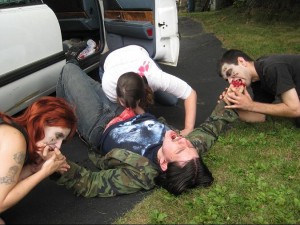
I was happy to see that they have their own reason for the cataclysm, and even material for a long-term campaign.  The book goes into detail about things your characters should be doing, and gives some options for survival.

Something that I found useful were the various encounter tables.  For instance, the player characters are going to need supplies.  They are going to need to raid some stores.  There are easy-to-use (seemingly realistic) tables for determining how much a particular store has already been raided.  So, nobody knows if a raiding run will be successful.  Nice.  There are also tables for hazards and roadblocks, random zombies roaming around – that kind of thing.  It’s great because in most games, when the GM sets up an encounter, you usually expect to get through the “level appropriate” encounter with a “somewhat loss of resources.”  Not necessarily so here.  Letting the dice dictate the encounter really adds tension and drama.  Again, nice.

When making your character, you’re expected to play yourself.  Basically, when putting yourself down on paper, you’re given a lot of leeway when plugging in the numbers.  The game has ways of determining your stat and skill ratings, but it all boils down to how you view yourself.  If you think you’re smart enough to have an 18 Intelligence, based on the guidelines in the book, put it on your sheet.  And no, the GM does not police your character.

Lots and lots of weapons.  Hey, when you’re fighting zombies, you need to know how much damage a tire iron does.

Lots and lots of skills.  Way too many skills.  I don’t think in my zombie games, anyone is ever going to need to know how well they sing, or how skilled they are at crafting jewelry, or how proficient they are in 60 other skills.

The character sheet is not so much a character sheet as it is a giant list of skills.  A designated place for weapons and gear would have been nice (and professional).

The game mechanic is so very “rules lite.”  When reading the rules of the game, I was again disappointed.  But, I have to remember that I’m definitely a “rules medium” kind of gamer, and this was nowhere near that.  Actually, I’d have to call it “rules very lite.”  For success-based skills, you roll a d20 and try to get under your skill rating.  For difficult tasks, your skill rating is cut in half, and then cut in half again, etc.  Opposed skills (like melee combat skills) are just the opposite – roll a d20 and add your skill rating – high roll wins.

HOW THE GAME PLAYED

So, we sit down at the table and the players start making their characters (themselves).  I had already printed out the sheets, and highlighted about 12 skills on each sheet.  We didn’t have all night to make characters, and I thought these 12 skills were the most relevant to the game.
After reading the book, I felt the game was designed to move quickly.  Action and zombie-eating combats seemed to be a torrid gorefest of in-your-face violence.  So, that’s how character creation went.  I did not want to spend an hour letting everyone figure out if they had a 10 in Strength, or an 11.  So, as we sped through character creation, I was actually pleased at how everyone at the table really got into statting themselves out.  Does Colin really have an 18 Intelligence?  Well, he is pretty smart, and according to the book, he does.  Does Stacey really have a 16 Strength?  Well, he is the strongest in our group, and according the book, he does.  To be honest, I almost cared that some stats may have been… exaggerated.  To be even more honest, I actually liked that they were.  Character creation was just a fun 15 minutes for us, and I think it set the tone for the game.

Most of us in the group have children.  So, right off the bat, I had to write them out of the game.  They were all either on vacation somewhere or at a friend’s house (children really have no place in a zombie game).

I was a little peeved at the very start of the game due to Colin not paying attention…

I started the game by saying that everyone had just sat down to play Deathwatch (but that I couldn’t make it).  I mentioned a loud noise, like a low-flying jetliner, and then later there was an odd snowfall, which they could see was actually some kind of ash.  So, Colin is actually standing at his front door looking out and I’m thinking, “Dude, are you gonna play, or what?  This is my first time running for this group and you’re not even interested.” No, he was actually in-character, “looking” at the ash outside, pseudo-larping his role in my game.

Nice.

And that’s how the night went.  Immediately, people were bringing (physically bringing) baseball bats and flashlights to the table, they were closing blinds, talking about an access way into the attic, saying what parts of the house to avoid for fear of zombies seeing movement, and so on.  I just about flipped over when Melissa brought the whole damn set of kitchen knives to the table.  And, it was pure gold when people started discussing what they knew, or thought they knew about zombies (you know, Shaun of the Dead, Zombieland, etc.).  Of course, Stacey brought his big truck to gaming that night, so traversing over the hills was no problem (I did make sure to sideswipe his shiny new truck, though).  On a side note, having a bunch of matchbox cars and trucks to put on your battle map is just cool, especially when some of them are flipped on their side.

I don’t know if it was the genre, or the fact that everyone was playing themselves, but the night just flowed.  I kept the pace fast and furious, which brought everyone that much further into the game.  In the end, lots of zombies were killed, three players had been bitten by zombies, and the players aren’t sure if any of those three are going to end up zombiefied.  We’ll have to see next time…

I had a probelm with one part of the game, and that was movement.  For a game that involves a lot of deadly combat with zombies, I think movement should be pretty clear, and not abstract, especially when it is very easy to get killed.

So, I made a quick and very effective house-rule.  Cut your Speed rating in half, and that’s how many inches you can move in one action.  It worked very well on the battle map, and no one ever had any problems.

MY FINAL THOUGHTS

At the end of the night, I thanked everyone for playing.  I reminded them that we played this game so that I could do a review, and I wanted some honest opinions.

Everyone agreed that this game was not professionally done, but that it was done well enough.  With the exception of our one house-rule, we didn’t have any problems with the very rules-lite mechanics.  I actually found that the rules-lite mechanics made it very easy to hand out bonuses and penalties on the spot. “You made your First Aid check?  Cool, now he gets a… +2 bonus to stave off the zombie disease.” It was actually kind of refreshing.

None of us thought we could play it as a weekly campaign.  We did, however, feel that we could play it as a filler game once every month or two, when we couldn’t play our regular game.  We felt it was perfect for some good old-fashioned zombie kick-assery.

So, I flat-out asked them, “Really, on a scale of 1-10, how much fun did you have?” Immediately, everyone said they were at either a 9 or a 10 on the fun scale.  They said this was a very fun night, and would definitely play it again.  That made me happy, because that is exactly how I felt.  I was really glad that the first time I ran a game for this group – it ended up being a win.

To be fair, I think you have to approach this kind of game a certain way.  It needs to be fast, dangerous, and hilarious.  The fact that you get to play yourself just adds to the mix.  Sure, if you die, there are rules for making a normal character, but a lot of the fun is trying to stay alive simply because you have a lot more invested in your character (after all, he’s you).
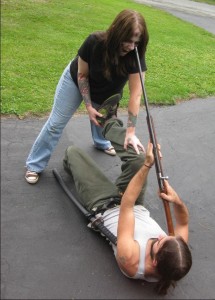
Something else that grew on me.  Earlier I said that the book is written as if the writer is talking directly to you.  I also said that there was no art; just photos.  Hell, I was actually concerned when I saw revolvers and bolt action rifles pressed up against the foreheads of some of these zombies.

But in the end, it all put me in the mood to play this slightly goofy game about killing zombies.  Zombie Cataclysm isn’t trying to be the next Dungeons & Dragons; it’s trying to be exactly what it is: a game about killing freaking zombies.  Sometimes I’m in the mood for watching a B-movie horror flick – and sometimes I’m in the mood for killing me some zombies.  I think the tone of the book is just right for getting you into the game – and the charm just grows on you.

The price for the PDF alone is $15.  I’m not really a PDF kind of guy, so for me, that’s a little on the steep side.  I think $9.95 is more reasonable.  If you have a few extra bucks and only want the PDF, then go ahead and get it here as an instant download.

However, for $23 you get both the paperback book and the PDF.  That, to me, is a great deal.  I would have bought that bundle, had I not gotten the PDF for free.  Now, after having played the game, I would recommend the bundle.  You can get the bundle at their homepage.

SO, WOULD I PLAY THE GAME AGAIN?

Hell yes.  Except that next time I want to kill me some zombies!  This is simply a great game to pull out for some good old-fashioned fun.

Oh, and the quote of the night was from Kayla, the seven year old who was watching us play.  John left an empty propane tank in the garage, and took the full propane tank as fuel they might need.  Kayla asks, “What, do zombies not like propane?”

No Kayla, no they don’t.  Rule # 23: Zombies don’t like propane.

Player Responsibilities

GMs aren’t the only ones with responsibilities. The players are co-creators with the GM and that gives them certain responsibilities.

Below are lists of player do’s and don’ts:

Game Preparation

  • Be on time. If possible, try to be a little early. That will give you some time to get settled and ready to play.  If you can’t be on time or have to miss a session entirely, call your GM.
  • Be prepared for the game session. Have your character sheet, dice, or whatever else you need to play.
  • Try to create a character that will fit in the rest of the group. If everyone else in your group is playing good characters, leave your anti-paladin at home, unless the GM and group say otherwise.
  • Recognize that your GM may have to cancel a game session occasionally.  The GM has a real life, too.

During the Game

  • Be honest with the GM and other players. Your character doesn’t have to be honest (unless that would severely disrupt the game), but you, as the player, should be completely honest about die results and other game-related information.
  • Share the limelight. Don’t hog all the GM’s attention.
  • Stay focused on the game. Keep conversations about the latest movies, etc. to before, after and during breaks in the game session. Don’t play on your computer during the session. Even when your character isn’t currently involved in the action, you can be updating your sheet, taking notes, planning strategy, etc.
  • Find out your group’s policies on notes to the GM and/or pulling the GM aside for individual conferences. In my games it’s not only allowed, but is actively encouraged as long as they’re kept short; other groups absolutely hate them. Find out your group’s preferences and stick to them.
  • Don’t talk about how you could run this game better or how things would be different if you were running this game. You’re there to play, not to GM.
  • If you have a suggestion on how the GM could improve the game, bring it up to him outside of the game session. Also, be willing to accept your GM’s decision on the suggestion; he usually has valid reasons for declining your idea.
  • Similarly, accept your GM’s ruling. If you disagree with her interpretation of a rule or with an event that happened, discuss it with your GM after the game session.
  • Look for ways to involve your character in the game without trying to monopolize it. Don’t leave it completely up to the GM to tell you what to do. However, if you’re lost and don’t know what to do with your character, ask the GM and the other players. They’ll usually be happy to help.
  • Keep game events in the game; try not to take them personally.
  • Leave personal issues outside the game.
  • Don’t look at the GM’s notes/adventure/other game stuff.
  • Trust your GM or be willing to leave the game. Often the GM will have reason for something happening in the game, but may not be able to reveal that reason until several game sessions down the road.

As a Guest

  • Be a courteous and respectful guest in your host’s home.
  • Clean up after yourself.
  • Unless your host says otherwise, confine yourself to the game room, the bathroom and (with the host’s okay), the kitchen of your host’s home. Don’t go wandering into other rooms of the house and, above all, try not to disturb non-playing members of the host’s family.
  • If a member of your group is violently allergic to something, don’t bring it, unless the individual gives the okay. For example, in my group, our GM has a severe allergy to pork. Even accidental contact with pork grease on his hands can send him to the emergency room. Any pork item is barred from our gaming table. On the other hand, I’m allergic to dairy, but only if I actually eat it.  I don’t mind if other people in the group bring dairy products.
  • Asking if anyone in the group has severe allergies and then being careful of them is a great way to make yourself a player who gets invited to many games.
  • Don’t hang around the host’s home long after the game session has ended. Unless you’re invited to stay by the host, thank her for hosting and leave when the other players do or when the host asks everyone to.
  • Don’t pick up or touch things in your host’s home without his permission.

And Above All:

  • Be willing to gracefully leave a gaming group that you don’t fit in with. Don’t flame the GM or other players; recognize that everyone has different play styles. You can be friends with people you don’t like to play with.

Deathwatch: Best RPG… Ever!

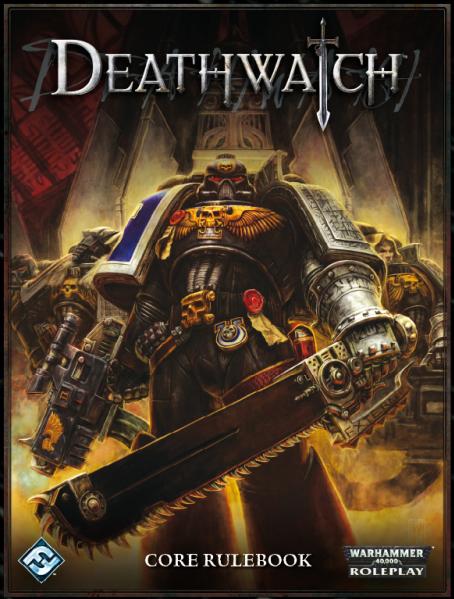
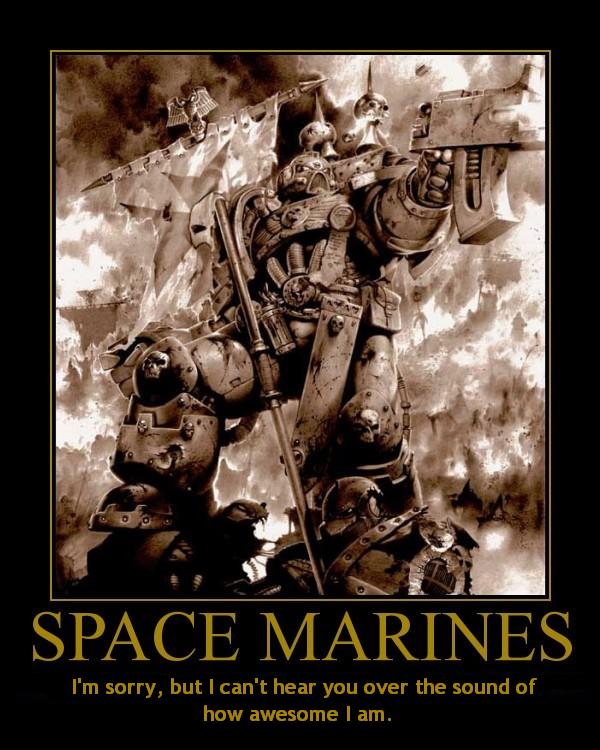
I’ve enjoyed a lot of different games over the years.  However, Deathwatch (the newest RPG from Fantasy Flight Games), has taken its place as my favorite roleplaying game of all time.  You heard right, all-time favorite.  For those of you unfamiliar with the basic concepts of the game, you can click here for a brief overview from FFG.

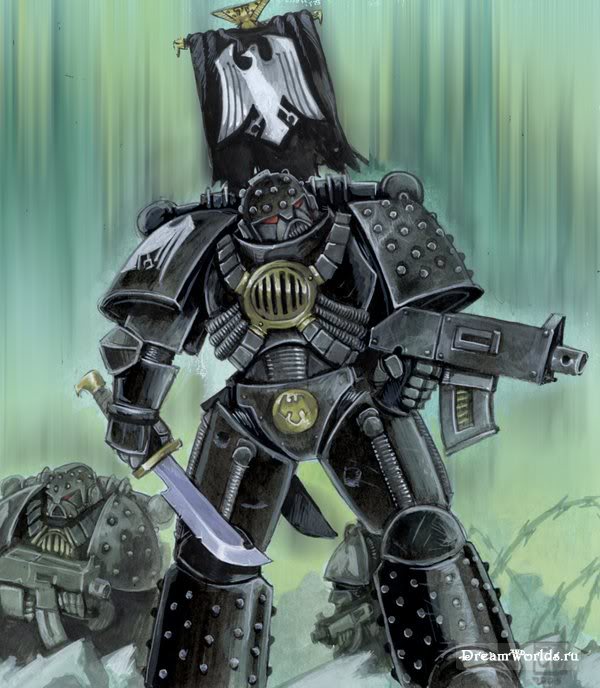
Deathwatch is the third RPG from FFG set in Games Workshop’s Warhammer 40,000 universe.  I enjoy the other two games immensely – Dark Heresy features players taking on the role of agents of the Inquisition, and Rogue Trader allows players to seek their own fortunes as explorers and merchant princes.  In Deathwatch, players take on the role of Space Marines – genetically enhanced, super-human warriors, who have been assigned to the Deathwatch and are dedicated to protecting humanity from threats too powerful to be dealt with by more conventional methods.

There are several reasons why this game has managed to top my charts, but before addressing them I’ll share a quick caveat: these are my opinions and why Deathwatch is my favorite game.  Here’s a little insight into the essential elements that I feel form the criteria on what makes a great RPG:

  • A well-developed, multi-faceted setting.
  • Characters with well-defined roles and a purpose within the setting.
  • A strong focus on teamwork and cooperative play.
  • Attention given to consequences and the cause-and-effect nature of the characters’ interactions with the setting and story.
  • Focus placed on the players’ choices and actions.
  • Rewards that go beyond the simple acquisition of “stuff.”
  • An “epic” feel.  I’m not necessarily talking about playing powerful characters, but playing characters whose actions matter to the story.

You’ll notice two things conspicuously absent from my list of game elements:

  • Mechanics.  So long as a game has easy-to-understand and internally consistent rules that don’t get in the way of telling a good story, I’m happy (and to me it’s very difficult to be superior to FATE for storytelling, though Deathwatch doesn’t use FATE).
  • Roleplaying.  I have always felt that the responsibility to provide good roleplaying is on the players and the GM.  It’s not the game’s responsibility to do the roleplaying, although it shouldn’t get in the way of roleplaying either!

With that being said let’s look at the reasons why Deathwatch puts me in my gaming happy-place:

STYLE & SETTING

The Warhammer 40K setting has been around for nearly 30 years, and there are an incredible number of games (miniature, board, card, and electronic), novels, web-sites, and even an upcoming feature-length movie detailing the setting.  In general, I’m inclined to not play a game with that much ancillary material in existence; “cannon” tends to ruin the enjoyment for me, making the game feel restrictive and repetitive.  However, FFG has done a fantastic job of blending what the fans “know” of the setting with the creation of a local area (the Jericho Reach) for the game, full of details and hooks, all of which serve to inspire without restricting.

For those of you unfamiliar with the setting, it can be hard to describe easily.  On the surface, it would be easy to think of Deathwatch as sci-fi, what with the spaceships, weapons, and aliens.  However, the Imperium of Man is an ancient institution that relies more on faith and superstition than knowledge and technology.  This gives the setting its heavy gothic feel with strong overtones of the supernatural and mysticism.  To me, the Warhammer 40K setting is more accurately described as “sinister fantasy meets medieval horror set against a grim science fiction backdrop.”  That’s kind of a mouthful for a genre, but the best I can do to capture the setting’s style, feel, and tone.  Style and setting are two of the elements that make Deathwatch a superior game for me.  Dark gothic fantasy trappings (aspects I invoke easily), blended with an oppressive and grim future just begging for heroes that might bring a flicker of light into the unending darkness.

Another element of style that speaks to me is the setting’s interesting dichotomy between moral absolutes and ambiguous shades of grey.  Space Marines, and mankind as a whole, view the galaxy in absolute black and white – aliens are blatant threats to mankind’s divine right to rule the galaxy, heresy must be purged lest it corrupts the Imperium from within, and the demonic forces of Chaos lurk everywhere waiting to spread their evil taint.  No extreme in service of the God-Emperor is too great in the protection of mankind from the myriad of threats lurking across the galaxy.

This mindset is clearly forged into the PC’s, as they are the ultimate defenders of humanity, literally built for it.  For me as a GM this is a great opportunity to really illustrate to the players the consequences of their characters’ actions by placing them in complex situations where they must make major decisions that don’t have easy answers.  Here are a few examples of the type of moral decisions that can frequently come into play in Deathwatch:

  • Do you kill a world in order to protect the galaxy?
  • Should a heretic be brought before justice or do you serve as judge, jury, and executioner?
  • Not everyone’s priorities are the same, where do yours lie?  To the Deathwatch?  Your Space Marine Chapter?  The Imperium?  Maybe even to yourself?
  • What do you do when faced with aliens who desire to serve the “greater good” and believe that sentient beings can live together in peace and work toward each others mutual aid?
  • There’s a fine line between ignorance and heresy – can you tell the difference?

These are just a few examples of the kind of moral dramas that play out so very well in Deathwatch.  For me, what makes these much more powerful than in other games is the default role in which the characters are defined.  They are Space Marines.  They are the greatest defenders humanity has ever known.  They are the servants of the God-Emperor.  They are the Deathwatch.  What the characters are impacts every decision they make.  However, what they are doesn’t necessarily offer any clear answers to the dilemmas they face.  They must choose, and live with the consequences of their choices.

For me, there are a few other elements of style that really set Deathwatch apart from other RPG’s.  I’m not suggesting that any of these aren’t present in other games, just that in Deathwatch they are moved to center stage and surpass such things as the quest for power or the acquisition of loot. To me some of the most interesting include:

  • Duty
  • Honor
  • Courage
  • Leadership
  • Loyalty

In many games these concepts rarely come up.  If they do, it’s most likely only relevant to one character and probably doesn’t impact the whole of the game.  As Space Marines of the Deathwatch, all of these concepts are built into the characters by the very nature of who they are and their role within the setting.  However the interesting thing to me is how these concepts will manifest for each individual character as well as for the Kill-Team as a whole.  It is the way each player interprets and embodies these concepts that makes the game really take on depth and nuance.  These are the details that make characters feel more three-dimensional than your typical RPG characters, ones that are forever embroiled in the “adventure to gain experience and stuff; go up in level and use stuff to go on adventures” cycle.

SCOPE & FORMAT

Deathwatch is a game that is epic in scale.  Although the heroes’ actions will never be known by those they protect, their mission is among the most important in the galaxy.  Entire worlds live or die based on the actions of the characters.  But even with this kind of power and responsibility the heroes still struggle against a never-ending tide of unimaginable threats – hordes of enemies too numerous to count, vile fiends too horrible to contemplate, and threats that seek only to eradicate humanity from the galaxy.  This kind of scope gives Deathwatch real weight and substance.

In addition to the nature of the setting and the roles the players take, Deathwatch achieves this level of epic scope through several means, many of which also appeal to my criteria for a superior RPG.  These specific game elements and concepts include the following:

  • Patronage:  As Space Marines, the characters are members of a monastic warrior cult, the Deathwatch, and they serve the Imperium of Man by the grace of the God-Emperor.  By the very nature of their role the characters are part of the Imperial war-machine.  This gives the players purpose and patronage.  However, as part of the super-elite Deathwatch the players have a great deal of autonomy and are free to carry out their missions as they see fit.  In this way the game has found the perfect balance between duty with purpose, and freedom to make choices and act.
  • Missions: By default, Deathwatch scenarios are organized into Missions.  For me, the Mission format is fantastic.  It gives the players a clear sense of purpose and well-defined goals, but doesn’t limit them in any way as to how they accomplish those goals.  It also means that play tends to focus on making important choices and executing decisive actions.  I’ve played in way too many games where the “adventure” is trying to figure out what the adventure is.  This isn’t to say that Deathwatch puts everything on a silver platter for the players.  Objectives can change, intelligence can be erroneous, and nothing ever goes as planned.  Overall, the Mission format gives direction (in the form of Objectives), but allows for real decision making on the part of the players as to how, and which, Objectives to complete.  As GM, I simply find the Mission format easy to work with and design for.
  • Leadership: The idea of PC leadership is one that many RPG’s intentionally shy away from – not so in Deathwatch.  Every mission that a Kill-Team is sent on will have a designated leader.  The team leader is the one who is ultimately responsible for the success or failure of the mission (at least in the eyes of the team’s commander), and is responsible for making decisions when the team can’t reach a consensus.  The choice of team leader also impacts Cohesion (see below) and dictates which Oaths a team can take before a mission.  Oaths grant the team special abilities for the duration of the mission.  Every single character will have something different to offer if they are team leader, so it becomes an important decision on the part of the players as to who will lead any given mission.  What I love about this is that it allows the “leadership baton” to be passed around from mission to mission.  It’s great to see that normally reserved, quiet player come out of their shell when they have to step up and take command of the Emperor’s finest!
  • Renown & Requisition: Most RPG’s put an emphasis on the acquisition of treasure and loot.  To me, this can sometimes cheapen the feel of the game.  Space Marines are far beyond such petty needs as piles of gold or magical trinkets.  In Deathwatch, the primary reward for successfully completing a mission (besides mere survival) is Renown.  Renown is a point-based measure of the character’s success, reputation, and accomplishment.  Although irrelevant to those outside the Deathwatch, Renown comes into play through the nature of the game’s Requisition aspect.  Space Marines are always assumed to have the basic gear that is necessary for their specialty (power armor, bolter, etc.).  In addition, at the start of a mission, after the initial briefing, players can “purchase” additional equipment based on their perceived needs for mission success.  What they can have is based on Renown and Requisition.  Requisition is a point “budget” given to each player based on how difficult the mission is thought to be.  Each player may “buy” additional equipment with these points.  However, all items have a minimum Renown level that the character must meet in order to be trusted with the item in question.  I’ve found that this system lends itself to interesting encounters with the Deathwatch arms-master and the players seem to really enjoy the tactical aspect of selecting a limited amount of gear to accomplish their mission, especially since these decisions may be based on faulty intelligence (not that I’d do that to my players!).
  • Solo Mode & Squad Mode: One of the more interesting aspects of Deathwatch is the inclusion of two “modes” of operation: Solo Mode & Squad Mode.  Solo Mode is the default mode for each character and conceptually works just like every other RPG out there.  This is the mode where players take actions and do stuff as individuals.  Squad Mode (on the other hand) is a very different beast.  When the characters meet the conditions to be in Squad Mode, their abilities and options available are greatly increased – they can support and defend squad mates better, and become a more effective combat unit.  In Squad Mode, Space Marines really shine, and their legendary combat prowess becomes obvious.  However, the ability to retain Squad Mode is dictated by Cohesion.  It takes a strong leader and players who focus on teamwork to make the most of Squad Mode, which is another one of the reasons why Deathwatch is in my number-one RPG spot.


All of these things contribute heavily to my criteria for Deathwatch being not only a great game, but my all-time favorite RPG – and this game has it in spades!  For some, this game may be easy to dismiss as a combat heavy, hack-and-slash gore-fest with little room for “real roleplaying,” but don’t be fooled, it’s anything but.  Deathwatch will surprise you with its depth, its complexity, and its ability to bring out the best in your players as they adopt to roles they may not be used to.  It’s exciting to see the party “tank” deal with the consequences of his actions, or the quiet girl at the table thrust into the spotlight as team leader, or the “over-thinker” forced to take action.

If you’re looking for a game with action, excitement, intensity, and the potential to invoke some serious dramatic roleplaying, look no further than Deathwatch.

If this game sounds like it would be fun, you can get it here, or download here.

$700 in Product for $25. I’d Help That Charity.

So, have you done your good deed for the day?  If not, how about you donate $25 to Doctors Without Borders?  You’ll get $700 in downloadable RPG products, but more importantly, you’ll be helping those who are in a lot worse condition than yourself.

  • Can you imagine not having electricty in your home?
  • Can you imagine not having running water in your home?
  • Can you imagine not having a home?

Click here to donate $25 and receive over $700 in RPG Titles

Click here to donate $10 and receive over $100 in Comics

Click here for more information on Doctors without Borders

I went through all of the product that you get in the bundles, and I gotta say, while there’s plenty of stuff I would never use, there’s PLENTY of stuff that I would.  Also, this is the perfect time to try out some stuff that I was on the fence about.  Just remember that it’s all downloads.

It’s only $25.  Check it out, and do some good.