Weeping Angels – Steal This Monster

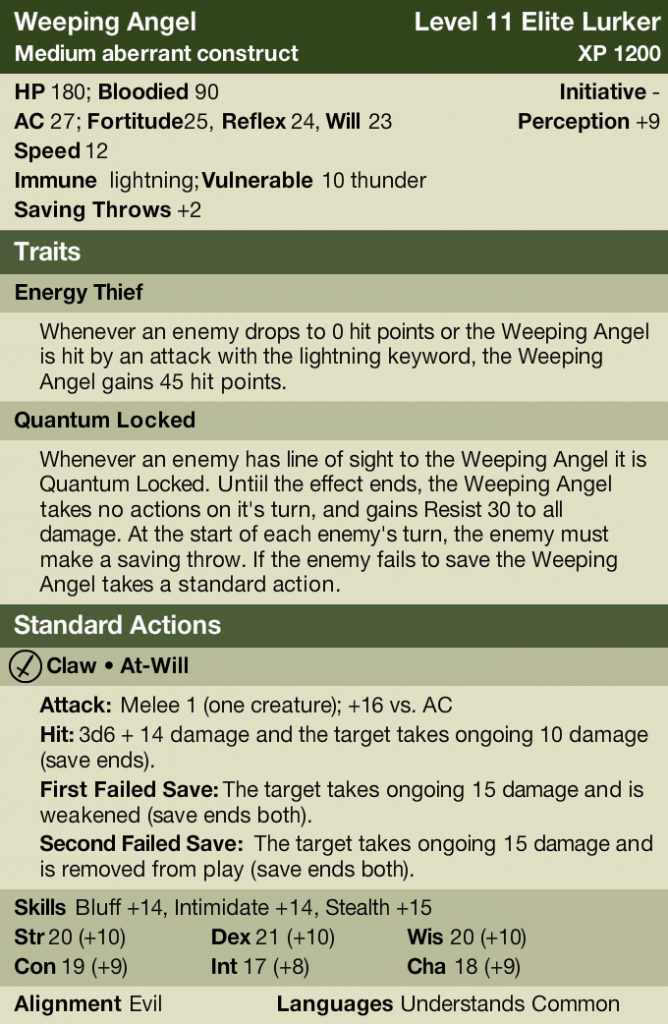
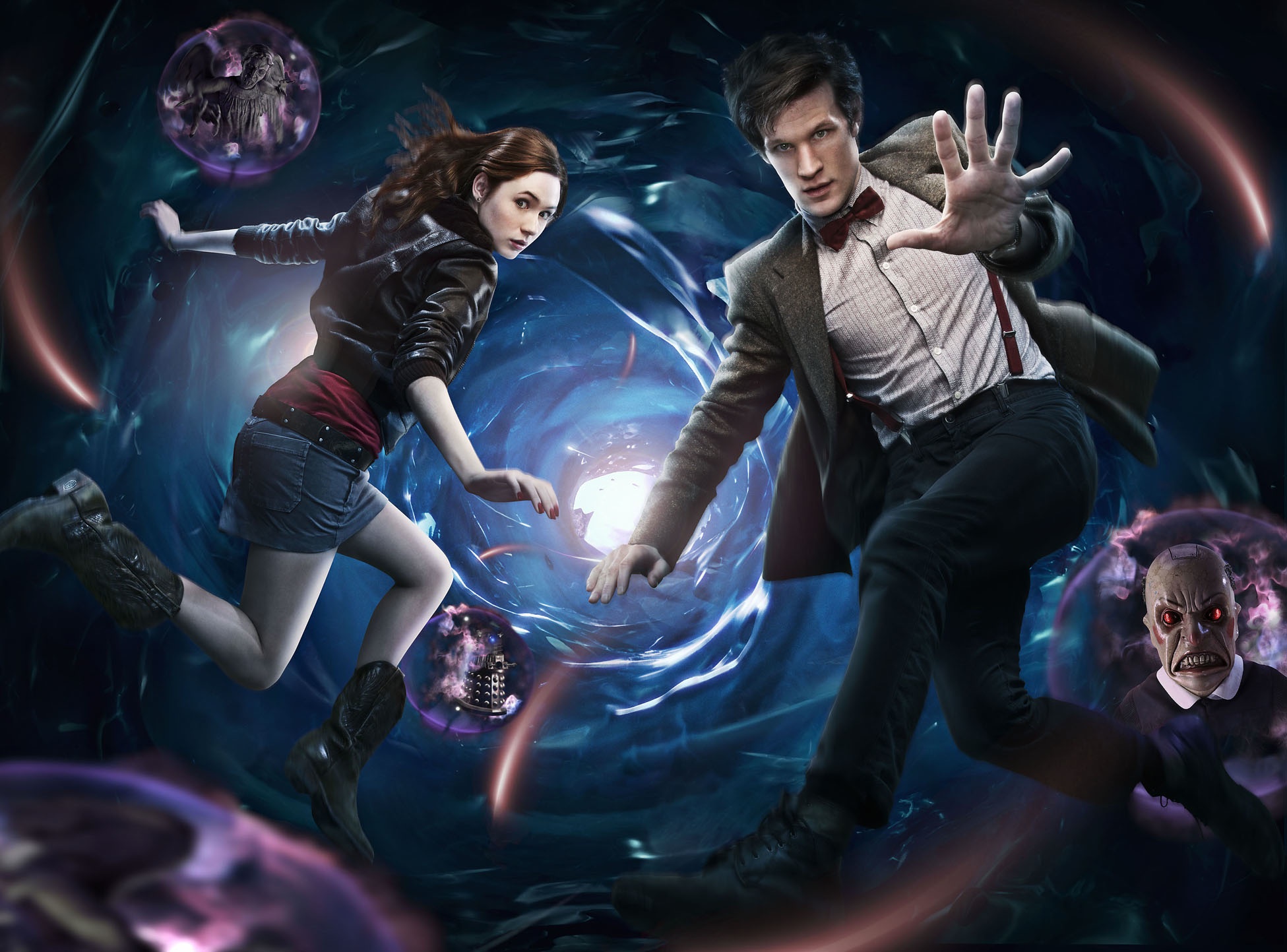
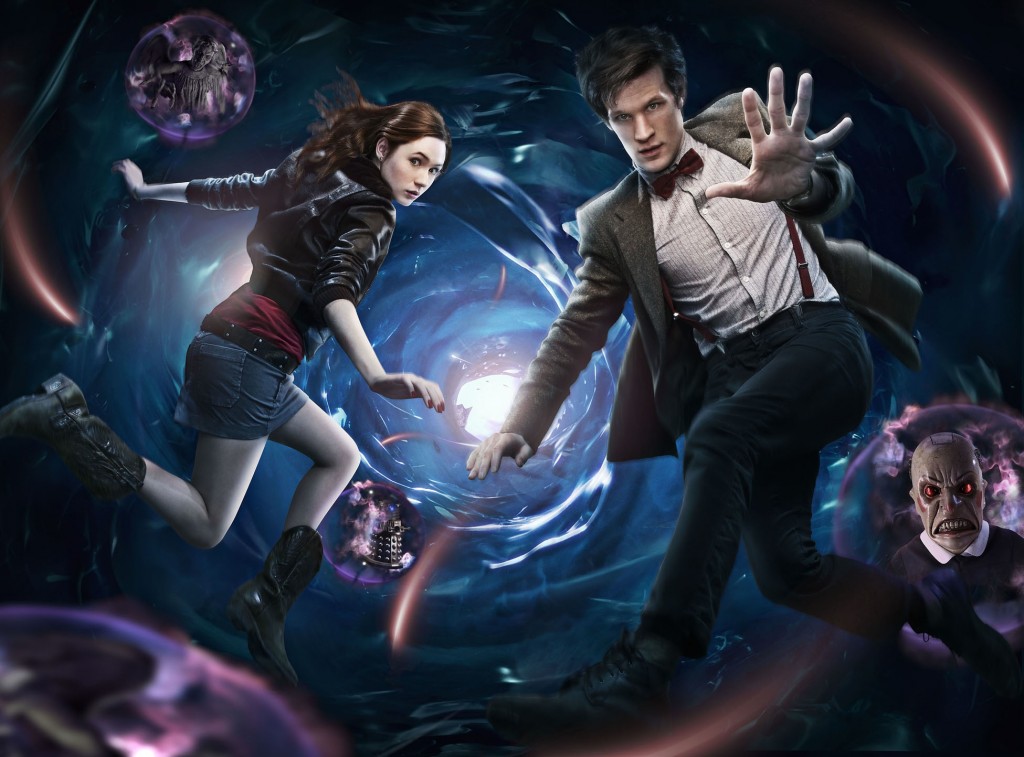
The Weeping Angels are an alien race developed for and featured in the current run of Doctor Who. The version presented here has been slightly altered in order to create a compelling 4th edition combatant.

“Don’t blink. Blink and you’re dead. Don’t turn your back. Don’t look away. And don’t blink. Good Luck.” – The Doctor.

The Weeping Angels are one of the oldest races to have crossed from the far realm into our world. Even still little is known about how they live and operate, since few people realize they’ve encountered the creatures and live to tell the tale. To mortal eyes, the Weeping Angels appear as statues, unmoving and without breath. When none are watching the creatures come to life, stealing the energy from a living soul to sustain themselves.

Form of Angels

It is said that Weeping Angels can appear in many forms, but most tales tell of the form of an angel. One ancient scholar speculates that since the Weeping Angels appeared on the material plane as early as the Dawn War, the angelic servants of the gods were likely the first creatures they encountered. Owing much to the deities who forced the primordials into the elemental chaos, angels were some of the first beings to be immortalized in stone, and so what may at first have been simply a form to exist in our world, became a natural disguise. Some speculate that present gargoyles are descendants of the Weeping Angels, who slowly lost some of their aberrant nature, and became more like the native stone they mimicked.

Uncontrollable Defenses

The Weeping Angels ability to take statue form is both a defense and a weakness. The ability is an innate part of their being, and they cannot ignore it. Whenever another sentient creature views them, including another Weeping Angel, they must become inanimate. For this reason they often cover their eyes with their hands, so they do not accidentally lock vision with another of their kind. This gives them the appearance of crying while in statue form.

One tale tells of a particularly powerful person who wished to rid one temple of the beings. He purposefully bound his eyes, relying on his other sense to hunt the monsters. Without another being viewing them, the angels did not have their hard skin to protect themselves. Different tellings vary on whether his plan proved successful.

Life Leeches

The Weeping Angels feed off of energy and potential energy. They can take this energy directly from creatures who run off the elements, and can often be found in cities rich with constructs of steam-driven technology. When facing the living for energy, they cut the creatures connection to the plane, forcing them out of existence. Creatures of powerful will can fight this ability and sometimes manage to force themselves back onto the plane, but only have a short amount of time to do so.

Angels in Play

Should all the PCs be removed from play, they lose a direct link to the material plane and may not be able to make saves to return. They may instead appear in a different point in time, in the far realm, or some other area that is difficult to escape, as your campaign dictates.

The Weeping Angels may also be used against players of lower level, where a combat situation is less likely to succeed. In this case I recommend running the angels as a skill challenge. The Players making Endurance and Perception checks to keep their eyes unblinking on the angels, while they attempt to get to safety, or trick the angels into viewing each other.

Psychic Paper – Steal this Item

Today in the United States we are celebrating Memorial Day. We were going to delay our next article until Tuesday. However, I was recently speaking with Jared Von Hindman (the weird D&D art guy) about how release schedules are unfair internationally. We here at StufferShack.com believe that we should all be able to watch and read the best geek content with relative equality. In the interest of international relations, please enjoy this mini article. We’ll see you again tomorrow.

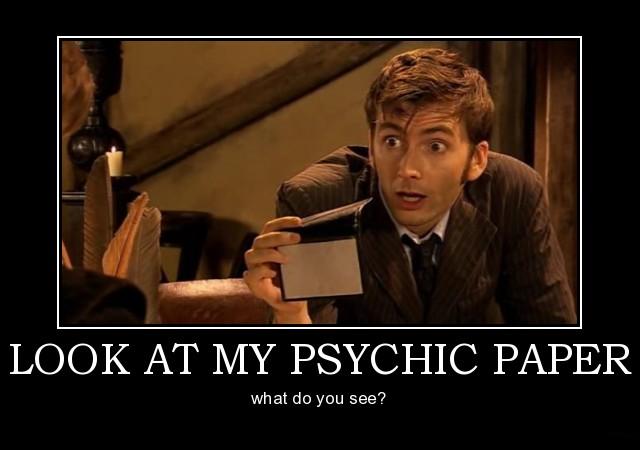
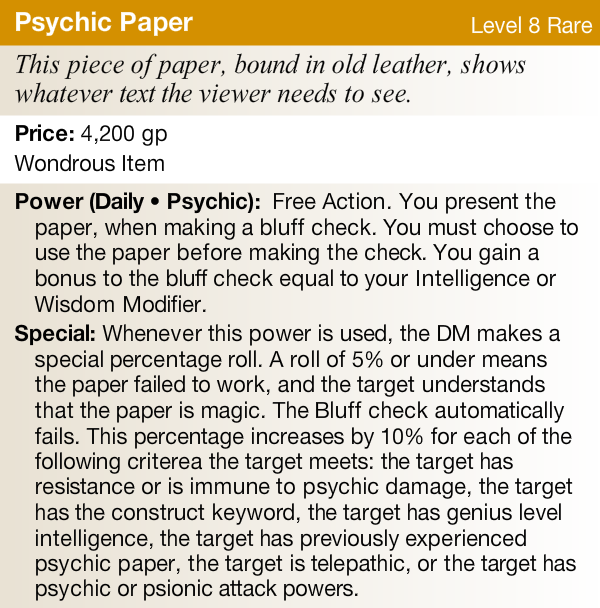
Psychic Paper may appear blank to those looking at it quickly, but when presented with confidence the target will see whatever information the wielder desires. This has traditionally been used to produce instant identification documentation. The paper can appear to be a letter of note from local royalty, personally identification as a members of a merchants guild or even just a business card. Many cultures use such identification, and quick recognition can help smooth over many situations.

Plothooks

Due to the nature of psychic paper, its properties sometimes lead to unintended situations. The following can be used by DMs to create fun situations or jumpstart new plots, when one of their PCs employs psychic paper.

  • Individuals with powerful psionic abilities can project messages onto psychic paper, even over great distances. Doing so takes a great effort and may get intercepted by other psychic individuals or devices. For these reasons, it is generally only used in times of great need such as dire warnings or calls for help.
  • Individuals who are less than confident or who are inexperienced may accidentally show their surface thoughts on the psychic paper instead of the information they want the target to see.
  • Individuals with psionic training who are targeted with psychic paper can sometimes turn the connection back on the user, having the paper display secret information the wielder has.
  • Individuals with psychic powers may accidentally boost their powers when using the paper, getting glimpses of the future thrust upon them.

Cybermen – Steal this Monster

“They’ve had all their humanity taken away. That’s a living brain jammed inside a cybernetic body, with a heart of steel. All emotions removed.” –The Doctor (Rise of the Cybermen, 2005)

Download the PDF of this article, here.

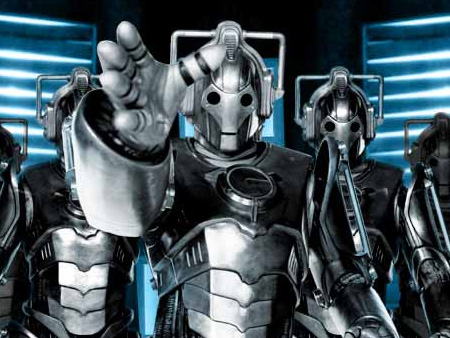
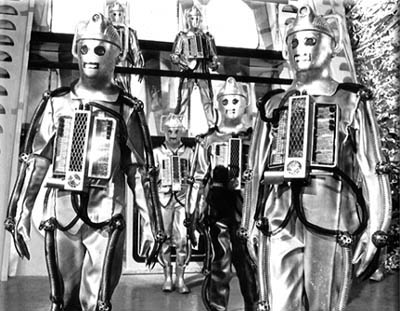
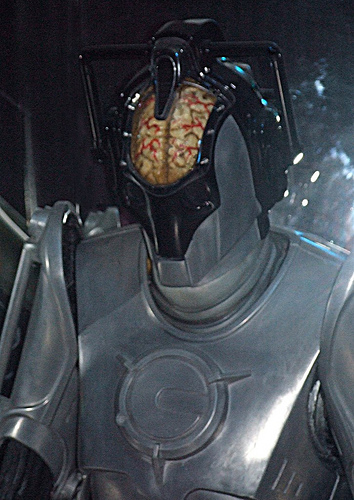
Cybermen are a staple villain in Doctor Who, second only to the Daleks and possibly The Master. We’ve seen several different variations of these metal monstrosities over the years, though they all possess some shared qualities. They were once human (or at least mortal men of flesh), they are now part machine and part humanoid, and they will stop at nothing until the Cybermen are the only life form in the multiverse.

This is great for Dungeon Masters who are willing to dip their feet into the established science fiction pool. We have a foe that good characters will want to try to save, who will almost certainly start combat situations, and have grand, tier-spanning goals. Since the Cybermen aren’t native to fantasy, we can either make our own version (half construct humanoids are very Eberron-eske) or we can have them invade the world from another plane. Either way it’s established that their resources and tactics aren’t always the same, so that justifies any difference between expected power and abilities compared to what we build for play at the table.

The Cybermen presented here are built for late Paragon. The Mk I and Mk II have very different mechanics. They could represent Cybermen from two very different times, different dimensions, different resources on hand at creation, or even the differences between an invading Cyberman and one made from a native of this world.

Lore


Arcana 22: The strange men you see before you are known as the warriors of Cybrus. Born of another world, they have only been seen before by oracles and planar travelers. It is said they will stop at nothing to destroy all life.

Arcana 29: Cybermen consider themselves to be the perfect race, emotionless and efficient. Able to upgrade themselves, different models have been written about as they were experienced at different times. A few things have been consistently reported: they have exceptional armor, unerring resolve, and should not be exposed to lightning.

Leaders of different models can be determined by the black paint on their helmets.

Arcana 38: The otherworldly Cybermen were once very similar to humans, before altering their form with construct magic, until they were beyond recognition. Behind each metallic warrior there is still flesh, blood, and the remains of a tattered soul.

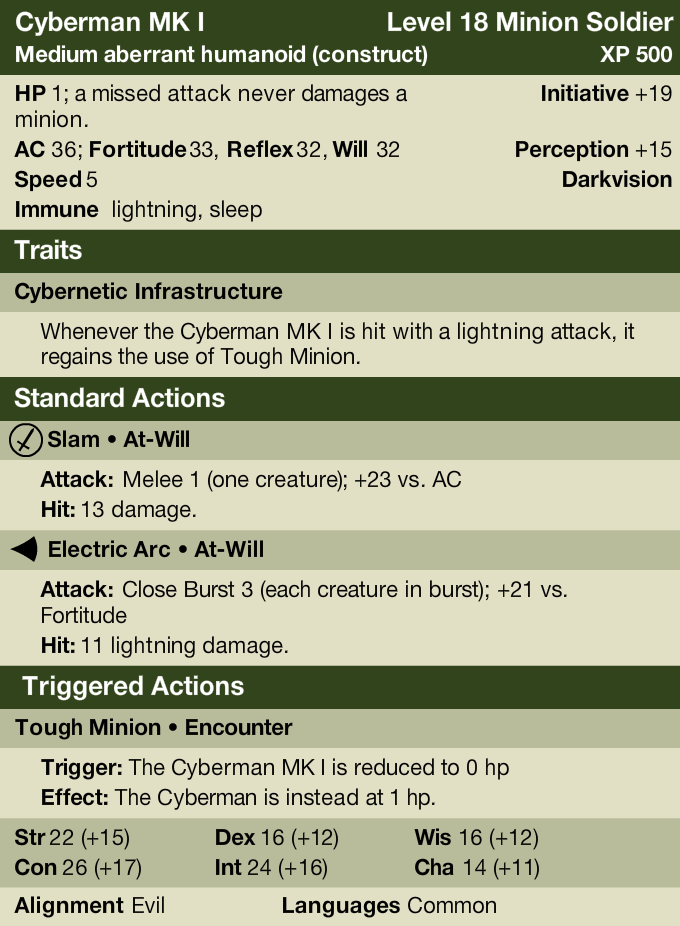
Cyberman MK I

Tactics: The Cybermen are fearless and the MK I are no different in this regard. They benefit greatly from fighting in close quarters, as the electric arc of others can heal their damage, at least partially. However, due to their feeling of superiority and the desire to leave no survivors, they will often split up in order to flank and cut off escape routes.

Once in melee, unless they face many opponents, they will use Slam as their main attack, in order to reduce opponents more quickly.

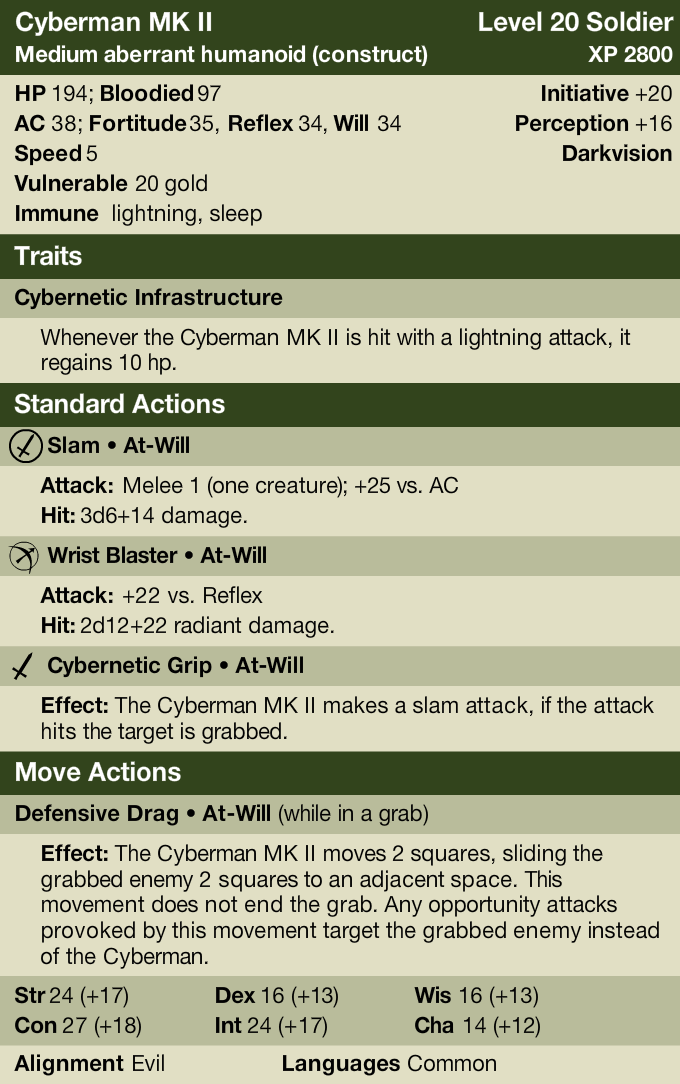
Cyberman MK II


Tactics: These warriors are much tougher than the MK I but have no built-in ability to rebuild themselves. They must instead seek out sources of lightning energy if they manage to take extensive damage.

Built to withstand heavy fire, they take on their mission to not just destroy other races, but expand their ranks, with frightening efficiency. One line of Cybermen, will act as artillery, firing with wrist blaster while a second group moves into melee, grab a victim and slowly drags them behind the firing line.

Cyber Leader


Tactics: The Cyber Leader is programmed to make decisions for small groups of Cybermen and give orders in battle. While they could hold their own in melee, they find more success in the back lines, firing along with MK II models.

They will issue a Full Volley whenever serious threats are determined, or hold such actions if waiting for a portal to be breached, so that the full force attack happens as soon as enemies are within sight.

Any foe that gets too close, soon finds itself hurled back with lesser Cybermen advancing into melee.

They keep their commands communicated through silent telepathy unless trying to intimidate their opponents.

Dungeons and Doctor Who

I love Doctor Who quite a bit. It provides elements of fantasy, science fiction, adventure, humor and historical fiction in an almost hap-hazardously creative fashion. I also like to blend many of these genres into my Dungeons and Dragons home campaign. When one of my players approached me, saying that he wanted his new character in the campaign to be The Doctor, I assumed he meant that the character would be like The Doctor. I was wrong.

I said yes almost instantly. I should have thought about it more perhaps, but I like Doctor who, and trust this player to look for fun characters more than characters with odd or broken builds.

I wasn’t worried about breaking the game world. I have a bit of a history of tongue-in-cheek reference in my game. Over the last few years my players have broken into a school for gifted youngsters that secretly housed a training facility for mutated warriors, brought down the gladiator champion and master artificer Antonius Sparks, and still occasionally call on an eccentric wizard whom they saved from the mysterious Grey Gale. I think I can allow my players a bit of blatant fan service.

When I started thinking about this new character, I became more concerned about how this would affect gameplay and plot. The player built the character as a deva invoker. I didn’t grant any ability bonuses or give him any unique abilities. Looking over the sheet, the character wasn’t particularly powerful. In fact, he was more invested in social abilities, including several instances of the Linguist feat. Nothing world-shattering or overwhelming here, though certainly strong in niche situations.

Secretly, I’ve always considered my world part of a Spelljammer setting. If you travel far enough in my Astral Plane, you don’t hit the Far Realm, but Phlogiston, and beyond that more worlds. It should be very possible for players to travel to other worlds, including official and unofficial settings. It’s just a coincidence that this has never been explored by the players in the eight or so years they’ve been campaigning in this world.

With the inclusion of The Doctor into my campaign, it confirms that the Whoniverse (or a variant of it) is part of my multi-verse. This opens up a number of possibilities. So, how is my campaign world changed, now that it’s been touched by another world, that so directly involves the players?
Technology

 The Doctor has seen technology far beyond the level of my world. What’s stopping him from building a combustion engine, or even a time machine? The short answer is time and resources. I can always make sure, using my DM World-controlling powers that the player never has enough time to do so, or just can’t get his hands on the material. This type of forced restriction can get old fast, if the player realizes effects are happening not for naturally occurring story reasons, but because I’m trying to stop him from doing something he wants to do.

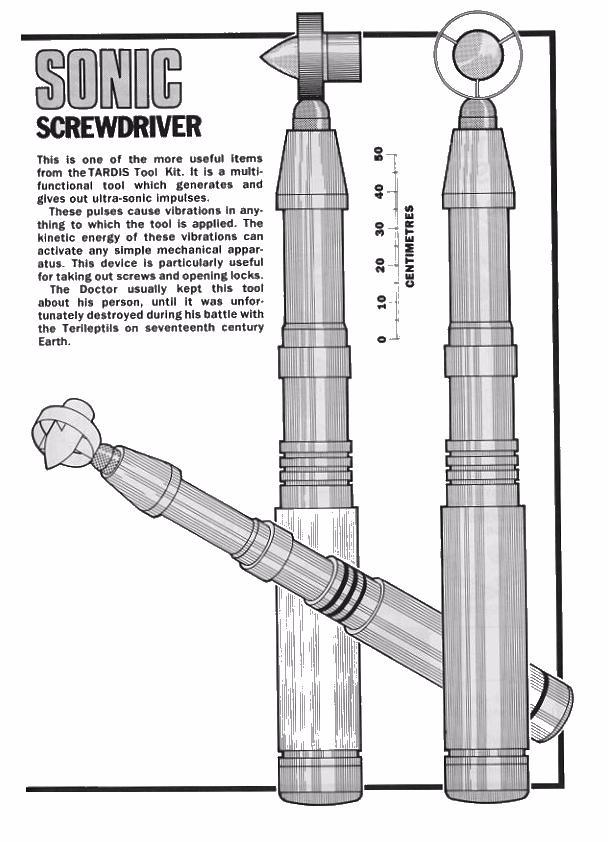
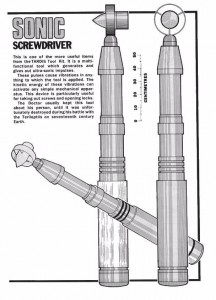
So far, my player has not attempted to add technology to the world, besides snazzy clothing choices. His sonic screwdriver is just a rod, mechanically, and as far as anyone else is concerned, it is. We established at the beginning that the TARDIS was lost and possibly broken. Recovering his mystical blue box has been one of the driving motivations of the character.

In the end, I think that’s really what keeps the character from completely changing or overwhelming the world. The fact that I spoke to him and came to an understanding about what the character was about, and how we can work toward larger-than-life goals. You have to trust your players, and if you can collaborate on motivations, then no one will be disappointed later when expectations are entirely trounced upon.
Spotlight Stealing

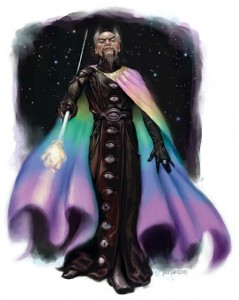
I mentioned this character was in my campaign on twitter, which led to some interesting questions. One of the questions was basically, “How are the other players taking the change in situation? Do they feel overwhelmed or minor compared to this character?”  I had not really considered this. I felt confident that the party (as a whole) was still the star of my campaign, but I didn’t know for sure how they felt. So I asked a couple of other players privately. They seemed quite flabbergasted by the notion as well. It was a resounding “No. The Doctor’s fun, but he’s just another character.”  They did not feel reduced to Companion status.

With such a big character, how did this not happen? Well, for one, The Doctor was not created as a powerhouse of pain in combat. Our play sessions are about 50% combat, 50% role-play, planning and discussion. In addition, the players all treated this new character as just another ally. The character could claim to be a Timelord till the cows come home, but the truth of the matter is that they had stuff to do before he arrived, and weren’t about to ignore it because some crazy person in odd clothing showed up, even if he was useful at times.

The character also showed up around mid-paragon tier. At this point in the players’ career they’re not run-of-the-mill soldiers, scientists and citizens. They’re some of the most powerful and well-travelled people in the area, if not the material plane. A couple levels later and they’re all prepping for epic destinies. In comparison to demi-gods, archmages and primal avatars, The Doctor is cool, but it’s easy to get distracted by those around him.
New Options

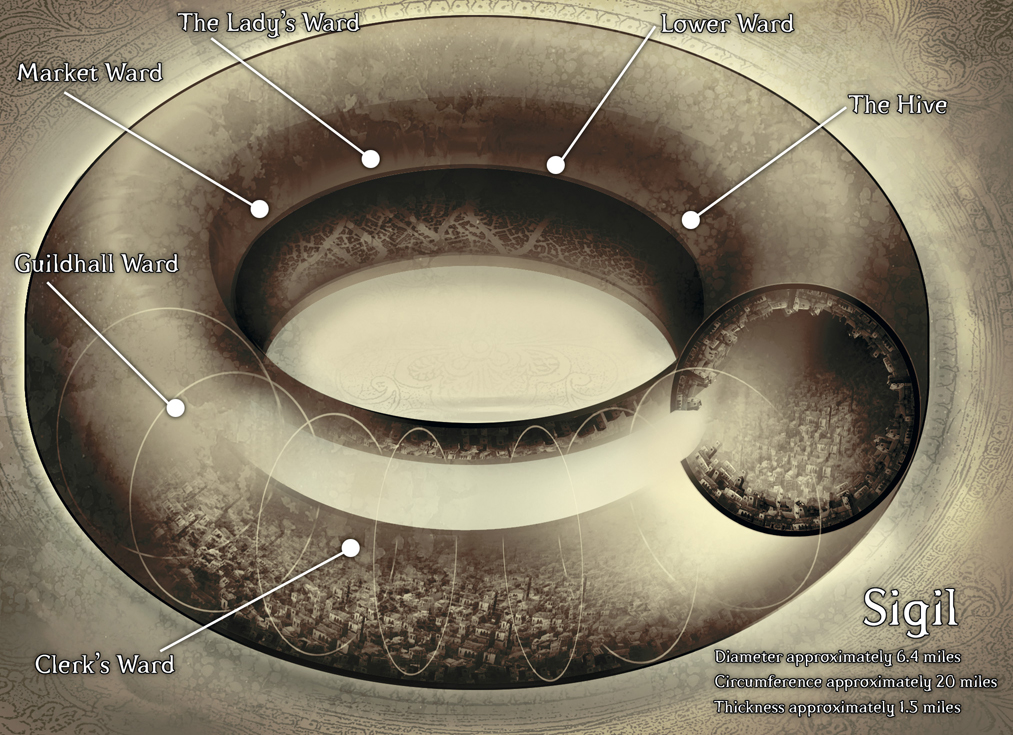
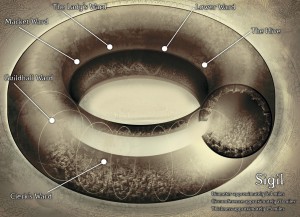
What The Doctor’s presence in the game really adds is more options for players and the DM. I already mentioned that his presence provides real physical proof that other worlds can be accessed. So, players know that this is an option. They may seek out a Spelljammer or be more inclined to travel to Sigil. They might do this as a way to increase their powers, find new allies, buy new items, or even just to seek out trouble.

In the same vein, I can drop more fantastic plots and elements that would have been less believable before. Instead of taking the idea of the Fantastic Four and making a D&D version of them, I really could use the Fantastic Four. After all, the heroes are part of an active multiverse. I could even bring the heroes to the Marvel Universe.

The option of Time Travel is probably what The Doctor is most known for. Once the players have the TARDIS, what’s stopping them from going back in time and killing the Lich before he becomes a lich?

My answer, “Nothing but fear.” I’ve made it quite clear that they could really ruin the world by playing with Time Travel, but I’m prepared to make those consequences fun. Doctor Who is full of these examples. The Doctor himself was responsible for the destruction Pompeii, and knows well that sometimes sticking your nose in places has less than good results. To quote another universe slogan, “With Great Power, Comes Great Responsibility.” I’ve made it clear to my players that if they go this route, they will have to make very careful choices. Epic Failure may be almost assuredly a result.

The final option in my lap is using The Doctor myself. Once a character enters play, I reserve the right to control them should they retire. Former PCs now occupy such awesome slots as upcoming villain, god of life, and lord of the 5th layer of hell. Once the Doctor enters that box and flies off alone, he’s mine. I already have plans…

 This post is dedicated to Elisabeth Sladen.