 Every role-player has games that just sit there on the bookshelf. They lurk, their spines staring accusingly at you as you pass. “Why won’t you play me?” they mutely inquire. You know you want to.
But still you don’t, and apart from their annual lift off the shelf for one more guilty read-through, they remain alone and unloved. Perhaps it’s because of an inability to enthuse the other players in your gaming group, other commitments, or because you simply don’t know where to start when it comes to running a whole ‘nuther system. There’s a whole host of reasons why these games just don’t get the love they deserve.
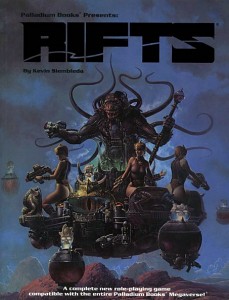
For me, the accusing spine that glares at me more than most is Rifts, that venerable tome from Palladium Books. It’s difficult these days to talk about Rifts without at least glossing over the legal idiocy that has plagued it throughout its long life, so let’s do that first just to get it out of the way.
Rifts is, first and foremost, a system derivative of everything. We have Nazi Cyborgs, Mech Warriors and Giant Manga Robots rubbing shoulders with tropes of classic fantasy (cheekily called Tolkeen). This is a system which, from a legal standpoint, deserves to be sued to Hell and back by everyone from Tolkien Estates to Phillip K Dick and Studio Ghibli. Yet it hasn’t been, and the world (quite frankly) is a better place for it. The ability to patent ideas, concepts and imagination will be the death of civilization, I swear.
This makes Kevin Siembieda’s legal battles over “rights” regarding Rifts all the more ridiculous. In his time, he has ordered fan sites be taken down and claimed that he somehow owns the concept of a “Rift” (despite the fact the word and definition has been around for, oh, hundreds of years). It’s my opinion that, despite the fact that he writes awesome role-playing games, he doesn’t make the best business decisions, and that’s all there is to it.
There. Gloss done. On to the good stuff.
The world of Rifts is near-future modern day Earth, with one minor twist. Well, when I say minor…. The Golden Age of humanity ended when Rifts in time and reality itself opened up, spewing forth other-dimensional beings and worse. The shape of the land changed as magic re-awoke (not that it was ever truly asleep in the first place) and dinosaurs once again roamed the earth. Thankfully though, that’s all in the past.
What we have now is a world shaped by chaos where a Coalition State keeps an iron grip on what remains of the old Earth human Empire and tries to hold back the tide against pretty much anyone else, and there’s no such thing as good guys any more.
Rifts is perhaps best described as “Survivalist horror in the Warhammer 40k world of Judge Dredd.” Except it’s more than that. Rifts, more than any other non-generic system I’ve encountered, can be pretty much anything you want it to be. Want to play a group of heroes fighting against the Coalition for their rights to a Free State? Psionic cops rooting out mutant scum in Chi-Town? Glitter Boys fighting radioactive dinosaurs in the outback? You’ve got all that, and more.
The rules system itself is common to all those in the Palladium line. It’s best described as functional rather than elegant in that it gets the job done without too much fuss, and doesn’t get in the way. The system for handling huge-scale damage (called Mega-Damage – each point is roughly equal to 100 normal damage points) works well enough in-play, and I’m beginning to yearn for a similar system in 4e D&D where it’s easy for high-level monsters to have thousands of hit points. Ick.
We have a plentiful supply of Occupational Character Classes ranging from streetwise City Rats to Coalition Grunts and Glitter Boys. There’s Cyber Knights (high-tech Paladins) and all manner of Borgs, Crazies, Scholars and Scientists. If that’s not enough, there’s wizardly Line Walkers, Techno-Wizards, Mystics, pyrokinetic Bursters and much more.
The character classes themselves are gloriously unbalanced. At one end of the scale there’s OCCs such as the Cyber-Doc who gains moderate skill bonuses and not much else. At the other there’s the Glitter Boy in his faux Mech Warrior power armour. To my mind that’s a huge strength of the system as the GM is free to permit different character classes based on the preferred campaign style. Whether you want high-explosive large scale warfare or street-level action, there’s OCCs that provide. In Rifts, as in any RPG, only the foolish GM would open up all the options.
In a way though, there’s too much, and that’s one of the reasons why Rifts still sits on my shelf. It’s overwhelming as a system. It’s like every idea, ever, has found a place in the core book’s 256 pages, and it’s difficult to even know where to begin. Add in the (randomly laid out but excellently written) Word Book supplements and it’s easy to face Information Overload head-on.
 Whenever I suggest running a short Rifts campaign, I get the reply, “We’d rather play TMNT instead.” This is much the same rules system as Rifts but lets the players create mutant animals using one of the best semi-random character generation engines ever made.
One of these days I’ll let them generate critters in TMNT, them dump them into the Rifts universe.
Ha! I’ll have my way yet!