GM Screen / Narrative Aid for Shadowrun: Anarchy

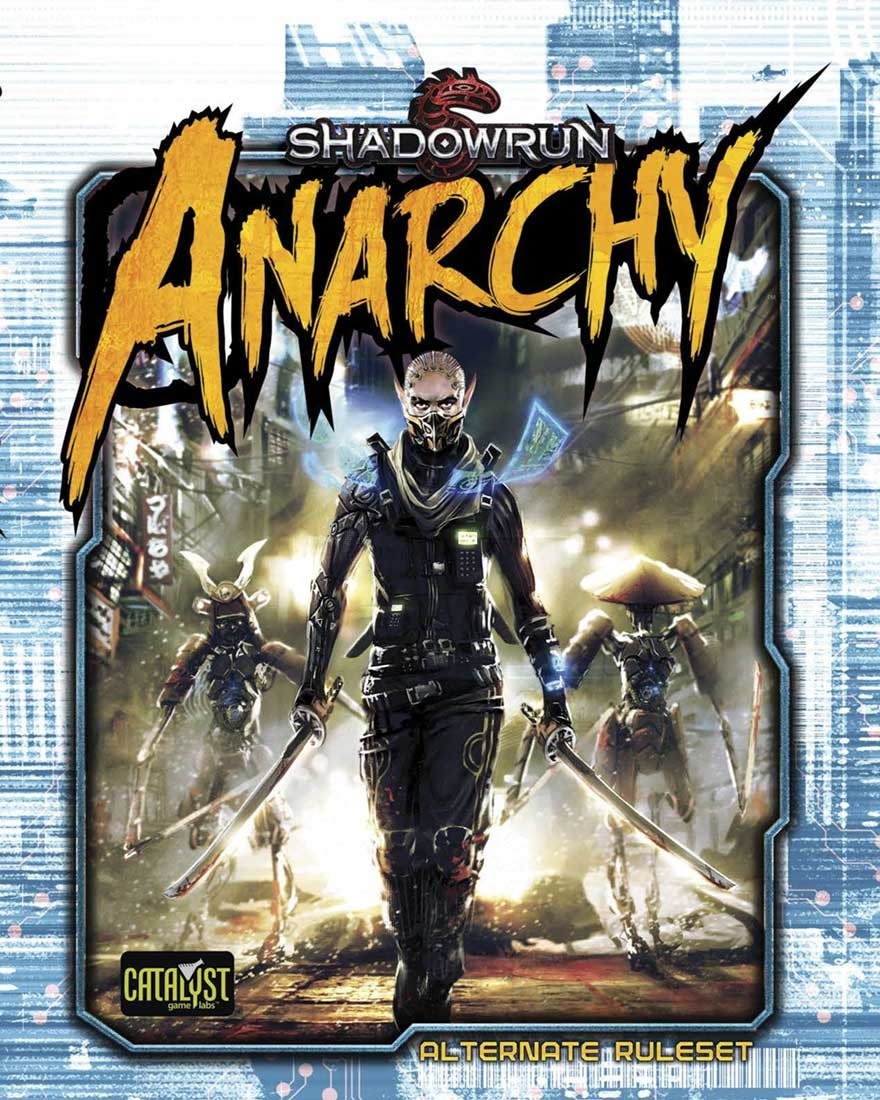
Shadowrun: Anarchy is the new, rules-light, narrative-focused, alternate ruleset for the world of Shadowrun (You can read my review Here). It allows GMs and players to get into the action and intrigue of Shadowrun much faster and to stay there much longer without reference to rules and charts and extensive calculations of Shadowrun 5th Ed.

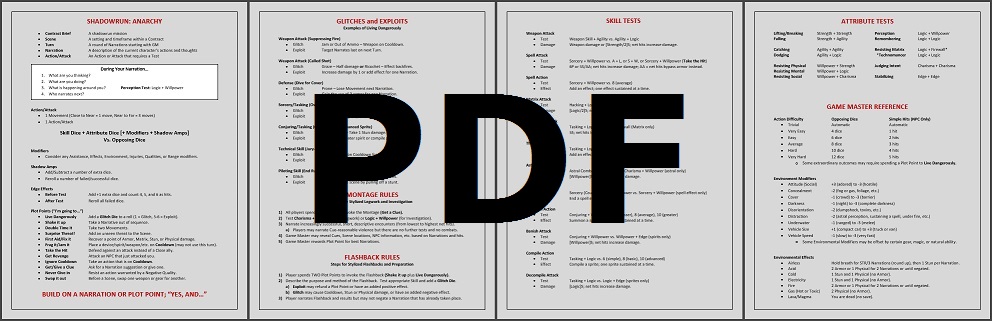
There are rules, however light, and every game with rules deserves a GM Screen. Players unused to narrative-heavy roleplaying may also need a little more on which to cling while they get their sea legs. Shadowrun: Anarchy, the book, also leaves a lot up in the air regarding some rather simple mechanics. For all of these reasons, I created a Narrative Aid for myself and my players to help us navigate the alternate ruleset and the meta-game that plays on top of it.
Download the PDF

Attached is a 4-page document (fan material) that is intended to be printed 2 Pages per Sheet and Print on Both Sides (flip pages on short edge). It could easily be printed on 4 pages to create the quintessential quad-fold GM screen. Below are details that I chose to include or add: Continue reading “GM Screen / Narrative Aid for Shadowrun: Anarchy”
Shadowrun: Anarchy Threats… Sorted Out (PDF!)

In a recent review of CGL’s new Shadowrun: Anarchy, I pointed out that the cast of NPCs published therein were best used as inspiration for your own cast of NPC threats. There were issues with balance, utility, and playability that needed to be resolved before I pit them against my players.

In this article, I submit to you the set of NPCs that I have been using. I have made several changes to fit my gaming table and they may inspire you as well. Here are the changes I have made:

Download the PDF (15 pages)

Click to download

Formatting

  • Reformatted each entry to list dice pools rather than Skill + Attribute (unless variable). So if it says 8, roll 8.
  • Standardized most Shadow Amp phrasing.
  • Renamed Vehicle Weapons to Gunnery (for space and clarity); and Piloting (Ground) or Piloting (Other) to Pilot Ground and Pilot Other (that way you can add a specialization without double parenthesis).
  • Used kla060365’s (from Shadowgrid Forums) re-balance of Assault Rifle and Machine Gun. Applies a -2 to ARs and MGs at close range (this gives purpose to SMGs).

Stratification

  • Similar to Professional Ratings, I needed a way to measure the threat level each NPC would pose. These are somewhat loose levels based on Attributes + Skills + Shadow Amps.
  • Threat Levels are Thug Level (<28), Gang Level (28), Street Runner (38), Prime Runner (48), Terror Level (>48).
  • Added options for Mooks who use only one Condition Monitor (like SR5 Grunts), and Mains who gain one Positive Quality.

Categorization

  • Separated NPCs into Categories such as: Critters, Corporate, Magic (includes Spirits), Matrix, Military, Security, Shadow (includes generic runner archetypes), and Street. This might determine which Knowledge Skills or types of Contacts might apply.
  • Each category has about 4 entries.

Expanded Entries

  • Added Barghest, Boston Lockdown Head Cases (Shambler, Rager, Manipulator, Hidden), Corporate Security (Elite), Enemy Drone (Mini), Enemy Shaman, Enemy Technomancer, Rent-a-Cop (HTR), two vehicles (Armored Personnel Carrier and Light-Assault Copter), five generic runners (Company Man, Street Sam, Pistol Adept, Razor, Combat Medic), and Wiz-Ganger.
  • Added options for Enemy Mages, Lesser Spirits, Blood Spirits, Toxic Spirits, Shadow Spirits, Intrusion Countermeasures, Sprites (a new version), Ganger types (because not all gangers replace their arms…), and Gun Emplacements.

Re-Balanced Entries

  • Tried to get each entry closer to an appropriate Threat Level by adding/subtracting Attributes, Skills, or Shadow Amps. Probably just gamer OCD.
  • Rebuilt Spirits with a few non-combat options (that can be taken in lieu of combat options). This will help for those tables that tend to shy from combat-heavy campaigns.
  • Rebuilt Sprites to closer match IC mechanics and power levels. I added Firewall for proper Matrix use. I removed Willpower and Charisma and added the Tasking skill to use Complex Forms.
  • Rebuilt Enemy Drones. Drones are vehicles with Armor only (no Condition Monitor, like it outlines in the book). They use Logic to make attacks rather than Agility, so that drone size has less to do with accuracy. I defined Flying as a Shadow Amp that forces a reroll when attacked but takes extra damage when hit. Audio Analyzer just interprets voice commands.
  • Re-balanced Enemy Drones weapon options. Small Drones can no longer take out an entire team of Prime Runners with crazy accurate grenade launchers and death from an unhittable killing platform.

I hope that you find this list of Anarchy Threats useful in challenging your players (without boring them or murdering them). They may inspire you to create interesting Contract Briefs and even your own NPCs suitable for your own table.

Download the PDF (15 pages)

Good luck, and more resources for Shadowrun: Anarchy are to come!

Shadowrun: Anarchy… What the Heck?!

shadowrun-anarchyIt’s no secret… Shadowrun (any edition) has not exactly been a rules-lite game.  It’s a meaty cyberpunk-fantasy dystopian setting with a very solid fan-base, and it also comes with a hefty set of rules for a very “simulationist” feel.  I’m not saying that’s a bad thing (I have my favorite edition and have played many, many hours of it); I’m saying that that type of game isn’t for everyone.

Enter Shadowrun: Anarchy

Shadowrun: Anarchy uses the Cue System (from the same company, Catalyst Game Labs).  It’s a rules-light RPG system that is all about getting started quickly and creating a story.

Using Cues, you’ll create a plot and narrate your character’s way through the story.  Your character sheet has stats, gear, and abilities, and you still throw lots of d6s to resolve things, but there’s less dice-rolling and much less rules.  It’s a simpler, faster, and more narrative system, and it still carries part of the Shadowrun mechanic (throw a bunch of d6s… 5s and 6s count as successes).

Most importantly, everyone is a player at the table, and everyone takes turns as the gamemaster throughout the session.  It’s a collaborative type of narrative story-telling, as opposed to the traditional RPG setup.  Included in the mechanics are Plot Points with which one can spend to do extra things, but more importantly to further the story.

I imagine that this is definitely not something where you’d be sitting there at the table, waiting for your turn and getting bored, because you’d be too busy leaning forward, engaged in the scenario with your friends.  Actually, I don’t think I’d be doing it justice by saying that it’s a rules-lite game (it is); it’s better served to be called a rules-narrative game.

This post is in no way a review; I’m simply blabbing about something that seems cool that came out recently, and I think it could be a lot of fun.  Currently, the PDF is $14.99.  If you think this could be your thing (this version of Shadowrun), then check it out – I think I will…