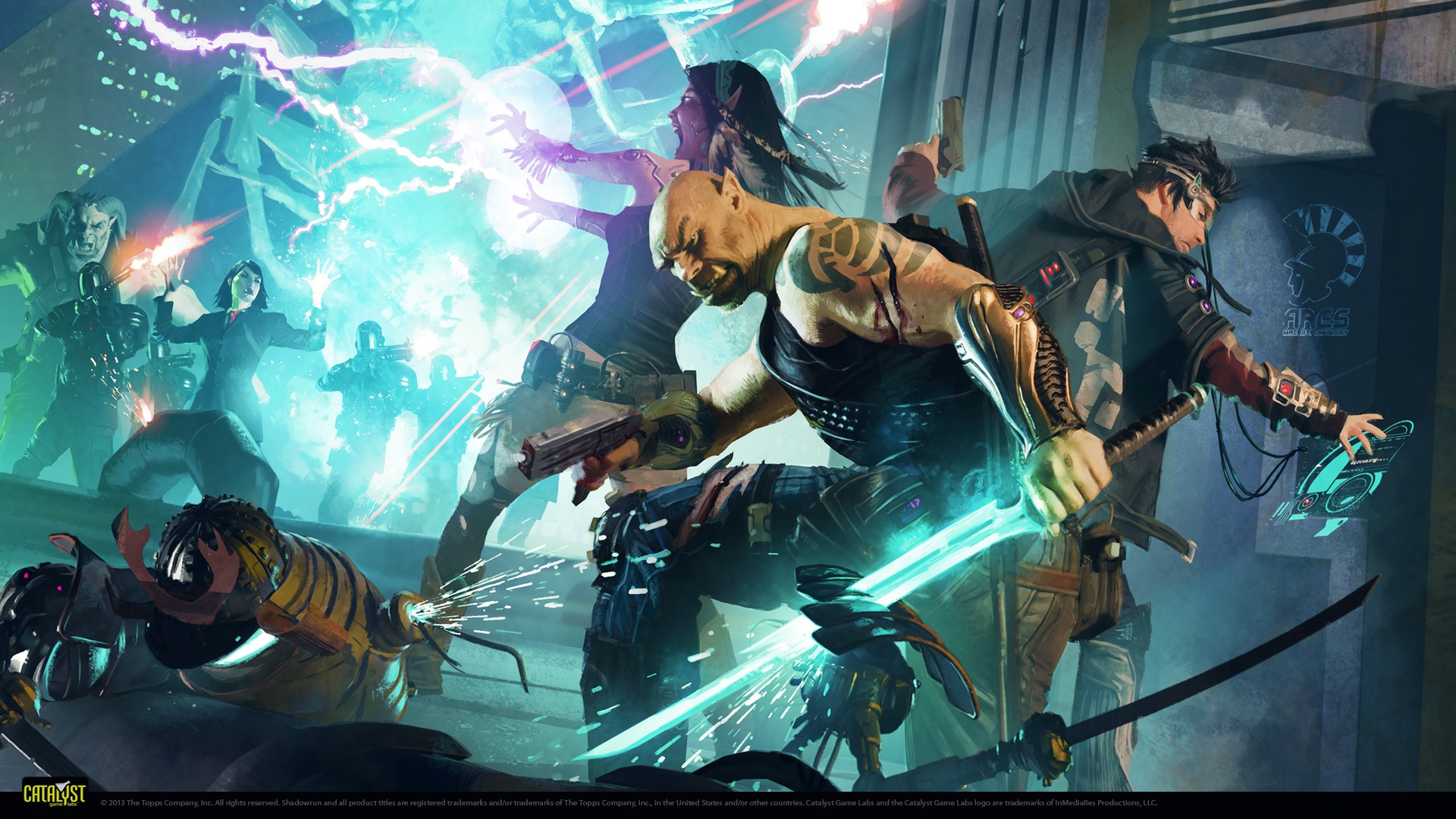
SHADOWRUN HACK OF SHADOWRUN (Downloads!)

Shadowrun

“This ever happen to you, chummer?  It’s 4 a.m. and you find yourself in front of the SoyFroYoGo machine (again), choosing between pink-blue and orange-yellow (tan? really?).  It must be the Stuffer Shack.  Suddenly, the door’s AR chimes, and behind you enters a trio of Halloweeners, armed with all manner of ballistic beat-down.  Your finger finds the trigger of the sawed-off shotgun beneath your coat. Continue reading “SHADOWRUN HACK OF SHADOWRUN (Downloads!)”

Shadowrun: Anarchy… What the Heck?!

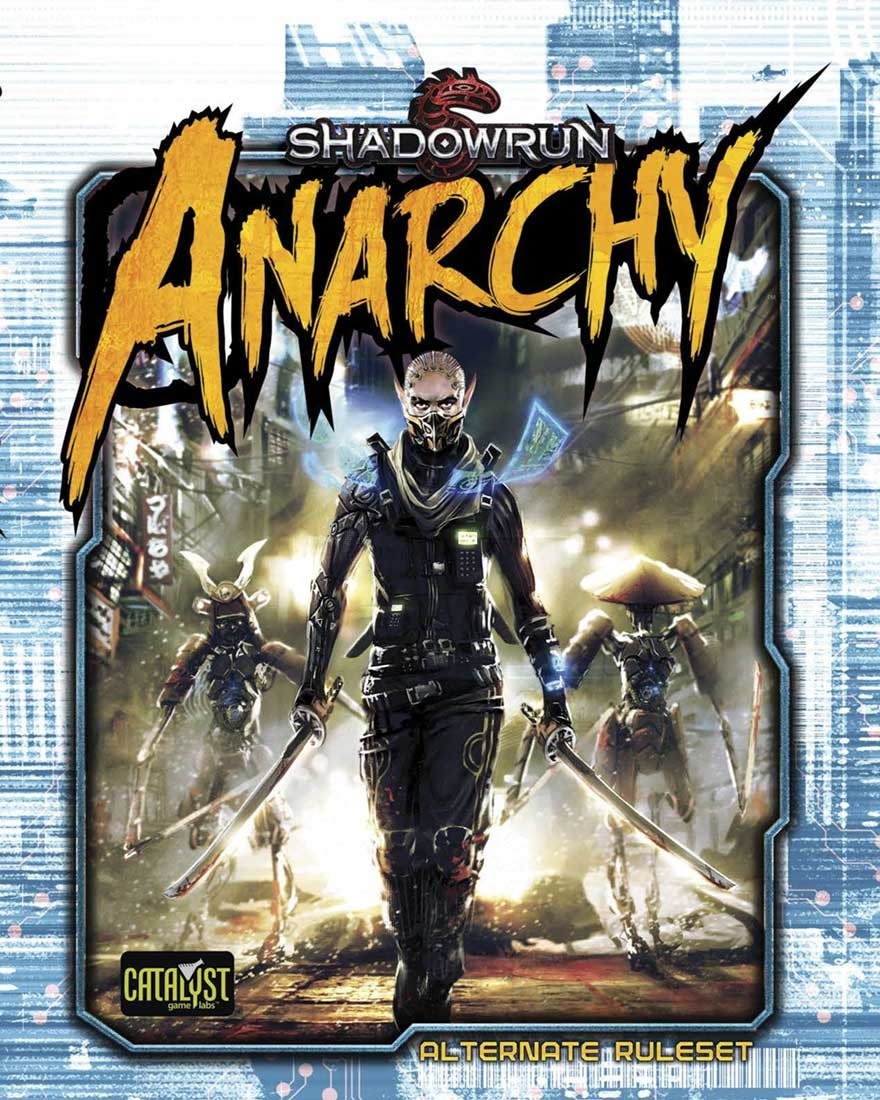
shadowrun-anarchyIt’s no secret… Shadowrun (any edition) has not exactly been a rules-lite game.  It’s a meaty cyberpunk-fantasy dystopian setting with a very solid fan-base, and it also comes with a hefty set of rules for a very “simulationist” feel.  I’m not saying that’s a bad thing (I have my favorite edition and have played many, many hours of it); I’m saying that that type of game isn’t for everyone.

Enter Shadowrun: Anarchy

Shadowrun: Anarchy uses the Cue System (from the same company, Catalyst Game Labs).  It’s a rules-light RPG system that is all about getting started quickly and creating a story.

Using Cues, you’ll create a plot and narrate your character’s way through the story.  Your character sheet has stats, gear, and abilities, and you still throw lots of d6s to resolve things, but there’s less dice-rolling and much less rules.  It’s a simpler, faster, and more narrative system, and it still carries part of the Shadowrun mechanic (throw a bunch of d6s… 5s and 6s count as successes).

Most importantly, everyone is a player at the table, and everyone takes turns as the gamemaster throughout the session.  It’s a collaborative type of narrative story-telling, as opposed to the traditional RPG setup.  Included in the mechanics are Plot Points with which one can spend to do extra things, but more importantly to further the story.

I imagine that this is definitely not something where you’d be sitting there at the table, waiting for your turn and getting bored, because you’d be too busy leaning forward, engaged in the scenario with your friends.  Actually, I don’t think I’d be doing it justice by saying that it’s a rules-lite game (it is); it’s better served to be called a rules-narrative game.

This post is in no way a review; I’m simply blabbing about something that seems cool that came out recently, and I think it could be a lot of fun.  Currently, the PDF is $14.99.  If you think this could be your thing (this version of Shadowrun), then check it out – I think I will…

Flakka Outbreak – Steal this Shadowrun…

Flakka

The group’s favorite Johnson helped someone bring in some new drugs into the city… super cheap and super killer. Everyone wants it. The only problem is that some of its users go freakin insane, including the dealer who owns it. All the negative attention is making things real dirty, and the Johnson is looking to wash his hands of the whole mess. The problem is that he still has a ton of the product locked up, waiting to be sold. Rivals want to steal it, the Johnson wants to dump it, and Lone Star wants to find the Johnson responsible.

The players are asked to get to the stuff as fast as they can and get rid of it, before someone else finds it, and before Lone Star connects the drug to the Johnson. The problem is, he’s tapped all out of cash at the moment. Call it a favor that he won’t forget.

One Campaign, Many Systems: An Experiment (Part IV)

In Part I of this series, I laid out my plan to play through a series of RPG systems – one a week – over the summer. On top of that, I wrote about my gaming groups’ desire to maintain a single set of characters and therefore a cohesive story for the duration of the campaign…

In Part I of this series, I laid out my plan to play through a series of RPG systems – one a week – over the summer. On top of that, I wrote about my gaming groups’ desire to maintain a single set of characters and therefore a cohesive story for the duration of the campaign.

Shadowrun

This week (well, two weeks) we played Shadowrun. The group as a whole was pretty excited, as they’d heard good things about the game. It was new to everyone, myself included. I started the story with the new Shadowrun characters passing their Gamma World characters in a huge teleportation transportation hub, in keeping with our decision to change characters with RPG systems and hang the one-shot stories together more loosely.

Shadowrun is only the second new RPG that I’ve run this summer, even though it’s the fourth system we’re using. I am very familiar with D&D 4e and Gamma World (our first and third weeks), though our second RPG – Microscope – was also new to me. Of course, Microscope is a GM-less game, so it’s safe to say that Shadowrun was my first real trial in learning and running a brand new game in the span of a week.

So, a quick lowdown on mechanics for those of you unfamiliar. Shadowrun uses dice pools of d6’s to manage action resolution. Your character has a number “rating” in each attribute (like strength or intelligence) as well as a number rating in a handful of skills (like hacking or small arms). And I will say there are a lot of skills in this game. When you try to do something, the GM will ask for a roll like this – “That’s intelligence plus hacking” – so you add together the number you have for intelligence and the number you have for hacking, then roll that many d6’s. Let’s say you have a 6 in intelligence and a 4 in hacking – you roll 10d6. Yup, rolling a fistful of d6’s is pretty common. Out of all those d6’s you just rolled, any 5’s or 6’s are successes (or “hits”), and you’re trying to meet a “threshold” of “hits,” which is basically the DC of the action.

Combat is a bit more complicated, and also a bit more complicated than D&D combat, but it still uses the “roll a fistful of d6’s and count up your 5’s and 6’s” mechanic.

Our Shadowrun session ran two weeks – the first week we ran through the Quickstart scenario, which saw the characters in a Stuffer Shack brawl, and the second week we used the adventure Ping Time, which I found for free online. It was easy to modify the quickstart scenario to lead into Ping Time – I simply changed the “target” that the PCs rescue in the Quickstart into the fixer that employs them in Ping Time. Easy peasy.

The Quickstart was great to get a feel for the game – both thematically and mechanically. The majority of it is combat, which is essential because combat is the most complicated part of the game (as far as I could tell). The players got to go through several rounds of opposed rolls and counting net successes and comparing armor to damage, and… well, you get the picture. It gave them a handle on the game.

Ping Time kind of flipped that on them because there’s only one combat, and it occurs at the very end of the adventure. There is the possibility of combat at other points in the adventure, but it is assumed that the characters use other means to achieve their ends most of the time.

Overall, we really liked Shadowrun. As a matter of fact, I liked it enough to preorder the 5th edition rules which coincidentally went up for sale around the time we played. It’s possible we’ll be playing at least a few sessions of it next summer. Even if we don’t, I’m very intrigued to read about the myriad skills present in this system.

What I Learned

Quickstart rules are fine if all you’re running is the quickstart scenario, but if you’re going to dip into other free adventures (for any system), you’re probably going to want the actual rules. In Ping Time, I was able to muddle through some things, but I was completely unable to improvise anything on the spot. And I said so to the players.

On the other hand, Quickstart rules are awesome if you’re playing a bunch of new RPGs serially. They’re the single most important resource for a group looking to learn a new system. Everything is laid out as if you’re a beginner (because you are), and what is presented is only what you need. It’s also whatever the designers think you need to get a good feel for the system. And that’s pretty important.

I also learned to not be afraid of Theatre of the Mind. While I have had a foray or two into mapless combat in the past, the majority of my RPG experience has used maps for combat. But we were able to slide pretty easily into Shadowrun’s assumption that you don’t need a piece of wet erase vinyl to kill stuff. And that’s good, because we’re headed into Leverage and Dread in a few weeks, and both of those systems rely on TotM alone. But first, we’re taking an unscheduled detour into Pathfinder next week. And I’m not the DM!

Con Games 1: Shadowrun

Note: A few years ago, I went to a gaming convention somewhere in Connecticut with my dear friend Dave, and had the opportunity to play a few games I’d never played before, which is why conventions exist. If you go to a convention and only play inside your comfort zone, you are totally missing out.

In the Shadowrun game, I played Samson, an enormous rock-headed troll who was about 90% metal and carried a large pistol, a large rifle, and something called a laser crescent axe, which sounded delightfully vicious. The rest of the group was Andy, a dwarf who liked shooting people and fixing stuff; Francis, an orc thug who liked shooting people and breaking stuff (especially when people called him “Frank”); Lee Chan, an elf punch n’ kick specialist; and Bobby, a zip-zowie-bang spellcaster.

First, the setup: We were involved in a scheme both lengthy and complicated, which included such things as the mean old company Wolfur & Sons, some doctor named Johnson, a stolen serum we had to recover, and a happy little business called Stubbs Medical Corporation who conducted research, explored scientific boundaries, and dabbled in human experimentation. Most of the folks there were just your average work-a-day data entry clerks and secretaries, and for some reason, that meant we couldn’t drive through the front door and fire high-caliber, explosive-shelled, glaser mega-rounds into everything that so much as winked in our direction.

So that night, a-sneakin’ we did go, through the first floor, then down some stairs to the basement, bonking the heads and tasering the dreams of the minimum wage security guards we met. Easy beans. We went down an elevator to the sub-basement, where we found the desired serum being injected into a sallow-faced street girl. We got the girl, and then everything went splat. Or more accurately, budda-budda-budda-budda, as a pair of nasty looking swivel machine guns popped out of the walls and started stitching new and exciting patterns through our brave group. Our clever computer girl went offline permanently, and our brave leader was reduced to grated cheese just after ba-banging one of the machine guns with a grenade. And here came some guards from the elevator, a trio of unhappy looking fellows, orc, troll, and human.

(COMMENCE PLAY): So began the firefight in the research bay, as Lee Chan hai-yahhed into combat, firing her gun and slashing with her mono blade, Andy the dwarf and Francis the orc engaged a little more cautiously, and Bobby the mage cast a few spells and nearly fainted from all the excitement. As only a true rock-headed troll can, I grabbed the barrel of the remaining swivel-gun and directed it at those party-pooping guards, but it refused to fire, so I tore it out of the wall. Shortly, the three guards were dispatched and we were discussing options on how to get the heck out of the building.

Air ventilation shaft? Nah, not big enough for the big-as-a-nightmare troll. Climb up the elevator shaft? Ride the elevator? Ride on top of the elevator? Form a barbershop quintet and tour the country? All excellent suggestions, but after exhaustive discussion, we settled on Francis the orc riding atop the elevator with Serum Girl, while the rest of us rode inside the elevator, humming along to “The Girl from Ipa Nima.” It was quite soothing.

In the basement we discovered our remaining team member sporting the latest in large bullet holes through various body parts. He had gone down fighting, polishing off the guards who surprised him there, but not in any shape to attend our after-mission party. Francis went into the security office and found a bank of monitors displaying all corners of the building, including the corners upstairs on the ground floor. This was how he spotted the armed guard hiding up there, waiting for us to come up the stairs so he could leap out and shout, “Surprise!” Instead of playing along, I tossed a concussion grenade into his immediate vicinity, and completely ruined his day. No, it didn’t kill him, but it made him very sad. We took him hostage and introduced him to Serum Girl, and the two hit it off famously.

Andy called up our ride outside, an excitable fellow with a name like Transit or Ransom (Transom?), and found out that he had been set upon by a couple vans as he waited outside to pick us up. Currently he was tearing all over town with the two vans pursuing, trying to keep close to the building while avoiding getting his body riddled with bullets and his sweet ride all dinged and scratched.

“How do you want me to come in?” Transom asked.

“Straight through the front glass,” Andy said. So that’s what driver-boy did.

CRRRASSSHHHHHHHHH! went the front of the building, and Transom skidded around in a tight circle and the side door slid open. We were in, and then we were gone.

We returned to our safe house where we dumped our prisoner and considered our situation. Dr. Johnson told us to meet him with the serum (now in girl form, with Retsin!) at Pier 17. We’d pile onto his yacht and all leave together for a new and better life, a life where the food is sweet, the drink is plentiful, the cartoon birds land on your shoulders, and nobody ever shoots you in the eye. Sounds great, except hardly any of us had been born the day before, so we made other plans.

We placed Serum Girl in Transom’s handy hands, and, after loading up on My-Tee Kill-Deth weapons and ammo, we secured our very own set of wheels, a large and muscular Humvee, and drove to the pier. It was located in the middle of a dreadfully run-down wharf, with abandoned warehouses, twisted chain link fences, and not the slightest sign of cartoon shoulder birds. Down at the end of Pier 17, we could see a town car idling beside a big old boat, and figured this must be the place.

Francis the orc exited the Humvee early and scampered towards one of the warehouses, and Lee Chan hopped out right after that, running around the other way. Andy the dwarf, Bobby the mage, and trolled-out me kept riding.

We all heard the gunfire from inside Francis’ warehouse, and I suggested to Andy the dwarf that he encourage the town car off the pier and into the water. Of course, I said it more like, “You smash, make boom,” so he did, stomping on the accelerator and roaring towards the town car. Two fellows who were definitely not Dr. Johnson dove out right before we hit, and the battle was joined.

I burst from the side of the Humvee and buried my axe into the side of an elf, who responded by blowing off most of my face with a pistol that fired a silent storm of razors. Yee-ouch! We exchanged blows for a while, me consistently missing, him consistently hitting me in the head area. Andy the dwarf and Bobby the mage tangled with the other guy, another spellcaster, who wanted to do something really nasty but couldn’t because Francis in the warehouse had found a sniper rifle and evaporated most of the spellcaster’s head. Lucky for me, the rest of the team shot, blasted, and slashed the elf before he was able to fatally razor me.

Lee Chan and Andy the dwarf examined the boat and discovered a trip-wire by tripping over it, and it blew in a massive explosion that nearly killed them, so we decided it was time to leave. There was a little bit of wrap-up and explanation, but suffice to say that we were

  • double-crossed
  • didn’t have the serum
  • there was no Dr. Johnson
  • and most of my face was missing

But, the street girl wanted to join our group. So, it wasn’t a total loss.

Part 2 is here.