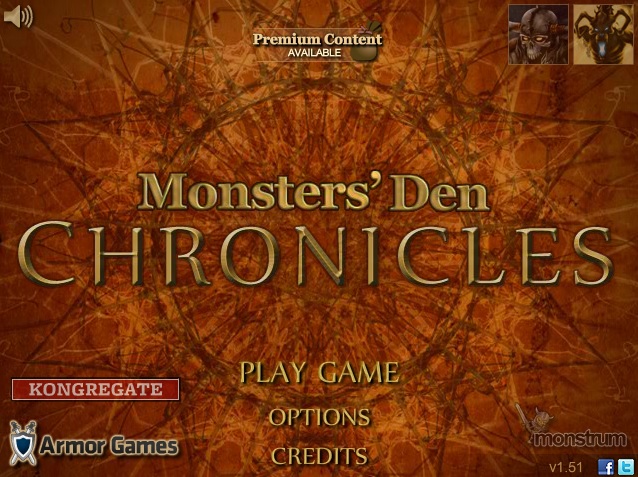
Played: Monsters’ Den Chronicles

Look, sometimes you just want to grab your gear, head into the dungeon, and slay some monsters. And if you do, you could do worse than to make Monsters’ Den Chronicles your destination as MDC is exactly what you’re looking for…

MDC1Michael here. It’s been a while (okay, a long while) since my last post/review. A shame, yet life happens. But I’m finally back with another review and some additional news:

I’ve got my own blog featuring my previously published d20/OGL fantasy material (chiefly from my work with Ronin Arts) as well as new stuff. I’m updating it almost daily so if 3.0/3.5 and Pathfinder are your thing, check GMWorkbook out.

Alright, let’s get to the review… Continue reading “Played: Monsters’ Den Chronicles”

Played: Cursed Treasure – Don’t Touch My Gems

Cursed Treasure: Don’t Touch My Gems is a tower defense game where you place towers with varying capabilities on the map to try and stop waves of enemies from stealing your gems. The atmospheric twist here is that you’re the evil Overlord using Orcs, Undead, and Demons to stop the heroes…

Michael here. This is the second in what I guess is now “officially” my ongoing series of computer game reviews I enjoy and believe you will enjoy. For the rationale and methodology behind these reviews, as well as background on tower defense games and because I’ll be referencing the game in this review, see the Kingdom Rush review.

Name: Cursed Treasure – Don’t Touch My Gems
Genre: Real Time Strategy
SubGenre: Tower Defense
Atmosphere: Fantasy
Websites: Armor Games, Kongregate
Rating: 4/5

Cursed Treasure

Gameplay

Cursed Treasure: Don’t Touch My Gems is a tower defense game like Kingdom Rush where you place towers with varying capabilities on the map to try and stop waves of enemies from stealing your gems. The atmospheric twist here is that you’re the evil Overlord using Orcs, Undead, and Demons to stop the heroes.

CT:DTMG has 15 levels, each of which consist of a map made of varying terrain (there are three terrain types corresponding to the three towers and each tower) and one or more paths the heroes follow to and from your gem cave. The overall goal of any level is to keep the heroes from carrying all your gems off the map. If they succeed, you’ve lost the level. If you manage to keep at least one gem on the map (it doesn’t have to be in the cave), you win and unlock the next level.

To keep the heroes from succeeding, you have three basic tower types: the orc Den, the undead Crypt, and the demon Temple. Each of the tower types has a different range/rate/upgrade path and can only be built on one of the three terrain types (Grass, Snow, and Rock respectively), but otherwise may be built anywhere on the map (though you may have to clear the terrain of trees first, see below). There are also special High Ground tiles that provide a large range bonus where any tower may be built.

Towers automatically shoot at any heroes that come within range, gaining experience points in the process. Once a tower has enough experience, you may upgrade it to a higher level if the map allows it.

Building and upgrading towers requires gold, and while you start of with some gold at each level (that you can increase through purchasing and upgrading skills, see below), the chief way to gain gold is to kill the heroes.

CT:DTMG wouldn’t be a fantasy game if it didn’t have magic for you to use, and in this game the magic takes the form of three spells: Cut Out (to clear the aforementioned trees), Frenzy (which increases the firing rate of all your towers for a brief period of time), and Meteor (which devastates an area you designate with, well, meteors). These spells cost mana, of course, and you gain mana over time as well as by building the appropriate tower on mana pools on levels that have them.

Completing a level, even if you lose, earns you Experience Points that help you level up. With each level you advance, you are given three Skill Points you can use to buy various Skills to do things such as buy special powers for your towers, reduce the mana cost of spells, etc. The more gems you retain, the higher your rating and XP. Interestingly enough, while keeping the heroes from even touching your gems (it’s in the title, after all) gets you the highest rating of Brilliant, it actually doesn’t provide you with any more XP than simply keeping your gems on the map. Skill Points can be reset at any time so you can try various combinations out to find the one that works best for the level you’re trying to beat.

Of course, most of the preceding information is included in the handy tutorial in the first two levels of the game along with plenty of help the rest of the way.

Levels become increasingly more difficult as you advance, especially if like me you want to get that Brilliant rating. That being said, no level is impossible though you may have to do some tweaking of your Skills/level up to get the right combo to win the level.

What Makes The Game Worth/Not Worth Playing

If you liked Kingdom Rush or are a fan of the tower defense genre, this is right there at the top of the heap. Now I don’t rate it as highly as Kingdom Rush (which I consider the gold standard of TD games) for a couple of reasons:

  1. CT:DTMG came out in mid-2010 (it’s undoubtedly a predecessor to KR) so its graphics and gameplay are not as sophisticated.
  2. There’s no real story, the sound/voice acting isn’t as quality, there are no easter eggs, it doesn’t have as many levels – it’s simply not as good of a package.

However, these things in no way make CT:DTMG not worth playing. It’s still a solid and fun tower defense game that meets all my requirements for a game I enjoy (see the Kingdom Rushreview for the full list). Chances are, if you enjoyed KR, you’ll enjoy CT:DTMG. Oh, and this game does have something KR doesn’t: a fast-forward option to move those hero waves along.

Played: Kingdom Rush

I play games for two reasons. The first is for entertainment. The second is to take my mind off my work when things just aren’t clicking creatively (for some reason my mind does great work when I’m not thinking about said work). Ideally, a game meets both of those goals at the same time.

Kingdom-RushMichael here. This is the first in what (I hope) will become a series of articles on games I’ve played that I believe you will enjoy playing as well (assuming you haven’t already discovered them on your own, of course). Now, before I launch into this initial review, I feel a little background is in order as to the method behind the madness.

I play games for two reasons. The first is for entertainment. The second is to take my mind off my work when things just aren’t clicking creatively (for some reason my mind does great work when I’m not thinking about said work). Ideally, a game meets both of those goals at the same time. So I look for games that:

  1. Are web-based (hey, I spend a lot of time on the computer – see my bio)
  2. Don’t require a lot of time to complete an objective/level/the game itself
  3. Don’t require heavy strategizing, complex controls, or anything else that would keep me from effectively jumping right in
  4. I can pick up right where I left off
  5. Are challenging without being frustrating
  6. Free (not free-to-play, which in many cases might as well be called “fee-to-play”)

In short, something a bit more involved than casual games but less involved than more complex games such as MMORPGs, RTSs, and such. If you’d like an example of the kind of game I like, check out my nostalgia piece on Spybot: The Nightfall Incident.

Alright, enough of that, let’s get on into this first review.

Name: Kingdom Rush
Genre: Real Time Strategy
SubGenre: Tower Defense
Atmosphere: Fantasy
Websites: Kingdom Rush, Armor Games, Kongregate
Rating: 5/5

Gameplay
At the risk of boring those of you already familiar with tower defense games, I’m going to give a brief explanation. Tower defense games are games where you place towers with varying capabilities on a map to try and stop waves of enemies that enter the map at one or more locations from exiting the map. It’s one of my favorite genres (oops, subgenres) because it meets my game criteria perfectly as you will see.

Among the many tower defense games, Kingdom Rush is one of my all-time favorites, a fact substantiated by the high ratings it has received on both Armor Games and Kongregate as well as the host of imitators it has spawned since its debut in late 2011.

In Kingdom Rush you are King Denas’ General tasked with defending the realm from an incursion of bad guys. You accomplish this through a series of campaigns that take you from the bucolic countryside through the mysterious elven forests and the icy mountains to the great volcanic plain until finally . . . well, I won’t spoil the ending for you.

The individual battles within a campaign consist of a series of maps where you build your towers along the road(s) the enemy will travel on in the hopes of killing your foes before they exit. Unlike in some TD games, Kingdom Rush limits where you can build your towers to specific areas, but this is not a problem at all.

To build a tower, simply click on the location, select from one of the four towers (Archer, Dwarven Bombard, Barracks, or Mages), and click to build (provided you have enough money). Then once you’ve got everything you can afford in place, send in the first wave. The towers themselves have distinctive abilities. The Archers are fast with good range, the Dwarven Bombards are slow but cause area damage, the Barracks put troops on the road that physically impede the enemy (at least the ones who can’t fly), and the Mages blast away with their magic.

As you kill enemies you will receive gold. This gold can be used to purchase more towers or, in every level but the first, to upgrade existing towers to more powerful ones. As you advance through the campaigns the level to which you can upgrade the towers increases, revealing all manner of special abilities.

You also have a couple of powers you can call on periodically to help even the odds in your favor. The first is Call Reinforcements, which allows you to put a couple of peasants anywhere on the road to impede the progress of ground-based enemies. The other is Rain of Fire, which rains down hell on an area of the road you choose. Spam the reinforcements, but take note of the long cooldown time on Rain of Fire.

You have 20 lives per battle with every enemy who exits taking one (sometimes more) of those lives with it. Depending on how well you do, you’ll earn from one to three stars for your efforts. Also, once you complete a battle you can replay that battle as a Heroic Challenge and an Iron Challenge, earning one additional star for each. These stars can be used to upgrade aspects of your towers and abilities or, if you’ve got enough of them, to buy a hero.

Note that heroes are a recent addition to the game; when Kingdom Rush first came out, there were no heroes. As a result, heroes are not necessary to win the game at all, but they can sure be fun to play as they are quite powerful and can be moved all over the map. Of course, the stars you spend on heroes are not available to upgrade your towers/abilities, so choose wisely!

Individual battles can be quite challenging and you often have to play them more than once to get the full three stars, tweaking your upgrades/heroes in the process. That being said, there are no impossible levels and even the final battle is not too hard once you figure out which towers to use.

That’s all I’m going to say about the gameplay as Kingdom Rush really takes care of teaching you the game all on its own: the first mission serves as a tutorial, any time something new is introduced there’s a pop-out from the left side of the screen that explains things to you, and if all that fails, there’s always the Encyclopedia.

What Makes The Game Worth Playing
Aside from the gameplay, Kingdom Rush is at the top of the heap for a number of reasons, not the least of which is: it’s adorable! Sorry, I just couldn’t think of a better adjective here. From the cute graphics to the towers’ catchphrases to the fact that every poor cannon fodder you put on the road has a name, there’s just so much neat detail put into the game that you’ll simply have to play it to see what I mean; I still get a kick out of upgrading the Archer tower until it’s filled with Rangers shooting out of their canopy fort while an old bearded Druid stands at the base of the trunk periodically calling forth entangling (and thorny!) vines on the advancing foe. And speaking of foes, so many classic enemies are here: orcs, goblins, ogres, hordes of skeletons, dark knights, winter wolves, elementals, giant spiders, and many more. And it’s all free! Well, not all of it. Only a couple of the heroes are available to you and while the main game is completely free, there is an additional campaign you can purchase. And I don’t see a problem with that at all. The additional campaign is completely separate from the actual game and the inaccessibility of the additional heroes in no way keeps you from wining the game or in any way makes it more difficult.

What Makes The Game Not Worth Playing
Kingdom Rush has only one glaring weakness (and it’s jarring precisely because the game is so good): a lack of a fast-forward option. Except for the ability to call waves early, there is no ability to speed up the advance of the enemy. This is an unusual omission for this kind of game and can, especially on maps with many waves, be somewhat frustrating if you have good enough defenses in place to where you really don’t need to do much to destroy the enemy. Still, this is a minor quibble in an otherwise excellent game.

So what are you waiting for? The kingdom needs you!

KR1-600x516

A Game Fondly Remembered – Spybot: The Nightfall Incident

I had (many years ago) stumbled upon a surprisingly excellent hacker game called Spybotics: The Nightfall Incident. So I thought I’d share it with you in case you missed this gem…

Just this morning while working on a current cyberpunk project – FlashCity Stories – something dredged itself up from the depths of my memory banks. Specifically, it was while looking at various angles for a hacker story that I recalled I had (many years ago) stumbled upon a surprisingly excellent hacker game called Spybot: The Nightfall Incident. So I thought I’d share it with you in case you missed this gem.

Spybotics_the_Nightfall_Incident

A little background is in order. Spybot was a set of four Lego robot sets released in 2002 that, with the aid of a CD-Rom, could be programmed to accomplish various missions. How this is done I have no idea – I never owned the sets and it’s not at all important for the game itself. In any case, along with the sets Lego released the titular game, which is where I first played it. Sometime later when I went back to play it again, it was no longer on the Lego website. Don’t know if Spybot just wasn’t successful or what, but they killed the entire thing including the game. Fortunately, at least in this case, once something is on the internet it never dies and today several archive-type websites host the game; I’ve included the link for the first site that pops up through a Google search.

So what is S:TNI all about? I don’t want to reveal too much because when I first played it I had no real idea what it was and as a result the game was that much more fun. Note that there are, of course, websites that will break the game down in its entirety, but I really encourage you to spoil as little of it as possible, especially the story, because it is just that much fun. Also the game has a tutorial right at the start that helps you understand what is going on. Still, I feel compelled to share something about the actual game.

In a nutshell, S:TNI is a turn-based Shockwave game where you play a SMART (Secret Mission Agents Robotics Team) agent whose job it is to track down crime on the internet. You do this by engaging in databattles where you pit your programs (with names such as Hack, Slingshot, and Bug) against rogue software (Watchman, Sentinel, Sensor, etc.). As is usual in most games, you start off with limited resources – in this case the two programs Hack and Slingshot – and can upgrade along the way by winning battles and receiving a credit reward. That’s the essence right there. Again, there’s a tutorial to take you through the actual gameplay and there is other helpful information along the way.

Why I like and recommend this game:

The Atmosphere: Somehow, despite its (even by the standards of 10 years ago) basic graphics and music capabilities, the game creates a really great atmosphere between the story, the music, and the gameplay – it just feels right. I know that’s rather vague, and yet it is most appropriate. So many games I’ve played feel like, well, games. But this one, perhaps because it is so simple so your imagination goes to fill in the blanks, really allows you to become immersed, and not because you’re maxing your APMs and forgetting to blink.

The Story: It’s a simple story we’ve seen before but there are some pleasant surprises along the way both in terms of the narrative and the programs that become available to you.

The Gameplay: It’s a turn-based game that’s actually much like table-top miniatures games in that you deploy your pieces, er… load your programs, move them up to a certain amount and have them perform an action, then wait for your opponent to do the same. It’s easy to get the hang of but has a surprising number of options as you get more programs, including which programs to purchase and which to deploy.

The Level of Difficulty: I found the game neither too easy, nor too difficult, which is to say, it gets it right. The difficulty does ramp up as the game goes on but it never gets frustrating nor will you ever find things too easy no matter how many, or which, programs you have.

If it isn’t obvious from the preceding, I really enjoyed the game and believe you will enjoy it as well. There’s just something about its simple graphics, basic yet deep gameplay, storyline, and atmosphere that somehow combine for a really great experience that is worth your time to check out.

Do Castles Have A Purpose In FRPGs?

It strikes me as odd that castles existed in a world where dragons, griffons, manticores, and all manner of large, dangerous flying things ruled the air…

Bodiam-castle

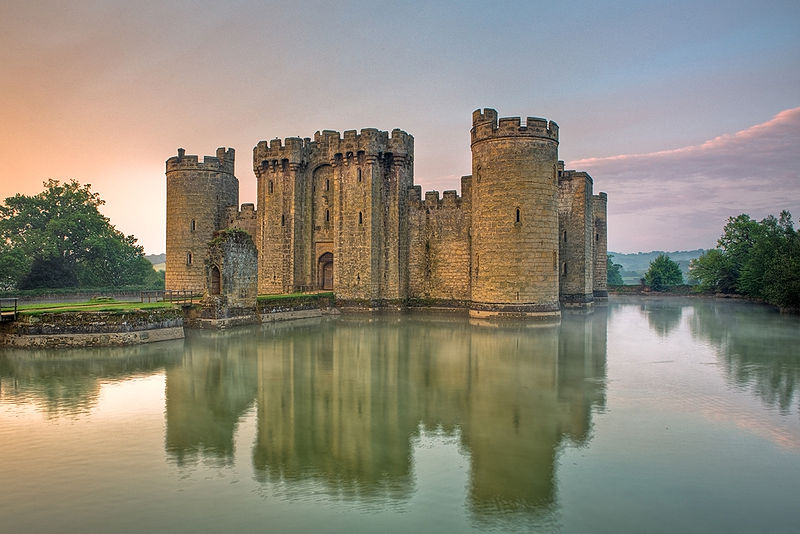
One of the things that struck me as odd even back when I first started playing D&D lo these many years ago was the assumption that castles existed in a world where dragons, griffons, manticores, and all manner of large, dangerous flying things ruled the air. Not to mention the fact that any adventuring party with a few scalps under its belt had access to levitate, fly, and dimension door and at least one member who was really good at climbing walls. The fact is, against the former a castle would provide no real protection and against the latter it would hardly be an obstacle.

Now don’t get me wrong. I understand the assumption is that such monsters are rare (although surprisingly common once you reach requisite level . . .) and that higher-level individuals are far from the norm (although, again, surprisingly common at times . . .). In other words, it’s bunk. To my mind castles, at least in the real-world sense, would not exist in a fantasy world because they simply cannot serve the same purpose in a fantasy world as they would in the real world. At least not built as they are. After all, real-world castles and fortresses developed, were refined, and finally fell out of use based on real-world concerns. So how would a castle – and by this I really mean fortified structure sitting on the ground – be built in a fantasy world?

Obviously if it’s a low fantasy/classic Tolkien fantasy game where powers and creatures able to circumvent a castle’s defenses are rare or non-existent then castles can be as they are, climb walls notwithstanding. But if it is your standard D&D/Pathfinder type game then some changes would need to be made.

Chief among these would be increased protection from aerial assaults. That means no wooden/slate shingles as roof-protection – we’re talking solid roofs here. It also means the end of an open courtyard, at least without some means of preventing flying creatures from landing in it. This could take the form of anything from nets and cables strung across open areas to some form of magical protection (more on that later) to not having any open spaces at all (and if there is an open space, you can be certain it is a trap). Another option would be to build the entire thing, or at least a large part of it, below ground (think Maginot Line); the castle has effectively become a dungeon.

Having dealt with aerial threats the design of a castle would now concern itself with magical threats. One such spell is of course guards and wards, but that is mainly for dealing with intruders already inside. What about defenses for the outside? How about a spell that senses someone climbing the walls and turns the stone to glass or causes the stone to turn to mud and then turn back to stone, trapping the climber? How about a dimensional shield/wall effect that prevents passing through the walls? You can rest assured that in “action/equal opposite reaction” style spellcasters would work around the clock to create spells to counteract these threats.

So in the end there would probably still be castles in FRPGs, but they’d look more like modern-day bunkers designed to deal with big guns and aircraft than the classic medieval designs. Furthermore, they’d be protected by an array of magic designed to counteract those wonderful spells and abilities the adventurers find so handy.