An Adventure Template

Venger Satanis[This template will be included in Universal Exploits, an upcoming supplement for Alpha Blue. Kickstarter happening now]

Few Space Dungeon Masters out there are as free-wheeling as myself. I like to have a general idea of what’s going to happen or maybe a few key random tables at my fingertips, but that’s pretty much it. I don’t do much planning – especially for a “space sandbox” RPG like Alpha Blue.

And despite that – or possibly because of it – I frequently find myself adhering to a particular formula. I mean, I’ve only watched, like, a trillion hours of sci-fi movies in my lifetime. When I was 5, I had pretty much every word of Star Wars memorized. Eventually, certain concepts absorbed into my weird geek brain, becoming second nature.

Is a formula absolutely necessary? Hell no. Is it a good idea to be familiar with a formula that works, you know, just in case? Absolutely. Even stream-of-consciousness can benefit from having structure. Besides, this formula has a lot of play. By that, I mean it’s open-ended enough to accommodate thousands of ideas… millions! Continue reading “An Adventure Template”

Climbing the Wall of Text – let’s design an RPG adventure!

When I think back to the best times I had running adventures, I feel like they were great not because the adventure was fantastic (although in some cases, they were), but were great because of how we filled in the gaps…

Robert J. SchwalbWhen I think back to the best times I had running adventures, I feel like they were great not because the adventure was fantastic (although in some cases, they were), but were great because of how we filled in the gaps. If you run Steading of the Hill Giant Chief as written, you’d be painting lip-gloss on a shotgun and squeezing the trigger before you got to the end of the adventure. Why? After you explore and kill all the giants in ten rooms or so, you’ve probably had enough. Do this ten more times and you have found the very definition of boring.

A surface read of the classic adventures reveals that despite the fun we had with them, as written they do little to light me on fire. Many are just page after page of room descriptions, sprinkled liberally with monsters to kill, traps to avoid, and treasure to find. If there’s a plot, it’s thin and, often, acts to the adventure’s detriment, something best ignored or adapted to suit the game master running it. The adventure is a framework and it’s up to GM and the players to bring it to life.

For me, this is why adventures like Steading and the rest of the G series were so great. Yes, you can kill room after room of giants, if you decide to approach the adventure that way. It’s far more entertaining to infiltrate the steading, to sneak, to hide, and keep the fighting to a minimum. After all, make a lot of noise and you’re going to bring the entire place down on your head. If you can get in and out with a few sacks filled with loot and without having to swing a sword, you can count the entire enterprise as a win. This sounds like so much fun, I want to run it right now!

This approach to adventure design has largely fallen out of favor. It seems far more important to ram a thick plot down the audience’s throat. Rather than getting a map, some interesting locations, and some clear goals, adventures demand you first climb the wall of text, to read and absorb 32 or more pages of background, to discover an entire cast of characters, each with their own goals and agendas, the detailed histories and layouts of countless towns and cities, with every plot presented with meticulous detail. Once you survive this gauntlet, you might get to the adventure itself.

But wait! No designer wants to create a railroad adventure. Players want choice! They want to go where they want, do what they want: They don’t want to follow the GM through to the end. And so the adventure gains pages and pages and pages of side-treks, hooks, work-arounds, helpful advice to get the PCs back on track, adding page after page after page of information, all of which obscures what is, effectively, a simple treasure-hunting, stop the bad guy, destroy the artifact expedition.

I understand why adventures often take this shape. A robust story can cover the unforeseen decisions the players might make. The development sections insulate the GM against the confusion and mishap that can occur when the players go off script. So rather than pull back on story, the solution has been, at least for most mainstream games, to go full on story, to map out a web of possibilities so no GM will be caught unprepared.

And this is why adventure design gives me an ulcer. Why should the adventure cover almost any and every eventuality? It runs counter to the user experience—designers throw their labor into the wild and the audience puts it together in whatever ways they want. A designer has no control over how the audience uses the game, so why would we bother to hand out scripts that do exactly what the game experience is not supposed to do?

Of the many games and systems out there, it’s Savage World’s take on adventure design that gets me all hot and sweaty. I’m looking at “The Dark Side of Love” in Solomon Kane and what I see is a basically a broad outline for how the action might unfold with the climactic scene at the end. The game expects the players and GM to fill in the details and let the adventure play out in as organic manner as possible. This, my friends, is the way to do adventures.

I would go a bit further, though. Here are the things I would cut from general adventure design:

  • Text in the background that exceeds 100 words.
  • The adventure synopsis
  • NPC descriptions that go longer than a sentence or two.
  • All read-aloud text.
  • Location descriptions would be limited to three basic things: Broad parameters about the place, the first thing visitors notice, and something for the players to play with—a secret to find, a monster to kill, treasure to grab.
  • All descriptions of things that exceed the most basic information a GM needs to know.
  • All stat-blocks for creatures other than ones new to the adventure.
  • Anything that is a mechanical process that the core rules already cover.
  • Conclusions, aftermaths, anything that deals with what happens next.

The idea here is to empower the GM and players to frame the story in a manner that works for the group. I would take this approach for dungeon crawls, investigations, mysteries, explorations, hex crawls, everything. I know, this is aggressive, but I think it’s crucial to keeping people playing the game. How many times have you wanted to run a game but couldn’t because you had nothing prepared? How many times have you hit upon something in the adventure you’re running and accidentally forgot to reveal an important plot point? How many times have your players gone off script and left you frantically trying to adjust?

Let me give you an example before I sign off. I think it would be fun to set a story in a ghost town near some mines. So here we go:

Background: The miners delved too deep and came upon a demon imprisoned in the deep, dark depths. The miners freed it. It killed them. The demon, gore-slicked, crawled out of the mine and butchered the townsfolk. One person got away. The PCs find the survivor, who’s insane and gibbers “Everyone is dead!”

Town: The town has ten buildings. They include 6 homes, a smith, a tavern and inn, a church, and a general store. Muddy footpaths meander between them. Farms ring the town for about a mile all around, speckled with farmhouses, silos, and barns.

The Demon: The demon eats the people it killed. Roll a d10 when the PCs arrive to see where the demon’s eating. On a 1–6, it’s in a home; 7, the smith; 8, the tavern; 9, the church; 10, the general store. If the demon hears a loud noise, it comes out to investigate, perhaps bringing its meal along with it.

Other Threats: A pack of 1d6 + 6 wild dogs fighting over the corpses of the dead; a gang of 1d4 hungry ghouls; a survivor who’s thoroughly mad and screams if he sees anyone, which alerts the demon and draws it out.

Scenery: You can use the following to dress up the town.

  • A room painted in blood with a blood-drenched doll in the middle.
  • The body of a woman that looks alive from the front, but is dead and missing the back of her skull. Let’s say there are horrid teeth marks in the bloody brain matter.
  • A cloud of flies, each fly bearing a human face, evacuated from the demon’s bowels and lingering in a room. Their buzzing forms the words “You will die” over and over again.
  • An uncast shadow creeping across a wall.
  • A hidden room that holds a victim’s treasure, say 20 + 1d20 sp and a jade idol of a fat, horned god worth 1 gp.
  • A hidden room that holds the trappings of someone’s deviant and secret fetish—manacles, a leather suit, or something really gross.

And that’s it. A map could be helpful, but really isn’t needed. It’s not like their arrangement is all that important to the story. And if it’s important, the GM can just make it up. There’s enough here for a GM to get an idea about the place, ways to set the mood, monsters to fight, treasure to find, and the information creates a scenario that the GM can play through in an evening. If I wanted to expand it, I might talk about the mines. The PCs could follow the trail back to the mines, deal with some underground critters—beetles and so on—and finally come to the room where the demon was released. Perhaps the characters find a ritual scroll and can perform the ritual to bind the demon once more. Of course, the ritual’s performance would recall the demon to their presence and it’s probably not at all happy about being sealed up again. But this is an adventure and it’s enough for a group to play – have a great time, and, hopefully, remember for a long time.

Running a one-shot RPG, and then fail happened

I had only a couple of days to get ready for this game, so I tried to squeeze as much as I could. I had been mulling over a new fantasy setting in my head for awhile, one that was influenced heavily by religion, so I figured that this was a perfect time to test it out. Unfortunately, it was the beginning of a long list of mistakes…

I like to game. More specifically, I like role-playing games such as Pathfinder, Dungeons & Dragons, Shadowrun, Savage Worlds, and others. I look forward to Wednesdays when the Mid-Week Geeks get together to roll some dice. With all that said, I HATE it when a game gets canceled.

Epic-Failure

That’s what happened this week. The GM canceled, and we were faced with having to wait another week to game. So, I panicked, and posted that I would volunteer to run a one-shot.

And then fail happened.

[I’ve run several successful campaigns over the course of two decades, so this one-shot shouldn’t have been a problem.]

I had only a couple of days to get ready for the game, so I tried to squeeze as much as I could. I had been mulling over a new fantasy setting in my head for awhile, one that was influenced heavily by religion, so I figured that this was a perfect time to test it out. Unfortunately, it was the beginning of a long list of mistakes…

I wrote out a setting page (two pages, actually). It explained the religion and how society was wrapped around it. Character concepts were heavily influenced by this as well.

Mistake #1: I spent way too much time developing the setting for a one-shot. I should have used an established or generic setting. Time was wasted, and the snowball effect began.

The Mid-Week Geeks have a Facebook page, and we use it a lot. It’s very helpful in communication between us and I can’t see us ever abandoning it. This is where I announced that I would run the one-shot, and that I would have pre-gens ready. I didn’t really use it again after that.

Mistake #2: This was the perfect opportunity to post all of the information on the setting. However, I did not do that. I did not post a primer what-so-ever, and I should have. Basically, I forgot, and then later I figured it would take only a minute to explain at the gaming table. In actuality, I spent several minutes at the table explaining the setting, several minutes well-wasted.

I told everyone that we would be using Savage Worlds -“Fast, Furious, Fun!” (something we haven’t played in a while), and that I would have pre-gens ready for them to use. When making the characters, I was tweaking a few of the powers so that they would better fit the new setting.

Mistake #3: Tweaking anything. I spent wayyy too much time making characters. Making new powers (and then printing those new powers on power cards) just took forever. In the end, I was able to complete only three out of six characters. When everyone showed up, I had those players with the most experience make up their own characters.

In order to really get the feel of the setting that I had created, I had the characters play at a high level. It was an epic story with epic characters pitted against epic foes (Pit Fiend, anyone?).

Mistake #4: With the characters at high levels, it took longer to get them made. On top of that, these player characters were brand new to the players, so there was some slow-playing as people were trying to figure out which powers to use, and then trying to figure out how to use them.

Since we were down a player, that brought our group count to one GM and five PCs. At the last minute, one of the players asked if he could bring along a friend. I said, “Great! The more the merrier!”

Mistake #5: This was a one-shot. We didn’t have a lot of time to play, and the spotlight already has trouble getting spread around the table. Add to the fact that this new player was a new player to roleplaying, and it slowed things down even more. Oh, and he needed a character made for him.

For this one-shot, I elected to use Savage Worlds. I like Savage Worlds – it’s lite, fits everything, and is easy to play.

Final Mistake: I used Savage Worlds. Savage Worlds is great, but I’ve never really had any success as a GM with it. I don’t understand why. I’ve run several adventures and campains using other systems, so what’s my problem with Savage? I don’t know, but (luckily) someone who is very familiar and comfortable with it acted as referee for the night.

In the end, I think everyone had a great time. We managed to stop demons and devils from forming a pact, blocked their doorway to the underworld, and helped a player character fulfill his destiny. I just wish that we had more time to do it. After wasting time on all of the failed prep work, and then throwing a birthday party for one of the players, we ended up with three hours of game time, three very short hours.

While our gaming night was a blast, I felt that my running of the game was a disaster. Everyone had fun, but I was completely flabbergasted inside.

I think I’ve learned my lesson. I think that running a one-shot takes up more prep time than for your regular game. And I think that the next time I run a one-shot, I will approach it much more wisely. +1 Wisdom!

Designer Diary – Inspiration is Not Cheating

It can be hard to come up with new ways to describe common play elements over and over, and that’s one of the reasons why the Urban Dressing line exists…

Urban Dressing

It can be hard to come up with new ways to describe common play elements over and over. It’s one of the reasons why the Urban Dressing line exists. We created charts of names, descriptions, personality quirks, and other fun story elements so you can fresh text on the fly to add to your games.

I have a new dirty secret to tell. Even I, the great game designer Brian Liberge, have a hard time coming up with ideas. I mean come on, how do you describe a hundred different, low magic, interesting but not game-derailing alleys? I need a little help, just something to get my mind cranking in new ideas. It feels like cheating, but I assure you it’s not.

For Alleyways, I looked to my past work. I pulled up an old draft of Urban Dressing: Traders & Craftsmen, for which I had created a chart of a hundred trades and services. Nothing fancy, just one or two-word entries. Then I used them to inspire new details. The coppersmith became artistic metal gutters, the fisherman is now an odd stench, the carpenter inspired a pile of refuse blocking the way.

I found myself looking for inspiration again when working on Urban Dressing: Temples. I knew I wanted to have two charts, one of features based on your god’s domains, and the other descriptions that could be applied to any temple. The only problem was that the domain chart seemed to have all the cool ideas! I needed ways to generate more interesting mundane ideas, so they didn’t start stretching into the fantastic and competing with the domain chart. A quick Google search revealed an online random adjective generator and I was off. Grouchy, worthless, articulated, delicate. . . I couldn’t actually use each word to describe a temple, but they all brought new images and ideas to mind. That’s the great part, and the real reason inspiration is not cheating. If you were to use that generator to come up with your own temple descriptions, we might overlap on some themes, but the final product would be completely different.

So now you might be saying, “Brian, this is all well and good, but I’m not a game designer.”

Ah, but you’re probably the creative type (you’re a gamer, after all). If you’re the GM, your constantly designing cities, foes, quests and NPCs. Maybe you’re only a player(?), you still might want ideas to spice up your back-story. It’s easy to find new ideas without blatantly just copying something you saw in a movie. The key is to go looking for something new that isn’t exactly what you need. Anything new (i.e. not starring at your rule book or campaign wiki) will get your mind going, then return to the task at hand and try to apply it.

A cool tip I’ve stolen from others is to head to Google Maps. Jump to an area of the world you’re not familiar with and start looking at the names. Check out villages and counties. Zoom in further and read the street names. Now try swapping around the consonants or vowels (probably not both). You’ve got a whole new sound in your head perfect for naming the villages in that rival nation that the players suddenly decided to head for.

Inspiration can come from almost everywhere. It’s OK to seek it out!

Do Castles Have A Purpose In FRPGs?

It strikes me as odd that castles existed in a world where dragons, griffons, manticores, and all manner of large, dangerous flying things ruled the air…

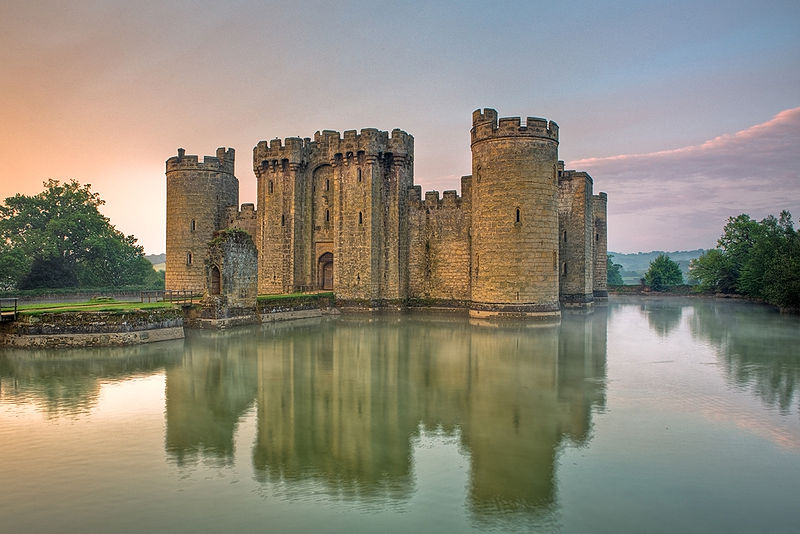
Bodiam-castle

One of the things that struck me as odd even back when I first started playing D&D lo these many years ago was the assumption that castles existed in a world where dragons, griffons, manticores, and all manner of large, dangerous flying things ruled the air. Not to mention the fact that any adventuring party with a few scalps under its belt had access to levitate, fly, and dimension door and at least one member who was really good at climbing walls. The fact is, against the former a castle would provide no real protection and against the latter it would hardly be an obstacle.

Now don’t get me wrong. I understand the assumption is that such monsters are rare (although surprisingly common once you reach requisite level . . .) and that higher-level individuals are far from the norm (although, again, surprisingly common at times . . .). In other words, it’s bunk. To my mind castles, at least in the real-world sense, would not exist in a fantasy world because they simply cannot serve the same purpose in a fantasy world as they would in the real world. At least not built as they are. After all, real-world castles and fortresses developed, were refined, and finally fell out of use based on real-world concerns. So how would a castle – and by this I really mean fortified structure sitting on the ground – be built in a fantasy world?

Obviously if it’s a low fantasy/classic Tolkien fantasy game where powers and creatures able to circumvent a castle’s defenses are rare or non-existent then castles can be as they are, climb walls notwithstanding. But if it is your standard D&D/Pathfinder type game then some changes would need to be made.

Chief among these would be increased protection from aerial assaults. That means no wooden/slate shingles as roof-protection – we’re talking solid roofs here. It also means the end of an open courtyard, at least without some means of preventing flying creatures from landing in it. This could take the form of anything from nets and cables strung across open areas to some form of magical protection (more on that later) to not having any open spaces at all (and if there is an open space, you can be certain it is a trap). Another option would be to build the entire thing, or at least a large part of it, below ground (think Maginot Line); the castle has effectively become a dungeon.

Having dealt with aerial threats the design of a castle would now concern itself with magical threats. One such spell is of course guards and wards, but that is mainly for dealing with intruders already inside. What about defenses for the outside? How about a spell that senses someone climbing the walls and turns the stone to glass or causes the stone to turn to mud and then turn back to stone, trapping the climber? How about a dimensional shield/wall effect that prevents passing through the walls? You can rest assured that in “action/equal opposite reaction” style spellcasters would work around the clock to create spells to counteract these threats.

So in the end there would probably still be castles in FRPGs, but they’d look more like modern-day bunkers designed to deal with big guns and aircraft than the classic medieval designs. Furthermore, they’d be protected by an array of magic designed to counteract those wonderful spells and abilities the adventurers find so handy.