TaDRPG

I came up with the concept for this game on my way to work one morning and I couldn’t get it out of my head all day, so I wrote it up on my lunch break.

I’ve always been a big fan of rules-light systems because they’re easy to memorize and easy to tweak. I think, one of my favorite things to do from time to time is surf the interwebz for indie RPGs that are free to download or cheap to download, especially if they’re rules-light. I’ve spent hours doing this and my hard drive is full of different systems with wildly different ways of handling similar things and I like to look through and pick and choose which part of which system I like best.

My goal with this system was to make a good beer and pretzels game. Something that takes no more than a few minutes to read through and something that, when read once, you can memorize.

When I came up with the idea, I had two things on my mind.

  1. I wanted to run a dungeon crawl in a mega-dungeon full of the most deadly traps from Grimtooth.
  2. I wanted to try an old idea of running a game where the GM rolls all the dice and the players control their characters based on the environment instead of their character sheet.

When I posted my idea on one of the forums I frequent, I got a lot of negative feedback, mostly based on not knowing your exact chance of failure or success.

So, I created this system. It’s easy, it forces you to build a character based on a concept rather than on number crunching, and it gives every chance in the form of a percent, so you always know your odds of success or failure.

Once I had the finished product, I knew it was so good I had to share it. I think it would make a great system for one of those nights where a player is missing or nobody’s really in the mood for the system you were playing and everyone wants just a lighthearted, fast paced game. My hope is that somebody finds good use of this system.

Titles and Descriptions RPG (TaDRPG)

This game is based on two simple concepts—the most general concepts of RPGs: doing something is harder than doing nothing and some people are better at stuff than others.

Each character has a title which describes the basic concept of the character.

These titles help make things easier for the character, but only as they relate to the title. For example, Jared the Barbarian will not be able to speak in public as easily as Lily the Talkative, but he will be able to fight more easily. This will be explained in more detail in the crunch section.

Characters will, in addition to their titles, get six descriptions: 3 positive descriptions and 3 negative descriptions. These also affect how easy or hard things are for the character, but to a lesser extent than titles. These can be very vague or very specific. More specific descriptions will make things more easy or more hard and are also more limited than vague descriptions.

It’s important to note that when creating descriptions, you can be too vague, but you can never be too specific.

Crunch

There are two things to remember based on the two general concepts of RPGs and these make up the crunch.

Doing Something is Harder than Doing Nothing

This covers the rules for randomization and potential failure or success. What RPG would be fun if it was you and your friends describing how much nothing your characters are doing?

This game uses a percentile system, with all modifiers in increments of 5%. This makes it easy to convert to a d20, if you prefer. Either way, they’re the same odds.

To succeed, you need to roll equal to or greater than the difficulty assigned to the task.

Some People are Better at Stuff than Others

This is where titles and descriptions come into effect. There are two kinds of titles: Basic and Complex. Basic titles consist of one thing, such as Jared the Barbarian. Complex titles consist of two things, such as Theodore the Mage who knows Kung Fu.

Titles make things that relate to the title easier for the character. Basic titles make things 15% easier for the character.

Complex Titles make things 5% easier for the character. Remember, Complex titles are relevant to more situations.

There are also two types of descriptions: positive and negative.

Positive descriptions make things 10% easier for the character.

Negative descriptions make things 10% harder for the character.

Increase those percents in increments of 5% for more specific descriptions depending on how specific they are.

Success, Failure, Combat, and Magic

Whenever a character attempts something and fails, that character accumulates 1 failure. Once a character accumulates 3 failures, the character becomes incompetent and incapable of doing anything. As such, the character dies.

Whenever a character attempts something and succeeds, that character accumulates 1 success. If the character has accumulated any failures, the success will negate one of those failures; otherwise, the success has no effect.

Combat works in a similar way to other situations. When a character attacks, a die is rolled for the attack. The result sets the Difficulty for the defense. The defender must roll and match or beat the attacker’s roll. If the defender fails, one failure is accumulated.

Making an attack easier due to titles or descriptions means making the defense that much harder.

When a character decides to use magic, that character must roll against a certain difficulty to see if the desired spell has been prepared or is otherwise available. The difficulty should be adjusted by how specific a spell is rather than how powerful the spell is. If the roll is a success, the spell is available to the character. Attacking with a spell works the same as combat.

Example of Play

GM: “You’re at a large pit with a 50% chance to make the jump. Difficulty 10 on the d20.”

Jimmy the Acrobat: “My title grants me a 15% bonus to the jump, correct?”

GM: “Yes. You have a 65% chance.”

Jimmy the Acrobat: *rolls* 13 on d20. “Success.”

GM: “You make the jump.”

Jimmy the Acrobat: “I flip three times before jumping and do a somersault in the air, nailing the landing like a champ.”

Thomas the Reckless: “If I try to jump and slam my climbing spikes into the opposite wall, will my reckless title make it easier?”

GM: “Yes, but you will need to climb with a 70% chance of success.”

Thomas the Reckless: “I have the description Good Climber, which makes that an 80% chance.” *rolls* 9 on d20. “Phew! That was close, but I made the jump.” *rolls* 19 on d20. Made it.

Miri the Careful: “I make the jump carefully.” *goes to roll*

GM: “Wait. How do you jump carefully?”

Miri the Careful: “I don’t know. I kind of ease up to the edge and hang over, then try to push myself off to the other side.”

GM: “That’s ridiculous. You could never make the jump that way.”

Miri the Careful: “But, it’s careful.”

GM: “Sigh. Fine. It’s a 35% chance, but with your title, it’s a 50% chance.”

Miri the Careful: “I also have the description Good at Jumping in Ridiculous, but Careful Ways. Can I get a 20% bonus from that, since it’s so specific?”

GM: “….”

The blog that hosts the link to download the pdf is below. The pdf version has examples and tables for easier comprehension.

http://burningpromises.blogspot.com/

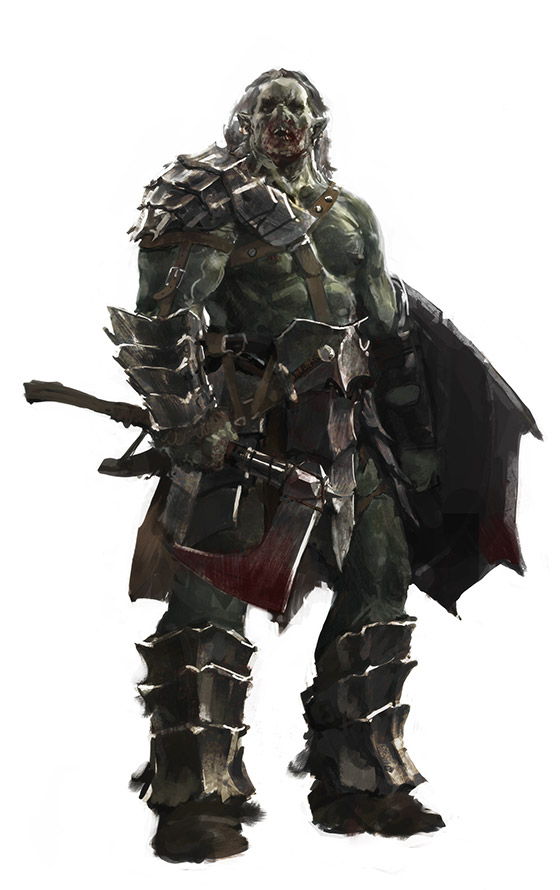
Orcish Revenge (steal this encounter)

The Setup

The PCs are traveling between towns, no big deal. It’s just a regular day, maybe it’s raining or snowing. Maybe the wind foreshadows some bad weather ahead. Maybe they’re just noticing that they haven’t seen the sun all day. Or, maybe it’s just a bright day and the butterflies are flying and the birds are chirping.

Things are just dandy until they run into a patch on the road that indicates a recent fight (Easy Spot DC). Blood splattered around, chunks of armor scattered about, torn clothing. What’s interesting, it appears to have been a fight between about five men against one (Medium/Easy whatever DC) Orc (Medium whatever DC). From that spot, a trail left by a wheeled device leads in the direction the PCs were headed, followed by five sets of footprints (Medium whatever DC) three of which were limping (Hard DC).

The Initiation

A short ways down the road trouble brews when a band of Orcs ambushes the PCs from behind rocks and bushes. At first with slings, but once the encounter becomes melee, they fight with powerful clubs and raw force of strength. They are enraged, stopping at nothing to slaughter the PCs, failure means death for either side in this encounter. It is known that Orcs will eat the flesh of their victims once they’ve been defeated, even cannibalizing their own kind.

This fight should be challenging, but not very difficult or overpowering. For a small group of 3-4 there should be one Orc for each member of the party and the Orcs should be tough, but not unbeatable in a 1-on-1 fight. Ganging up on an Orc should spell defeat for it.

For a larger group of 5-6 there should be one fewer Orc than party members (4-5) and the Orcs should be a bit tougher, almost unbeatable in a 1-on-1 fight. Ganging up on an Orc should be the key to victory.

The Orcs are not trained warriors and will not focus their attacks on any one PC. They will sometimes gang up and sometimes disperse, moving between targets before finishing any off. They are wild barbarians and should fight as such. Do not keep one Orc standing still, fighting one PC for the encounter.

Once the Orcs are defeated, there is little treasure to be found on their bodies. They had clubs and slings and their clothes. You can add a few trinkets if you wish.

The Climax

“Wow,” your players might think as their PCs continue their travels, “I wonder what provoked such a vicious attack.”

Try to disguise your manaical chuckling as they spot the final enraged Orc charging towards them from down the road, club in hand.

This should be another challenging fight, for it is against the chieftain of the Orcs. He wears a headdress and wields a heavy spiked club and wears tattered leather armor for protection. He should be a match for the PCs, even injured as he is, but shouldn’t be as difficult as the fight before.

Remember that his rage makes him agile and strong, he will get a number of initiatives equal to half the number of PCs, rounded down (4-5PCs=2 initiatives, 6PCs=3 initiatives). His hits should hurt to the point that a PC is afraid of being hit. He should also be able to withstand an assault of arrows and sling pellets from afar and a couple rounds of combat, but this fight should not drag on.

The Reward

Now, it is time for the PCs to be rewarded for their troubles. The Orc chief, when felled, will be carrying a powerful totem that grants him Strength or Speed or Toughness, something to explain his powerful combat prowess. It is also known that the chieftain’s headdress is a valuable prize.

Down the road, the PCs will find the result of another combat, similar to the marks on the patch of road from earlier, only this time there are the corpses of five of the city guard. One of which was a sergeant, as he was carrying his seal. The guards had some decent equipment, maybe better than the PCs. They also carried some gold. Beside them is a wrecked cage sitting on two wheels and made of iron. The sergeant is carrying a log detailing their tracking and live capture of the Orc chief, with plans to interrogate him as to the whereabouts of his tribe.

Bringing the sergeant’s seal to the lieutenant or captain or higher up of the guard will reward the PCs with a hefty sum of gold, showing the headdress will grant them even more rewards.

In Conclusion

This encounter is made as a simple replacement for a random encounter in your game, much like the Garrison Road Encounter. It’s a fun little sidetrack from your normal story or dungeon crawl. A simple distraction for a group craving some action.

Garrison Road (steal this encounter)

Garrison Road – trickling with bandits, and bordering well-known Orc tribes in the forest.  However, that is no issue for your PCs; they can most certainly handle themselves. Bandits? Ha! They laugh in the face of bandits, and Orcs exist for the sole purpose of sharpening your blades before taking on dragons, and your PCs know it. So, they decide to travel this perilous road, despite the many warnings of the dangers that lie ahead.

 Good.

 This is exactly what you want, because you know what is in store for them: a violent, bloody death. “Mwahahaha!” you shout as your players look warily in your direction. “Too late,” you whisper, “Down the road, you see a group of men: three wielding bows, one with a bastard sword and a light shield, and one with no visible weapon in sight. Each is dressed in various leathers and hides. They do not look friendly.”

As your players grab their dice and character sheets, readying themselves for the upcoming battle, you stop them, “They wish to make a bargain with you. A small toll. 100gp per head and you may pass peacefully. Do you accept their offer?”

PCs being what they are, you know the attempt at peaceful negotiation was pointless, but at least you can say with confidence that you gave them an out. You did not force them into their now-definite deaths. “Roll initiative!” you shout as you lay templates in front of you, ready to own some PC tail. The bandits, as you know, are motivated – not by murder, but by greed. They honestly only want the PCs’ money, and will take every opportunity to make off with it. Because of their lust for gold and silver, they have a few tricks up their sleeves: tangleroot sacks that hinder the PCs’ movements, and flashbangs to temporarily blind them. Using these tools, the bandits will attempt to cut at the purses on the PCs’ belts, and run away. Their lust, however, will not encourage them to fight to the death; they will quickly flee from a battle they are obviously losing.

“So elegant; so simple,” you whisper to yourself. You know that this battle will not end so easily. As the bandits flee in either success or defeat, they are stopped by large Orc warriors.

The largest Orc, with his face covered in decorative blue paint, smiles grimly at the group of humans he’s found himself facing. “Looks like we’ve found some fresh meat, boys.” His Orcish tongue is gruff and threatening, even if the PCs don’t understand a word of it.

The bandits turn to the PCs with desperation in their eyes. “We’re in this together,” they plead silently as Orcs surround the group.

A variety of Orcish warriors come into the field wielding bows, swords, flails and whatnot. What do the PCs do? Do they take this small window of opportunity to try to flee, knowing that the Orcs will be after them soon, or do they stay and fight back-to-back with the bandits, knowing the extra swords will greatly increase their chances?

If the PCs run, do not be afraid to split the Orcish warband up and send half after the group, or simply send the entire warband after the PCs a few minutes later, after having neatly sliced up the bandits. If the PCs choose to stay and fight, will the bandits be grateful enough to return the PCs’ gold, or will they try to run off with it when the opportunity presents itself? Orcish warriors are not afraid to fight to the death, but the bandits still are.

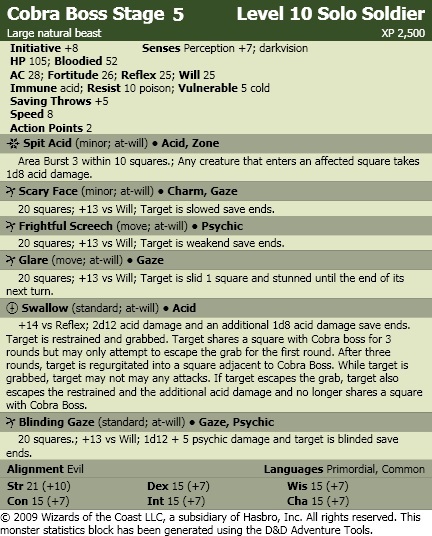
Giant Cobra Boss – Steal this Monster

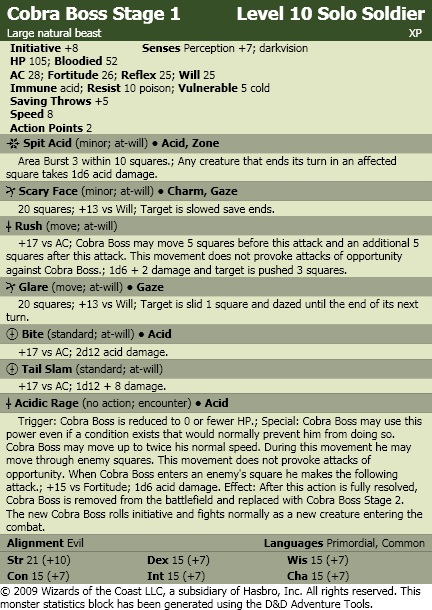
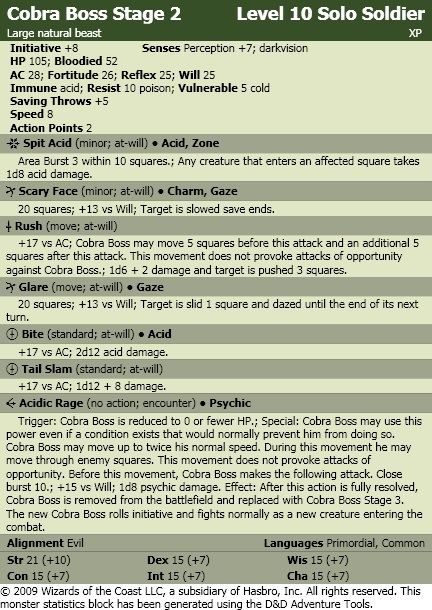
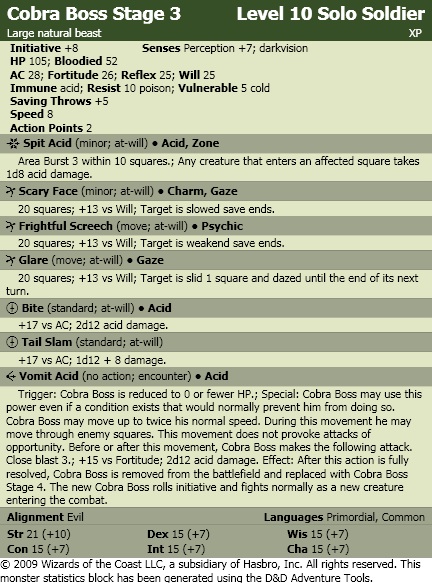
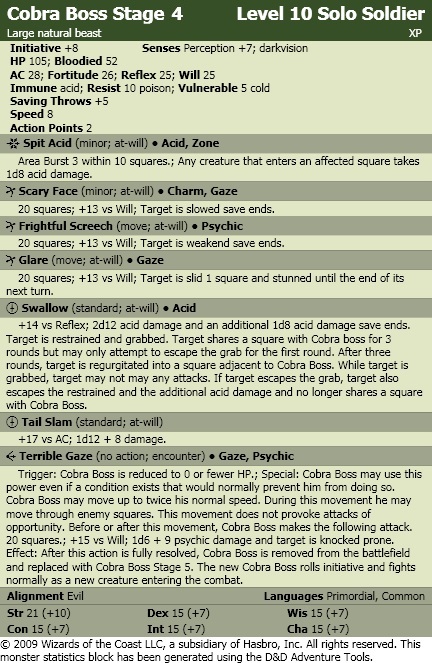
I’m gonna change things up a little bit with this particular creature, so let me explain a few things. This is an adaptation of the Boss Monster template that can be found over at The Angry DM. I say adaptation because I’ve changed a few things up. You see, the idea behind the boss monster is to emulate boss monsters from various video games. You know, the things that possibly take you hours to beat and you may have to try multiple times just to do it? This particular idea that Angry throws at us doesn’t necessarily simulate the extreme difficulty that some boss monsters can possess, instead it simulates other attributes: mainly, their ability to shake off negative effects and come back in full force after being taken down one or two times.

These boss monsters have different stages. Angry explains everything very well, so I will sum it up. Each stage is has a few different characteristics and between stages, the boss monster gets a powerful attack to indicate that it is switching up. The boss monsters that Angry created all have three stages, but I decided to take it up a notch. If you’ve ever beaten Final Fantasy VIII, you may remember the final boss. You beat her once, and she summons something to fight you, you beat that and they merge, then they change, then they change again. It seems almost endless, fighting all five stages of this boss. Well, that’s sort of what I did; I created a boss monster with five stages.

There are a few mechanical differences from 4th Edition D&D that should be explained. For one, each boss monster is a solo with 3 stages (in this case 5). It’s total hit points are split evenly between each stage. So, a boss monster with 3 stages and 300hp has 100hp for each stage. Also, in order for this solo fight to be a bit more interesting than other solo fights, the boss monsters get multiple types of attacks that encompass minor, move, standard, and immediate actions. This way, when their turns come around, they have a few things to do. This helps shake things up and make for more dynamic and more difficult battles. The boss monsters have one more feature, whenever one stage dies, the next stage is treated as a completely new and different creature; that means that anything that affected the first stage when the boss dies, does not effect the next stage: no paralysis, stun, ongoing damage, nothing.

Now, let me explain what this boss monster is like. He is hard. He is very very hard, if you do him right. If you want to do him right, it’s simple. Give him minions and give him interesting environments that may or may not give him an advantage. The minions I used did a few different things and I used them all at different stages. I looked for my templates for the minions (I actually have never used a monster from the monster manual) but I could not find them so I’ll tell you what they did to give you some ideas. The minions could mark, grapple, grapple/pull from a distance, knock prone, and cause ongoing damage. The environments were a little different; they worked in tangent with the minions to create interesting terrain and such for the PCs in case the boss had to retreat (which he did between stages). The first room had pillars that would fall on the PCs, the second was a maze full of minions that would grapple, the third room was a maze full of minions that would knock the PCs prone, the fourth room was full of small corridors that were blocked off by minions, and the final room had no minions, but was dripping with acid that was difficult to navigate around.

When you use this boss, I don’t want you to go easy on your players. I created this boss to challenge my players and he did a good job of it. A good thing about this boss is, if you do find that he is a bit more challenging than you anticipated, you don’t have to use everything he’s got; the players won’t really know the difference.

I hope you enjoy this monster, or at least visit The Angry DM and get inspired by his stuff; it’s a great read.

How to Improvise Your Game

Step 1 – Don’t Prepare

Now, I know you’re busy with work or school or kids, so you don’t always have time to prepare for your sessions. That’s okay because it’s your first step to running a great improv session. Remember, the less you actually prepare, the better off you will be. Now, I’m not saying don’t prepare anything; create monsters or NPCs or dungeons as appropriate to your gaming style. Just don’t make too many, or you’ll ruin it.

Step 2 – Reveal Nothing

Players are a funny kind of animal. They like to believe that they’ve figured you out and know what’s coming up next – use this to your advantage. If your players think you’ve planned everything, they’ll try to predict you. This will be useful to you in later steps. Remember to take advantage of the players making things up. Take more credit than you deserve. Let the story create itself as you go. If you have  no secrets to keep, there are no secrets that they can expose.

Step 3 – Maps Are Easy

Maps are easy to make, if you use them. They are nothing more than shapes within shapes, usually boxes. Just make sure you put the shapes in place so that you create some obstacles for the PCs to maneuver around, and enough room for all the PCs to fit.

Step 4 – Steal from Your Players

Steal from your players.  This is probably the most important thing to remember. Whenever your player says,

“They’ve probably got an alarm system in place.”

They have an alarm system in place whether you thought of it or not! Whenever your player says,

“He’s probably running to get back-up.”

Guess what? He’s totally coming back with back-up even if he was just running away. Your players will never know you stole from them, they’ll just think they were smart enough to predict something that happened. This relates back to Step 2 – Reveal Nothing; don’t say why somebody is suspicious or running, and don’t give more than the essential details – let your players fill in the rest.

Step 5 – Continuity is for Pansies

Don’t worry about continuity. If your players catch you messing up, use your awesome brain skills to work your way around it. This is probably the hardest thing to learn, but practice makes perfect.

GM – “The ogre knows your plans.”

Player – “The ogre doesn’t know our plans to infiltrate their tribe and mess up their rituals – we whispered that part.”

GM – “Aha! He knows your plan to booby trap the bridge because you didn’t whisper that part!”

Make sure that when you do this you do not look surprised or the players will realize what you’re doing.

Step 6 – Let the Players Create the World

When the players look for something specific, let them find it, or at least let it be around. Don’t hesitate to add things to the world that your players have made up. If your rogue thinks there must be a hidden compartment full of treasure in the large featureless hallway – there is now! Let him look for it, and if he’s successful, let him find it (just don’t be afraid to set some booby traps in the way).

This step is designed to make your improv session so much easier. The less you have to make up, the less you have to worry. This will also keep your players engaged. If they feel like they’re smart enough to figure out some secret you placed in the King’s bedroom, they’ll feel better about themselves and their characters.

Step 7 – Let the Players Create Their Own Plot Points

Plot points are the point of most Role-Playing Games and, let’s face it, sometimes they’re just so darn hard to come up with. Then, once you’ve created this awesome plot point, your players will ignore it. We’ve all been there. That’s why you should let the players create the plot points.  These plot points can come from background stories or from role-playing; don’t be afraid to steal anything the players throw at you. If a player decides that some random NPC that has no point to anything is a jerk, give the player a reason to hate him.

Player – “That guy makes me feel uncomfortable and he’s kind of a jerk.”

GM – “Well, he is known for killing puppies.”

Player – “That explains it.”

If your players decide that they don’t care that the king was murdered, and that they just want to get out of the city, give them a way out of the city and drop any plot you may have started working out. Let them find a smuggling ring in the outskirts of the city, or a secret tunnel out. If it’s what the players want, let them have it.

Step 8 – Don’t Be Afraid to Say Yes

I lied. Step 4 is not the most important thing to remember – this is. Don’t be afraid to say yes. Say yes to most everything the players want to do. If they want to one-shot the dragon, you’re allowed to say no. If they want to run on the wall and flip onto the dragon’s back to stab it in the neck, say yes. Let them pull that off and they’ll love you forever.  Besides, the more you let the players make up, the less you have to make up. The coolest things you can do with a game are the things that are not in the rules; remember that.

I’m not saying you should neglect all mechanics to let the players do whatever they want all the time. I’m saying that you should adopt the players’ ideas into the mechanics. If your player wants to flip off the chandelier, land on the giant’s shoulder and hit the robot with his boomerang, just make that player roll the appropriate skills and see if it’s successful. Letting the players know that there is a chance of success – even if there isn’t – will make them happy.