The Friendly Bar Room Brawl, Revised!

So, I wrote up an encounter a while back that was pretty fun for our group. As a post here at Stuffer Shack, it was also generally well-received by our readers. However, I won’t post a link to that Brawl encounter, because I’ve revised it – so it’s a million times better!

Hi, there! Long time no see! Well, I’m back – and I have a revision to make…

Bar BrawlSo, I wrote up an encounter a while back that was pretty fun for our group. As a post here at Stuffer Shack, it was also generally well-received. However, I won’t post a link to that Brawl encounter, because I’ve revised it – so it’s now a million times better!  [New rules are below…]

The last time I ran the Bar Room Brawl encounter, it just seemed to be missing something.  So, on a whim, I changed the rules.  The result was overwhelmingly the most fun encounter of our entire Rise of the Runelords campaign, and that campaign lasted well over a year!  How did I change the encounter?  By having the players interpret and dictate how the bar fight went down…  It was simply a blast… easily the most fun we’ve had in a while.

The Friendly Bar Room Brawl can take place for any reason. Do the characters have some downtime with nothing else to do? Are they meeting someone important and a brawl is a great interruption? Or is there an NPC or new PC that needs to be introduced to the group? Whatever reason, there’s always room for a Friendly Bar Room Brawl!

I’m including this encounter as a Word document that you can conveniently download and print for your game…

The Friendly Bar Room Brawl, Revised!

This is a semi-friendly fight – as soon as knives, guns, lasers, or fireballs come out to play, the fight either stops – or becomes a standard combat encounter. That’s up to the GM and the players to decide, but hopefully it doesn’t come to that.

     Rules:

  1. The brawl starts with the player on the left of the GM (or with whichever PC started the fight).
  2. The player makes a simple Strength, Dexterity, or Agility roll against an average target number (average target number for the group so that – in theory – they hit half of the time). The GM must keep track of the number of successes and the number of failures.
  3. Regardless of whether the PC succeeded or failed, the player rolls a d20 and compares the result to the chart below. If the player had succeeded in his attack roll, he/she must describe how they successfully kick ass that round while referencing the clue in the chart. If the player had failed in their attack, they must likewise use their clue to describe their failure. [“Oh crap! Well, I try to kick the big guy, but I slip on some ale and land flat on my back!”]
  4. Each player character in the bar gets a turn. When one player is done with their turn, the player on their left goes next. No NPCs or enemies get turns; only the player characters. When all of the player characters have gone, a new round starts.
  5. If there are only 2 or 3 players, there must be 6 rounds of brawling. If there are 4 players, there must be 5 rounds of brawling. 5 players = 4 rounds, and 6 or more players = 3 rounds of brawling.
  6. When the appropriate number of rounds have been completed (6, 5, 4, or 3), the brawl ends. If the players have equal or more successes than failures, they win the brawl. Otherwise, they lose! Here’s the kicker… it’s up to the players to decide the outcome of the fight. Do they make new friends? Do they make new enemies? Do they gain information or gear? Do they lose gear? Is the building even still standing? Make sure you and the players describe the aftermath. It should be fun and helpful in some way!

     D20:

  1. Your turn involves the bar, front door, or window. How?
  2. You succeed or fail because of a non-combatant. How?
  3. Your turn involves an animal [WTF?]. How?
  4. Either you or your opponent is unbelievably unlucky. What happened?
  5. How, exactly, did you humiliate your opponent (or get humiliated)?
  6. Your turn involves a drink, pitcher, or bottle. What happened?
  7. Your turn involves a stool, chair, chandelier, railing, or table.
  8. Your turn involves someone REALLY big, or REALLY small, and it’s quite humorous or pathetic.
  9. Your turn involves the worst brawling wound ever, one that lasts for days.
  10. How, exactly, did you just make a friend?
  11. Your turn involves a server, bar wench, or bartender. How?
  12. You or your opponent does or says the dumbest thing – something that does not belong in a bar fight. What was it?
  13. Your action (or your opponent’s) is pathetic. How pathetic, exactly?
  14. How, exactly, did you demoralize your opponent (or get demoralized)?
  15. Your turn is uncharacteristically challenging and insane. Why?
  16. The outcome of your turn is a direct result of the previous player’s turn. How?.
  17. How exactly did you taunt your opponent? And what happened?
  18. What happened that gave the player on your left a +2 bonus or penalty on their next turn?
  19. Someone just got knocked the eff out! How?! If it was you, this counts as two failures. If it was your opponent, this counts as two successes!
  20. Either you or your opponent is the ultimo badass. Explain why. Also, this counts as either two successes or two failures! And… either a +2 or -2 penalty for the next player’s turn!

Download the Word Document Brawl Rules.

Pilfer this Western plot seed – Campfire stories…

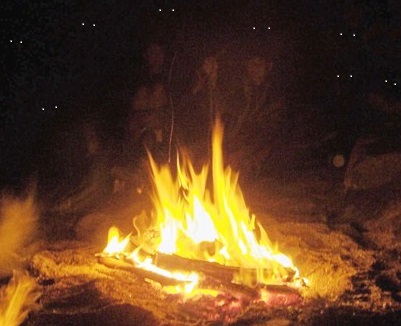
CampfireAlthough the basics of this plot seed are set in a western style play environment, GMs should feel free to adapt it to fit in any campaign they choose, as long as it would make sense for the player characters to spend an evening around an open fire telling stories, and trying to scare the snot out of each other.

For best results, give the players a week or so warning about what you’re planning on doing, to give them a chance to prepare some suitably spline chilling stories.

Cold nights always follow hot days in the back end of nowhere that is the frontier. It’s more than possible to cross three county lines without seeing another soul, or even knowing that you’ve done so. The loneliness can be deadly. Sure, it ain’t as immediate as a rattler bite or even the thirst, but it can turn a man’s head… funny. Company is a fine commodity this far out West. Not just for watching out for rustlers and bandits, scaring away varmints and keeping the cattle docile. Just having someone to talk to that isn’t the echoes of your own thoughts is essential. And come those damned cold evenings, around a campfire that’s starting to die down, with a hot coffee to keep the chill the fingers, it seems like such a good idea to tell each other stories, just something to wile the time away.

Scene setting can do you a lot of favours here, but sadly might not be possible depending where your group gets together to play. For full effect though, try as many of the following as possible:

  • Take the character sheets away from the players. This will be a purely story telling/narrative session. If they really do feel the need to skill check, keep their character sheets in front of you, and roll for them so as not to break to the flow.
  • As mentioned above, give the players warning that they should have a scary story ready for the telling.
  • Sit apart from the players, so the GM isn’t a presence around the table. I know this one seems strange, but it does work.
  • Kill as many other lights as possible. This is supposed to be a night in the middle of nowhere, far from artificial light. A lamp in the middle of the table to represent the fire should be enough. If you can get away with it though, a large plate covered with small candles is ideal, especially if they start to go out as you get closer to the end of the session…

With all that set up, allow the players to tell each other their stories. Feel free to interject at appropriate moments with sounds of the prairie to give them goose bumps. Let them take as long as they have to, and don’t worry if you end up running this over two sessions. It will seem like you have very little to do, but I’ve found I have a lot of fun with games that are driven by in character speech. Between stories allow a little bit of banter. If the players/characters are trying to lighten the mood, it just means that it’s working, and they’re trying their best to stop letting themselves get scared.

As the final player begins their story, it’s time for you to get involved again. With any luck the players will – by this point – by fully engrossed in another story, so give the final speaker a chance to hook everyone in. Then you should try and get a seat around the ‘fire’ with the other players. Don’t make a big deal out of it, in fact, try and do it without even speaking. From this point on, you’re playing a character yourself, and you want to take the party by surprise. Give the last person a moment or two after they’ve finished, then start talking…

I’ve never liked dogs. I wasn’t bit as a young ‘un you understand, there’s no reason for the unease, or least there weren’t until a couple of years ago. It was what I’ve heard called a irrational fear. All I had to hear was a growl or bark, and shivers would run right down my spine. I think I always knew that one day, from somewhere out o’ the blue, a dog was comin’ for me. 

It weren’t just one though. That night, walking outta town, back to my tent, I heard the growl, real low like… You know the sound, when the mutt ain’t just making the noise for somethin’ to do, but because he’s got himself riled up and is ready to go for the throat. Then ‘nother joined in, even deeper soundin’ if you believe such a thing were possible. Within seconds, I was sure I was surrounded, but I still tried to run. I ran until my lungs were a fire, and my legs heavier ‘n lead before I was brung down hard. 

I gotta tell you though, weren’t no pooch that I looked up that was sat bold as brass on my chest, no sirree, that big son of a bitch was wolf, and no mistaking it. How in the name of God it had gotten a pack of stray and mangy curs following it, I have no idea. But there they were, walking around me as I lay there, out of breath and out of luck. Now, you’re probably wondering how I survived such a thing, am I right? Well, what makes you think I did…[Or something very much like this; don’t feel like you have to read from it as a script, and put as much of your self into this story as you like]

At this point, you’ll want to turn off the light/blow out the last candles, and step back away from the group. Knowing where the light switch is or having some other form of illumination would be great right about now. The players will likely be confused, but should take it all as being in character and respond in the same way.

With no night vision left, they’ll have no chance to spot anything until they get the fire going again, so let them get that done first. They’ll be no sign of the mysterious story teller – in my head, he’s called Ash, but I’m not sure why – but surrounding the camp will be various canine tracks, as if the group has been surrounded by them, just outside of the light. At this point, you can take it a couple of ways depending on just how much supernatural you have in your game. Ash is either a conman and thief, who uses some trickery and misdirection to get the part spooked, then scares them more with his pack of trained dogs (and maybe other ways too, if you read to the bottom). Or just maybe, there’s something to his story after all, and the characters really should be careful around dogs…

Possible future plot threads.

  • Quite simply, just take any of the stories your players have told, and integrate elements of them into your story. This can either be supernaturally inspired – the stories brought to life by some malevolent entity – or just a conman with a neat bag of tricks, making sure as all hell that his marks are so terrified they’ll start to make mistakes. 

Orcish Revenge (steal this encounter)

The Setup

The PCs are traveling between towns, no big deal. It’s just a regular day, maybe it’s raining or snowing. Maybe the wind foreshadows some bad weather ahead. Maybe they’re just noticing that they haven’t seen the sun all day. Or, maybe it’s just a bright day and the butterflies are flying and the birds are chirping.

Things are just dandy until they run into a patch on the road that indicates a recent fight (Easy Spot DC). Blood splattered around, chunks of armor scattered about, torn clothing. What’s interesting, it appears to have been a fight between about five men against one (Medium/Easy whatever DC) Orc (Medium whatever DC). From that spot, a trail left by a wheeled device leads in the direction the PCs were headed, followed by five sets of footprints (Medium whatever DC) three of which were limping (Hard DC).

The Initiation

A short ways down the road trouble brews when a band of Orcs ambushes the PCs from behind rocks and bushes. At first with slings, but once the encounter becomes melee, they fight with powerful clubs and raw force of strength. They are enraged, stopping at nothing to slaughter the PCs, failure means death for either side in this encounter. It is known that Orcs will eat the flesh of their victims once they’ve been defeated, even cannibalizing their own kind.

This fight should be challenging, but not very difficult or overpowering. For a small group of 3-4 there should be one Orc for each member of the party and the Orcs should be tough, but not unbeatable in a 1-on-1 fight. Ganging up on an Orc should spell defeat for it.

For a larger group of 5-6 there should be one fewer Orc than party members (4-5) and the Orcs should be a bit tougher, almost unbeatable in a 1-on-1 fight. Ganging up on an Orc should be the key to victory.

The Orcs are not trained warriors and will not focus their attacks on any one PC. They will sometimes gang up and sometimes disperse, moving between targets before finishing any off. They are wild barbarians and should fight as such. Do not keep one Orc standing still, fighting one PC for the encounter.

Once the Orcs are defeated, there is little treasure to be found on their bodies. They had clubs and slings and their clothes. You can add a few trinkets if you wish.

The Climax

“Wow,” your players might think as their PCs continue their travels, “I wonder what provoked such a vicious attack.”

Try to disguise your manaical chuckling as they spot the final enraged Orc charging towards them from down the road, club in hand.

This should be another challenging fight, for it is against the chieftain of the Orcs. He wears a headdress and wields a heavy spiked club and wears tattered leather armor for protection. He should be a match for the PCs, even injured as he is, but shouldn’t be as difficult as the fight before.

Remember that his rage makes him agile and strong, he will get a number of initiatives equal to half the number of PCs, rounded down (4-5PCs=2 initiatives, 6PCs=3 initiatives). His hits should hurt to the point that a PC is afraid of being hit. He should also be able to withstand an assault of arrows and sling pellets from afar and a couple rounds of combat, but this fight should not drag on.

The Reward

Now, it is time for the PCs to be rewarded for their troubles. The Orc chief, when felled, will be carrying a powerful totem that grants him Strength or Speed or Toughness, something to explain his powerful combat prowess. It is also known that the chieftain’s headdress is a valuable prize.

Down the road, the PCs will find the result of another combat, similar to the marks on the patch of road from earlier, only this time there are the corpses of five of the city guard. One of which was a sergeant, as he was carrying his seal. The guards had some decent equipment, maybe better than the PCs. They also carried some gold. Beside them is a wrecked cage sitting on two wheels and made of iron. The sergeant is carrying a log detailing their tracking and live capture of the Orc chief, with plans to interrogate him as to the whereabouts of his tribe.

Bringing the sergeant’s seal to the lieutenant or captain or higher up of the guard will reward the PCs with a hefty sum of gold, showing the headdress will grant them even more rewards.

In Conclusion

This encounter is made as a simple replacement for a random encounter in your game, much like the Garrison Road Encounter. It’s a fun little sidetrack from your normal story or dungeon crawl. A simple distraction for a group craving some action.

The Friendly Bar Room Brawl

*Edit: This awesome encounter has been revised.
Go here to check it out!

How many times have you watched a bar room brawl on TV and thought, “Cool. Too bad it doesn’t happen like that in real life.”? Well, I usually say, “Cool. Too bad it doesn’t happen like that in RPGs.”

Now it does!

Introducing the Friendly Bar Room Brawl!

Use this encounter any time your players are in a bar, and you want some good old-fashioned fist fights (not the kind that can end in slit throats or explosive fireballs, but the kind that involves banging heads together and getting thrown out a window). In real life, bar room brawls are usually mean and dirty, and have the potential for serious injury or death. Not so with this encounter!

The setup:

  • The PCs need a distraction.
  • The PCs need to drink and relax.
  • The PCs need to drink and gain intel.
  • The PCs need to drink and gain friends.
  • The PCs need to advertise their presence.

The execution:

This is a semi-friendly fight. As soon as knives, guns, lasers, or fireballs come out to play, the fight either stops – or becomes a standard combat encounter. That’s up to the GM and players to decide, but hopefully it doesn’t come down to that.

  1. Each PC gets a turn (and only the PCs). The player makes a simple or basic unarmed attack (or simply strength, dexterity, or agility attacks).
  2. The difficulty for these attacks should be a fixed number, not individual NPC defenses. If the PCs are in way over their heads, they should expect to hit about 25% of the time. If they are even-matched, they should hit about 50% of the time. If the PCs are considered “heroes” or “experienced” when the NPCs are considered normal, the difficulty to hit should be reflected so that they hit around 75% of the time. Find the average of the party’s to-hit bonus to figure out what the DC is for everyone. This can (of course) be adjusted if most of the people in the bar don’t like the PCs. Personally, I like the idea that the PCs only hit about 50% of the time.
  3. On a player’s turn, he makes a single attack roll. If he succeeds, he rolls on the Success Table, and if he fails, he rolls on the Failure Table.
  4. Each player takes a turn, and then the round starts over (NPCs don’t make attack rolls).
  5. The brawl is over when the PCs rack up a total of 16 successes, or 16 failures (that seems like a good number). Regardless, the PCs are tired and battered, but have not sustained any permanent injuries. Any hit points (etc.) come back after a little bit of rest.

In the end, it is the PCs who get to determine the ramifications of the fight, depending on its outcome! Do the PCs end up drinking the night away with their new friends, or get tossed out on their butts? Do they succeed in distracting the guards guarding the upstairs? Have they made their presence known? Barring any game-breaking consequences, let the players decide what happens, regardless of how the fight ends. They’ll love it, and trust you more as a GM.

Success Table:

  1. The group gets their normal success, but the PC doesn’t do anything special.
  2. The group gets their normal success, but the PC doesn’t do anything special.
  3. The group gets their normal success, but the PC doesn’t do anything special.
  4. PC throws an NPC out the front door.
  5. PC blocks a hit for an NPC, and makes a friend!
  6. PC manages to take a swig of beer or ale.
  7. PC grabs two NPCs and bashes their heads together.
  8. PC splashes ale into an NPC’s face.
  9. PC smashes chair across back of NPC.
  10. PC smashes stool across back of NPC.
  11. PC throws an NPC out the window.
  12. PC throws an NPC over the bar.
  13. PC tosses NPC onto table, smashing it everywhere.
  14. PC smashes beer bottle or pitcher of ale over NPC’s head.
  15. PC manages to steal a kiss from a server.
  16. PC hops on table and jumps off, knocking several NPCs down.
  17. PC performs some uncharacteristically agile stunt. He looks like the ultimo badass.
  18. PC taunts the NPCs. They cower for a moment. Some leave.
  19. PC has the advantage. Next round, he gets to make two attacks.
  20. Somehow, the PC manages to knock out several NPCs (player must explain how). This counts as an additional success!

Failure Table:

  1. The PC gets thrown onto the bar, dragged the length of it, then launched off the end.
  2. PC gets kicked in the groin. Crumples like a rag doll.
  3. PC gets thrown out the front door.
  4. PC accidentally hits an ally (the player to the right).
  5. A flying chair soars across the room, smashing into a PC.
  6. The PC somehow gets pantsed.
  7. PC gets ale splashed into his face.
  8. PC gets a chair smashed across his back.
  9. PC gets a stool smashed across his back.
  10. PC gets thrown out a window.
  11. PC gets thrown over the bar.
  12. PC gets tossed onto a table, smashing it everywhere.
  13. PC gets beer bottle or pitcher of ale smashed over his head.
  14. PC is mocked like a pansy, making others laugh.
  15. A small person lands on the shoulders of a PC, and smacks the PC senseless, repeatedly.
  16. PC slips on ale, falling flat on his back. Yes, everyone saw.
  17. PC gets a black eye which will be with him for several days.
  18. PC gets a busted lip, which he’ll have for several days.
  19. PC is at a disadvantage. Next round, he must make two attacks, taking the worse result.
  20. Somehow, the PC manages to get knocked the F out (player must explain how). This counts as an additional failure. Next round, he’s back in the game.

Remember, regardless of who wins the brawl, it’s up to the PCs to determine the outcome. How do they end the night?

I got this idea from Sully over at Pack of Gnolls from this article. Thanks Sully!

Garrison Road (steal this encounter)

Garrison Road – trickling with bandits, and bordering well-known Orc tribes in the forest.  However, that is no issue for your PCs; they can most certainly handle themselves. Bandits? Ha! They laugh in the face of bandits, and Orcs exist for the sole purpose of sharpening your blades before taking on dragons, and your PCs know it. So, they decide to travel this perilous road, despite the many warnings of the dangers that lie ahead.

 Good.

 This is exactly what you want, because you know what is in store for them: a violent, bloody death. “Mwahahaha!” you shout as your players look warily in your direction. “Too late,” you whisper, “Down the road, you see a group of men: three wielding bows, one with a bastard sword and a light shield, and one with no visible weapon in sight. Each is dressed in various leathers and hides. They do not look friendly.”

As your players grab their dice and character sheets, readying themselves for the upcoming battle, you stop them, “They wish to make a bargain with you. A small toll. 100gp per head and you may pass peacefully. Do you accept their offer?”

PCs being what they are, you know the attempt at peaceful negotiation was pointless, but at least you can say with confidence that you gave them an out. You did not force them into their now-definite deaths. “Roll initiative!” you shout as you lay templates in front of you, ready to own some PC tail. The bandits, as you know, are motivated – not by murder, but by greed. They honestly only want the PCs’ money, and will take every opportunity to make off with it. Because of their lust for gold and silver, they have a few tricks up their sleeves: tangleroot sacks that hinder the PCs’ movements, and flashbangs to temporarily blind them. Using these tools, the bandits will attempt to cut at the purses on the PCs’ belts, and run away. Their lust, however, will not encourage them to fight to the death; they will quickly flee from a battle they are obviously losing.

“So elegant; so simple,” you whisper to yourself. You know that this battle will not end so easily. As the bandits flee in either success or defeat, they are stopped by large Orc warriors.

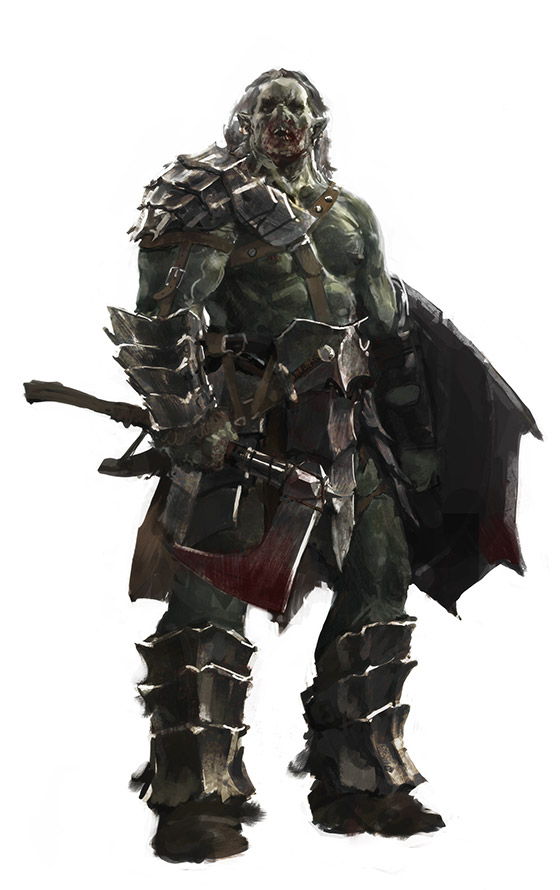
The largest Orc, with his face covered in decorative blue paint, smiles grimly at the group of humans he’s found himself facing. “Looks like we’ve found some fresh meat, boys.” His Orcish tongue is gruff and threatening, even if the PCs don’t understand a word of it.

The bandits turn to the PCs with desperation in their eyes. “We’re in this together,” they plead silently as Orcs surround the group.

A variety of Orcish warriors come into the field wielding bows, swords, flails and whatnot. What do the PCs do? Do they take this small window of opportunity to try to flee, knowing that the Orcs will be after them soon, or do they stay and fight back-to-back with the bandits, knowing the extra swords will greatly increase their chances?

If the PCs run, do not be afraid to split the Orcish warband up and send half after the group, or simply send the entire warband after the PCs a few minutes later, after having neatly sliced up the bandits. If the PCs choose to stay and fight, will the bandits be grateful enough to return the PCs’ gold, or will they try to run off with it when the opportunity presents itself? Orcish warriors are not afraid to fight to the death, but the bandits still are.

Solo Trap: Rolling Boulder Gauntlet (steal this encounter)

Oh darn…

Here’s another submission for Stuffer Shack – I guess it falls under Steal This Encounter. It’s a solo trap that I ran with great success in my own campaign.

To make the best use of this encounter, it is being presented as a PDF.  There’s a lot of good info to help run this trap, including use of several obstacle/hazard stat blocks, and even a record of how this played out in testing.

Enjoy!

Download the PDF: Rolling Boulder Gauntlet

Negotiations at the Temple of Blood – Steal this Encounter

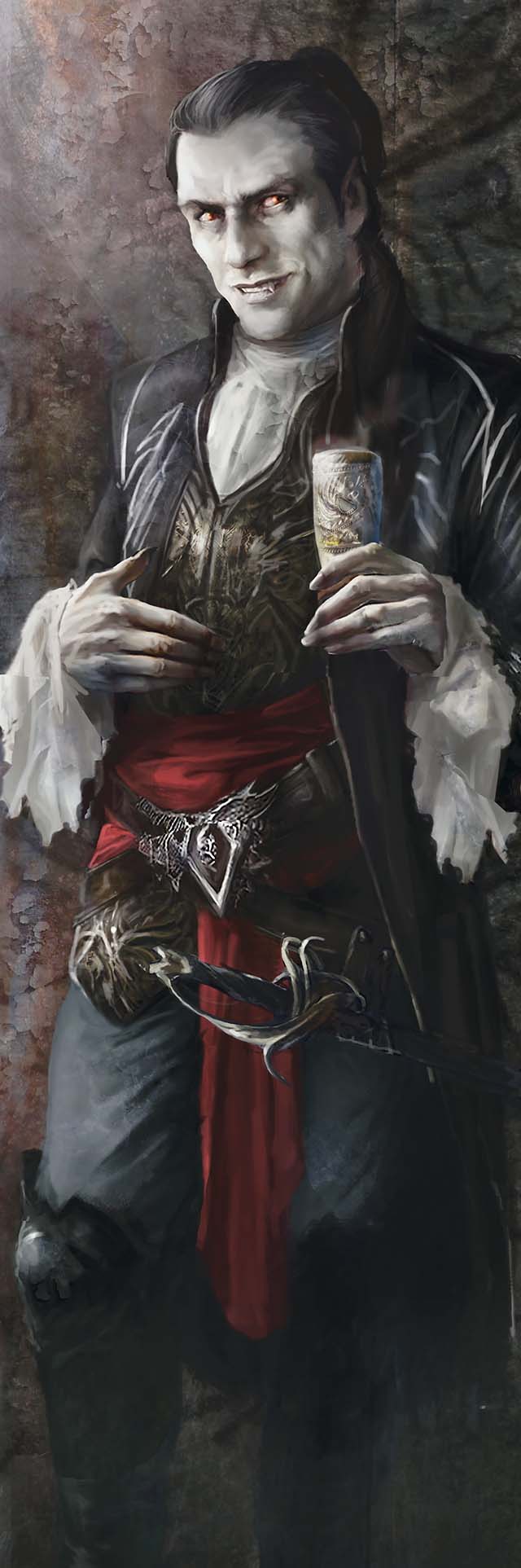
In an abandoned village, off a road rarely traveled, rests a temple forgotten by all but a select few. The temple was once a place dedicated to the gods of good and protection, and in such a small community, it served as the center of daily life. These days it only sees activity two nights a month. That is when the vampire lord Andragen conducts business.

Negotiations at the Temple of Blood is a level 22 encounter for D&D, 4th Edition. It includes a map, a skill challenge, and a brand new solo monster. It was originally submitted to A Walk in the Dark as part of their solo contest series. While I didn’t take home the prize, I hope you still find use for it in your game. It has been edited from its original submitted version with two new optional rules, which I believe should make the encounter more dynamic.

You can download the encounter here.

Minion Madness – Steal this Snake Trap

By Alton, from 20ft Radius.

Traps have always intrigued me.  From Indiana Jones to Gilligan’s Island, and from SAW to Star Wars, traps have always been sources of conflict to entertain the audience.  What better way to create suspense than to place the characters from a book, movie, or even television into a situation, and to watch how they manage to get themselves out of it?

Through all the editions of Dungeons & Dragons, traps have always had a role of either hampering or just plain decimating characters.

The trap that always comes to mind when I think about them is the Snake Trap in Indiana Jones and The Raiders of the Lost Ark.  Since it is ‘Snake Week’ here at Stuffer Shack, I have chosen to create this trap to reflect the theme. It can also be modified and inserted into any campaign, and to be used in probably any situation with little to no modifications.

Click to make bigger!

Imagine walking down a corridor in search of the answer to the plague that is decimating your home town.  You have traced the plague’s origin to the Temple of Zehir in the valley of the Forgotten Fang, a string of mountains that look like snake’s fangs  – also known for harbouring the temple’s cultists.  The party is exploring passageways, and ends up in a room with a large burning brazier sitting in the middle of the room.  An altar on the other side depicts scenes of snakes being killed and placed in a container, partisans being swallowed whole by some large anaconda, and priests of some good deity being crushed by giant constrictors.

________________

Chris has been inviting me to write for the site, but I guess you can say I am a little keyboard shy. Fortunately for him, he rolled a critical diplomacy check and managed to twist my virtual arm and has challenged me to put on paper what I have been putting off for years.  I am testing my mettle today and will see if his confidence is warranted.  Enjoy the read!

Countryside Barn – Steal this Encounter

In the hamlets surrounding most major population centers, farmers and ranchers eke out a meager existence, growing all manner of crops and raising livestock. But outside city walls, law enforcement isn’t present, and often skirmishes can break out in the least likely of places.

Hooks: Perhaps the party arranges to meet in the barn as neutral ground. Perhaps a ranch hand is involved in something nefarious. Or maybe the party has simply negotiated with the landowner to stay in the barn overnight, and finds themselves subject to a midnight ambush. To allow for flexibility in this encounter, there is a level 3 version, a level 6 version, and a level 9 version. All assume that there are five characters in the party.

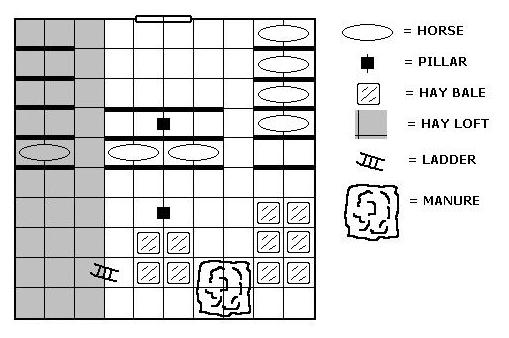
Loft:
Above the stables, a small loft near the barn’s roof allows for extra storage.
The westernmost three squares are shaded to indicate that a second level exists. This area is accessible via the ladder. Climbing the ladder requires no Athletics check, but it does require an extra three squares of movement, and anyone who ends a turn on the ladder grants combat advantage to any attackers as long as he remains on the ladder. The loft is ten feet high, and characters on the loft may attack characters below using ranged attacks.

Manure:
A thin coating of manure stains the barn floor from when the stable boy last mucked out the horses’ stables.
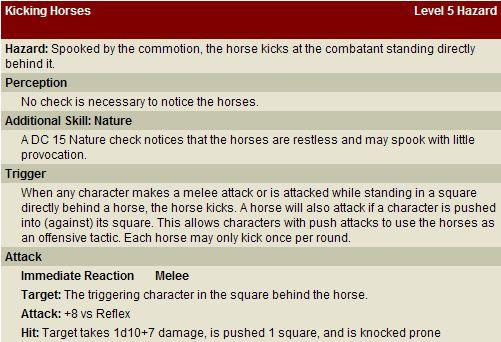
The manure pile is challenging terrain. Characters who enter a manure square must check Acrobatics DC 15 or slip and fall prone.

Hay Bales:
A large bale of hay stands in the barn, still green and bound together for easy transport.
The hay bales provide cover to anyone standing behind them. Taking a minor action to kick a hay bale (Athletics check DC 15) will reduce the hay to difficult terrain.

Pillars:
A thick wooden post supports the barn’s ceiling.
The pillar stands in two separate squares. It acts as cover, and characters must use a squeeze action to pass through a square containing a pillar.

Level 3 encounter
Enemies: Goblin Hexer, 2 Goblin Skullcleavers, 3 Goblin Warriors
Tactics: While the skullcleavers rush forward heedlessly, the hexer immediately tries his stinging hex on a strong melee character. If it hits, he orders everyone away from that character. If possible, he’ll use his Incite Bravery power to do so. This tactic can be repeated as often as the hexer’s stinging hex recharges. Once a battle line forms, the hexer will use his vexing cloud for concealment and stay near the skullcleavers so as to use Lead from the Rear. One of the goblin warriors will climb up to the loft and throw javelins while the others dance in and out of the vexing cloud using Mobile Ranged Attack to avoid the cloud’s attack penalties while retaining its cover.

Level 6 encounter
Enemies: 2 Ghouls, 2 Chillborn Zombies, 2 Corruption Corpses
Tactics: The corruption corpses will try to remain behind stalls, pillars, or bales of hay while throwing their necrotic matter at characters. The chillborn zombies do extra cold damage to any characters immobilized by the ghouls, so they stay close. All of the undead will remain completely oblivious to the danger posed by the horses until kicked.

Level 9 encounter
Enemies: Eladrin Twilight Encanter, 3 Eladrin Fey Knights, 2 Quickling Runners
Tactics: The Fey Knights issue their Feywild Challenges and the Twilight Encanter does his best to keep the targets of the Feywild Challenges from attacking the knights using Binding Bolts and Teleporting Bolts. If forced into melee, the Encanter uses his Dazzling Blast to escape. At first opportunity, he makes his way onto the hay loft or kicks out the easternmost hay bales to hide behind the second row of hay as he fights. If he can make it onto the hayloft, he can teleport anyone who follows him back to ground level. The Quickling Runners make their way immediately to the weakest characters using Quick Cuts. Note that all the fey can score critical hits on a roll of 19 due to the Fey Knights’ Feywild Tactics ability.

Written by Greg Howley, from greghowley.com

Ambush on the Old Marsh Road – Steal this Encounter

This is a level 7 encounter for five players.

Background: It’s no secret how the Old Marsh Road got its name. The Sulkpeel Swamp has always posed a threat to travelers, and the practice of going around it to get to the next major city soon created an easily followed path. As time progressed, some people settled along the road, offering beds to travelers and gathering herbs and reagents from the surrounding area to sell.

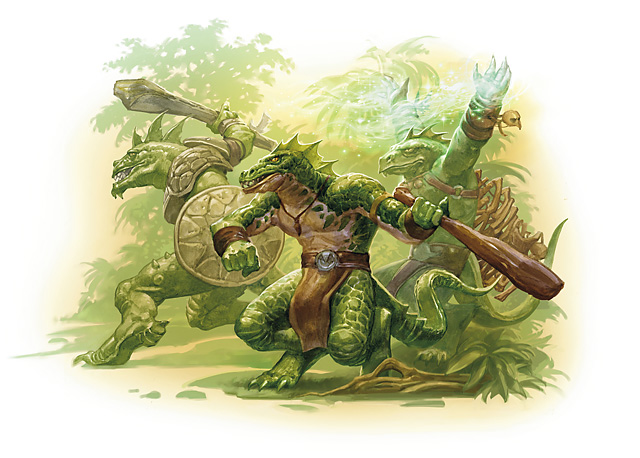
In more recent years, life has gotten harder outside of city walls. Acts of theft, violence, and the encroaching presence of the Speartooth Lizardfolk Tribe has driven out most of the road’s inhabitants, though many merchant still walk its path.

Enemies: The Speartooth Lizardfolk Tribe has set an ambush hoping to catch merchants. A group of adventurers, sporting potentially magic items, will substitute just fine.

Setup: The players could be traversing the road for any number of reasons, whether they are investigating the Speartooth’s reported movements, or just trying to get to the next town or dungeon. I suggest starting the players at the bottom of the map on the road. If your players don’t tend to seek out structural advantages, you could alternatively place them at the top of the map, so they are more likely to discover the temple’s secrets.

Place the Lizardfolk in the swamp, separated into two groups – one near the center and the other at the opposite end of the map from the players. The Warriors and Marsh Mystic can be discovered with a DC 16 Perception Check. The Darters and Tribal Fury require a DC 23 Perception Check. Any enemies not discovered should be given a surprise round.

Features: Marsh: Blue squares represent marsh terrain. These squares are two to five feet of still water on top of loose mud. Each square is difficult terrain. Small characters in Marsh Squares receive cover.

Characters in a Marsh Square can make a Stealth check by submerging themselves under water. Being submerged in the murky waters blocks line of sight, but not line of effect. Characters who are stealthed in this way must make checks to avoid suffocation while stealthed (DMG 159).

Boulders: The two boulders in the bottom right of the map are three squares tall. They block line of sight and provide superior cover. It takes a DC 12 Athletics Check to climb the boulder. Ranged attacks get a +1 to hit from on top of the boulder.

Makeshift Temple: In the top right of the map stands the remains of a one room house, now abandoned. Bits of the wall have broken away and the thatched roof is no more. Someone has converted the old home into a temple of Avandra (substitute any god of Travel).

Religion 11: This once home is now giving off a faint pulse of divine energy related to the goddess Avandra. The crudely carved symbols on the wall seem to relate primarily to her dominion over travel. The stone table, pushed into the center of the room, obviously some kind of makeshift altar.

Religion 16: The runes in this room send pulses of energy from the Feywild to speed the occupants’ step, increasing people’s ability to move with great care (reveal benefit below).

Any creature that starts its turn within the temple walls has the ability to shift one additional square whenever using a power or ability that allows them to shift.

Temple Walls: The walls are 2 squares tall and require a DC 16 Athletics Check to climb. The top of the wall is difficult terrain that requires a DC 11 Acrobatics check to move across.

Altar: The altar in the center of the room may look like little more than a stone table. The above Religion check reveals its true purpose, but not its bonuses. Moving onto the altar in the center of the room requires 2 squares of movement. Attacks from atop the altar gain a +1 to hit, and any divine powers do an additional +2 damage on a hit.

Door: The wooden door of the temple is reinforced with iron, and its lock is rusted shut. It takes a DC 20 Strength check to break down.

Enemy Tactics: The Lizardfolk attack without warning, hoping to take the party by surprise. The Warriors and Tribal Fury move quickly into melee, trying to establish flanking and keep the focus on them. The Darters and Marsh Mystic stay in the swamp for as long as they can keep Line of Sight with the PCs, trying to lure any who break away from melee into the slowing waters.  If a darter becomes the target of ranged attacks, it will submerge and find a new position before attacking again.

The Lizardfolk know the temple well, though they did not create it. If drawn in by the PCs, or if they manage to back the PCs in, they will immediately make use of the benefit, shifting two squares with a move action instead of the usual one. A DC 16 Nature Check will reveal that this is not a natural ability of the Lizardfolk, but they are under some kind of effect.

Once the Marsh Mystic and Tribal Fury are out of the fight, the others will flee if bloodied or intimidated. If the Tribal Fury falls before the Mystic, and the fight is not going well, the Mystic will begin to bargain with the adventurers, offering a truce at first, and bartering information (while still fighting) if it does not feel it can retreat safely.

Alternatively, the Lizardfolk are really just looking for wealth. Players who entice the Lizardfolk with opportunities of further gains, might be able to turn the combat into a skill challenge.

Hooks: The Speartooth Lizardfolk have seen more than one ambush before the PCs. Their loot may contain clues of former victims as well as possessions that may be rewarded if returned.

Further in the swamp, more Lizardfolk reside. When they find out of the slaughter of their hunters they will regroup and may begin to attack the closest villages directly.

The traveling cleric who created the temple to Avandra left clues to find another. Following his path takes the players on a twisting journey into the world of this goddess who is worshiped on the outskirts of man.

Notes: Should the party sleep in the temple, increase their distance traveled on the next day by 50%.

To download the full-sized version of the map click here. To download the same map with labeled grid for online play click here.

This map was built on a 20 x 30 grid to be drawn easily on a Paizo Flip Mat.

Previous Article in Series: King Lizard