Confessions of a Kickstarter Junkie: February’s Roundup

Here are a few kick-starters that I’m backing and that you might want to check out:

be57d701f2ed230262f192f6ba3392da_originalWilderness Adventures 28mm Scale Fantasy Gaming Terrain (ends Feb 23)

I love Fat Dragon Games’ stuff and have backed their kickstarters in the past. This one is for a whole lot of 3D outdoor terrain for your game. For just $60, you can get deserts, swamps, highlands, woodlands, forest ruins, a sphinx, a goblin camp, a volcano, a campsite, tents, tree creatures, a wagon, sci fi textures, a desert oasis, swamp tentacle monster, dragon turtle, dice tower and more as further stretch goals are reached. These pieces will definitely be hitting my game table in the future.

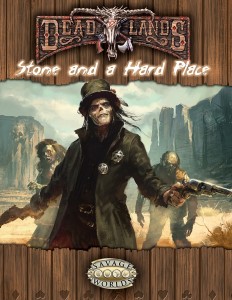
4e7b77ade00c11ccc1c13b87e0b7a8d4_originalDeadlands: Stone and a Hard Place (ends March 5)

This is the third Deadlands Reloaded Plot Point campaign. While it looks pretty cool, I’m more interested in the extras that I could add to my existing game. Pinnacle’s kickstarters are always great deals and should be snapped up when you can. For $20, you get a pdf of the campaign book, which includes expanded rules on playing Harrowed characters as well as the following digital stretch goals: enlarged maps of Tombstone, Tucson and Cochise County, an extra adventure featuring Stone and the Cackler, figure flats pdf and most importantly for me, scaled combat maps of Western buildings and key locations from the plot point campaigns. A great deal, don’t miss it!

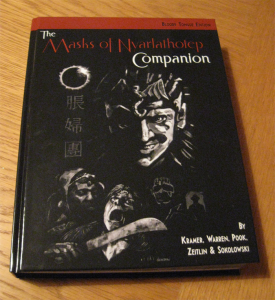
6f0f678bdb53eaafff9e2460bf2fd662_originalMasks of Nyarlathotep Companion for Call of Cthulhu (ends March 10)

If you’re planning on ever running the most famous Call of Cthulhu adventure of all time, this is the kickstarter for you. Well, the second one. The first would have been the Masks of Nyarlathotep Prop Set, but that one is over now. This one is for a comprehensive guide to help you run that amazing campaign and I am very much looking forward to doing just that later this year when I get the finished Companion and Prop Set.

81ad45a18119c156b722bc9f2655e4fb_originalGhostbusters: The Board Game (ends March 11)

This one is not strictly a tabletop RPG, as it’s a board game, but maybe you’re like me and are always on the look out for good miniatures and maps for your games. Particularly ones for rare categories. In this case, I’m excited to see some intriguing minis for this board game that would be great props for running InSpectres  (a ghostbusting RPG). This one is expensive though, with a pledge of at least $80 to get the game and stretch goals. For $125, you can get some extra stuff, like more game tiles and… the super-sized Stay Puft Marshmallow Man! I skipped the Conan blockbuster, but this one has some great minis that would be good for other horror settings as well. I love that they describe them as 28mm scale minis, obviously realizing that the RPG gamer market is keen on minis.

Honourable Mentions

I’m not backing these (yet), but caught my eye:

Dungeon Worlds (ends March 4)

Not to be confused with Dungeon World the RPG, this is durable urethane plastic 28mm terrain. It’s pretty affordable with a starting pledge of $50 for fifty pieces, but you need to pledge at least $100 to get the stretch goals. It looks good and has many interesting pieces, but I’ve already invested heavily in Dwarven Forge and prefer buying my terrain pre-painted where possible. Still, very cool pieces.

Time Cellist (ends March 7)

This time-travelling game was created by a couple of the hosts (Megan Pederson and Todd Nicholas) of the Jank Cast Podcast (a round table discussion podcast about gaming). It focuses on kids stopping an evil villain from taking over the world with help from the Time Cellist. I find the concept of the game mechanics (rock/paper/scissors & other kids games) very intriguing, but I’m not big into time travel games, the last one I bought was Pacesetter’s Timemaster back in 1985. Nevertheless, I do like their podcast and would like to see the rules. Just $5 gets you a pdf of the rules, so I’ll likely cave on this one. As an aside, up until the kickstarter, every time they talked about the game on their podcast I thought I heard them say “Time Chalice” and developed a very different concept of the game in my mind. Now, the Cellist seems odd to me.

Packs! A Fluffy Horror RPG for Savage Worlds (ends March 11)

Finally, what we’ve all been waiting for, an RPG where you play rats! I guess MouseGuard wasn’t enough for the rodent RPG field, now there’s a dark Savage Worlds option for all you furry aficionados. I’ll stick with MouseGuard personally, but you might want to be a rat. And it is Savage Worlds, so the temptation is always there for me.

Tavern Dungeon Decor 28mm Miniature Scenery Terrain (ends March 31)

I like the look of this and I always love more dungeon terrain, but between Reaper’s kickstarter and a few other terrain ones, I have more than enough tavern decor. It’s a bit of a saturated market for anyone who’s been following the dungeon dressing for a while. This set is pretty cool, and the price is right ($35) if you’re looking for such stuff.


If you’re backing something cool on kickstarter or have your own kickstarter that you think we should check out, let us know!

Gaming Life: Return to War of the Dead Campaign Session 2 – Into the Fire

My Savage Worlds War of the Dead campaign has returned to the gaming table. Please find Session 1 here.

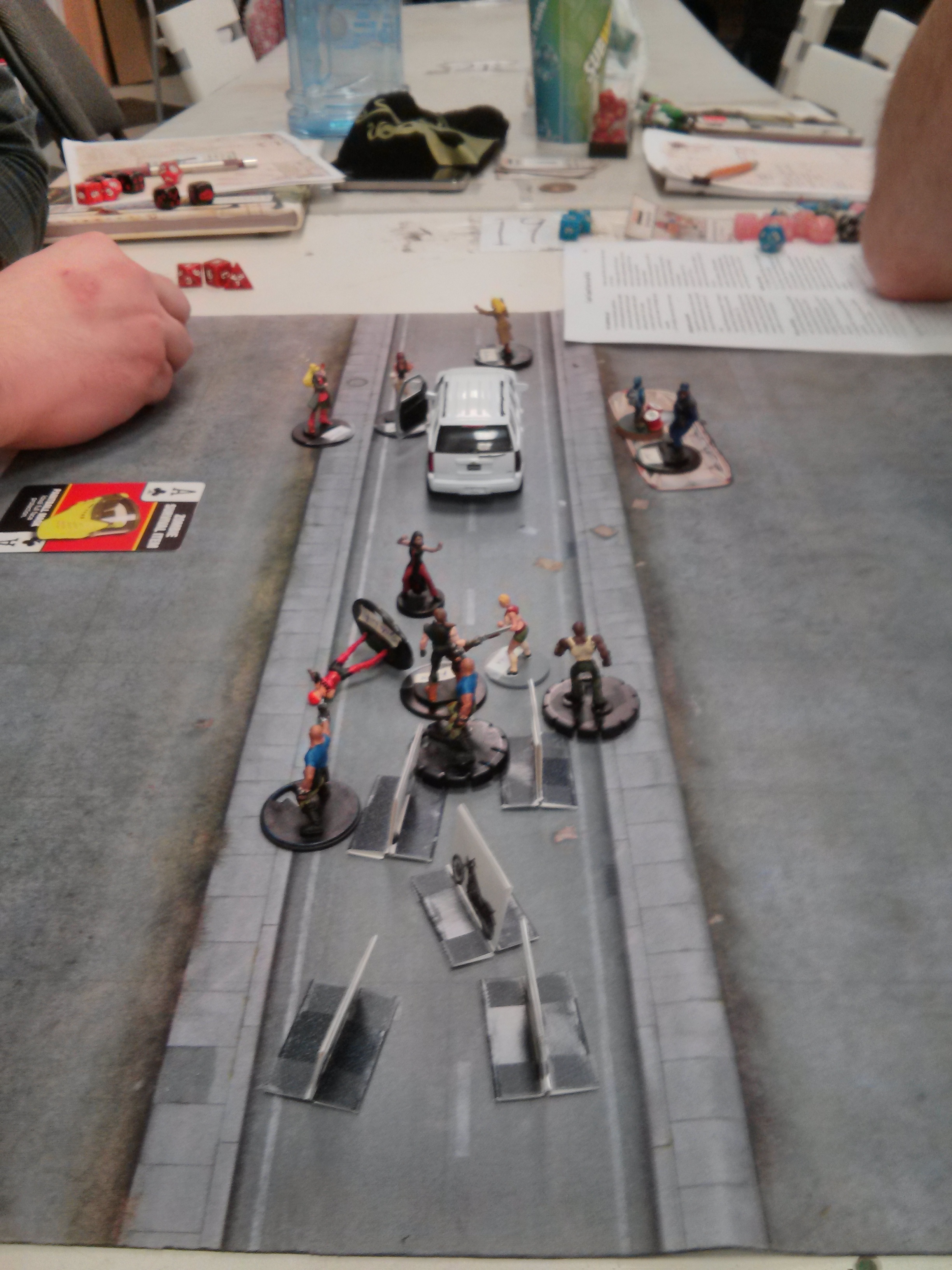
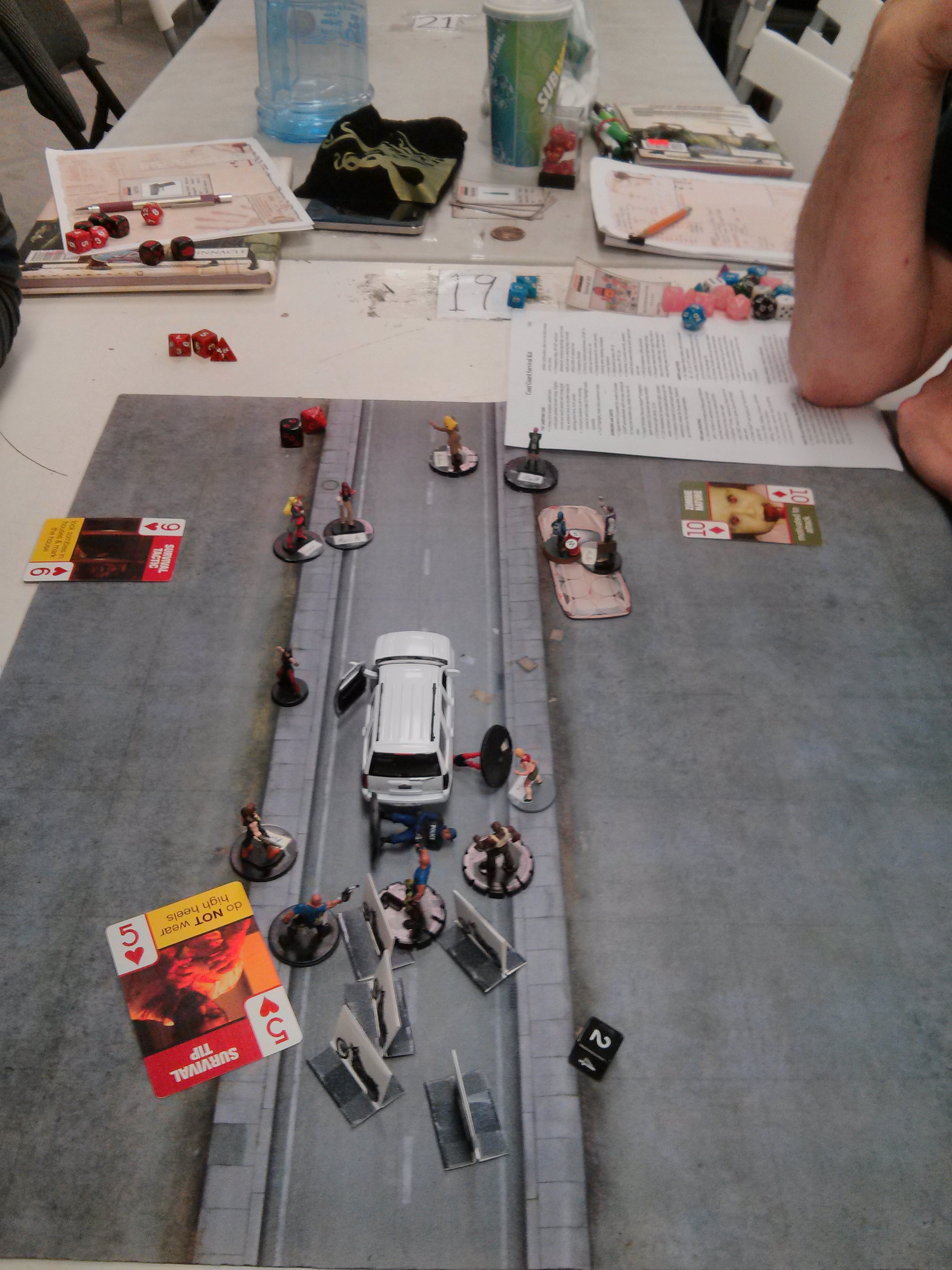
Our second session begins with the helicopter trying to make it to Atlanta, but running out of fuel over Augusta, Georgia and as the try to land in an industrial area, they hit some power lines and the helicopter goes in hard, spinning and landing on it’s side, warning sirens sounding and smoke filling the cabin. Outside, they can see figures moving.

IMG_20150205_175803

This started the night with a great mad scramble of the PCs trying to escape the burning helicopter with their children and the wounded/unconscious Coast Guard crew and avoiding the zombies who were congregating on this burning wreck. This race to escape was coupled with wanting to loot whatever they could from inside the helicopter and rescue their unconscious children and the unconscious crew. It was an intense start to the game. 

Unfortunately, one of the PC’s children pulled from the helicopter was eaten as the group tried to hold off the zombies, and another of the PCs got  greedy and just barely escaped the brunt of the inevitable explosion of the helicopter three rounds into the session, only to be knocked in the opposite direction from everyone else. But, what could possibly go wrong with being alone? She struggled from building to building as zombies kept amassing around her, finally managing to climb up a dumpster/fire escape onto the roof of a neighbouring building.

IMG_20150205_182848

The rest of the group made their way into one of the buildings, holing up for a bit to catch their breath while zombies pounded on the door. They noticed the place had already been looted. Escaping onto the roof, they saw the looter, a survivalist who is making it for his SUV at the end of the street.

While trying to get to him, the kid (grandkid of one of the PCs) who is extremely lucky and agile attempted running across some pipes between buildings. He figured, worst case scenario, he uses a couple Bennies and makes it faster than anyone else. Unfortunately for him, he rolled double 1’s (no Bennies allowed for double 1’s) and fell three stories, suffering three wounds and even worse injuries to his pride.

IMG_20150205_193503

They managed to rescue the kid and everyone reached the SUV, speeding out with any more casualties. Shortly into their journey though, they decided to ditch the survivalist, shooting him in the leg first (even these loved ones can be murder hoboes!). This was a strange event in the adventure, but players do always surprise. You can be sure he will show up again.

On the road again headed toward Atlanta, they finally had time to find out what was happening from the FBI agent and CDC Tech who had come to rescue them in the Coast Guard helicopter.

She explained that she was tracking down patient zero who was on the cruise ship and had stolen a virus from UniMed labs. Their loved ones (the main PCs) were picked up by the Coast Guard and taken to the Centre for Disease Control (CDC) HQ in Atlanta, but they’re not talking about what they know until their loved ones are brought to them. This is why the FBI agent came to get them on the boat, and she needs to get them to Atlanta so that she can find out what the (main PCs) know. In fact, the main PCs do have crucial information on the source of the outbreak, so this all does make sense.

Their next bad luck happened when the SUV broke down on the highway, only to have a gang of bikers show up and try to rob them. (The bikers were taken entirely from War of the Dead, I only added that one of the PC’s husband served time with the gang leader, so they knew each other – fitting with the fact that the husband is wanted dead by this gang!)

IMG_20150205_202246

Just as things were getting tense and combat was imminent, the quick-thinking kid sitting in the SUV (which was just repaired) decided to take matters into his own hands and took to the wheel and slammed on the gas in reverse(!), running over the gang leader’s girlfriend and scattering the rest of the gang members. After a quick firefight, the gang leader and one of his thugs escaped on their bikes, and the PCs had scored a few new motorcycles and some extra guns.

IMG_20150205_202506

It was a very intense evening! I was worried playing the PCs’ loved ones might not be as much fun, but the wives and children are proving to be some very interesting characters and the players all had a great time.

For this session’s game I again used many Heroclix figures and 1:43 scale vehicles.

The map for the first encounter is the City Slums from Dramascape. The second is a game mat from the Mars Attacks! miniatures game.

Finally of course, I use the markers from Stuffer Shack for noting shaken, wounds and multiples of characters.

How RPGs Helped Me Land My New Job

Job interviews are tough, but thanks to some transferable GMing skills I was able to land my new job…

ImproviseIt’s an unfortunate fact, but being a game designer doesn’t always pay the bills. In fact, it doesn’t pay many bills other than the dinner bill a few times per month, in some cases. With a brand new baby and mounting monthly expenses, I recently found myself in need of a day job. I found a position at a cal center for a major American bank, and with reluctance submitted my first resume in several years.

Three weeks later, I showed up for my first day of training.

I couldn’t believe how smooth this process went compared to the last day job I took, starting about seven years ago. Back then, I was nervous, with sweaty palms and flush cheeks, and I took my job offer to mean that the company would hire pretty much anyone with a pulse. I didn’t interview well in the past, and I couldn’t help but wonder what changed this time.

I was still nervous this time, but before the interview I kept reminding myself that I just needed to improvise. My only goal was to respond to my interviewers’ questions with all of the confidence of a GM being interrogated by his players. When the interview began, I did just that. Every time the interviewers asked a question, I put on my GM hat and pulled something out of thin air. It was like magic.

Seven years ago, my GMing experience was limited. I had run only a few games for a small group of players. Since then, I’ve designed multiple games and run many successful campaigns. And every time I act as GM, I improvise.

I’m one of those GMs who doesn’t like to spend a lot of time prepping for his sessions. I even wrote a series about Off the Cuff GMing on my own blog. Over time, I’ve learned that I developed a real skill for coming up with answers to questions and solutions to problems without much prep time. The way I see it, if my players have to respond to my lead without time to prep, I can respond to theirs. Who would have known Off the Cuff GMing was a transferable skill?

The funny thing is, it wasn’t this skill that I expected to come in so handy during the interview process. The position I applied for was a customer service position wit a pretty strong focus on sales, so I expected some of my recent RPG work to come in more handy. On my resume, I proudly listed “Marketing Manager, Third Eye Games” and “Sole Proprietor, Accessible Games” among my job history. I tried to talk up the fact that I’ve been into marketing various pieces of work–my own and other peoples–and that I interact with customers regularly.

None of that mattered much to these interviewers. Because neither of these jobs had structured sales goals, these call center-focused managers didn’t care to hear about them; if I didn’t have someone else setting measurable goals for me, they didn’t want to hear about it.

Thankfully, I was able to improvise. My previous customer service job from seven years ago came in handy. It gave me all of the experience they were looking for, but it was my ability to think on the fly and come up with examples from that job which really saved my bacon. I truthfully had prepared (inasmuch as I do prepare) to answer questions about my recent work, but I wound up having to improvis with responses about my past, less impressive qualifications.

The point being, it’s these last several years of GMing RPGs that gave me the confidence in my ability to improvise which helped me land the job. Without those skills, this interview would have been a total bust.

So the next time you find yourself looking for work and dreading the interview process, just remember to stay cool and try to wing it. You can’t prepare for every situation, so you might as well prepare to improvise. And if that’s not a talent you have just yet, then get out there and GM a few games. Your future self will thank you.

Fourth Edition, and Why We Can’t Have Nice Things

While every version of every roleplaying game has its detractors, it’s hard to avoid the perception that in the case of the Fourth Edition of Dungeons & Dragons, the detractors have effectively won…

yet againWhile every version of every roleplaying game has its detractors, it’s hard to avoid the perception that in the case of the Fourth Edition of Dungeons & Dragons, the detractors have effectively won. Fifth Edition may make a few nods to its immediate predecessor here and there but is clearly built along retro lines, and what laughably passes for the gaming press has by and large embraced the narrative that Fourth Edition was a horrible failure and a betrayal of the “real” D&D, which was thankfully kept alive by the traditionalists at Paizo. But this narrative leaves out an entire swathe of gamers, both those who liked Fourth Edition well enough and those who actually preferred it to earlier editions (and to what Wizards is offering now).  For people like me, it’s about time our side of the narrative was aired.

When Fourth Edition was being released I was not immediately on board. I had finished a reasonably long 3.5 game, enjoyed it well enough, and was generally in the mood for other genres and other systems and never keeping track of Armor Check penalties again. But what I saw I liked, and when I did take the plunge I found a game that felt fresh and streamlined, still crunchy but not obsessed with detail, and which gave many classes options I hadn’t considered before. The more I dug into it the more I grew to appreciate its bold tweaking of the familiar to get at what the essence of D&D was; heroic fantasy adventure in dark and dangerous places full of horrible monsters and piles of gold coins.

Which is why it’s been so damned disheartening to see the game and its ideas cast aside so thoughtlessly. It’s not a perfect game; it’s much more complex than it needs to be, combats take too long, and there are too many damned feats. But instead of being lambasted for its actual flaws, the game was called on the carpet for changing too many of the surface features of D&D- pure “Vancian” casting, the Great Wheel, Gnomes in the core Player’s Handbook, etc. The design of D&D’s Fifth Edition quickly became about resurrecting these sacred cows, asserting with a near-religious fervor that without all these familiar surface details the game could only be an impostor.

But something more vital is being lost here. What made 4e work as well as it did was that it was largely built from the ground up, with a commitment to balance. All the classes were roughly equal, all capable of unique contributions in and out of combat, and with this balance came freedom. There was no longer a Linear Fighter, Quadratic Wizard problem, no CoDzilla or caster supremacy of any sort. A commitment to tight math on both sides of the DM screen made encounter-building substantially easier and made the rules as a whole much more transparent.

And for some reason this is what is slipping from us. Of the major heroic fantasy games on the market now, none has 4e’s commitment to tight design. 13th Age makes many concessions to tradition, Pathfinder can’t drift too far from 3.5 for fear of losing its fan-base, and D&D Next has explicitly been put together through “feel”, throwing together familiar elements first and figuring out how they’re supposed to work together after. Game designers don’t seem to talk much about balance anymore, nor is anyone rushing to replace 4e’s rich tactical options. Because elements of the fan-base disliked how 4e balanced classes and options, balance itself became the enemy. Or, at least, something not to put too much effort into.

I know I can’t be the only one who likes being able to pick out options that fit a character concept without worrying about accidentally building an incompetent PC. I can’t be the only one who likes the security of building an encounter knowing that if there’s a TPK, it’ll be because I was actually trying for it and not because I forgot to note a creature’s DR 10/cold iron. I can’t be the only one who likes to have a system that just works.

And that’s why I come to praise 4e rather than bury it. Because the hobby needs good design; it needs to value balance and the freedom it brings. Designers ought to be encouraged to think hard about the numbers they give to things, rather than going with what seems like a good idea at the time. It’s true that a great GM can make any system sing, but we’re not all great GMs, and GM skills are learned, not inborn.

Mostly, though, I praise 4e because it’s a damn good game. Great works have often been misunderstood or rejected, and we should celebrate them rather than bow to the will of the masses. If the Fourth Edition of Dungeons and Dragons is a failure, it’s one worth classing with D. W. Griffith’s Intolerance, Jack Kirby’s Fourth World comics, and Arrested Development. Sometimes the losing side isn’t the worst place to be.

Conventionally Speaking, Part 2

As I mentioned in Part 1, I had never really played any of these games, and I loved them all. I say “never really played” because I had already dipped my toe into the D&D Next waters, and had, along with countless other gamers, submitted one or two opinions on the whole endeavor…

ConnectiCon Introduction
As it happens, it’s a lot easier to drone on and on about the logistics of a convention (see Conventionally Speaking, Part 1) than the games you play at a convention. At least, it’s easier for me. In Part 1, all I had to do was tell you what happened: how I got there, what I saw, what it was like. All of that is extremely subjective, and I can be wildly inaccurate while servicing the needs of the narrative. Nobody can say, “That’s not what really happened!” or “That’s not the order it happened in!”, since nobody was there experiencing it from my point of view.

But now I want to talk about the games I actually played in, games with rules, rules that you people can look up and say, “No, you’re wrong, that’s not the way this game works!” It’s far too easy to share way too much about the game (“Drogonilithuz Smorgle-Borgle, a Zed-Alpha level half-troll splatterpunk elementalyte, played by Ernest K. Bindlehopper, a 26-year old database modulator who was sitting on my right, picked up his scarlet 30-sided dice, shook it four times, rolled a 13, applied his Specialty Convergence, his Tantric Positioning, and his Mortgage Prime Rating, for a total of 27.459, and compared that against the rigger pirate clown clone’s Life Protection Soaking Score, adjusted for the heights of all players at the table, and then…”), or share way too little (“Played cool game it was good I liked it”).

Confronted with these daunting challenges, I elected not to do anything, and time passed and Editor-in-Chief Mr. Chris seethed and silently plotted my death. Unfortunately, my strategy of inaction didn’t make the writing job any easier or more finished, so I’ve elected to apply Nose A to Grindstone B and just write the bloody article. We’ll see if that works.

[editor’s note: Mr. Chris was not seething; he was waiting with +5 patience…]

What Dice Do I Roll?
As I mentioned in Part 1, I had never really played any of these games, and I loved them all. I say “never really played” because I had already dipped my toe into the D&D Next waters, and had, along with countless other gamers, submitted one or two opinions on the whole endeavor. Of course, this was before its Creators had received, processed, and instituted those opinions, resulting in many, many changes to the system. This was my first time playing the fer-realz D&D 5E, which meant that this particular savant (who had been playing Dungeons & Dragons since puberty) was transformed into a total noob, with no clear idea of what was going on, in this or any of the games.

My befuddlement can’t be blamed on the game systems or the Game Masters or the other players or the convention setting or the dice I rolled or even the chair I was sitting in. The reason I never knew what was going on is entirely my own fault. I have grown complacent in my RPG life, resistant to new systems for the single simple sin of being new. Instead of coming to any of these tables with a freshly formatted brain, I tend to view every game through the cloudy filter of GAMES-I-ALREADY-KNOW. This has proven to be a severe disability with every new game I’ve played, including the games below and my other forays into Shadowrun, Call of Cthulhu, Savage Worlds, Eclipse Phase, and Death Race Z.

The Games in Common
As different as my three convention games were constructed, there were a few notable and delightful similarities. First of all, there was nary a grid to be found in any of the three. I have been spoiled / ruined by 1” square battle maps, leaving my “theater of the mind” abandoned, rundown, and very dusty. I had actually come to believe that I was unable to play games that lacked a scaled map, a million miniatures, and lots of space counting (“I’m going to move over here… 1, 2, 3—no wait, I’m going to move over here… 1, 2, 3, 4—hold on, I’m going to move over here…”). Playing inside a shared imagination resulted in more vivid memories instead of fewer, as I was forced to picture the settings, and wound up filling in parts that a flat map could never convey: the swish-swash of ocean waves, the sugary aroma of a mug full of honey mead, the agony of my bard’s skin cooking and cracking in roiling fire.

Secondly, all three games featured Game Masters of the “say yes” variety, which means that no matter how ludicrous our character’s plans or plots were, these GMs rolled along with them. To be sure, this was typically a “yes but” situation, allowing us to perform our silly heroics, but with a complication or two thrown in for flavor. If you’ve never heard of this style of gamemastering before, it’s probably because your GM sounds like this: “Can I—?” NO. “What if I—?” NO. “I’d like to—“ NO. I’m about to make a wildly unfounded generalization, so please buckle your seatbelts. I believe these newer games are being specifically created to encourage, if not actively enforce, these “say yes” GMs, and that is a very good thing.

The Games, in Practice

ICONS

Without question, doubt, or feather torturing, ICONS was my favorite of all three games, and that’s not just because it was run by the guy who freaking wrote it, Steve Kenson (who also, by the way, wrote Mutants & Masterminds). ICONS is a superhero game, requiring a couple 6-sided dice and a great heaving pile of imagination. We five players created our characters right at the table (magnificently randomized, similar to Gamma World but with capes), got a crash course in the way the game runs (roll 1d6, add stuff to it, and beat a target number for success), and were off and playing in about half an hour.

Built right into the body of the game is a mechanic called Qualities, which are three descriptive phrases that define and describe your character. You can call upon these Qualities to accomplish something particularly cool and superhero-ey, but be careful, because the GM can call upon these Qualities as well, to bring a little trouble your way.

For example, in our game, one character had the quality “Arrogant son of a god.” When we players were confronted with an obvious danger, we quite naturally hung back, evaluating and considering. The GM suggested that Mr. Arrogance should probably charge straight ahead, so that’s exactly what he did, and by the way, what he HAD to do. A game mechanic that enforces roleplaying, how cool is that?

13th AGE

Jonathan Tweet and Rob Heinsoo were booted from Wizards of the Coast during consecutive Christmas layoffs (Tweet in ’08, Heinsoo in ’09), a cheery Wizards’ tradition, and they decided to channel their inner Bender and declare, “We’ll go build our own game, with blackjack and hookers. In fact, forget the game and the blackjack. Ahh, screw the whole thing!” Only they didn’t screw the whole thing, they actually wrote it, and it’s really good. It’s what happens when two people who are very passionate about different versions of the same game get together without engaging in a stupid slap-fight about “whose is better.”

It has ability scores and classes and races and rolling dice and adding numbers and just enough bits that you’re familiar with that the violently unfamiliar bits—specifically the Icons and Icon Relationships—don’t cause your brain to abruptly leak out of your ears. At least, it didn’t have that effect on anyone else at the table. I had no idea what was going on. I probably should have read some more or asked some questions.

Even so, I experienced enough in the game to 1) have a lot fun, even with a fairly complex character, and 2) want to play again. And again. And again.

It’s immediately clear that the game is a result of its creators playing it and other games, and then asking the one question you’re never supposed to ask: “You know what really sucks about RPGs?” 13th Age is packed with answers to this question, but my two favorite answers are the following:

  • Escalation Die. Instead of letting battles drag on endlessly and needlessly in a series of miss-miss-miss-miss-miss-misses, this mechanic makes the characters (and sometimes the monsters, oh no!) more dangerous as the fight progresses. This turned the cleric in our party into an UNSTOPPABLE GODBLADE OF VENGEANCE, which really started to annoy the barbarian.
  • Fight in Spirit. You know what’s great? A thrilling, roller-coaster of a battle. You know what’s not great? When this fight happened, your character happened to be at the library reading. As a player, you have to sit there and watch of all your so-called friends have a great time. Jerks. But this “fight in spirit” actually lets you participate! It’s not automatic; you do have to roleplay yourself into the moment, explaining how you’re boosting morale. But you do get to play.

DUNGEONS AND DRAGONS

.

.

For a more thorough take on D&D 5E, please see Jonathan Baldwin’s article, “What Comes Next: The Future of D&D,” which has covered many of the things I was already thinking about. Still, I have all this white space, so I probably should say something.

I absolutely love what they’ve done with Advantage / Disadvantage. Someone deserve a kiss full on the lips for coming up with this, though probably from a person more attractive than me. It is one of those rare rules that covers nearly every circumstance, but is single-celled organism simple. If you’re in a good spot (enemy is blinded, you are blessed, DM likes the cut of your jib), you have advantage and so you roll twice and take the better roll. If you’re in a bad spot (sneaking in heavy armor, you’re cursed, DM just found out what you did to his dog), you have disadvantage and so you roll twice and take the worse roll.

While I was initially concerned about the significant shrinkage in numbers across the game (bonuses are down, defenses are down, hit points are way, WAY down), I only recently realized that I had fallen for the trick of the Millionaire Monopoly game, that by adding zeroes to everything increases the enjoyment by an order of magnitude. In fact, it just makes the math harder (“Okay, I rolled an 8, I have a +35, so that’s… wait… uh… okay, 43! Hit! Now I roll six 12-sided dice, add 26, and it’s… hmmm… a really big number.”).

Conclusion
These were three very different games, with very different rules and mechanics, but they resulted in 12 hours of lotza joy, and not a single moment of my checking the time and wondering when we’d be done. I got caught up in the games, in the story and excitement of them, and yes, credit goes to the GMs and to the setting and to my fellow players, but I don’t dare forget about the games themselves. I would recommend each of them. Go, spend money. The creators deserve it. Tell them I sent you. Don’t be surprised if their immediate response is, “Who?”
What Comes Next: The Future of D&D

It’s the moment NOBODY has been waiting for: when I finally step out from behind my PDF copy of the basic rules and tell everyone what I think of where D&D is heading…

D&D Player's HandbookIt’s the moment NOBODY has been waiting for: when I finally step out from behind my PDF copy of the basic rules and tell everyone what I think of where D&D is heading.

In short? Color me cautiously optimistic.

I have a few problems in terms of being objective about D&D Next that I’d like to get off my chest and get out of the way, just like, up front and obvious.

  1. Up to now, D&D 4th Edition has been my favorite take on D&D. Anything that replaces it is going to have a tough act to follow in my book— though I freely admit that it had its problems. One of which, lately, is somehow offering too many good choices but being oddly rigid about how those choices interact.
  2. On some level I basically give an automatic free pass to any edition of Dungeons & Dragons in which the Warlock is considered a core class.

So I might not be the best person to evaluate this because in one sense, it feels like I’m exactly not the target audience, and in another … Warlock and Tiefling are core, I’m already set.

The bad news for spell casters is, vancian spells appear to be back. The good news is, cantrips have been beefed up to fill the role occupied by at-will powers (the damaging cantrips I saw dealt a base damage of 1d8 that increased with your character level). Multiclassing doesn’t seem to gimp casters anymore, since caster level is replaced with character level for all the important math. Most of the math is simpler. Spontaneous Casting (veterans of the 3.5 Sorcerer will know what this is) seem to be the norm. There are recovery mechanics to reuse a certain number of spell slots within a given day. Redundant spells have been replaced by the ability to cast spells at a higher level.

The good news on the math front is that ability scores appear to be capped at 20, and base attack bonuses (or rather their equivalent, the multipurpose “proficiency bonus” which is a nice idea) never get higher than 6. This should simplify a lot of calculations, cut down on abuse, and at the same time make it easier to use the same monsters throughout a campaign by eliminating a lot of the mathematical arms-races.

In short, it builds on 3.5 in a lot of ways… on the surface anyway.

“Feats as an optional rule” is an idea that’s going to take me a lot of getting used to, but it’s a nice idea for helping new players grasp the game quickly— choose the level of complexity you’re comfortable with, and everyone can still operate at the same table. It’s a worthwhile goal but there’s not really a way to see how it’ll really work out until we have the player’s handbook in … well, in hand. But here’s what we know about the feat rules:

To take a feat, you give up a +2 to an ability score that you’d otherwise take at that level.

Given that your ability scores cap at 20, more often than not this will likely be a boost to an otherwise unneeded tertiary score … which should work out fairly well as a decent trade for many characters.

What the feats actually are will make or break that, but. There’s not much to go on yet. My hunch is, that’ll be where a lot of the other cool 4th edition inspired stuff people liked gets back-doored back in.

Bottom line: it looks promising, and sounds fun. I’ll know after I see the PHB whether I’ll be throwing my full support behind it or house-ruling my 4e books to suit my own preferences.

Robin Williams, so easy to relate to.

Williams was also, like us, a gamer…

Robin Williams

On Monday, August 11th, film-goers, gamers, and countless others lost a dear friend.  Robin Williams succumbed to his personal demons and took his own life.  He was 63.

He was my first favourite actor, something shared by many of my friends.  You knew that if he was in a movie, you were likely to laugh yourself silly.  And as you got older, you knew you were going to get a performance with a little more heart and authenticity.  His Oscar-winning performance in Good Will Hunting is a standout in a career that was more excellent than not, ranging from over-the-top comic characters to desperate optimists to serial killers.

Williams was also, like us, a gamer.  He made no secret of this in interviews.  The titles he expressed affection for look familiar to ours: Warcraft III, Half-Life, Ocarina of Time, and Battlefield 2.  His daughter, Zelda, is named after exactly who you think.  He counts Isaac Asimov and C.S. Lewis among his favourite fantasy authors.  Blizzard Entertainment are set to create a digital tribute to him in World of Warcraft.

Williams’ joy seemed infectious, and was seemingly never without a joke, quip, or impression ready to go at a moment’s notice.  He was also known to be generous with his time, participating in six USO tours for troops stationed worldwide, donating blood immediately after the September 11th terrorist attacks, and even buying Conan O’Brien a bicycle during his public dismissal from The Tonight Show.  Even within a few days of his death, stories and anecdotes from his co-stars, fellow comedians, and other entertainers about his generous spirit and humility towards his peers are pouring out.

He was also troubled.  His struggles with addiction were public, and he, like me and countless others, lived with depression.  After a lengthy period of sobriety, Williams relapsed in 2003 and sought treatment in 2006 and again in 2014.

In 2006, before his relapse and death, Phillip Seymour Hoffman ominously told Aaron Sorkin that a celebrity death from an overdose could be a wake-up call and save others from meeting the same fate.  I hope the same is true of Williams’ suicide.  But that doesn’t make it sting any less.

Robin Williams 2For information on mental illness, including depression, please check out NAMI.  Tons of education and support programs, as well as awesome discussion groups.  NAMI.

Conventionally Speaking, Part 1

Lock Up Your Daughters!

A few weeks ago, my wife drove me and my 15-year old daughter, Rachel, to attend the mega-monster-sprawling gaming-anime-cosplay cradle of chaos called ConnectiCon. This would be my third consecutive year, but it was Rachel’s first, and by the way, her first convention of any kind, ever…

ConnectiCon Lock Up Your Daughters!
A few weeks ago, my wife drove me and my 15-year old daughter, Rachel, to attend the mega-monster-sprawling gaming-anime-cosplay cradle of chaos called ConnectiCon. This would be my third consecutive year, but it was Rachel’s first, and by the way, her first convention of any kind, ever. Through her tween years, she had developed an appreciation for many things nerdy, including anime, manga, and video games. This was the year that she told me, with no room to wiggle, “I’m going to ConnectiCon.”

In fact, she had also made this declaration last year, but it just didn’t happen, because I’m a terrible father and a monstrous human being. But this time, firmly in the center of her teeniness, adamantly convicted that she knew exactly what she wanted and also that she deserved to have it, she made it clear that it would happen, that she would be going, and that she would be wearing a costume.

As I suggested above, ConnectiCon is not a small event. We’re not talking about a bunch of bespectacled buds who take over the multipurpose room at the local motel and play Risk and Munchkin all weekend. No, this is more like many thousands of people, many of them in elaborate costumes from TV, movies, comics, and warped imaginations, swarming all over the city center like nerdy ants over a brownie. This is the crucible into which I was dragging my daughter, or more accurately, into which she was dragging me.

Something Screwy
There is an indisputable law in the universe that says, “No matter how carefully you plan, something will go gonad-crushingly wrong at a convention.” It could be something fairly small like, “I can’t believe I forgot my dice.” Or it could be something less-small like, “What do you mean you have no record of me registering for the convention?” Whether small or large, whether a minor inconvenience or incontrovertible proof of a Prankster God, it will always happen.

For me, it was a hotel reservation that went missing.

This goes back several months when the convention’s pre-registration first opened, and there was a strong indication that there would be Thursday activities. Being the obsessive lunatic that I am, I immediately booked my hotel for Wednesday to Sunday, with plans of arriving bright and early at the convention Thursday morning.

As time went by, it became irritatingly clear that the activities planned for Thursday were as follows:

  1. Pick up badges at 6 PM
  2. Leave
ConnectiCon
Do you like the color of my eye shadow?

Because I had booked my hotel through a travel site, I couldn’t just cancel Wednesday night. So I called the hotel and asked if it was okay for me to come in on Thursday instead of Wednesday. They said yes, but I wouldn’t get a refund for Wednesday because of the travel site booking. I said I wanted to be sure they wouldn’t cancel my reservation if I didn’t come on Wednesday. They said that wouldn’t be a problem, and suggested I call the week of the reservation to remind them. I did. They made a note of it. Everything was perfectly fine until Rachel and I arrive on Thursday afternoon.

“Sorry,” the front desk regretfully told me. “When you didn’t come in yesterday, we canceled your reservation. And now our hotel’s completely full. And because of that travel site, you won’t get a refund.”

ConnectiCon
TAKE THE ELEVATOR.

The front desk did eventually sort me out, finding me a room and apologizing profusely, but that was after an interval long enough for me to spin up into a vortex of rage and panic, and consider all sorts of absurd alternatives: I’ll stay with friends, I’ll stay with strangers, I’ll sleep on the streets, I’ll rent another room at another hotel several miles from the convention and pay five times as much. The point isn’t that I got my hotel room, but rather that it was the bit that went wrong. For one tiny eternity, my stress, already hovering in the sweaty panic zone because of the impending convention, had spiked up into, “I can’t feel my legs, what’s this pain in my chest, why does this ALWAYS HAPPEN TO ME, DAMMIT DAMMIT DAMMIT!!!” Not a great place to be, emotionally speaking.

Cosplay, Cosplay, Everywhere
For a microscopic sample of the costumes at ConnectiCon, take a look at a blog I created with my daughter: Rachel @ Connecticon 2014.

Occasionally, it felt like I was the only person not in costume. These people were everywhere, all over the convention center, in and through the hotel, out and about in the city. A life-sized Oscar statuette, a crowd of varied Doctor Who incarnations, a John Stewart Green Lantern with gleaming green eyes, uncountable Spider-men and Batmen and Deadpools and Wolverines, armies of Browncoats, and representatives from every video game ever imagined, most of which I didn’t recognize.

Actually, I didn’t recognize a lot of characters or costumes there. It started to frustrate Rachel. “Who’s that?” I would say, and she would roll her eyes, and say, “That’s [multisyllabic] from [incomprehensible],” and I would ask, “What is that, an anime?” And she would only shake her head.

It’s the oldest I’ve ever felt at a convention, and this is coming from someone who’s really quite old. On the other hand, it felt kind of wonderful, knowing that Rachel knew all of these characters. It felt like coolness by association, like I knew somebody who knew people, somebody who could get me past the bouncer and into the club, somebody who would be recognized upon entering and told, “Your table is right over here.” Of course, this is Gaming Convention Coolness, not, Real World Coolness. I’ll never have that, no matter who I know.

Speaking of costumes I didn’t recognize, Rachel went as Yuki Cross from the manga and anime, Vampire Knight. Rachel’s outfit was perfect, which is what happens when you buy it online. This is a despicable sin in the world of cosplayers, where you are expected to create everything from scratch. I kept suggesting that she tell people that she worked with her mother and grandmother to make it, which is technically true—her mother located it on eBay and her grandmother fitted it using needle and thread. Unfortunately, Rachel learned honesty at some point in her life (it certainly wasn’t from me), and refused to massage the truth even a little.

Vampire Knight
Pssst… there are people behind us…

It turns out that this was the perfect costume, not so obvious that she was lost in a crowd of clones, and not so obscure that she was ignored out of fear of ignorance: “So what are you supposed to be?” The right people reacted in exactly the right way, with delirious enthusiasm: “Oh, I LOVE Vampire Knight!” They’d come charging over from across the convention hall, calling her character name: “Yuki! Yuki! Yuki!” They’d beg for her picture. They’d gush over her costume. Rachel was simultaneously pleased and overwhelmed, though she did get better at striking poses for the pictures.

For the record, nobody asked for my picture.

Accruing Experience Points
I knew that this would be a different sort of convention for me, attending with my daughter. She was not interested in roleplaying games or sitting quietly for four hours while I enjoyed them. We worked out a compromise where she would head back to the safety of the hotel room while I played a couple games here and there, and then on Sunday, she agreed to play one game with me.

I’ll go into more detail about the games in Part 2, but let me say here that they were all new to me, and I loved them all.

Fantasy Football is essentially D&D… with linebackers

As someone who identifies as a nerd, but dabbles in jock territory, I found the RPG elements of Fantasy Football very intriguing…

MAX DAMAGELast year, I was invited by a friend to join his Fantasy Football league. While I do maintain a healthy interest in pro sports (I’m required to cheer for an NHL team by Canadian law), my interest in the NFL was hard to rekindle after losing interest in pro sports during college. But I do enjoy watching the Super Bowl every year, and have teams I cheer for and teams I cheer against. I took him up on his offer, and stepped into a much more familiar world than I anticipated.

It starts with the fantasy draft. You select your stable of players from all 32 NFL teams. Teams consisted of a Quarterback, two Running Backs, three Receivers, one Tight End, a Kicker, the Defence and Special Teams of any one team in the league, and a Flex player, who could be from any position other than Quarterback or Kicker. Mine was a head-to-head league, where each week, your team faced off against someone else’s team. When a player on your team performs well in the game he’s playing on the field, he gets points in your game. Whoever gets the most points wins, and as the regular season winds down, the most successful teams face each other in a playoff bracket to determine the champion.

So you’d expect this to give long-time, hardcore NFL fans the advantage. They follow the game extensively, understand the positions, and might know which rising star to bank on and which veterans still have something left in the tank. And to some degree, this is the case and their understanding of the game, and passion for it, is an asset. But while the concept of fantasy sports seems like a jock’s playground, those of us with gaming know-how and experience have some key advantages, especially for those of us in head-to-head leagues. From a certain point of view, fantasy football is essentially D&D with linebackers.

Like combat in an RPG, attribute strategy is key. In Fantasy Football, each play gives you points, not that different from damage points. Your players have different attributes, and each has their place. Examining statistics and researching reputations of players with RPG attributes in mind can reveal an awful lot. The players with high strength are consistently ranked near the top of fantasy rankings, but those who favour other attributes are still valuable, and can sometimes be the better choice.

To use the most recent Super Bowl quarterback matchup as a rough example, Denver’s Peyton Manning has considerably more strength than Seattle’s Russell Wilson, but Wilson’s very high dexterity and perception, particularly compared to Manning’s, was what won him the day.

Luck, of course, plays a role. This is professional sports, after all, and anything can happen. There’s countless takes of improbable victories, epic collapses by superior athletes, and heroism from unlikely sources that become the stuff of legend and hagiographic reporting on ESPN. While it is impossible to quantify those kinds of things, the reputation of players can be telling. Certain players are known for performing better under pressure. Call it clutch, call it elite, call it lucky, opinions on who has it and who doesn’t are not difficult to find. It might not be important in all match-ups, but should one of your players be against a tough opponent in a high-stakes game, picking the one with the reputation of luck will make you look like a savvy veteran.

Another possible advantage is objectivity. While fantasy sports is essentially a numbers game, a passionate football fan’s intimacy with the game is also a weakness. In my particular league, I saw one player who stubbornly started his idol each week despite poor results, and another who turned down a proven asset because he hates the Colts. While there is certainly overlap between gamers and sports fans, those who approach their league as an RPG to win rather than a way to get more invested in their team’s season can make those strategic decisions with greater ease. As a means of testing your RPG strategy with the maximum objectivity possible, allow your team to be drafted automatically. This may cause some initial concern about your dedication to the league, but those concerns will vanish once you begin tweaking your lineup.

As someone who identifies as a nerd, but dabbles in jock territory, I found the RPG elements of Fantasy Football very intriguing. We’re worlds beyond the simplistic jock v. nerd stereotype from the 80’s, but there are still clear boundaries. Fantasy sports, however, blur the line more than I ever expected. So if you’re looking for an RPG that’s a little different, consider joining a Fantasy Football league… getting together in a local tavern near you.

Not The Gold Standard

For this month, I was going to spill some ink about earning XP for finding treasure. I had nearly 2,000 words in place, all ready to go. Something else, however, had been stomping around in my little attic and making so much noise, I felt compelled to go upstairs to find out what it was. So here we go. The post that I did not intend to write…

The Gold StandardFor this month, I was going to spill some ink about earning XP for finding treasure. I had nearly 2,000 words in place, all ready to go. Something else, however, had been stomping around in my little attic and making so much noise, I felt compelled to go upstairs to find out what it was. So here we go. The post that I did not intend to write.

Here’s a confession: I have a really weird relationship with D&D. It was my first RPG. It was the game that hooked me. It’s the game I prefer to play over any other. I’m happiest when I’m working with the other players to explore a dungeon, fighting monsters, finding treasure, and adding the XP to my character sheet. I love solving puzzles, mapping dungeons, and drawing upon my encyclopedic knowledge of the game and its lore. I love the classic experience. And it is in this world where I am most at home. So why then do I have all this frustration? Why can’t I be happy?

To get this right, we have to go back to the beginning. My first experience with D&D was with the adventure Rahasia. I had nothing else. So, instead of pressing my parents to get me the rules, I just made them up. I called it Passages. It was super easy. I think you rolled a d6 and if you rolled some number or higher, you killed the monster. You gained a level every time you moved onto a new map.

It wasn’t long after that my parents presented me with the red box. I still remember pulling off the thin plastic and removing the lid, finding the two booklets, some inexpensive dice, a crayon, and an ad for the RPGA. I looked through the player’s book and discovered, to my dismay, D&D was nothing like the game I had made. It looked complicated and had all sorts of strange rules. I was disappointed.

My friend Landon, however, was a big-time D&D guy. I remember seeing him run AD&D on the playground for some other kids. They had strange books, the Advanced ones, and I clearly remember them discussing Oriental Adventures and the cool stuff it contained. I was intrigued. I wanted to join them, to have the same experiences, to find out just how many flavors of dwarf there were. I want to play, too. Landon, I suppose, sensed my interest and invited me to spend the night at his house. We talked about comics quite a bit. Eventually we sat at his kitchen table and ended with my first D&D character, a fighter named Booger. I landed on the name Booger from my disdain for the entire enterprise. Character creation bored me to death. Later that night, when the lights were off, and I was drifting off to sleep on the floor, I had decided that D&D was not for me. I was, again, disappointed.

The next Friday, Landon invited me over again, this time to play. It was just me and Travis. Travis had his two characters, and I had Booger and a magic-user Landon had put together for me. I named the magic-user Pardu after Tom Hanks’s character from Monsters & Mazes. The game began. Within minutes, mere minutes, I was frantically erasing the name Booger from my character sheet and was scrawling Ator in its smudged place. I was hooked. From that day on, I went to Landon’s house or he went to mine. We swilled Mountain Dew and Sundrop. We devoured chili dogs and lasagna. And best of all, we had awesome adventures in a world of our imagination.

The takeaway from this charming anecdote is the manner in which I became hooked. I took one look at the rules and character creation (laughably simple now of course) and was ready to quit before I had even played a single session. But once I had dice in hand, once the story began, I never wanted to stop. The experience of playing, the genuine fear I felt for my character when we faced down the gnolls for the first time, the excitement I had when I found a +1 two-handed sword: all this had sparked my imagination and would eventually launch my career.

So with all that love, I’m left wondering what the problem is. In suspect it’s that for the last 15 years or so, the most important part of the game has not been playing but rather creating for it. Character creation used to be something you had to do before you could have the fun. The mechanics were the necessary evil, the gauntlet you had to run. In recent years, the fun has moved from the time you spent at the table to the time you spend thinking about the table. Sure, back in the old days, I made plenty of characters for games I played and games I wanted to play but never really did. It was just like doing math problems. They had solutions. You just had to roll the dice, make the choices, and plug the information into the sheet. But hasn’t been that way for a while.

It seems the fun for many is in putting the different pieces together to create something new. Clever play now occurs in isolation. The player earns the greatest reward not from having a good idea at the table or thinking to look behind the wardrobe and finding a magic item, but from the discovery of a winning combination of mechanics, the perfect marriage of two spells, skill and feat, class feature and widget. The pleasure comes from realizing the broken combination and from putting the mechanical abomination into play. No delight is sweeter than that which is experienced by watching the expressions of those who must bear witness to your creative horror. Does it matter that the loophole makes the game unplayable? Does it matter that such shenanigans immediately put the beleaguered Dungeon Master on the defensive, to the point that he or she flails because the game no longer seems to work? Not at all. Why? Because the game wants you to break it. It begs for you to dig in and explore the options. The endless parade of new mechanics demand you to pick them up, peer at them in the light, and plug them in. It’s a game made for the tinkerers. Oh, you just want to play? Well, you’ll need these ten books, this character generation tool, and on and on and on.

The prize for being the best player goes not to the creative mind, the cunning tactician, the burgeoning actor, but to the best mathematician. Perhaps this was the way it was doomed to go. The seeds were there all along. The mechanical-minded played spellcasters—who dominated—while the rest plodded along with fighters. As the game evolved, it was no longer sufficient for the fighter to become more accurate or to attack more often: the fighter had to do things beyond swing a sword or loose an arrow from a bow. The game needed rules for every situation, for every scenario, and with each new rule came a new exploit, a new opportunity to bend the game into something terrifying.

This has turned rant-ish and for that I apologize. I do not believe there is a right way or a wrong way to play this game. I know a great many people love to tinker, to build, and create. They see the character sheet as a blank screen, eager for new code, a canvas craving the brush. And that’s cool. But for me, I don’t want that experience anymore. I crave lighter fare. I want the thrill of discovery. The excitement that arises at the table. The hilarity of defeat and the thrill of success.

So here we are, at the dawn of the next edition, an edition I, in some part, helped to create. When I was brought onto the team, it was with the understanding that I would fly the 4th Edition flag, a game I had worked hard to support through the countless articles and supplements throughout the life of that game. Looking back, I find it strange since I have all but divorced myself from the 4th Edition rules, largely for the reasons I outline above. While I enjoy 4E, it scratched a different itch for me than the one D&D had for many years. As I worked on 5th Edition, I shed my 3rd Edition and 4th Edition influences. I abandoned conceptions and beliefs about design that I had held as truths for years until I returned to my roots, to a place where the most important part of D&D is not what’s in the book but what happens at the table. And so, I look forward to the coming months, to see what I hope will become a return to the glory days of D&D to a style of play both familiar and new. I believe this game preserves just enough of the customization elements that defined the 3rd and 4th Editions to be recognizable to newer members of the audience, while having reclaimed the heart of the game from the earliest editions and put it back where it belongs. It should be an exciting future and one that I am proud to have helped create.