Warriors and Warlocks, a New Fantasy

We’ve talked a lot on this site about adapting D&D 4th Edition to a more “Classic” feel, but if you’re burned out on D&D’s method of, “kill monsters, take/sell their stuff, and then go shopping,” re-skinning the game isn’t your only option. If you’re not particularly attached to a particular set of rulebooks, it may be more viable to look for something that was designed with your idea of “Classic Fantasy” in mind.

So let’s take another look at Mutants & Masterminds.

Clearly, He’s Lost It

No, really, I’m not joking. Follow my train of logic, here. If, A) Mutants and Masterminds is designed to do anything that is done in a comic book, then B) Anything that has appeared in a comic book is fair game. Anyone else familiar with the comics featuring Red Sonja and Conan the Barbarian, respectively?

Now, it’s true that DC Adventures/M&M 3E has yet to publish a single splatbook (though I’ve no doubt that they’re coming) and the core super’s setting is the only one provided by default. But let’s take a look at the game’s history and see what we find. . .

Oh, that’s right. Warriors and Warlocks. An M&M 2E supplement designed to adapt the game to a Swords and Sorcery setting. . . which is basically half a step from Classic Fantasy. Convenient.

I could just point you in that direction, but unless you’re playing M&M 2E (which really is a perfectly letigimate option) that would be irresponsible. What I’ll do instead is talk a bit about what’s applicable to using Mutants and Masterminds for a fantasy game.

Heroic, Paragon, and Epic: Tiers in M&M

Rather than having levels in classes, or dividing things into tiers the way D&D 4th Edition does, M&M is a point-buy system that uses something called Power Level (PL) to determine the focal point of the campaign – this sets a cap on pretty much all the important numbers in the game. Power level ranges from 0 (okay, 1, normally) for the incredibly weak, and upward to a soft limit of 20 for your omnipotent deities. Here are some rough ideas and benchmarks to give you an idea of how the system works – I’m going to try to use as many recognizable examples as possible to help establish the range I discuss.

PL 0-1: Mostly non-combat characters. May be highly skilled in certain areas – the skill caps are high enough that professionalism and skill mastery is perfectly possible, even at this low level of power. Aunt May, your housecat, and the vast majority of innocent bystanders and villagers fall under this category. Civilians.

PL 2-3: Gangsters, thugs, rogues, thieves, brutes with guns and a little of that dangerous knowledge. Goblins, perhaps. Maybe some orcs, even.

PL 3-5: Town guards, Police officers, SWAT Officers on the high end; by this point we’re looking at some serious combat training.

PL 5-7: Soldiers, mercenaries, and “street level” super-heroes. Think middle Heroic Tier and you’re not too far off. PL 5 is the minimum level assigned to “Trained Combatants,” which most police forces technically aren’t. Think the 1st few levels of D&D and you’ll have a fair idea.

PL 7-9: “Pulp” heroes, more experienced “street level,” superheroic side-kicks, the vast majority of characters from action movies, and most of the characters from Watchmen (with the probable exception of Dr. Manhattan) would probably fall in here. Robin is a good comic-book example at PL 8. Most of the characters from Lord of the Rings probably fit in here, too. Think somewhere between Heroic Tier and the first half of Paragon – that’s about where the focus of the game is going to be. Funny how that much range fits into so small a space, isn’t it? I’d also fit Conan the Barbarian and Red Sonja right in the middle of this range, along with (probably) Drizz’t. Oh, and most characters from Star Wars. Indiana Jones.

PL 10-12: One character of this level is likely responsible for the safety of a city, and may occasionally get into teamups for “the fate of the world.” In a fantasy game, you’re determining the course of the world on a regular basis, even when you don’t realize it. Catwoman, Green Arrow and Black Canary fall in PL 10 (and probably, so does Robin Hood). So does Nightwing. Batman, Aquaman and The Flash, are all officially rated at PL 12; I’d estimate Spider-man at around the same point. Zatanna is an 11 (though only offensively). Hercules and similar mythological figures (before they became comicbook characters) probably would fall in this range, too. I’d also estimate this range for the X-men and the Fantastic Four… Er, I mean, Future Foundation. (Blast you, Marvel, and your current continuity.)

PL 13-15: The heavy hitters of the Justice League and the Avengers, demigods, dragons, and Kryptonians: by this point, you’re occasionally dealing with the fate of the world without backup. Iron Man, Superman, Wonder Woman, Martian Manhunter, Captain Marvel, Thor, Loki, Green Lantern, The Silver Surfer, Hercules (post-comicbook incarnation), full-grown dragons, mad wizards, Elminster, the most powerful demons… And of course, D&D characters who are nearing (or have reached) their Epic Destiny.

PL 16: Black Adam, Darkseid, Thanos. Mad “gods” or beings powerful enough that they might as well be gods. Asmodeus, maybe.

PL 18: The Tarrasque, Galactus.

Okay, so by PL 18 I’m just guessing. It’s fun to think about, though.

A Question of Scale

Most superheroic-type games have movement speeds in the 1000’s of miles per hour. Fantasy tends to be a bit lower key with respect to movement rates, because traveling is part of the genre. Speed, Flight, and Teleport should be limited in their use – anything over 1 rank should have a flaw attached of some kind.

Speed may actually be an exception for some characters – it has been pointed out that about 2-4 ranks of speed can represent Olympic level running prowess. So consider that a legitimate option for Monks and the like.

Basically, though, the idea is to limit things down to the point where you could conceivably use a battle mat if you really wanted to. Not that you need one. If you’re looking for superheroes with swords, feel free to toss this out the window, but you’re losing out on the chance for “random encounters,” right?

I’d also highly recommend the optional rule from Warriors and Warlocks about not charging power-points for equipment that’s native to the setting, unless it’s really integral to the character concept.

What about magic items?

Powers with the Removable flaw – they cost you less points that way. Otherwise, they’re exactly the same as any other element of your character. You want them, you pay points for them – but in no way are they mandatory.

Where does class fit into all this?

Well, it doesn’t. Unless you want it to.

See, M&M doesn’t have classes. Warriors and Warlocks offered templates for fantasy archetypes, which worked beautifully – just pay the point cost for the template and you’re gold, with points left over for customization. Add some templates for fantasy races and you’ve got your D&D equivalent all set.

Here’s a sample template for M&M 3rd edition, assuming a PL 8 game – took me about 30 seconds:

Wizard: 30 points total.

  • Magic: Base effect, Magic Missile: Bolt of arcane force, Ranged Damage 8: 16 points
    • Choice of 5 other spells: 5 points
  • Skills: 8 points
    • Expertise (Magic) 8, Choice of one other
  • Advantages: 1 point
    • Extraordinary Effort
  • Complications: Power Loss (Magic: must be able to speak and gesture in order to cast spells.)

It gets pretty easy with practice. And in a PL 8 game, you’d still have 90 points left to finish defining the character. Take care of his attack skills in whatever way you want, boost magic’s rank if your trade-offs allow it, whatever.

“But wait,” you say, “what about my favorite prestige class?”

Well, in terms of flavor, here’s mine:

Arcane Archer: 26 points total.

  • Arcane Bowmanship: Base effect, Mystic Arrow: Bolt of arcane force, Ranged Damage 8, Removable (requires bow): 16 points – 6 points = 10 points
    • Choice of 5 other spells: 5 points
  • Skills: 8 points
    • Expertise (Magic) 8, Acrobatics 8,
  • Advantages: 3 points
    • Extraordinary Effort, Equipment 2 (Longbow)

Yep. It’s that simple. Though in the archer’s case, I might drop the rank of Magic by 2 and increase his accuracy instead – it all depends on what combat style I think he’d favor.

Which reminds me.

How does advancement work?

1-3 Power Points earned in a session, spent on whatever the player wants. It’s a little slower than D&D in the sense that you don’t have big, sweeping changes happening every few sessions, but the gradual flow of Power Points is generally nicer – want a new “Feat/Advantage”? Pick it up after the session. Need another magic item? Save your points, or get it as an alternate effect of one you already have. Feel like you’ve exercised a particular skill? Boost it a little with the points you earned from the session and become even better at it. Used a particular power stunt a lot and you really liked it? Get it as an alternate effect so you can use it even more often (Power Stunts often wind up being a way of trying out new things before you spend points on them).

What about combat?

Fast and brutal. Especially if you run out of Hero Points – all the more reason to let those complications trigger! But on the plus side, healing is usually pretty fast between combats (like a comicbook) (unless it’s a lasting injury complication) – so you can play without a cleric if you want to.

Okay, so the mechanics are good, but why should I switch?

Here’s my top 11 reasons. Why top 11? Ask the Nostalgia Critic.

  1. You want something that melds the benefits of rules-lite gaming with the best elements of d20.
  2. You’ve ever forgotten what character you created and started playing the same guy you always play at the table.
  3. You want a game that features fast-paced, somewhat brutal combat over the slow dungeon crawls you’ve been doing.
  4. You hate the rigid nature of classes and multiclassing; you came to build a character, not a collection of stats.
  5. You want something flexible enough that when you decide next month that you’d really rather play Cyberpunk, you don’t have to learn an entire new system in order to do it.
  6. You don’t like spending your time between sessions “shopping” and trying to guess which spells will be useful next time.
  7. You like a game that emphasizes the genre you’re playing in and the world around you over the rules they’ve devised to simulate it.
  8. You like a game that has a strong community of helpful people, like the one at Atomic Think Tank.
  9. You like the idea of a game that simulates a genre, not reality.
  10. You’re sick of “Spells per day.”
  11. You want a game that puts the role back in role-playing.

Welcome to Warriors & Warlocks
The Best of Mutants and Masterminds

To finish off our Supers week at the Shack, we have Jonathan Baldwin’s take on the game – Mutants & Masterminds.

I love comic books. I always have (it’s not exactly a secret). I love everything about them; the over-the-top story-lines, the colors, the grand and exciting battles, the ridiculous speeches and origin stories, rings of power, radioactive spiders, last survivors of a dying world… okay, everything except the nineties with its excess of guns and shoulder pads, but I missed most of that at the time in my attempts to recapture the Silver Age. Lucky me.

Consequently, I love Mutants and Masterminds/DC Adventures. It’s the most natural thing in the world for me. It plays like a dream and turns on a dime; it offers all that comic-book craziness as well as the finely-tuned character creation engine that lets me create a reasonable set of stats for just about any character in fiction. Unfortunately, it’s ruined film for me; I can’t watch an action movie without thinking in terms of Minions, Complications, Hero Points and Extra Effort. It’s easy; it’s like the language of fiction.

And I’m here to tell you a few of the tricks I’ve worked out from my experiences with the system. Interested? Let’s go.

Note: For the purposes of this article, I will be treating “DC Adventures/DCA” and “Mutants & Masterminds/M&M” as synonymous with each other and using them interchangeably.

DC Adventures is a role-players dream.

If you like Fate’s Aspects, you probably have some idea of how Complications work already. Complications give your GM ideas for things to throw at you, they capture your nemesis and major relationships, your responsibilities, your Codes of Honor, your critical overwhelming Kryptonite-like weaknesses, or, say, DareDevil’s blindness. Invoking a complication – regardless of whether the GM or player invokes it – gives you a shot at earning a Hero Point. Thus, you get incentive to play your character well (even if it might otherwise be a disadvantage) and give the players more control over the game and the story, which can only be good.

Complications give you a way to define a character beyond mere numbers. Not that the numbers aren’t good… in fact, I’d go so far as to say that they’re very good. But this was the first system I’d encountered that let me play the character I wanted, both mechanically and in terms of their personality.

DC Adventures Can Stat Anything.

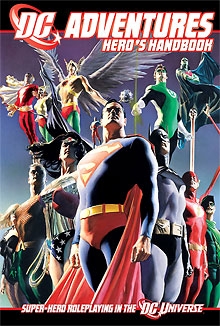
Batman, Superman, The Flash, Captain Marvel, Green Lantern, Zatanna, Robin and Nightwing, Plastic Man, Green Arrow, Black Canary, Aquaman – all find a place in the DC Adventures Hero’s Handbook. The included Archetypes (prebuilt characters representing the most common character types in comics) include the Battlesuit (Iron Man lite), and the villains in the back cover a wide range between The Joker, Darkseid, and Gorilla Grodd.

The game system called Power Level governs the highest stats characters can have, and allows for certain trade-offs between accuracy and damage, as well as between avoiding hits and toughing them out. It’s very intuitive, and once you get a handle on it, the hows and whys of what makes a character tick start coming together pretty quickly – as well as how someone like Batman could measure up so nearly to Superman (Batman’s 12, Superman weighs in at 15). Using Power Level and a few decent rules of thumb, balancing encounters is perfectly possible (if a little unnecessary at times).

Comic books are well-known for having differently powered foes square off and use each other’s Complications (and weaknesses) to gain the victory. While the game normally recommends having everyone play the same PL, there’s no reason why you couldn’t just have everyone play members of the Justice League – or toss the recommended PL of 10 out the window the other direction and do a medieval fantasy/swords and sorcery game set around PL 6 or 8.

It’s a bit more scientific than D&D’s “Challenge Rating,” but there’s a lot of art to it, too – a little practice and you’ll get the hang of it in no time. I’ll talk specifics later, right now I’m just giving you the big picture view.

Mutants and Masterminds Does Spellcasting Right.

Okay, so this is more from the player’s side of the screen, but so what?

Extra Effort is how characters do the exceptional things that heroes are known for; pushing beyond their limits for brief periods, or using powers/effects in creative and unexpected ways – the “Power Stunts” mechanic. It gets tiring under normal circumstances (for the character, not the player!), but one of the things Hero Points are used for is negating that fatiguing effect – encouraging creativity.

So, a M&M/DCA spellcaster will have a short list of effects – “Spells” – that they use all the time, but be able to stunt others in battle if they’re needed at the cost of fatigue. Or Hero Points. None of this “Once per day” stuff written on their sheet – anything that’s used that seldom is just a power stunt. Or possibly a Ritual. Did I mention that this game gets rituals right the first time, too?

For the first time, I can play a magic user and actually LIKE it without ever feeling limited by what my class does and doesn’t offer – regardless of the GM’s setting of choice. Heck, I could probably do a game set in Golarion, and like it.

DC Adventures is a GM’s Best Friend.

Let me let you in on a little secret. The last game I ran using the DC Adventures system had almost no prep time, and the villain that my buddy’s PC fought didn’t even have a proper statblock. He hardly noticed.

I sketched out a rough idea of the plot, gave my bad guy a Power Level and a few trade-offs, noted about 3 powers, and called him good. He was, after all, a one-shot villain who was basically a one-trick pony – more effort than that really didn’t make sense. Anything I needed him to have, I just noted down in my notes and added it to my rough sketch of him while I kept up projecting the baddie’s character.

From the GM’s side of the screen, M&M gives you all the tools you need to be as detailed or abstract as you want about the baddies you throw at your players. Some sample bad guys are included (as well they should be), but you can get a LOT done just using the Power Level charts and some imagination.

I’m a proponent of the “Lazy” style of GMing, so the less thinking I have to do in order to get the game happening and moving – the better off everyone is going to be. On the other hand, if you poke around Atomic Think Tank for awhile, chances are good that SOMEONE will have made stats for something similar to what you want already, which makes it easy to just borrow, plug, and play. Call it an online monster manual, if you will – or just run with the sample statblocks that are provided in the core book. A little imagination combined with those will give you plenty to play with, and customizing an opponent is easy – just add whatever effects/powers, Advantages, or whatever else you need to and make note of any changes to the Power Level.

DC Adventures Can Handle A Fight Scene.

Quite a few of them, actually. Including everything from a nice one-on-one type brawl to a simple mugging to a boss fight with dozens of minions.

Yes, minions. Minions work better here than they do in 4th Edition D&D, thanks in part to the damage system abandoning Hit Points in favor of a Toughness Save – minions go down on their first failed save, and players get to make Routine Attack Checks against them – taking a 10. They go down fast, which is what they’re meant to do, but a little blind luck could still keep them on their feet for an extra round.

My rule of thumb? Any NPC who isn’t marked “Important” is by default a minion. It simplifies thing quite a bit for me as a GM, and simulates the genre fairly well. After all, minions exist to make the PC’s look good.

Mutants & Masterminds Can Do Anything.

It’s a universal game system …

… cleverly disguised as a superheroes game. No, really. I’d use it for fantasy, I’d use it for anime, comic books (anything from Silver to Modern to Iron Age), games set in the Star Wars universe, or some video game world (Assassin’s Creed: The RPG, anyone? Anyone?), I’d use it for grim and gritty detective stories, or even lighthearted school stories. And all that using only the core book.

Yes, it’s that awesome. One book, infinite possibilities. One might even say it’s . . . magical.

Okay, there’s one little caveat to that statement – tactically oriented, squad/grid-based combat. But if you want something that feels like you’re part of a book or a movie (or anything with battlefields that aren’t measured in 100’s of feet), yeah. I’d use this one.

In closing: Make Mine Mutants & Masterminds!

A Beginner’s Guide to Superhero Gaming, Part Two

Last time we looked at what makes superhero gaming different (some would say superior, but that’s fightin’ talk) to other genres of role-playing. This turn around, it’s time to get down & dirty and take a close look at how Mutants & Masterminds Third Edition might just be the ideal system for your first foray into the world of the spandex’d hero.

For those of you that have played previous editions of M&M, I suggest you stick around, too. You’ll learn a little of what makes this edition even better than what came before. Steve Kenson has achieved the impossible, improving an already fantastic (nay, perfect) game. I’ll show you how, and what to look out for, as you turn the page.

In order to play M&M3e (an unwieldy acronym, but less tiring than typing Mutants & Masterminds Third Edition repeatedly) you need just one book: the core rules. This comes in a choice of two flavours – DC Adventures, which contains the entire rules system coated in wonderful DC Comics campaign setting fluff and artwork, or the vanilla all-you-can-eat Mutants & Masterminds Hero’s Handbook, which doesn’t. Both are available as either print (DC Adventures is hardcover, the Hero’s Handbook is softcover, and coming soon) or pdf. Of the two, DC Adventures is better value overall. The pdf is $20 (just $2.50 more than the Hero’s Handbook) and the Hardcover $40 ($7 more than the softcover Hero’s Handbook), but has better artwork (which is to be expected) as well as full stats for Batman, Superman & co. What’s not to love?

Compared to the World’s Most (or Least, depending on who you ask) Popular Role-Playing Game, M&M3e is an absolute bargain. There are other, simpler, cheaper superhero systems out there (ICONS is a terrific game, and at only $2 should be on every gamer’s hard drive) but M&M3e, like D&D, is The Daddy. It is the game to which all others aspire, the one which has (in our group, at least) overtaken all of the other superhero systems out there (and there’s no shortage of great ones right now) and we turn to time and again.

Where M&M3e differs from Second Edition is that it has taken a step away from the core d20 system as laid down by the D&D System Reference Document, and become more of a unique game in its own right. This is a Good Thing as it means the emphasis is placed more on elements that need pushing to the fore in the superhero genre.

For example, instead of just a single Dexterity stat, there are three: Agility (speed, grace and overall body control), Dexterity (manual dexterity and fine motor skills) and Fighting (the raw ability to hit or avoid a blow). This lets you create a character who is highly dextrous, but lacks combat talent (a Stage Magician, for example), a clumsy pugilist or acrobat (who lacks both fighting and manual dexterity skills). In previous editions, as with D&D itself, you would either have to create a character with high DEX and hand-wave their shortcomings, or use Feats and Skill Training to represent what should be natural talent (ie, Attribute-based).

The other changes to the system are likewise evolutionally rather than revolutionary in nature, and each one is an improvement over what has gone before. Feats are renamed Advantages and cover much the same ground, the Skills list is more tightly focused toward modern-day gaming and terminology, many of the Powers have reworked costs and mechanics, and all characters gain two Complications during character generation (which can act as plot-fodder for the GM). None of these are particularly earth-shaking, unless you’ve got Earth-Shaking as a Power, of course.

The biggest conceptual change is back with the attributes. In D&D terms, M&M3e just uses the Attribute Bonus as the stat. For example, STR 4 in M&M3e terms is the same as STR 18 (a +4 bonus) in D&D and previous editions of M&M. This change works especially well in the superhero genre where heroes (and villains) can have attributes far beyond human limitations.

This is the edition of Mutants & Masterminds where it grew up and learned to stand on its own two feet. Bless.

Enough of the mini-review. This is meant to be a beginner’s guide, so let’s start at the beginning. Again.

As with every RPG under the sun, your M&M3e experience is likely to begin with character generation. Mutants & Masterminds contains no classes, no races and none of the coat-hooks your typical D&D gamer will expect to be able to hang his hat on. That blank character sheet and pool of Points you spend to create your character from scratch can look awfully intimidating, so that’s why M&M offers up Archetypes. These are entirely optional pre-built character templates that the player can use as-is, adapt or draw from as inspiration. There’s no mechanical benefit to using an archetype (their points cost is calculated the same), but they do provide a quick and simple way of getting into the game. Imagine if the D&D Player’s Handbook included pre-generated character stats for an Elf Ranger, Human Wizard, Dwarf Fighter and Halfling Rogue, all ready to add a name to and play. That’s what Archetypes are in M&M. The ones provided are:

  • Battlesuit – Because everyone wants to play Iron Man, right?
  • Construct – You were made, not born. That means no birthday presents. Boo you.
  • Crime Fighter – You are a member of Batman Incorporated and want to be Nightwing or Batgirl when you grow up
  • Energy Controller – Covers everything from the Human Torch to Cloak & Dagger or Lightning from the JSA
  • Gadgeteer – I got your steampunk mixed in my superheroes
  • Martial Artist – I got your Bruce Lee mixed in my superheroes
  • Mimic – Anything they can do you can do, too
  • Mystic – Doctor StrangeFate!
  • Paragon – The iconic Superman who can fly faster than a speeding ticket and punch through walls
  • Powerhouse – Big, strong and ugly
  • Psionic – I know what you’re thinking. Stop that
  • Speedster – Can run at 64,000mph, thus making battlemat-using GMs cry
  • Shapeshifter – Proving that one size doesn’t fit all
  • Warrior – You are Aquaman, Ravager, or Conan

Phew! The Archetypes cover a huge number of superhero types and there’s bound to be at least one that appeals. As this is a Beginner’s Guide, I recommend picking an Archetype, then (if you’re feeling brave) customizing it a touch. Juggle the skill points around, switch out a Power or two, or change the Advantages. Add your own personal Complications, and you’re done.

Full blown start-with-a-blank-character-sheet generation is beyond the scope of this post, but it’s great fun to craft your own unique one-of-a-kind superhero. If you prefer pixels over pencil and paper, I heartily recommend Hero Lab. It is one of the best (if not the best) character generation applications around, and will create characters for M&M2e, M&M3e, Savage Worlds, Pathfinder and more. Well worth a look.

The most important part of character generation (whether you go the Archetype route or no) is to consider the team. Superhero gaming is, more than any other genre, about being a member of a group. You are a vital member of a superhero team who relies on each other to save lives, protect the innocent, and mash nasty villains into pulp. Think about how your powers and personality contribute to the team as a whole. Every one wants to be Batman, but no one wants to be the rest of the team that Batman is on. It might be cool to play the moody solo hero stuck in a team situation, but don’t be That Guy. At least, not for the first few sessions where you are all learning the game, ‘kay?

I’ll end with a quick example of character generation at work.

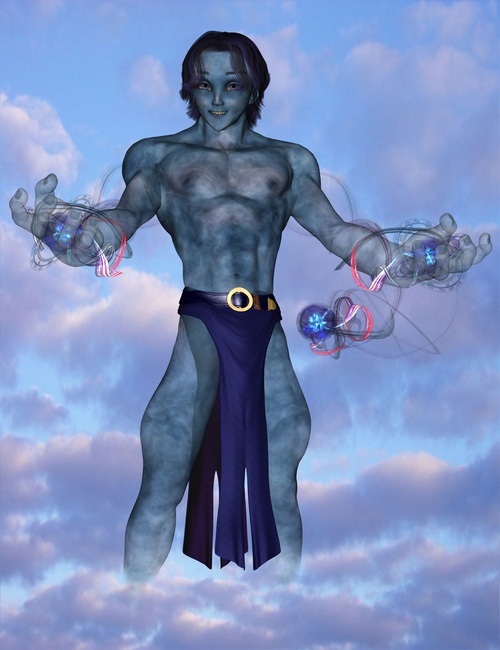
Meet Imagenie, a genuine honest-to-goodness Genie exiled from the Djinn City of Brass for questioning the authority of the High Council. In human terms, he is a teenager (albeit a 200 year old one) and would fit right in to a group such as the Teen Titans.

His main strength is his keen insight into other people – he has a high Awareness and terrific Deception and Insight skills that mean it’s almost impossible to pull the wool over his eyes. In a team, he is the guy in whom all the others confide – even when he is secretly pulling the strings behind their backs.

His powers are all wind-based. He can create tornadoes that he can fix in place or move around, let loose blasts of air, have it swirl around him or create “platforms” of air to carry himself and others. The wind-creations all seem to shimmer like half-created illusions, often of desert scenes and minarets. As he advances, he will gradually gain Illusion-based powers and truly come into his own as an adult Genie.

= Imagenie, PL8 120pp =
Str 2, Sta 3, Agl 4, Dex 6, Fgt 4, Int 4, Awe 8, Pre 6
Dodge 5, Parry 5, Fort 4, Tough 3, Will 12, Init +4

Close Combat 6, Deception 14, Insight 12, Persuasion 8, Ranged Combat 8, Sleight of Hand 8

Create 8 (200′, 250cu’, DC 18, Innate, Mobile, Stationary)
– AP: Blast 8 (200′ DC23, Area 60′)
– AP: Protection 8
– AP: Flight 8 (500mph, Platform, Affects Others)

Complications: Questions authority, Motivation: Find a way to return home

A Beginners Guide to Superhero Gaming, Part One

So you want to be a superhero gamer. You want to run, punch and fly faster, harder and further than ever before. You tire of being constrained by mere dungeons and battlemats, and want to create a character that is entirely the product of your own imagination, not the product of race plus class. You want a system that doesn’t skimp on the details yet is fast and fun to play, a game that really does make you feel like you are the hero.

In short, you want to play Mutants & Masterminds Third Edition. You just don’t know it yet.

Perhaps you have played in a superhero role-playing game before – maybe even Second Edition Mutants & Masterminds – and are tempted to take a look at Third Edition Mutants & Masterminds or DC Adventures. Both are exactly the same system but the latter contains information and details about the DC Universe as a complete ready-made campaign setting. Rules-wise, they’re identical.

What we’re going to do is take a look at Superhero Gaming as a whole – what makes it special and things to watch out for if you’re more accustomed to fantasy role-playing – then move on to how to get started with M&M 3e itself.

So strap on your rocket boots, shout Kimota, or run to the nearest telephone box to change. We’re about to enter the world of the Superhero Gamer!

If you are accustomed to fantasy role-playing games, one of the biggest shifts when you step into the superhero genre is one of scale. You’re going from a genre where everyone has roughly the same speed, and the strongest (STR 20) hero in your group can lift about 400 pounds, to one where some heroes will be able to run (or fly) around the world in a single round, or lift thousands of tons. This is a genre where anything goes – reanimated WWII soldiers can rub shoulders with immortal cavemen and shapeshifting aliens. Your hero may well have normal human strength, but he might be able to shoot laser beams from his eyes, teleport, or go intangible with but a thought.

This means that battles can be larger than will fit on a mere battlemat, and your superheroes will have to watch out for collateral damage. Punching a villain through a skyscraper might be fun, but make sure it is vacant first. Remember that lawyers are everyone’s kryptonite.

One of the unspoken tenets of superhero hero role-playing is this: No one can do everything. More than any other genre, superhero gaming is all about being a part of a team. It is about having a team name and a secret (or not so secret) headquarters. It is about wearing your spandex uniform with pride. Even if your hero can fly faster than a speeding bullet, take a direct hit from a rocket and punch like a freight train, you’re still going to need someone who can attack at range, wield magic or possess cool ninja tech.

Some supergroups work best when they’re built as a team from the ground up. If you can, have all the players create their heroes at the same time, all based around a common origin or concept. This gives you a ready-made reason for them working together as well as a chance to run their origin as your first scenario!

The Fantastic Four are a great example of a shared origin and group dynamics. The superheroes are based around the four elements (Earth, Air, Fire and Water for those at the back) and all gained their powers at the same time due to exposure to cosmic rays. Collectively, their powers neatly cover all the bases, though individually the heroes are weak in one or more areas.

The other type of group is the superhero mash-up. This throws heroes together because they all share some common power source (The X-Men), are roughly the same age (Teen Titans), are a family (The Incredibles), all live in the same area (East Coast Avengers), or are simply the best at what they do (Justice League). In your own campaign setting the superheroes could be the only ones of their kind, be reformed supervillains, or anything else you can come up with. It’s worth coming up with a reason for the group’s existence as soon as possible, as this helps reinforce the team spirit that is so central to a good multi-player superhero game.

The flipside of the coin is solo gaming, and here superhero gaming also excels. Who doesn’t want to play the lone avenger once in a while? Running a superhero game with just one player and GM puts that one superhero entirely in the spotlight and gives him a chance to really shine. This could either be a character designed for a solo game from the start, or a hero from a group given a little airtime. Unlike fantasy gaming where it’s rare for one of the party to have a solo side-trek (it screws up the XP allocation, for one), when it comes to superhero RPGs, you can run a solitaire adventure at the drop of a hat. Maybe your hero is on patrol duty around Super City, or is pursuing their own goals. This is a common enough trope in the comics where members of the Justice League have their own stand-alone comic title, so why not use it in your game too?

Then there’s the Superhero who always works alone. If you have only one other gamer in your vicinity or want to introduce the game to a new player without all that peer pressure, this is an ideal way to play. Remember that unlike building a hero for a superteam, your built-for-solo Superhero will need to be capable in many areas, but don’t sweat the details too much. A wise DM will build the adventure around the superhero’s strengths and style. It’s rare, for example, for Batman to face off against magical villains or Superman to go busting gangsters by Pier Thirteen.

Which leads us, in a roundabout way, to Mutants & Masterminds Third Edition. And that’s what we’ll talk about – next time.

Image by Greywulf, over at Greywulf’s Lair.