(Digital?) Storytelling: Lessons from Interactive Fiction and Tabletop Gaming

Only a year or two after I started GM’ing seriously, I got involved in Interactive Fiction (often abbreviated as “IF”) writing with a cyberpunk adventure game called Orchestra. My crummy setting naming skills and limitations of the platform I was building it on notwithstanding, it received generally positive feedback from the people who came to play it, and the things that players recounted to me really shaped the way that I run my games to this day.
Character

The first, and most pressing, constraint of the digital narrative experience is that it is nigh impossible to account for all the situational variables as your storyline becomes larger and more complex. Creating meaningful opportunities and implementing gamification are major components of this. Tabletop games tend to do a good job with game elements, but I see a lot of GM’s fail to give players good options in character progression.

When writing Orchestra, I found that writing game and narrative blended naturally into one combined process. There was a level of interesting interaction between game elements and narratives; players can work in their own explanation for how things happened and the only thing I had to do was create the basic impetus for a few events.

One of the things that IF does well when mixed with game elements is provide players with a sense of direction; the game elements fill in the gaps that otherwise would go unnoticed due to an inability on most writers’ behalf to actually write specific responses to every possible outcome. Players are able to visualize their avatar in such a way that they tell the story to themselves as it unfolds, and this is very similar to how characters in a tabletop game will build a story and persona around their players’ perceptions.

The obvious thing that this suggests is that these game elements can and should be used to encourage deeper character development.

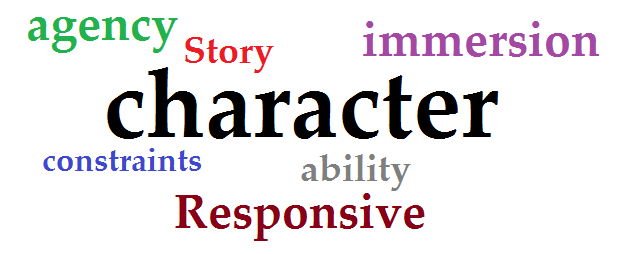
What does this mean? I’d say that it means that we have to be very careful when evaluating how we plan and run our games; it’s not just the act of writing a story, but encouraging players to use their characters as agents in the story. If we are to reach the largest possible audience, especially along the fringes of the people who currently play tabletop games, at the table it is critical to encourage the idea of the character as an agent in our players, stressing both the ability and constraints that a character has.

Likewise, I’ve found that my players’ favorite experiences come when the rules of the game don’t matter anymore, and they have become entirely immersed in the narrative; even when a character is killed or injured, the presence of a world with limits and opportunities is as important as the ability to execute a list of actions written on a character sheet. Unfortunately, this means that there’s a lot of potential work for a GM, and, as with any planning, stuff can go off the rails quickly, but a lot of this can be mitigated by considering what to plan and how to encourage players to follow paths that their character would take so that they can be satisfied without necessarily operating in a vacuum of direction that makes it difficult to respond to changing events.

The game should grant agency. I’ve always felt that the role of the GM is to work with players to build a story that’s interesting and fun for everyone, but I often see GM’s who just tell stories that the players want to tell or that they want to tell. Using plausible restrictions on players’ characters forces them to think inside the rule of the world, and it actually serves to humanize their characters. This makes it easier for players to connect with the non-player characters and events of the game, and gives them an idea that the universe that the events are taking place in exists as a coherent concept.

When we think of our favorite characters in fiction, almost all of them are constrained in a fairly major way by the world around them; their abilities are used in conjunction with the challenges they face to tell their journey, and as a GM it is possible to give players a memorable and satisfying experience in this way.

I think one of the things that stood out to me most when I applied things I learned writing IF to the tabletop was player perception. If I could align my users’ expectations with my work, or vice versa, they enjoyed the content more. If they expected to be a Bourne-esque supersoldier, I had to include things that allowed them to jump to that conclusion, but when I did they felt like my work was theirs in a vivid and experiential manner.

For comparison, one of the most frustrating experiences I ever had as a gamer was from EA’s reboot of Syndicate during the single player campaign. While the gameplay was actually far better than I expected, I was constantly frustrated by my lack of agency in the story. One of the deadly sins of storytelling is countermanding player expectations. While Kilo stood back and let events unfold, all I wanted to do was to get back into the action, and when major choices in the story came up he almost never wound up aligned with the people that I would have aligned with.

Giving players agency was as simple as learning what their expectations were; giving myself a little insight to the situation let me figure out what players want to do. When I run my games, I try to get an insight on what my players do. The paladin in shining armor will never strike a downed enemy, while the ruthless rogue will always throw in an extra stab for good measure. Because of this, I can plan narrative events that allow players’ characters to show their personality in an environment that responds to them—in the paladin and rogue example, adding a decision point involving incapacitated enemies gives players a chance to make a moral decision that would often be overlooked by staunch adherence to the combat rules of a system.
Flaws in the Universe: How Interesting Settings Push the Boundaries of Disbelief

The “concept of cool” does not necessarily have to cheapen our game worlds, but enrich them…

Assassin

I read an article by Andy Kelly on PC Gamer the other day that said the pursuit of the ‘concept of cool’ causes problems with games’ settings, and is why games aren’t as memorable or as popularly respected as other media. Basically, the argument made is that decisions that favor popular or flashy elements over realism are bad because “they’re indicative of a larger problem in game design: style over function.”

Yet this poses some serious issues for games. In both tabletop and digital media, games represent a method of conveying an interactive narrative, and certain issues will have to come up as a result. The answer is not always as simple as it seems. Andy Kelly uses the example of Stanley Kubrick’s wonderful film-making as an example of attention to detail and realism resulting in great narratives, but I beg to differ; Stanley Kubrick’s stories work because they are written with the quality and skill of Stanley Kubrick, and his focus on realism is merely a single way to create a meaningful tale.

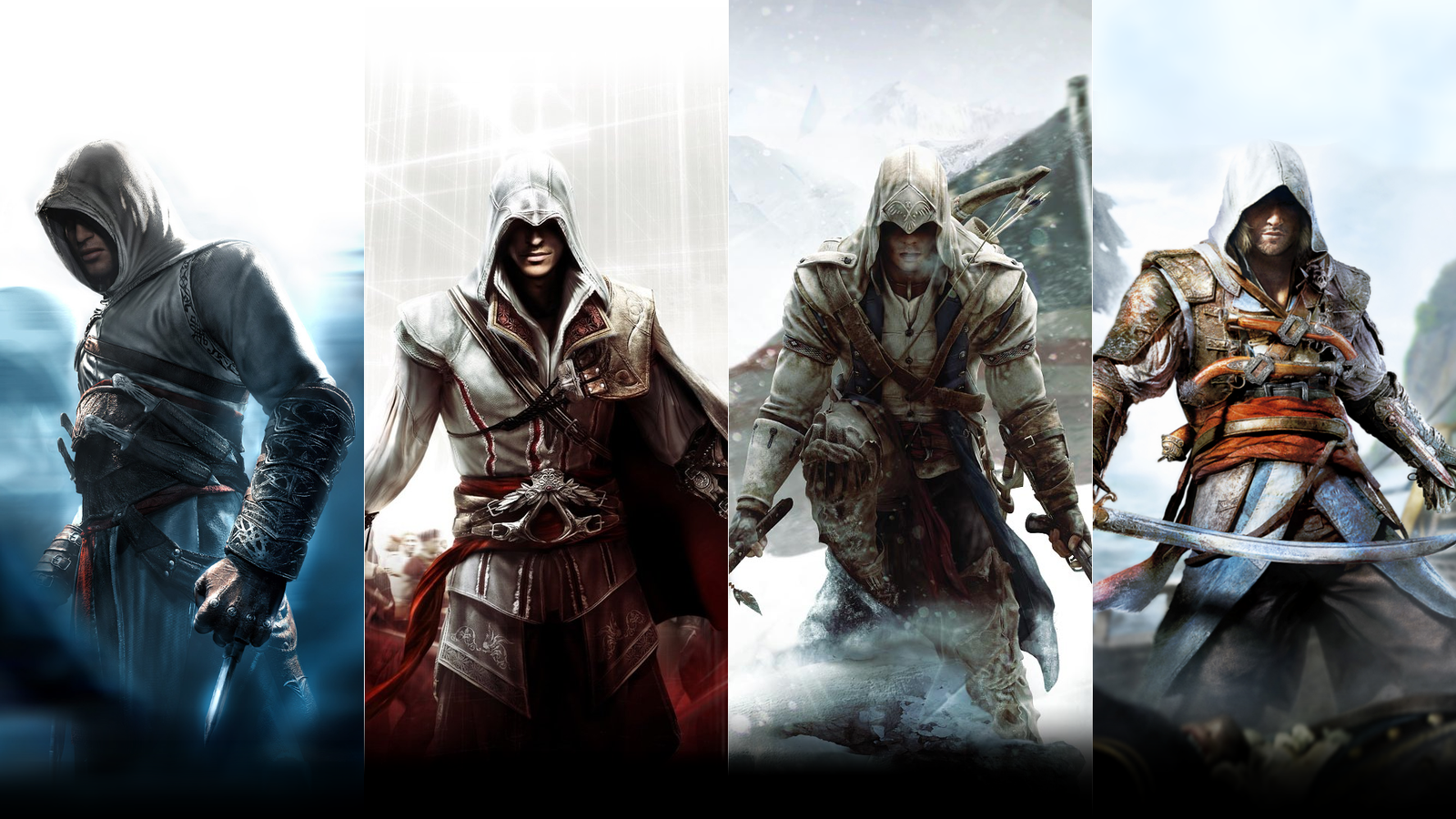
Part of the problem with this mindset is that it encourages a deconstruction of otherwise good games just because they don’t make sense or they have some flaws; it doesn’t matter that characters dress improbably, because that is part of the art. We want, expect, and need our characters to stand out visually. It allows us as gamers, game masters, and game designers to produce instant connections between tropes and archetypes and the individual characters and events that dot our narratives. Ezio’s layered garb and walking arsenal set him apart as a character who is important; despite the impracticality of his outfit, it is immediately apparent that he is an Assassin, which is the entire point of all the Assassins in the Assassin’s Creed series wearing the Assassins’ emblem overtly; it tells the player who their friends are and who is initiated into the inner circle of the secret society.

I agree with Kelly in some regards; attempts to inject these symbols and motifs into games often result in ham-handed or unintelligible outcomes, but part of the fun of games falls between the suspension of disbelief and credulity. It is crucial to remember that things that we bring into our games should remain engaging and push players onward, and sometimes the experience of an event outweighs the breaks in a setting it can bring; the Tunnel Snakes from Fallout 3, for instance, which were one of the things that Kelly cited as an inappropriate element, are ways to remind players that the world of Fallout is not simply set in America after a nuclear war, but rather a world where the future America embraces the values and lifestyles of an earlier America.

To deny a symbol that so clearly foreshadows the future elements of the setting on account of it being a little out of place—the Tunnel Snakes’ leather jackets are the element that Kelly finds most problematic, along with their adoption of greaser culture—overlooks the role of those elements in establishing the setting. Fallout as a setting is only successful because it brings its player into another world, as most good games will whether they are digital or analogue in nature. Without these things games would be far less memorable—it’s part of the reason why Two Worlds isn’t as engaging and memorable as Oblivion.

In Oblivion, the second the plot starts off, the emperor is entering the cell of a prisoner (who happens to be the player’s character) to escape an attempt on his life aimed at extinguishing his bloodline entirely. The lowly cultists that attempt to kill him should not, in the setting, have even an ounce of a chance of killing him or his bodyguards, yet they manage to eventually assassinate him in plain view of the player. This establishes the player on a journey through the dark but often wondrous and fantastical world of Tamriel, yet it’s also something that would never actually happen. Despite being nothing more than a lowly former prisoner, the player is set on a path to adventure.

In Two Worlds, by comparison, the player starts off cleaning out a tomb with a couple of monsters in it. While it’s a feasible enough tutorial, there’s no introduction, no back-story up front, and it’s very hard to sympathize with the player character, even though they have much more of a background than the player character in Oblivion. Issues with the player’s ability to engage with their avatar aside, Two Worlds fails because it avoids these tropes and conventions; it has a deep and rich setting, but in an attempt to avoid an illogical introduction, it diminishes the player to the roll of trash collector.

It is not skill that determines the accuracy of the setting, but the quality. In his example of Aliens: Colonial Marines, Kelly scourges the use of logos and symbols throughout the game (and is likely right to do so) as a gap in the logic of the universe. However, one thing to point out comes from a quote from one of Alien’s artists, Ron Cobb, who complains about the shallowness of science-fiction films that depend on cool imagery over substance. The symbols in Aliens: Colonial Marines are shallow. A good game, however, utilizes these symbols in a deep and interactive context, where they take on the role of more than a homage and metamorphose into a functional part of an engaging and meaningful universe, even if their presence does not necessarily make logical sense when thoroughly analyzed.

So how can we apply this in our games and settings? Simple; when something works well, use it. I’ve found that in my games, players are less willing to nit-pick and get caught up on the minor inconsistencies that might result when they are having a good time, and part of the way to do that is to satisfy their desire to have things in the setting that they would actually be interested in. This doesn’t mean that realism has to be entirely disregarded, but having a character who is capable of breaking the rules of the setting or who has actually done something “impossible” means that there’s a mystery to explore and a new flavor to the world. It does not punch a hole in the game that makes it “less memorable” and prevent it from approaching the likes of 2001 and Alien, but it adds a new undertone and complexity to the setting.

There’s a single question that can be used to ensure that things make enough sense in a setting, and it’s something that every designer and game master should ask: “Does this make sense by itself?” It’s not exactly a profound question, but it’s important—when we see a character who is wearing eight layers of armor for a walk around town, we know that they’re adventurers. Players who see them will know that they’re either there to help or hinder the efforts of the party, and they allow us to direct attention and interest where it needs to go in order to further the narratives and plots we show our players, which makes them more memorable than an undirected exploration of an entirely “realistic” world.

If you’re interested in seeing a setting that applies the rule of cool very well, I’d suggest checking out 13th Age, which has a ton of interesting fantasy elements, and explicitly encourages characters with unique and interesting powers that don’t have to agree with the existing universe. The end result causes the universe to change and become more memorable (not less) on account of the interesting figures and imagery, rather than causing problems.

Seven Habits of Highly Effective Video Game Tutorials

Have you ever played a game that felt like it was drawing you in from the very beginning? One that presented you with the things you needed to know in order to play without making you sit through dreary pauses, cut-scenes, and simple tasks?

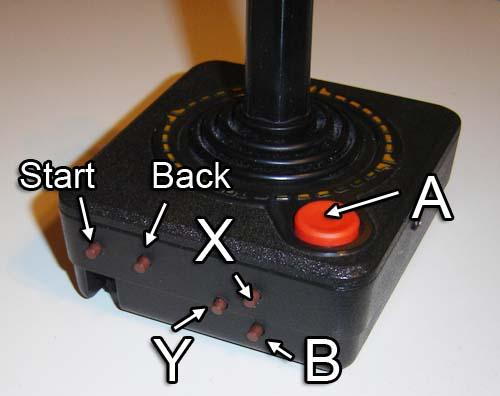
atari game controllerHave you ever played a game that felt like it was drawing you in from the very beginning? One that presented you with the things you needed to know in order to play without making you sit through dreary pauses, cut-scenes, and simple tasks? Very effective video game tutorials tend to be a rarity rather than the commonplace. A major factor that contributes to this is the fact that so many tutorials are just designed however the developer thinks they should be, without really caring to get a feel for their audience or for the skills they should be teaching. Unfortunately, this often leaves a lot to be desired, and a high-quality tutorial has to use solid principles of design rather than merely “guesswork” or a “gut feeling”.

Assessment is the first stage of any tutorial. Sadly, these days it’s often lacking or severely underdeveloped. A lot of games just drop the players into a level and tell every player the same thing, slowing down the players who know what they’re doing and offering too few opportunities to practice if a player is confused or uncertain. Tutorials that excel at assessment either react to player performance, telling them their perceived aptitude and encouraging them to continue with their learning or move on to the game, or come in many optional segments so that players can self-assess and look at only the things they need to know and skip those they don’t.

Accessibility is another major part of tutorials. They must be visibly available to the player, and must not be capable of being easily accidentally skipped or overlooked. Most games do this well, but games that follow the increasingly popular tutorial pop-ups system run the risk of having players click through something they meant to read (or later wish they had). In addition, tutorials must account for the control scheme being used; I’ve seen several PC games that run fine with a mouse-and-keyboard despite the fact that the developers only thought to include guides for 360 controllers, and this is one of those things that really will turn off an audience as they frantically search for keys to do what they need to do.

Clarity is also important. Tutorials should make it clear what skill they’re focusing on well and provide performance driven feedback. For instance, nobody would expect a military shooting range to be the locus of movement practice, and the obstacle course that precedes it to actually be the place to practice one’s aim. Yet tutorials often make it unclear what players are supposed to do and learn; frequent reminders and hints will remind players about what they’re supposed to be learning, and allow them to focus on the skills they are acquiring.

Multi-aspect tutorials include a variety of means of giving players advice and feedback. For instance, having a voice actor read commands while a text prompt comes up on the screen is great, as is demoing the appropriate controls on-screen. This means that the player has visual, written, and audio instructions to better help them figure out what they’re doing. If possible, try to include mathematics driven feedback as well-players should know roughly how well they did on the tutorial, and should be presented with this information in as many ways as possible so they can better understand how well they did. “Excellent” is a very vague term if you have eight higher ratings, and 80/250 can be the mean score on certain tests.

Scaffolding works on building up skills. Most games do this pretty well already, but I’ve seen some, especially games that assume unlikely amounts of prior player knowledge, that skip steps. It’s a term from pedagogy that involves the building of skills by adjusting content slightly above what is known. Tutorials’ learned content shouldn’t be easy, and should remain just beyond what the mainline incoming player should know at any given point; if you make the experience of your tutorial just a little challenging but not overwhelming it will encourage players to become better at the game and retain what they have learned, rather than skipping it out of boredom or frustration.

Review is a simple concept. At the end of the tutorial, you should have an assessment or practice of the skills contained within. Sometimes this doesn’t even look like a tutorial; you can move into a form of your normal gameplay and even start the narrative, but be sure to go through the steps you started in your tutorial. The exact execution of this is rather flexible; you can go through steps in order again, skip overly simple ones like “WASD” movement in most PC games, and/or rearrange the order entirely to create a more engaging experience. Just be sure that you have an idea of where players will be at the end of the tutorial, and make the review appropriate-it’s their chance to either practice their skills or build their self-competence regarding them, and if you have people who know what they’re doing but are forced to “do this three times” they’ll get frustrated and disengaged, while if you have people who pulled the move off once but are still shaky you should probably give them a couple more opportunities to study.

Finally, tutorials should be able to be returned to. Not many players will, but you should be sure that the information is available again in a simple and direct package. Sometimes you can just go through the tutorial again, or you could have a separate stripped-down version of the tutorial that skips any fluff in-between sections. If your tutorial is broken down into chunks it makes returning easier, so long as players can find the part that they feel like practicing again. Ideally, you’d also include a written help guide, for those who just need to review controls or gameplay principles they haven’t used in a while, and allow for a more rapid and direct access of concepts rather than forcing players to repeat the original learning process.

In short, good tutorials assess the player as they go through it, are accessible to beginners, are clear, provide various means of learning as well as feedback for players, teach more advanced concepts after training the skills necessary to carry them out, return to previously taught knowledge in a way that won’t frustrate players, and allow players to come back and rediscover skills they missed out on or need more practice in.

Core Elements of Great Games: Engagement

Engagement is key whenever one designs an entertainment experience. As a writer, I can testify for the fact that something that is boring won’t get read. Great games are made by people that recognize this concept and apply it to its fullest. The core principle behind engagement is the idea that players should always be focusing on the current action or a future action…

Engagement is key whenever one designs an entertainment experience. As a writer, I can testify for the fact that something that is boring won’t get read. Great games are made by people that recognize this concept and apply it to its fullest. The core principle behind engagement is the idea that players should always be focusing on the current action or a future action.

Engage

Current action is perhaps the most simple to design around. Stuff blowing up, immediate concerns, and high stimulation environments can provide a great and simple way to create a current action. This works in most cases; when someone comes under fire in a military game they are immediately pulled into the task they are doing, even if they’d been doing a slow march for the past kilometer or so of Altis. These actions are the simplest to plan and act around because of the simple fact that there’s no consideration needed to get them to work. If one wants to have an explosion, they can create it. There’s no requirement for things to be pre-scripted or dynamic, and to a certain extent actions don’t even have to be responsive in order to gain the player’s focus. Even if a player intentionally ignores something, say, running straight through an artillery strike, the addition of more action to the scene will provide something for the player to think about. These environmental current actions provide a cheap but meaningful event, and give the player something to do in downtime or as a brief respite from challenging segments-pausing on a ledge outside a window as a guard finishes his cell phone conversation can be just as engaging as being in the center of a firefight if the developers and writers play their cards right.

Current action can also take the form of actions that the player is undertaking. Picking a lock or hacking a computer in Fallout 3 can be just as engaging as having a mine go off underfoot. If a game can lead a player to undertake actions that are meaningful to them within the context of the narrative or as an exercise unto themselves, then it is still successful at creating an engaging experience even if the actions themselves lack a meaningful base of stimulation to keep players constantly assessing and reacting to their environment. However, player-driven current action cannot be discounted as a powerful force; if the player is bored with the setting, narrative, and aesthetics of the game but is enjoying the simple action of fighting monsters or matching jewels into rows of at least three, they are still engaged in the game.

Let’s take the Hitman series as an example. While they tend to shy away from having constant action, there are few cases where the player is disengaged, because the player is always working toward an objective. Future engagement is an important factor in a lot of player interactions with games, particularly more cerebral ones. This is where things like predicting, planning, and conceptualizing come in, and Hitman’s a particularly good example because it relies heavily on all three processes.

Predicting is a more advanced form of the situational awareness exploited and used by environmental stimulation. The action of predicting is itself engaging; the player is taking in information and figuring out what they believe will happen. For instance, if a guard is reaching for a pack of cigarettes, he will likely go out for a smoke. Not all players really think this through, which is somewhat of a shame, but the players who jump the gun on this are typically still focusing on current stimulation in the environment and are likely already engaged. Figuring out how opponents and threats act is a core element of the predicting component of future engagement.

Planning is the application of predictions; at this point players have begun to figure out what they will do. Most players plan, even if they skip straight to it from the predicting phase. It comes directly prior to the actual execution of an action, and involves a somewhat complex process of weighing options and future actions that is beyond the scope of this article. However, the important thing to remember about planning as future engagement is that the first steps toward action are likely to begin at this point, and it is often used in conjunction with a rote action (such as moving) toward the goal of achieving whatever action is being planned (kicking the guard off a bridge).

Finally, conceptualization is future engagement at the moment at and directly following execution of an action. It’s a reaction to the events that have occurred in order to figure out what will follow. Whether the player’s actions went as planned or not, the conceptualization is the immediate recognition of the events that have occurred and represent a return to the prediction phase. This is when they begin to study their environment and figure out what happened before they continue with their actions. Games that focus a lot on foresight and planning but don’t allow for sufficient time can become too busy, and become confusing or frustratingly difficult.

However, it should also be noted that engagement doesn’t always have to involve taking up all of a player’s mental capacities or even focus their attention; if they can willfully participate in the game’s events without them feeling cheapened as artificial, they still matter enough to keep players engaged. A thief in Skyrim who’s maxed out the stealth tree probably doesn’t have to be keeping too close an eye on the detection meter as they creep up behind a brigand. Competitive games can also do this well; Audiosurf and other rhythm games are examples where players can often operate on “autopilot”, and be thinking about other things while mechanically completing the necessary tasks. This partial engagement is not necessarily something desirable as a core goal of a game, but it can still offer something to a player, even if their mind is wandering away from the game.

In short, engagement is important for game designers. The same things that lead to it can cause confusion or frustration, but without it a game becomes incredibly boring. Engagement comes in two forms; current and future, which can also be analogized to environmental stimulation versus intellectual stimulation. At the end of the day, a highly successful game will utilize many forms of engagement to satisfy all a player’s desires for an engaging experience.

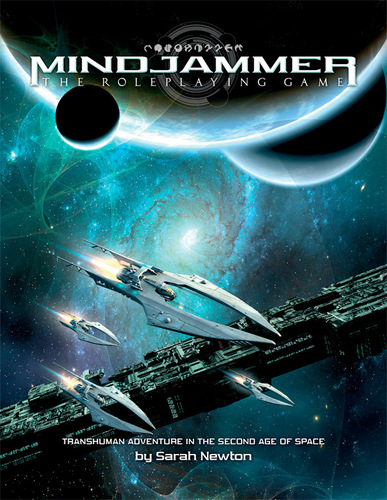
Review: MINDJAMMER, The Roleplaying Game

Mindjammer is many things in one. It’s a space opera game that really has rules and mechanics for pretty much everything, all powered by the Fate Core system…

MindjammerMindjammer is many things in one. It’s a space opera game that really has rules and mechanics for pretty much everything, all powered by the Fate Core system. It’s also set in an interesting and unique setting, with a lot of potential for exploration and adventures, and is well-illustrated with examples and tools for players and game-masters to experience a certain sort of adventure.

The New Commonality of Humankind is the central power player Mindjammer’s setting, in which humanity has essentially grown over ten thousand years into an openly transhuman society. The Commonality recently unlocked the secrets of FTL travel and has begun to rediscover other human colonies. This works incredibly well, integrating elements of exploration and high adventure that Fate Core begs for. Barring the unknown, there are many named places and organizations to explore in the standard setting. The Venu Empire, which is the most fleshed-out other faction, is the largest competitor to the New Commonality of Humankind. However the majority of the example setting content has nothing to do with the Venu, although references are made to a historical war between them and the Commonality, and they remain too mysterious to be a protagonist faction without modifications.

The standard setting, however, is a bit hit or miss. It has a lot of original and thought-provoking content, but it could likely be dissatisfying for players. Having the most advanced faction be an almost benevolent but often Orwellian and authoritarian entity is interesting, but its repressive undertones also mean that the Commonality can bring up some incredibly touchy and dark subjects, which are handled relatively loosely. For instance, the Commonality, until recently, implemented forced euthanasia, and engages in cultural manipulation that includes a lack of tolerance for freedom of speech and religion. I’m not sure I’d feel comfortable playing with the Commonality as protagonists.

That isn’t to say, of course, that the setting is horrible for everyone. Warhammer: 40k (whose Imperium of Man the Venu resemble) has proven that people are more than willing to play cogs in a larger, often unpleasant, machine, and Mindjammer has certainly got a degree of complexity and many potential sources deep affinity for players that can easily draw them in when possible. There’s a lot of stuff to like, and only a few adjustments have to be made to find something that will interest pretty much any group, but the setting suffers from not trying to define the role of the players. Normally, this is not a problem for a narrative game, but with many different parts of the setting never meeting each other it becomes difficult to fully appreciate the breadth of the content and remain believable. GM’s and players have to be careful to pin down the setting, which even in the examples seems to be a problem.

My disappointment with the setting can be summed up in a single example. The Mindscape gets one of twenty-six chapters devoted to it, and its ten pages are devoted rather heavily to rules and mechanical explanations. There are a lot of term definitions throughout the book, and many things are like real-world analogues with a twist, but there’s just a general lack of the human aspect. For a setting with a novel, there’s only snippets of fiction, and setting elements remain distant and vague.

Mindjammer is built on Fate Core, which uses Fudge dice. As a game that really draws from the space opera genre and takes place in a setting where the question about what is possible generally boils down to individuals’ ability rather than technology limitations, it’s a good pairing. The mechanics allow richly detailed characters and scale well to the various other game constructs, such as organizations and even whole planets. The narrative style of the game is exactly what the Fate Core system was built to handle best, and Mindjammer’s mechanics are well-constructed and generally make sense.

Unfortunately, just because Fate can handle these scales doesn’t mean that it should. At over five-hundred pages to read it’s easy to have a GM burn out, and the length is extremely intimidating even for players who won’t have to master all the rules. Fortunately, common mechanics make adaptation more simple, but there’s still a lot of bloat in Mindjammer, some of which is a natural consequence of attempting to facilitate so many different scales of play and some of which just comes from repetition and an unwillingness to focus on any one experience.

Another major problem with Mindjammer is that working with things at different scales just doesn’t feel entirely right when working with the same mechanics. There’s a scheme for determining how things on different scales interact, but it doesn’t always make a whole lot of sense in outlier contexts. While Mindjammer allows for essentially down-scaling to achieve a desired scale result (for instance, you can branch an organization down to its branch in a city to see how it deals with a local threat on the fly), this also means a lot more work and bookkeeping to the point where using a simpler discrete mechanic would perhaps be better. The marriage of Mindjammer to the Fate Core mechanic works really well on personal and vehicle scales, but past that it’s impractical unless one is working with like types.

Mindjammer also includes random generation tools for a ton of things. They seem to be heavily weighted to create things that fit well within the Mindjammer setting. All advanced societies are going to be more and more like the Commonality. Some of this can be stated to be a result of the fact that the Commonality is the most advanced society in Mindjammer’s known universe, so all the other advanced societies are branches of it, but it also means that you’ll never find a high-tech anarchic society or a low-tech collectivist society. Part of this is, I believe, complicated by the use of Fudge dice for the random generation, which introduces the complications of a probability curve and relatively low resolution outcomes. When coupled with a setting that makes creating new content incredibly easy, it seems a little redundant and a little unnecessary to have such massive focus on random generation, especially if it just generates content that is much like the example suite. The few parts of the random generation I like I have other tools that I could use to replicate, and the parts I didn’t like felt too inflexible and inorganic to provide meaningful results.

In a sense, my gripes with Mindjammer could be conveyed by saying it is functionally the opposite of Eclipse Phase. Rather than being an incredibly detailed and vivid setting with mechanics that fail to meet its requirements, Mindjammer has many mechanics but falls into the trap of having a setting that fails to delve deep into the sort of things that give flavor and texture to the universe. I couldn’t tell you what the average citizen of the Commonality does, or even what the more noteworthy ones do-the human element is severely lacking, despite the fact that a major goal of the setting is to ostensibly examine what makes one human, transhuman, or posthuman. This is not necessarily horrible, as it leaves room for expansion, but it is also somewhat disappointing.

That said, Mindjammer is top-notch production value; for being a massive book it is very well edited, and the art throughout is high-quality. Page elements get repetitive early on, and remain the same for the whole book, but this is not an unforgivable sin. It’s easy to read and everything looks well-put together with no glaring errors, though it doesn’t have any interesting or fun layout gimmicks like, say, Eclipse Phase, that would provide some awesome visual effects to break up the lengthy read.

Mindjammer attempts to present a compelling, engaging, complex universe, and it has 500 pages in which it attempts to do so. It feels unusually long in some places while glossing over sources of potential interest. There’s a ton of content, but it fails to really present stuff in a usable state; it loves having mechanical expression but fails to create authenticity and meaning behind it. Too many mechanics and too few setting details makes it feel oddly impersonal. Mechanically, it’s a gold-mine if you like the Fate System, but be prepared to fill in a lot of gaps where the setting doesn’t deliver content you’d need to run a game.

You can get a free preview of Mindjammer here…

Choice in Games: Does It Require Nonlinearity?

Choice. It’s something that nobody really considers to be a “bad” thing in gaming. However, it is also something that is fundamentally misunderstood by a lot of people in gaming…

Choice. It’s something that nobody really considers to be a “bad” thing in gaming. However, it is also something that is fundamentally misunderstood by a lot of people in gaming. I’ve seen people complain about how “linear” a game is, despite the fact that they would then comment on it being engaging and feeling well-written, while other times I’ve heard people lament that they just couldn’t get into an open world experience. In fact, when we intentionally implement choice into games it’s often a fallacious exercise, actually forcing players to conform to standards they don’t accept.

One of the things I’ve noticed as a critic and as I’ve gone through training in order to become an English teacher is that the narratives of games are often simple to an extreme. Here’s the big bad guy, and here’s what he does. The modern reboot of Syndicate, for example, was considered a huge failure with a lot of people complaining about the game’s break from its strategy roots. I hated it for the exact opposite reason-I loved Starbreeze’s interpretation of the gameplay concepts, and I actually felt it was one of the best designed games of the year, with a stunningly cool AR overlay and a satisfying cyberpunk shooter experience. However, I found myself enjoying the cooperative play more than the single player, even though it was the single-player experience that had some of the most awesome action scenes. This was a simple consequence of one thing: I hated every NPC through the story. Every. Last. One. Not because they were necessarily “bad guys”, but because they had lied to, deceived, and generally been mean to my character.

The issue was one of choice. Highly linear games have succeeded in the past. Nobody fried DOOM for being linear, because DOOM was a self-driven experience; you clear one level of hellspawn and you move on to the next. I grew up playing roguelikes and JRPG’s, and while they certainly offer a fair degree of exploration they are all for the most part linear and allow very little player input on the actual game. However, the important thing to note is that I chose how to drive the game forward. However, in Syndicate I was a supersoldier with the safety on, and it just felt wrong.

A rather startling examination of gamers showed that about 10% of people who played Red Dead Redemption finished it. I haven’t played it, in part because it hasn’t come to PC and my consoles see about as much use as my gym membership, but it’s well-received. This is not a game that people hated. However, what we see is that they didn’t finish it. In Skyrim, as of the time of writing, 90% of people have completed the achievement for “Unbound”, the introductory quest, on Steam, while 35% of people have finished the one for “Dragonslayer”, the final main storyline quest. The reason for this is simple; I’m willing to bet that 35% of Skyrim players actually felt like playing through the main storyline. That’s not a game designer’s fault, especially with the massive amount of content in Skyrim and the fact that there’s probably a portion of gamers out there, even a good chunk of time later, who are still going to complete the main story but just haven’t gotten around to it yet.

Hitman-Minion

However, we don’t see people hating on Skyrim or Red Dead Redemption because they haven’t beaten them. The matter is one of choice, and this is where massively unpopular linear experiences come up. If a game has only one path, whether there’s multiple orders to complete it or you always go through the same way, it will fail. Hitman: Absolution had a rather weak storyline, but it wasn’t too bad because at least it felt like 47’s motives should be aligned to the story. Everyone else, on the other hand, made some really poor decisions. 47 was handled well – while in Syndicate everyone in the narrative made the decisions they should have made, and they felt realistic, but Miles Kilo, the player avatar, was forced to do things that were dubiously aligned to his interests. Nonlinear and sandbox style games don’t have to worry about this nearly as much, because if the player doesn’t want to do something they don’t have to, and they have more chances to reach a satisfying conclusion.

I’ve been playing through the Game of Thrones game recently for a review, and one of the most interesting things that I noticed is that for all its lack of polish it actually does a really good job of making me feel like my decisions are the ones I’d choose to make. Some of this is accomplished by providing good dialogue cues, but for the most part it’s the fact that the game doesn’t judge an appropriate path through every situation, providing alternatives for consideration that have meaning but don’t massively impact the plot. Sure, it was harsh to have the peasants call me a butcher for failing to peacefully resolve rioting, but I deserved it. When I showed mercy it was a choice I made, and when I enacted bloody vengeance it was also my call. It had no impact, at least as far as I could tell, other than a few throw-away lines down the road, but it was something that helped me define my vision of the characters I controlled, rather than forcing me to portray them in a way I didn’t want to.

So what’s the takeaway? We don’t need to have nonlinearity or a sandbox to have choice in games, but we do need the opportunity to make a meaningful decision with our characters, even if that decision is to follow the linear plot of the game.

—

If you’re interested, you could check out the cross-application of this to the tabletop in an article I wrote on indecision in tabletop gaming and how to address it as a GM:

http://blog.homoeoteleuton.com/?p=1325

Getting Women To The Table

One of the things I’ve often been asked as a somewhat experienced GM who’s run games with lots of players is “How do I get girls interested in my games?” It’s an interesting question, and one that can be really quite painful…

GenderGapOne of the things I’ve often been asked as a somewhat experienced GM who’s run games with lots of players is “How do I get girls interested in my games?” It’s an interesting question, and one that is really quite painful to a lot of the tabletop games hobby, since we do miss a lot of the female market share. Part of the reason that we miss out on that market, however, is that we explicitly hound female gamers, trying to get as many of them as possible, without remembering the core principles of gaming.

Gaming is, first and foremost, an enjoyable activity. I don’t entirely buy into the premise that we enjoy what society tells us to enjoy, but there is truth in that certain demographics participate in certain activities more than others, and gaming is an alternative to other leisure activities. If someone wants to go and hang out and get their clothes-shopping done (to use a horribly cliched example) while chatting with a friend, they’re not going to necessarily prefer to go and roll dice while chatting to a friend. The role of leisure is often overlooked in modern day studies of the human experience, but gaming is far from the only way to meet the need, and women often prefer to do things with their preexisting friends, enjoying something which to a mainstream American male seems like a task to complete efficiently and without joy or socialization.

However, gaming is also an investment. When I had a prospective player who I didn’t particularly want to have join my game, I’d talk about reading stuff for my games. Saying “Yeah, I went back and re-read all 1000 pages of Eclipse Phase back in January” works well as a loyalty test. It’s a difficult hobby, and while I don’t think there’s anyone who participates in it who thinks that games should all be shortened to five or six pages, you also need to consider that anything too complex represents a pretty respectable amount of knowledge and learning, and even if you have a GM handling most of the rules and players only need to learn thirty or forty pages worth of rules and content, players still wind up with a lot of responsibilities.

You want to make sure that all players at your table are valued. This isn’t as difficult as a lot of people think, but it’s also not something that most people do naturally. If everyone wants to get together and have the gaming equivalent of a drunken brawl, but consider whether you’re doing it to hang out with your friends or if it’s really the gaming experience that matters. This is why a lot of games actually last a session or two and then fizzle out; they’re a means of hanging out but they don’t actually generate value for the players other than the experience of hanging out. If someone doesn’t want to hang out with you just for the sake of hanging out, especially in our society which tends to be rather gender segregated in terms of our social activities, you need to consider the fact that you need to offer something more than just hanging out. A lot of people say “well, cater to women,” but that’s also a fallacy. What are you going to do, paint all your books pink? Not only is that so shallow as to border on the offensive, but it’s an entirely wrong viewpoint. Consider what your game offers, and what a prospective player wants. Don’t make gender the main goal.

At the same time, it’s also important to look at the subjects and topics you’re discussing. Avoid sexually charged topics, and remind players to keep their behavior civil. Particularly with men, a lot of players don’t understand sensitive topics. When they’re talking about “Charisma scores” and the attractive elven waitress, they’re directly alienating female players. Having worked in a service industry, I’ve been able to see the way that a lot of my female coworkers were treated by male customers, and quite frankly it’s disgusting. You don’t want that at your table.

It helps if your gaming group is socially defined. I have never had a group in which the players have not been friends and acquaintances with each other. If your social circles are predominantly composed of people of a certain gender, your games will be also. Don’t hunt outside your social circles to meet an arbitrary goal, like saying “I have to get a girl for my D&D campaign.” I’ve had luck with introducing gamers outside my social circle to my games, of both genders, but you don’t win someone over by saying “We want to play with you because you’re a girl.” Barring the creepiness factor, it’s important to remember that humans are intelligent, and seeing that one’s presence is exclusively for the sake of novelty is a major turn-off. Even if you don’t know each other, do activities outside gaming that are less rigorous. You don’t need everyone together to go see a movie and have a night out, and you can have a lot of fun and improve your game by having social activities outside gaming.

A final note is to look at the convoluted definition of a traditional tabletop roleplaying game. There’s a large crowd of tabletop gamers who approach the hobby with a rules focused mindset because they were first and foremost raised on video games. I’m one of these people. However, people who had their first meaningful gaming experience within tabletop games tend to be more interested in story and narrative, more along the lines of acting, than in the actual game itself, and from case studies I’ve found that my female players are almost always more concerned about the narrative than about the rules, while the opposite is true of my male players, in a rather neat 1:2 ratio either way.

In short, the failure within trying to get women interested in games typically comes from approaching them as “women,” as if there’s some mystical difference conferred by a second X chromosome. Look at them like any other non-gamer, and remember that who a person is cannot be summed up by a stereotype or statistic.

Why “Bad” Games Are So Successful, And Why It Doesn’t Matter

One thing that a lot of people who describe themselves as “hardcore” gamers lament is how the highest profile games always are the ones that are the least like what they want to see in the market. For instance, every Call of Duty release cycle, there will be a fairly large crowd posting vitriolic comments stating hat “Call of Duty is the cancer in gaming” or “not the same game again”. And every few years or so, the concept that this will come to some sort of apocalyptic climax for gaming comes up. It’s entirely false, however, for a number of reasons…

GamingOne thing that a lot of people who describe themselves as “hardcore” gamers lament is how the highest profile games always are the ones that are the least like what they want to see in the market. For instance, every Call of Duty release cycle, there will be a fairly large crowd posting vitriolic comments stating hat “Call of Duty is the cancer in gaming” or “not the same game again”. And every few years or so, the concept that this will come to some sort of apocalyptic climax for gaming comes up. It’s entirely false, however, for a number of reasons.

First, gaming is a widespread genre. It’s not even fair to say “I enjoy video games” anymore, because that’s such a broad distinction that it’s rarely true. We wouldn’t lump chess, checkers, and backgammon into a single game for the purposes of discussing their play. It’s like saying “I enjoy movies”; it’s not a wrong statement, but it’s lacking in detail. The genre is so widespread that of course there will be games for all people; there are even multiple types of games that focus on the same thing, such as competitive play (shooter, MOBA, fighting, and strategy games to name a few), and even these have distinctions between them.

Second, even though we see large corporations making games based on poorly-derived marketing decisions, their impacts are lessening. Companies like EA have begun to realize that it’s not possible to give every game a brown-and-bloom reboot as a shooter. The concept that every game can succeed if it’s given an AAA treatment is somewhat absurd, and stemmed from the fact that game companies spent a long time in monopoly deals with sports leagues and misinterpreted the fact that football fans want to play a football game with a recent roster. However, other genres have shown that players expect a new and novel experience from different games if they appreciate games as a medium for entertainment independent of other things. Even though some series see huge chains of releases with similar gameplay precepts, like Final Fantasy, they’d never dare to include even near 80% of the same content in each subsequent game like sports games and Call of Duty do.

Of course, the thought that all games have to be created by huge corporations is just as incorrect. The indie market, for all its pretentious side, is actually a very good source for unique and innovative experiences, or expanding things that weren’t looked at correctly. Roguelikes have had some of the highly celebrated features of recent AAA titles for years. Family operations have produced the like of Dwarf Fortress and other such incredibly complex and revolutionary games, and the idea that game development has some mystical “break-in” barrier that other industries don’t is a myth.

However, most importantly, it’s not possible that all games will appeal to all people as soon as they enter the market for them. Some people will never move past games that are their entry-level experience, be it a casual puzzle game or a Call of Duty styled mainstream shooter. However, there’s a reason why these experiences make such a good entry-level; they’re the equivalent of a book written for a third grader to read. They don’t require a lot of thought, investment, or interest. Their complexity is limited to an easily comprehensible set of rules. They don’t have huge skill gaps, with the ways that players prove skills being more complex than just winning or losing; anyone can expect to win fairly often, but the ways to score well require more nuanced approaches.

James Paul Gee, a researcher in educational video games at Arizona State University’s Mary Lou Fulton Teacher’s College, describes video games as learning machines. While the pedagogical potential of digital entertainment experiences falls outside the scope of this article, it’s worth noting that video games are engaging enough to teach us skills. Following traditional pedagogical advice and applying it to the field of gaming, then it also makes sense that there is a zone of proximal development in which players will begin to be capable of dealing with a more complex experience.

So, in short, when we hear that games are being ruined because another piece of low-grade shovelware is being pushed out, or because the new Call of Duty doesn’t introduce a meaningfully complex update to the franchise, it’s not a sign that video gaming as a hobby and industry is dying, it’s a sign that we’re actually beginning to diversify our interests in the field of gaming, we are now offering a coherent blend of “low grade level” and “high grade level” experiences fit for people of various degrees of gaming competency.

At the same time, it’s also important to note that it’s important to suspend the notion of a lack of innovation or complexity being bad. It’s likely natural to dislike a less stimulating game, and many gamers use gaming to fill a cognitive stimulation void from their daily activities, but other games attempt to meet other needs, providing emotion-or adrenaline-based stimulation for a gamer who is looking for a different experience.

So what’s the takeaway? In short, “bad” simple games aren’t going to drown out more complex and demanding games any time soon, and they serve a crucial role in the market.

How “Open” Licenses Harm Tabletop Gaming

Creative CommonsCreative Commons and the Open Game License were supposed to herald a new, open, era of gaming in which we see games being released to a broader audience for enjoyment and consumption but also for creation of content. However, one often overlooked fact is that many of these licenses wrongly provide a sense of protection that is not available within certain works, and also cause confusion both about the degree and extent to which content is freely licensed as well as the legal uses for content outside of an explicit general license.

Copyright law explicitly does not protect the means or rules by which a game is played. This does not necessarily mean that the play itself is protected; video games are protected in part because they are software and in part because they are a means for parsing rules, but tabletop games and board games have never really enjoyed this same protection. This does not mean that it is safe to merely copy other peoples’ works, but the idea that a d20-driven system should automatically be placed under Wizards of the Coast’s OGL is fallacious and absurd. Of course, Dungeons and Dragons and its derivatives under the umbrella of the “d20 System” are protected textually, but a clean-room reverse engineered game that is compatible with the play concepts of Dungeons and Dragons as well as the character sheets would likely be entirely legal, barring trademark issues with terms such as “Armor Class”, which isn’t a terribly huge concern in the grand scheme of things.

In addition, these games often have third-party content created for them without any official licensing existing in the first place. This does not necessarily mean that there is a solid legal precedent for doing this, but a case could be made that troves of amateur third-party content is freely available for most games, and in cases where no original content is duplicated there is no case under copyright, patent, or trademark law precedent that would actually count as infringing. Compatible “stat blocks” for games are likely protected only in the most dubious cases, and there is a blank form doctrine that likely applies. On the other hand, this does mean that third-party content is expressly forbidden from even mentioning copyright protected elements (places, things, or events) and has to avoid the use of trademarked terms, but even then the precedent for a lawsuit is not there, especially if the attempt is to supplement rather than supplant the original work. Third party adventures and supplements have existed without official legal recognition for a long time, and we have rarely seen instances where they hurt the original game or bothered the publishers enough for them to take action, especially given the legally dubious nature of suing someone who has created entirely original content that doesn’t actually replicate any copyright protected elements of the work.

As a footnote, means of play can theoretically be patented. I know of one case of this, and one case only, and I’m not sure it was ever invoked. It was likely a defensive action to prevent external legal action, and even then it would be only dubiously useful in the case of infringement; you’d have to do something that clearly violates something someone at the patent office thought was a truly revolutionary method of play and could never have happened before. In short, patent law being applied to shut down games is dubious.

The OGL is a complex, complicated legal framework likely established in order to make Hasbro’s shareholders happy as they divested some of the components of an outdated version of Dungeons and Dragons. Mind you, that’s not to be mean to 3.5, Pathfinder, or any OGL licensed work, but the OGL has several key flaws. First, it’s not human legible. The OGL is about as long as this article, and it’s written in Lawyer’s Cant. It likely applies, ironically, to the dubiously copyrighted parts of text, the rules and mechanics. While the one upside of the OGL is that it does distinguish between individual facets of a roleplaying game (unlike CC licenses, which I’ll get to in a bit), and does allow for a good chunk of the text to be used, including such elements such as a Dwarf with a -2 Charisma and +2 Constitution (accuracy be darned), which would at least have a plausible chance of having a copyright lawsuit filed that doesn’t get laughed out by the judge. However, the fact that Product Identity is included and protected in a non-free manner may be a stumbling block, especially since the line between whether or not certain things constitute your product’s identity can be somewhat blurry. It’s not a very free license in the long run, though third-parties can apply it in a more open manner. Also of interest is the GSL, which allows people to make 4th Edition compatible material, showing that the point of this licensing is more likely to prevent unofficial D&D-setting sequels rather than third-party additions or alternative rulesets, such as [edit…] stuff like what Pathfinder and Spycraft did for the 3.5 ruleset; obviously under the GSL it’s not possible to create stuff that integrates under the old rules, but it’s still possible to integrate third-party content into the 4th Edition system.

Creative Commons is a good license, and a good license, and several bad licenses. The main issue with CC is that it encompasses a dozen or so different license “packages”. Most of these “chain”, meaning that the most restrictive thing morally applies, though legally something without the “share-alike” clause can be licensed under whatever scheme the holder wants. The Attribution clause is really the only true open clause, anything with the non-commercial or non-derivative clauses is far from open in a realistic interpretation of the license. Share-Alike is tricky, since it leads to what’s called viral licensing, where it means that anyone who makes a derivative is forced to license likewise, which is not terribly free. The Creative Commons public domain license likely should be rebranded (Perhaps Public Domain by Creative Commons rather than CC-0) to mitigate the implied relationship between CC and the public domain, though it is a nice tool for such a release.

In short, in order to actually have “Open” tabletop gaming, we need to consider multiple facets, something along the lines of the more open CC licenses with the differentiation provided by the OGL to produce a truly nuanced and unambiguous license that allows for differentiated licensing within individual projects.

Image used with permission from LuMaxArt.