Interview with Mike McConnell, author of Nova Praxis (SoF)

Being big fans of Strands of Fate, if we get the chance to talk with Mike McConnell, you know we’re going to take it…

FATE (Fantastic Adventures in Tabletop Entertainment) is a generic role-playing game system originating from the FUDGE gaming system.  It’s designed to offer the least possible obstruction to role-playing while encouraging the most amount of creative storytelling (by GMs and players).

In October of 2010, Mike McConnell and Voidstar Games published Strands of Fate, a stand-alone Fate system for any setting.  His follow-up book, Strands of Power, was published about a year later, and his new book, Nova Praxis, is slated for an early 2013 release.  If you’ve followed our Playing with Fate series, you’d know that we’re big fans of the game, and eagerly look forward to all products from Voidstar Games.  So, of course, if I get the opportunity to talk with Mike McConnell, you know I’m going to take it…
Thank you for talking with me about Nova Praxis.  There have been several different versions of the Fate system used for several different Fate games. Your Strands of Fate is a system that has finally pulled together several of the best Fate ideas (as well as adding your own great elements) to end up with a complete, setting-neutral Fate system. Can you please tell me how and when you decided it was time to create Strands of Fate, and what resources you may have used?

A few years ago I got this idea for a sci-fi setting that I just fell in love with. (This was the seed from which Nova Praxis would spring.) So, naturally, the first step was nailing down the system I wanted to use. I believe I started with GURPS, moved to Savage Worlds, and then to Cortex.

I was hard at work on the Cortex version when I learned that Evil Hat was working on a Dresden Files RPG using the FATE system. At that time, I’d never read FATE, but I was a huge Dresden Files fan. So I decided to give it a closer look. I read through the SRD, and then learned that Starblazer Adventures had just came out.

FATE sci-fi? Sold!

Switching gears to Starblazer, I eventually came to realize that I wanted to use FATE for all sorts of games. But there were some things about the current incarnation of the FATE 3.0 system that I felt needed to be tweaked if it were going to function as a universal toolkit. So I put the setting aside and started working on a generic version of FATE that I could use for all my games.

One thing led to another, and with the success of Lulu, self-publishing began to look feasible. I went into it thinking that if I could sell a hundred copies or so, that’d be enough to justify the extra effort it took to transform my notes into Strands of Fate.

Two years later, it has sold around 2700 copies. All things considered, I consider it an astounding success.

You’ve written Strands of Fate, Strands of Power, and soon we’ll see your new Strands setting, Nova Praxis. How does this hard sci-fi setting differ from other futuristic settings?

To summarize it, Nova Praxis is a post-singularity sci-fi setting that explores transhumanism and post-scarcity societies against a backdrop of action, adventure, conspiracy and intrigue.

There have been some games that have touched on some of those elements before, but I think Nova Praxis has a few things going for it that make it rather unique. The first is the dedication to making the setting believable. I describe it as a hard sci-fi setting with optimistic projections of technological advancement. The setting owes a lot to authors like Richard Morgan, but just as much to folks like Ray Kurzweil and Peter Diamandis.

I’ve spent the last three years carefully watching tech trends, trying to get a grasp on what sort of technologies the characters in the setting might utilize.  Nova Praxis takes place after the technological singularity. The singularity concept, by its very nature, means we can’t know what happens next. People have proposed a number of different scenarios, but the one we’ve gone with for Nova Praxis is that the singularity gave birth to an AI of nearly godlike intelligence.

It was chosen because I found it incredibly fascinating, and it provides a good foundation for an RPG. While not actually much more intelligent than a genius-level human mind, Mimir (the AI) was capable of thinking around 10,000 times faster. It only stayed active for about three months before mysteriously shutting down. But what could a genius level human mind (that never forgets anything, never gets sick, and never takes breaks) create in nearly 2500 years?

Mimir’s “birth” and subsequent “death” resulted in a paradigm shift in humanity’s technological evolution. Instead of trying to invent the next big thing using the previous big thing as a starting point or inspiration, humanity shifted its focus to combing through the nearly incomprehensible data logs Mimir had created before it “died”.

So the next thing I’d say Nova Praxis has going for it is the exploration of a new technological paradigm. Humanity uses advanced technology that they really don’t understand. It’s not magical, but computers in Nova Praxis are several orders of magnitude more complex than the systems today. And as a result, it’s impossible for a human to completely understand. Thankfully, Mimir anticipated this and designed these systems in such a way that humans could still write programs and customize the systems for specific applications. They just can’t hope to understand the deeper layers of the operating system.

Except, of course, the Savants…

Originally published in Strands of Power, the Savant can run unrestricted software (called “SINC, short for Self-Interfacing Neural Code”) on a computer implanted in his brain (called a “mindset”). This allows them to hack computer systems by directing their own Agent (a sort of virtual personal assistant) against the target computer’s security Agent. Access may be short-lived, but the effects can be very powerful. Drones can be possessed. Security sensors can be tapped. etc.

They can even do more advanced stuff like directing their Agent to compile security feeds, personnel profiles, local statistics, psychology reports, and all manner of other data to create relativity accurate predictions of the future or readings of the past (effectively making appear precognitive or postcognitive). Security feeds from other locations can be hacked, granting the Savant a sort of clairvoyance. Other people’s mindsets can be attacked, causing them to see augmented reality objects that appear real, or simply causing them pain, blindness, etc.

Or maybe the Savant just wants to tap into the target’s mind/machine interface to listen to their thoughts. And if that fails to illicit the desired result, he might direct his personal swarm of nanomachines to pick his enemy up and hurl him across the room, or solidify into a blade and impale him, flow over the Savant and become armor to resist attacks, or flow over his target and rip him apart molecule by molecule.

The Savants are the “psychics”, “wizards”, or “priests” of the setting, and despite no supernatural ties, and are often viewed by non-Savants to be just that sort of thing. They perform miracles with technology.

And lastly, Nova Praxis allows characters to download their minds into new biological or synthetic bodies (called “sleeves”), or upload their minds onto a computer server. A device called a mnemonic core keeps a backup of the character’s mind, which can be used to download the copy into a new sleeve, resulting in a form of immortality.

The setting also explores the idea of a reputation-based economy, and a number of other post-scarcity ideas.

Some of this is familiar ground to fans of Eclipse Phase or Transhuman Space, but we’re putting our own spin on it.

What was the hardest part of developing this setting? I’m talking about the creative aspects – trying to envision the RPG’s society, use of tech, tech level, character concepts, types of proposed game sessions, and so on… what was the most challenging?

I had a vision of what I wanted the future to look like, and what I wanted the characters to do. So the challenge became figuring out what believable events and technological advancements would have to take place along the timeline to get from here to the future I envisioned.

As an author, it’s really easy to say “It just works this way, you figure out why,” which is just another way of saying “A wizard did it.” I really didn’t want to lean on that. While it’s impossible to cover all the bases, I felt that in general, it all had to make sense to me. Now, in some cases Mimir became the “wizard” that did it, but that’s in keeping with the post-singularity theme and is a major feature of the setting.

Other things, like figuring out how a reputation-based economy would work, took a lot of studying and problem solving. After all, I’m no economist. That may have been the most difficult. I had to figure out how it would work in the world itself, and then translate it to game mechanics.

Fortunately, I was able to answer one of the biggest questions I was struggling with before Strands of Power came out, and that was: “How do you put magic in a setting where there are no supernatural elements?” That question was eventually answered by the Savants.

There were tons more. Nova Praxis is the result of more than three years of problem solving. And up until recently, only a very small percentage of that time had to do with game mechanics.

A reputation-based economy?  That seems interesting.  I look forward to seeing that in action.  Now, Nova Praxis is post-singularity, and you already talked about the Savants.   I assume that means we’ll see human characters, transhumans, AIs, cybernetics, and so on, and I get the feeling that there will not be alien characters. Can you go into a little detail as to the types of characters that are available?

In the current version of the playtest, you decide what “state” your character is in during character creation. Your choices are:

Pure – Pure characters are normal humans unmodified beyond some basic tweaks to insure good health. They may then decide if they want to take any cyberware and/or wetware augmentations.

Sleeved – The character has undergone Apotheosis, the procedure that gradually transforms your mind into software. The mind is then downloaded into a new “sleeve.” Characters of this type get to customize their sleeve in a number of ways, including augmentations.

SIM – SIM is short for “Substrate Independent Mind.” In short, you don’t have a body. You exist on a server, in a virtual environment, and interact with the real world via sensors, drones, etc.

Humanity has not yet discovered any sentient alien races. Though some choose to augment themselves beyond the limitations imposed by the law, and these posthumans often become something very alien indeed.

Can you give a one or two paragraph description of what a typical adventure/mission would be like?

The types of scenarios Nova Praxis is designed for revolve around shady back room deals, corporate espionage, conspiracy and intrigue. The default assumption of the setting is that the characters are members of a crew of specialists who are able to sort of slip between the cracks in society.

So you may be tasked with retrieving information, hunting someone down, stealing a hot fabrication template, planting false evidence, etc.

That’s no to say that’s the only way to play. The “crew” structure is there to provide a jumping off point, but the setting is going to be open to other campaign styles. There is no reason you can’t play the loner detectives or members of a military unit.

You talked earlier about the most challenging part of developing this setting. On the flipside, what aspect of the game’s design was the most enjoyable?

That’s hard to answer. I think the same things I list as being the most difficult were at the same time the most enjoyable.

From a game mechanics standpoint, figuring out how the different states work was a lot of fun, as were the augmentations and savant programs.

I understand that Nova Praxis uses an evolution of the Strands of Fate system, and is designed specifically to support the setting. What kind of evolution are we talking about?

Strands of Fate is a just a big toolkit right? It generally provides at least two ways to accomplish most any campaign design goal. So you pick the tools from the toolbox you need to build your setting.

Strands of Fate is the toolbox. Nova Praxis is an example of what you can build with those tools.

So, what you’ll see in Nova Praxis is a specific configuration of the rules and optional rules in Strands of Fate that best fit Nova Praxis. And of course, we tweaked some things a bit, and added new systems for things like resleeving and the reputation economy.

Strands of Fate has generally been received with open arms among gamers, especially Fate gamers. One source of contention, though, has been its exclusion of skills. I imagine that (in general) defined settings might need their very own set of skills to help make the setting flow and help support game immersion. Will we see skills (in some form) in Nova Praxis?

Yes. This is something I wrestled with for a while. Initially, the plan was to use Strands’ Abilities, but the more I worked on the system, the more it became clear that Skills were a more elegant solution for a number of reasons.

The biggest reason, as you mentioned, is that Skills help define a setting. For example, Nova Praxis has a Skill called “Apostate Networking.” It exists because being able to call upon people in apostate society can be a valuable tool in the game.

Had the game used Persuasion instead, with an Advantage called “Apostate Networker” (or something buried in the Advantage list), its importance wouldn’t be clear. Worse yet, most players would never spend a precious Advantage on something like that.

The same goes for Skills like “Mnemonics” or “Cohesion.”

So, for now at least, we are working with Skills. It’s still early though, and you never know what changes may get made between now and release.

Many times, a defined setting book can benefit its gamers by providing a sample adventure. Will there be any resources to help gamers jump right in? How about supplements?

Yes, Nova Praxis will have an intro adventure in it. Or, at the very least, an intro adventure will be available on release day as a separate download or something.

As far as supplements go, it’s really too early to say. I’ve got some ideas, but I don’t want to commit to anything at this point.

You’ll just have to stay tuned!

I’m tuning in that dial right now…

Thanks again for chatting with me, Mike.  As a fan of both Strands of Fate and sci-fi settings, I’m really looking forward to playing Nova Praxis.

My pleasure, and thank you as well.
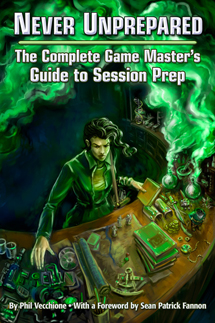
Never Unprepared – A Review!

Recently I was given a sneak peek at Engine Publishing / Gnome Stew’s latest book, “Never Unprepared: The Complete Game Master’s Guide to Session Prep, and asked to do a review. Let’s see how it goes…

Recently I was given a sneak peek at Engine Publishing / Gnome Stew’s latest book, “Never Unprepared: The Complete Game Master’s Guide to Session Prep, and asked to do a review.  Now, I’m currently running a Serenity game – which has been great so far – but I admit that I’ve been very lackluster in getting those sessions ready (a common theme with my games, lately).  Since the producers of the book claim that “[It] will help you prepare for games faster, avoid common pitfalls, and have more fun in the process,” I immediately jumped at the chance.  Sure, I could do a review, but I was really more interested in seeing if it could actually help me prepare for my games better.  Let’s find out…

At a Glance

  • Never Unprepared – The Complete Game Master’s Guide to Session Prep
  • From: Engine Publishing (enginepublishing.com) and Gnome Stew (gnomestew.com)
  • Author: Phil Vecchione
  • Publisher: Martin Ralya
  • Pages:128, 9×6 (digest)
  • Price: $19.95 print + PDF bundle, or $9.95 PDF

My Initial Thoughts

The producers of Never Unprepared have already come out with  two well-received, high-quality role-playing game books.  This (coupled with the truth that I am in dire need of a session prep attitude adjustment) has given me high hopes that the book will deliver.

Upon cracking open the PDF, I’m met with what seems to be a professionally produced book.  The content is laid out nicely in a single column, Justified text format, with the occasional piece of art to break it up. We have Credits, a Table of Contents, a Forward, an Introduction, and a How to use this Book section.   That’s all fine, but I wanted to get to the meat of the matter – I wanted to know how to prep my games better.

It wasn’t until I reached chapter 2, page 16, that I finally sat upright in my chair and began reading more intently.  Up to this point I was a little let down, because it seemed that the book was going to be nothing but fluff.  I don’t mind fluff, exactly, it just seemed like there was too much of it.  Perhaps the author had to fill the book up to 128 pages for production reasons?  I don’t know, but it was tedious.  I really feared that the rest of the book was going to be filled with a lot of, well, filler.

So, my initial impression was not good.

The Rest of the Book

The book offers a step-by-step process of getting ready for your game session, beginning with Brainstorming.  In fact, there’s a whole chapter on Brainstorming.  This is the kind of stuff that I like.  I like being shown and told what to do, and I like that it’s a step-by-step process.

Phil Vecchione’s concept of session prep includes five steps:

  1. Brainstorming
  2. Selection
  3. Conceptualization
  4. Documentation
  5. Review

Each step has a devoted chapter of it’s own, and each chapter includes tips, tricks, ideas, solutions, and even your own personal skill assessment.  I felt (after reading these five chapters) that I was finally starting to get my money’s worth (well, if I had paid for it, anyway).

The book goes on to include information on tools that you might use to help with your session prep (and ways to get the most out of them), and information on finding and developing a schedule to compliment your peak productivity.  To be honest, I felt the author had some good ideas on utilizing prep tools, but the amount of effort Phil puts into helping you find time (or the creative energy) for session prep is not necessary.  I found myself (once again) just trying to get to the next section.  Don’t get me wrong, it’s obvious that Phil knows what he’s talking about, I just don’t feel that the section of time and creative management applied to me.

However, immediately after forcing my way through that section, I’m introduced to the chapter, “Your Personal Prep Templates.”  If the step-by-step process that I mentioned earlier is the meat of the matter, the Personal Prep Templates are the delicious flavor.  Of course, the book (as a whole) should explain how to better prepare for a session (and it does), but this section alone seems to provide half its worth.  Earlier parts of the book help you prepare for the game, but this section helps you run it.  Please don’t mistake those two as the same thing, because they aren’t.  I guess I would say that the section on templates is a great little bit on how to improve as a GM, sneakily disgused within session prep.  I don’t know what else to say about it.  I simply found this section very interesting, eye-opening, and extremely useful.

The book concludes with information and ideas on how to prep using less-than-ideal time and situations, and helps you deal with prep under unusual circumstances.

My Final Thoughts

I was asked to do a review, but what I really wanted was to see if the book could improve my session prep, and thus, improve my game.  So, I put it to the test.  As I said earlier, I’ve been running a Serenity game with a minimum amount of session prep.  I’ve been lucky in that my group has seemed to enjoy every minute of it, even though I have not.  I’d forget NPC names, not know which direction to go with the story, and rely too often on food breaks to come up with ideas mid-game.  You could say that if the players didn’t seem to notice and were having fun, then I’m doing fine.  However, I don’t like the stress that comes with the uncertainty.

So, I spent some time preparing for the next session.  I specifically followed the step-by-step method (Brainstorming, Selection, Conceptualization, Documentation, and Review), and then I spent some more time developing my Personal Templates.  I wish I could tell you that our game was a raging success, but we haven’t played it yet.  In honest truth, I’m simply really looking forward to it.  I feel very confident, not that the session will run well, but that I will truly be the master of the game.  I’m not really worried about whether or not the players will have fun (I think they would enjoy it even if I was completely unprepared), I just know that I will enjoy it, because I’ll feel confident that I’ll be running a good game.

As far as putting the book to the test, I’m confident that it passed.  I am fully ready for our next session, and look forward to preparing future sessions.  I seriously doubt there will be any more procrastinating or flying by the seat of my pants, because I feel that I now have the tools to prepare correctly, confidently, and to full effect.

In Conclusion

For information on how you can get this book, click here.

I found Never Unprepared to be a long read.  I found myself getting impatient at times.  And I found myself thinking that the book could have been cut to half as many pages.  It wasn’t until page 16 rolled around that I started to find it interesting, and even then there still seemed to be too much filler content continuing forward.

I found Never Unprepared interesting.  I found myself saying, “I’ll have to try that.”  And I found myeslf looking forward to preparing and running my next game.  While different sections of the book will sing to different readers, I found two sections which seemed to have been written specifically for me.  I would describe the five-chapter step-by-step process as the meat of Never Unprepared, but I would say that  “Personal Prep Templates” is the section that solidifies its value.

I dare say that every GM could benefit from this book, and if I hadn’t gotten a preview copy, I’d buy one myself.

Make Mine Marvel

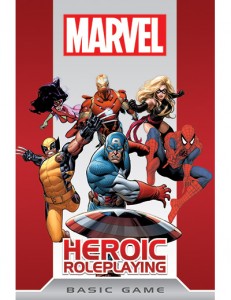
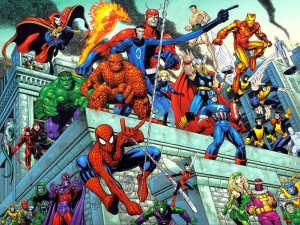
My players and I are between D&D Campaigns. I’ve got the opening scenes laid out in my head, but I’m just not ready for that pivotal first session. Knowing what I had on hand, I gave my players three choices: I could run their characters in our side campaign through some purchased adventures (D&D 4e), we could try the quickstart rules for DragonAge (closer to D&D), or we could try the new Marvel Heroic Roleplaying. To my surprise, the group that didn’t even want to try Pathfinder, chose Marvel!

I’m not going to walk you through every element of the game in this review. A number of people have done a great job of that. Check out Exploring Infinity’s excellent Marvel Page for an ever growing list of articles, if you need a little more context.

I’m going to hit some of the highlights and possible pit traps in this article. Maybe this will inspire you to run it. I hope it will, because it’s really a blast. My players are eager for new sessions beyond what was included in the basic game.

The Good

1. Gridless Done Right. There are no maps to speak of in this book. Even though Marvel has a line of miniatures, they made no attempts to even suggest using them. This is a blessing. None of the heroes are reduced in ability to try to make the game seem more balanced. With heroes like Iron man, or the Sentry, the party could quickly be in remarkably different locations and the game handles it with ease. It even encourages you to split the party and bring them back together. It mimics the action of comics quite well, while leaving you unrestrained by a 30 by 24 grid. If you’re curious how this is possible, its because nobody has a measurable movement speed. Distance is measured in narrative with bonuses for creative awesome (also called Stunts and Complications).

2. Accessible Setting and Characters. When playing a Marvel Video game where Cyclops, Captain America and the Hulk all need to stand side by side, you may wonder why they all seem to be doing similar amounts of damage. It’s all for game balance of course. Marvel Heroic Roleplaying does not weaken their most powerful characters so that everyone is starting equal at “Level 1”.

This makes the characters all the more accessible, because if you know what Thor can do in the movies or comics, you already have a great grasp of what he can do in game and can get started describing the action in Epic detail. The balance comes in by allowing characters to add more dice to their roll for thinking creatively and interacting with the narrative.

3. Doom. Not the Doctor, but the Dice. Marvel uses a great system where the Watcher (the GM) slowly builds more dice as the heroes roll 1s (providing opportunities), make use of abilities that have negative sides (like rage), or when other bad things happen. The dice build right in plain view of the table and really does add a creeping “oh no” factor to play. The Watcher can, in turn, use these to powerful effect in his own rolls, or end a scene that’s gone on a bit longer than is useful/fun.

4. Milestones. You don’t get XP for killings things and taking their stuff. You get XP for achieving your character’s roleplaying goals, even if its negative.

The Less Good

1. Assets, Stunts, Resources, Complications etc. Every game comes with its own baggage of jargon. However some of Marvel’s is really similar and are all based on the same mechanic. You need to read the rules, reference and play to really get a handle on things. I think its worth it. One of the most fun parts of the game is that the players have the ability to narratively change the scene. They may be activating a security system, breaking a wall or hijacking a plane, but to an extent they wield the power of the DM, because those elements don’t need to exist before the players establish them. It doesn’t work if you don’t understand your options. This post, also at Exploring Infinity, does an excellent job describing resources in terms of vehicles. I recommend you read it.

2. You have to read the whole thing. This may seem really obvious, but often we don’t do this. We read through the beginning to make sure we have the basic concepts down, and then we go play. I did this for my first session, and we still had fun, but I improvised a bit to make up for it. There are plenty of areas in the book that return to things it covered earlier in part, but then make it clearer or more distinct. You should read all the rules before running the game. If you’re going to run the included event, read the whole thing first. Don’t just skim it. Remember movement is very flexible, and the designers know this. The included event is not linear. There’s no encounter 1 and then encounter 2.

I found myself having more villains than I needed for each Act, which ensured I could be flexible with the story my players were helping to tell, but for the first session I wish I had a better handle on the resources I had available.

One final note. There was also a little confusion on how to buy the book. The date on Amazon changed while it didn’t change equally on the Margaret Weis website. You can get it now for 20 bucks at the main site. Save a few bucks from Amazon but you’ll have to wait until April 10th. The PDF is available at an even lower price. I went with the PDF and managed to run things just fine, however I probably will end up closer to even after my printed character sheets, and if I print the included event for PAXEast.

Speaking of which, if you’re not sold, come find me at the Convention. I plan to be running it. See a future post for more info on my PAX Schedule.

I think it’s clear from this review that I like the game very much. Its real A-level material.

I can’t close this article without plugging a great new site, Plot Points by Dice Monkey. I’ve already made great use of his sliding time table in my own planning, and new content is being produced every day. Show him your love.

FantasyMuse App: A Review!

I’m not really an app kind of guy (I’m pretty sure app is short for application). I’m simply way behind the curve when it comes to iphones and apps, that there’s no hope for me to catch up. My son, however, got an Ipad a few months ago, and I’ve since developed an unhealthy obsession with Litebike 2, so at least I’m not completely oblivious.

Recently I had the chance to try out an app called FantasyMuse. I had to have my wife help me download it, not because it was hard to download, but because I usually have to ask her for help with such things. She showed me what to do, and it was actually a cinch. Hey, I have a deficiency in Technology (-5), so this was a milestone.

Not knowing what to expect, I found FantasyMuse super easy to use, and pretty darn convenient – well worth the $1.99 that I didn’t pay for, but would have.

Ok, but what does it do?

“This universal iOS app generates three types of content specifically for writers of fantasy fiction and roleplaying game material. The app can generate millions of different character outlines, factions and quest seeds, and the app allows you to save your favorites via email or simply using the clipboard on your iPhone or iPad.”

Basically, if you need a quick idea for a character or an NPC, a group or faction, or even a quest, one push of a button is all you need. For example:

To me, this is something that I could definitely benefit from. As a player, it could give me ideas for not only my character, but my character’s friends, family, acquaintances, and enemies. I might use the Faction generator as something that I belong to (or once did), and the Quest generator as something that I’ve attempted in the past.

Of course, a game master would get MUCH more mileage out of this program than a player. Quests can be fun little sidesteps that distract the PCs from the over-arching adventure, or be inspiration for an entire campaign. As for Characters and Factions, well, I can’t tell you how many times that I (as the GM) have produced the same cookie-cutter NPCs and enemies – this stops that rut in its tracks, pronto. Your NPCs and villains will certainly be different and fresh, making them much more memorable.

I’ve seen other random generators before, but this one rarely (if ever) produced silly results. For me, the meat of it would be the Character generator, as I would use that on-the-fly in practically every session I ran (the world is filled with NPCs, after all).

This app is designed for both iPhone and iPad

  • $1.99
  • Category: Utilities
  • Released: Aug 19, 2011
  • Version: 1.0
  • Size: 1.2 MB
  • Language: English
  • Seller: Rasmus Rasmussen
  • © 2011 Rasmus Rasmussen
Rated 12+ for the following:

  • Infrequent/Mild Alcohol, Tobacco, or Drug Use or References
  • Infrequent/Mild Mature/Suggestive Themes
  • Infrequent/Mild Cartoon or Fantasy Violence

Requirements: Compatible with iPhone, iPod touch, and iPad. Requires iOS 4.0 or later.

I wholeheartedly recommend this app. And the fact that it costs only $1.99 is icing on the cake (I don’t really know what other apps cost, though). I apologize for not having more examples of it’s random results, but I guess the free code I got was only temporary. Bummer. I’ll have to ask my wife how to buy it!

The Dark Veil Campaign Arc – A Review!

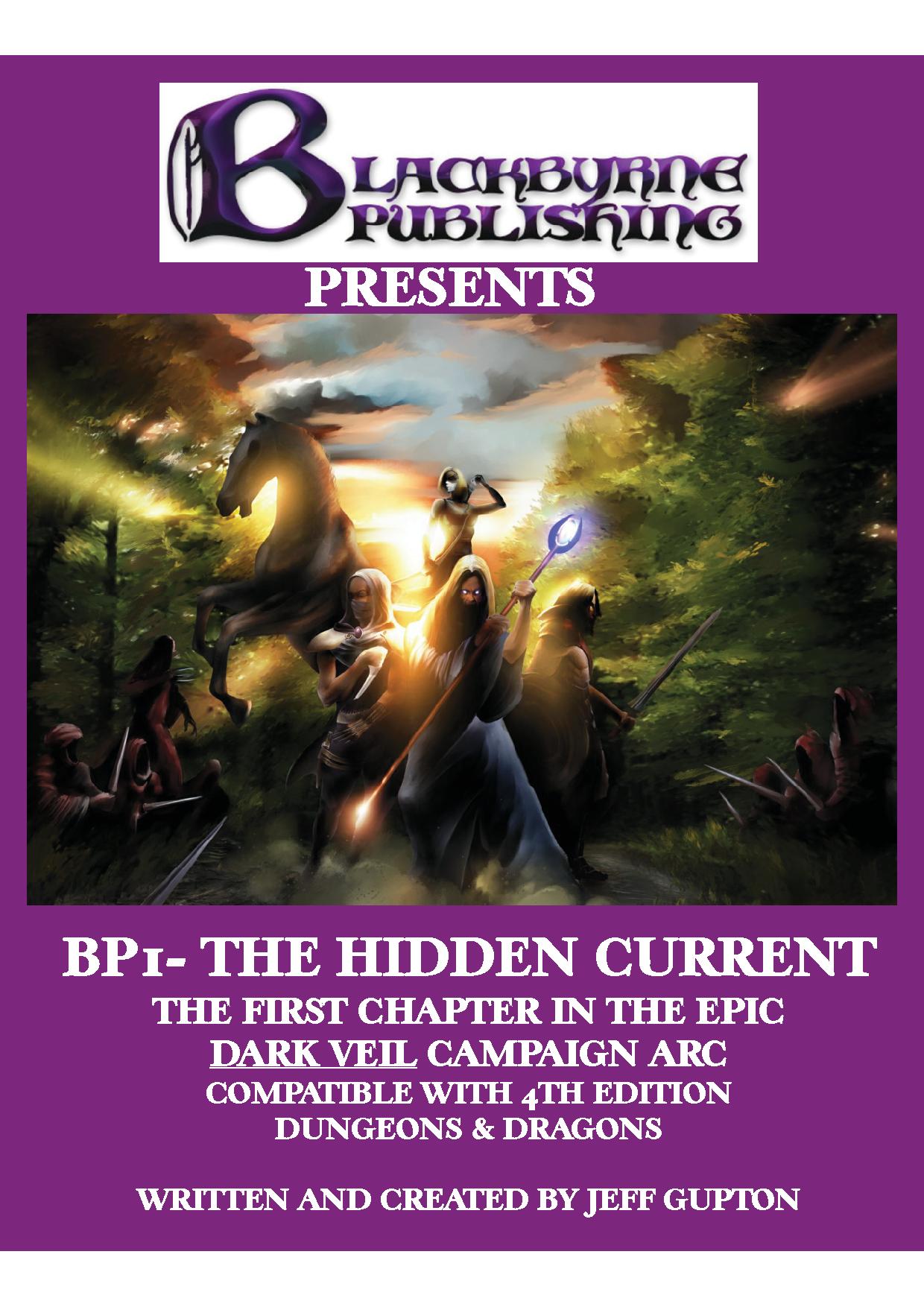
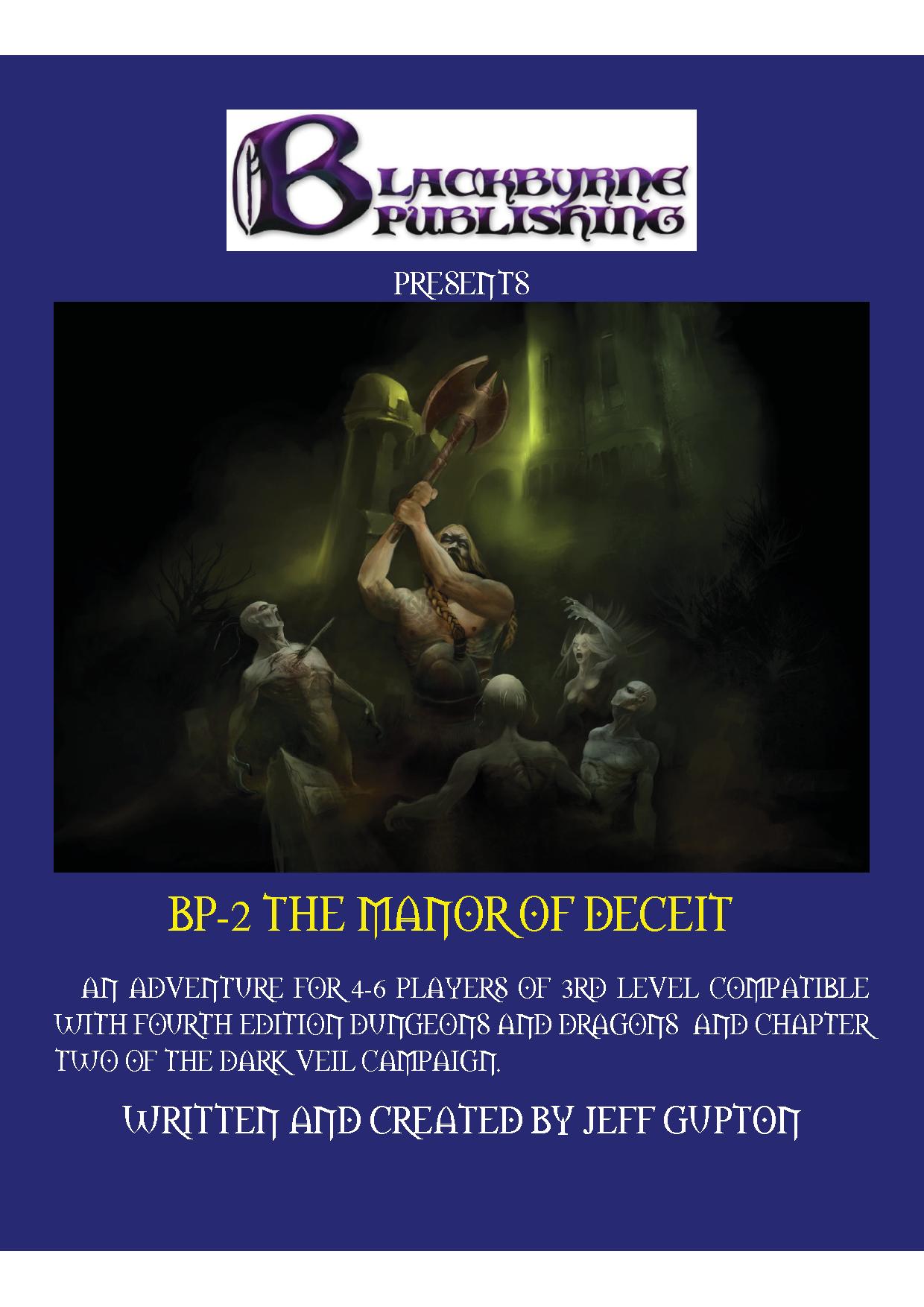
I have recently had the privilege to read through two adventures from Blackbyrne Publishing – The Hidden Current and The Manor of Deceit. These are the first two adventures in the Dark Veil Campaign Arc, written for Dungeons and Dragons 4th Edition. I received them as part of a contest the publisher was running as a random drawing among their twitter followers. In case you missed the memo, I like new content, so I was surprised but delighted to receive the adventures.

I received both adventures in print form, though they are also available in PDF. I will be reviewing them together in one article, as I think they benefit from comparison.

Warning: Yarr! There be spoilers ahead!

Story/Setting: The first adventure will take your players from 1st to 3rd level. It’s classic fantasy fair, with bandits, goblins, zombies and even a dragon. You’ll find a standard caravan guard mission that becomes much more, and, of course, everything is not as it seems. The second adventure takes you down river to a larger town to continue the story. Your players end up navigating a decrepit manor, with secret tunnels, more zombies, some pirates, and lizardmen! (Regular readers know I love Lizardmen).

The author makes a point of including multiple reasons why the party may choose, or be coaxed down, the adventure path. These motivations are revisited later in the adventures to keep people from wandering too far or finishing early.

The story really is classic D&D. There’s nothing revolutionary here, which I do not see as a negative. You’ve chosen to play D&D for a reason, so you probably enjoy some classic fantasy tropes. If not, this adventure may not be for you. I don’t want to make the adventure sound boring because it’s not. It’s just not jaw dropping, I don’t believe it!, exciting.

Standard races are mentioned such as humans, elves, and dwarves. Newer races, like deva, or dragonborn are not. If you decided not to continue the adventure path, or are looking for an adventure to add to your current world, adapting this will likely be easy.

Layout: Two columns, with decent sized text makes up most of the books. NPCs are fluff, with no stats unless intended to be fought. Each encounter area has read aloud text, a description, tactics, illumination, terrain, tactics and notes on how to scale encounters, up or down. Oh, and did I mention full color maps?

The maps are easily what makes this product stand out over the rest I’ve seen. The author used Campaign Cartographer to map out his encounters. You get a mini map as reference in each encounters notes. However in the back of the book, taking up about half the pages in each adventure, you’ll find all the maps printed to scale. Simple copy (or tear them like me) and match them up on the table. No drawing required. The maps are reasonably reusable too, if you take decent care of them.

The other neat feature is that nearly all of the monsters have stat blocks in their own section, separate from the encounters. At first, I did not like this, because it meant I was flipping back and forth allot between the sections. However, in combat, that sheet is getting ripped right out for quick reference. There’s even a little initiative tracker at the bottom of each page.

There are some issues with editing, such as a missing or misplaced word, or an extra period, but they are minor.

Art: The art for the NPCs in the first adventure is distractingly low quality. I’m not trying to be mean, but they appear to be quick sketches that never got a second pass. I would have rather that there was no art, instead of art at that level. The rest of the art however was fine. It was simple, black and white, and of a consistent quality that reminded me of older products. Again, nothing awe inspiring, but pretty good. At the end of the day, I’m not buying any adventure for the art. So average is probably the best for the price range.

Encounters: Encounters were my largest issue with the first book. All the stats are new monsters presented in the adventure. They get reused a great deal. Anyone out there that runs this adventure, I highly recommend grabbing your Monster Vault and mixing up your goblins and bandits a little bit. I feel like my players would get bored fast. There is slightly more variation in the second adventure, that makes this far less of an issue.

In the first adventure, I also found that the description of terrain would often seem to contradict the given map. It would say the camp is clear, when there are clearly tents, and give no notes on how to handle the tents. This, again, happened rarely, if ever, in the 2nd adventure.

My final problem with the encounters are some questionable choices in the monster stat blocks. Some things feel like they were not thought all the way through, or possibly not marked correctly. An example from the first book, has Anvil Bloodbeard with two Melee Basic Attacks. One is completely useless in comparison to the other: it does less damage, it has no status rider, and the creature has no power that triggers it, or allows him to use both. In the second book one of the Lizardfolk has a rechargeable ability that allows it to attack again on a hit. This additional attack deals 1 damage with no other effect. Considering it has to recharge, then hit, it hardly seems worth describing.

Despite the listed issues, the encounters were for the most part quite useable, and often contained something more than just another fight to get to the end.

Wrapping Things Up

The Good: Classic fantasy, that’s easy to run, with free reusable maps.

The Bad: Some art is quite poor for a paid product. Some issues with repetitive monsters, confusing stats and map terrain descriptions.

The Meh: There’s a lot I could buy with twenty dollars. I’m curious how much cheaper it would be if those maps were black and white. Classic fantasy is also easy to produce if that’s your thing. Nothing here is really new. If you have time to do it yourself, this may not be too useful to you.

Overall: C+. I could use this, and I don’t normally use published adventures. The maps alone may be worth half the price, since it’s already printed to scale. The again, its nothing revolutionary and there are some problems to work around.

The Adventure’s are available from Drivethru RPG. They cost 19.99 for print, or 11.90 for PDF. As of this writing they were on sale, so check it out fast. The author has also recently funded his campaign, Age of Lords, via kickstarter. There is still time left to fund the project even more, and get a first printing you must act fast.

Soldiers of Fortune, a Review!

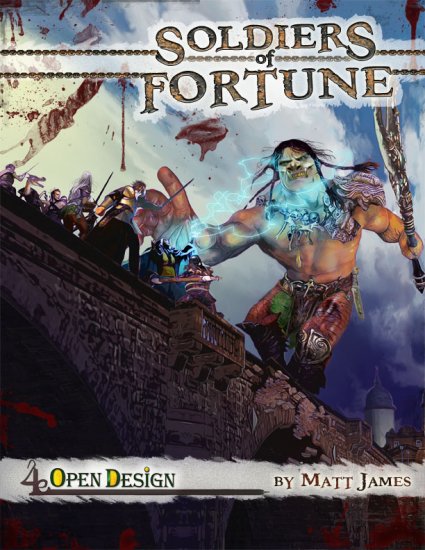
Soldiers of Fortune is a new book from Author Matt James and Open Design (the people who bring us Kobold Quarterly). It’s designed for 4th Edition and features the Midgard Campaign Setting, though the mechanics really are not setting-dependent.

The book features rules and ideas for Ward-based Adventures and Campaigns. It provides new mechanics for player characters as well as some new tools, and a lot of ideas for DMs. Heroes of Battle did something similar for 3.5, and it was one of my favorite supplements, so I was very excited to review this book and test it out. Let’s take a look at my initial overview. I do not promise brevity.

Book Contents and Initial Impression

Section 1: Going to War (6 Pages)

Going to War is more DM-oriented than player-oriented.  It breaks down the five main reasons a nation might go to war and provides essential story hooks for adventure building.  The hooks are designed so that each reason gets enough to drive a campaign from 1-30. This is followed by ideas on how to incorporate other war games into your D&D campaign as well as many individual scenarios that could be used as one-shot adventures, or dropped into a campaign.

This is really a primer of ideas for those who have never managed a war-based campaign before. Some of the scenarios are classic, while others a bit more unique. A couple of scenarios that really stuck out for me were the Variable Power Drain, where the very sources of PCs’ power were in flux and needed to be fixed, as well as Counterfeiting Cascade, which sets up an adventure where the PCs would need to discover and foil a plot of money smugglers working for a rival nation.

Section 2: Warfare in Midgard (9 Pages)

Warfare in Midgard breaks down into two areas. The first section talks briefly about each of the major races in Midgard, gives their reasons for going to war, and a little bit about how they go to war. It’s interesting and flavorful, but very brief.

The second section is on skill challenges, which I know is often one of many people’s least favorite elements of 4th edition. However, when we’re talking about the larger scale of battle, directing large swaths of troops and managing resources over long periods of time, it can be an elegant solution. I think Matt James shines here. These three challenges can be used right away, but also provide excellent models for you to base other skill challenges off of. They range from taking place over a few days to possibly stretching over an entire tier. Each skill challenge is scalable to different levels, so you can place the war in a convenient place for your grander campaign (if war is only going to be one part of it).

Section 3: Midgard Stratagems (7 pages)

This was my least favorite section. It’s primarily flavor, based around Midgard’s version of the Art of War. Individual treatises break down basic strategies and pieces of war. You can use it for adventure ideas, or as more primer if you’re unfamiliar with war scenarios for play. The most stealable parts for me were the PC backgrounds that were slid behind each section. All in all, the theme of the writing (this fake Midgard war text) almost made it feel more like filler than content for me. I can’t imagine this was the intent, because there are plenty of sections that would have benefited from a few more pages. The two legendary generals at the end are useful leader monsters, but not that compelling.

Section 4: New Powers and Paragon Paths (12 Pages)

This section is almost entirely for the player. The beginning breaks down the mercenary theme which is interesting, but because there’s no other theme I would feel compelled to open it up to other character types. There’s a handful of feats, useful but small in number. That’s followed by few pages of powers, mixed among different power sources. It seems primarily martial, primal and arcane, but you’ll find divine and a couple of psionic and shadow. While some players might disagree, I like the low-ish numbers for these options. It’s difficult to get players using options that can’t be found on or easily added to the character builder. I’m glad that the feats didn’t take up much room for this reason.  A couple of feats were circumstantial and thematic enough that they could be given as bonuses to players without worrying about balance issues. The powers are generally useful on or off the battlefield, but are certainly flavorful. They’ll probably be the most compelling reason to get players away from the DDI-only content.

The Paragon Paths are mixed. They each seem well-balanced, but they’re almost plain compared to some of the options players already have. They last two hold a bit more weight for me. The Spellscourge Mercenary is a spear-wielding arcanist who hunts others down, and the final payout on the Sacrosanct Legionnaire allows you to embody the Avatar of War.

Section 5: Spoils of War (9 Pages)

This section contains items, standards and rituals. Neither of these areas is particularly bloated, which is excellent since players already have an overwhelming number of equipment options. I found the items to be very creative. They’ll interest any players who love story, and I expect players to use them in very unique ways. The standards contain a lot of fluff, which is fine for what they are. The rituals are heavily war-themed, and generally useful in specific instances. They’re the kind of thing I’d expect a quartermaster to stock and give out for specific missions.

Section 6: The Battle of Sanguine-Crag Pass (8 Pages)

Short, sweet, and ready to get you moving. If you don’t have time to create something yourself using the other material in this book, then this can give you something to do in one night. It’s designed for 7th level characters, and the individual elements are very stealable. Otherwise, it’s not a great adventure, but certainly not a bad one.

Section 7: Monsters, Minions and Templates (24 Pages)

The largest section of the book, because it’s chock full of stat blocks. The templates at the front were the most surprising to me. I do not like the templates presented in most books. I generally find templates to be a bit of work that does not pay in the end. A lot of templates from other sources are either not easily used or do not create balanced elites.

Not so with these templates. They make clear sense and can be dropped onto most humanoids to create specific types of warriors for combat. Many have flavor that easily inspire specific types of encounters built around them. For example, the Jittery Conscript does not change the role or xp worth of a creature at all, but instead adds bonuses and a drawback to represent troops forced into war. Counter to that, the Patrol Captain and Quartermaster each have subtle leadership abilities that might make their allies more dynamic, without using overly complicated abilities you must keep track of.

The monsters are broken down by region. Each section gives a lot of flavor text about each region, a little history and how they go to war, before presenting a couple of monsters. The monsters are alright, and could help you quickly fill out some encounters that are specific to one nation of Midgard. I was happy to see some of templates being used, but overall I did not find the monsters terribly dynamic. I don’t know that I would spend the time to copy over these stat blocks when I have a lot of base creatures easily copied from the Monster Builder. Big exception to this was the Goblin Bomber, which is a minion that literally blows itself up. Not a new concept, but very fun and well-executed.

The regional information was very interesting, though, and a good precursor to the Campaign Setting being worked on (for those interested in running Midgard).

At the very end is a short sampling of siege engines and how to use them. While the section was short I was excited for them because it’s something I know my players are interested in. The rules were clear, made sense and were easy to use. I wish that a few more examples were included, but what was presented was easily skin-able and scale-able.

Prepping the Playtest

I decided that I really wanted to use some of the Paragon Paths (so the characters would be level 20) in order to gain their final powers. I also decided that I would pre-generate the characters, in order to increase play time. I set the adventure as a flashback in my own world, in order to make it relevant to the current campaign (my playtesters are my players after all).

I almost immediately got frustrated. In 4th edition, by 20th level, you have a lot of powers. In order to keep play moving you really need to have powers written out, with the math. Plus, my players are used to this due to the Character Builder. I adapted the Google Spreadsheet Character Sheet I made for Living 4th edition on ENworld for this purpose. I had intended to make six characters in this way, four of which featuring the four Paragon Paths. I ended up only making two. Even with this tool, it takes a long time to make higher level characters when you need to write out all the powers and abilities.

I also discovered some typos in the powers, or missing information.

Next came the Adventure. The Seige skill challenge for the first encounter worked well and needed almost no adaptation. I just grabbed the skill DCs off the Sly Flourish Ultimate DM Chart. Most of the creatures in the book were for lower levels, but I grabbed the Peak Wizard (Elite 17, Controller) and the Enchanted Tatzlwurm (25, Skirmisher Swarm). I found issues in the stat block with both. The Peak Wizard was missing ranges on some of his powers, and the Tatzlwurm’s Noxious Breath power was oddly formatted. Looking back over other entries showed similar issues, and none of the powers have keywords. I can easily make them up as needed, but I’d rather have a complete monster.

The Playtest

The Playtest went quite well. The characters started with the Seige, and failed. I had two different encounters next, depending on Success or Failure. Because failure meant less active soldiers and holes in the cities defenses, they got ambushed by lurkers and the peak wizard during a late night planning session. The PCs were then drawn into the main battle that was overwhelming the city, until they met with Giant General and prime guard. They just happened to bring the Enchanted Tatzlwurm with them in a big magic pot on sticks (think Arc of the Covenant). We didn’t get all the way through the final encounter due to time.

I asked for feedback and the first thing the players told me is they wanted another shot. They wanted to play the encounter they would have faced if they had won the skill challenge, face the whole final encounter, and play with these characters again. That’s an excellent sign for the book. Some also asked for access to the spreadsheet I used so that they weren’t tied to the character builder and its limitations. Considering my main worry was players not wanting to do the work involved with using non-Wizards of the Coast material, this was my test of success.

Their favorite parts were the Paragon Paths, which they really enjoyed. The other powers were mixed between ‘Meh, it’s alright’ and ‘Awesome’. Do to my quick prep on some of the other characters, I think some of the powers tested just weren’t appropriate for the character it was given to. They thought the monsters used were balanced and interesting, but it wasn’t their highlight.

Let’s Wrap it Up

The Good: The Player Powers and Paragon Paths were big hits, as well as the idea of Siege Engines, even if they didn’t get much play yet. The templates and skill challenges were the best tools for me, the DM, and I don’t normally like templates. All of the crunch is easily transferable out of Midgard.

The Bad: I would be very happy to see this get another round of editing for a new pdf. There are just too many problems with the stat blocks for powers and monsters. In addition, I did not find much value in the Midgard Stratagem section.

The Meh: There’s a lot of fluff about Midgard in here. It’s interesting stuff, but until I have the Midgard Campaign Setting, which is going to take a little while, this is downgraded to being maybe stealable in bits and pieces.

Overall: This book gets a solid B+. Most of the things I had problems with were annoyances more than issues, and had easy fixes. A great bit of it is instantly useful in a fun and engaging way. My players liked it enough to do more work, which is saying a ton for the quality of the material. This will positively see good use in my campaign.

The Book goes on sale today. You can buy the hardcover here (18.95) and the PDF here (9.95). Soldiers of Fortune will also be available from DriveThruRPG, RPGNow, Paizo and e23.

Now if you excuse me, I need to work on getting a few more pregens properly done, and rebalance the last fight a little bit. My players did demand more, and I’m itching to apply one of those templates.

Rule #23: Zombies Don’t Like Propane. A Zombie Cataclysm Review

About a month ago I got a request to do a review for a new game, Zombie Cataclysm. I thought, “Sweet! Someone values my opinion, finally!” Then I thought, “Oh crap, what if I don’t like it? Can I do a negative review?” Then I said, “Sweet! Someone values my opinion, finally!” In the end, I just said to myself that I didn’t know the owners of this game, I don’t owe them anything, and that I could do this. Now, I don’t know the “correct” way to do a game review (or if there is correct way), so I’m just going to tell you:

  • My initial thoughts.
  • What the game offers.
  • How the game played.
  • My final thoughts.
  • Would I play it again?

So let’s get started…

This game is about killing zombies.  No, this game is about YOU killing zombies.  What would you do if your neighbors began turning into flesh eating walking dead?  Well, now you get to find out.

  • By Lance Meyer and Joe Bozlinski
  • Paperback, 76 pages
  • Color Photographs
  • PDF $15, Paperback + PDF Bundle $23
  • No ISBN

MY INITIAL THOUGHTS

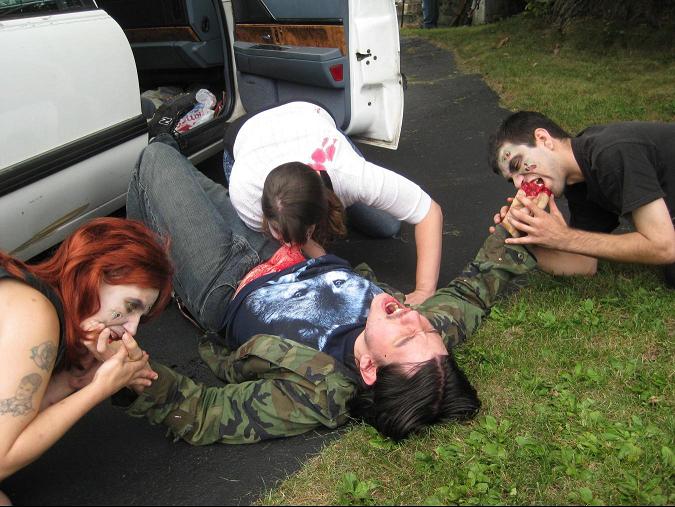
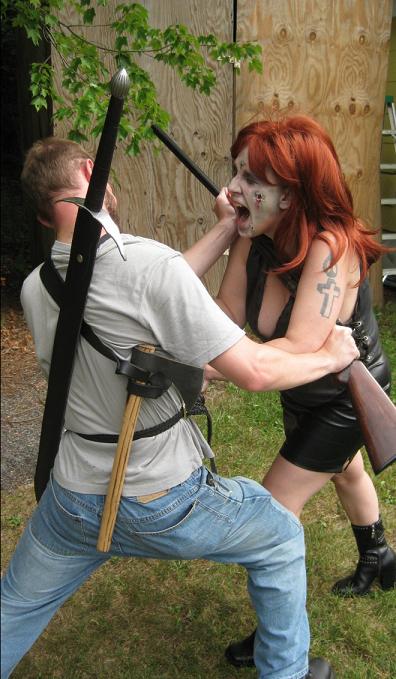
I’ve recently gotten into a lot of zombie movies, and I’ve actually wanted to try out a game of some zombie killing.  So when I got the request I was immediately stoked.  Then I was sent the PDF and was immediately disappointed.  No art.  It’s all photographs.  It looks like the writer got a few gaming buddies together, gave some of them weapons, and others some zombie make-up, and then started taking pictures.  Where’s my art, damn it?

The game was written and printed in Word, double-column, Times New Roman, left-aligned, on plain white paper.  Aside from the various photographs, there’s no other graphics.  The pages look like they were written and printed right off a home printer.  If there is ever to be a second printing, I’d like to see the text justified, and each page to have some background graphic, like a little bit of blood (or something) – plain white paper just does not look professional.

Once you start reading, you quickly see that the writer is speaking directly to you.  Most role-playing games read like a professional manual; this reads as if the writer is sitting right next to you, telling you about the game and its rules.  At first, I was a little put off by this, but my opinion eventually changed, and I’ll explain why later.

You’ll immediately realize that this is a game written by a gamer, and published on a budget.  Because of that, I felt that my play-testing of the game was going to be a bust.  To be honest, I was not looking forward to it.

  • My initial thoughts: Disappointed.

WHAT THE GAME OFFERS

I’ve said it already, and I’ll say it again.  Zombie Cataclysm is about YOU killing zombies.  Or, it’s about you getting your brains eaten.  Whichever.

I was happy to see that they have their own reason for the cataclysm, and even material for a long-term campaign.  The book goes into detail about things your characters should be doing, and gives some options for survival.

Something that I found useful were the various encounter tables.  For instance, the player characters are going to need supplies.  They are going to need to raid some stores.  There are easy-to-use (seemingly realistic) tables for determining how much a particular store has already been raided.  So, nobody knows if a raiding run will be successful.  Nice.  There are also tables for hazards and roadblocks, random zombies roaming around – that kind of thing.  It’s great because in most games, when the GM sets up an encounter, you usually expect to get through the “level appropriate” encounter with a “somewhat loss of resources.”  Not necessarily so here.  Letting the dice dictate the encounter really adds tension and drama.  Again, nice.

When making your character, you’re expected to play yourself.  Basically, when putting yourself down on paper, you’re given a lot of leeway when plugging in the numbers.  The game has ways of determining your stat and skill ratings, but it all boils down to how you view yourself.  If you think you’re smart enough to have an 18 Intelligence, based on the guidelines in the book, put it on your sheet.  And no, the GM does not police your character.

Lots and lots of weapons.  Hey, when you’re fighting zombies, you need to know how much damage a tire iron does.

Lots and lots of skills.  Way too many skills.  I don’t think in my zombie games, anyone is ever going to need to know how well they sing, or how skilled they are at crafting jewelry, or how proficient they are in 60 other skills.

The character sheet is not so much a character sheet as it is a giant list of skills.  A designated place for weapons and gear would have been nice (and professional).

The game mechanic is so very “rules lite.”  When reading the rules of the game, I was again disappointed.  But, I have to remember that I’m definitely a “rules medium” kind of gamer, and this was nowhere near that.  Actually, I’d have to call it “rules very lite.”  For success-based skills, you roll a d20 and try to get under your skill rating.  For difficult tasks, your skill rating is cut in half, and then cut in half again, etc.  Opposed skills (like melee combat skills) are just the opposite – roll a d20 and add your skill rating – high roll wins.

HOW THE GAME PLAYED

So, we sit down at the table and the players start making their characters (themselves).  I had already printed out the sheets, and highlighted about 12 skills on each sheet.  We didn’t have all night to make characters, and I thought these 12 skills were the most relevant to the game.

After reading the book, I felt the game was designed to move quickly.  Action and zombie-eating combats seemed to be a torrid gorefest of in-your-face violence.  So, that’s how character creation went.  I did not want to spend an hour letting everyone figure out if they had a 10 in Strength, or an 11.  So, as we sped through character creation, I was actually pleased at how everyone at the table really got into statting themselves out.  Does Colin really have an 18 Intelligence?  Well, he is pretty smart, and according to the book, he does.  Does Stacey really have a 16 Strength?  Well, he is the strongest in our group, and according the book, he does.  To be honest, I almost cared that some stats may have been… exaggerated.  To be even more honest, I actually liked that they were.  Character creation was just a fun 15 minutes for us, and I think it set the tone for the game.

Most of us in the group have children.  So, right off the bat, I had to write them out of the game.  They were all either on vacation somewhere or at a friend’s house (children really have no place in a zombie game).

I was a little peeved at the very start of the game due to Colin not paying attention…

I started the game by saying that everyone had just sat down to play Deathwatch (but that I couldn’t make it).  I mentioned a loud noise, like a low-flying jetliner, and then later there was an odd snowfall, which they could see was actually some kind of ash.  So, Colin is actually standing at his front door looking out and I’m thinking, “Dude, are you gonna play, or what?  This is my first time running for this group and you’re not even interested.” No, he was actually in-character, “looking” at the ash outside, pseudo-larping his role in my game.

Nice.

And that’s how the night went.  Immediately, people were bringing (physically bringing) baseball bats and flashlights to the table, they were closing blinds, talking about an access way into the attic, saying what parts of the house to avoid for fear of zombies seeing movement, and so on.  I just about flipped over when Melissa brought the whole damn set of kitchen knives to the table.  And, it was pure gold when people started discussing what they knew, or thought they knew about zombies (you know, Shaun of the Dead, Zombieland, etc.).  Of course, Stacey brought his big truck to gaming that night, so traversing over the hills was no problem (I did make sure to sideswipe his shiny new truck, though).  On a side note, having a bunch of matchbox cars and trucks to put on your battle map is just cool, especially when some of them are flipped on their side.

I don’t know if it was the genre, or the fact that everyone was playing themselves, but the night just flowed.  I kept the pace fast and furious, which brought everyone that much further into the game.  In the end, lots of zombies were killed, three players had been bitten by zombies, and the players aren’t sure if any of those three are going to end up zombiefied.  We’ll have to see next time…

I had a probelm with one part of the game, and that was movement.  For a game that involves a lot of deadly combat with zombies, I think movement should be pretty clear, and not abstract, especially when it is very easy to get killed.

So, I made a quick and very effective house-rule.  Cut your Speed rating in half, and that’s how many inches you can move in one action.  It worked very well on the battle map, and no one ever had any problems.

MY FINAL THOUGHTS

At the end of the night, I thanked everyone for playing.  I reminded them that we played this game so that I could do a review, and I wanted some honest opinions.

Everyone agreed that this game was not professionally done, but that it was done well enough.  With the exception of our one house-rule, we didn’t have any problems with the very rules-lite mechanics.  I actually found that the rules-lite mechanics made it very easy to hand out bonuses and penalties on the spot. “You made your First Aid check?  Cool, now he gets a… +2 bonus to stave off the zombie disease.” It was actually kind of refreshing.

None of us thought we could play it as a weekly campaign.  We did, however, feel that we could play it as a filler game once every month or two, when we couldn’t play our regular game.  We felt it was perfect for some good old-fashioned zombie kick-assery.

So, I flat-out asked them, “Really, on a scale of 1-10, how much fun did you have?” Immediately, everyone said they were at either a 9 or a 10 on the fun scale.  They said this was a very fun night, and would definitely play it again.  That made me happy, because that is exactly how I felt.  I was really glad that the first time I ran a game for this group – it ended up being a win.

To be fair, I think you have to approach this kind of game a certain way.  It needs to be fast, dangerous, and hilarious.  The fact that you get to play yourself just adds to the mix.  Sure, if you die, there are rules for making a normal character, but a lot of the fun is trying to stay alive simply because you have a lot more invested in your character (after all, he’s you).

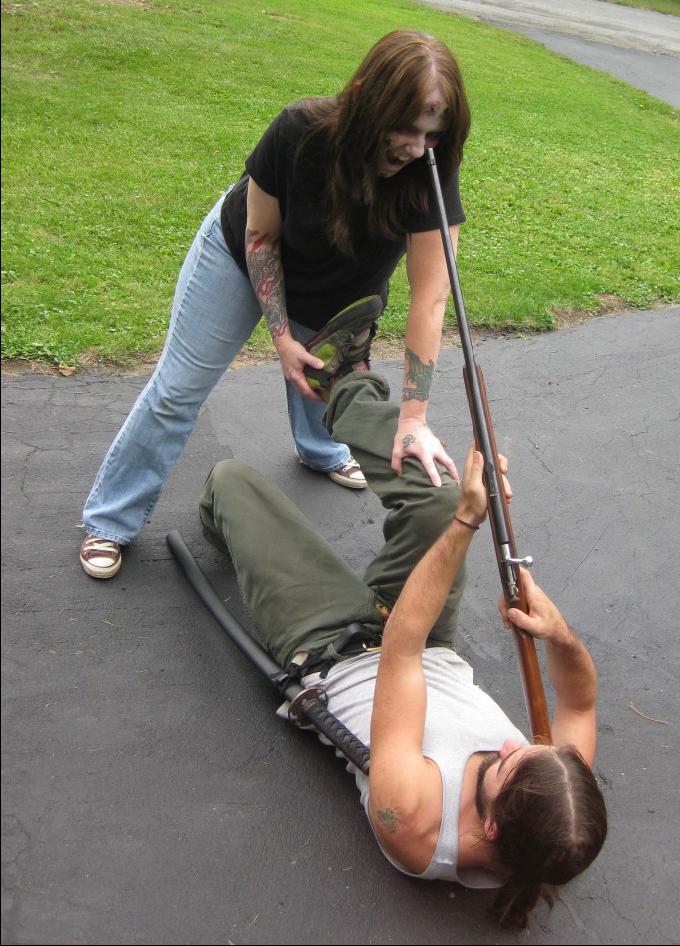
Something else that grew on me.  Earlier I said that the book is written as if the writer is talking directly to you.  I also said that there was no art; just photos.  Hell, I was actually concerned when I saw revolvers and bolt action rifles pressed up against the foreheads of some of these zombies.

But in the end, it all put me in the mood to play this slightly goofy game about killing zombies.  Zombie Cataclysm isn’t trying to be the next Dungeons & Dragons; it’s trying to be exactly what it is: a game about killing freaking zombies.  Sometimes I’m in the mood for watching a B-movie horror flick – and sometimes I’m in the mood for killing me some zombies.  I think the tone of the book is just right for getting you into the game – and the charm just grows on you.

The price for the PDF alone is $15.  I’m not really a PDF kind of guy, so for me, that’s a little on the steep side.  I think $9.95 is more reasonable.  If you have a few extra bucks and only want the PDF, then go ahead and get it here as an instant download.

However, for $23 you get both the paperback book and the PDF.  That, to me, is a great deal.  I would have bought that bundle, had I not gotten the PDF for free.  Now, after having played the game, I would recommend the bundle.  You can get the bundle at their homepage.

SO, WOULD I PLAY THE GAME AGAIN?

Hell yes.  Except that next time I want to kill me some zombies!  This is simply a great game to pull out for some good old-fashioned fun.

Oh, and the quote of the night was from Kayla, the seven year old who was watching us play.  John left an empty propane tank in the garage, and took the full propane tank as fuel they might need.  Kayla asks, “What, do zombies not like propane?”

No Kayla, no they don’t.  Rule # 23: Zombies don’t like propane.

Deathwatch: Best RPG… Ever!

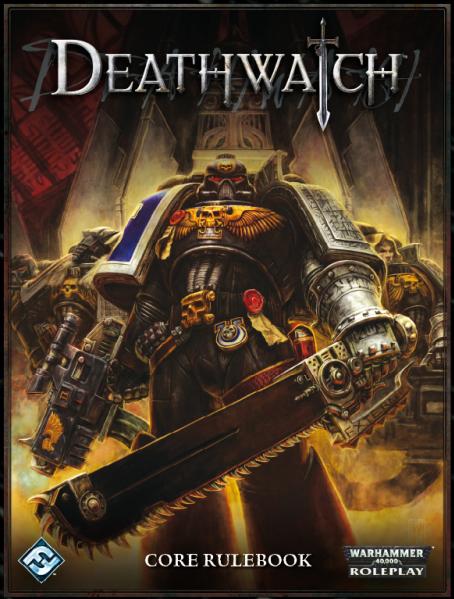
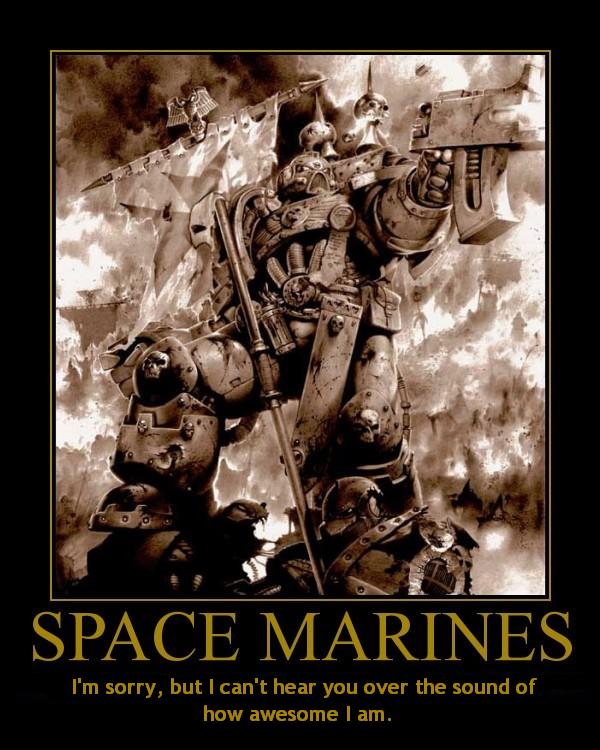
I’ve enjoyed a lot of different games over the years.  However, Deathwatch (the newest RPG from Fantasy Flight Games), has taken its place as my favorite roleplaying game of all time.  You heard right, all-time favorite.  For those of you unfamiliar with the basic concepts of the game, you can click here for a brief overview from FFG.

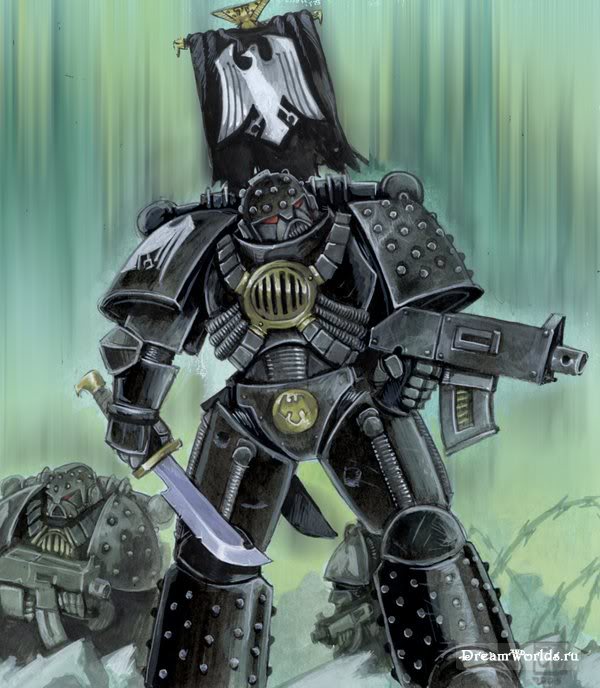
Deathwatch is the third RPG from FFG set in Games Workshop’s Warhammer 40,000 universe.  I enjoy the other two games immensely – Dark Heresy features players taking on the role of agents of the Inquisition, and Rogue Trader allows players to seek their own fortunes as explorers and merchant princes.  In Deathwatch, players take on the role of Space Marines – genetically enhanced, super-human warriors, who have been assigned to the Deathwatch and are dedicated to protecting humanity from threats too powerful to be dealt with by more conventional methods.

There are several reasons why this game has managed to top my charts, but before addressing them I’ll share a quick caveat: these are my opinions and why Deathwatch is my favorite game.  Here’s a little insight into the essential elements that I feel form the criteria on what makes a great RPG:

  • A well-developed, multi-faceted setting.
  • Characters with well-defined roles and a purpose within the setting.
  • A strong focus on teamwork and cooperative play.
  • Attention given to consequences and the cause-and-effect nature of the characters’ interactions with the setting and story.
  • Focus placed on the players’ choices and actions.
  • Rewards that go beyond the simple acquisition of “stuff.”
  • An “epic” feel.  I’m not necessarily talking about playing powerful characters, but playing characters whose actions matter to the story.

You’ll notice two things conspicuously absent from my list of game elements:

  • Mechanics.  So long as a game has easy-to-understand and internally consistent rules that don’t get in the way of telling a good story, I’m happy (and to me it’s very difficult to be superior to FATE for storytelling, though Deathwatch doesn’t use FATE).
  • Roleplaying.  I have always felt that the responsibility to provide good roleplaying is on the players and the GM.  It’s not the game’s responsibility to do the roleplaying, although it shouldn’t get in the way of roleplaying either!

With that being said let’s look at the reasons why Deathwatch puts me in my gaming happy-place:

STYLE & SETTING

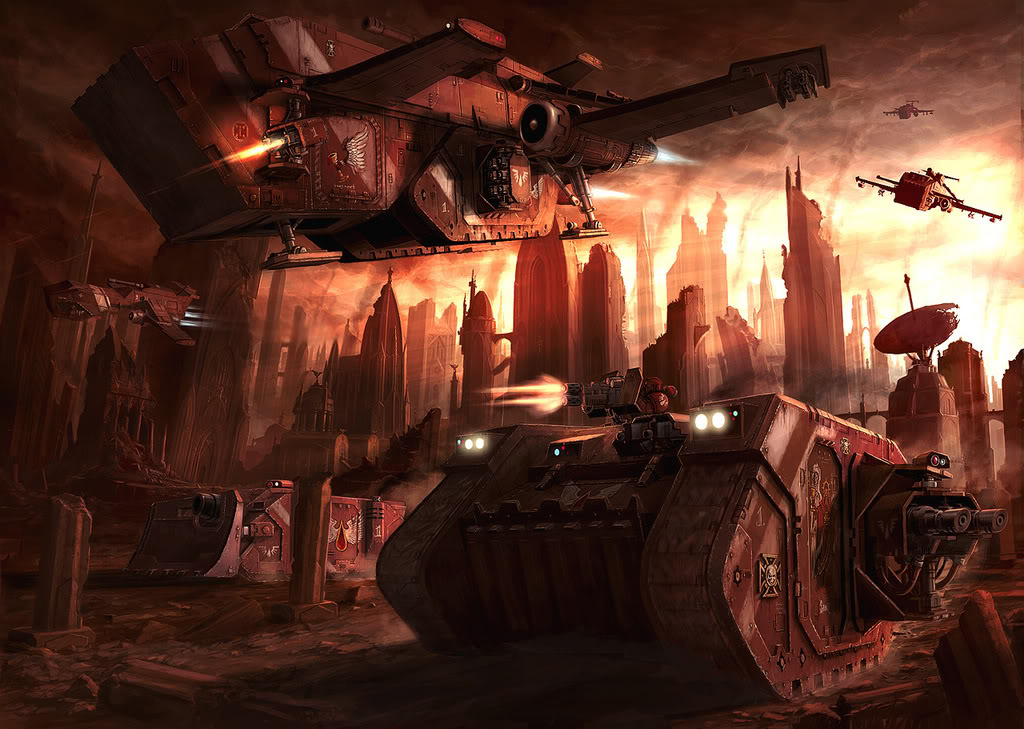
The Warhammer 40K setting has been around for nearly 30 years, and there are an incredible number of games (miniature, board, card, and electronic), novels, web-sites, and even an upcoming feature-length movie detailing the setting.  In general, I’m inclined to not play a game with that much ancillary material in existence; “cannon” tends to ruin the enjoyment for me, making the game feel restrictive and repetitive.  However, FFG has done a fantastic job of blending what the fans “know” of the setting with the creation of a local area (the Jericho Reach) for the game, full of details and hooks, all of which serve to inspire without restricting.

For those of you unfamiliar with the setting, it can be hard to describe easily.  On the surface, it would be easy to think of Deathwatch as sci-fi, what with the spaceships, weapons, and aliens.  However, the Imperium of Man is an ancient institution that relies more on faith and superstition than knowledge and technology.  This gives the setting its heavy gothic feel with strong overtones of the supernatural and mysticism.  To me, the Warhammer 40K setting is more accurately described as “sinister fantasy meets medieval horror set against a grim science fiction backdrop.”  That’s kind of a mouthful for a genre, but the best I can do to capture the setting’s style, feel, and tone.  Style and setting are two of the elements that make Deathwatch a superior game for me.  Dark gothic fantasy trappings (aspects I invoke easily), blended with an oppressive and grim future just begging for heroes that might bring a flicker of light into the unending darkness.

Another element of style that speaks to me is the setting’s interesting dichotomy between moral absolutes and ambiguous shades of grey.  Space Marines, and mankind as a whole, view the galaxy in absolute black and white – aliens are blatant threats to mankind’s divine right to rule the galaxy, heresy must be purged lest it corrupts the Imperium from within, and the demonic forces of Chaos lurk everywhere waiting to spread their evil taint.  No extreme in service of the God-Emperor is too great in the protection of mankind from the myriad of threats lurking across the galaxy.

This mindset is clearly forged into the PC’s, as they are the ultimate defenders of humanity, literally built for it.  For me as a GM this is a great opportunity to really illustrate to the players the consequences of their characters’ actions by placing them in complex situations where they must make major decisions that don’t have easy answers.  Here are a few examples of the type of moral decisions that can frequently come into play in Deathwatch:

  • Do you kill a world in order to protect the galaxy?
  • Should a heretic be brought before justice or do you serve as judge, jury, and executioner?
  • Not everyone’s priorities are the same, where do yours lie?  To the Deathwatch?  Your Space Marine Chapter?  The Imperium?  Maybe even to yourself?
  • What do you do when faced with aliens who desire to serve the “greater good” and believe that sentient beings can live together in peace and work toward each others mutual aid?
  • There’s a fine line between ignorance and heresy – can you tell the difference?

These are just a few examples of the kind of moral dramas that play out so very well in Deathwatch.  For me, what makes these much more powerful than in other games is the default role in which the characters are defined.  They are Space Marines.  They are the greatest defenders humanity has ever known.  They are the servants of the God-Emperor.  They are the Deathwatch.  What the characters are impacts every decision they make.  However, what they are doesn’t necessarily offer any clear answers to the dilemmas they face.  They must choose, and live with the consequences of their choices.

For me, there are a few other elements of style that really set Deathwatch apart from other RPG’s.  I’m not suggesting that any of these aren’t present in other games, just that in Deathwatch they are moved to center stage and surpass such things as the quest for power or the acquisition of loot. To me some of the most interesting include:

  • Duty
  • Honor
  • Courage
  • Leadership
  • Loyalty

In many games these concepts rarely come up.  If they do, it’s most likely only relevant to one character and probably doesn’t impact the whole of the game.  As Space Marines of the Deathwatch, all of these concepts are built into the characters by the very nature of who they are and their role within the setting.  However the interesting thing to me is how these concepts will manifest for each individual character as well as for the Kill-Team as a whole.  It is the way each player interprets and embodies these concepts that makes the game really take on depth and nuance.  These are the details that make characters feel more three-dimensional than your typical RPG characters, ones that are forever embroiled in the “adventure to gain experience and stuff; go up in level and use stuff to go on adventures” cycle.

SCOPE & FORMAT

Deathwatch is a game that is epic in scale.  Although the heroes’ actions will never be known by those they protect, their mission is among the most important in the galaxy.  Entire worlds live or die based on the actions of the characters.  But even with this kind of power and responsibility the heroes still struggle against a never-ending tide of unimaginable threats – hordes of enemies too numerous to count, vile fiends too horrible to contemplate, and threats that seek only to eradicate humanity from the galaxy.  This kind of scope gives Deathwatch real weight and substance.

In addition to the nature of the setting and the roles the players take, Deathwatch achieves this level of epic scope through several means, many of which also appeal to my criteria for a superior RPG.  These specific game elements and concepts include the following:

  • Patronage:  As Space Marines, the characters are members of a monastic warrior cult, the Deathwatch, and they serve the Imperium of Man by the grace of the God-Emperor.  By the very nature of their role the characters are part of the Imperial war-machine.  This gives the players purpose and patronage.  However, as part of the super-elite Deathwatch the players have a great deal of autonomy and are free to carry out their missions as they see fit.  In this way the game has found the perfect balance between duty with purpose, and freedom to make choices and act.
  • Missions: By default, Deathwatch scenarios are organized into Missions.  For me, the Mission format is fantastic.  It gives the players a clear sense of purpose and well-defined goals, but doesn’t limit them in any way as to how they accomplish those goals.  It also means that play tends to focus on making important choices and executing decisive actions.  I’ve played in way too many games where the “adventure” is trying to figure out what the adventure is.  This isn’t to say that Deathwatch puts everything on a silver platter for the players.  Objectives can change, intelligence can be erroneous, and nothing ever goes as planned.  Overall, the Mission format gives direction (in the form of Objectives), but allows for real decision making on the part of the players as to how, and which, Objectives to complete.  As GM, I simply find the Mission format easy to work with and design for.
  • Leadership: The idea of PC leadership is one that many RPG’s intentionally shy away from – not so in Deathwatch.  Every mission that a Kill-Team is sent on will have a designated leader.  The team leader is the one who is ultimately responsible for the success or failure of the mission (at least in the eyes of the team’s commander), and is responsible for making decisions when the team can’t reach a consensus.  The choice of team leader also impacts Cohesion (see below) and dictates which Oaths a team can take before a mission.  Oaths grant the team special abilities for the duration of the mission.  Every single character will have something different to offer if they are team leader, so it becomes an important decision on the part of the players as to who will lead any given mission.  What I love about this is that it allows the “leadership baton” to be passed around from mission to mission.  It’s great to see that normally reserved, quiet player come out of their shell when they have to step up and take command of the Emperor’s finest!
  • Renown & Requisition: Most RPG’s put an emphasis on the acquisition of treasure and loot.  To me, this can sometimes cheapen the feel of the game.  Space Marines are far beyond such petty needs as piles of gold or magical trinkets.  In Deathwatch, the primary reward for successfully completing a mission (besides mere survival) is Renown.  Renown is a point-based measure of the character’s success, reputation, and accomplishment.  Although irrelevant to those outside the Deathwatch, Renown comes into play through the nature of the game’s Requisition aspect.  Space Marines are always assumed to have the basic gear that is necessary for their specialty (power armor, bolter, etc.).  In addition, at the start of a mission, after the initial briefing, players can “purchase” additional equipment based on their perceived needs for mission success.  What they can have is based on Renown and Requisition.  Requisition is a point “budget” given to each player based on how difficult the mission is thought to be.  Each player may “buy” additional equipment with these points.  However, all items have a minimum Renown level that the character must meet in order to be trusted with the item in question.  I’ve found that this system lends itself to interesting encounters with the Deathwatch arms-master and the players seem to really enjoy the tactical aspect of selecting a limited amount of gear to accomplish their mission, especially since these decisions may be based on faulty intelligence (not that I’d do that to my players!).
  • Solo Mode & Squad Mode: One of the more interesting aspects of Deathwatch is the inclusion of two “modes” of operation: Solo Mode & Squad Mode.  Solo Mode is the default mode for each character and conceptually works just like every other RPG out there.  This is the mode where players take actions and do stuff as individuals.  Squad Mode (on the other hand) is a very different beast.  When the characters meet the conditions to be in Squad Mode, their abilities and options available are greatly increased – they can support and defend squad mates better, and become a more effective combat unit.  In Squad Mode, Space Marines really shine, and their legendary combat prowess becomes obvious.  However, the ability to retain Squad Mode is dictated by Cohesion.  It takes a strong leader and players who focus on teamwork to make the most of Squad Mode, which is another one of the reasons why Deathwatch is in my number-one RPG spot.


All of these things contribute heavily to my criteria for Deathwatch being not only a great game, but my all-time favorite RPG – and this game has it in spades!  For some, this game may be easy to dismiss as a combat heavy, hack-and-slash gore-fest with little room for “real roleplaying,” but don’t be fooled, it’s anything but.  Deathwatch will surprise you with its depth, its complexity, and its ability to bring out the best in your players as they adopt to roles they may not be used to.  It’s exciting to see the party “tank” deal with the consequences of his actions, or the quiet girl at the table thrust into the spotlight as team leader, or the “over-thinker” forced to take action.

If you’re looking for a game with action, excitement, intensity, and the potential to invoke some serious dramatic roleplaying, look no further than Deathwatch.

If this game sounds like it would be fun, you can get it here, or download here.

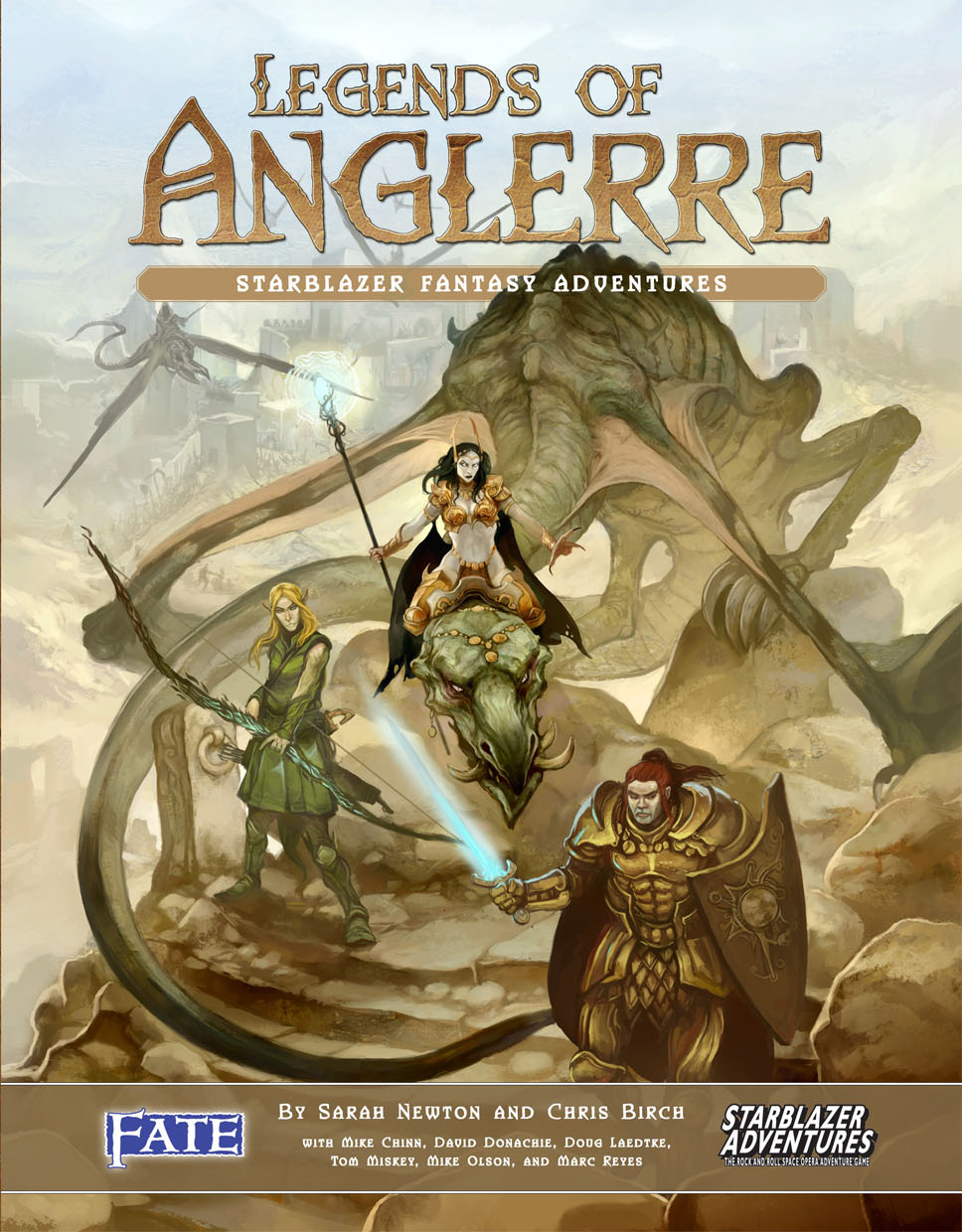
RPG Review: Legends of Anglerre

I buy a lot of RPG’s that I’m never going to play.  In fact, for most of the games I buy, I do so intending on simply using them for inspiration or for exposure to new rule systems.  A friend recently turned me on to the FATE system, and all I can say is that I can’t believe it’s taken me this long to start using it.  I’ve been aware of FATE since the release of Spirit of the Century, but neither me nor my gaming group are really into pulp adventure, so unfortunately I let FATE pass me by.  Now, however, Cubicle 7 Entertainment has released Legends of Anglerre, and at last I have a FATE RPG in my preferred genre, fantasy.

Let me start by saying that I almost missed this game.  Why?  Well frankly when it comes to fantasy RPG’s, I’m not really looking for a specific setting, and I’ve never even heard of Anglerre or the Starblazer Adventures comics that inspired the setting.  But upon closer examination I was pleased to discover that only one chapter, sixteen of the book’s 378 pages, is about Anglerre as a setting.  The other 362 pages are much more accurately described as “The Fantasy Toolkit for FATE”.

Right up front, this is a beautiful book.  The layout and design are top-notch, the index and the contents are user friendly, and numerous sidebars and examples allow for easy understanding of the game.  The artwork is all black and white panels, apparently from the original British comic series.  It took awhile to grow on me, but I like the consistent look and style.

Mechanically, this is my favorite iteration of FATE (having recently read Diaspora, The Dresdin Files, and Spirit of the Century).  For those of you unfamiliar with FATE, it is a narrative-based game that strongly supports player contribution to both the story and setting.  Characters are quick and easy to create, and are defined by their Aspects (short descriptive phrases) instead of lists of numeric data.  In fact, when we tried Legends of Anglerre using the quick-play character generation system provided, five of us made up characters and were playing in literally 10 minutes.  Full-blown character generation might take as long as 30 minutes or so.

In addition to character generation and rules for basic actions, Legends of Anglerre includes an excellent system for creating other elements in the campaign in a consistent and logical format.  You can easily create and define anything from a bustling city – to a secret organization – to an elite unit of spearmen, using the same basic system as used in character creation.  The beauty here is that all of these things can interact with each other in a variety of interesting ways.  This allows Legends of Anglerre to include rules for other things, such as mass combat (say between a castle and an invading orc horde) as well as interactions between organizations (such as a thieves’ guild and local constabulary).  All of this meshes completely with character scale mechanics and systems.  In addition, one of the coolest components of Legends of Anglerre are the chapters dedicated to running the game, creating stories, and building campaigns.  Regardless of the game you’re running, there is fantastic advice here for any gamemaster.

Overall I give legends of Anglerre my highest recommendation with only one caveat, and that has to do with the FATE system itself.  Without going into a lengthy discussion of the way FATE works, you should know that it is generally a “rules light” system.  For those of you needing more “crunch,” FATE may not be for you.  This isn’t to say that the system is lacking in anything, just that it’s not about lots of math, hard data, and five-page character sheets.  However, for those of you looking for an extremely flexible fantasy system, one that places the emphasis on storytelling over mechanics, and are not afraid of letting players make some of the decisions about the campaign, then Legends of Anglerre may be exactly what you are looking for.

So, if you like story over mechanics, and narrative over data, or you’re just a fan of FATE, then do yourself a favor and pick up this game.   As for me, Legends of Anglerre has definitely become my game of choice, and the vehicle by which I want to tell fantasy stories.  In fact, I’ve already begun work on my next fantasy campaign, and can’t wait to put Legends of Anglerre into action.

Editor’s note: Sadly, Legends of Anglerre has been discontinued, but you can still get copies at Amazon!

Review: Check Out These Cool Dice from Q-Workshop!

For the longest time, I’ve meant to get some dice from Q-Workshop, but I kept putting it off.  Then I read a great review by Bartoneus about them and I was sold.  So, I made my order, got my dice, and couldn’t be happier.

Then, I was talking to my buddy Mateusz over there in Poland (all of us internet dudes are buddies, right?) and I mentioned that I was going to have a contest soon, and would be giving away some of his dice.  So, he sent me some extras! Let me tell you about what came in the mail…

I open up the box and the first thing I see are the packages for their regular dice.  I know what you’re thinking, “Who cares about the dice package?” Well, I do – It makes for a good first impression.  Their newer Classic dice don’t get the same special treatment, but I can live with that.

First up, we have Q-Workshop’s Classic dice.  I got two different sets: the Black and White Classic dice, and the Blue and Red Translucent dice (both retail for $4.95).

I have to say that at first I was disappointed by the Translucent Blue and Red dice.  Not only do they not look like the picture from Q-Workshop’s website, but they were hard for me to read as well.  I showed them to my wife and she said that they were simply beautiful.  Then she went on to remind me that I’m partially color-blind, and have trouble seeing red.  Damn you evil eyes! She said that she hoped no one picked these for the upcoming contest because she’d like them for herself.  I said, “Yeah, good luck with that.”

Next up are the Black and White Classic dice.  I gravitated towards these immediately, as they are more my style.  They have the same design as the Translucent dice, but are solid black with white numbers.  I can tell you that, regardless of the race/class of character that I might be playing, if he were a bit sinister-like, these would be the dice for him.  I just think these dice would eat up any character that was associated with the words: honor, principled, or good.  Hey, the dice want what the dice want.  It’s best not to fight them on this.

Now for the Forest dice and the Celtic dice. I have to say, I love these, especially the Celtic 3D.  These are the type of dice that I would use for a great character, one that I was proud of making and looked forward to playing.  Both retail for $16.00.

The Forest dice have a very nice design, but they’re a little hard to read at first.  However, after just a short while, I got used to it – that’s when I really started to appreciate them.  These are perfect for Druids, Rangers, Seekers, Wilden, Wood Elves, etc.  Obviously, they’re good for any nature-loving characters out there.  I would use these over my favorite set of dice for any of those types of characters – it just adds a little something to the game, and helps reinforce a character’s character.

The Celtic 3D dice instantly found a place in my heart, and have moved into the top spot as my favorite set of dice.  They have a nice design and a more solid contrast.  They’re just cool.  I’m pretty much going to use these for most of my player characters, and all of my NPCs when I run games.  I just think that they’re that damn good.   While the Classic dice are very easy on the pocketbook, the Forrest and Celtic dice come in at a heftier price tag (but not too hefty).  I think they’re priced just right.

For the longest time, my group has had a ritual at the start of the gaming session: We take our huge bags of dice, dump them in front of us, and then handpick the dice that we’d be using for that night.  We do this every time.  Well, I can tell you that from now on I will be breaking that ritual, and pulling out my “Danger Dragon Dice Bag.”

So, to all of my old dice that have been residing in my velvety purple Crown Royal bag all these years – I’m sorry, but you just can’t share a bag with the new dice.  Actually, we might even have to go our separate ways.

Q-Workshop, check them out.