FATE (Fantastic Adventures in Tabletop Entertainment) is a generic role-playing game system originating from the FUDGE gaming system. It’s designed to offer the least possible obstruction to role-playing while encouraging the most amount of creative storytelling (by GMs and players).
In October of 2010, Mike McConnell and Voidstar Games published Strands of Fate, a stand-alone Fate system for any setting. His follow-up book, Strands of Power, was published about a year later, and his new book, Nova Praxis, is slated for an early 2013 release. If you’ve followed our Playing with Fate series, you’d know that we’re big fans of the game, and eagerly look forward to all products from Voidstar Games. So, of course, if I get the opportunity to talk with Mike McConnell, you know I’m going to take it…
Thank you for talking with me about Nova Praxis. There have been several different versions of the Fate system used for several different Fate games. Your Strands of Fate is a system that has finally pulled together several of the best Fate ideas (as well as adding your own great elements) to end up with a complete, setting-neutral Fate system. Can you please tell me how and when you decided it was time to create Strands of Fate, and what resources you may have used?
A few years ago I got this idea for a sci-fi setting that I just fell in love with. (This was the seed from which Nova Praxis would spring.) So, naturally, the first step was nailing down the system I wanted to use. I believe I started with GURPS, moved to Savage Worlds, and then to Cortex.
I was hard at work on the Cortex version when I learned that Evil Hat was working on a Dresden Files RPG using the FATE system. At that time, I’d never read FATE, but I was a huge Dresden Files fan. So I decided to give it a closer look. I read through the SRD, and then learned that Starblazer Adventures had just came out.
FATE sci-fi? Sold!
Switching gears to Starblazer, I eventually came to realize that I wanted to use FATE for all sorts of games. But there were some things about the current incarnation of the FATE 3.0 system that I felt needed to be tweaked if it were going to function as a universal toolkit. So I put the setting aside and started working on a generic version of FATE that I could use for all my games.
One thing led to another, and with the success of Lulu, self-publishing began to look feasible. I went into it thinking that if I could sell a hundred copies or so, that’d be enough to justify the extra effort it took to transform my notes into Strands of Fate.
Two years later, it has sold around 2700 copies. All things considered, I consider it an astounding success.
You’ve written Strands of Fate, Strands of Power, and soon we’ll see your new Strands setting, Nova Praxis. How does this hard sci-fi setting differ from other futuristic settings?
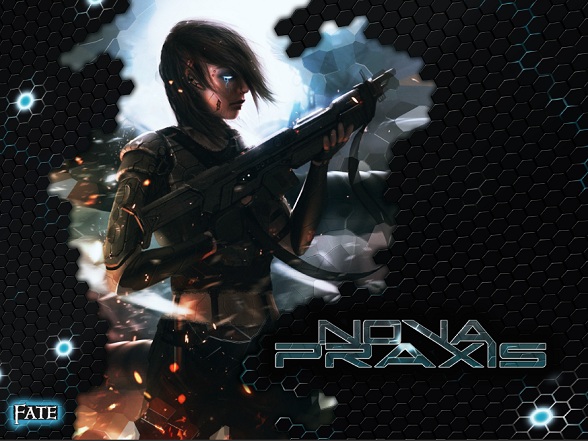
To summarize it, Nova Praxis is a post-singularity sci-fi setting that explores transhumanism and post-scarcity societies against a backdrop of action, adventure, conspiracy and intrigue.
There have been some games that have touched on some of those elements before, but I think Nova Praxis has a few things going for it that make it rather unique. The first is the dedication to making the setting believable. I describe it as a hard sci-fi setting with optimistic projections of technological advancement. The setting owes a lot to authors like Richard Morgan, but just as much to folks like Ray Kurzweil and Peter Diamandis.
I’ve spent the last three years carefully watching tech trends, trying to get a grasp on what sort of technologies the characters in the setting might utilize. Nova Praxis takes place after the technological singularity. The singularity concept, by its very nature, means we can’t know what happens next. People have proposed a number of different scenarios, but the one we’ve gone with for Nova Praxis is that the singularity gave birth to an AI of nearly godlike intelligence.
It was chosen because I found it incredibly fascinating, and it provides a good foundation for an RPG. While not actually much more intelligent than a genius-level human mind, Mimir (the AI) was capable of thinking around 10,000 times faster. It only stayed active for about three months before mysteriously shutting down. But what could a genius level human mind (that never forgets anything, never gets sick, and never takes breaks) create in nearly 2500 years?
Mimir’s “birth” and subsequent “death” resulted in a paradigm shift in humanity’s technological evolution. Instead of trying to invent the next big thing using the previous big thing as a starting point or inspiration, humanity shifted its focus to combing through the nearly incomprehensible data logs Mimir had created before it “died”.
So the next thing I’d say Nova Praxis has going for it is the exploration of a new technological paradigm. Humanity uses advanced technology that they really don’t understand. It’s not magical, but computers in Nova Praxis are several orders of magnitude more complex than the systems today. And as a result, it’s impossible for a human to completely understand. Thankfully, Mimir anticipated this and designed these systems in such a way that humans could still write programs and customize the systems for specific applications. They just can’t hope to understand the deeper layers of the operating system.
Except, of course, the Savants…
Originally published in Strands of Power, the Savant can run unrestricted software (called “SINC, short for Self-Interfacing Neural Code”) on a computer implanted in his brain (called a “mindset”). This allows them to hack computer systems by directing their own Agent (a sort of virtual personal assistant) against the target computer’s security Agent. Access may be short-lived, but the effects can be very powerful. Drones can be possessed. Security sensors can be tapped. etc.
They can even do more advanced stuff like directing their Agent to compile security feeds, personnel profiles, local statistics, psychology reports, and all manner of other data to create relativity accurate predictions of the future or readings of the past (effectively making appear precognitive or postcognitive). Security feeds from other locations can be hacked, granting the Savant a sort of clairvoyance. Other people’s mindsets can be attacked, causing them to see augmented reality objects that appear real, or simply causing them pain, blindness, etc.
Or maybe the Savant just wants to tap into the target’s mind/machine interface to listen to their thoughts. And if that fails to illicit the desired result, he might direct his personal swarm of nanomachines to pick his enemy up and hurl him across the room, or solidify into a blade and impale him, flow over the Savant and become armor to resist attacks, or flow over his target and rip him apart molecule by molecule.
The Savants are the “psychics”, “wizards”, or “priests” of the setting, and despite no supernatural ties, and are often viewed by non-Savants to be just that sort of thing. They perform miracles with technology.
And lastly, Nova Praxis allows characters to download their minds into new biological or synthetic bodies (called “sleeves”), or upload their minds onto a computer server. A device called a mnemonic core keeps a backup of the character’s mind, which can be used to download the copy into a new sleeve, resulting in a form of immortality.
The setting also explores the idea of a reputation-based economy, and a number of other post-scarcity ideas.
Some of this is familiar ground to fans of Eclipse Phase or Transhuman Space, but we’re putting our own spin on it.
What was the hardest part of developing this setting? I’m talking about the creative aspects – trying to envision the RPG’s society, use of tech, tech level, character concepts, types of proposed game sessions, and so on… what was the most challenging?
I had a vision of what I wanted the future to look like, and what I wanted the characters to do. So the challenge became figuring out what believable events and technological advancements would have to take place along the timeline to get from here to the future I envisioned.
As an author, it’s really easy to say “It just works this way, you figure out why,” which is just another way of saying “A wizard did it.” I really didn’t want to lean on that. While it’s impossible to cover all the bases, I felt that in general, it all had to make sense to me. Now, in some cases Mimir became the “wizard” that did it, but that’s in keeping with the post-singularity theme and is a major feature of the setting.
Other things, like figuring out how a reputation-based economy would work, took a lot of studying and problem solving. After all, I’m no economist. That may have been the most difficult. I had to figure out how it would work in the world itself, and then translate it to game mechanics.
Fortunately, I was able to answer one of the biggest questions I was struggling with before Strands of Power came out, and that was: “How do you put magic in a setting where there are no supernatural elements?” That question was eventually answered by the Savants.
There were tons more. Nova Praxis is the result of more than three years of problem solving. And up until recently, only a very small percentage of that time had to do with game mechanics.
A reputation-based economy? That seems interesting. I look forward to seeing that in action. Now, Nova Praxis is post-singularity, and you already talked about the Savants. I assume that means we’ll see human characters, transhumans, AIs, cybernetics, and so on, and I get the feeling that there will not be alien characters. Can you go into a little detail as to the types of characters that are available?
In the current version of the playtest, you decide what “state” your character is in during character creation. Your choices are:
Pure – Pure characters are normal humans unmodified beyond some basic tweaks to insure good health. They may then decide if they want to take any cyberware and/or wetware augmentations.
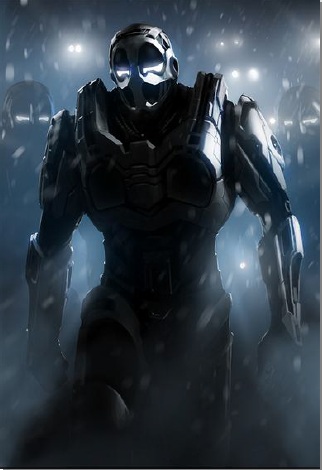
Sleeved – The character has undergone Apotheosis, the procedure that gradually transforms your mind into software. The mind is then downloaded into a new “sleeve.” Characters of this type get to customize their sleeve in a number of ways, including augmentations.
SIM – SIM is short for “Substrate Independent Mind.” In short, you don’t have a body. You exist on a server, in a virtual environment, and interact with the real world via sensors, drones, etc.
Humanity has not yet discovered any sentient alien races. Though some choose to augment themselves beyond the limitations imposed by the law, and these posthumans often become something very alien indeed.
Can you give a one or two paragraph description of what a typical adventure/mission would be like?
The types of scenarios Nova Praxis is designed for revolve around shady back room deals, corporate espionage, conspiracy and intrigue. The default assumption of the setting is that the characters are members of a crew of specialists who are able to sort of slip between the cracks in society.
So you may be tasked with retrieving information, hunting someone down, stealing a hot fabrication template, planting false evidence, etc.
That’s no to say that’s the only way to play. The “crew” structure is there to provide a jumping off point, but the setting is going to be open to other campaign styles. There is no reason you can’t play the loner detectives or members of a military unit.
You talked earlier about the most challenging part of developing this setting. On the flipside, what aspect of the game’s design was the most enjoyable?
That’s hard to answer. I think the same things I list as being the most difficult were at the same time the most enjoyable.
From a game mechanics standpoint, figuring out how the different states work was a lot of fun, as were the augmentations and savant programs.
I understand that Nova Praxis uses an evolution of the Strands of Fate system, and is designed specifically to support the setting. What kind of evolution are we talking about?
Strands of Fate is a just a big toolkit right? It generally provides at least two ways to accomplish most any campaign design goal. So you pick the tools from the toolbox you need to build your setting.
Strands of Fate is the toolbox. Nova Praxis is an example of what you can build with those tools.
So, what you’ll see in Nova Praxis is a specific configuration of the rules and optional rules in Strands of Fate that best fit Nova Praxis. And of course, we tweaked some things a bit, and added new systems for things like resleeving and the reputation economy.
Strands of Fate has generally been received with open arms among gamers, especially Fate gamers. One source of contention, though, has been its exclusion of skills. I imagine that (in general) defined settings might need their very own set of skills to help make the setting flow and help support game immersion. Will we see skills (in some form) in Nova Praxis?
Yes. This is something I wrestled with for a while. Initially, the plan was to use Strands’ Abilities, but the more I worked on the system, the more it became clear that Skills were a more elegant solution for a number of reasons.
The biggest reason, as you mentioned, is that Skills help define a setting. For example, Nova Praxis has a Skill called “Apostate Networking.” It exists because being able to call upon people in apostate society can be a valuable tool in the game.
Had the game used Persuasion instead, with an Advantage called “Apostate Networker” (or something buried in the Advantage list), its importance wouldn’t be clear. Worse yet, most players would never spend a precious Advantage on something like that.
The same goes for Skills like “Mnemonics” or “Cohesion.”
So, for now at least, we are working with Skills. It’s still early though, and you never know what changes may get made between now and release.
Many times, a defined setting book can benefit its gamers by providing a sample adventure. Will there be any resources to help gamers jump right in? How about supplements?
Yes, Nova Praxis will have an intro adventure in it. Or, at the very least, an intro adventure will be available on release day as a separate download or something.
As far as supplements go, it’s really too early to say. I’ve got some ideas, but I don’t want to commit to anything at this point.
You’ll just have to stay tuned!
I’m tuning in that dial right now…
Thanks again for chatting with me, Mike. As a fan of both Strands of Fate and sci-fi settings, I’m really looking forward to playing Nova Praxis.
My pleasure, and thank you as well.