Nova Praxis KICKSTARTER (Sci-Fi Strands of Fate)

Nova Praxis is the biggest endeavor of Voidstar Games, and its quality shows…

With several writers contributing to Stuffer Shack, you know we like and talk about a myriad of various games, systems, and settings.  One of our favorites is Strands of Fate.  We’ve talked about it several times, and even have a great Playing with FATE special project series.

Mike McConnell (author of Strands of Fate) is putting together a transhuman sci-fi setting for SoF, called Nova Praxis.  We’ve interviewed Mike about it, and Greywulf gave us a great preview.

Nova Praxis is the biggest endeavor of Voidstar Games, and its quality shows.  A Kickstarter project was started just a few days ago to help fund artists, writers, and printers, though this post is not designed to help the project achieve its funding goals (its already done that in just a few days).  The purpose of this post is to simply inform those who aren’t familiar with the game.  There are some good rewards and some great stretch goals, and Mike is very good about answering questions, so check it out!

A great video…

Interview with Mike McConnell, author of Nova Praxis (SoF)

Being big fans of Strands of Fate, if we get the chance to talk with Mike McConnell, you know we’re going to take it…

FATE (Fantastic Adventures in Tabletop Entertainment) is a generic role-playing game system originating from the FUDGE gaming system.  It’s designed to offer the least possible obstruction to role-playing while encouraging the most amount of creative storytelling (by GMs and players).

In October of 2010, Mike McConnell and Voidstar Games published Strands of Fate, a stand-alone Fate system for any setting.  His follow-up book, Strands of Power, was published about a year later, and his new book, Nova Praxis, is slated for an early 2013 release.  If you’ve followed our Playing with Fate series, you’d know that we’re big fans of the game, and eagerly look forward to all products from Voidstar Games.  So, of course, if I get the opportunity to talk with Mike McConnell, you know I’m going to take it…
Thank you for talking with me about Nova Praxis.  There have been several different versions of the Fate system used for several different Fate games. Your Strands of Fate is a system that has finally pulled together several of the best Fate ideas (as well as adding your own great elements) to end up with a complete, setting-neutral Fate system. Can you please tell me how and when you decided it was time to create Strands of Fate, and what resources you may have used?

A few years ago I got this idea for a sci-fi setting that I just fell in love with. (This was the seed from which Nova Praxis would spring.) So, naturally, the first step was nailing down the system I wanted to use. I believe I started with GURPS, moved to Savage Worlds, and then to Cortex.

I was hard at work on the Cortex version when I learned that Evil Hat was working on a Dresden Files RPG using the FATE system. At that time, I’d never read FATE, but I was a huge Dresden Files fan. So I decided to give it a closer look. I read through the SRD, and then learned that Starblazer Adventures had just came out.

FATE sci-fi? Sold!

Switching gears to Starblazer, I eventually came to realize that I wanted to use FATE for all sorts of games. But there were some things about the current incarnation of the FATE 3.0 system that I felt needed to be tweaked if it were going to function as a universal toolkit. So I put the setting aside and started working on a generic version of FATE that I could use for all my games.

One thing led to another, and with the success of Lulu, self-publishing began to look feasible. I went into it thinking that if I could sell a hundred copies or so, that’d be enough to justify the extra effort it took to transform my notes into Strands of Fate.

Two years later, it has sold around 2700 copies. All things considered, I consider it an astounding success.

You’ve written Strands of Fate, Strands of Power, and soon we’ll see your new Strands setting, Nova Praxis. How does this hard sci-fi setting differ from other futuristic settings?

To summarize it, Nova Praxis is a post-singularity sci-fi setting that explores transhumanism and post-scarcity societies against a backdrop of action, adventure, conspiracy and intrigue.

There have been some games that have touched on some of those elements before, but I think Nova Praxis has a few things going for it that make it rather unique. The first is the dedication to making the setting believable. I describe it as a hard sci-fi setting with optimistic projections of technological advancement. The setting owes a lot to authors like Richard Morgan, but just as much to folks like Ray Kurzweil and Peter Diamandis.

I’ve spent the last three years carefully watching tech trends, trying to get a grasp on what sort of technologies the characters in the setting might utilize.  Nova Praxis takes place after the technological singularity. The singularity concept, by its very nature, means we can’t know what happens next. People have proposed a number of different scenarios, but the one we’ve gone with for Nova Praxis is that the singularity gave birth to an AI of nearly godlike intelligence.

It was chosen because I found it incredibly fascinating, and it provides a good foundation for an RPG. While not actually much more intelligent than a genius-level human mind, Mimir (the AI) was capable of thinking around 10,000 times faster. It only stayed active for about three months before mysteriously shutting down. But what could a genius level human mind (that never forgets anything, never gets sick, and never takes breaks) create in nearly 2500 years?

Mimir’s “birth” and subsequent “death” resulted in a paradigm shift in humanity’s technological evolution. Instead of trying to invent the next big thing using the previous big thing as a starting point or inspiration, humanity shifted its focus to combing through the nearly incomprehensible data logs Mimir had created before it “died”.

So the next thing I’d say Nova Praxis has going for it is the exploration of a new technological paradigm. Humanity uses advanced technology that they really don’t understand. It’s not magical, but computers in Nova Praxis are several orders of magnitude more complex than the systems today. And as a result, it’s impossible for a human to completely understand. Thankfully, Mimir anticipated this and designed these systems in such a way that humans could still write programs and customize the systems for specific applications. They just can’t hope to understand the deeper layers of the operating system.

Except, of course, the Savants…

Originally published in Strands of Power, the Savant can run unrestricted software (called “SINC, short for Self-Interfacing Neural Code”) on a computer implanted in his brain (called a “mindset”). This allows them to hack computer systems by directing their own Agent (a sort of virtual personal assistant) against the target computer’s security Agent. Access may be short-lived, but the effects can be very powerful. Drones can be possessed. Security sensors can be tapped. etc.

They can even do more advanced stuff like directing their Agent to compile security feeds, personnel profiles, local statistics, psychology reports, and all manner of other data to create relativity accurate predictions of the future or readings of the past (effectively making appear precognitive or postcognitive). Security feeds from other locations can be hacked, granting the Savant a sort of clairvoyance. Other people’s mindsets can be attacked, causing them to see augmented reality objects that appear real, or simply causing them pain, blindness, etc.

Or maybe the Savant just wants to tap into the target’s mind/machine interface to listen to their thoughts. And if that fails to illicit the desired result, he might direct his personal swarm of nanomachines to pick his enemy up and hurl him across the room, or solidify into a blade and impale him, flow over the Savant and become armor to resist attacks, or flow over his target and rip him apart molecule by molecule.

The Savants are the “psychics”, “wizards”, or “priests” of the setting, and despite no supernatural ties, and are often viewed by non-Savants to be just that sort of thing. They perform miracles with technology.

And lastly, Nova Praxis allows characters to download their minds into new biological or synthetic bodies (called “sleeves”), or upload their minds onto a computer server. A device called a mnemonic core keeps a backup of the character’s mind, which can be used to download the copy into a new sleeve, resulting in a form of immortality.

The setting also explores the idea of a reputation-based economy, and a number of other post-scarcity ideas.

Some of this is familiar ground to fans of Eclipse Phase or Transhuman Space, but we’re putting our own spin on it.

What was the hardest part of developing this setting? I’m talking about the creative aspects – trying to envision the RPG’s society, use of tech, tech level, character concepts, types of proposed game sessions, and so on… what was the most challenging?

I had a vision of what I wanted the future to look like, and what I wanted the characters to do. So the challenge became figuring out what believable events and technological advancements would have to take place along the timeline to get from here to the future I envisioned.

As an author, it’s really easy to say “It just works this way, you figure out why,” which is just another way of saying “A wizard did it.” I really didn’t want to lean on that. While it’s impossible to cover all the bases, I felt that in general, it all had to make sense to me. Now, in some cases Mimir became the “wizard” that did it, but that’s in keeping with the post-singularity theme and is a major feature of the setting.

Other things, like figuring out how a reputation-based economy would work, took a lot of studying and problem solving. After all, I’m no economist. That may have been the most difficult. I had to figure out how it would work in the world itself, and then translate it to game mechanics.

Fortunately, I was able to answer one of the biggest questions I was struggling with before Strands of Power came out, and that was: “How do you put magic in a setting where there are no supernatural elements?” That question was eventually answered by the Savants.

There were tons more. Nova Praxis is the result of more than three years of problem solving. And up until recently, only a very small percentage of that time had to do with game mechanics.

A reputation-based economy?  That seems interesting.  I look forward to seeing that in action.  Now, Nova Praxis is post-singularity, and you already talked about the Savants.   I assume that means we’ll see human characters, transhumans, AIs, cybernetics, and so on, and I get the feeling that there will not be alien characters. Can you go into a little detail as to the types of characters that are available?

In the current version of the playtest, you decide what “state” your character is in during character creation. Your choices are:

Pure – Pure characters are normal humans unmodified beyond some basic tweaks to insure good health. They may then decide if they want to take any cyberware and/or wetware augmentations.

Sleeved – The character has undergone Apotheosis, the procedure that gradually transforms your mind into software. The mind is then downloaded into a new “sleeve.” Characters of this type get to customize their sleeve in a number of ways, including augmentations.

SIM – SIM is short for “Substrate Independent Mind.” In short, you don’t have a body. You exist on a server, in a virtual environment, and interact with the real world via sensors, drones, etc.

Humanity has not yet discovered any sentient alien races. Though some choose to augment themselves beyond the limitations imposed by the law, and these posthumans often become something very alien indeed.

Can you give a one or two paragraph description of what a typical adventure/mission would be like?

The types of scenarios Nova Praxis is designed for revolve around shady back room deals, corporate espionage, conspiracy and intrigue. The default assumption of the setting is that the characters are members of a crew of specialists who are able to sort of slip between the cracks in society.

So you may be tasked with retrieving information, hunting someone down, stealing a hot fabrication template, planting false evidence, etc.

That’s no to say that’s the only way to play. The “crew” structure is there to provide a jumping off point, but the setting is going to be open to other campaign styles. There is no reason you can’t play the loner detectives or members of a military unit.

You talked earlier about the most challenging part of developing this setting. On the flipside, what aspect of the game’s design was the most enjoyable?

That’s hard to answer. I think the same things I list as being the most difficult were at the same time the most enjoyable.

From a game mechanics standpoint, figuring out how the different states work was a lot of fun, as were the augmentations and savant programs.

I understand that Nova Praxis uses an evolution of the Strands of Fate system, and is designed specifically to support the setting. What kind of evolution are we talking about?

Strands of Fate is a just a big toolkit right? It generally provides at least two ways to accomplish most any campaign design goal. So you pick the tools from the toolbox you need to build your setting.

Strands of Fate is the toolbox. Nova Praxis is an example of what you can build with those tools.

So, what you’ll see in Nova Praxis is a specific configuration of the rules and optional rules in Strands of Fate that best fit Nova Praxis. And of course, we tweaked some things a bit, and added new systems for things like resleeving and the reputation economy.

Strands of Fate has generally been received with open arms among gamers, especially Fate gamers. One source of contention, though, has been its exclusion of skills. I imagine that (in general) defined settings might need their very own set of skills to help make the setting flow and help support game immersion. Will we see skills (in some form) in Nova Praxis?

Yes. This is something I wrestled with for a while. Initially, the plan was to use Strands’ Abilities, but the more I worked on the system, the more it became clear that Skills were a more elegant solution for a number of reasons.

The biggest reason, as you mentioned, is that Skills help define a setting. For example, Nova Praxis has a Skill called “Apostate Networking.” It exists because being able to call upon people in apostate society can be a valuable tool in the game.

Had the game used Persuasion instead, with an Advantage called “Apostate Networker” (or something buried in the Advantage list), its importance wouldn’t be clear. Worse yet, most players would never spend a precious Advantage on something like that.

The same goes for Skills like “Mnemonics” or “Cohesion.”

So, for now at least, we are working with Skills. It’s still early though, and you never know what changes may get made between now and release.

Many times, a defined setting book can benefit its gamers by providing a sample adventure. Will there be any resources to help gamers jump right in? How about supplements?

Yes, Nova Praxis will have an intro adventure in it. Or, at the very least, an intro adventure will be available on release day as a separate download or something.

As far as supplements go, it’s really too early to say. I’ve got some ideas, but I don’t want to commit to anything at this point.

You’ll just have to stay tuned!

I’m tuning in that dial right now…

Thanks again for chatting with me, Mike.  As a fan of both Strands of Fate and sci-fi settings, I’m really looking forward to playing Nova Praxis.

My pleasure, and thank you as well.

Playing with FATE – Using Resources

In the FATE system there is the Resource ability. The rules for Resource are very basic and, aside from purchasing goods, there does not seem to be many reasons to use it. The alternative to Resource is actually tracking money, so it’s nice that Strands of FATE stays consistent with the abstract nature of the game.  With a little creative thinking, Resource is a worthy ability that can benefit or hinder a character without adding any new mechanics (remember, hindering a character can be good!).  Here are some suggestions to make the Resource ability more important in any campaign setting.

For a description of Resource, think of it like the character’s Strength attribute. It is not a measure of raw wealth as much a measure of how well the character manages his financial resources. As an example, there could be two characters, each with a 3 Resource, but one is merely wealthy while the other knows how to shop for deals and barter when necessary. The net result is the same.

Aside from the suggestions listed in SoF, there are plenty of ways to use Resource. Usually, it’s used whenever someone needs to purchase something. When this happens, they take the cost of the item and use it as an attack against the character’s wealth track. If the character makes the target number or better, he afforded the item without any problems. If the character makes more than one purchase in a game session, each consecutive purchase is at -1 to defend. When a character does fail, he does not make the purchase. He also cannot purchase anything else at that value (or greater) for the remainder of the session. Optionally, he takes stress on the wealth stress track. Of course, stress heals quickly and unless it is a large purchase, taking stress is not much of an issue. Here are some suggestions for adding value to the Resource attribute.

Unless the character has a profession where their day-to-day expenses are easily met, a monthly maintenance roll is needed. This is a Resource roll against a target number (set below). If the character missed work, a penalty of -1 per week or less missed would be a good modifier against the roll.  The following is a guideline for maintenance based on lifestyle:

Very Poor: 0
Poor: 1
Average: 2
Moderately Wealthy: 4
Wealthy: 6
Very Wealthy: 8
Filthy Rich: 10

For games where adventuring is their source of income (i.e., private investigator, adventurers, etc.), this is a reminder as to why they work. The fact that they work is the reason within the game as to why their Resource is where they set it. If a character is working a lot of overtime or they find treasure, they could be given a bonus for that roll. The bonus helps give the player the satisfaction of putting in the extra work.

I run a fantasy game where treasure is part of the genre. My players occasionally hit the big score which gives them one-shot wealth bonuses. These are expendable wealth points that benefit a Resource roll at a one-for-one ratio.  It allows them to make those occasionally large purchases without raising their Resource attribute or going into debit on the wealth track. On one occasion, I had a player accumulate so many wealth bonuses (not spending them) that I allowed him to use them as experience points to purchase up his Resource attribute.

For some purchases, the characters will run into situations where some products are either rare or more common than back home. For these cases, a cost modifier is in order. I developed my table based on the D6 Adventure by West End Games. I got my copies through one of the many online gaming resource sites.

Cost target modifiers might look like this:

Very Common: -2 (This is when the PCs are located where the bolts of silk fabric are woven or the mines for the rare ore are located.)
Common: +0
Uncommon: +2
Rare: +4
Very Rare: +6 (It might be easier to go on a quest to acquire this item)
High quality goods: +2 (i.e., The sword does extra bonus, The dress is of high quality, etc.)
Low Quality: -2 (i.e., The item is damaged or used.)

Of course, there are plenty of other modifiers that could be used.

Even if characters make monthly maintenance rolls it should not affect their other purchases. Of course, if their maintenance target is above their Resource, a modifier would be in order. So would a maintenance below their Resource. This better reflects the limited resources the character has to live and how wasteful or frugal they are.

For normal purchasing rules, the cost settings are fine. For those GMs who like to use the wealth stress track, I recommend adjusting the money value higher per dollar to account for the fact a character can make a purchase by taking stress on their wealth track. Since the first couple of consequences are minor and easily recovered, the Resource attribute is actually more powerful with the stress track to benefit it. For this situation, I recommend that money follows the same linear track that Strength does in place of the standard quadrupling the money for each rank. I leave it to the individual GM to decide what the right balance is for them.

I also think that there should be a “Wealthy” power. It could follow the rules as Strength for how it escalates for the amount of advantage points spent. This means each rank of wealth is equal to one rank of size for lifting capacity. With a “Wealthy” power, antagonists can be brought into a game who have resources that only vast amounts of money can buy. A certain villain in DC comics comes to mind.

There are plenty of options for using the Resource attribute. Feel free to experiment. It’s a worthwhile attribute that can be used to manage wealth by any measure without the need for meticulous cash counting.

Did you spend your Fate Points today?

One aspect of the FATE system is the ability to alter the course of your (or your opponent’s) dice roll. However, the Refresh Rate is once per session, and the players may be concerned that there might be one more challenge around the corner and thus, need that fate point. As a piece of advice, spend the point if you need to; don’t save it for what might be around the corner. When a player does not spend available Fate points, they just end up being wasted.
For those who do not play the game, a Fate point is like a credit to modify dice rolls, or to cause an effect to enhance or change the story of the game.  The number of Fate points that a character starts the session with is determined by the game’s Refresh Rate.

In all honesty, it is easy to not need Fate points in the Strands of FATE system. A character can have a high ability that almost certainly grants automatic success. There are plenty of advantages and powers that do not need Fate points (granting their own inherent bonuses).  A player could even be in a session where more role-playing than rolls is needed to get through an encounter. Any of these are viable excuses for not spending the entire refresh of Fate points. However, it does not matter if the points are not needed for success, or if they’re being horded for the next possible encounter. A Fate point remaining is a Fate point lost if it remains when it is time to refresh.

This is because Fate points do not stack after refresh, and a character cannot recover fate points beyond his refresh rate. A character who has 4 points in the pool at the end of a session and has a refresh of 8 will still only have 8 Fate points at the new session. This means that 4 points were lost.

Here are some reasons why players should utilize all their Fate points:

  • The character made his search/maneuver/defense roll, but there are better results if you generated spin (a high roll).
  • The points refresh after each session.
  • If necessary, the character can go into negative Fate points. The negative is treated as bad luck.
  • Even if you go into negative Fate points, the refresh will replenish everything.
  • If the next fight is that critical, the GM should refresh the Fate pool just before the fight happens.
  • There are no bragging rights for not using Fate points.

Whenever a character makes a success doing any of the items above, he gets the results of that roll. However, by generating spin, the character can perform more phenomenal things. When searching, a success may mean the character finds a clue leading to the next encounter, but spin might give a clue to the villain’s plans. When doing a maneuver, spin might make it sticky (a good benefit in this case). When generating spin while defending, the next attack against that opponent gets a +1.

Unless there are special circumstances (like ending the session in the middle of a scene), the character refreshes his points at the new session. Use them or lose them. ‘Nuff said.

Fate points can go into the negative. The reason has to make sense for the story, or the GM will not allow the negative point. If the character does go into negative points, he earns a temporary unlucky aspect. What an opportunity to earn extra fate 😉 Seriously, the points will refresh next session and the aspect will go away.

GMs don’t generally want to see their characters die a horrible death, unless he is running something Lovecraftian. If the characters are low on Fate and a big encounter is coming, the GM will refresh the points for that encounter. Of course, he will not refresh before the encounter happens. He would not want to tip his hand.

Obviously, the GM has final say on all of these points. Nevertheless, the only way to not waste a Fate point is to use the point. Take advantage of the tools in front of you when playing your character. Fate points are one of those tools.

John Armor, “Old School Tough Guy” – an Interface Zero + Strands of FATE character

John Armor, “Old School Tough Guy,” is a character for the fantastic cyberpunk game of Interface Zero, made up using the awesome Strands of FATE system.

Sigma Six, an “off the books” corporate black ops team, was recently dismissed when its parent company was bought out. This suited John Armor just fine, because now he was free to pursue the missions that interested him, and decline those that didn’t – at least, that’s what he tells himself.

John Armor, “Old School Tough Guy,” is a character for the fantastic cyberpunk game of Interface Zero, made up using the awesome Strands of FATE system.

Defining Aspect: Old School Tough Guy

John “Crowbar” Armor grew up living the hard life.  In his early years, he was a knockaround guy and an enforcer.  Eventually taking a deal to avoid prison, he chose to enlist and serve in the North American Water Wars.  Being a first-generation Human 2.0 meant that he had all the physical traits the military was looking for in a soldier, and then some.  Fortunately for him, his dead-end attitude was reshaped through the rigors of two back-to-back tours.

After his duty was over, he tried to go back to the criminal life, but just couldn’t.  Those years in the war taught him discipline, respect, and loyalty, so he opted for a simple, legitimate security guard position instead.

Because of his physical presence, skills, and new-found loyalty to the company, he was soon recruited to the division’s elite security detail.  And from there he was finally recruited to the company’s secret black ops team (Sigma Six).  After many years on the team (and at the nice age of 55), his company was bought out, forcing the company to cut ties with the team.

In all of his years, regardless of what he was doing, he always preferred to take care of problems with the simplest of solutions, because those were the ones that usually worked.  He wasn’t much of a negotiator, opting instead to let his size and strength be his words.  Forceful and direct was the way to go, because that simply got the job done.

He’s always had the attitude that you should say what you mean, say it with dignity and respect, and remain loyal to friends and family.  He doesn’t like to play games, he doesn’t like to beat around the bush, and he doesn’t waste his time worrying about the little things.

After getting disbanded from the company, he sold his pad and moved into a street-level, run-down garage.  There, he lives a modest life working on his bike, and occasionally donates money to help out the locals.  He quickly gained a reputation in his neighborhood for this, but it’s more likely you’ve heard a different story…

“Let me tell you why you shouldn’t fuck with that old dude down at the garage.  A few months ago some punks stole his bike and then sold it.  After tracking the thieves down, he broke into their place, beat the shit out of two of them with a crowbar, and left the third cowering in the bathroom.  So, he goes into the bathroom, takes a shit, and then leaves – and he never said a word.  The dude’s bike was back at his garage the next day.  THAT’s old-school.”

Racial Aspect: Genetically Enhanced

Being 55 years old, John is a first generation Human 2.0.  Because of that, he doesn’t look a day past 40.  With his parents’ access to resources, he received the best genetic treatments money could buy.

Racial Specialty Aspect: Attractive

The genetically enhanced get all the perks.  That’s just the way it is, so stop bitching about your bad luck.

Character Aspect (Ambition): Someday I’ll do some good

Growing up in the criminal life, then fighting on the wrong side of the war, and then operating as a Sigma Six Black Ops team member, John Armor hasn’t really made the world a better place.  In fact, he’s done just the opposite.  He’s vowed that he will one day atone for his sins; the problem is that he just doesn’t exactly know how to yet.

Character Aspect (Background): Veteran of the Water War

Life as a soldier really whipped John into shape (mentally), and fixed his attitude problem.  It’s also responsible for most of his skills as a street ronin.  Ranged combat, hand-to-hand combat, power armor combat, first aid, demolitions, survival, mechanics, and so on, he learned while in the military.  Even though he knows now that he was on the wrong side of the war, he still looks back at that time period as his turning point in life.

Character Aspect (Conviction): Loyal to the last

As an only child, and one who lost his parents at an early age, John felt it was crucial that family and friends were the most important things in life.  He felt that way towards his criminal pals, his war buddies, and his Sigma Six team members.  “If you don’t have friends and family, you don’t have anything” is a motto of his.  This is something that he’s known for.

Character Aspect (Disadvantage): These old bones

At 55 years of age (and years of combat abuse), father time is starting to catch up with John.  He’s still buff as hell and ready to throw down with anyone, but he’s starting to notice that he has less pep in his step.

Specialty Aspect (Exceptional Skill): Experience matters

John aint some young punk just off the street; he’s been around the block and knows a thing or two.  Listen to him, because it’ll save your life.

Specialty Aspect (Foe): The shadows are full of friends and enemies

With his sordid, lengthy past, John has racked up a surprisingly large number of friends and enemies (perhaps even people you would think couldn’t be).

Specialty Aspect (Foe, swapped in for Gear): Estranged son

Somewhere along the way John fathered a son.  Not always there as a father figure, John and his son don’t exactly have the “Leave it to Beaver” relationship.  In fact, some might say they’ve become rivals.  Does John hate it that he doesn’t have a good relationship with his son?  Yes.  Will he try to fix this problem?  Someday.

Specialty Aspect (Help): Doc Op

Back in the war, John became fast enemies with a fellow soldier.  Their hate for each other was reckless, and bordered on insanity, if not stupidity.  Now that both are no longer in the military, they get along like old buddies – the best of old buddies.  On the street, “Doc Op” has patched up John more than once, and has even tended to some of the old members of Sigma Six. He can often be seen drinking a beer in John’s garage, just hanging out like one of the guys.

Specialty Aspect (Inferior Skill): Why isn’t this working?

Even though John has been around for a while, he doesn’t know everything, especially when it comes to high tech stuff.  “Why isn’t this working?  It’s supposed to work, damn it.”  Specifically, he has a bit of trouble when dealing with high tech gadgets and computers.  Sure, everything nowadays is computer-related, and that just pisses him off.

Playing with FATE: Using Different Scales in Combat

Richard Mortellaro talks a bit more about FATE, helping us envision different scales of zones in the same encounter.

Usually when there is a combat scene, it’s either all melee, all ranged, or a mix of the two. For most combats, using the Personal Zone Scale is the best option. The actual size of zones is only relevant to the scene and does not need to fit any fixed constraints. However, when dealing with mixed combat, it is sometimes best to combine scales.

As an example: an assassin snuck through the tall grass and reaches a squad of guards watching a press gang. The assassin’s task was to kill the guards without harming the press gang. Most of the gang were in a trench digging, and the guards stood above them at the edge of the trench. The assassin moved to within range of his bow (one zone) and started killing the guards one by one.

It was not until after the second guard fell that they had an idea where the shooter was. Once the direction of the arrows was known, the guards initiated a charge to get the assassin. The guards had six zones to cover, and held formation in their charge. To keep the formation, the guards could only move 2 zones per round. During the guards’ charge, the assassin held his ground and shot the remaining guards before they could reach him.

What?! Yes, the assassin was one zone away for archery and the guards were six zones away for movement. How far is a zone? Well, that depends; a zone is as large as it needs to be. Even though a bow only has a range of one, that does not mean it needs to be the same zone(s) used for movement.

Strands of Fate (in fact all Fate systems) use zones. Zones use a zone/measurement system that operates differently from a grid system, but still performs the same function. Unlike traditional grid/ fixed measurement systems, zones can vary in size and shape – and all on the same map. Grid systems use a fixed distance for each square on a given map. Despite the different sizes, each zone measures one unit of movement. The roughness of the terrain or obstacles bordering zones are used to determine the zone’s size and dimensions. If the zone seems too large to navigate in a standard three second round, remember that time is also elastic in Fate. There is no harm in saying that a round lasts longer than three seconds or even a minute.

Normally, when there is a combat, all the combatants use zones of the same scale, whether using hand-to-hand action or ranged attacks. In melee action, despite the actual range of bows and guns, they use the same personal zones for range as movement. This suits ranged combat by representing the brief time given to aiming before shooting. It also suits melee combat because of the chaotic nature, and prevents ranged weapons having a significant advantage in a story driven game.  If it helps for melee combat, think of range weapons as being pointed and not aimed during the time pressed combat.

When dealing with mostly ranged combat, the zones could represent larger spaces and time that allow for aiming. There is no need to worry how large a zone is for ranged combat, because if someone moves, the flexible nature of time in fate will adapt to fit the scale of the zone. Sometimes there can be a trade-off, like when using one scale for ranged weapons and another for hand-to-hand combat.

In the case of the assassin, he had time to set up and put himself at the furthest range for accurate bow shooting. The best combined scale for that scene was six personal zones per skirmish zone. As long as the assassin did not move during the combat, he was allowed to use skirmish scale zones for range. If he moved to keep his distance from the guards, he would have been forced to use personal zones to represent the haste and confusion of combat at personal range. This simplified combat between the assassin and the guards. It also meant the assassin would pay a price for moving by losing his range advantage.

Whenever one type of combat is going on during a scene, using the same scale is the best option. The few quarks concerning ranged versus melee combat is not a game killer. In fact, it can enhance the drama. For those occasions where the range of a weapon does not fit into a melee scene, combine scales by adding skirmish zones to the personal zones.

Playing with FATE: Using Zone Aspects

When a player in Strands of Fate (SoF) uses a character aspect to his advantage, or compels another’s character aspect against an NPC, he has a good feel for how to use the aspect and what to expect from that aspect. When using a zone aspect, perceptions change. The question becomes, “How do I use this zone aspect?” or “How come I can’t make the swampy ground swallow up my opponent?” The answer is simple: zone aspects are just like character aspects.

The rules on SoF are clear when applying character or specialty aspects during an adventure. They are not so clear when dealing with zone aspects during the same adventure. The rules only mention using zone aspects, but to understand them, careful attention must be paid to the examples. The SoF PDF page 215 is one such example.

Taking the cue from that example, it is best to treat zone aspects like any character aspect. Aspects do not make things happen by default; they influence the dice roll to improve or hinder a character’s action.

As an example, we will use a bounty hunter who is after a bounty. His name is James “Bring ‘em back” Earl, and he tracked down a notorious criminal who escaped custody two months ago. James has all of his Abilities at 2 with the Look before you leap and Old soldier Aspects. He also has the Bum leg (Agility) Specialty Aspect. James found his bounty at a small fishing cabin by the lake. There are three zones with the following aspects:

  1. By the cabin: Knee-deep snow
  2. Ice near the lake shore: Slippery (P)
  3. Thin ice in the middle of the lake: Thin Ice (P)

Any movement on the ice requires a roll with a target of 2. A result of 0 or less will result in the character falling and losing a turn. If on the thin ice, a result of 0 will result in falling through.

Example:

James approached the cabin following in the bounty’s tracks. When James reached the door, he invoked his Look before you leap Aspect and placed his ear to listen. That is when the door was forced open. James failed an Agility roll to remain on his feet and was knocked into the snow.

The first round, James and the bounty rolled for initiative and the bounty won. The bounty invoked his Brutal thug Aspect and swung at James with a baseball bat and rolled a 2 giving the bounty a 6 on his attack (2 roll +2 Aspect +2 Str). James invoked his Old soldier Aspect, rolled a 3 to dodge giving him a 7 on his defense (3 roll +2 Aspect +2 Agility); just enough to avoid being hit. The GM decides that the bounty needs to make this attack count and compelled the Knee deep snow on James preventing him from making his dodge. James’ roll was reduced to 5, giving the bounty a one advantage over James. With the bat’s WR of +2, James took 3 points of damage. James’ coat absorbed 1 point and James took the other 2 as Physical Stress.

The next round, James stood up and the bounty ran onto the ice. The third round, James chased after the bounty and rolled a total of 3, but the bounty compelled James’ obvious Bum leg Aspect (a -2 to the total), giving James a 1. James failed to cover any zones. James’ bounty was two zones ahead of him. Next round, James and the bounty roll to move and James rolled well enough to cover two zones and the bounty also covered two zones. The bounty moved into the middle of the lake (where the ice is thin) and James compelled the Thin ice Zone Aspect on the bounty. The cracking ice caused the bounty to not move any zones. James caught up to the bounty and . . .

Remember to keep it simple. If there are Zone Aspects to be used by a character or GM. Think of them as just another Character Aspect that anyone in the zone can use. As well as using zone aspects as character aspects, zone aspects can be uses for declarations. The same bounty hunter can be in an abandoned garage, with the Abandoned Garage Aspect, at an old filling station. He noticed a trap door in the back of the garage but could not get the door open. James could invoke the Abandoned garage Aspect and declare that there were some tools left behind when the building was abandoned that could help open the trap door. The character gained a ball-peen hammer and a long-handled screwdriver to pry the door open.

The key to any aspect is to remember that any aspect, regardless of the source, has the potential of being invoked or compelled like a character aspect. As long as the player thinks of zone aspects as character aspects, he can use them as character aspects.

Playing with FATE: Conversions

As a generic rule-set, Strands of FATE is a fully functioning game system lacking only two ingredients: (1) a creative gaming group, and (2) a setting in which to play. I can’t help much with the former ingredient, that’s up to you, but I can assist with the latter.

Many of you out there who’ve picked up Strands of FATE (or any of the other FATE-based games) have already discovered how flexible, complete, and stream-lined the system is. Hopefully you’ve had a chance to see the system in action and thought to yourself that this may help you get the RPG experience you’re looking for (at least that’s what it did for my group!). So really there is just one thing remaining, either creating your own setting for SoF, or converting your favorite game and setting. For those of you looking to convert your favorite game, setting, or campaign to Strands of FATE, this article is for you.

My gaming group has already done a couple of conversions to FATE, and over the years I’ve converted several other settings and systems (Savage Worlds, Modern d20, and Cortex to name a few). With each of these projects, I’ve learned a lot about how to execute a good conversion. The most important thing I’ve discovered is that we GM’s tend to make conversion projects infinitely more complex then they need to be. Like my high school English teacher always said, “Unless your name starts with Shake and ends with Spear, keep it simple!” On that note, here’s my advice for pain-free conversions:

Define the “Feel” of the Source Material

Before undertaking a conversion, sit back and really think about what elements of the source material are the key components for the “feel” of the setting. Ask yourself what makes this setting exciting: is it genre, theme, scale, or the nature of the heroes or villains? What makes this setting conversion-worthy? Make a list of these elements.

For example: our list for a recent Eberron (D&D 4E) conversion looked something like this:

  • Swashbuckling high adventure in a fantasy setting.
  • Numerous power-brokers (governments, noble families, guilds, Dragonmarked houses, religions, secret societies, etc.) all
    vying for increased power.
  • “Interesting” heroes (more so than “powerful” ones) with a “pulp” feel. More Indiana Jones than Drizzt do’Urden. Larger-than-life maybe, but not epic “super-heroes”.

Take a good look at your finished list. If you notice that your list focuses on “hard” gaming elements, such as rules or mechanics, I’d suggest not doing the conversion. Maybe you need to tweak the source material a bit for the game you want, but in my experience you’ll only get frustrated trying to make all of the mechanics “fit” into a different rule-paradigm, so you’re probably better off just using the existing materials as written for your game.

However, if your list tends to focus on “soft” gaming elements, such as genre, theme, style, and other non-mechanical elements, then a FATE conversion may be exactly what your game needs.

Separate Rules from Setting

With a few exceptions, most rules don’t necessarily do anything to convey the feel of the setting, they simply provide a working framework for the game. As you look through your source material, note if there are any rules that specifically address elements that are important to experiencing the setting. These are usually genre-specific and fulfill a specific function within the context of the setting. Here are some examples:

  • Call of Cthulhu: Rules for fear and insanity
  • Star Wars: Dark side and light side Force powers
  • Shadowrun: Hacking, AR, and VR.

If your source material has rules like these, take a look at how SoF handles the issue and go with it. Stands of FATE is an amazingly complete set of rules, and nearly anything you need can be found within. Other rules, such as for two-weapon fighting, reloading, or lockpicking, really don’t do anything for the setting so don’t worry about converting them. SoF has rules covering these things already so avoid the temptation to convert mechanical minutia just because it exists in the source material. It doesn’t add anything to your game, and just tends to overly “complexify” your FATE game.

Understand the FATE Paradigm and Embrace It Fully

I can’t stress this enough: let FATE work the way it is designed. Don’t try to make FATE fit your source material; make your source material fit FATE. This is the most critical element of a conversion, and once you understand it, the process will be pain-free and virtually effortless.

My current conversion project is the Warhammer 40K RPGs from Fantasy Flight Games (Black Crusade, Dark Heresy Deathwatch, and Rogue Trader). The setting is incredible, but the rules have a great deal more complexity than I want to deal with. The most important thing for me and my players is to truly capture the dark, bleak, hopeless feel of the 41st millennia.

When I first began the conversion I was quickly overwhelmed by all of the elements I “had” to convert. But after a while I realized that 90% of the rules were only relevant in context with other rules and didn’t really do anything to bring the setting to life. Once I had that realization, the conversion was a breeze. For each game, I selected one or two elements and then converted them. The rest is pretty much just “standard” Strands of FATE.

In Conclusion

Hopefully this will help you on your path to that FATE game you really want to run. I’ve been extremely impressed at how well this system works and how easy conversions are. Just remember the most important thing: don’t over think it, it’s easier than you think.

Playing with FATE: “Is it right for me?”

By John Lewis
– Fate is a great game, but it requires an unorthodox way of thinking…

This past year a lot of interest has been generated for RPG’s that utilize the FATE system.  Our Playing with FATE series of articles, focusing on the generic Strands of FATE (SoF) rule-set, has been well-received by many readers and even attracted the attention of SoF designer Mike McConnell.  I’ve had the chance to use the system for a couple of different convention games as well as in my home gaming group, and I’ve learned some important lessons.

When we first looked at SoF, most of our gaming group liked what they saw, but like any change, we’ve struggled through some growing pains.  Don’t get me wrong, I really like the system presented in SoF, but it may not be for everyone.  Even for those of you who would like to give it a go may find it a difficult adjustment for your group.  I’m not criticizing the game design in any way (it’s easy to learn and very well-constructed), but FATE does have a very different paradigm than most RPG’s.  And therein lays potential pitfalls.

To give FATE the opportunity to really shine and show you what it can do, you need to be aware of three elements to the game that may be very different from the way you’re used to playing.

  1. Increased Player Control
  2. Aspects: The FATE Point Economy
  3. Abstraction

Increased Player Control

This will most likely be the biggest adjustment for groups to face when switching to FATE. In most other games the GM controls virtually everything; setting details, NPC personalities, plot elements, etc.  Players, on the other hand, control relatively little.  They are responsible for their characters’ decisions and individual actions, but not much else.  FATE is a very different beast.

In SoF the primary element that shifts control is the Declaration.  With a roll of the dice, or the simple expenditure of a FATE point, players can “declare” something about the game.  These Declarations could range from colorful background details, plot hooks, and NPC relationships, to potential bonuses and penalties for both players and NPC’s.

  • “We’re docking at Stormhaven?  My cousin Bertrim lives here.”
  • “Don’t worry, caprimundas are nocturnal.  We’ll be safe during the day.”
  • “I have to be careful in this town; I have a warrant for arrest for a little misunderstanding with the magistrate.”
  • “I’m approaching from downwind, that should give me an advantage.”

This puts tremendous power in the players’ hands and forces the GM to be more flexible and adaptive.  Both of which take a little getting used to, but I think are good things for the game.  In my experience, players tend to be a bit reluctant making “campaign decisions,” and GM’s sometimes have a hard time letting the players manipulate the stories and campaigns they worked so hard on.  But don’t worry, as a player, you’ll love impacting stories in whole new ways, and as a GM you’ll be amazed at how much less prep work you’ll find yourself doing.

If you really want to see and experience the power of FATE, you owe it to yourself to embrace the idea of the Declaration.  In my experience, the end result is a game with much greater emphasis on collaborative group storytelling and campaigns that players really connect with.

Aspects: The FATE Point Economy

Understanding and utilizing Aspects and the FATE point mechanic are absolutely essential to the FATE experience.  In SoF, Aspects are EVERYTHING and FATE points make them work.  Anything in the game can, and should, have Aspects: characters, equipment, the setting, vehicles, creatures, locations, etc.  As a GM, your descriptive notes are probably perfect Aspects, so use them.  The only thing to decide is whether or not the Aspect is relevant right now, on this dice roll.  And here’s the simple little secret – any Aspect is relevant so long as someone is either spending or earning a FATE point, if not, it doesn’t matter right now.

The concept of the Aspect is simple and eliminates the need for dozens of different rules, mechanics, and sub-systems found in other games.  This is what makes SoF so easy to play.  You don’t need to remember what the cover bonus for a wooden crate is.  Just ask yourself, “Does Pile of Crates seem like an appropriate scene Aspect?” If so, you’re done.  Whether or not the crates will impact the game is up to the character that is willing to spend a FATE point to Invoke the Aspect for cover and gain the +2 bonus (it’s always a +2 bonus by the way).  Or maybe the GM will Compel the Aspect against the player, forcing him to take a -2 penalty to his shot because the crates are in his way, but earning the player a FATE point for the trouble.

Aspects and FATE points (Invoking for +2 / Compelling for -2) are 95% of the rules.  Instead of slowing the game down looking for a specific rule or chart, the GM merely has to decide if something is potentially relevant enough to be an Aspect.  We’ve found that this becomes pretty organic after a while.  The GM usually has a couple of Aspects in mind for any given encounter, a few more are usually self-evident (the spilled oil on the floor makes it Slippery), and the players will make Declarations or simply ask questions (“How’s the lighting in here?  It’s Dark and Shadowy).  It’s really very simple, just ask yourself “Does this (thing) seem like it might be relevant to the encounter?”  If the answer is yes, it’s an Aspect.  No? Forget about it.

Abstraction

The term “abstraction” tends to generate strong feelings amongst gamers these days.  Some people prefer a more simulation-like experience in their game while others don’t care.  SoF embraces a fairly abstract set of assumptions.  There are no 5-foot grid squares or 50 meter ranges.  Space and distance are determined by Zones which are defined by the need of the scene.  Most of the game elements are fairly open and tend to be varying depending on the scene and situation.  If you’re looking for exactly how many yards your .38 pistol can shoot and still be lethal, you might want to look at other games.  Whether or not this may be appealing to you and your group really depends on personal preferences and group desires.

– – –

Strands of FATE is an excellent fit for my style of gaming. But much like jalapenos, line-dancing, or S&M, self-awareness of your own preferences, and understanding how things work together, goes a long way toward potentially enjoying the experience.

Playing with FATE: Creating a Huge-Ass-Snake Monster

Giant Snake

Welcome back to our Playing with FATE series.

Being the GM of any game definitely has it’s rewards, but it also has it’s challenges.  A big part of those challenges includes working those creative muscles – specifically envisioning, designing, and implementing adversaries for your group.  Sure, this can also be a reward, which is why I’m enjoying writing this particular post.  Today, I’m going to show you how easy it is to create a giant snake monster for the fantastic game, Strands of FATE.

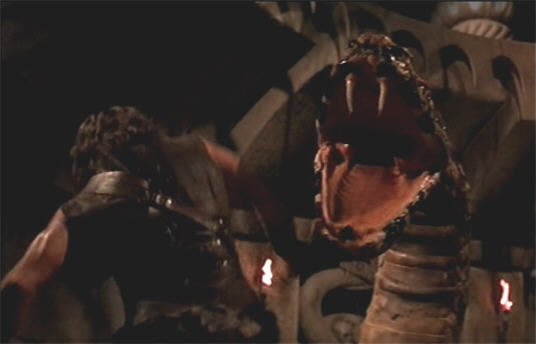
So, I have an idea of what I want the players to face: a giant snake monster of some kind.  This idea was inspired by watching Conan the Barbarian, and then Anaconda.  If you’ve seen these two movies, then you know that both snake monsters are quite different.  Granted, that might be due to the age difference between special and visual effects, computer animation, and animatronics, but if you simply watch both movies, we see those two snake monsters act differently, and instill different emotions.

In Conan the Barbarian, the giant snake monster is this huge, hulking, brutish-yet-sly creature of patience and stealth.  In Anaconda, we see a much more agile and evil monster, one that apparently delights in the hunt.  I think I’d like to combine the two creatures to create a monster that is animal-like, though evil, agile enough to chase after an adventuring party, and tough enough to stand toe to tail with multiple threats.  I want it to have decidedly snake-like features and tendencies, but monsterish enough to act like an evil monster.

So, where to start?  Well, in the back of the Strands of FATE book are several entries for a variety of NPC, enemy, and monster stats.  It only seems natural that we start with a normal snake, and also take a look at some other entries, like crocodile, bear, bull, and dragon.  This will give us an idea of the power ‘level’ for our monster, to make sure we create an encounter worth it’s weight in ferocity.  Since this is going to be a major enemy, or monster, I could make it exactly as a player character, giving it experience as I see fit, but I think we’ll keep it a bit more free-form.

CHARACTER ASPECTS

Most animal creatures in the Stands of FATE book have a single Character Aspect.  Major antagonists understandably have more (as I feel this creature also deserves).  I think an obvious first character aspect for this monster would simply be Huge-Ass-Snake.  You think of a snake, and then see a 50+ foot monstrosity, and it can be pretty clear how to use this character aspect.  Fear, attacking reach, possibly a bonus to hide (or a penalty), and so on.

Borrowing from the Dragon entry, I’ll include the character aspect, Apex Predator. This creature is definitely at or near the top of the food chain, and the aspect will very easily apply in combat when fighting humanoids.

One more character aspect that will work for us is “I’ll eat anything.” Snakes will often attack prey several times larger in circumference than the snake, simply because it’s jaws and digestive tract can take it.  This can be useful when stalking prey, facing a larger enemy, resisting fear, etc.

SIZE

Ok, right off the bat I know that I want the snake monster to be big.  Humans are generally a size 0, and if I wanted this snake monster to be able to swallow a human mid combat, it would have to be at least 3 sizes bigger.  However, I only want this monster to swallow a motionless human, so I’m going to knock its size down to a 2.  By comparison, a goblin is a size -1, a troll is a size 1, bull is a size 1, an elephant is a size 2, and a dragon is a size 3.  So, in-game I can tell the players that this thing is big enough to crush the life out of them, and then swallow them later.  In real life there are currently no snakes measuring 30 feet, or capable of swallowing an adult human.  For this creature, I think we could describe him as being over 50 feet long, and fully capable.

ABILITIES

For its abilities, I’m going to take a look at the entry for snake, bear, bull, and dragon.  This will easily tell me where to place what numbers where.  Since this creature is a monster, I want it to have some non-physical stats that are improved over a normal animal’s.  In the end, I end up with:

  • Agility: 5
  • Endurance: 7
  • Perception: 4
  • Strength: 6
  • Craft: n/a
  • Knowledge: -2
  • Reasoning: -2
  • Willpower: 2
  • Deception: 0
  • Empathy: 0
  • Persuasion: n/a
  • Resources: n/a

SPECIALTY ASPECTS

This monster is pretty deadly, so he’ll be getting a few specialty aspects as well.  Just like from the Snake entry, we’ll give him Slithers (Agility) – hey, they’re naturally sneaky, and the sight alone of a slithering snake can cause fear.  Deadly, Pinpoint Strike (Strength) is a good one, because it’s hard to see an attack when it comes at you in a direct, straight line.  For a snake, I think that At Home in Cover (Agility) works great for sneaking, and striking from hiding.

NOTABLE ADVANTAGES

  • Keen Smell: +2 on rolls to smell
  • Stealthy: +2 on rolls to hide and sneak
  • Natural Climber: +2 on rolls to climb trees, ledges, and landings (not little nooks)
  • Poison: Subtly: 3, Potency: 3, Delivery: Bite
  • Heat Sensitive: +2 on Perception rolls to detect heat
  • Crushing Grapple: every round that the target is grappled, they take net damage from that attack

PHYSICAL ATTACK

Bite

  • Attack modifier: +6(+2 WR) – Strength & Fangs
  • Def. Ability: Agility
  • Range: 0
  • Poor Defense, bite delivers poison

TOTAL PHYSICAL DEFENSE MODIFIER

  • +5(+7) – Agility and leather skin

This snake monster is fast, tough, and deadly.  It has beefy stats akin to what I imagine a giant snake might have, and aspects that will easily help it defeat its foe.  With only a little bit of work, its aspects can be used against it by the PCs.  Its fangs and leathery skin give it decent rating bonuses (+2), and its advantages give him a lot of that extra “oh crap” factor.

All that’s left is for me to test him out against the doomed PCs… I mean, uh…