Playing with FATE – Using Resources

In the FATE system there is the Resource ability. The rules for Resource are very basic and, aside from purchasing goods, there does not seem to be many reasons to use it. The alternative to Resource is actually tracking money, so it’s nice that Strands of FATE stays consistent with the abstract nature of the game.  With a little creative thinking, Resource is a worthy ability that can benefit or hinder a character without adding any new mechanics (remember, hindering a character can be good!).  Here are some suggestions to make the Resource ability more important in any campaign setting.

For a description of Resource, think of it like the character’s Strength attribute. It is not a measure of raw wealth as much a measure of how well the character manages his financial resources. As an example, there could be two characters, each with a 3 Resource, but one is merely wealthy while the other knows how to shop for deals and barter when necessary. The net result is the same.

Aside from the suggestions listed in SoF, there are plenty of ways to use Resource. Usually, it’s used whenever someone needs to purchase something. When this happens, they take the cost of the item and use it as an attack against the character’s wealth track. If the character makes the target number or better, he afforded the item without any problems. If the character makes more than one purchase in a game session, each consecutive purchase is at -1 to defend. When a character does fail, he does not make the purchase. He also cannot purchase anything else at that value (or greater) for the remainder of the session. Optionally, he takes stress on the wealth stress track. Of course, stress heals quickly and unless it is a large purchase, taking stress is not much of an issue. Here are some suggestions for adding value to the Resource attribute.

Unless the character has a profession where their day-to-day expenses are easily met, a monthly maintenance roll is needed. This is a Resource roll against a target number (set below). If the character missed work, a penalty of -1 per week or less missed would be a good modifier against the roll.  The following is a guideline for maintenance based on lifestyle:

Very Poor: 0
Poor: 1
Average: 2
Moderately Wealthy: 4
Wealthy: 6
Very Wealthy: 8
Filthy Rich: 10

For games where adventuring is their source of income (i.e., private investigator, adventurers, etc.), this is a reminder as to why they work. The fact that they work is the reason within the game as to why their Resource is where they set it. If a character is working a lot of overtime or they find treasure, they could be given a bonus for that roll. The bonus helps give the player the satisfaction of putting in the extra work.

I run a fantasy game where treasure is part of the genre. My players occasionally hit the big score which gives them one-shot wealth bonuses. These are expendable wealth points that benefit a Resource roll at a one-for-one ratio.  It allows them to make those occasionally large purchases without raising their Resource attribute or going into debit on the wealth track. On one occasion, I had a player accumulate so many wealth bonuses (not spending them) that I allowed him to use them as experience points to purchase up his Resource attribute.

For some purchases, the characters will run into situations where some products are either rare or more common than back home. For these cases, a cost modifier is in order. I developed my table based on the D6 Adventure by West End Games. I got my copies through one of the many online gaming resource sites.

Cost target modifiers might look like this:

Very Common: -2 (This is when the PCs are located where the bolts of silk fabric are woven or the mines for the rare ore are located.)
Common: +0
Uncommon: +2
Rare: +4
Very Rare: +6 (It might be easier to go on a quest to acquire this item)
High quality goods: +2 (i.e., The sword does extra bonus, The dress is of high quality, etc.)
Low Quality: -2 (i.e., The item is damaged or used.)

Of course, there are plenty of other modifiers that could be used.

Even if characters make monthly maintenance rolls it should not affect their other purchases. Of course, if their maintenance target is above their Resource, a modifier would be in order. So would a maintenance below their Resource. This better reflects the limited resources the character has to live and how wasteful or frugal they are.

For normal purchasing rules, the cost settings are fine. For those GMs who like to use the wealth stress track, I recommend adjusting the money value higher per dollar to account for the fact a character can make a purchase by taking stress on their wealth track. Since the first couple of consequences are minor and easily recovered, the Resource attribute is actually more powerful with the stress track to benefit it. For this situation, I recommend that money follows the same linear track that Strength does in place of the standard quadrupling the money for each rank. I leave it to the individual GM to decide what the right balance is for them.

I also think that there should be a “Wealthy” power. It could follow the rules as Strength for how it escalates for the amount of advantage points spent. This means each rank of wealth is equal to one rank of size for lifting capacity. With a “Wealthy” power, antagonists can be brought into a game who have resources that only vast amounts of money can buy. A certain villain in DC comics comes to mind.

There are plenty of options for using the Resource attribute. Feel free to experiment. It’s a worthwhile attribute that can be used to manage wealth by any measure without the need for meticulous cash counting.

Did you spend your Fate Points today?

One aspect of the FATE system is the ability to alter the course of your (or your opponent’s) dice roll. However, the Refresh Rate is once per session, and the players may be concerned that there might be one more challenge around the corner and thus, need that fate point. As a piece of advice, spend the point if you need to; don’t save it for what might be around the corner. When a player does not spend available Fate points, they just end up being wasted.

For those who do not play the game, a Fate point is like a credit to modify dice rolls, or to cause an effect to enhance or change the story of the game.  The number of Fate points that a character starts the session with is determined by the game’s Refresh Rate.

In all honesty, it is easy to not need Fate points in the Strands of FATE system. A character can have a high ability that almost certainly grants automatic success. There are plenty of advantages and powers that do not need Fate points (granting their own inherent bonuses).  A player could even be in a session where more role-playing than rolls is needed to get through an encounter. Any of these are viable excuses for not spending the entire refresh of Fate points. However, it does not matter if the points are not needed for success, or if they’re being horded for the next possible encounter. A Fate point remaining is a Fate point lost if it remains when it is time to refresh.

This is because Fate points do not stack after refresh, and a character cannot recover fate points beyond his refresh rate. A character who has 4 points in the pool at the end of a session and has a refresh of 8 will still only have 8 Fate points at the new session. This means that 4 points were lost.

Here are some reasons why players should utilize all their Fate points:

  • The character made his search/maneuver/defense roll, but there are better results if you generated spin (a high roll).
  • The points refresh after each session.
  • If necessary, the character can go into negative Fate points. The negative is treated as bad luck.
  • Even if you go into negative Fate points, the refresh will replenish everything.
  • If the next fight is that critical, the GM should refresh the Fate pool just before the fight happens.
  • There are no bragging rights for not using Fate points.

Whenever a character makes a success doing any of the items above, he gets the results of that roll. However, by generating spin, the character can perform more phenomenal things. When searching, a success may mean the character finds a clue leading to the next encounter, but spin might give a clue to the villain’s plans. When doing a maneuver, spin might make it sticky (a good benefit in this case). When generating spin while defending, the next attack against that opponent gets a +1.

Unless there are special circumstances (like ending the session in the middle of a scene), the character refreshes his points at the new session. Use them or lose them. ‘Nuff said.

Fate points can go into the negative. The reason has to make sense for the story, or the GM will not allow the negative point. If the character does go into negative points, he earns a temporary unlucky aspect. What an opportunity to earn extra fate 😉 Seriously, the points will refresh next session and the aspect will go away.

GMs don’t generally want to see their characters die a horrible death, unless he is running something Lovecraftian. If the characters are low on Fate and a big encounter is coming, the GM will refresh the points for that encounter. Of course, he will not refresh before the encounter happens. He would not want to tip his hand.

Obviously, the GM has final say on all of these points. Nevertheless, the only way to not waste a Fate point is to use the point. Take advantage of the tools in front of you when playing your character. Fate points are one of those tools.

Playing with FATE: Using Different Scales in Combat

Richard Mortellaro talks a bit more about FATE, helping us envision different scales of zones in the same encounter.

Usually when there is a combat scene, it’s either all melee, all ranged, or a mix of the two. For most combats, using the Personal Zone Scale is the best option. The actual size of zones is only relevant to the scene and does not need to fit any fixed constraints. However, when dealing with mixed combat, it is sometimes best to combine scales.

As an example: an assassin snuck through the tall grass and reaches a squad of guards watching a press gang. The assassin’s task was to kill the guards without harming the press gang. Most of the gang were in a trench digging, and the guards stood above them at the edge of the trench. The assassin moved to within range of his bow (one zone) and started killing the guards one by one.

It was not until after the second guard fell that they had an idea where the shooter was. Once the direction of the arrows was known, the guards initiated a charge to get the assassin. The guards had six zones to cover, and held formation in their charge. To keep the formation, the guards could only move 2 zones per round. During the guards’ charge, the assassin held his ground and shot the remaining guards before they could reach him.

What?! Yes, the assassin was one zone away for archery and the guards were six zones away for movement. How far is a zone? Well, that depends; a zone is as large as it needs to be. Even though a bow only has a range of one, that does not mean it needs to be the same zone(s) used for movement.

Strands of Fate (in fact all Fate systems) use zones. Zones use a zone/measurement system that operates differently from a grid system, but still performs the same function. Unlike traditional grid/ fixed measurement systems, zones can vary in size and shape – and all on the same map. Grid systems use a fixed distance for each square on a given map. Despite the different sizes, each zone measures one unit of movement. The roughness of the terrain or obstacles bordering zones are used to determine the zone’s size and dimensions. If the zone seems too large to navigate in a standard three second round, remember that time is also elastic in Fate. There is no harm in saying that a round lasts longer than three seconds or even a minute.

Normally, when there is a combat, all the combatants use zones of the same scale, whether using hand-to-hand action or ranged attacks. In melee action, despite the actual range of bows and guns, they use the same personal zones for range as movement. This suits ranged combat by representing the brief time given to aiming before shooting. It also suits melee combat because of the chaotic nature, and prevents ranged weapons having a significant advantage in a story driven game.  If it helps for melee combat, think of range weapons as being pointed and not aimed during the time pressed combat.

When dealing with mostly ranged combat, the zones could represent larger spaces and time that allow for aiming. There is no need to worry how large a zone is for ranged combat, because if someone moves, the flexible nature of time in fate will adapt to fit the scale of the zone. Sometimes there can be a trade-off, like when using one scale for ranged weapons and another for hand-to-hand combat.

In the case of the assassin, he had time to set up and put himself at the furthest range for accurate bow shooting. The best combined scale for that scene was six personal zones per skirmish zone. As long as the assassin did not move during the combat, he was allowed to use skirmish scale zones for range. If he moved to keep his distance from the guards, he would have been forced to use personal zones to represent the haste and confusion of combat at personal range. This simplified combat between the assassin and the guards. It also meant the assassin would pay a price for moving by losing his range advantage.

Whenever one type of combat is going on during a scene, using the same scale is the best option. The few quarks concerning ranged versus melee combat is not a game killer. In fact, it can enhance the drama. For those occasions where the range of a weapon does not fit into a melee scene, combine scales by adding skirmish zones to the personal zones.

Playing with FATE: Using Zone Aspects

When a player in Strands of Fate (SoF) uses a character aspect to his advantage, or compels another’s character aspect against an NPC, he has a good feel for how to use the aspect and what to expect from that aspect. When using a zone aspect, perceptions change. The question becomes, “How do I use this zone aspect?” or “How come I can’t make the swampy ground swallow up my opponent?” The answer is simple: zone aspects are just like character aspects.

The rules on SoF are clear when applying character or specialty aspects during an adventure. They are not so clear when dealing with zone aspects during the same adventure. The rules only mention using zone aspects, but to understand them, careful attention must be paid to the examples. The SoF PDF page 215 is one such example.

Taking the cue from that example, it is best to treat zone aspects like any character aspect. Aspects do not make things happen by default; they influence the dice roll to improve or hinder a character’s action.

As an example, we will use a bounty hunter who is after a bounty. His name is James “Bring ‘em back” Earl, and he tracked down a notorious criminal who escaped custody two months ago. James has all of his Abilities at 2 with the Look before you leap and Old soldier Aspects. He also has the Bum leg (Agility) Specialty Aspect. James found his bounty at a small fishing cabin by the lake. There are three zones with the following aspects:

  1. By the cabin: Knee-deep snow
  2. Ice near the lake shore: Slippery (P)
  3. Thin ice in the middle of the lake: Thin Ice (P)

Any movement on the ice requires a roll with a target of 2. A result of 0 or less will result in the character falling and losing a turn. If on the thin ice, a result of 0 will result in falling through.

Example:

James approached the cabin following in the bounty’s tracks. When James reached the door, he invoked his Look before you leap Aspect and placed his ear to listen. That is when the door was forced open. James failed an Agility roll to remain on his feet and was knocked into the snow.

The first round, James and the bounty rolled for initiative and the bounty won. The bounty invoked his Brutal thug Aspect and swung at James with a baseball bat and rolled a 2 giving the bounty a 6 on his attack (2 roll +2 Aspect +2 Str). James invoked his Old soldier Aspect, rolled a 3 to dodge giving him a 7 on his defense (3 roll +2 Aspect +2 Agility); just enough to avoid being hit. The GM decides that the bounty needs to make this attack count and compelled the Knee deep snow on James preventing him from making his dodge. James’ roll was reduced to 5, giving the bounty a one advantage over James. With the bat’s WR of +2, James took 3 points of damage. James’ coat absorbed 1 point and James took the other 2 as Physical Stress.

The next round, James stood up and the bounty ran onto the ice. The third round, James chased after the bounty and rolled a total of 3, but the bounty compelled James’ obvious Bum leg Aspect (a -2 to the total), giving James a 1. James failed to cover any zones. James’ bounty was two zones ahead of him. Next round, James and the bounty roll to move and James rolled well enough to cover two zones and the bounty also covered two zones. The bounty moved into the middle of the lake (where the ice is thin) and James compelled the Thin ice Zone Aspect on the bounty. The cracking ice caused the bounty to not move any zones. James caught up to the bounty and . . .

Remember to keep it simple. If there are Zone Aspects to be used by a character or GM. Think of them as just another Character Aspect that anyone in the zone can use. As well as using zone aspects as character aspects, zone aspects can be uses for declarations. The same bounty hunter can be in an abandoned garage, with the Abandoned Garage Aspect, at an old filling station. He noticed a trap door in the back of the garage but could not get the door open. James could invoke the Abandoned garage Aspect and declare that there were some tools left behind when the building was abandoned that could help open the trap door. The character gained a ball-peen hammer and a long-handled screwdriver to pry the door open.

The key to any aspect is to remember that any aspect, regardless of the source, has the potential of being invoked or compelled like a character aspect. As long as the player thinks of zone aspects as character aspects, he can use them as character aspects.

Playing with FATE: Conversions

As a generic rule-set, Strands of FATE is a fully functioning game system lacking only two ingredients: (1) a creative gaming group, and (2) a setting in which to play. I can’t help much with the former ingredient, that’s up to you, but I can assist with the latter.

Many of you out there who’ve picked up Strands of FATE (or any of the other FATE-based games) have already discovered how flexible, complete, and stream-lined the system is. Hopefully you’ve had a chance to see the system in action and thought to yourself that this may help you get the RPG experience you’re looking for (at least that’s what it did for my group!). So really there is just one thing remaining, either creating your own setting for SoF, or converting your favorite game and setting. For those of you looking to convert your favorite game, setting, or campaign to Strands of FATE, this article is for you.

My gaming group has already done a couple of conversions to FATE, and over the years I’ve converted several other settings and systems (Savage Worlds, Modern d20, and Cortex to name a few). With each of these projects, I’ve learned a lot about how to execute a good conversion. The most important thing I’ve discovered is that we GM’s tend to make conversion projects infinitely more complex then they need to be. Like my high school English teacher always said, “Unless your name starts with Shake and ends with Spear, keep it simple!” On that note, here’s my advice for pain-free conversions:

Define the “Feel” of the Source Material

Before undertaking a conversion, sit back and really think about what elements of the source material are the key components for the “feel” of the setting. Ask yourself what makes this setting exciting: is it genre, theme, scale, or the nature of the heroes or villains? What makes this setting conversion-worthy? Make a list of these elements.

For example: our list for a recent Eberron (D&D 4E) conversion looked something like this:

  • Swashbuckling high adventure in a fantasy setting.
  • Numerous power-brokers (governments, noble families, guilds, Dragonmarked houses, religions, secret societies, etc.) all
    vying for increased power.
  • “Interesting” heroes (more so than “powerful” ones) with a “pulp” feel. More Indiana Jones than Drizzt do’Urden. Larger-than-life maybe, but not epic “super-heroes”.

Take a good look at your finished list. If you notice that your list focuses on “hard” gaming elements, such as rules or mechanics, I’d suggest not doing the conversion. Maybe you need to tweak the source material a bit for the game you want, but in my experience you’ll only get frustrated trying to make all of the mechanics “fit” into a different rule-paradigm, so you’re probably better off just using the existing materials as written for your game.

However, if your list tends to focus on “soft” gaming elements, such as genre, theme, style, and other non-mechanical elements, then a FATE conversion may be exactly what your game needs.

Separate Rules from Setting

With a few exceptions, most rules don’t necessarily do anything to convey the feel of the setting, they simply provide a working framework for the game. As you look through your source material, note if there are any rules that specifically address elements that are important to experiencing the setting. These are usually genre-specific and fulfill a specific function within the context of the setting. Here are some examples:

  • Call of Cthulhu: Rules for fear and insanity
  • Star Wars: Dark side and light side Force powers
  • Shadowrun: Hacking, AR, and VR.

If your source material has rules like these, take a look at how SoF handles the issue and go with it. Stands of FATE is an amazingly complete set of rules, and nearly anything you need can be found within. Other rules, such as for two-weapon fighting, reloading, or lockpicking, really don’t do anything for the setting so don’t worry about converting them. SoF has rules covering these things already so avoid the temptation to convert mechanical minutia just because it exists in the source material. It doesn’t add anything to your game, and just tends to overly “complexify” your FATE game.

Understand the FATE Paradigm and Embrace It Fully

I can’t stress this enough: let FATE work the way it is designed. Don’t try to make FATE fit your source material; make your source material fit FATE. This is the most critical element of a conversion, and once you understand it, the process will be pain-free and virtually effortless.

My current conversion project is the Warhammer 40K RPGs from Fantasy Flight Games (Black Crusade, Dark Heresy Deathwatch, and Rogue Trader). The setting is incredible, but the rules have a great deal more complexity than I want to deal with. The most important thing for me and my players is to truly capture the dark, bleak, hopeless feel of the 41st millennia.

When I first began the conversion I was quickly overwhelmed by all of the elements I “had” to convert. But after a while I realized that 90% of the rules were only relevant in context with other rules and didn’t really do anything to bring the setting to life. Once I had that realization, the conversion was a breeze. For each game, I selected one or two elements and then converted them. The rest is pretty much just “standard” Strands of FATE.

In Conclusion

Hopefully this will help you on your path to that FATE game you really want to run. I’ve been extremely impressed at how well this system works and how easy conversions are. Just remember the most important thing: don’t over think it, it’s easier than you think.

Playing with FATE: “Is it right for me?”

By John Lewis
– Fate is a great game, but it requires an unorthodox way of thinking…

This past year a lot of interest has been generated for RPG’s that utilize the FATE system.  Our Playing with FATE series of articles, focusing on the generic Strands of FATE (SoF) rule-set, has been well-received by many readers and even attracted the attention of SoF designer Mike McConnell.  I’ve had the chance to use the system for a couple of different convention games as well as in my home gaming group, and I’ve learned some important lessons.

When we first looked at SoF, most of our gaming group liked what they saw, but like any change, we’ve struggled through some growing pains.  Don’t get me wrong, I really like the system presented in SoF, but it may not be for everyone.  Even for those of you who would like to give it a go may find it a difficult adjustment for your group.  I’m not criticizing the game design in any way (it’s easy to learn and very well-constructed), but FATE does have a very different paradigm than most RPG’s.  And therein lays potential pitfalls.

To give FATE the opportunity to really shine and show you what it can do, you need to be aware of three elements to the game that may be very different from the way you’re used to playing.

  1. Increased Player Control
  2. Aspects: The FATE Point Economy
  3. Abstraction

Increased Player Control

This will most likely be the biggest adjustment for groups to face when switching to FATE. In most other games the GM controls virtually everything; setting details, NPC personalities, plot elements, etc.  Players, on the other hand, control relatively little.  They are responsible for their characters’ decisions and individual actions, but not much else.  FATE is a very different beast.

In SoF the primary element that shifts control is the Declaration.  With a roll of the dice, or the simple expenditure of a FATE point, players can “declare” something about the game.  These Declarations could range from colorful background details, plot hooks, and NPC relationships, to potential bonuses and penalties for both players and NPC’s.

  • “We’re docking at Stormhaven?  My cousin Bertrim lives here.”
  • “Don’t worry, caprimundas are nocturnal.  We’ll be safe during the day.”
  • “I have to be careful in this town; I have a warrant for arrest for a little misunderstanding with the magistrate.”
  • “I’m approaching from downwind, that should give me an advantage.”

This puts tremendous power in the players’ hands and forces the GM to be more flexible and adaptive.  Both of which take a little getting used to, but I think are good things for the game.  In my experience, players tend to be a bit reluctant making “campaign decisions,” and GM’s sometimes have a hard time letting the players manipulate the stories and campaigns they worked so hard on.  But don’t worry, as a player, you’ll love impacting stories in whole new ways, and as a GM you’ll be amazed at how much less prep work you’ll find yourself doing.

If you really want to see and experience the power of FATE, you owe it to yourself to embrace the idea of the Declaration.  In my experience, the end result is a game with much greater emphasis on collaborative group storytelling and campaigns that players really connect with.

Aspects: The FATE Point Economy

Understanding and utilizing Aspects and the FATE point mechanic are absolutely essential to the FATE experience.  In SoF, Aspects are EVERYTHING and FATE points make them work.  Anything in the game can, and should, have Aspects: characters, equipment, the setting, vehicles, creatures, locations, etc.  As a GM, your descriptive notes are probably perfect Aspects, so use them.  The only thing to decide is whether or not the Aspect is relevant right now, on this dice roll.  And here’s the simple little secret – any Aspect is relevant so long as someone is either spending or earning a FATE point, if not, it doesn’t matter right now.

The concept of the Aspect is simple and eliminates the need for dozens of different rules, mechanics, and sub-systems found in other games.  This is what makes SoF so easy to play.  You don’t need to remember what the cover bonus for a wooden crate is.  Just ask yourself, “Does Pile of Crates seem like an appropriate scene Aspect?” If so, you’re done.  Whether or not the crates will impact the game is up to the character that is willing to spend a FATE point to Invoke the Aspect for cover and gain the +2 bonus (it’s always a +2 bonus by the way).  Or maybe the GM will Compel the Aspect against the player, forcing him to take a -2 penalty to his shot because the crates are in his way, but earning the player a FATE point for the trouble.

Aspects and FATE points (Invoking for +2 / Compelling for -2) are 95% of the rules.  Instead of slowing the game down looking for a specific rule or chart, the GM merely has to decide if something is potentially relevant enough to be an Aspect.  We’ve found that this becomes pretty organic after a while.  The GM usually has a couple of Aspects in mind for any given encounter, a few more are usually self-evident (the spilled oil on the floor makes it Slippery), and the players will make Declarations or simply ask questions (“How’s the lighting in here?  It’s Dark and Shadowy).  It’s really very simple, just ask yourself “Does this (thing) seem like it might be relevant to the encounter?”  If the answer is yes, it’s an Aspect.  No? Forget about it.

Abstraction

The term “abstraction” tends to generate strong feelings amongst gamers these days.  Some people prefer a more simulation-like experience in their game while others don’t care.  SoF embraces a fairly abstract set of assumptions.  There are no 5-foot grid squares or 50 meter ranges.  Space and distance are determined by Zones which are defined by the need of the scene.  Most of the game elements are fairly open and tend to be varying depending on the scene and situation.  If you’re looking for exactly how many yards your .38 pistol can shoot and still be lethal, you might want to look at other games.  Whether or not this may be appealing to you and your group really depends on personal preferences and group desires.

– – –

Strands of FATE is an excellent fit for my style of gaming. But much like jalapenos, line-dancing, or S&M, self-awareness of your own preferences, and understanding how things work together, goes a long way toward potentially enjoying the experience.

Playing with FATE: Creating a Huge-Ass-Snake Monster

Giant Snake

Welcome back to our Playing with FATE series.

Being the GM of any game definitely has it’s rewards, but it also has it’s challenges.  A big part of those challenges includes working those creative muscles – specifically envisioning, designing, and implementing adversaries for your group.  Sure, this can also be a reward, which is why I’m enjoying writing this particular post.  Today, I’m going to show you how easy it is to create a giant snake monster for the fantastic game, Strands of FATE.

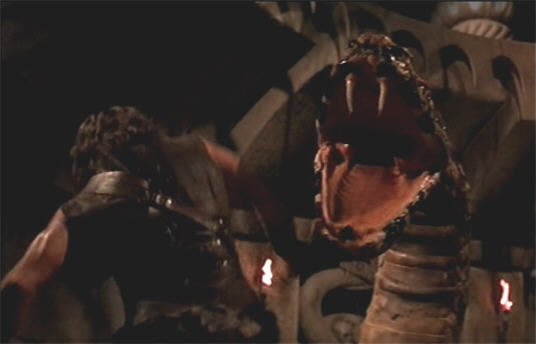
So, I have an idea of what I want the players to face: a giant snake monster of some kind.  This idea was inspired by watching Conan the Barbarian, and then Anaconda.  If you’ve seen these two movies, then you know that both snake monsters are quite different.  Granted, that might be due to the age difference between special and visual effects, computer animation, and animatronics, but if you simply watch both movies, we see those two snake monsters act differently, and instill different emotions.

In Conan the Barbarian, the giant snake monster is this huge, hulking, brutish-yet-sly creature of patience and stealth.  In Anaconda, we see a much more agile and evil monster, one that apparently delights in the hunt.  I think I’d like to combine the two creatures to create a monster that is animal-like, though evil, agile enough to chase after an adventuring party, and tough enough to stand toe to tail with multiple threats.  I want it to have decidedly snake-like features and tendencies, but monsterish enough to act like an evil monster.

So, where to start?  Well, in the back of the Strands of FATE book are several entries for a variety of NPC, enemy, and monster stats.  It only seems natural that we start with a normal snake, and also take a look at some other entries, like crocodile, bear, bull, and dragon.  This will give us an idea of the power ‘level’ for our monster, to make sure we create an encounter worth it’s weight in ferocity.  Since this is going to be a major enemy, or monster, I could make it exactly as a player character, giving it experience as I see fit, but I think we’ll keep it a bit more free-form.

CHARACTER ASPECTS

Most animal creatures in the Stands of FATE book have a single Character Aspect.  Major antagonists understandably have more (as I feel this creature also deserves).  I think an obvious first character aspect for this monster would simply be Huge-Ass-Snake.  You think of a snake, and then see a 50+ foot monstrosity, and it can be pretty clear how to use this character aspect.  Fear, attacking reach, possibly a bonus to hide (or a penalty), and so on.

Borrowing from the Dragon entry, I’ll include the character aspect, Apex Predator. This creature is definitely at or near the top of the food chain, and the aspect will very easily apply in combat when fighting humanoids.

One more character aspect that will work for us is “I’ll eat anything.” Snakes will often attack prey several times larger in circumference than the snake, simply because it’s jaws and digestive tract can take it.  This can be useful when stalking prey, facing a larger enemy, resisting fear, etc.

SIZE

Ok, right off the bat I know that I want the snake monster to be big.  Humans are generally a size 0, and if I wanted this snake monster to be able to swallow a human mid combat, it would have to be at least 3 sizes bigger.  However, I only want this monster to swallow a motionless human, so I’m going to knock its size down to a 2.  By comparison, a goblin is a size -1, a troll is a size 1, bull is a size 1, an elephant is a size 2, and a dragon is a size 3.  So, in-game I can tell the players that this thing is big enough to crush the life out of them, and then swallow them later.  In real life there are currently no snakes measuring 30 feet, or capable of swallowing an adult human.  For this creature, I think we could describe him as being over 50 feet long, and fully capable.

ABILITIES

For its abilities, I’m going to take a look at the entry for snake, bear, bull, and dragon.  This will easily tell me where to place what numbers where.  Since this creature is a monster, I want it to have some non-physical stats that are improved over a normal animal’s.  In the end, I end up with:

  • Agility: 5
  • Endurance: 7
  • Perception: 4
  • Strength: 6
  • Craft: n/a
  • Knowledge: -2
  • Reasoning: -2
  • Willpower: 2
  • Deception: 0
  • Empathy: 0
  • Persuasion: n/a
  • Resources: n/a

SPECIALTY ASPECTS

This monster is pretty deadly, so he’ll be getting a few specialty aspects as well.  Just like from the Snake entry, we’ll give him Slithers (Agility) – hey, they’re naturally sneaky, and the sight alone of a slithering snake can cause fear.  Deadly, Pinpoint Strike (Strength) is a good one, because it’s hard to see an attack when it comes at you in a direct, straight line.  For a snake, I think that At Home in Cover (Agility) works great for sneaking, and striking from hiding.

NOTABLE ADVANTAGES

  • Keen Smell: +2 on rolls to smell
  • Stealthy: +2 on rolls to hide and sneak
  • Natural Climber: +2 on rolls to climb trees, ledges, and landings (not little nooks)
  • Poison: Subtly: 3, Potency: 3, Delivery: Bite
  • Heat Sensitive: +2 on Perception rolls to detect heat
  • Crushing Grapple: every round that the target is grappled, they take net damage from that attack

PHYSICAL ATTACK

Bite

  • Attack modifier: +6(+2 WR) – Strength & Fangs
  • Def. Ability: Agility
  • Range: 0
  • Poor Defense, bite delivers poison

TOTAL PHYSICAL DEFENSE MODIFIER

  • +5(+7) – Agility and leather skin

This snake monster is fast, tough, and deadly.  It has beefy stats akin to what I imagine a giant snake might have, and aspects that will easily help it defeat its foe.  With only a little bit of work, its aspects can be used against it by the PCs.  Its fangs and leathery skin give it decent rating bonuses (+2), and its advantages give him a lot of that extra “oh crap” factor.

All that’s left is for me to test him out against the doomed PCs… I mean, uh…

Playing with FATE: Skills – Who Needs ‘em?!

As you’ve probably noticed, our gaming group’s preferred incarnation of the FATE system is Strands of Fate. SoF resembles other Fate games in many respects, but differs in its approach in a couple of ways, ways that I feel improve the Fate experience.

Author’s Note: For a comparison of differences, click here.

For me, the difference that really sets SoF apart from it’s contemporaries is the lack of a traditional Skill System.  I know what you’re thinking – I myself can’t believe that my favorite RPG doesn’t have a defined, specific skill system clearly showing what my character can do and what he’s good at.  For the past 20 years or so I wouldn’t even consider playing a game without skills.  But, when I looked at how SoF handles skills, I instantly recognized genius.

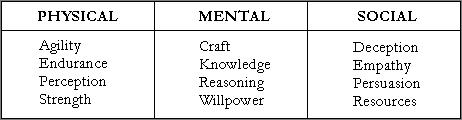
Instead of traditional skills or attributes, SoF uses twelve Abilities:

In general, these Abilities will be rated between -1 and 5.  In my experience so far, as both a player and a GM, these twelve Abilities cover everything I could possibly do with my character as well as helping me define a great deal about him.

However, with SoF this is only the beginning.  To really see what a character is good at, or really bad at, we need to take a look at his Aspects (Specialty Aspects in particular).  Aspects tell you so much more about a character’s strengths and weaknesses than a skill with a number ever could.  For example, in most Fate games someone good with a gun may have something listed like this:

  • Firearms: +4

Ok, that’s nice.  I guess the character is better than a guy with +3, but worse than the one with +5.  And I guess he’s the same with any type of gun.  In Strands of Fate that character might have an Aspect or two looking like this:

  • Fastest six-gun in the west.
  • Born with a rifle in his hand. (Agility)
  • One shot, one kill. (Perception)
  • “It’s time to rock and roll!” (Agility)

This tells me a lot more than “Firearms: +4” ever could.  This was illustrated for me during the game I recently ran at DunDraCon.  Four of the players at the game were new to Fate.  One guy, after glancing at his character sheet said, “What does my guy do?  What’s he good at?”  Before I responded, another player told him to read his character’s Aspects (SoF characters have at least ten).  After reading the Aspects, the first guy nodded and said, “I’ve never had such a clear idea about who my character is, and what my character does.  I even know what he doesn’t do. Cool.”  That’s one of those great “ah-ha” moments.  In SoF, a quick look at well-written Aspects and you usually know more about a character than two pages of background and notes.

Eliminating a traditional skill system has two additional benefits.  First off, players have the ability to focus on roleplaying Aspects, instead of number-crunching.  They look at their characters from a more story-focused and narrative viewpoint than a simple collection of stats and modifiers.  The second benefit, and the one I really appreciate as a GM, is having a very brief list of Abilities to remember instead of a chart of 30 skills.

I play in a Deathwatch game a couple of times a month.  It’s a fun game, but there are more than 40 different skills.  As a GM, I want to be familiar with all the skills so that I can ensure they each see a little “screen time” and that the players who’ve invested in certain skills feel rewarded by seeing them come into play.  In SoF, I only need to remember the twelve Abilities.  If a character has a relevant “skill” (Aspect), it’s up to them to remember to Invoke it.

For me, this not only makes adventure design easier, it also really streamlines on-the-fly decisions.  So far, in the SoF games I’m playing in, it’s always been very clear what the appropriate Ability to use is, and each of the players know their character well enough to decide if any of their Aspects should come into play.

This is yet another reason why Strands of Fate has become my roleplaying system of choice – a simple but comprehensive mechanic combined with a rock-solid focus on story-telling.

Playing with Fate: Your “Specialty Aspects”

This part of character creation (in my opinion), is the fun part.  It’s where I get to personalize my character and really make him stand out.  I know, we thought we did that with both of the last two articles (here and here), but that just shows how cool Strands of Fate really is.  In this article, we continue with the second half of our character’s ten aspects.  Last time we talked about our five Character Aspects, today we discover our five Specialty Aspects.

Remember, this is totally optional – you could make five more Character (or generic) Aspects if you wanted, but to really get a diverse and dynamic character, I’m going to follow the recommended Aspect Alphabet as best as I can.  Also, Specialty Aspects are usually tied to particular Ability, where Character Aspects are more broadly interpreted.

Let’s take a look at our Aspect Alphabet again.  We’ve already looked into our first five, now we’ll move on to our last five:

  1. Defining Aspect
  2. A = Ambition
  3. B = Background
  4. C = Conviction
  5. D = Disadvantage
  6. E = Exceptional Skill
  7. F = Foe(s)
  8. G = Gear
  9. H = Help
  10. I = Inferior Skill

6. Exceptional Skill

What skill or talent has “Desolation” Amearus Omaron excelled in?

That’s easy (and simple).  He’s a great warrior, but it’s his skill with a long blade that his enemies fear.  I will most often tie this aspect to my Strength ability.

Master Swordsman

7. Foe(s)

Who out there has it in for Desolation?  Who despises him?  Or, who does Desolation want to do in?

Well, as a General in the 100 Years War, Desolation and his soldiers have certainly wracked up some enemies.  But who is it that I want to make an appearance in his story from time to time?  Enemies are important, so I don’t want his to be some Joe Schmoe from a random nation; I want them to have significance in his current situation.

So, in Desolation’s story, he died in the war and was somehow resurrected as a revenant (unknown by who or why).  I know that Death brought back his ashes because it still has plans for him, but the character doesn’t know that.  His people, leery of his return, sent him to the land of their ancestors, Aerenal.  There, the Undying Court might have the answers that he seeks.  Is he alive, is he dead, is he in a state of “deathlessness” like his distant ancestors?  Is he destined to join the Undying Court?  He doesn’t know, and he isn’t sure if the Undying Court knows either.  However, they have instructed him that his mysterious resurrection has something to do with an unraveling, but equally mysterious Draconic Prophesy, and he needs to investigate this prophesy on behalf of the Undying Court.  Only then will they know how to help him.  Desolation can’t help but feel that he’s being used, but he has no other choice.  So, for the time being, he is forced to follow the direction of the Undying Court, and investigate this Draconic Prophesy.

This makes the Undying Court his “Enemy,” because of his unwanted association with them.  They’re using him for their own purpose, and he knows it, but he has no other choice.  Foes are always associated with your Persuasion ability.

Forced to follow the Undying Court

8. Gear

When I first thought of Desolation, I didn’t have any specific gear in mind for him because he was resurrected out of the Mournland.  No one was there to greet him, and no one was there to answer his questions.  So, I was about to skip this aspect in favor of some other random aspect when I thought, “No, I want to try to get as much out of the game as I can.” So, I figured Desolation was resurrected naked, in the Mournland, with nothing but his signature sword. He is a master swordsman, after all.  So, Desolation has a signature sword, and it came back to him with his resurrection.  What is it about this sword that makes it special? What is it about this sword that is going to have an impact on Desolation’s overall story?
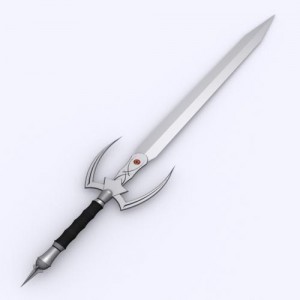
Well… it used to belong to a king or duke (someone of importance).  This was a sword that was a symbol of power or prestige among their people, and (in a fierce battle) Desolation took the sword from its owner (a powerful Hobgoblin king) and killed him with it.  Now he uses that sword proudly in battle as a show of what he has accomplished (and goblinoids of all kind loathe him for it).  If this sword has any special properties other than its craftsmanship and reputation, Desolation isn’t keenly aware of it yet.  He’ll benefit from using the sword in a variety of ways, but he has yet to unlock it’s true potential and significance.  I’m sure the sword’s re-emergence with his resurrection has something to do with Death, and Death’s plans for Desolation.

Sword of Ozroc ‘Uhl

9. Help

Who out there can Desolation call upon for help?  What can he use to help him out of a pinch?

I specifically created Desolation to be out there all on his own, with no one to turn to.  The only help he’s getting is going to come from himself.  His people, his tribe, even his own family have turned their backs on him.  His whole life has been turned upside down by being resurrected as a revenant, and no one he knew wants anything to do with that.  So, if he ever needs any help, he’s going to need to find it in himself.  I think I’ll use “Revenant” as his Help Aspect.

Certainly there are instances where being neither alive or dead can help him.  Later on in character creation, I could purchase a “Racial Package – Revenant,” as an Advantage, but I think I won’t, and instead go with a simple aspect for his race that also satisfies my need for a Help Aspect.  Perhaps later in Desolation’s story I might buy that Racial Package, and even later on I might buy the full-on Undead package.  We’ll see.

Revenant

10. Inferior Skill

I always thought of Desolation as a normal soldier, though one who could inspire his troops.  So right off the bat I couldn’t think of an inferior skill.  Then I remembered his new race as a revenant, and figured that being an “almost undead” character, he’s losing touch with people in general.  I think that a simple, fun aspect would work great here.

Overly blunt

How Can I Invoke My Specialty Aspects?

(Remember, you invoke an aspect when you (the player), want a part of your character to influence the story, scene, or action.  Spend a Fate Point to get a +2 bonus to a single action, perform a re-roll, or to invoke an effect)

  1. Defining Aspect – Resurrected Valenar Warrior of Legend
  2. Ambition – I will regain my glory
  3. Background – Death’s right hand
  4. Conviction – Honor is my middle name
  5. Disadvantage – The end justifies the means
  6. Exceptional Skill – Master Swordsman – This is very simple and straightforward for me to invoke.  My character is a Resurrected Valenar Warrior of Legend (which I can invoke in just about any melee combat), but when wielding a sword, I become an even greater warrior (I am, after all, a Master Swordsman).
    • [Bonus] For just about any attack or parry I make while wielding a sword, I can take a +2 bonus or reroll.
    • [Bonus] After fighting and injuring a tough combatant, I could make an Intimidate attempt to get him to surrender.  I could invoke Master Swordsman to help in this intimidation attempt because he just saw a demonstration of my mastery over the long blade.
    • [Effect] It’s possible that the person standing before my character is one of his old sparring partners, one who can take at least partial credit for Desolation’s skill with a blade.  This is totally subject to GM approval, of course.
  7. Foe – Forced to follow the Undying Court– As my enemy, this aspect will most likely be compelled more often than invoked.
    • [Effect] The shire reeve, who I’m speaking to over dinner, shares in my distaste for the Undying Court.
    • [Bonus] When speaking to any of the elves from Aerenal, I can bring up my association with the Undying Court to gain either their sympathy or trust.
  8. Gear – Sword of Ozroc ‘Uhl– This is a very easy aspect to invoke.  This famous sword belonged to a hobgoblin king (famous among the hobgoblins, anyway).  The sword also has special, yet undiscovered qualities. When I want to use the sword, I must bring it into the scene by spending a Fate Point.  The trade off is that I don’t have to spend any money or resources to buy this item, it will probably be a part of my character’s story for a long time, and I can use it to help me in a variety of ways.
    • [Effect] When combat starts, I can spend a Fate Point to declare that my sword is in my hand, automatically (flair it up however you like).  This brings it into the scene, and allows further invoking by me.
    • [Effect] After our party has been captured, and all our gear taken from us, I can declare that my sword has been claimed by a particular guard, and that said guard is posted right outside our cell.  Remember that this sword is important to my character’s story, which is why it is my Gear Specialty Aspect.  Therefore, unless there’s a very good reason, my character won’t be parted with it for too long.
    • [Effect] Anytime I want to get the attention of a hobgoblin, or group of goblinoids, I can display the sword.
    • [Bonus] I could gain a bonus/reroll when trying to inspire soldiers, because they will then  probably know who I am, and how I got the sword.
    • [Bonus] I could gain a bonus/reroll when trying to intimidate other soldiers, especially goblinoids.
    • [Bonus] And lastly, in a dangerous battle, after I have invoked my Resurrected Valenar Warrior of Legend aspect, and after I have invoked my Master Swordsman aspect, I might be able to call upon the Sword of Ozroc ‘Uhl for one last bonus (it’s a finely crafted, possibly magical weapon of a king, after all).
  9. Help – Revenant – Desolation is now a revenant (not alive, not dead, but somewhere in between).  That could help him out in several situations.
    • [Effect] I need to get to the other side of the crypt (the crypt filled with zombies, skeletons, and ghouls).  Perhaps the GM will let my character simply stumble through them all, as they possibly accept me as an undead?
    • [Bonus] A succubus is attempting to seduce me, perhaps even to dominate me in combat.  As a revenant, I am not as in-touch with my mortal desires as I once was.
    • [Bonus/Effect] As my comrades are retching over, throwing up their rations due to the dismembered, rotting corpses laying about in the dungeon, I am largely unaffected.
    • [Bonus] Me: “Was that poison?  My heart barely beats as it is.”
  10. Inferior Skill – Overly Blunt –My character sometimes loses touch with proper social etiquette.  More often than not, this aspect will be compelled.
    • [Bonus] When trying to fit in with a rowdy bunch of scumbags, I might get a bonus to blend in or befriend these riffraff.

How Can My Specialty Aspects Be Compelled?

(Remember that you, the GM, and even other players compel an aspect to create conflict for your character, instilling complications into his story.  Gain a Fate Point to take a -2 penalty, be forced to re-roll, or make something bad happen)

  1. Defining Aspect – Resurrected Valenar Warrior of Legend
  2. Ambition – I will regain my glory
  3. Background – Death’s right hand
  4. Conviction – Honor is my middle name
  5. Disadvantage – The end justifies the means
  6. Exceptional Skill – Master Swordsman – I imagine that this aspect will not be compelled too often.  It might take some work to consistently compel Master Swordsman.
    • [Penalty] Me: “This opponent is nimble on his feet, and he’s wielding a long whip.  Damn, while I love the sword, it might not be the best defensive weapon in this fight.  This will give me a penalty to parry.”
    • [Effect] It’s possible that the man standing before me has heard of my skill with a blade, and he challenges me to a high-stakes duel.
  7. Foe – Forced to follow the Undying Court– Damn those ancient, undead elves of Aerenal.
    • [Effect] GM: “You know that these elves you’re fighting are from Aerenal, home to the Undying Court.  You probably shouldn’t kill them.”
    • [Effect] GM: “Yeah, your character has fought the horrors of the Sundered Caverns before, and you know that there is treasure still to be found there, but that really has nothing to do with the Prophesy, the one that the Undying Court has directed you to investigate.  You have a solid lead to investigate in the tower.”
  8. Gear – Sword of Ozroc ‘Uhl– Wielding proudly the famed sword of a hobgoblin king (who I’ve killed) is a huge insult to any goblinoid.  Trouble is just around the corner.
    • [Effect] Me: “Hey GM, these street thugs trying to harass us, can they all be hobgoblins?” Why yes, yes they can.
    • [Effect/Penalty] Me: “Hey GM, this sheriff, the one we’re trying to get help from, can he be a hobgoblin?” Why yes, yes he can (as the other players groan).
    • [Effect] Anytime I want to get the attention of a hobgoblin, or group of goblinoids, I can display the sword.
    • [Penalty] Sometimes I might be able to invoke this aspect to help me intimidate hobgoblins.  And sometimes, this could backfire as a compel instead.
    • [Penalty] Perhaps the sword, at times, doesn’t want to hurt hobgoblins, and I thus gain a penalty?
  9. Help – Revenant – Just as I can benefit from my Help aspect, so too can I be penalized by it.
    • [Effect] Anytime I need to interact with an animal (such as a mount), I might have trouble.
    • [Penalty] When sneaking through a village, some of the village animals (chickens, dogs, horses, etc.) might start making a bit of noise because of my presence, affecting my Sneak roll.
    • [Penalty] Perhaps as someone who is not exactly alive, I sometimes receive a penalty to attack undead creatures, or a specific undead creature.
    • [Penalty/Effect] I could receive a penalty (or straight up failure) anytime I try to inspire my comrades or townsfolk (I’m simply losing touch with mortals).
  10. Inferior Skill – Overly Blunt –I plan on compelling this aspect a lot, simply because of the fun to be gained from it.
    • [Penalty] Me: “Thank you, my lord, for seeing us.  You have a lovely palace, and wonderful food, but I think your children eat too much.”
    • [Effect] Me: “My lady, these are H’assassins trying to kill you, very deadly.  We will try our best to protect you, but by morning, you’ll probably be dead.” I might not get a Fate Point for that one, but it sure would be funny.
    • [Special!] Our group might need to convince the townsfolk to calmly pack their things and head out into the hills for their safety, and that by week’s end, the threat will have passed.  The GM could try to compel me to be overly blunt, to get me to tell the townsfolk that they’re going to die if they don’t move their asses.  However, I decline the compel (and the Fate Point that comes with it).  So, the GM (really wanting to create panic in the streets) offers me two Fate Points for this compel.  Now I have to wonder, should I take the compel for two Fate Points, or stick to my guns about keeping the townsfolk at ease?

In Conclusion

We have just finished developing my character’s ten aspects, as suggested by the Strands of Fate “Aspect Alphabet.”  In just ten little phrases, we have come up with everything we need to know about my character’s background, the people he knows, his attitudes, morals, and goals.  Of course, I’ve committed a lot of digital words describing these aspects, but nowhere on our character sheet are we expected to explain our aspects; it’s quite enough to simply list them.  After this, all we have to do is assign our Ability Points, figure out our Advantages (talents and powers), and equipment.  It’s all simple and straightforward, and not intensive at all.

For more articles on Playing with Fate, go here.

Strands of Eberron (or “How I Learned to Stop Fearing and Start Loving Fate”)

In Chris’s articles, he describes the path our group is currently on.  We’ve been playing in Eberron using 4th edition D&D. Although our game has started well, and everyone has been relatively happy with the experience, there are enough of us that think Fate can give us more.  I was a big proponent for this change until it hit me, “Oh crap, I have to DM this for everyone!!!”

Classically, I have taken the stance that the DM should know the game the best.  He has to make rulings.  He should be able to answer rules questions as they come up.  He should be in a position to help players get the characters they want to play.  I picked up the Strands of Fate book and did what I always do – I started reading from cover to cover.  Now that I have a wife, a 9-year old, a 1-year old, pets, and a mortgage, it’s a bit harder to find the time to do that…

In order to hide my shortcomings, I made a deception roll against my group – 4 plusses!!  (That’s right; in Fate, you roll a different set of dice than the traditional polys or 6-siders.  The “dF” (as it’s known) is a d6, but instead of 1-6, you have 2 blanks, 2 ‘+’s, and 2 ‘-’s.)

I used the character creation method suggested by Strands.  We all sat down as a group and went around the table describing the characters with their Defining Aspect.  With everyone in the group chipping in and helping each other flesh out their aspects, everyone ended up with beautiful Defining Aspects that fit their character.  For example:

  • Amearus – Resurrected Valenar Warlord of Legend
  • Malic – Mercurial Tiefling Scoundrel
  • Ashen – Savage Shifter Shaman
  • Ulgarzi Bearsoul – Dragonmarked Gatekeeper Druid of House Tharashk
  • Shalondra – Eladrin Warrior Guided by Fate

This is the start of our 4E conversion, and thanks to the group doing the heavy lifting, my DM tension is at an all-time low.  So far, so good.  The rest of aspect generation went smoothly and we spent the rest of our first session making some of the best looking / sounding characters I’ve had the pleasure to share a table with. We then entered into the transition adventure.

I kept the encounter mapping as simple as possible so we could focus more on aspects and the abstractions of the game.  Going into the first area, Ashen’s player makes a declaration by throwing a fate point and shouting, “It’s a trap!!” Perfect; the unadorned, unfilled, undecided 3-chamber crypt that was going to be full of horrid to-be-decided aberrations became instead a trap gauntlet that I was able to on-the-fly adjudicate by using the PC’s aspects against them.  The players enjoyed it immensely, and not a lot of prep work was needed by me – fantastic!!

I plan on going into the next adventure fairly free-form and leave more openings for my players to make more declarations and assessments and grow the scenes as we describe them to make the game a little more theirs, and the burden a little less mine.  That’s what makes the game so fun to run, everyone at the table  is involved in the rewarding and enjoyable endeavor.