Playing with Fate: Your “Character Aspects”

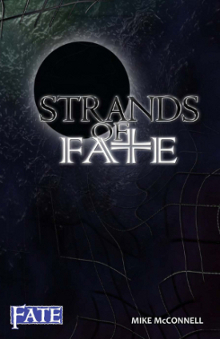
In Strands of Fate, most player characters are created with ten aspects.

Wait a sec… Let me back up… If you aren’t familiar with Fate, here’s the 38-word rundown: Aspects are simple phrases that sum up everything that is important about your character. These phrases come into play quite often as a simple, major component of the game mechanic, while simultaneously explaining your character’s concept and background.

“Yeah, but how do I come up with those 10 little phrases?”

Easy. Just follow the Aspect Alphabet. The Aspect Alphabet is a nice little package that helps you invent your aspects one at a time, with each one leaning a certain direction. Using this alphabet is entirely optional, but even many veteran Fate gamers will use all or most of this tool, as it simply helps to make a well-rounded, rich character.

The Aspect Alphabet is divided into two parts: Character Aspects and Specialty Aspects. Today we’re going to talk about Character Aspects. As the name implies, these aspects describe who your character really is:

  1. Defining Aspect
  2. A = Ambition
  3. B = Background
  4. C = Conviction
  5. D = Disadvantage

We’ve already talked about our Defining Aspect (Resurrected Valenar Warrior of Legend), so let’s jump right into our other Character Aspects, starting with Ambition.  After we figure out what they are, we’ll look into how we can use them in the game.

2. Ambition

What is it that my character, “Desolation” Amearus Omaron, seeks? What is he trying to do? What is his goal?

Well, I know that as a Resurrected Valenar Warrior of Legend, he once attained immortality (figuratively speaking). Others revered him as a great warrior, chanting war cries about him after his death. That’s quite an honor in Valenar society, and made his family proud. However, now that he has been resurrected (especially as a revenant), he has lost that distinction. The Valenar elves revere their greatest dead warriors, not their undead. Granted, Amearus isn’t undead, but as a revenant, he’s not alive, either. This has isolated him from his people, who don’t really know what to think of him. They certainly don’t respect him like they used to, and in truth, they now just barely tolerate him. This is all more than he can bear, and wants nothing more than to regain his glory. He must regain his glory. That’s it, I’ve found my Ambition:

I will regain my glory

3. Background

What is there about my character’s background that will influence his future? What, from his past, is going to have an effect on this character’s story?

In the 100 Years War, Amearus had fought in over 100 battles. As a soldier, he was certainly skilled enough, but it was an unnatural power that followed him into battle. Almost all of his opponents have died from their injuries, even those opponents who surrendered or retreated – they still died from their injuries inflicted by Amearus. His fellow soldiers eventually noticed this, and used it to help drive fear into their enemies. He quickly earned the fitting moniker “Desolation,” which in turn furthered his reputation, status, and rank. Few (if any) questioned this rumored “cloud of death” that followed Desolation into battle, because (in a time of war) he and his men produced continuous, solid results. Until recently, even Desolation didn’t question his place as death’s right hand. That’s it, I’ve found my Background:

Death’s right hand

4. Conviction

What does Desolation believe in? When is he going to stand his ground? When he has something important to say, what is it about?

Elsewhere I mentioned that I wanted this character to be (at times) at odds with his morals and convictions.  I wanted him to have strong ideals about honor, loyalty, and duty to country, though because of his taint with “Death” (Death’s right hand), he’s starting to lose touch with his former, ideal self.  Death’s right hand has an effect on him that will be subtle at first, then more pronounced as he continues to do Death’s work.  So, for his Conviction Aspect, I think that Honor is my middle name will work great.

Honor is my middle name

5. Disadvantage

To give my character some great inner conflict, I’m going to make my Disadvantage pretty much go directly against my Conviction.  I think The end justifies the means will do just fine. This aspect is not exactly dishonorable or evil, but it’s going to be useful in balancing out his Conviction.  It’s a great way to justify doing things that he might not normally do.  It’s more or less a sneaky tool that Death is using to corrupt Desolation, to help him cause more death and destruction.  In Desolation’s story, there is now potential for a tug-of-war between Desolation’s Conviction and Disadvantage.  He’s naturally an honorable person, but his Disadvantage will slowly start to blur the lines between right and wrong, order and chaos, and maybe even destroy his sanity.

The end justifies the means.

How Can I Invoke My Character Aspects?

(Remember, you invoke an aspect when you (the player), want a part of your character to influence the story, scene, or action.  Spend a Fate Point to get a +2 bonus to a single action, perform a re-roll, or to invoke an effect)

  1. Defining Aspect – Resurrected Valenar Warrior of Legend
  2. Ambition – I will regain my glory– I will most often invoke this aspect any time that my character is going to do something flamboyant, difficult, or very challenging – especially if others are present to witness.  This is my “show off” aspect.  This is my character trying to “be the man” so that others will revel my awesomeness.  Only as a glorious warrior will I once again achieve immortality among my people.
    • [Bonus] Should we get ambushed by orcs, I’ll take on three at a time.
    • [Effect] I could bait the biggest, toughest foe to attack me (or all enemies).
    • [Bonus] Should I try to intimidate the orc chieftain in front of his men, I’ll do so with style.
  3. Background – Death’s right hand – Death is hanging over me, following me wherever I go.  I’m a great warrior, but even more so because I have the touch of death, and can call upon it to aid my blade.  This is an aspect that I would invoke in combat, but only under certain conditions.  I think this fits well when facing living opponents.  It doesn’t usually work against constructs, demons, devils, objects, or elementals (or any chaos monsters that are hell-bent on death and destruction), and it probably doesn’t work using ranged attacks (it’s an up close and personalkind of thing).
    • [Bonus] Any soldier worth his weight in dirt should know not to face me (or so I feel).  Death will certainly back me up on this with a +2 bonus.
    • [Effect] I could invoke Death’s right hand on an injured opponent (who I wounded) who runs away.  Perhaps rolls to heal him take a -2 penalty, or he doesn’t heal at all, and ends up dying?
  4. Conviction – Honor is my middle name– What can I say?  I’m an old-fashioned, honorable kind of guy.
    • [Bonus] Should some spell effect me to do something dishonorable, I can use this aspect to fight that spell.
    • [Effect] Should I ask the Duke to help us in our quest, he might be more inclined to help an obviously honorable man.
  5. Disadvantage – The end justifies the means – As this is my Disadvantage (and because of how it is worded), I’ll be invoking this rarely.  This aspect will come into play more often when compelled by either me or the GM. Later on in Desolation’s story, I might start invoking it more often to reflect him becoming more of an agent of Death and destruction (if that’s how his story plays out).  For now, I’ll invoke this aspect any time I’m working toward a goal, but my method is not exactly honorable.
    • [Bonus] Should we ever need to get information out of an unwilling subject, this will work quite nicely as I “encourage” him to talk.
    • Really, any action I take that can progress me to my goal (and is not exactly an honorable action) can benefit from this aspect.

How Can My Character Aspects Be Compelled?

(Remember, you and the GM compel an aspect to create conflict for your character, instilling complications into his story.  Gain a Fate Point to take a -2 penalty, be forced to re-roll, or make something bad happen)

  1. Defining Aspect – Resurrected Valenar Warrior of Legend
  2. Ambition – I will regain my glory– I imagine that this will be compelled when my character is trying to do something on the down-low.   My character is trying to accomplish great things to regain his immortality, not subtle things to just “get by.”
    • [Effect] I’ve been tasked by the party leader to sit tight and watch our back.  However, the GM can compel me to go off on my own and search that other room instead.
    • [Effect] My character could be badly injured and retreating, but the GM can compel me to go after more enemies (or the toughest enemy).
  3. Background – Death’s right hand – Death IS hanging over me, following me wherever I go.
    • [Effect] Any enemy that I fight, that I’m trying to capture, might get hit with a killing blow accidentally.  Or, he simply might die from his injuries after the fight ended.
    • [Penalty] Perhaps I take an action in an attempt to save an ally.  Now I have a penalty to that action.
  4. Conviction – Honor is my middle name– Sometimes honor can get in the way of things.
    • [Effect] When the situation calls for it, strong arm tactics are the only way to go.  I could be compelled to not let that happen.
    • [Effect] The GM could pull this one whenever I try to tell a much-needed lie.  “Ok, it was us who killed your brother.”
    • [Penalty] Sometimes intimidation is not in my nature.
  5. Disadvantage – The end justifies the means– This is simply great because it can easily represent my past coming back to bite me in the ass.
    • [Effect] “Damn.  In one of my previous battles in the war, my men and I set up an ambush in a village to trap an advancing enemy.  The enemy was beaten, but the village was leveled.  These people are those displaced villagers, and they do remember me.”

Coming soon: Your “Specialty Aspects”
How FATE Relates to Other Games

I’ll admit, I’m a slow convert and I love my d20, but the more I read about FATE, the more tempted I am by it (I love universal systems. I don’t know why. It’s an illness). But since the game isn’t my primary area of expertise, I thought I would offer some counterpoint to the current direction of The Shack – specifically, how FATE relates to some of the other systems I play with regularly, and maybe, just maybe, some ideas on how to get a little of that FATE magic in your other games.

Aspects, Complications, And Extra Effort: FATE in DC Adventures

I remember reading somewhere that Steve Kenson was inspired by systems like FATE, Fudge, and so on, and that they were what drove him to write ICONS. But the other system he designed already has a lot of that magic back-doored in. Here’s a quick primer.

Complications are like the negative side of Aspects; in the same way that an Aspect can be compelled by the GM (earning you a Fate point in exchange for a penalty), Complications can be invoked (by either the player OR the GM!). There are are probably as many kinds of complications as there are Aspects.

The most basic kind of complications are Complications as Character: every character has a list of complications that make it easier to get into their head and into their world. Here’s a list from the book:

  • Flashbacks: Batman is sometimes stunned by traumatic flashbacks to the night his parents were murdered, especially in connection to Crime Alley, where the killings took place.
  • Nemesis: The Joker
  • Obsession: Crime fighting
  • Relationships: For a loner, Batman has a number of important people in his life, including Nightwing, Robin, Oracle, Alfred Pennyworth (the faithful Wayne family butler) and Police Commissioner James Gordon.
  • Responsibility: Batman considers Gotham “his” city, and his responsibility.
  • Secret Identity: Bruce Wayne

And here’s one I wrote awhile ago for a Marvel character writeup I did on Atomic Think Tank:

  • Guilt: Deaths of loved ones; Uncle Ben, Gwen Stacy
  • Significant Other: Super-model Mary Jane Watson
  • Relationships: Harry Osborn, Aunt May, Black Cat, Flash Thompson, Betty Brant, much of the Superhuman community
  • Low Finances: Peter is almost always strapped for cash.
  • Nemesis: J. Jonah Jameson
  • Enemy (Peter has tons of them): Norman Osborn, Eddie Brock, and the rest of a sizable rogues gallery.
  • “With Great Power, Comes Great Responsibility“: That’s the catchphrase of old Uncle Ben.  If you missed it don’t worry they’ll say the line again and again and again.
  • Reputation: J. Jonah Jameson makes sure that this is as bad as it can get.
  • Secret Identity: Peter Parker
  • Radioactive Blood: This can make transfusions difficult, to say the least…

(And before you ask, One More Day never happened. It NEVER HAPPENED. Ahem.)

And of course, Superman’s list wouldn’t be complete without Vulnerability to Kryptonite, right?

As a GM, seeing a list like this is great. Instantly, it gives you a feel for what kind of game the player is actually looking for, and gives you a whole HOST of ideas for how you can mess with him. And that’s just awesome, isn’t it? If you use something on the list against the player, give ’em a hero point. Isn’t bribery FUN??

There are also temporary complications, like Running out of Ammo, or Still having trouble seeing straight from that last attack. The former one is something that a GM might “Compel” on a player who’s been using that gun too much – effectively, “take a hero point and think of a new way to solve your problem.” The second one is even more entertaining; players are allowed to use complications to explain a failure, gaining a hero point and accepting an appropriate penalty – but only if they describe it narratively.

“But wait,” you’re saying, “that’s only half of what Aspects do. Where does the other half come in?”

I’m glad you asked. This is where I talk about Descriptors.

Descriptors, simply put, describe things. Yeah, I know, revelatory. They describe powers; they describe the environment; they describe origins, heroes, villains, purses and guns, space ships and laser beams. A descriptor is the difference between, say, burning hands and cone of cold.

Why do they matter? Well, I’ll tell you one good reason: Extra Effort.

Like Fate Points, the Hero Point economy in DCA/M&M is meant to be rapid. You need something to spend them on, right? This is where Extra Effort comes in.

Extra Effort can be used to gain:

  • Extra actions
  • Gain a bonus (+2, or increase an existing bonus to +5) on a single check, or negate a -2 penalty. (Which reminds me: the “GM’s Best Friend” is actually pretty much the core mechanic (or at least the core modifier) of most of the game. +2/-2/+5/-5, depending on how good or bad something is for you, and you’re good to go. SO much simpler than all those weird inconsistent rules from D&D, like “50% miss chance.” This is something that I seriously consider importing to every other d20 game I play as a house rule.)
  • Boost the rank of pretty much any one thing by +1 for a turn
  • Perform a Power Stunt, letting you temporarily gain a new effect for a power based on its descriptors.
  • Etc.

Normally, Extra Effort causes Fatigue; if you’re already fatigued then it causes Exhaustion. If you’re already exhausted, then it’ll incapacitate you. Hero Points? They change all that. Hero Points let you Edit the Scene: they give you re-rolls if you want them, but most importantly they let you shake off fatigue and other conditions like it (or move from Exhausted to Fatigued). There are a whole host of other uses, but I’ll shorten the explanation and just say that they’re kind of like FATE points. Oh, and of course they can be used to avoid a complication, (“No! I still have bullets! Keep your hero point, and here’s another!”) But honestly, why would you want to?

In Other Games…

So, we’ve seen how something like Aspects can look in another game system. How well would this translate to another game, like, say, D&D 4th Edition? Or Pathfinder?

Honestly, I think it’d work pretty darn well, though the list of things that you can do with them would have to change a bit. 4th Edition already has Action Points – pull that system, remove the spending, and plug in a modified version of Extra Effort (complete with “Awesome Points” or whatever you want to call them) and you’re good to go. With the lack of Power Stunts as an option (though you could add them, in theory) I’d go with Aspects over Complications, but either should work well – and make picking them a mandatory part of character creation. Ideally fairly early on in the process. Every character should have at least 2 – better characters have more.

Proposed House Rules for D&D Variants:

Author’s note: these rules are un-playtested; while they should, in theory, work excellently, there is always the possibility that I have missed something critical. Still, I’d love the chance to try them out.

  • Make ammo a complication. We all know that you’re not tracking ammo right now, anyway; this way, you have the ability to make the players run out of it at dramatic moments. Toss ’em a hero/fate/awesome point for their trouble.
  • Material Components are a potential complication. Just try not to be too mean about it. Seriously, though, this is another thing that gets cut in about the first five minutes with every D&D group I’ve ever met.
  • Establish a list of things that you can do with your point economy that is more impressive than just “take an extra Standard Action.” Truth be told, there are moments when I consider switching to Fate’s action system – you get one action, period, and if you want a move action, too, it’ll cost you a -1 on your die roll. Speed the turns along! But that’s an aside for another time. Most of the Extra Effort list could probably be used as is, really.
  • Not having enough rope is a complication. Having an extra 50ft coil on hand might cost you a hero point.
  • Not having enough money to pay the innkeeper is a complication. Let’s be honest; I hate the amount of time spent shopping for things in D&D, and a more abstract wealth system combined with the Dark Sun rules for Boons (or the Classic Fantasy variation found on this site!) goes a long way toward easing my pain. Make money a Complication/Aspect on top of that, and you’ve taken another step toward a more narratively focused game (and drastically reduced your bookkeeping).
  • Flat modifiers that make sense. Anything that calls for a 50% miss chance becomes a -5 penalty (or a -4, if you want to be consistent with 4th Editions “DM’s Best Friend.”) Anything that calls for a 20% miss chance becomes a -2. The next time you fight a ghost (or from behind cover), you’ll thank me (one less die roll! Hallelujah!)

Or, on the other hand, if that sounds unappealing:

  • Convert your D&D game to another system, like FATE, or Mutants and Masterminds. Either one could serve your needs well, honestly (M&M 2nd Edition even had a source-book for playing Swords and Sorcery style gaming, called Warriors and Warlocks). I may offer my own notes on how to do fantasy with M&M in a future series.

Anyone out there who’s used Aspects in D&D/Pathfinder/Insert System of Your Choice Here, please feel free to chime in with suggestions or experience. How did it work? What needed to be changed?

Happy gaming!

Houseruling Aspects Into Your Game

Hello, Wrath of Zombie here!

Tourq emailed me and asked if I would do a guest article for the Stuffer Shack about incorporating Aspects from FATE into other games, and I have to say I’m very excited about the opportunity.

What Are Aspects?

Aspects are an amazing mechanic used in the FATE system to help players and GM’s develop the characters and story.  The truly unique thing about Aspects is that they are not chosen from a list like Edges and Hindrances (as Savage Worlds) or Feats (DnD/Pathinder), but made up solely by the player.  The mechanic really puts the whole character into the hands of the player.

Aspects can really be anything: A motto or saying, an item, an idea, etc.  The point of this is that players can “invoke” an Aspect to give them a +2 bonus to their roll, or allow them to completely re-roll a bad result.  Both instances require you burning a FATE Point.

The other point is for the players or GM to “compel” a player’s Aspects.  The best kind of Aspect will be a double edged sword, something that can give a character strength, yet come back to bite them in the butt in certain situations.  When an Aspect is compelled and the player goes along with it, they are rewarded, not only by the possibility of some awesome role-playing situations, but with a FATE Point.

A good example would be: Anger is My Security Blanket.  This phrase can be used in certain situations to give the player power over the scene, or it can be used by the GM to get the player into some interesting situations that might not have otherwise happened.

This brings me to my next point:

Why Are Aspects Important (in Any Game)?

In my experience players tend to forget all that there is on their character sheet.  Who can blame them when you look at a game like DnD or Pathfinder that have TONS of things to keep track of over 2-4 pages (depending on which character sheet you use).  Not only do players tend to forget some feat abilities, items, and the like, but I’ve seen players also forget goals and parts of their character’s personality.

Prior to discovering the awesomeness of Aspects, I would ask my players to make a few bulleted notes of key points of their character’s personality in a few words.  This allowed them to remember and keep focus on who they wanted their character to be, and keep track of a few key goals.

Aspects do this as well, and the mechanic offers rewards for characters who put themselves in unpleasant and possibly hazardous situations.  I would like to point out that this is something that people new to Aspects have a hard time wrapping their brains around – especially for those who have really only played DnD/Pathfinder in the past.

While I love DnD/Pathfinder, there really isn’t any mechanic that rewards role-playing, and it punishes you for taking risks or playing “against” your character archetype.  Many games other that have embraced a newer school of thinking reward this kind of action (Savage Worlds and Mouse Guard come to mind).

When you put Aspects in a game and get a group together to discuss them, you will see some awesome creativity come into play and some truly amazing Aspects be created.  Here’s a shameless plug, but informative- I did a post about communication and Aspects, which you may find interesting.

Putting Aspects in Other Systems

 Every system has some form of mechanical bonus that can be applied to Aspects.  DnD 4e, and 3.5 (after the introduction of Eberron) has Action Points.  Action Points have some sort of function that can be used in conjunction with Aspects.  In the Pathfinder game that I am currently running, I wanted to make sure that I incorporated Aspects into my house rules so all would harmonize and feed off the other.

Savage Worlds uses Bennies to reward players for doing something cool in-game, helping the GM, maybe telling a funny joke, or whatever.  The player can use Bennies to soak damage, or re-roll a failed traits or skills roll.  This mechanic can easily be modified to work with Aspects.

I discovered a really good post on Savage Worlds and Aspects not too long ago.  What the author suggests is pretty much right down the line of what I have done to my Savage Worlds game.

I like Aspects as an option rather than Edges and Hindrances, because, as I mentioned earlier, in previous SW games I have ran the players forget to play their characters as vengeful, or forgot the mechanics of Hard to Kill (or some other Edge).  With Aspects, if you forget, you forget.. no harm no foul, except that you really aren’t getting full use and development of your character.  However, in Savage Worlds, when you forget to play up your vengeful manner, yet you DO remember all the bonuses of your edges, is that really fair?  You’ve taken a Hindrance and aren’t using it, but using the Edge.  Another issue is that Aspects are able to be rewritten and are usually pretty clever, where I’ve seen many Hindrances just go to the wayside because they really don’t fit into the campaign, or it is too much of an issue to try to incorporate them.

A recent post I did for Aspects is for incorporating the mechanic into Dragon Age RPG.  That one is also simple to incorporate, and it really is a simple and wonderful system.  As I say in that post, it’s really easy to do:

Give each character 3 Dragon Points and have them create X number of Aspects (to be determined by the GM).  When a player invokes an Aspect it works exactly as with FATE.  The player gets +2 to an ability test or a complete re-roll.  Compels would work the same way as in FATE as well.

By and large, incorporating Aspects into a game is easy.  In most cases you can honestly just use the same mechanics from FATE to whatever system.  Look at the mechanics of the system you like and see what needs to be tweaked.

I will use the three games I mentioned above as examples:  Pathfinder/3.5, Savage Worlds, and Dragon Age.

To start, at the beginning of every session (regardless of system), each player starts with 3 Fate Points, Bennies, Action Points, Dragon Points, or whatever you want to call them.

Pathfinder: If you just wanted to be simple, the standard FATE rules will work.  Burn a point to invoke an Aspect to add +2 to a roll or completely re-roll.  However, I feel that +2 is honestly not a huge number in Pathfinder/3.5 and would recommend making that number +4.  That +4 makes it more heroic and garners the likelihood for success.

The important thing to remember is that when a player is using an Aspect they are saying they want to do something cool and they want to succeed.  Also keep in mind that they will generally be excited that their Aspect, which they created themselves, is able to fit the scenario and come into play.

Savage Worlds and Dragon Age: I’m lumping these two together, because honestly, their mechanics (while different) operate closely in numerical value and difficulty classes.  For these games, the normal Fate Rules work perfectly fine (see the above example from Dragon Age again).  The +2 is a huge boon in both Savage Worlds and Dragon Age, and would operate in the same way as +4 in Pathfinder/3.5.

I would like to give further examples of how to incorporate your own house rules into facilitating Aspects, but I don’t know your house rules so it would all be supposition at this point and moot.  Again, feel free to look at a post of mine where I show how I linked my house rules to Aspects.  I’m more than willing to give my opinions on other people’s mechanics and thoughts on the subject, just leave a comment here or on my blog!

I Have to Have the Last Word

Good Aspect right there.  I hope I have conveyed how awesome this simple mechanic is.  Players really get excited about creating Aspects because it really and truly is theirs.  It is exciting (as a GM) when players really want compel their own Aspects to see where the story will go and what will happen.  This is very motivating since the players are engaged and helping share in the story that the GM has crafted.

Aspects are simple, elegant, and easily incorporated into pretty much any system.  It is something that I really recommend any group try, it’s something I really compel you to do.

Playing with Fate: Your “Defining Aspect”

Even though all aspects have the same base definition, and mechanically act in the same way, your Defining Aspect really encompasses the meat of your character.

  • Who is this?
  • What do they do?
  • What is their profession?
  • Where does he come from?
  • How is he different from others like him?
  • What is it about this character that will make me immediately aware of who I’m really playing?

Sum it up with a single phrase.  Here’s an example:

Elven Fighter

Ok, that’s a start.  Let’s expand upon that.  Well, I know he’s been in over 100 battles in the 100 Years War, so let’s give him a reputation (he’s a great warrior after all).  A soldier, legendary even.

Elven Fighter of Legend

This guy is legendary.  He’s not a mere fighter or grunt soldier.  He was a Warlord or General.  Actually, his legendary status comes more from his personal accomplishments on the battlefield, not his leadership ability.  A Warrior.

Elven Warrior of Legend

Wait a minute.  He’s bred for war.  Who’s bred for war…?  The Valenar elves.  Even after the war has ended, they’re still looking for ways to start it back up.  That’s all they really care about.  Yeah, Valenar.  Besides, the Valenar all aim to become glorious warrious, legendary.  Yeah that fits.

Valenar Warrior of Legend

And why is he legendary, exactly?  …Because, in all those battles he took part in, just about all of his face-to-face opponents have died from their injuries.  Even if they were able to surrender or retreat, most of them still died anyway.  This gave him the nickname, “Desolation.”  Nice.  Perhaps this touch of death, or Death, has plans for him.  However, I think that sounds like a different (separate) aspect, so I’ll save that for later.

Valenar Warrior of Legend

That’s cool.  Seems about right.  But how can I punch it up a little bit more?  I know… he died and has been resurrected.  Yeah, that’s perfect.  The Valenar elves revere their dead ancestors, so when he died, that’s when his legacy became immortal.  Many Valenar would go on to revere him in their stories and war-cries.  However, he’s been resurrected, perhaps as a revenant.  Yeah, those Valenar aren’t going to like that. Not dead or alive, but somewhere in between.  They aren’t going to like that at all.   Especially Desolation, because that’s stripping him of his “immortal” status (no more campfire songs and war-cries about him – he’s tainted).  He had attained “immortality” through his reputation and deeds, now that he’s alive again (kind of), that distinction is gone.  I think I’ll keep revenant for another aspect, though, and go with:

Resurrected Valenar Warrior of Legend

THAT, is my Defining Aspect.  That is who I am playing.  Not merely a simple “Elven Fighter,”  but a Resurrected Valenar Warrior of Legend.  When I need to be reminded of who he is and what he does, this is the phrase I’ll come back to.  When someone asks what kind of character I’m playing, this Defining Aspect is what I’m going to say, and they’re going to know exactly what I mean.

Resurrected Valenar Warrior of Legend

So, how can I use this aspect in the game?  I imagine, because it’s my defining aspect, that it’ll come into play often.  As with all aspects, the best ones are those that can be used both for and against you.

How Can I Invoke My Defining Aspect?

In Strands of Fate (your version of Fate may differ slightly), I will spend one Fate Point (FP) to invoke my Defining Aspect.  I’ll do this anytime I think that my Defining Aspect is relevant to the action, scene, or story, and I want to get a +2 bonus or effect.

In combat, it’s very easy for me to say, “I attacked the orc and got a 6.  Since I’m a Resurrected Valenar Warrior of Legend, I easily have the training and experience to cut this mongrel to shreds.” I spend my FP and thus get a +2 bonus to my attack roll, making my total a mighty 8.  Conversely, had I rolled poorly to begin with, I could have spent the FP to get a reroll instead.  Of course, this works the same way when the tables are turned – I could invoke my Defining Aspect when being attacked by the orc, and I want a bonus to parry.

By spending the FP, I’m saying, “My character is a bad-ass, and at this moment, his skill, talent, and experience are really shining through.”

Social Conflicts are, of course, a viable time for me to invoke this aspect.  “Hey GM, we need to get these soldiers to quit hassling us so we can continue along this road.  I invoke my Defining Aspect, Resurrected Valenar Warrior of Legend, when I talk with them.  I want them to understand that I’m used to giving orders to hundreds of soldiers, and they should think twice about trying to push us around.” For this, I would get a +2 bonus when trying to intimidate these soldiers, or get past them diplomatically (also spending that FP).

Also, I could invoke this aspect when talking with other Valenar warriors, to show a sort of camaraderie of old soldiers who fought on the same side of the war.

As a declaration, I could say to the GM that “because I’m a Resurrected Valenar Warrior of Legend, I actually fought a battle in this particular valley.  There is, in fact, a stronghold around the bend where we can take refuge from the advancing pack of gnolls.” Of course, this is ultimately subject to the GM’s approval, but you get the idea.

One more example: The party is being attacked by four wraiths.  I could spend the FP and say, “because I’m a Resurrected Valenar Warrior of Legend (resurrected being the key word), all of the wraiths will attack me in the first round.  I have tasted death (and should, in fact, be dead).  The wraiths simply don’t like the fact that I’ve cheated that fate.” Yeah, I’m the heroic bad-ass.  This is all part of my plan to regain my glory.  Now, I could spend the FP for this declaration (and the GM could certainly accept it), but if he was feeling especially generous, the GM might even give me this declaration for free, because ultimately, it’s my character who’s paying the price.

Turning the Tables, How can my Defining Aspect be Compelled?

At first you may think that it’s bad for the GM to compel your aspects.  And really, how can he compel your Defining Aspect?  That’s who you are.  Easy (and for good reason).  First of all, his compelling of your aspects provides you with Fate Points – points with which you power your aspects for your advantage, as well as using many of your other special abilities.  Not only that (and more importantly, in my opinion), the GM compelling your aspects makes for greater conflict and thus, greater story.  I mean, really, do great heroes spend their time overcoming sunny days and tea parties?  No, they are great because they overcome conflict.  And that is where “compelling your aspects” comes in.  Remember, just because the GM is compelling one of your aspects (offering you a FP for it), you don’t have to accept the compel; you can choose not to take the FP and negate the compel.

In combat, it might be tricky for the GM to compel your Defining Aspect (I mean, I am a Resurrected Valenar Warrior of Legend, after all), so in this case the GM would have to get inventive.  He could say, “You’re a Valenar Soldier, used to going after the killing blow.  Honorable, friendly duels are not exactly your forte.  So, in this friendly duel with the Baron (this round), I’m compelling your Defining Aspect to take a -2 penalty to your roll.  If you take the penalty, you’ll get one Fate Point.”

You could take the penalty and gain the FP, or you could refuse them both, saying, “You’re right, I’ve never been in a duel, but a duel is much like sparring with a training partner, and I’ve done that many a time, so I’ll do just fine.”

The GM could also say, “As a Valenar Warrior, you’ve fought the Valenar way for over 50 years – direct, hard, and brutal.  And, most of your opponents have been opposing soldiers.  These swarms of  rot beetles are not your typical foe, so they get a +2 bonus to attack you this round.  Do you accept the FP and the compel?”

Remember the four wraiths that I wanted to attack me?  That was me invoking my aspect so that I could save my friends.  Let’s say that I wasn’t feeling especially so brave, and at that moment I felt that it was every man for himself.  The GM could simply compel my Defining Aspect and have all of the wraiths attack me (those wraiths hate the resurrected).  At least I got a FP for it, and the story got that much better.

Social conflicts are easy to handle with this particular Defining Aspect.  The GM could compel the Valenar part of the aspect anytime the character is talking with someone who hates the Valenar (or elves, even).  Or perhaps, as an ex-soldier, the PC is talking with someone who has been repeatedly harassed by soldiers.

Getting even more bang for your buck, “You would think that because you’re a Valenar Warrior of Legend, these other Valenar warriors would respect you.  It’s just that you’ve been resurrected, and in their eyes, all that glory has been reversed.  These Valenar actually pity you.  You’re almost a disgrace.”

As a declaration, the GM can also pull this one:  “Here’s a Fate Point.  You can’t deny this declaration.  The man standing before you is the soldier who killed you in your last battle of the 100 Years War.  He’s hunted you down, and quite apparently aims to finish what he started.  Roll Initiative.”

And my favorite: “I’m a warrior, bred for war.  This Noble’s ball is not exactly my scene, and I’m totally out of my element.  Sorry guys, but I stick out like a sore thumb here.  Hey GM, I declare that too many people are taking notice of me, and I’ll take that Fate Point for it.”  See that?  The GM is not the only one who can compel an aspect; you can too (it makes a better story, and you get more Fate Points).

In Conclusion

In each of the above examples, the Defining Aspect of the character has affected the plot and story of the game, or at least shown clear motivations for certain actions (by both the player and GM).  In each instance, the story became more rich, and the character more memorable.  Everything was centered around who the character is, how he affects the game, and where the story goes.

That, is a Defining Aspect.

For more articles on Playing with Fate, go here.

Embrace Your FATE

Although the FATE system has been around for a few years now, 2010 really shaped up as the year of FATE.  Last year we saw the release of The Dresden Files (urban fantasy), Diaspora (hard sci-fi), Legends of Anglerre (fantasy), and Strands of FATE (universal).  All of these games have added to the critical acclaim of Spirit of the Century (pulp action) and Starblazer Adventures (space opera).   These games have been very well-received by the ever-expanding FATE fan base, and I’m among the converts.  We like FATE so much here at Stuffer Shack that we’ve even dedicated this new column to getting the most out of the system.

For me, my favorite version of FATE thus far is Strands of FATE (SoF).  As a universal set of rules, it is among the very best I’ve ever seen.  For the past few months, my gaming group and I have used these rules for fantasy adventures set in Eberron, pulp action set in the 30’s, and in a couple of days I’ll be starting a campaign based on the world presented in the Malifaux skirmish game (sort of a Rippers meets Deadlands meets Dark Matter).  Long story short, it’s been a long time since a rule-set has inspired me this much.

Since embracing FATE, my gaming experience has improved greatly.  It’s been years since I’ve felt this inspired and creative at the gaming table.  Usually, the mechanics of a game are the thing that I just have to sort of deal with and work my campaign around, hoping that the rules assist the telling of a good story,  instead of detracting from it.  With SoF, rules and story-telling come together into one element – you can’t really do one without the other.  The rules for FATE are very simple, some might even say “rules-light.”  However, many rules-light games tend to feel “rules-incomplete.”  I’ve found that you can’t really use terms like this with FATE.  In essence, the rules are very light – a simple note card can cover most of the basics.  In execution, however, the rules are extremely comprehensive and easily handle whatever you throw at it.

For those of you interested in what FATE has to offer, go for it.  You won’t regret it.  However, I do have to add a cautionary note to my praise.  The game represents a significant paradigm shift over most of the main-stream and indie RPG’s out there.  Additionally, the longer you’ve been gaming the more difficult this shift may be to overcome.  My advice: forget the things you’ve grown comfortable with.  Forget about tables, fixed modifiers, and move rates.  Stop thinking in terms of min/maxing numeric scores, optimizing abilities, and choosing the best equipment.  Forget about abstraction vs. realism.

FATE is a story-telling game engine, but it’s far from free-form.  The power behind the system is the Aspect.  In a nutshell, Aspects are descriptive phrases that speak to a quality of a thing.  For example:

A person might have Aspects like:

  • Fastest gun in the west.
  • Initiate in the Order of Seven Dragons.
  • “You killed my father, prepare to die!”

Vehicles and equipment have Aspects:

  • Fastest ship in the galaxy.
  • Slowest ship in the galaxy.
  • Unsinkable

Locations can have Aspects too:

  • Haunted by echoes of the past.
  • Floor covered in debris.
  • Deep shadows.

An Aspect’s primary purpose is as a game mechanic.  A player can Invoke one of his Aspects by spending a FATE point and gain a bonus, or have one of his Aspects Compelled against him for a penalty (but earning him a FATE point in the process).  This “FATE Point Economy” and Aspects are the real motivating force behind the game and replace most of the conventions we gamers are used to seeing.  Two things the aspiring FATE player must remember:

  1. Anything potentially relevant is probably an Aspect.
  2. If it is relevant right now, a FATE point is going to be involved.

Keeping these two things in mind allows you to know virtually all of the rules for the game.  In FATE, you don’t need to know the bonus for being in cover.  If cover is available it’s probably an Aspect (Crates and pallets everywhere.)  If you spend a FATE point to Invoke the Aspect, you get a bonus – if not, you don’t.  The FATE point is saying that this quality (the Aspect) is relevant right now.  If you don’t spend the FATE point, the crates and pallets aren’t a factor (at least not now).  Of course, next turn when you’re trying to spot someone in the room, the GM may Compel the very same Aspect – giving you a penalty (the crates and pallets make it difficult to see), and a FATE point for your trouble.

What makes FATE the story-telling powerhouse is that Invoking and Compelling take much more than simply tossing a FATE point and saying, “I’m invoking Crates and pallets everywhere.”  In order to Invoke and Compel you must provide narrative context as to how the Aspect is relevant to the situation.  “I dive over the rail and into the crates as he shoots at me!” Stating something along those lines and tossing out the FATE point not only answers the mechanical needs of the situation, but also gives great narrative roleplaying flavor.

Additionally, I love Aspects simply because they convey so much with so little.  When I look at a character sheet I can instantly tell about the character’s personality, history, and motivation without having to read a separate background page.  As a GM, this really saves me some time.  A few Aspects on an NPC sheet and I know everything I need to know – same goes for an encounter area, village, or evil organization.  In fact, the old bullet-point style notes I used to use have simply become Aspects without any additional work.

This is just a quick glimpse at the power of the Aspect.  Expect to see more in the coming weeks and months.  Stuffer Shack already has several articles ready and more on the way (as well as insight from Strands of Fate creator, Mike McConnell).  In the mean time, feel free to comment and ask questions – we’ll do what we can to help you embrace your FATE…

One last thing: Even though we’ll be talking about the FATE system, many of its concepts will apply to any game you’re playing. So stick around!

For more articles on Playing with Fate, go here.

Playing with FATE, a New Project!

In our opinion, no other game brings out the role-player in you, like FATE can. No other game brings out the collaborative story-telling, like FATE can. And no other game can simply be as rewarding – as FATE can. However, with the many incarnations of FATE (and its radical approach to gaming), it can be a little intimidating to tackle. But fear not! We’re here to help you.

There are several games that utilize the FATE engine (Fantastic Adventures in Tabletop Entertainment):

  • Spirit of the Century
  • Starblazers Adventures
  • Dresden Files RPG
  • Diaspora
  • Awesome Adventures
  • and several others…

The newest version (Strands of FATE) pulls previous versions of the system together into a more streamlined, multi-genre utility. We believe that because of its potential, it’s going to become the system of choice for many, many new games coming out in the near future.  2011 – 2012 will simply be huge for FATE-based games. Because of this, and because we love the system so much, we’re starting a new project…

PLAYING WITH FATE

Basically, you’ll be seeing several articles that explore the system, putting it into use, and showing you how to get the most out of it. Concepts will be explained, examples will be given, and questions will be answered. It’s not that the FATE system is hard to use, it’s simply a different approach to RPG systems (truly collaborative story-telling between players and GM, as well as greater immersion into player characters).  In short, if you want to learn how to play FATE – and get the most out of it – look no further.

Articles will primarily be written by some of us at the Shack, as well as Strands of Fate creator, Mike McConnell.  If you have experience with Strands of Fate (or any FATE-based game), and would like to contribute, shoot us an email!

One last thing: Even though we’ll be talking about the FATE system, many of its concepts will apply to any game you’re playing.  So stick around!

For more articles on Playing with Fate, go here.

FATE: My only real role-playing game.

A few years ago, I was sitting at work in the jail as a new-hire.  I was talking with a couple of guys about gaming and they brought up that the next edition of game XYZ was coming out.  The game was taking an entirely new direction, offering all these new, cool options, mechanics, and support.

“Radical!  I can’t wait to try it out!  Tell me more about it.” I said.

And they did.

And then I said, “Well, what does it do to encourage roleplaying?”

The response I got was, “It completely leaves the role-playing responsibility in the hands of the individual player.  It’s up to the player to role-play as much or as little as he likes or is comfortable with.”

…Not really what I was looking for.

That was my moment.  That was the moment I realized that I was looking for something different, something that simply fit me better.  Sure, role-playing ultimately falls on my shoulders, but I was looking for a game that helped me with that.

I can make any character out there, play anything, and be anyone, but when I sit down to make my character, roll stats and assign build points, all I’m doing is building numbers, abilities, and powers.  The rest – the history, values, quirks, aspirations, contacts, motivations, enemies, relatives, and so on, I have to fill in myself (as an option).  I know, cry me a river.  My point is that I could make my character and skip all that fluff stuff, and still have a PC to roll dice for (some cookie-cutter character that everyone has seen a million times over).

The problem with that, is that when I actually do take the time to write up my character, with all the idiosyncrasies that come with him, I lose much of those character hooks during play.  No matter how much effort I put into my character, I’ll just end up playing

  • the elven warrior with a chip on his shoulder.

When I sit down to play a character, I want this character’s character to come alive.  I want to take on the role of

  • the resurrected Valenar warrior of legend, upset that his resurrection has stripped him of his immortal achievements.
  • The warrior who loathes the direction of the Undying Court because they might hold the secrets to his destiny, and are stringing him along for their benefit.
  • The warrior who, when under pressure, even questions his loyalty to his own morals.

I want to see that character at the table.  Sure, I could probably pull it off at times, but I’m not a strong role-player to begin with.  I’d simply like a game that helps immerse me into my character, which in turn enhances the story.

Well, I found a way, and it’s called FATE.  Specifically, Strands of Fate.

Were I to see this book on the shelf, I’d probably pass it by.  It doesn’t have the crunch that I normally like.  It doesn’t have the tactical combat that I normally like.  And it doesn’t have the feel of the traditional RPG that I normally like.

But I like it.

Basically, all those character quirks, values, history hooks, personality traits, and so on, are called Aspects.  In any other game they usually get pushed aside or mostly forgotten;  in FATE, they are the driving force of your character.  They ARE the mechanic.  Aspects drive your PC’s actions, affect your dice rolls, and influence his decisions.   Not only will you never forget who your character really is, but you’ll make a much more rich and full character to begin with.

So, after a few playtests and one-shots, I sneakily worked on my GM to get him to convert our 4E Eberron game to Strands of Fate.  Never mind that in the beginning, it was I who pushed for us to use 4E for our game.  That doesn’t matter.  What matters is that I had found a game where I thought I could finally pull off the character that I wanted.

So, we made our characters last week, and it’s one of those things that you should do as a group.  Sure, you come up with the general idea of him on your own, but you really get the most out of it when you’re bouncing ideas off of everyone at the table.  I can’t tell you how many times one of us was thinking of some concept, some aspect, but couldn’t get all the way there.  And then someone else offered up some ideas and you just… the light pops on, and it fits, you know?

One of our players has been playing Malik – kind of a sailor, bard, adventurer, fighter, arcane mix.  In the first few levels of 4E, this character had gone through some mechanical changes simply because the player could never really pin him down.  Well, to end the night of our characters being generated with FATE, this player sort of mused to himself that he was absolutely positive that he had finally “found” the Malik he wanted to play.  He and I could have been the same player, because I felt the exact same way.

I realized then that if I ever rewrite my RPG (we all have one, right?), I’m going to steal shamelessly from FATE.  Hell, I might use the entire damn system – I think it works that well.  In terms of helping you make and play a character that comes alive in-game, there’s just no better RPG.

And that is why, for me, FATE is the only real role-playing game.

The Power of Fate

Since my last article, I’ve had a chance to look over the Fate 3.0 SRD (system reference documents), and I’ll say this: it has a lot going for it. And I’m not just saying that because it’s free. Really.

The specific SRD I was referencing was Spirit of the Century, and while I’m not certain how complete of a picture it gave me, it looks as if the game would be easy to adapt to any number of genres, just by changing what kind of skills and stunts are available.

But that’s not why I’m here. I’m not here to sell you on Fate – I haven’t played it once (yet!), so I don’t have the slightest clue how it would run, even if it looks alright on paper. I’m here to tell you what I liked most about Fate, and what I feel other RPG’s could learn from it. This overlaps somewhat with what I liked most about Mutants and Masterminds, but let’s take a run through it anyway – I’ll draw on both for examples.

1) Aspects and Fate Points.

Similar in some respects to the Complication/Hero Point/Extra Effort rules in Mutants and Masterminds – by far my favorite thing in the system, and I’ve been looking for a way to apply it more broadly across d20 systems in general. Aspects are character traits, relationships, or special objects that are integral to your character concept – they can be positive, negative, or both. Having a good mix is best, because positive applications can be triggered (through Fate points) to grant bonuses when appropriate, while negative applications are basically a way for the GM to pay you (in Fate points) for letting him do something he’d do anyway – screw you over – for the sake of the story, of course! 🙂

Aspects can be almost anything, from “Man of Iron” to “Arrogant Wizard” to “Reckless Poker Player” to “Trained by Qui-Gon Jinn.” A complication might be, say, “Vulnerable to Kryptonite,” but an aspect might be “Kryptonian,” which could include Vulnerable to Kryptonite.

Why they’re good: Aspects/Fate points (and the similar but different Complications/Hero Points) encourage good role-playing, discourage powergaming, and offer a mechanical way to reward the kind of behavior GMs want at their table.  Players get more control over what happens without breaking the game, or permanently boosting a character’s power level. Nice.

As an added bonus, for GM’s creating their own campaign world, having your players give you a list of “Aspects/Complications” is great – the more detailed the better. By putting it on their sheet, they’re telling you what kind of stuff they want to see in the game, and that’s way better than trying to railroad them through something you came up with on your own after a lengthy mind-reading session. If a player has down on their sheet that they have an “Eternal Rivalry with a Psychotic Clown,” then you might as well come up with a good way to use that for one of your villains. Why should you do all the work when you can get your players to do it for you, and they’ll have more fun as a result?

2) The Novel.

This may be specific to Spirit of the Century, but regardless, with a little refluffing it’s a brilliant idea (make it the “Graphic Novel” for a superheroes game, or “The Legend” for a medieval fantasy setting … easy).

Essentially, here’s the idea: Before the campaign starts, hand each of your players a piece of paper and have them write down a title and a summary of an adventure that their PC went on in the past, including a few brief notes about how it affected their character. This is the Novel. Then everyone gives them back to the GM, who mixes them up in a hat and has everyone draw one.  If a player gets his story, he puts it back and draws again.

Your character was a supporting cast member in the adventure that you drew.  Put your character’s name down on the paper, with some notes as to how you contributed to the story.

Now do it again.  No one can be in the same novel twice.

The result? Built-in connections between your character and at LEAST two other party members, possibly more. You know each other, and have already worked together in some small capacity. Make sure you note whose books you appeared in as well as who appeared in yours.

I’m always on the lookout for good ways to avoid the whole “Tavern” issue, so this seems like a good step to take in almost any RPG, though flavored a little differently in other settings. Bare minimum, there is now significantly less than 6 degrees of separation between any two party members.

Genius.

3) Combat that emphasizes creativity and cleverness over “Kewl Powerz.”

Okay, this one is kind of subjective, but I’m going to throw it out there anyway. The problem with D&D 4th Edition has rarely been the game itself. The problem is the players.

Yeah, I sound like a game designer. Bear with me a second.

I was watching an interview (Meet the Author) with R.A. Salvatore that I found over on Grognardia. Not a place that often caters to my style of gameplay, but it’s funny how much you can find to agree on with someone of a differing perspective when you put some effort into it. But that’s a digression.

Salvatore said of 4th Edition that when the game devolves into “I use X Daily Power,” it’s just a card game, and it dies. When you have creative players who describe what the character is doing and use the mechanics of the power as a rough guideline for their description, who stop thinking about the miniatures on the table and focus on the characters in their epic struggle, then the system really sings. That’s when it hit me.

That’s true of any RPG ever. If the players aren’t into it, aren’t being creative, and above all aren’t stepping into the shoes of their character, the game is going to die inside.

Both Fate and Mutants and Masterminds operate with this as the default assumption of the game – that’s just how they work. You can’t really do anything without describing what your character does and how they do it (or if you can, you shouldn’t), and if the players get into it it’s pure gold. But no matter how the game is structured mechanically, if the players and GM don’t get immersed . . . why aren’t you just playing a board game? Or a card game? Or a video game? I hear that Halo: Reach is excellent.

For the GM, the best advice I can give is that you have to start the process – you have to describe, describe, describe, and don’t let your players get away with, “I use Twin-Strike. Again.” Use sound effects! Stunning visuals! Stand up and demonstrate if you have to! Just don’t let the game turn into Magic: The Gathering.

Not that there’s anything wrong with Magic: The Gathering, mind you, but that isn’t really why you sat down to tell stories together.

Sure, it might be faster to just name the power, but isn’t there something superior about, “I duck and weave, evading the Orc’s attacks, striking quickly with my blades,” or, “I slide between the ogre’s legs and slash at his Achilles tendon?” “I swing my shield in an arc to throw him off balance, then throw my weight forward to knock him backward?” Or any number of other possibilities? No one else at the table cares which move you’re using, just make it and make it sound awesome. Even (especially?) if it’s “just” a Basic Attack.

I’m sure there’s plenty of DMs out there for whom this is old hat, and have already figured this out ages ago, but for everyone who knows how to run the game there’s another DM out there who’s still making their players consult spell mechanics and look up all their feats at the table instead of just playing the game. Not that they shouldn’t have that sort of thing memorized by now, mind you . . .

So, what does it all mean? Okay, since you asked, gentle readers, I’ll tell you.

There is no magic bullet. There is no perfect game system that will instantly do everything right for you the first time, but every last one of them has something to offer. Some more than others, sure, depending on your needs. But nearly every game has something to teach you.

The trick is finding it, and figuring out how best to apply it.

Happy gaming, happy holidays, and may your game table be the one where the fun is this season. Excelsior!