Playing with FATE: Skills – Who Needs ‘em?!

As you’ve probably noticed, our gaming group’s preferred incarnation of the FATE system is Strands of Fate. SoF resembles other Fate games in many respects, but differs in its approach in a couple of ways, ways that I feel improve the Fate experience.

Author’s Note: For a comparison of differences, click here.

For me, the difference that really sets SoF apart from it’s contemporaries is the lack of a traditional Skill System.  I know what you’re thinking – I myself can’t believe that my favorite RPG doesn’t have a defined, specific skill system clearly showing what my character can do and what he’s good at.  For the past 20 years or so I wouldn’t even consider playing a game without skills.  But, when I looked at how SoF handles skills, I instantly recognized genius.

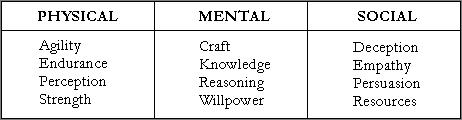
Instead of traditional skills or attributes, SoF uses twelve Abilities:

In general, these Abilities will be rated between -1 and 5.  In my experience so far, as both a player and a GM, these twelve Abilities cover everything I could possibly do with my character as well as helping me define a great deal about him.

However, with SoF this is only the beginning.  To really see what a character is good at, or really bad at, we need to take a look at his Aspects (Specialty Aspects in particular).  Aspects tell you so much more about a character’s strengths and weaknesses than a skill with a number ever could.  For example, in most Fate games someone good with a gun may have something listed like this:

  • Firearms: +4

Ok, that’s nice.  I guess the character is better than a guy with +3, but worse than the one with +5.  And I guess he’s the same with any type of gun.  In Strands of Fate that character might have an Aspect or two looking like this:

  • Fastest six-gun in the west.
  • Born with a rifle in his hand. (Agility)
  • One shot, one kill. (Perception)
  • “It’s time to rock and roll!” (Agility)

This tells me a lot more than “Firearms: +4” ever could.  This was illustrated for me during the game I recently ran at DunDraCon.  Four of the players at the game were new to Fate.  One guy, after glancing at his character sheet said, “What does my guy do?  What’s he good at?”  Before I responded, another player told him to read his character’s Aspects (SoF characters have at least ten).  After reading the Aspects, the first guy nodded and said, “I’ve never had such a clear idea about who my character is, and what my character does.  I even know what he doesn’t do. Cool.”  That’s one of those great “ah-ha” moments.  In SoF, a quick look at well-written Aspects and you usually know more about a character than two pages of background and notes.

Eliminating a traditional skill system has two additional benefits.  First off, players have the ability to focus on roleplaying Aspects, instead of number-crunching.  They look at their characters from a more story-focused and narrative viewpoint than a simple collection of stats and modifiers.  The second benefit, and the one I really appreciate as a GM, is having a very brief list of Abilities to remember instead of a chart of 30 skills.

I play in a Deathwatch game a couple of times a month.  It’s a fun game, but there are more than 40 different skills.  As a GM, I want to be familiar with all the skills so that I can ensure they each see a little “screen time” and that the players who’ve invested in certain skills feel rewarded by seeing them come into play.  In SoF, I only need to remember the twelve Abilities.  If a character has a relevant “skill” (Aspect), it’s up to them to remember to Invoke it.

For me, this not only makes adventure design easier, it also really streamlines on-the-fly decisions.  So far, in the SoF games I’m playing in, it’s always been very clear what the appropriate Ability to use is, and each of the players know their character well enough to decide if any of their Aspects should come into play.

This is yet another reason why Strands of Fate has become my roleplaying system of choice – a simple but comprehensive mechanic combined with a rock-solid focus on story-telling.

Playing with Fate: Your “Specialty Aspects”

This part of character creation (in my opinion), is the fun part.  It’s where I get to personalize my character and really make him stand out.  I know, we thought we did that with both of the last two articles (here and here), but that just shows how cool Strands of Fate really is.  In this article, we continue with the second half of our character’s ten aspects.  Last time we talked about our five Character Aspects, today we discover our five Specialty Aspects.

Remember, this is totally optional – you could make five more Character (or generic) Aspects if you wanted, but to really get a diverse and dynamic character, I’m going to follow the recommended Aspect Alphabet as best as I can.  Also, Specialty Aspects are usually tied to particular Ability, where Character Aspects are more broadly interpreted.

Let’s take a look at our Aspect Alphabet again.  We’ve already looked into our first five, now we’ll move on to our last five:

  1. Defining Aspect
  2. A = Ambition
  3. B = Background
  4. C = Conviction
  5. D = Disadvantage
  6. E = Exceptional Skill
  7. F = Foe(s)
  8. G = Gear
  9. H = Help
  10. I = Inferior Skill

6. Exceptional Skill

What skill or talent has “Desolation” Amearus Omaron excelled in?

That’s easy (and simple).  He’s a great warrior, but it’s his skill with a long blade that his enemies fear.  I will most often tie this aspect to my Strength ability.

Master Swordsman

7. Foe(s)

Who out there has it in for Desolation?  Who despises him?  Or, who does Desolation want to do in?

Well, as a General in the 100 Years War, Desolation and his soldiers have certainly wracked up some enemies.  But who is it that I want to make an appearance in his story from time to time?  Enemies are important, so I don’t want his to be some Joe Schmoe from a random nation; I want them to have significance in his current situation.

So, in Desolation’s story, he died in the war and was somehow resurrected as a revenant (unknown by who or why).  I know that Death brought back his ashes because it still has plans for him, but the character doesn’t know that.  His people, leery of his return, sent him to the land of their ancestors, Aerenal.  There, the Undying Court might have the answers that he seeks.  Is he alive, is he dead, is he in a state of “deathlessness” like his distant ancestors?  Is he destined to join the Undying Court?  He doesn’t know, and he isn’t sure if the Undying Court knows either.  However, they have instructed him that his mysterious resurrection has something to do with an unraveling, but equally mysterious Draconic Prophesy, and he needs to investigate this prophesy on behalf of the Undying Court.  Only then will they know how to help him.  Desolation can’t help but feel that he’s being used, but he has no other choice.  So, for the time being, he is forced to follow the direction of the Undying Court, and investigate this Draconic Prophesy.

This makes the Undying Court his “Enemy,” because of his unwanted association with them.  They’re using him for their own purpose, and he knows it, but he has no other choice.  Foes are always associated with your Persuasion ability.

Forced to follow the Undying Court

8. Gear

When I first thought of Desolation, I didn’t have any specific gear in mind for him because he was resurrected out of the Mournland.  No one was there to greet him, and no one was there to answer his questions.  So, I was about to skip this aspect in favor of some other random aspect when I thought, “No, I want to try to get as much out of the game as I can.” So, I figured Desolation was resurrected naked, in the Mournland, with nothing but his signature sword. He is a master swordsman, after all.  So, Desolation has a signature sword, and it came back to him with his resurrection.  What is it about this sword that makes it special? What is it about this sword that is going to have an impact on Desolation’s overall story?

Well… it used to belong to a king or duke (someone of importance).  This was a sword that was a symbol of power or prestige among their people, and (in a fierce battle) Desolation took the sword from its owner (a powerful Hobgoblin king) and killed him with it.  Now he uses that sword proudly in battle as a show of what he has accomplished (and goblinoids of all kind loathe him for it).  If this sword has any special properties other than its craftsmanship and reputation, Desolation isn’t keenly aware of it yet.  He’ll benefit from using the sword in a variety of ways, but he has yet to unlock it’s true potential and significance.  I’m sure the sword’s re-emergence with his resurrection has something to do with Death, and Death’s plans for Desolation.

Sword of Ozroc ‘Uhl

9. Help

Who out there can Desolation call upon for help?  What can he use to help him out of a pinch?

I specifically created Desolation to be out there all on his own, with no one to turn to.  The only help he’s getting is going to come from himself.  His people, his tribe, even his own family have turned their backs on him.  His whole life has been turned upside down by being resurrected as a revenant, and no one he knew wants anything to do with that.  So, if he ever needs any help, he’s going to need to find it in himself.  I think I’ll use “Revenant” as his Help Aspect.

Certainly there are instances where being neither alive or dead can help him.  Later on in character creation, I could purchase a “Racial Package – Revenant,” as an Advantage, but I think I won’t, and instead go with a simple aspect for his race that also satisfies my need for a Help Aspect.  Perhaps later in Desolation’s story I might buy that Racial Package, and even later on I might buy the full-on Undead package.  We’ll see.

Revenant

10. Inferior Skill

I always thought of Desolation as a normal soldier, though one who could inspire his troops.  So right off the bat I couldn’t think of an inferior skill.  Then I remembered his new race as a revenant, and figured that being an “almost undead” character, he’s losing touch with people in general.  I think that a simple, fun aspect would work great here.

Overly blunt

How Can I Invoke My Specialty Aspects?

(Remember, you invoke an aspect when you (the player), want a part of your character to influence the story, scene, or action.  Spend a Fate Point to get a +2 bonus to a single action, perform a re-roll, or to invoke an effect)

  1. Defining Aspect – Resurrected Valenar Warrior of Legend
  2. Ambition – I will regain my glory
  3. Background – Death’s right hand
  4. Conviction – Honor is my middle name
  5. Disadvantage – The end justifies the means
  6. Exceptional Skill – Master Swordsman – This is very simple and straightforward for me to invoke.  My character is a Resurrected Valenar Warrior of Legend (which I can invoke in just about any melee combat), but when wielding a sword, I become an even greater warrior (I am, after all, a Master Swordsman).
    • [Bonus] For just about any attack or parry I make while wielding a sword, I can take a +2 bonus or reroll.
    • [Bonus] After fighting and injuring a tough combatant, I could make an Intimidate attempt to get him to surrender.  I could invoke Master Swordsman to help in this intimidation attempt because he just saw a demonstration of my mastery over the long blade.
    • [Effect] It’s possible that the person standing before my character is one of his old sparring partners, one who can take at least partial credit for Desolation’s skill with a blade.  This is totally subject to GM approval, of course.
  7. Foe – Forced to follow the Undying Court– As my enemy, this aspect will most likely be compelled more often than invoked.
    • [Effect] The shire reeve, who I’m speaking to over dinner, shares in my distaste for the Undying Court.
    • [Bonus] When speaking to any of the elves from Aerenal, I can bring up my association with the Undying Court to gain either their sympathy or trust.
  8. Gear – Sword of Ozroc ‘Uhl– This is a very easy aspect to invoke.  This famous sword belonged to a hobgoblin king (famous among the hobgoblins, anyway).  The sword also has special, yet undiscovered qualities. When I want to use the sword, I must bring it into the scene by spending a Fate Point.  The trade off is that I don’t have to spend any money or resources to buy this item, it will probably be a part of my character’s story for a long time, and I can use it to help me in a variety of ways.
    • [Effect] When combat starts, I can spend a Fate Point to declare that my sword is in my hand, automatically (flair it up however you like).  This brings it into the scene, and allows further invoking by me.
    • [Effect] After our party has been captured, and all our gear taken from us, I can declare that my sword has been claimed by a particular guard, and that said guard is posted right outside our cell.  Remember that this sword is important to my character’s story, which is why it is my Gear Specialty Aspect.  Therefore, unless there’s a very good reason, my character won’t be parted with it for too long.
    • [Effect] Anytime I want to get the attention of a hobgoblin, or group of goblinoids, I can display the sword.
    • [Bonus] I could gain a bonus/reroll when trying to inspire soldiers, because they will then  probably know who I am, and how I got the sword.
    • [Bonus] I could gain a bonus/reroll when trying to intimidate other soldiers, especially goblinoids.
    • [Bonus] And lastly, in a dangerous battle, after I have invoked my Resurrected Valenar Warrior of Legend aspect, and after I have invoked my Master Swordsman aspect, I might be able to call upon the Sword of Ozroc ‘Uhl for one last bonus (it’s a finely crafted, possibly magical weapon of a king, after all).
  9. Help – Revenant – Desolation is now a revenant (not alive, not dead, but somewhere in between).  That could help him out in several situations.
    • [Effect] I need to get to the other side of the crypt (the crypt filled with zombies, skeletons, and ghouls).  Perhaps the GM will let my character simply stumble through them all, as they possibly accept me as an undead?
    • [Bonus] A succubus is attempting to seduce me, perhaps even to dominate me in combat.  As a revenant, I am not as in-touch with my mortal desires as I once was.
    • [Bonus/Effect] As my comrades are retching over, throwing up their rations due to the dismembered, rotting corpses laying about in the dungeon, I am largely unaffected.
    • [Bonus] Me: “Was that poison?  My heart barely beats as it is.”
  10. Inferior Skill – Overly Blunt –My character sometimes loses touch with proper social etiquette.  More often than not, this aspect will be compelled.
    • [Bonus] When trying to fit in with a rowdy bunch of scumbags, I might get a bonus to blend in or befriend these riffraff.

How Can My Specialty Aspects Be Compelled?

(Remember that you, the GM, and even other players compel an aspect to create conflict for your character, instilling complications into his story.  Gain a Fate Point to take a -2 penalty, be forced to re-roll, or make something bad happen)

  1. Defining Aspect – Resurrected Valenar Warrior of Legend
  2. Ambition – I will regain my glory
  3. Background – Death’s right hand
  4. Conviction – Honor is my middle name
  5. Disadvantage – The end justifies the means
  6. Exceptional Skill – Master Swordsman – I imagine that this aspect will not be compelled too often.  It might take some work to consistently compel Master Swordsman.
    • [Penalty] Me: “This opponent is nimble on his feet, and he’s wielding a long whip.  Damn, while I love the sword, it might not be the best defensive weapon in this fight.  This will give me a penalty to parry.”
    • [Effect] It’s possible that the man standing before me has heard of my skill with a blade, and he challenges me to a high-stakes duel.
  7. Foe – Forced to follow the Undying Court– Damn those ancient, undead elves of Aerenal.
    • [Effect] GM: “You know that these elves you’re fighting are from Aerenal, home to the Undying Court.  You probably shouldn’t kill them.”
    • [Effect] GM: “Yeah, your character has fought the horrors of the Sundered Caverns before, and you know that there is treasure still to be found there, but that really has nothing to do with the Prophesy, the one that the Undying Court has directed you to investigate.  You have a solid lead to investigate in the tower.”
  8. Gear – Sword of Ozroc ‘Uhl– Wielding proudly the famed sword of a hobgoblin king (who I’ve killed) is a huge insult to any goblinoid.  Trouble is just around the corner.
    • [Effect] Me: “Hey GM, these street thugs trying to harass us, can they all be hobgoblins?” Why yes, yes they can.
    • [Effect/Penalty] Me: “Hey GM, this sheriff, the one we’re trying to get help from, can he be a hobgoblin?” Why yes, yes he can (as the other players groan).
    • [Effect] Anytime I want to get the attention of a hobgoblin, or group of goblinoids, I can display the sword.
    • [Penalty] Sometimes I might be able to invoke this aspect to help me intimidate hobgoblins.  And sometimes, this could backfire as a compel instead.
    • [Penalty] Perhaps the sword, at times, doesn’t want to hurt hobgoblins, and I thus gain a penalty?
  9. Help – Revenant – Just as I can benefit from my Help aspect, so too can I be penalized by it.
    • [Effect] Anytime I need to interact with an animal (such as a mount), I might have trouble.
    • [Penalty] When sneaking through a village, some of the village animals (chickens, dogs, horses, etc.) might start making a bit of noise because of my presence, affecting my Sneak roll.
    • [Penalty] Perhaps as someone who is not exactly alive, I sometimes receive a penalty to attack undead creatures, or a specific undead creature.
    • [Penalty/Effect] I could receive a penalty (or straight up failure) anytime I try to inspire my comrades or townsfolk (I’m simply losing touch with mortals).
  10. Inferior Skill – Overly Blunt –I plan on compelling this aspect a lot, simply because of the fun to be gained from it.
    • [Penalty] Me: “Thank you, my lord, for seeing us.  You have a lovely palace, and wonderful food, but I think your children eat too much.”
    • [Effect] Me: “My lady, these are H’assassins trying to kill you, very deadly.  We will try our best to protect you, but by morning, you’ll probably be dead.” I might not get a Fate Point for that one, but it sure would be funny.
    • [Special!] Our group might need to convince the townsfolk to calmly pack their things and head out into the hills for their safety, and that by week’s end, the threat will have passed.  The GM could try to compel me to be overly blunt, to get me to tell the townsfolk that they’re going to die if they don’t move their asses.  However, I decline the compel (and the Fate Point that comes with it).  So, the GM (really wanting to create panic in the streets) offers me two Fate Points for this compel.  Now I have to wonder, should I take the compel for two Fate Points, or stick to my guns about keeping the townsfolk at ease?

In Conclusion

We have just finished developing my character’s ten aspects, as suggested by the Strands of Fate “Aspect Alphabet.”  In just ten little phrases, we have come up with everything we need to know about my character’s background, the people he knows, his attitudes, morals, and goals.  Of course, I’ve committed a lot of digital words describing these aspects, but nowhere on our character sheet are we expected to explain our aspects; it’s quite enough to simply list them.  After this, all we have to do is assign our Ability Points, figure out our Advantages (talents and powers), and equipment.  It’s all simple and straightforward, and not intensive at all.

For more articles on Playing with Fate, go here.

Strands of Eberron (or “How I Learned to Stop Fearing and Start Loving Fate”)

In Chris’s articles, he describes the path our group is currently on.  We’ve been playing in Eberron using 4th edition D&D. Although our game has started well, and everyone has been relatively happy with the experience, there are enough of us that think Fate can give us more.  I was a big proponent for this change until it hit me, “Oh crap, I have to DM this for everyone!!!”

Classically, I have taken the stance that the DM should know the game the best.  He has to make rulings.  He should be able to answer rules questions as they come up.  He should be in a position to help players get the characters they want to play.  I picked up the Strands of Fate book and did what I always do – I started reading from cover to cover.  Now that I have a wife, a 9-year old, a 1-year old, pets, and a mortgage, it’s a bit harder to find the time to do that…

In order to hide my shortcomings, I made a deception roll against my group – 4 plusses!!  (That’s right; in Fate, you roll a different set of dice than the traditional polys or 6-siders.  The “dF” (as it’s known) is a d6, but instead of 1-6, you have 2 blanks, 2 ‘+’s, and 2 ‘-’s.)

I used the character creation method suggested by Strands.  We all sat down as a group and went around the table describing the characters with their Defining Aspect.  With everyone in the group chipping in and helping each other flesh out their aspects, everyone ended up with beautiful Defining Aspects that fit their character.  For example:

  • Amearus – Resurrected Valenar Warlord of Legend
  • Malic – Mercurial Tiefling Scoundrel
  • Ashen – Savage Shifter Shaman
  • Ulgarzi Bearsoul – Dragonmarked Gatekeeper Druid of House Tharashk
  • Shalondra – Eladrin Warrior Guided by Fate

This is the start of our 4E conversion, and thanks to the group doing the heavy lifting, my DM tension is at an all-time low.  So far, so good.  The rest of aspect generation went smoothly and we spent the rest of our first session making some of the best looking / sounding characters I’ve had the pleasure to share a table with. We then entered into the transition adventure.

I kept the encounter mapping as simple as possible so we could focus more on aspects and the abstractions of the game.  Going into the first area, Ashen’s player makes a declaration by throwing a fate point and shouting, “It’s a trap!!” Perfect; the unadorned, unfilled, undecided 3-chamber crypt that was going to be full of horrid to-be-decided aberrations became instead a trap gauntlet that I was able to on-the-fly adjudicate by using the PC’s aspects against them.  The players enjoyed it immensely, and not a lot of prep work was needed by me – fantastic!!

I plan on going into the next adventure fairly free-form and leave more openings for my players to make more declarations and assessments and grow the scenes as we describe them to make the game a little more theirs, and the burden a little less mine.  That’s what makes the game so fun to run, everyone at the table  is involved in the rewarding and enjoyable endeavor.

Playing with Fate: Your “Character Aspects”

In Strands of Fate, most player characters are created with ten aspects.

Wait a sec… Let me back up… If you aren’t familiar with Fate, here’s the 38-word rundown: Aspects are simple phrases that sum up everything that is important about your character. These phrases come into play quite often as a simple, major component of the game mechanic, while simultaneously explaining your character’s concept and background.

“Yeah, but how do I come up with those 10 little phrases?”

Easy. Just follow the Aspect Alphabet. The Aspect Alphabet is a nice little package that helps you invent your aspects one at a time, with each one leaning a certain direction. Using this alphabet is entirely optional, but even many veteran Fate gamers will use all or most of this tool, as it simply helps to make a well-rounded, rich character.

The Aspect Alphabet is divided into two parts: Character Aspects and Specialty Aspects. Today we’re going to talk about Character Aspects. As the name implies, these aspects describe who your character really is:

  1. Defining Aspect
  2. A = Ambition
  3. B = Background
  4. C = Conviction
  5. D = Disadvantage

We’ve already talked about our Defining Aspect (Resurrected Valenar Warrior of Legend), so let’s jump right into our other Character Aspects, starting with Ambition.  After we figure out what they are, we’ll look into how we can use them in the game.

2. Ambition

What is it that my character, “Desolation” Amearus Omaron, seeks? What is he trying to do? What is his goal?

Well, I know that as a Resurrected Valenar Warrior of Legend, he once attained immortality (figuratively speaking). Others revered him as a great warrior, chanting war cries about him after his death. That’s quite an honor in Valenar society, and made his family proud. However, now that he has been resurrected (especially as a revenant), he has lost that distinction. The Valenar elves revere their greatest dead warriors, not their undead. Granted, Amearus isn’t undead, but as a revenant, he’s not alive, either. This has isolated him from his people, who don’t really know what to think of him. They certainly don’t respect him like they used to, and in truth, they now just barely tolerate him. This is all more than he can bear, and wants nothing more than to regain his glory. He must regain his glory. That’s it, I’ve found my Ambition:

I will regain my glory

3. Background

What is there about my character’s background that will influence his future? What, from his past, is going to have an effect on this character’s story?

In the 100 Years War, Amearus had fought in over 100 battles. As a soldier, he was certainly skilled enough, but it was an unnatural power that followed him into battle. Almost all of his opponents have died from their injuries, even those opponents who surrendered or retreated – they still died from their injuries inflicted by Amearus. His fellow soldiers eventually noticed this, and used it to help drive fear into their enemies. He quickly earned the fitting moniker “Desolation,” which in turn furthered his reputation, status, and rank. Few (if any) questioned this rumored “cloud of death” that followed Desolation into battle, because (in a time of war) he and his men produced continuous, solid results. Until recently, even Desolation didn’t question his place as death’s right hand. That’s it, I’ve found my Background:

Death’s right hand

4. Conviction

What does Desolation believe in? When is he going to stand his ground? When he has something important to say, what is it about?

Elsewhere I mentioned that I wanted this character to be (at times) at odds with his morals and convictions.  I wanted him to have strong ideals about honor, loyalty, and duty to country, though because of his taint with “Death” (Death’s right hand), he’s starting to lose touch with his former, ideal self.  Death’s right hand has an effect on him that will be subtle at first, then more pronounced as he continues to do Death’s work.  So, for his Conviction Aspect, I think that Honor is my middle name will work great.

Honor is my middle name

5. Disadvantage

To give my character some great inner conflict, I’m going to make my Disadvantage pretty much go directly against my Conviction.  I think The end justifies the means will do just fine. This aspect is not exactly dishonorable or evil, but it’s going to be useful in balancing out his Conviction.  It’s a great way to justify doing things that he might not normally do.  It’s more or less a sneaky tool that Death is using to corrupt Desolation, to help him cause more death and destruction.  In Desolation’s story, there is now potential for a tug-of-war between Desolation’s Conviction and Disadvantage.  He’s naturally an honorable person, but his Disadvantage will slowly start to blur the lines between right and wrong, order and chaos, and maybe even destroy his sanity.

The end justifies the means.

How Can I Invoke My Character Aspects?

(Remember, you invoke an aspect when you (the player), want a part of your character to influence the story, scene, or action.  Spend a Fate Point to get a +2 bonus to a single action, perform a re-roll, or to invoke an effect)

  1. Defining Aspect – Resurrected Valenar Warrior of Legend
  2. Ambition – I will regain my glory– I will most often invoke this aspect any time that my character is going to do something flamboyant, difficult, or very challenging – especially if others are present to witness.  This is my “show off” aspect.  This is my character trying to “be the man” so that others will revel my awesomeness.  Only as a glorious warrior will I once again achieve immortality among my people.
    • [Bonus] Should we get ambushed by orcs, I’ll take on three at a time.
    • [Effect] I could bait the biggest, toughest foe to attack me (or all enemies).
    • [Bonus] Should I try to intimidate the orc chieftain in front of his men, I’ll do so with style.
  3. Background – Death’s right hand – Death is hanging over me, following me wherever I go.  I’m a great warrior, but even more so because I have the touch of death, and can call upon it to aid my blade.  This is an aspect that I would invoke in combat, but only under certain conditions.  I think this fits well when facing living opponents.  It doesn’t usually work against constructs, demons, devils, objects, or elementals (or any chaos monsters that are hell-bent on death and destruction), and it probably doesn’t work using ranged attacks (it’s an up close and personalkind of thing).
    • [Bonus] Any soldier worth his weight in dirt should know not to face me (or so I feel).  Death will certainly back me up on this with a +2 bonus.
    • [Effect] I could invoke Death’s right hand on an injured opponent (who I wounded) who runs away.  Perhaps rolls to heal him take a -2 penalty, or he doesn’t heal at all, and ends up dying?
  4. Conviction – Honor is my middle name– What can I say?  I’m an old-fashioned, honorable kind of guy.
    • [Bonus] Should some spell effect me to do something dishonorable, I can use this aspect to fight that spell.
    • [Effect] Should I ask the Duke to help us in our quest, he might be more inclined to help an obviously honorable man.
  5. Disadvantage – The end justifies the means – As this is my Disadvantage (and because of how it is worded), I’ll be invoking this rarely.  This aspect will come into play more often when compelled by either me or the GM. Later on in Desolation’s story, I might start invoking it more often to reflect him becoming more of an agent of Death and destruction (if that’s how his story plays out).  For now, I’ll invoke this aspect any time I’m working toward a goal, but my method is not exactly honorable.
    • [Bonus] Should we ever need to get information out of an unwilling subject, this will work quite nicely as I “encourage” him to talk.
    • Really, any action I take that can progress me to my goal (and is not exactly an honorable action) can benefit from this aspect.

How Can My Character Aspects Be Compelled?

(Remember, you and the GM compel an aspect to create conflict for your character, instilling complications into his story.  Gain a Fate Point to take a -2 penalty, be forced to re-roll, or make something bad happen)

  1. Defining Aspect – Resurrected Valenar Warrior of Legend
  2. Ambition – I will regain my glory– I imagine that this will be compelled when my character is trying to do something on the down-low.   My character is trying to accomplish great things to regain his immortality, not subtle things to just “get by.”
    • [Effect] I’ve been tasked by the party leader to sit tight and watch our back.  However, the GM can compel me to go off on my own and search that other room instead.
    • [Effect] My character could be badly injured and retreating, but the GM can compel me to go after more enemies (or the toughest enemy).
  3. Background – Death’s right hand – Death IS hanging over me, following me wherever I go.
    • [Effect] Any enemy that I fight, that I’m trying to capture, might get hit with a killing blow accidentally.  Or, he simply might die from his injuries after the fight ended.
    • [Penalty] Perhaps I take an action in an attempt to save an ally.  Now I have a penalty to that action.
  4. Conviction – Honor is my middle name– Sometimes honor can get in the way of things.
    • [Effect] When the situation calls for it, strong arm tactics are the only way to go.  I could be compelled to not let that happen.
    • [Effect] The GM could pull this one whenever I try to tell a much-needed lie.  “Ok, it was us who killed your brother.”
    • [Penalty] Sometimes intimidation is not in my nature.
  5. Disadvantage – The end justifies the means– This is simply great because it can easily represent my past coming back to bite me in the ass.
    • [Effect] “Damn.  In one of my previous battles in the war, my men and I set up an ambush in a village to trap an advancing enemy.  The enemy was beaten, but the village was leveled.  These people are those displaced villagers, and they do remember me.”

Coming soon: Your “Specialty Aspects”

Playing with Fate: Your “Defining Aspect”

Even though all aspects have the same base definition, and mechanically act in the same way, your Defining Aspect really encompasses the meat of your character.

  • Who is this?
  • What do they do?
  • What is their profession?
  • Where does he come from?
  • How is he different from others like him?
  • What is it about this character that will make me immediately aware of who I’m really playing?

Sum it up with a single phrase.  Here’s an example:

Elven Fighter

Ok, that’s a start.  Let’s expand upon that.  Well, I know he’s been in over 100 battles in the 100 Years War, so let’s give him a reputation (he’s a great warrior after all).  A soldier, legendary even.

Elven Fighter of Legend

This guy is legendary.  He’s not a mere fighter or grunt soldier.  He was a Warlord or General.  Actually, his legendary status comes more from his personal accomplishments on the battlefield, not his leadership ability.  A Warrior.

Elven Warrior of Legend

Wait a minute.  He’s bred for war.  Who’s bred for war…?  The Valenar elves.  Even after the war has ended, they’re still looking for ways to start it back up.  That’s all they really care about.  Yeah, Valenar.  Besides, the Valenar all aim to become glorious warrious, legendary.  Yeah that fits.

Valenar Warrior of Legend

And why is he legendary, exactly?  …Because, in all those battles he took part in, just about all of his face-to-face opponents have died from their injuries.  Even if they were able to surrender or retreat, most of them still died anyway.  This gave him the nickname, “Desolation.”  Nice.  Perhaps this touch of death, or Death, has plans for him.  However, I think that sounds like a different (separate) aspect, so I’ll save that for later.

Valenar Warrior of Legend

That’s cool.  Seems about right.  But how can I punch it up a little bit more?  I know… he died and has been resurrected.  Yeah, that’s perfect.  The Valenar elves revere their dead ancestors, so when he died, that’s when his legacy became immortal.  Many Valenar would go on to revere him in their stories and war-cries.  However, he’s been resurrected, perhaps as a revenant.  Yeah, those Valenar aren’t going to like that. Not dead or alive, but somewhere in between.  They aren’t going to like that at all.   Especially Desolation, because that’s stripping him of his “immortal” status (no more campfire songs and war-cries about him – he’s tainted).  He had attained “immortality” through his reputation and deeds, now that he’s alive again (kind of), that distinction is gone.  I think I’ll keep revenant for another aspect, though, and go with:

Resurrected Valenar Warrior of Legend

THAT, is my Defining Aspect.  That is who I am playing.  Not merely a simple “Elven Fighter,”  but a Resurrected Valenar Warrior of Legend.  When I need to be reminded of who he is and what he does, this is the phrase I’ll come back to.  When someone asks what kind of character I’m playing, this Defining Aspect is what I’m going to say, and they’re going to know exactly what I mean.

Resurrected Valenar Warrior of Legend

So, how can I use this aspect in the game?  I imagine, because it’s my defining aspect, that it’ll come into play often.  As with all aspects, the best ones are those that can be used both for and against you.

How Can I Invoke My Defining Aspect?

In Strands of Fate (your version of Fate may differ slightly), I will spend one Fate Point (FP) to invoke my Defining Aspect.  I’ll do this anytime I think that my Defining Aspect is relevant to the action, scene, or story, and I want to get a +2 bonus or effect.

In combat, it’s very easy for me to say, “I attacked the orc and got a 6.  Since I’m a Resurrected Valenar Warrior of Legend, I easily have the training and experience to cut this mongrel to shreds.” I spend my FP and thus get a +2 bonus to my attack roll, making my total a mighty 8.  Conversely, had I rolled poorly to begin with, I could have spent the FP to get a reroll instead.  Of course, this works the same way when the tables are turned – I could invoke my Defining Aspect when being attacked by the orc, and I want a bonus to parry.

By spending the FP, I’m saying, “My character is a bad-ass, and at this moment, his skill, talent, and experience are really shining through.”

Social Conflicts are, of course, a viable time for me to invoke this aspect.  “Hey GM, we need to get these soldiers to quit hassling us so we can continue along this road.  I invoke my Defining Aspect, Resurrected Valenar Warrior of Legend, when I talk with them.  I want them to understand that I’m used to giving orders to hundreds of soldiers, and they should think twice about trying to push us around.” For this, I would get a +2 bonus when trying to intimidate these soldiers, or get past them diplomatically (also spending that FP).

Also, I could invoke this aspect when talking with other Valenar warriors, to show a sort of camaraderie of old soldiers who fought on the same side of the war.

As a declaration, I could say to the GM that “because I’m a Resurrected Valenar Warrior of Legend, I actually fought a battle in this particular valley.  There is, in fact, a stronghold around the bend where we can take refuge from the advancing pack of gnolls.” Of course, this is ultimately subject to the GM’s approval, but you get the idea.

One more example: The party is being attacked by four wraiths.  I could spend the FP and say, “because I’m a Resurrected Valenar Warrior of Legend (resurrected being the key word), all of the wraiths will attack me in the first round.  I have tasted death (and should, in fact, be dead).  The wraiths simply don’t like the fact that I’ve cheated that fate.” Yeah, I’m the heroic bad-ass.  This is all part of my plan to regain my glory.  Now, I could spend the FP for this declaration (and the GM could certainly accept it), but if he was feeling especially generous, the GM might even give me this declaration for free, because ultimately, it’s my character who’s paying the price.

Turning the Tables, How can my Defining Aspect be Compelled?

At first you may think that it’s bad for the GM to compel your aspects.  And really, how can he compel your Defining Aspect?  That’s who you are.  Easy (and for good reason).  First of all, his compelling of your aspects provides you with Fate Points – points with which you power your aspects for your advantage, as well as using many of your other special abilities.  Not only that (and more importantly, in my opinion), the GM compelling your aspects makes for greater conflict and thus, greater story.  I mean, really, do great heroes spend their time overcoming sunny days and tea parties?  No, they are great because they overcome conflict.  And that is where “compelling your aspects” comes in.  Remember, just because the GM is compelling one of your aspects (offering you a FP for it), you don’t have to accept the compel; you can choose not to take the FP and negate the compel.

In combat, it might be tricky for the GM to compel your Defining Aspect (I mean, I am a Resurrected Valenar Warrior of Legend, after all), so in this case the GM would have to get inventive.  He could say, “You’re a Valenar Soldier, used to going after the killing blow.  Honorable, friendly duels are not exactly your forte.  So, in this friendly duel with the Baron (this round), I’m compelling your Defining Aspect to take a -2 penalty to your roll.  If you take the penalty, you’ll get one Fate Point.”

You could take the penalty and gain the FP, or you could refuse them both, saying, “You’re right, I’ve never been in a duel, but a duel is much like sparring with a training partner, and I’ve done that many a time, so I’ll do just fine.”

The GM could also say, “As a Valenar Warrior, you’ve fought the Valenar way for over 50 years – direct, hard, and brutal.  And, most of your opponents have been opposing soldiers.  These swarms of  rot beetles are not your typical foe, so they get a +2 bonus to attack you this round.  Do you accept the FP and the compel?”

Remember the four wraiths that I wanted to attack me?  That was me invoking my aspect so that I could save my friends.  Let’s say that I wasn’t feeling especially so brave, and at that moment I felt that it was every man for himself.  The GM could simply compel my Defining Aspect and have all of the wraiths attack me (those wraiths hate the resurrected).  At least I got a FP for it, and the story got that much better.

Social conflicts are easy to handle with this particular Defining Aspect.  The GM could compel the Valenar part of the aspect anytime the character is talking with someone who hates the Valenar (or elves, even).  Or perhaps, as an ex-soldier, the PC is talking with someone who has been repeatedly harassed by soldiers.

Getting even more bang for your buck, “You would think that because you’re a Valenar Warrior of Legend, these other Valenar warriors would respect you.  It’s just that you’ve been resurrected, and in their eyes, all that glory has been reversed.  These Valenar actually pity you.  You’re almost a disgrace.”

As a declaration, the GM can also pull this one:  “Here’s a Fate Point.  You can’t deny this declaration.  The man standing before you is the soldier who killed you in your last battle of the 100 Years War.  He’s hunted you down, and quite apparently aims to finish what he started.  Roll Initiative.”

And my favorite: “I’m a warrior, bred for war.  This Noble’s ball is not exactly my scene, and I’m totally out of my element.  Sorry guys, but I stick out like a sore thumb here.  Hey GM, I declare that too many people are taking notice of me, and I’ll take that Fate Point for it.”  See that?  The GM is not the only one who can compel an aspect; you can too (it makes a better story, and you get more Fate Points).

In Conclusion

In each of the above examples, the Defining Aspect of the character has affected the plot and story of the game, or at least shown clear motivations for certain actions (by both the player and GM).  In each instance, the story became more rich, and the character more memorable.  Everything was centered around who the character is, how he affects the game, and where the story goes.

That, is a Defining Aspect.

For more articles on Playing with Fate, go here.
Embrace Your FATE

Although the FATE system has been around for a few years now, 2010 really shaped up as the year of FATE.  Last year we saw the release of The Dresden Files (urban fantasy), Diaspora (hard sci-fi), Legends of Anglerre (fantasy), and Strands of FATE (universal).  All of these games have added to the critical acclaim of Spirit of the Century (pulp action) and Starblazer Adventures (space opera).   These games have been very well-received by the ever-expanding FATE fan base, and I’m among the converts.  We like FATE so much here at Stuffer Shack that we’ve even dedicated this new column to getting the most out of the system.

For me, my favorite version of FATE thus far is Strands of FATE (SoF).  As a universal set of rules, it is among the very best I’ve ever seen.  For the past few months, my gaming group and I have used these rules for fantasy adventures set in Eberron, pulp action set in the 30’s, and in a couple of days I’ll be starting a campaign based on the world presented in the Malifaux skirmish game (sort of a Rippers meets Deadlands meets Dark Matter).  Long story short, it’s been a long time since a rule-set has inspired me this much.

Since embracing FATE, my gaming experience has improved greatly.  It’s been years since I’ve felt this inspired and creative at the gaming table.  Usually, the mechanics of a game are the thing that I just have to sort of deal with and work my campaign around, hoping that the rules assist the telling of a good story,  instead of detracting from it.  With SoF, rules and story-telling come together into one element – you can’t really do one without the other.  The rules for FATE are very simple, some might even say “rules-light.”  However, many rules-light games tend to feel “rules-incomplete.”  I’ve found that you can’t really use terms like this with FATE.  In essence, the rules are very light – a simple note card can cover most of the basics.  In execution, however, the rules are extremely comprehensive and easily handle whatever you throw at it.

For those of you interested in what FATE has to offer, go for it.  You won’t regret it.  However, I do have to add a cautionary note to my praise.  The game represents a significant paradigm shift over most of the main-stream and indie RPG’s out there.  Additionally, the longer you’ve been gaming the more difficult this shift may be to overcome.  My advice: forget the things you’ve grown comfortable with.  Forget about tables, fixed modifiers, and move rates.  Stop thinking in terms of min/maxing numeric scores, optimizing abilities, and choosing the best equipment.  Forget about abstraction vs. realism.

FATE is a story-telling game engine, but it’s far from free-form.  The power behind the system is the Aspect.  In a nutshell, Aspects are descriptive phrases that speak to a quality of a thing.  For example:

A person might have Aspects like:

  • Fastest gun in the west.
  • Initiate in the Order of Seven Dragons.
  • “You killed my father, prepare to die!”

Vehicles and equipment have Aspects:

  • Fastest ship in the galaxy.
  • Slowest ship in the galaxy.
  • Unsinkable

Locations can have Aspects too:

  • Haunted by echoes of the past.
  • Floor covered in debris.
  • Deep shadows.

An Aspect’s primary purpose is as a game mechanic.  A player can Invoke one of his Aspects by spending a FATE point and gain a bonus, or have one of his Aspects Compelled against him for a penalty (but earning him a FATE point in the process).  This “FATE Point Economy” and Aspects are the real motivating force behind the game and replace most of the conventions we gamers are used to seeing.  Two things the aspiring FATE player must remember:

  1. Anything potentially relevant is probably an Aspect.
  2. If it is relevant right now, a FATE point is going to be involved.

Keeping these two things in mind allows you to know virtually all of the rules for the game.  In FATE, you don’t need to know the bonus for being in cover.  If cover is available it’s probably an Aspect (Crates and pallets everywhere.)  If you spend a FATE point to Invoke the Aspect, you get a bonus – if not, you don’t.  The FATE point is saying that this quality (the Aspect) is relevant right now.  If you don’t spend the FATE point, the crates and pallets aren’t a factor (at least not now).  Of course, next turn when you’re trying to spot someone in the room, the GM may Compel the very same Aspect – giving you a penalty (the crates and pallets make it difficult to see), and a FATE point for your trouble.

What makes FATE the story-telling powerhouse is that Invoking and Compelling take much more than simply tossing a FATE point and saying, “I’m invoking Crates and pallets everywhere.”  In order to Invoke and Compel you must provide narrative context as to how the Aspect is relevant to the situation.  “I dive over the rail and into the crates as he shoots at me!” Stating something along those lines and tossing out the FATE point not only answers the mechanical needs of the situation, but also gives great narrative roleplaying flavor.

Additionally, I love Aspects simply because they convey so much with so little.  When I look at a character sheet I can instantly tell about the character’s personality, history, and motivation without having to read a separate background page.  As a GM, this really saves me some time.  A few Aspects on an NPC sheet and I know everything I need to know – same goes for an encounter area, village, or evil organization.  In fact, the old bullet-point style notes I used to use have simply become Aspects without any additional work.

This is just a quick glimpse at the power of the Aspect.  Expect to see more in the coming weeks and months.  Stuffer Shack already has several articles ready and more on the way (as well as insight from Strands of Fate creator, Mike McConnell).  In the mean time, feel free to comment and ask questions – we’ll do what we can to help you embrace your FATE…

One last thing: Even though we’ll be talking about the FATE system, many of its concepts will apply to any game you’re playing. So stick around!

For more articles on Playing with Fate, go here.

Playing with FATE, a New Project!

In our opinion, no other game brings out the role-player in you, like FATE can. No other game brings out the collaborative story-telling, like FATE can. And no other game can simply be as rewarding – as FATE can. However, with the many incarnations of FATE (and its radical approach to gaming), it can be a little intimidating to tackle. But fear not! We’re here to help you.

There are several games that utilize the FATE engine (Fantastic Adventures in Tabletop Entertainment):

  • Spirit of the Century
  • Starblazers Adventures
  • Dresden Files RPG
  • Diaspora
  • Awesome Adventures
  • and several others…

The newest version (Strands of FATE) pulls previous versions of the system together into a more streamlined, multi-genre utility. We believe that because of its potential, it’s going to become the system of choice for many, many new games coming out in the near future.  2011 – 2012 will simply be huge for FATE-based games. Because of this, and because we love the system so much, we’re starting a new project…

PLAYING WITH FATE

Basically, you’ll be seeing several articles that explore the system, putting it into use, and showing you how to get the most out of it. Concepts will be explained, examples will be given, and questions will be answered. It’s not that the FATE system is hard to use, it’s simply a different approach to RPG systems (truly collaborative story-telling between players and GM, as well as greater immersion into player characters).  In short, if you want to learn how to play FATE – and get the most out of it – look no further.

Articles will primarily be written by some of us at the Shack, as well as Strands of Fate creator, Mike McConnell.  If you have experience with Strands of Fate (or any FATE-based game), and would like to contribute, shoot us an email!

One last thing: Even though we’ll be talking about the FATE system, many of its concepts will apply to any game you’re playing.  So stick around!

For more articles on Playing with Fate, go here.

FATE: My only real role-playing game.

A few years ago, I was sitting at work in the jail as a new-hire.  I was talking with a couple of guys about gaming and they brought up that the next edition of game XYZ was coming out.  The game was taking an entirely new direction, offering all these new, cool options, mechanics, and support.

“Radical!  I can’t wait to try it out!  Tell me more about it.” I said.

And they did.

And then I said, “Well, what does it do to encourage roleplaying?”

The response I got was, “It completely leaves the role-playing responsibility in the hands of the individual player.  It’s up to the player to role-play as much or as little as he likes or is comfortable with.”

…Not really what I was looking for.

That was my moment.  That was the moment I realized that I was looking for something different, something that simply fit me better.  Sure, role-playing ultimately falls on my shoulders, but I was looking for a game that helped me with that.

I can make any character out there, play anything, and be anyone, but when I sit down to make my character, roll stats and assign build points, all I’m doing is building numbers, abilities, and powers.  The rest – the history, values, quirks, aspirations, contacts, motivations, enemies, relatives, and so on, I have to fill in myself (as an option).  I know, cry me a river.  My point is that I could make my character and skip all that fluff stuff, and still have a PC to roll dice for (some cookie-cutter character that everyone has seen a million times over).

The problem with that, is that when I actually do take the time to write up my character, with all the idiosyncrasies that come with him, I lose much of those character hooks during play.  No matter how much effort I put into my character, I’ll just end up playing

  • the elven warrior with a chip on his shoulder.

When I sit down to play a character, I want this character’s character to come alive.  I want to take on the role of

  • the resurrected Valenar warrior of legend, upset that his resurrection has stripped him of his immortal achievements.
  • The warrior who loathes the direction of the Undying Court because they might hold the secrets to his destiny, and are stringing him along for their benefit.
  • The warrior who, when under pressure, even questions his loyalty to his own morals.

I want to see that character at the table.  Sure, I could probably pull it off at times, but I’m not a strong role-player to begin with.  I’d simply like a game that helps immerse me into my character, which in turn enhances the story.

Well, I found a way, and it’s called FATE.  Specifically, Strands of Fate.

Were I to see this book on the shelf, I’d probably pass it by.  It doesn’t have the crunch that I normally like.  It doesn’t have the tactical combat that I normally like.  And it doesn’t have the feel of the traditional RPG that I normally like.

But I like it.

Basically, all those character quirks, values, history hooks, personality traits, and so on, are called Aspects.  In any other game they usually get pushed aside or mostly forgotten;  in FATE, they are the driving force of your character.  They ARE the mechanic.  Aspects drive your PC’s actions, affect your dice rolls, and influence his decisions.   Not only will you never forget who your character really is, but you’ll make a much more rich and full character to begin with.

So, after a few playtests and one-shots, I sneakily worked on my GM to get him to convert our 4E Eberron game to Strands of Fate.  Never mind that in the beginning, it was I who pushed for us to use 4E for our game.  That doesn’t matter.  What matters is that I had found a game where I thought I could finally pull off the character that I wanted.

So, we made our characters last week, and it’s one of those things that you should do as a group.  Sure, you come up with the general idea of him on your own, but you really get the most out of it when you’re bouncing ideas off of everyone at the table.  I can’t tell you how many times one of us was thinking of some concept, some aspect, but couldn’t get all the way there.  And then someone else offered up some ideas and you just… the light pops on, and it fits, you know?

One of our players has been playing Malik – kind of a sailor, bard, adventurer, fighter, arcane mix.  In the first few levels of 4E, this character had gone through some mechanical changes simply because the player could never really pin him down.  Well, to end the night of our characters being generated with FATE, this player sort of mused to himself that he was absolutely positive that he had finally “found” the Malik he wanted to play.  He and I could have been the same player, because I felt the exact same way.

I realized then that if I ever rewrite my RPG (we all have one, right?), I’m going to steal shamelessly from FATE.  Hell, I might use the entire damn system – I think it works that well.  In terms of helping you make and play a character that comes alive in-game, there’s just no better RPG.

And that is why, for me, FATE is the only real role-playing game.