Review: EVOLAND, the old-school / new-school PC RPG

I came across a PC game that brought me back to what got me hooked on video RPGs (games like Legend of Zelda from the Game Boy days or even Final Fantasy from the SNES days). With Evoland (from Shiro Games), new players will discover a bit of video game history and veteran RPG players will be taken back to amazing titles and memories…

EVOLANDI came across a PC game that brought me back to what got me hooked on video RPGs (games like Legend of Zelda from the Game Boy days or even Final Fantasy from the SNES days). With Evoland (from Shiro Games), new players will discover a bit of video game history and veteran RPG players will be taken back to amazing titles and memories…

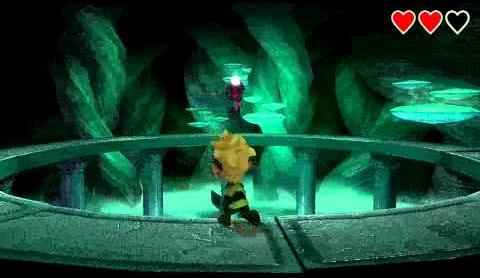
Evoland starts out with an 8-bit look – you need to find and open chests to start the upgrades to the game (8-bit to 16, 16 to 32, 32 to 64, 64 to 128 and so forth). You play as the hero of the story (adventuring around finding chests like the good old days) until you get to a point where the graphics and sound are what we are used to in 2013. If you remember, 8-bit games were from the NES years, 16-bit games were from the Genesis years, and 32-bit games were from the Playstaion 1 years (a huge time for consoles). Then there was the famous 64-bit system (the Nintendo 64), and then in 2000 the Playstation 2 came out with their amazing 128-bit. And finally, Microsoft jumped in on the action with the XBOX – which brought you the best game to date (Halo!). So, there’s a bit of break down memory lane, and now, back to my review of Evoland…

EVOLANDJust like in Legend of Zelda, it has a hack-and-slash gameplay and offers puzzle-solving quests. After finding some chests, you will come to the play style of Final Fantasy, meaning random encounters. Remember turn-based RPG battles? Yep, that’s what this game has. The storyline in this game is pretty basic – you’re the hero meeting other characters and accepting quests to move forward in the story. You remember the old sword and shield? Right. What about your trusty bow?

PROS

  • Brilliant concept of going from 1985 to 2013 in graphics and sound
  • Has funny moments
  • Fun side games
  • Nice dungeons
  • Collectable cards

CONS

  • Game is a little short
  • Some parts seem a little too easy.

If you enjoyed Legend of Zelda, then this game is right up your alley. I found this game on the Steam Summer Sale and paid $3.29 for it, but I’d have to say that it’s well worth the nomal price of $9.99. After playing this game, it brought back great memories of playing my first RPGs. It’s not the best or the worst game I have ever played, but it made me feel right at home. There’s some funny parts in the game and some intense battles, and once you start earning your experience and leveling up, you won’t be disappointed. So, if you’re looking for a short (less than 10 hrs, but very fun) game, then check it out!

Game: EVOLAND
Developer: Shiro Games
Genre: Adventure Games
Available: Here
Cheats: On GameFAQs

Review: Playing at the World

Playing at the World takes us on a fascinating journey to observe various factors that served to ultimately catalyze the creation of a new type of game with the creation of Dungeons & Dragons in 1974. This is the history of our hobby…

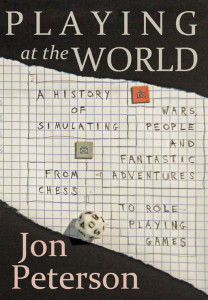
Playing-at-the-WorldWhen we think of topics that deserve a historical analysis, role-playing games aren’t considered to have much candidacy, being only forty years old. Even if we widened our scope to include the history of the various factors that influenced the creation of role-playing games, from war games to fantasy fiction, that would likely serve only to make such a study overly broad, and thus dilute the main idea…wouldn’t it?

Jon Peterson, author of Playing at the World: A History of Simulating Wars, People and Fantastic Adventures from Chess to Role-Playing Games, says no. His book takes us on a fascinating journey to observe various factors that served to ultimately catalyze the creation of a new type of game with the creation of Dungeons & Dragons in 1974. This is the history of our hobby.

…or rather, the pre-history of our hobby. While Playing at the World does discuss the immediate aftermath of Dungeons & Dragons’ debut, it is far and away more focused on the elements that led to its creation. Those looking to find a detailed examination of the growth and evolution of the role-playing hobby industry will not be completely disappointed, but they are far less favored than those who want to understand how such an industry could possibly have formed in the first place.

Before we venture deeper into that subject, however, a moment must be taken to discuss the book’s format. Simply put, Playing at the World is HUGE. The book is seven hundred pages long, and even taking into account that roughly ten percent of that is the bibliography and index, there is still a massive amount of reading material here. Beyond the page-count, part of this can be attributed to the small, densely-packed font, making for a high volume of words per page, even before the extensive footnotes are taken into account. While illustrations are to be found, they are comparatively rare.

If the above paragraph makes the book sound intimidating, then it’s doing it justice. This is not a volume for casual perusal, as it lays out its history with rigorous precision (though the author does temper his writing style to be that of a peer, albeit a didactic one, more than a professor). Fortunately, the author had the good sense to break the material in the book down into chunks. Beyond presenting the material in the form of chapters, each chapter is itself broken down into sub-sections, and a large number of those have sub-sub-sections. The effect of this is to limit each block of text to about twenty pages or so of material, allowing the reader to digest what’s here in bite-sized pieces, rather than demanding long slogs through several dozen pages all at once.

Playing at the World divides itself into five broad chapters, each covering a different area of influence for how role-playing games came to be. The first such chapter starts in medias res, as it walks us through the preceding ten years immediately prior to the advent of D&D. Here, Peterson looks at the bubbling cauldron that was the immediate time and place that created a new type of game, with a primary focus on the emerging nature of collaborative hobby-gaming. Here is where fanzines were in full swing, and historical war games were not only widespread, but were starting to make room for their fantasy-focused cousins.

It’s also here that we see the most concrete example of what makes Playing at the World so different from similar works on the history of role-playing games: this book utterly eschews contemporary interviews in favor of studying written materials from the period being observed. By restricting himself solely to what was written at the time, instead of relying on the vagaries of memory, Peterson avoids the natural inclination that historical observers have to white-wash history and pave over the details of what they might deem to be inconsequential or irrelevant. Thus do we get an uncharacteristically honest look at the details of the founding of our shared hobby.

This is a method of research that Peterson retains throughout the entirety of the book, including the second chapter, which is focused not on a particular time, but on a particular mode of inspiration for D&D. In this case, as the chapter title plainly tells us, it is the medieval fantasy genre itself that is under the proverbial microscope. As noted above, Peterson knows better than to examine the whole of fantasy fiction, instead restricting his analysis to the major works (largely from the 1930’s through the 60’s) that had clear thematic elements appearing in D&D, from the the objective forces of Law and Chaos in the works of Moorcock, to the “visitation fantasies” (a person from Earth visiting a fantastic realm, akin to how a role-player temporarily visits such a place in their game) of Burroughs and Anderson, to the unique spellcasting of Vance, among others.

Chapter three is the meatiest portion of the book, both in scope and page-count, focusing on the development of the rules of war games. Indeed, this chapter is more like two chapters that have been amalgamated, as it separates the sections that discuss the history of the development of war games over the last two centuries from those that outline the unique attributes of role-playing game rules (e.g. multiple polyhedral dice, individuated characters, and character progression). This is the section of the book that historically-minded gamers are likely to have some familiarity with, as its here that we hear familiar names such as Reiswitz, Bath, and Zocchi.

It’s only in the book’s fourth chapter that we start to see how the elements from the previous two began to mix. Here, the actual playing of roles is discussed, not in the context of the previous chapter’s focus on rules, but in how that was applied in practice throughout the nascent gaming community. Whereas chapter one discussed the manner in which war games arose as a hobby, here we see the first attempts to actually craft shared worlds, where multiple characters undertook actions that changed the landscape of the game setting for everyone playing. Notwithstanding chapter one’s discussion of Blackmoor, it’s here where we see the first proto-campaigns being attempted.

With all of the formative factors now explored, the book’s final chapter turns its gaze forward to focus on the immediate impact of Dungeons & Dragons. The period under analysis here is quite small, covering roughly the first three years of the game, but the results here are dramatic, as we begin to see how quickly the gaming community – to which sharing and modifying rules was already well-established – began to grow beyond D&D by itself, giving rise to what would eventually become a hotbed of role-playing games to try and satisfy burgeoning demand for new mechanisms for role-playing.

The book’s aim is largely fulfilled at this point, but Peterson has the acumen to present a brief (and make no mistake, compared to the remainder of the book, less than forty pages is brief) epilogue looking over the long-term impact of role-playing games. Here at last we come to the more familiar stomping grounds of role-playing history, from the “Satanic Panic” of the eighties to the Zork computer game to the birth of MMORPGs with Ultima Online. Of course, none of these get more than an overview, which grow increasingly cursory as we approach the present day, but all are acknowledged.

History is attempting to explain why things happened the way that they did, with works of historical analysis focusing on asking these questions in regards to specific times and places. Playing at the World, with its focus on role-playing games, expands on this question to ask not only why RPGs were created in the time and place that they were, but why they contained the elements that they did. It’s in asking this question that the book moves beyond a dry reading of facts (though it is still replete with them) and becomes a genuine examination of the genesis and evolution of the ideas that went on to form an entire new way to play games. It’s there that Playing at the World can be called a truly scholarly analysis of role-playing games.

More than knowing its history, Playing at the World helps us to better understand the hobby that we all enjoy so much.

Playing at the World can be found at DriveThruRPG and Amazon.

CLOUD ATLAS sucks. No, wait…?

Cloud Atlas gave us a premise that spanned several different stories over the course of several different centuries, and to that I said, “BRING IT, BABY.” The premise of Cloud Atlas looks cool, and it sounds cool… but does it end up being super cool, or just super cold?

Cloud-AtlasSo, I like movies that are different, movies that are out there. I like drama-action-romance-suspense-mystery-medieval-colonial-modern-futuristic-sci-fi, and more. Heck, I like them all (except for musicals, musicals suck).

Cloud Atlas gave us a premise that spanned several different stories over the course of several different centuries, and to that I said, “BRING IT, BABY.” The premise of Cloud Atlas looks cool, and it sounds cool… but does it end up being super cool, or just super cold?

In a nutshell…

Cloud Atlas is based off of a novel by David Mitchell. We are told six different stories, set in six different time periods. It all has to do with oppression of people and cultures, and implies that people and events are linked through time.

– Spoilers follow. Actually, I recommend reading the spoilers – it makes the movie better).

  1. South Pacific Ocean, 1849: Lawyer Adam Ewing saves a slave, is then saved by that slave, then decides to give up his life of law to join the Abolition Movement with his wife. Ewing writes a journal detailing his revelations.
  2. England and Scotland, 1936: Young musician Robert Frobisher begins composing his masterpiece, “The Cloud Atlas Sextet,” but a famous composer tries to take dual ownership of the music. Frobisher (after having read some of Ewing’s journals) gains enough confidence to stand his ground, and then finishes it on his own. He eventually writes a bunch of love letters to his boyfriend (Rufus Sixsmith).
  3. San Francisco, 1973: Journalist Luisa Rey meets an older Sixsmith, now a nuclear physicist. She does some investigating, almost gets murdered, then uncovers a plot to use a nuclear accident that will benefit big oil companies. Also, Rey finds Frobisher’s lover letters to Sixsmith, and (for some reason) tracks down a recording of his music, “The Cloud Atlas Sextet.”
  4. United Kingdom, 2012: Timothy Cavendish, a 65-year-old publisher, gets strong-armed for money. When he asks his brother for help, his brother tricks him into an old-folks home, the likes of which he can’t seem to escape. When he finally does escape, Cavendish writes a screenplay about his life, after reading about journalist Rey’s life.
  5. Neo Seoul (Korea?), 2144: Sonmi-451 is a genetically-engineered human clone created to be a slave worker (actually, there’s a small race of these “fabricants”). After coming into contact with ideas from Cavendish’s adventures, Sonmi-451 is instilled with ideas of rebellion and liberation. She eventually makes a public broadcast of her story (including words against exploitation), and is then executed.
  6. The Big Island, 106 winters after the fall (2321): Primitive Zachry and his tribe get a visit from Meronym, a member of an advanced society still holding on to the last remnants of technology. She needs his help to find “Cloud Atlas,” a remote communication station. With it, she can call Earth’s colonies to come back and help the few remaining humans on Earth. Zachry then finds out that his revered goddess, Sonmi, is actually Sonmi-451, a dead human clone.
Cloud-Atlas

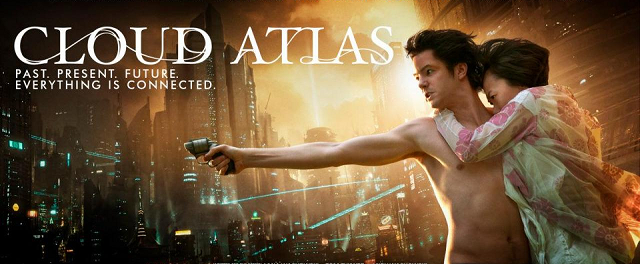
One thing that I really did like is how the film depicts these six time periods. I never once disbelieved in what I was seeing because of the sets. Of course, Tom Tykwer and The Wachowskis were at the helm of this colossal movie, so I knew it would look good. Simply put, verisimilitude was never compromised (there, I’ve finally been able to use ‘verisimilitude’ in an actual print sentence).

So, visually, the movie scores high marks. And that’s really the only thing that I have good to say about it.

Let’s begin…

First of all, when the same actors portray different characters from different time periods, you wonder how their specific connections will be revealed in all their awesomeness. Well, the characters spanning the Cloud Atlas time periods weren’t connected, and having them played by the same actors was just damn distracting. It wasn’t symbolic or teamed with any meaning. And no, it wasn’t “artsy.” I guess on some level, one could argue that some characters may have been related, but (regardless) having them played by the same actors just didn’t work.

That was a gripe, and now we move on…

Movies that intertwine several stories is nothing new (Twenty Bucks, Love Actually, Four Rooms, etc.). However, where previous intertwining vignettes have something that actually intertwines them, Cloud Atlas really doesn’t. For example, in Twenty Bucks, we follow the stories that are told as they unfold around an object. In Love Actually, we follow the stories that are told through characters that are all linked via various relationships. And in Four Rooms, we follow the stories as they relate to a specific individual (one of my favorite movies, by the way).

Cloud AtlasIn Cloud Atlas, however, I watched most of the movie wondering if all of these stories were really linked at all. Sure, I could follow each of the individual stories just fine – there was nothing unusual or ground-breaking about them. It was trying to piece the entire thing together that got me stumped. At the two-hour mark, I wondered if this thing was ever going to coalesce. The six individual stories were interesting enough, but the movie (as a whole) was not.

At the end of the film, the movie still didn’t really come together. I had to read up on the plot to fill in all of the holes. “Well, I knew that these two stories were tied together because of a manuscript that was mentioned in that one line of dialogue, but it turns out that that was it?!” That’s how it was with all of them. The stories were connected only by a few fragile threads, and I dare say that if you’re not paying attention, you’ll miss at least half of them (I was paying attention, but I guess some were just beyond me – or, I just couldn’t believe that what I was seeing was actually the connection).

Basically, this film is six short stories. That would not necessarily be a bad thing, if you wanted to present a film titled, “Six Short Stories, By David Mitchell.” I would have enjoyed this movie if it had been six short stories, one after another, including the minor connecting threads between them.

But each story is supposed to be a story that is read, observed, or realized by the main character in the next story at a pivotal moment. That’s apparently supposed to be a big deal, and we’re supposed to notice and revere it. At six integral moments in the film, we’re supposed to go, “Ohhhhhh… I get it, I see what you did there.” I just wasn’t awed by any of that. “Oh, ok, he read her manuscript… and so… he’s writing his own.” Really?! That’s the connection between Rey and Cavendish?

The real problem…

If the movie is trying to tell us that the past, present, and future are all connected by small events, well, I can be fine with that (regardless of how insipid those events actually are). What really makes this movie tedious to watch is that each story is cut up so many times in the film… jumping back and forth between all six over and over and over again. It was like trying to watch six different short films on six different TVs at the same time. At a time when I’m trying to figure out how all of these stories are connected, or if something dramatic is going to pull everything together, I don’t want to get vertigo from watching a massive collage of snippets.
Cloud-AtlasIt would have been monumentally better to tell each story individually before moving on to the next. Or, if I’m especially mentally fit, to tell half of a story, then move on to the next story when the protagonist observes or reads about the last story, and so on.

In this way, we would watch them in succession until their turning points, and then go back and finish in the same way. THAT would have been a much smoother thing to watch, instead of watching six stories get cut every 5 minutes onto the next. It was pure visual noise, and I just couldn’t settle down into the movie as it was presented. When (at the end of a very long movie) we quickly and finally see how each of the stories are connected (if we see those connections at all), our eyes should open wide and we should be saying, “ahhhh… brilliant.” But instead, we simply say, “uhhh, ok.”

And, as a kick in the side, by the end of the movie we realize that a very old and venerable Zachry is orating all six stories over a campfire. We see him this way at the very beginning of the film, and then again at the very end. The movie is a dramatization of his telling of these six connected stories, but I can’t imagine he’s telling it in the order that we see it. No, cutting up the scenes and placing them all over the place was for the “dramatic effect” for us moviegoers, not his campfire audience.

Final thoughts…

The overall story wants to make us think of the various oppressions of people and cultures. However, I found myself constantly waiting – either waiting for the story to really unfold with all of these characters, or waiting to simply start caring for the characters. In the end, there was simply no great emotional payoff – none at all.

Indeed, this movie is a great big train, but I wouldn’t call it a train-wreck, because it was never able to get up to speed. It’s a movie that ends up trying to be more than it is, but just never stacks up. It has aspirations, but never achieves them. In the end, Cloud Atlas was trying to be more than the sum of its parts. However, because of the lack of meaningful connections, and the chopped-up frequency in which the stories were presented, it ended up being less.

Cloud-Atlas

We all have our opinions, of course. Some will like Cloud Atlas, and some won’t. Some will understand and appreciate this movie from start to finish, and some will be completely bored to tears. And of course, still others will think they like it simply because they think they should.

I feel, though, that the most vocal of those who disagree with me will describe me as unenlightened, uneducated, close-minded, or just plain stupid (if they dare use such a word). And they will use words such as existentialism, dualism, anti-solopsism, and transcendentalism to make their point for the movie. Well, I don’t know what those big words really mean, and I shouldn’t have to in order to like a film. Any particular movie is not for everyone, but if you’re making one of the most expensive indie films (at a budget of $102 million), you should know that if it’s complicated, it’s probably going to struggle to earn that budget back (as this movie did).

It’s unfortunate for me that I didn’t read the plot synopsis or a review of the movie ahead of time. Perhaps then I would have actually enjoyed it. I prefer to start a movie afresh, without any expectations (as I believe a movie should be able to stand on its own), but this is a case where a little preparation will actually help. I really feel that reading up on this movie beforehand will actually help one to understand and appreciate it better. At this point, re-watching Cloud Atlas would improve my disposition, but at a long two hours and forty-three minutes, I’ll have to pass.

As a stand-alone movie, presented without any preamble or preparation, I did not enjoy it. Had I learned a bit about the actual premise and how it was presented, I probably would have. Although my experience was undeniably negative, if you plan on watching Cloud Atlas, I sincerely hope that this review helps you to enjoy it. After all, it’s definitely a movie that should be enjoyed – you’re just going to need a little help to get there.
Gunpoint: An Overview

Gunpoint describes itself as a stealth puzzle game that centers on rewiring objects to accomplish your goals. What does this mean? I’ll break it down here…

Gunpoint

Recently I picked up an indie title called Gunpoint that I’ve been following for awhile. Gunpoint describes itself as a stealth puzzle game that centers on rewiring objects to accomplish your goals. What does this mean? I’ll break it down here.

Totalbiscuit recently said something that stood out to me; most good puzzle games are built around a single mechanic. That mechanic is how you engage with the world, and how you overcome the challenges you’re presented with. I’d actually take this a step further; most video games have a single primary mechanic, and if you’re lucky, some impressive subsystems.

For most games these days, that mechanic is called violence. In Portal, it was… um… portals. Duh. In a role-playing game like Mass Effect, the primary mechanic is dialogue. And so on.

The better and more engaging that primary mechanic is, the more enjoyable the game. This is a simplified view, maybe, but it’s a good starting point for discussion.

In Gunpoint, the primary mechanic is something called “crosslinking.” In essence, the idea is that you can quickly rewire objects to each other to make the environment serve your goals. Switches can be wired to doors, can be wired to elevators, can connect with wall sockets to knock a guard unconscious, and so forth. Put another way, the entire environment effectively becomes a Rube Goldberg machine. It’s up to you to decide how complex or simple a solution to pursue with the tools you have available.

Do you avoid detection entirely? Do you knock guards unconscious and leave them alive? Do you eliminate all witnesses of your actions? It’s largely up to you.

The campaign is relatively short (I think I powered through it in a few hours), but the game has more to offer. Specifically, the level editor is included. So with any luck, the community will be able to make and share new puzzles and challenges with each other. And the maps are, IIRC, stored as plain text; they’re tiny, and easy to share.

Gunpoint is ten bucks well-spent. I do recommend that you buy from the developer’s website. There, the game comes as both a DRM free version, and a Steam key. If you buy it directly from him, you receive both, and know that a bigger cut of your purchase goes to support an independent developer.

The Doubleclicks – Chainmail and Cello

This pair of sisters, Angela and Audrey Webber, combine their ukulele and cello with a whole lot of charm to produce delightfully nerdy tunes for their geeky audience…

The-Doubleclicks

The Doubleclicks are a comedic musical duo from Portland, Oregon. The pair of sisters, Angela and Audrey Webber, combine their ukulele and cello with a whole lot of charm to produce delightfully nerdy tunes for their geeky audience.

I first learned of The Doubleclicks while listening to the Going Last gaming podcast, another Portland-based creation. Their song about Dungeons and Dragons (entitled “This Fantasy World”) was particularly fitting for the show, and I was instantly hooked. Since then I have had the pleasure of seeing The Doubleclicks live inside a comic book shop, and after that it was a no-brainer to get their entire album.

So what makes “Chainmail and Cello” so great? The short answer is that it’s 15 tracks worth of sheer nerditude. From the opening track, “OH, Mr. Darcy,” to the very last, they sing about topics that touch on every aspect of geek culture. From Star Trek to D&D to grammar, the sisters sprinkle in a little bit of something for everyone.

Their sound is definitely indie; the combination of ukulele and cello isn’t something I’ve heard before. Both sisters have great voices and they harmonize quite well. Regardless of what your preferred musical genre might be, they have an appeal that crosses boundaries and enough silliness to make them an enjoyable listen even if the style isn’t normally your favorite. I find them to be a bit like Jonathan Coulton in that way.

Though you get 15 tracks with “Chainmail and Cello,” the songs are rather short, with most of them falling into the 2-minute range. Unfortunately that means the album isn’t very long, but there’s plenty of replay value to make it worth your while. The album is also available to listen to on websites like Spotify, Bandcamp, and even Google Play Music, so there are plenty of places to listen to it for free (or as part of a subscription) while still supporting the artists who created it.

Some highlights of the album include:

“Spock Impersonator,” a song about searching for love at a Star Trek convention; “Apostrophe,” about the troubled life of this misunderstood punctuation mark; “Clever Girl,” a song about velociraptors that must be heard to be understood; “Worst Superpower Ever,” which is self-explanatory; “Ironically,” which is about falling in love with a hipster, and “This Fantasy World,” a song about falling in love with a D&D player. Those may all be highlights, but they’re by no means the only great songs on the album; it’s a blast from start to finish.

If you’re into silly, geeky music, you need to check out The Doubleclicks. They’re fun and talented, which is a perfect combination for a super duo like the Webber sisters. Give them a listen and let us know what you think in the comments.

Chainmail and Cello Track List

  1. Oh, Mr. Darcy
  2. Spock Impersonator
  3. The Nerdy Birthday Song
  4. Apostrophe
  5. No Easy Way
  6. Clever Girl
  7. The Way I Glow
  8. The Internet National Anthem
  9. Don’t You Love Me?
  10. Will They Or Won’t They?
  11. Worst Superpower Ever
  12. A Lullaby For Mr. Bear (Adult Version)
  13. A Song About Eve Online
  14. Ironically
  15. This Fantasy World (Explicit)

A Game Fondly Remembered – Spybot: The Nightfall Incident

I had (many years ago) stumbled upon a surprisingly excellent hacker game called Spybotics: The Nightfall Incident. So I thought I’d share it with you in case you missed this gem…

Just this morning while working on a current cyberpunk project – FlashCity Stories – something dredged itself up from the depths of my memory banks. Specifically, it was while looking at various angles for a hacker story that I recalled I had (many years ago) stumbled upon a surprisingly excellent hacker game called Spybot: The Nightfall Incident. So I thought I’d share it with you in case you missed this gem.

Spybotics_the_Nightfall_Incident

A little background is in order. Spybot was a set of four Lego robot sets released in 2002 that, with the aid of a CD-Rom, could be programmed to accomplish various missions. How this is done I have no idea – I never owned the sets and it’s not at all important for the game itself. In any case, along with the sets Lego released the titular game, which is where I first played it. Sometime later when I went back to play it again, it was no longer on the Lego website. Don’t know if Spybot just wasn’t successful or what, but they killed the entire thing including the game. Fortunately, at least in this case, once something is on the internet it never dies and today several archive-type websites host the game; I’ve included the link for the first site that pops up through a Google search.

So what is S:TNI all about? I don’t want to reveal too much because when I first played it I had no real idea what it was and as a result the game was that much more fun. Note that there are, of course, websites that will break the game down in its entirety, but I really encourage you to spoil as little of it as possible, especially the story, because it is just that much fun. Also the game has a tutorial right at the start that helps you understand what is going on. Still, I feel compelled to share something about the actual game.

In a nutshell, S:TNI is a turn-based Shockwave game where you play a SMART (Secret Mission Agents Robotics Team) agent whose job it is to track down crime on the internet. You do this by engaging in databattles where you pit your programs (with names such as Hack, Slingshot, and Bug) against rogue software (Watchman, Sentinel, Sensor, etc.). As is usual in most games, you start off with limited resources – in this case the two programs Hack and Slingshot – and can upgrade along the way by winning battles and receiving a credit reward. That’s the essence right there. Again, there’s a tutorial to take you through the actual gameplay and there is other helpful information along the way.

Why I like and recommend this game:

The Atmosphere: Somehow, despite its (even by the standards of 10 years ago) basic graphics and music capabilities, the game creates a really great atmosphere between the story, the music, and the gameplay – it just feels right. I know that’s rather vague, and yet it is most appropriate. So many games I’ve played feel like, well, games. But this one, perhaps because it is so simple so your imagination goes to fill in the blanks, really allows you to become immersed, and not because you’re maxing your APMs and forgetting to blink.

The Story: It’s a simple story we’ve seen before but there are some pleasant surprises along the way both in terms of the narrative and the programs that become available to you.

The Gameplay: It’s a turn-based game that’s actually much like table-top miniatures games in that you deploy your pieces, er… load your programs, move them up to a certain amount and have them perform an action, then wait for your opponent to do the same. It’s easy to get the hang of but has a surprising number of options as you get more programs, including which programs to purchase and which to deploy.

The Level of Difficulty: I found the game neither too easy, nor too difficult, which is to say, it gets it right. The difficulty does ramp up as the game goes on but it never gets frustrating nor will you ever find things too easy no matter how many, or which, programs you have.

If it isn’t obvious from the preceding, I really enjoyed the game and believe you will enjoy it as well. There’s just something about its simple graphics, basic yet deep gameplay, storyline, and atmosphere that somehow combine for a really great experience that is worth your time to check out.

Star Wars: The Old Republic: First Impressions by a Non-MMO Player

So I’ve recently begun playing Star Wars: The Old Republic. Is this MMO strong enough of a storytelling engine to hold my interest? Let’s find out…

Star Wars The Old Republic

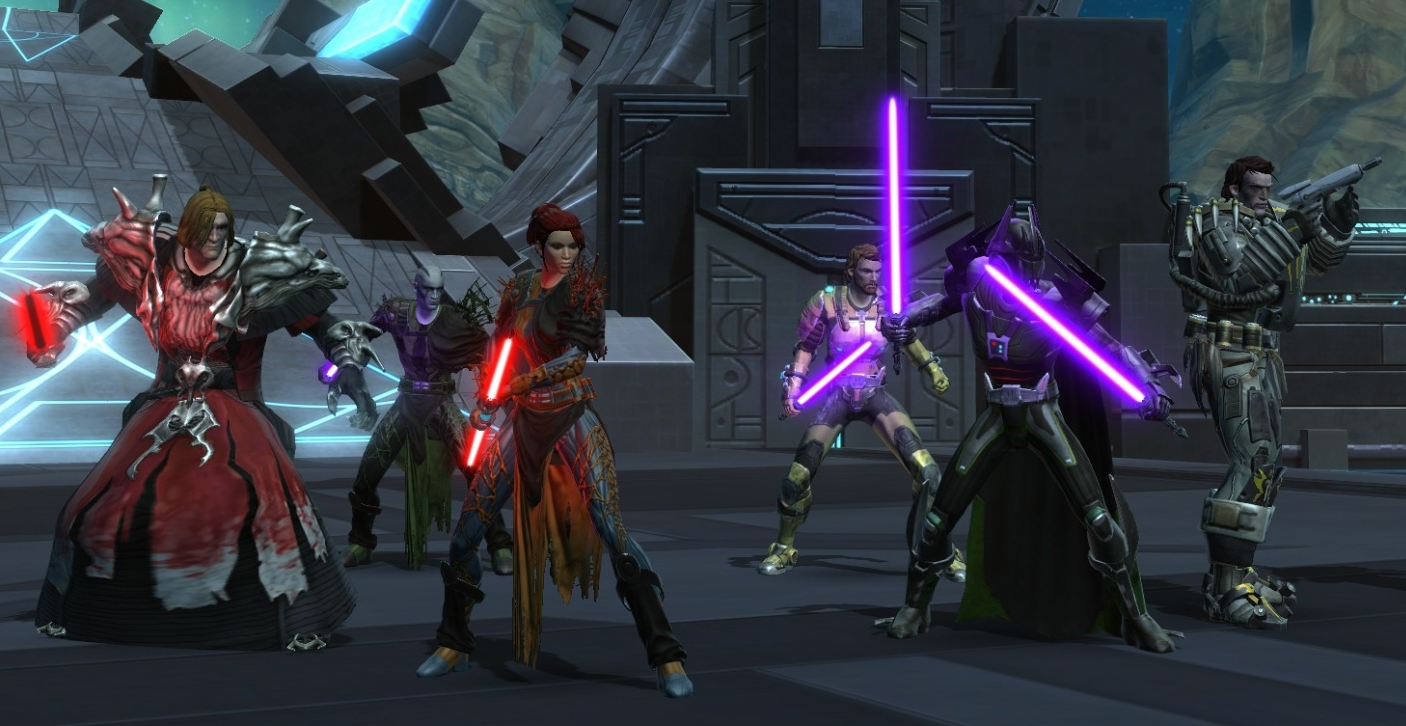
So I’ve recently begun playing Star Wars: The Old Republic, even as I replay my old favorite, Knights of the Old Republic. Is the now free-to-play MMO strong enough a storytelling engine to hold my interest? Let’s find out…

Spoiler alert: yes. Yes it is.

Well, that was easy, looks like you lot can go on home.

Oh… oh, you expect me to actually write about this, don’t you. Fiiiiiiiine.

Okay. I’m gonna go ahead and break down what I see as the good, the bad, and the annoying reality of dealing with a F2P game. Then I’m going to answer the most important question of all: is it enjoyable enough that it leaves me wanting to play it when alternatives exist?

The Good

So I started out on a PVE server running a Sith Inquisitor, because if there’s two things I like it’s primary casters and lightning. I was immediately grabbed by the story, which is something that literally has never come up in any conversation about World of Warcraft I’ve ever had. Probably because, well, it doesn’t have one. At least not one that’s visibly meaningful to the player. And certainly not one that’s different. Point is, I seriously cannot wait to find out what happens next in my apprenticeship with Lord Zash, so yeah, only good things to say. I’m often at the edge of my seat.

I run my Inquisitor with my GFs Warrior, which quickly got me intrigued by the possibility afforded for eavesdropping on someone else’s story as well. With at least 8 stories to get through, (one for each class) plus some unique twists and variations based on your species and gender, there’s a lot to like here, and there’s a solid amount of replayability. Which I like.

Combat plays much like I remembered from the beta, and it’s still surprisingly satisfying for MMO point and click + hotbar action. Maybe it’s because I just came off of KoTOR again, but it’s easier to enjoy than it was when I tried WoW.

The game also added a number of new twists since I last looked at it, like the Legacy system that lets you unlock perks and define relationships between all your characters on a server. This jumped out at me as being a really freaking cool idea; that all your characters contribute to the Legacy.

Another thing I liked? I’d planned to solo a LOT of the game, but group XP, social points, and guild XP bonuses all give you incentive to group up with people and play together without being terribly annoying. In fact, the flashpoints are some of the most fun I’ve had. I freaking LOVE the social rolls, getting a glimpse of everyone meaningfully participating in a conversation, helping to steer it to a conclusion… BioWare outdid themselves with this. And the dialog wheel here is at its best.

Companions that fill roles you don’t want to occupy and do all the otherwise boring grinding crap for you with a few mouseclicks help solidify the unique offering of this particular game over the long time behemoth in the room, WoW. I’ve often said that you can’t beat a competitor by merely imitating them; you have to offer something they don’t and aim for a niche, or do what they do so much better than they did it that their customer base flocks to you. SWTOR is smart enough to have included features that actually target annoyances that turned me away from WoW the only time I ever took a chance on playing the darn thing. Plus, companions have always been one of the best things about a BioWare game. Good job on a developer playing to their strengths.

Bonus points also go for convincing me to try the PvP modes; I normally freaking hate PvP in almost any game ever, but the war zones here are honestly pretty fun. Once you figure out what is happening. I accidentally jumped into a Huttball match without knowing how to throw the darn thing… whoops.

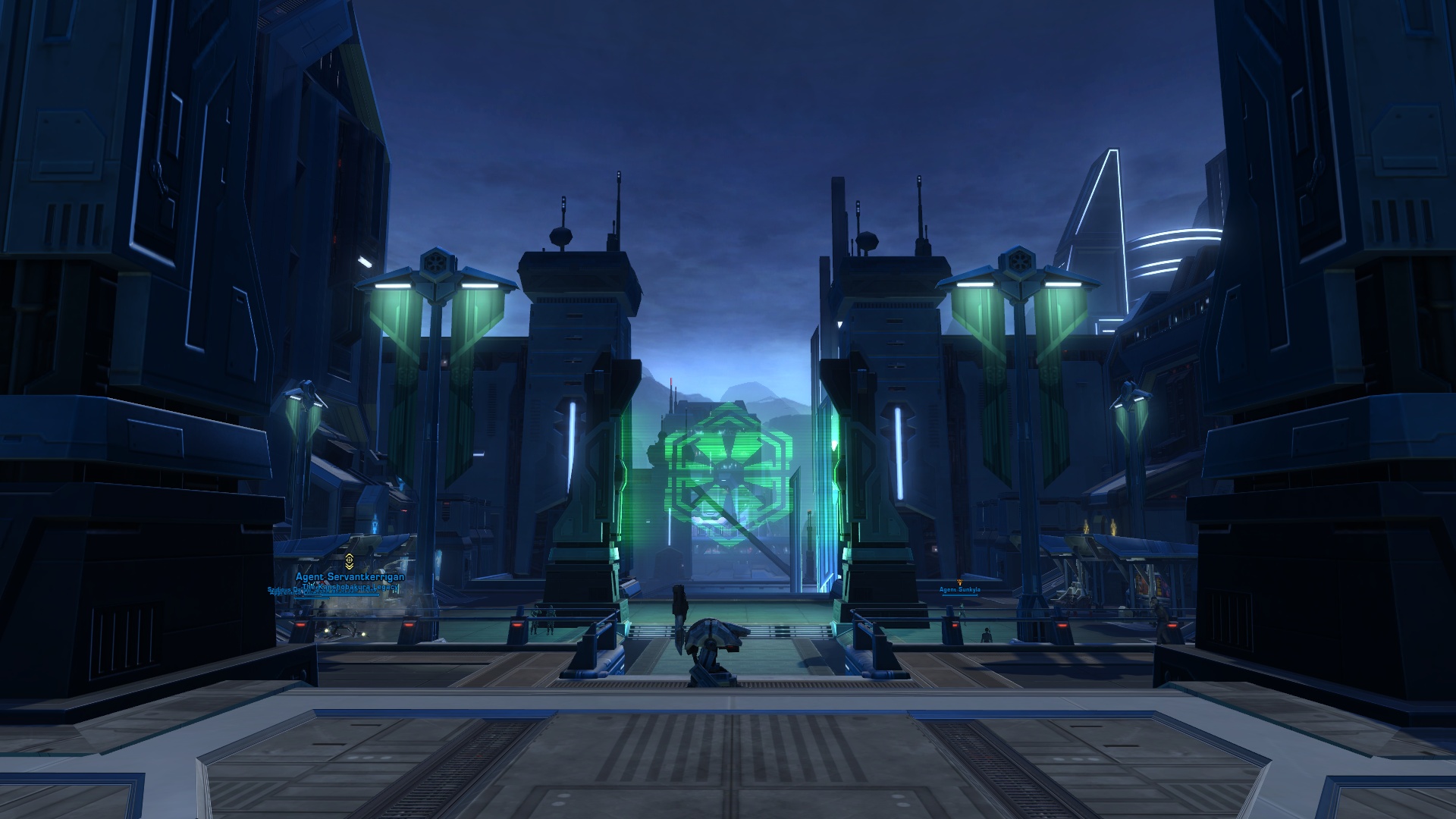
Have I mentioned that the environments are gorgeous?

The Bad

… you know, I actually don’t have anything to say here yet. I’ve played the now infamous Scarlet Blade. This game would have to fall a LONG way before anything in it qualified as genuinely BAD.

I know how much the Internet loves hyperbole, but I don’t really have any for you here. Sorry.

The Annoying

Look I’m just gonna be straight with you. There’s a lot of stuff hiding behind the pay wall. Nothing I’d call a deal breaker by any means, but there’s a good chunk of stuff in there and by far the biggest annoyances for me, so far, are the inability to use artifact level equipment out of the box and the low number of Galactic Trade Network slots. Between that and a lot of the unlocks showing the default (slightly misleading) per-character price rather than the per-account price in the cartel market, you have a recipe for annoyance.

It’s not all bad, though. You earn Cartel coins (the currency you normally buy with actual cash) as a F2P player for certain achievements and the like. This is already more than I can say for the one other F2P MMO I’ve tried. So hypothetically you can overcome a lot of those annoyances with time and effort.

Alternately, you can do what I did and resolve to throw a few bucks into the market from time to time and aim for sales and whatnot, a process I like to call “thanking the developers for opening up their game in a way that doesn’t ask me to commit to a monthly fee I don’t want to pay.” The first purchase in the market gives you four more character slots immediately (per server), so that’s a useful incentive. Lord knows with 8 stories to work through at LEAST once each, there’s plenty of reason to use a few extra slots.

And hey, the 2.1 update just landed. So now there’s even more stuff to check out. Apparently. I haven’t actually had the chance to play yet in the newly patched reality.

The Just Plain Weird Stuff I’ve Started To Notice About Every MMO Ever

So is it just me, or is the sense of scale in MMO environments almost universally off? I can’t quite put my finger on it but almost everything feels like it was designed for and by people who are bigger than the actual characters that occupy the world. Chairs feel oversized; bottles for drinks are the size of my head; hallways are massive; rooms are cavernous.

I don’t even know how to react to this but it feels that same way in every MMO I’ve so much as glanced at, and it’s definitely present here.

The Conclusion

There’s no reason left NOT to TRY this game. It’s free to start, you can explore all of the story without paying if you like, and it’s possible to solo much of PVE and to do MOST of the social missions with a mere two people. The busywork of grinding professions has been offloaded to companion characters, leaving you more time for actually playing the game and shopping or selling in the markets. This already cuts out 90% of what I hate about other MMOs. The stories are really well done and captivating, the voice acting is really excellent, the NPCs feel like people — BioWare at its finest. And it’s Star Wars. STAR WARS. FREAKING STAR WARS, MAN.

Granted, I may be a little obsessed. But I’m always going to be a little obsessed with the old republic.

KoTOR was the game of my youth, guys. It was the Star Wars that would never be ruined by midicholoroans or gungans or whatever. When SWTOR first launched, I was mad. I was upset because a subscription MMO meant the stories I wanted would never be told in a place I could reach. But that barrier is gone, now. Now the only thing between me and the stories is time.

I’ll check out Neverwinter eventually, guys, I promise. But right now, my people need my strength. The mysteries of the ancients call out to me. And so, I rise from humble origins to seize my destiny. The dark side is my ally; I fear nothing. EMPIRE FOREVER.

Review: Iron Man 3

One question has been bugging me about Tony Stark ever since since 2008… What’s going on in the man’s head?

Iron-Man-3

Everyone seems to be interested in their TV shows and movies answering their questions. I’m guilty of this as well; I wanted to know the the symbolism of the smoke monster, the history of the cigarette smoking man, and I still need to know the identity of Ted’s future wife. But these are questions being asked by all fans. What question has been bugging me about Tony Stark since 2008? What’s going on in the man’s head?

It’s a question that couldn’t go unanswered in Iron Man 3. Outing one’s self as a superhero, saving the world at least twice, and enduring considerable amounts of trauma in the process has to take a toll on your sanity. So naturally, I was pleased with how much time Tony spends outside the comfort of his suit(s) in Iron Man 3. And how much time was spent inside his head.

That’s not to say the entire film is psychodrama. It’s still chock full of spectacular scenes, sharp dialogue, and clever twists (though you might see some of them coming). But Downey has a meatier role here than he did in previous films. His armour gone, he’s forced to rely on the ingenuity we saw in the cave with a box of scraps all the more. Unable to cope with the events of The Avengers and the previous two Iron Man films, he struggles to keep anyone closer than arms length. He’s still funny, but the toll of being a celebrity and a superhero is quite evident. His swagger is fading, and we just might see him buckle under the weight of his own brand.

So when the action heats up, the stakes for Tony are as high as they can be. His suit protects him from harm, but now that Pepper, Rhodes, and Happy are all in the line of fire, it’s no longer just about him. It helps that the supporting cast all give stellar performances, with Guy Pearce and Ben Kingsley stealing their share of scenes from Downey. It’s also the biggest role yet for Gwyneth Paltrow’s Pepper Potts, and she gives a game performance.

Shane Black, best known as the screenwriter for Lethal Weapon and the Director of Downey’s first true comeback film Kiss Kiss, Bang Bang, sticks to his guns. Perhaps too much, as the film’s Christmas setting (a favourite of Black’s) proves to be fairly redundant, given the film’s Malibu and Miami locations. But Black knows his way around a well-written action film, and Iron Man 3 doesn’t disappoint. For those who felt let down by Iron Man 2 (myself among them), Iron Man 3 serves as a strong conclusion to the trilogy, and makes for a compelling follow up to The Avengers.

But the real strength of Iron Man 3? It’s not dependent on whether or not you’ve seen The Avengers, Thor, Captain America, or even if you remember all that much about Iron Man 2. It’s a sequel that can stand on it’s own merits and only has it’s own story to tell. Iron Man 3 may have implications for future Marvel films, but I didn’t leave the theatre feeling like I had to wait for the next Marvel blockbuster to get my money’s worth.

Iron Man III can be found at AMAZON.

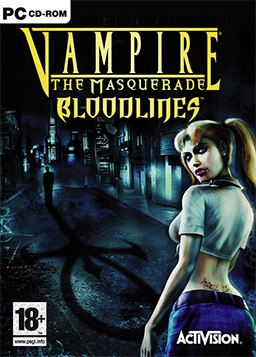
Vampire: the Masquerade – Bloodlines

For me, if there’s one video game that perfectly sums up what a vampire game should be, it’s Bloodlines….

I can count the number of games that ask me to make complex ethical decisions (and also portray those decisions as some shade of grey) on one hand. Mass Effect comes close, but even that still falls into the binary mentality — choices are either Paragon (noble and heroic) or Renegade (which ranges between badass and asshole). KoTOR put you on a sliding scale between Lightside and Darkside and made walking the line between extremes almost impossible.

Mass Effect differs from most of the other games I’ve played that offer some kind of ethical framework in that Paragon and Renegade are calculated separately and Shepard is fully capable of being a bit of both. In this sense, it’s a step above most RPGs, morality wise.

But there’s more than one right way to approach a moral framework.

“I could have died last night, but I heard the voice of a smaller god.”

You might remember me mentioning this game before. There’s a reason for that. I stumbled on this diamond in the rough early into my college career and I’ve never quite been able to let it go.

Vampire-the-Masquerade-BloodlinesSee, there’s this interesting thing about Vampire: the Masquerade – Bloodlines that most modern RPGs can’t really say. It doesn’t preach at you much. Sure, you have to keep up the Masquerade, you have to maintain your Humanity (in my experience it’s kinda hard to fail at this) but beyond that pretty basic idea of ‘don’t kill people who didn’t take a swing at you because that’s giving into the beast’ and a few other pointers, there isn’t really a sense of a binary morality in this game. Everything, and I mean everything and everyone you meet in Santa Monica (and the greater LA area) is a shade of grey. Its moral framework is pretty loose — maintaining Humanity is usually pretty obvious, you have to work hard to lose it — and within that restraint there’s a fair amount of leeway in terms of how you handle things. A lot of the quests (especially early on) can be solved with many different approaches — stealth, persuasion, seduction in some cases, mind control, brute force, you’ve got all sorts of tools available to you depending on the sort of vampire you’ve chosen and your own play-style. A few decisions can raise your Humanity score, a few others along the way can restore any status you’ve lost to Masquerade violations. Other than that? It’s all roleplaying. You’re a vampire. Act accordingly.

Rarely is there a clear right or wrong in this game. When there is, you’re inevitably facing something more horrifying than you. Sometimes that something is human.

And honestly? That’s… kind of brilliant. Don’t get me wrong, I love the BioWare formula, but every so often it’s nice to be reminded that it’s far from the only one that works. Bloodlines worked. There was a clear distinction between enemies in a combat zone and civilians on the street; you knew the rules and you followed them like a good vampire, and it actually impacted your way of behaving in the open world. Unlike, say, Saints Row 3 or Grand Theft Auto, where the police actions resulting from rampaging through the streets and making a very visible nuisance of yourself are a temporary inconvenience at best. Especially late game, your incentive to stay in character in the sandbox is almost nil. But the framework isn’t a leash; you’re given enough rope to hang yourself, as it were.

Really, when it comes to this game, probably the best thing about its sense of morality is that it fits the character and the setting. In this world, even the best of intentions can twist around on you (as they really should for a vampire) and… I think the highest complement I can pay this game is that the choices I made almost always left me wrestling with the most important questions of all: why did I make that choice? And do my intentions matter more than the result?

What does this choice say about me?

What am I becoming?

My personal recommendation is to play the game at least twice, once as a Malkavian. Because the Malkavian makes things very… very different, just in terms of your dialog choices and people’s reactions to them. And by different, I mean hilariously insane. Malkavians are pretty much universally batshit crazy.

Nosferatu also offers a unique approach, but personally I’m not all that big on the idea of being so hideous that stealth and violence are the only tools you’ll have left when dealing with mortals. What can I say? I like my vampires elegant. Still, if you’re more into horrifying, it’s nice that they give you the option. And that characters do react differently to the more… fringe choices. Not bad considering that Mass Effect only refers to Shepard’s class once in the entire trilogy and only offers you unique advantages for a particular class outside combat once, and it happens in a DLC mission. Bloodlines, meanwhile, was giving you unique dialog options for using your clan specific mind control powers in casual conversations, and when did this thing come out again?

Oh, right. In the dark prehistory before game developers started aiming for yearly releases of CoD.

As an added bonus, the soundtrack is really pretty darn good, most of the voice acting is solid, and the atmosphere is just indescribably gothic and oppressive. You really feel like this whole town is just waiting to tear itself apart. One or two quests in particular still give me chills when I think about them—the hotel sequence in particular is the example I point to when I say I want horror in video games to feel like this.

Bugged though it was, Troika deserves credit for trying, and there’s a lot in Bloodlines that modern developers really should be taking notes on. Sadly, they probably won’t. If a sequel to this game came out today it’d probably ship with a dozen microtransactions and a tacked-on multiplayer mode that features like a whole two distinct flavors of deathmatch. Ooo. Innovation! Who knew that it smells just like condescension?

For me, if there’s one video game that perfectly sums up what a vampire game should be, it’s Bloodlines. Not because it’s perfect; it isn’t. Because I still remember it. Because for all its flaws, I still think about it. Bloodlines made me feel like a vampire, slowly losing my humanity as I fought to hold my head high in a world far darker than I was, with characters who remain fascinating and threatening, dark and majestic and wholly unique.

I would love to see someone, a skilled development team, try to make a game like this today. Not a big budget mainstream monstrously, but something where they allowed themselves to innovate again. An open world title, single-player, maybe with a co-operative story, with cool powers and robust character building and role playing features. A world where actions have consequences, where your choices make you stop and ponder afterward.

I want, more than anything, someone to make me feel this way again.

First Impressions of Nova Praxis, a Preview!

Wherein Greywulf tells us about Nova Praxis from Voidstar Games, the sci-fi setting using Strands of Fate…

When asked if I could preview Nova Praxis, I thought this would be an easy task; spend a couple of days skim-reading it, then throw a few words on the page. How hard could it be?

I was wrong. Nova Praxis is not something to be skim-read. It sucks you in, demands to be read and enjoyed word-for-word. This is a thing to be savored, not rushed. So much for deadlines. 

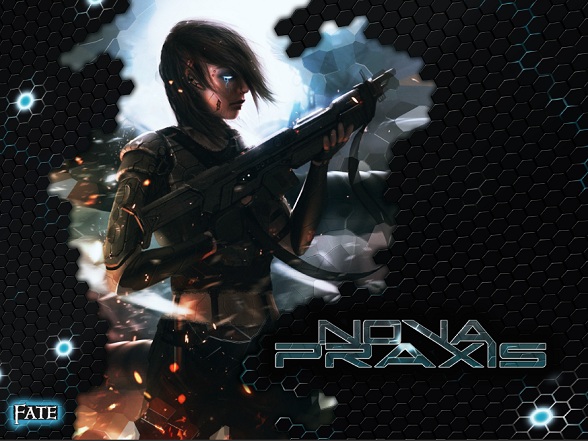
Novas Praxis is a beautifully illustrated, self-contained hard science fiction role-playing game built using the FATE role-playing engine. It’s around 200 pages long (I am previewing the Beta, so the actual page count will change) with an art style and layout that reminds me of (and clearly draws from) the large-scale science fiction strategy genre. As this is an area which hasn’t been fully explored in role-playing games previously, that makes Nova Praxis very much a good thing.

The game postulates a believable timeline from 2030 to 2140 which sees the discovery of nanotechnology, the creation of the first Artificial General Intelligence (and subsequent banning of them), and the destruction of Earth. That’s before the game even begins! I don’t want to spoil too much of the story behind the game setting; suffice to say it is extremely evocative, with plenty of scope for role-playing opportunities. It neither feels too broadly sketched nor too tightly drawn to give the players and GM room to create their own tales. It has managed to hit that sweet spot, and that’s no mean feat.

[Editor’s note: I just opened the book – I found the setting’s timeline incredibly engaging, and that’s only in the first chapter! -Chris]

The campaign “world” is our very own solar system, with a few notable exoplanets thrown in for good measure. This helps make the setting more familiar than the usual sci-fi game, but at the same time brings the differences into sharp relief; The future has shaped the worlds around our Sun in many different ways. The setting is “ruled” by Coalition Houses, each having their own special focus and interests, and this corporate conflict acts as a major driving force in the game.

The rules of the game themselves are FATE-based and use only six-sided dice (and poker chips or similar for Fate Points) for skill resolution. The lightness of the game engine meshes well with the hardness of the setting to create something where the focus is very much on the story being told, rather than on the mechanics of the game. Usually, hard sci-fi systems have similarly hard and complex rules, and end up creating something too doughy to be playable. Nova Praxis, again, gets the blend just right.

Players are encouraged to create Aspects (facets of their character which are used in play) that are rich and evocative (in their terms, Nova!) – don’t just be “Smart”, but instead have a “Mind Like a Bio-Steel Trap” – to help bring the story-telling and setting forwards. Aspects can come from many sources (Characters, Consequences, Maneuvers, Scenes, Zones and Equipment) and they all combine to allow the player to spend Fate Points to influence the direction of the scene.

Character creation is both fast and detailed. Your hero has six Aspects covering six different areas, and begins play in one of three states – Pure (human, possibly with genetic modification), SIM (you have uploaded your mind to become an entirely digital entity) or Sleeved (your digital mind has been downloaded into an artificial body). Intriguingly, it’s possible that your character will change from one state to another during play with your human character using an Apotheosis Augmentation to become software, then being downloaded to a biosleeve body to walk the world once more.

Generation is rounded out by choosing Skills, Advantages and Gear, and the calculation of your Rep-Rating (your reputation among the Coalition). I would rate character generation as roughly on par with Savage Worlds in terms of complexity, and significantly less complex than some FATE-based systems I have seen.

I could go on, and probably will. This is a great system and setting  that shows so much promise and doesn’t disappoint at any step of the way. When it comes out of Beta, I will be the first in line for a copy, that’s for sure.

You can find Nova Praxis here.