
The State of the Brian

As I begin to write this, it’s Monday, January 9th, 2012. This morning, the next edition of Dungeons & Dragons was announced. In the shower, I found myself getting stressed out about all the projects I had up in the air. I realized that this affects me in a way that’s more than just being a fan of a game.This post is not about 5e or DnDNext. There’s an excellent summary of that being collected on EN World. This is about me and my work. I don’t often talk about myself on this blog, so if you don’t care what I’ve been up to, you won’t upset me if you stop reading. Let me fill you in on the punch line. I’m going to keep writing for 4e, at least until 5e is published. You’ll be able to come here for that content.If you like my work, or just want a little insight on what it’s like to try your hand at freelancing, this is for you.

Before 2011

My daughter turned two years old in November. She had just started day care. My wife is working on her degree and I’m working full time in IT. I wrote my own blog, Free Orcs, off and on. It was hard for me to write regular content. One reason was that I was the only one writing. The other was that few people were reading and I had next to no feedback. It turns out I thrive on feedback, or at least the idea that people want to read what I’m saying. The only other group to host my content was an article on KoboldQuarterly.com and I didn’t even know when it had been posted. I eventually closed Free Orcs, not wanting to be another voice in the darkness.

I got an email from Chris about his site, this site, StufferShack.com. He read my blog and let me know he’d be willing to host my content. I had never heard of StufferShack but I liked the idea of writing with others. I began making and updating content.

2011

My articles begin to appear on StufferShack and Chris shows me how to view my hits. I feel successful when my articles get views in double digits then climb into the hundreds. At the beginning of February, I decided to set some goals for myself, keep track of my progress, and keep a good schedule. I decide by the end of the year I wanted to contribute to at least five different blogs or podcasts, and publish at least two books. StufferShack counted as one. I had work to do. This is in addition to my job, supporting my family and all the other goals I had set outside of RPGs.

I start using Reddit and Stumble Upon and soon I see my first article with over a thousand views. Plus, I got a re-tweet from @Wizards_DND. As far as I’m concerned that means someone who works for WotC liked something I wrote. That’s awesome. Its my first article in the thousands of hits.

I start submitting myself to sites to try to get my name out there. I did end up hitting my blogging/podcast goal, appearing on StufferShack, KoboldQuarterly (again), RPG Circus, Netherworks (now Hereticwerks), the DM Roundtable and the Gamer Assembly. Some of these even lead to other opportunities.

Podcasts

It turns out I really like being on Podcasts. It’s odd because I hate listening to my recorded voice. I think it’s because you always get a group of intelligent, opinionated people to speak on  a specific topic. To me that’s fun. I’ve become a regular host on RPG Circus. I sometimes leave the recording frustrated but keep coming back for new episodes. Who wants to listen to a bunch of people agree with each other? If you have a podcast and need guests, talk to me.

Open Design
I got the opportunity to review Soldiers of Fortune before it was released. I probably could have been kinder but I wanted to be honest, and I’m kind of a blunt individual. I ended up going through the book as an editor might, which led to a conversation with the author, Matt James, and the publisher, Wolfgang Baur. I am very thankful I was a stickler and found these errors. Aside from my wife, Matt James has probably been the single most encouraging person in regards to my writing. He is an awesome individual. You should buy his books.

I had some decent responses on Kobold Quarterly with my web content. Quinn Murphy and Tracy Hurley both live in my area, and had some success with working with Open Design, both being published in The Lost City. At Wolfgang’s encouragement I started working on a new project, which was larger than any I had yet tackled. “Project X” was to be my first publication. The work was slow.

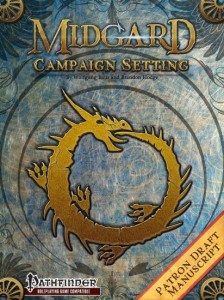
I signed up for the Midgard Campaign Setting, and after initial voting we found that 4e was not to be one of the primary settings. More patrons were interested in Pathfinder and AGE. Many of the 4e supporters left. I didn’t. Some of us began to write, and post, our own conversion. Project X was shelved for a new project, the Midgard Bestiary for 4e, which I developed with Richard Green. It came with a contract! I soon got a query accepted for KQ Magazine and finally was published in the Fall Issue. Despite the fact that the Midgard Bestiary isn’t slated to release until July (and these things can change) all the writing was submitted at the beginning of December. I’m counting it as my 2nd publication. Did I mention it has updated/converted/inspired content from almost every Open Design product ever released? And it’s awesome?

A quick note on Freelancing: Wolfgang is also awesome. If you’re interested in designing RPGs you should join an Open Design project and submit to Kobold Quarterly. He’s rejected plenty of my ideas, and every time he does he manages to encourage me to keep going despite the fact. It’s his superpower.

Community

Open Design is a great place for aspiring designers to chat and get feedback. I’ve been on EN World for years now, and found some great people in their Living Worlds’ forums. There’s been some discussion on Twitter and blogs this year on whether there’s a community around D&D. I firmly believe there is, and I feel better for being part of it.

The previously mentioned Quinn Murphy ran a site for most of 2011 called At-Will. It was a great site. At some point around May he started up an IRC Chat room for people to talk about D&D. It was great to finally speak to people and have a more natural conversation. Chat flows faster than forums, but allows for more complete thoughts than Twitter. He was kind enough to have me speak one night as one of the events, and I thank him for helping me connect with people I call friends.

There was an unfortunate misunderstanding that was complicated by other events and feelings. At-Will is no longer in operation but the chat lives on in the Gamer Assembly. We’ve even built upon it with a shared blog and wiki. It’s still being developed, but a few great things have already come of it.

2012

So what’s coming in 2012? Well I guess I really am a freelancer now. This morning’s announcement reminded me that I had several 4e projects in the works, and I did not know how this would affect them. Did I mention I wrote a book? It’s probably out in July.

“Project X” has been delayed until at least 2013. Another query I was waiting on has been rejected, at least in the form it was submitted for.

I’m going to keep writing here on StufferShack and on the Gamer Assembly. It will be mostly 4e content, as that’s what I play the most regularly. Expect to see some content roll in for some other systems as well. I’ve been looking back over the content that’s been the most read and trying to write more on those lines. My top five posts here are Designing Fantasy Cities: Purpose, Asmodeus – Steal this Monster, Dungeons and Doctor Who, Cybermen – Steal this Monster, and Fortune Cards – A Little bit of Critical Luck. So I get it, you like Doctor Who and D&D.

I did submit ideas to WotC during the last round of pitching. This is a big deal for me. Had you spoken to me in 2010 I never would have considered that I could be in Dungeon or Dragon magazine. It wasn’t on my radar as a possibility. That’s still unresolved.

I plan to attend PAXEast and hopefully my first Gen Con. I have not made much money on this yet, despite my morning nerves so we’ll see. April will see a new Site of the Year Contest, and I’ve had to step down from judging because it conflicts with my wedding. This also costs money, which is why you don’t see me at more cons.

If you want to support me, and freelancers like me, you should comment. Not just here, but on other blogs you read. Send questions into podcasts. Let KoboldQuarterly know that you like their content. Ask your favorite indie developer when their next product is coming out. Oh, and if you’re a 4e fan, don’t stop buying products. Some people are already ready for 5e, and that’s great, but if you’re still playing 4e over the next year, and you have the money, please buy something. It doesn’t have to be a forty dollar book. It can be some tiles, minis, or a ten dollar PDF. Let people know you are playing the game and want content.

I’ll see you this year. I’ll be writing as long as you’re wanting. There will be dragons.

The 10 Commandments of Writing an RPG

Some pitfalls and roadblocks to avoid, and tips to heed, when writing your own RPG…

I’ve said it before, “We all have our own RPG, right?”  Well, I assume that’s the case, because I’ve written several, and some of them have several editions.  No, I’ve never published any of my RPGs – they were always written for my enjoyment, my players’ enjoyment, and my need to vent creative brain vapor build-up.  Most often, I wrote them simply because I wanted to play or run a game (genre) that wasn’t really out yet or readily available.  Sometimes I even thought I could make a better version of an existing game.

In this article, I’m going to talk about some of the pitfalls of writing your own RPG, and how to overcome them.  Actually publishing a role-playing game for profit is a whole other ball of hot magma, one that I’m certainly not qualified to talk about.

 *I am not a professional writer, and I’ve never tried to sell a game.*

I’ve written several RPGs.  Unfortunately, most of them were 10-30 pages destined for a fiery death in the recycle bin.  I did, however, have a few juggernauts that saw some serious game-time, so I’m very happy about that…

  1. Back in high school (when my love / hate relationship with Heroes Unlimited began), I felt that I could make a better supers game than anything else out there.  Using Wordperfect, I put together 100+ pages of pure super material (titled “Supers“).  Unfortunately, it ended up being nowhere near original, so I rewrote it – only to find it still wasn’t very original.  So I just dumped the entire thing.
  2. I then created two editions of Militech, which was a brilliant combination of Aliens and Robotech.  Space Marine combat and Versatile Fighter combat provided our group many hours of entertainment, complete with military rank, tons of options, and some cool (ripped) artwork.  I even had six books printed, complete with a cool front cover.  Unfortunately, I eventually killed the game because I kept tinkering with it.  I’d get inspired by a movie or book and then try to add those new concepts to the game.  I should have just left it alone, since a lot of time went into that RPG.
  3. My last major endeavor was Nighthaven.  A Blade/Buffy/Underworld kind of a game.  This game had all the bells and whistles.  150+ pages, great options, and great (ripped) artwork.  Of course, I had to have it printed in book form.  We played this game through many, many sessions, and I simply liked it so very much.  I liked this game so much that it went through three editions.  <sigh> And that is what ultimately shelved it.  I kept tinkering with it, changing things, making the game “supposedly better” – and it simply ran away from me.  I really should have focused more on fluff than stuff.

So, where did I go wrong with all of my games?  And why am I even writing this article?

Well, I’m getting the itch to start developing Nighthaven again, but I don’t want to run into the same old problems.  So, I thought about it, and then came up with some of the roadblocks and pitfalls that I’ve faced in the past with the hope that I don’t make the same mistakes again.  If you’re looking to write your own RPG for fun, hopefully you’ll find this useful as well.

The 10 Commandments of RPG Writing

  1. Create a “to do” list.  Create a list of things that need to be explained in the game.  This is most often a list of chapters and subchapters.  I always look through other RPGs to see what kinds of things get explained in those games, to help ensure that my game will be complete.  Really, in creating a list, you’re creating a plan of attack, one that will help you stay on track.
  2. Don’t stall.  If you get an idea, go with it.  Don’t worry about your idea not being original or perfectly figured out – you simply have to get the ball rolling.  Don’t sit there trying to flesh it all out in your head.  I’ve sat for hours in front of my computer just waiting for the right words to mystically flow through my fingertips onto that keyboard.  And you know what?  Those were hours well-wasted. Once you get that initial idea, just go with it.  Write, write, write.
  3. Setting, Setting, Setting.  This is important.  A great system mechanic or character options tree might be cool, but it won’t last when paired with a poor, uninspired, or under-developed setting.  A setting connects the player characters to the story, and that’s mucho important in keeping players interested in the game.
  4. Only focus on what is on your mind. You don’t have to write your game from front to back (this is why you created your “to do” list).  If you’re working on a specific section – like PC  Races, but then get inspired about your PC Classes, work on your PC Classes.  You’ll get so much more done writing about what’s on your mind than if you try to finish one section before moving on to the next.  Trust me.
  5. Steal what works from your competitors. Hey, if you like how Wizards formats their D&D Powers section, copy it.  Or, copy and alter it.  Whatever.  It’s ok to study what’s out there, because it just might work for your game (and you may even be able to improve it).  On the flipside, you can also check out things from games that don’t seem to work, and avoid making those mistakes.
  6. Keep it simple.  Several of my failures occured in part because I thought I could make grapple rules more realistic, or ranged combat, or falling damage… whatever.  All that did was add more rules to an untested RPG system.  Using my “obviously superior intelligence” to make certain parts of the game more realistic only makes the game less playable.  It makes the game clunky, and opens your system mechanic to a vast set of inconsistent rules.  Just keep it simple.  Again, trust me.
  7. Consider using an existing game system.  In line with keeping it simple, why not make your game using an established generic system, like Savage Worlds or Stands of FATE?  This is soooo much less work and (more importantly) less stress.  Of course, if your idea of a game is based off a unique system mechanic of your own design, then by all means, go for it – just remember that desiging your own system can be a daunting, time-consuming, tedious task.  Using an existing generic game system can easily cut out tons and tons of age-inducing playtest hours.
  8. Playtest with one-shots on occasion.  This will help you adjust numbers, balance powers, and show you what simply doesn’t work (and anything that takes a lot of explanation certainly doesn’t work).  Players are not going to want to play the game if they can’t remember the eight-step process for determining initiative.
  9. Make the rules consistent.  When you design your own system, a common error occurs – it’s very easy to focus on combat resolution while disregarding conflict resolution.  Then, later you’ll realize that you need to figure out how to handle ability checks, skill checks, casting spells, and social interractions.  Pretty soon you could end up with several different ways of handling such conflicts (sub-systems), when you should have devised a single mechanic that applies to just about every situation.
  10. Stop making changes.  After you’ve finished your game and distributed it to your players, resist the urge to make changes.  This is the time to play the game, not work on it.  Unless you find something that is seriously breaking your RPG, leave it alone.  Just go with what you have and let it be. Sure, you’re going to find errors, inconsistencies, and power imbalance, but your players will forgive that.  They won’t forgive you for interrupting the campaign when you start making changes.  My two most successful games were ultimately killed because I kept trying to improve them.

That’s it, I think.  Hopefully this list will help you with your homebrew RPG project – I know it’ll help me.  Here’s a few more ideas to help make your original role-playing game a success:

  1. Include artwork.  I always rip images off the web for my personal RPG projects.  I’ll even doctor those images to suit my needs.  Imagery adds a great element – it helps give the game flavor, and helps your players envision the game’s concepts.  Just remember, don’t post your game online with ripped images, and I know you’re not going to try to sell it that way.
  2. Make a character sheet.  There are all sorts of ways to create a character sheet.  Microsoft Word or Excel is usually fine for a homebrew RPG, though there are many other (better suited) graphics programs out there.  Really, having players write their characters down on some binder paper is a no-no.  Doing so will irritate your players.  Make a character sheet, even if it’s a very simple one.
  3. Make your game easily available to your players.  If I’m going the cheap route, I’ll print my game on my home printer (or at work) and put it into binders for my players.  However, I prefer to have it printed in a printshop.  I’ve done it for as little as $15 per spool-binded book in color, with front and back covers.  Whether you print it or not, give your players a Word document or PDF of the game (you can save as a PDF in Word if you want).

  – – – – – –

I’m assuming you’re writing your own homebrew RPG because you have a cool setting, genre, or mechanic that you’d like to play, or because you’re dissatisfied with the output of the current industry games.  Writing an RPG takes a lot of work, and can easily lead to a lot of wasted hours.  I really do first suggest looking at other games to see if you can modify one of them to suit your needs.  That could very easily get you the game you want (and much sooner), instead of starting from scratch.

Of course, if you’ve read this article down to this point, then you’re probably like me – you probably get enjoyment not just from playing the game, but in creating it.

Mass Effect: Encounter Design Principles

So what does it take to build an encounter for a game like this one? In short, what makes running an encounter for a game setting like Mass Effect significantly different from a D&D setting, or a superheroic milieu?
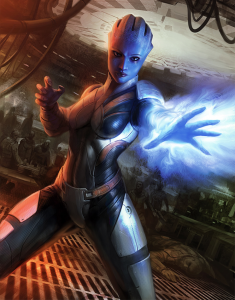
I’m glad you asked. Unless you didn’t, in which case I wish you had so that I could answer properly. I’ll wait. It’ll give me time to finish being impressed with myself for using the word “milieu” successfully.

Hm? Oh, good, you’ve asked now. Okay, then. As my DM is fond of telling me, the most important thing to think about is terrain.

Specifically, cover.

True story: the proper use of cover was the first thing I noticed when playing Mass Effect that separated it instantly in my mind from any other game with guns I’d encountered, and it’s important to notice because if your game table is anything like mine then you’re not used to using cover either. I don’t think I’ve ever been playing D&D, even as an archer type, and thought, “hey, I should get behind cover so those arrows don’t kill me.” You need to use cover in Mass Effect, or you’ll wind up dead. Fast. Partly because nearly everyone is using automatic weapons.

Now, thinking about cover is relatively easy once you’ve learned the one rule of Mutants & Masterminds 3e: namely, that pretty much every modifier in the game system that isn’t “power rank” or similar is boiled down to +/- 2/5. If something is somewhat beneficial, take a +2. If it’s very beneficial, take a +5.

Now, D&D has something similar (though in 4e it’s a 4, rather than 5) called the “DM’s best friend.” The difference is that M&M actually uses it for everything from concealment to invisibility to cover to fringe benefits provided by Advantages or Features to… well, you get the point. The point is that it’s everywhere. Very transparent.

The reason this is important is because it makes it a lot easier to focus on the rulings rather than on the rules, and I think that’s something that a lot of us can get behind in the interest of speed.

Encounters in the video game are largely about cover. Using it creatively; holding it against enemies who attempt to flank. Pulling a flanking maneuver and taking the enemy down from behind while your squadmates keep their attention. Using powers or biotics to pull enemies out from behind cover and into the line of fire. And so on.

Automatic weapon rules are built right into Mutants & Masterminds 3e, though since 2e the name was changed from Autofire to Multiattack to make it a bit more broadly applicable. They allow for covering fire, sweeping the weapon to attack multiple targets (for a minor penalty to accuracy) and grant bonus damage ranks for high attack rolls. Lovely.

This means it’s important that you, as the GM, are ready to think tactically. Have the bad guys provide covering fire for each other as they move to keep the player’s on their toes. Use readied actions. Use the Aim action. Deploy snipers. Make sure that there’s cover available, and that the bad guys use it. And (assuming that you haven’t told them ahead of time) pray that your players catch on to how the fights are going to work. Use those automatic weapons to their fullest potential to make it very very clear that there are dangers to the old run-and-gun.

Gun-fu will get you killed. Almost invariably.

Another important thing to remember about Mutants & Masterminds, and one of the reasons I’ve chosen it as the vehicle for this setting, is the Toughness save. Health is not a resource in this game; there are no “hit points”. Every hit brings with it the risk of incapacitation – though it is mitigated somewhat if the players have Hero points available. Every failed toughness save accumulates a penalty to the next save (your shields are weakened, your armor is damaged, you’re getting tired…), making it increasingly likely that a worse failure will leave you out of the fight entirely. This is good (in the dramatic sense) because it makes it entirely possible for even a powerful PC to drop after one shot with a particularly bad die-roll.

Even at the high power levels, combat is dangerous.

On the flip side of this, I should note that the default rules don’t let you die easily unless  someone is really trying to kill you. This is useful from a story perspective (protagonists shouldn’t die all that often, because they’re more important to the story) and it’s also useful because it’s kind of how things work in Mass Effect anyway. So, there’s that.

Mass Effect Tabletop: An Introduction

Some of you may remember the Steam Summer Camp Sale. Some of you, like me, may have spent far more money than you really expected to during that sale buying games that you were merely curious about.

Some of you, like me, probably bought something in the Mass Effect series. In my case, it was Mass Effect 2. I was not disappointed. Far from it – the game exceeded my expectations in just about every way, and offered me exactly the kind of immersion in a sci-fi universe I was craving. I played through the game about 5 times, and I’ve started looking at DLC. And naturally, perhaps inevitably, my thoughts turned to the tabletop.

A brief primer

For those of you who are unfamiliar, Mass Effect is an epic space opera in the best sense of the phrase. It manages to nod in the direction of just about everything good in the genre while still being its own unique entity, a wondrous blend that puts it somewhere in the realm of “CallofSereniBattleStarTrekWarsGalactiCthulhu.” In a good way. Okay, so that was obviously hyperbole, but the point stands. It’s kind of amazing. And it has everything you need for a good classic RPG. Division of roles, lots of weapon options, tons of competing organizations to populate the world with, a “magic” system (of sorts, but a pseudo-scientific sounding one that keeps it from falling into a midi-chlorian filled trap), space armor, multiple races…

The point is that there’s a lot of depth there that lends itself well to a tabletop campaign. And as a side note, yes, I would recommend it. Highly.

What this conversion is

I’m not going to talk much about gameplay except where it’s relevant to the issue of converting it. I’m more interested in converting concepts. As such, this could easily be done using something like FATE, but I’m more interested in using Mutants and Masterminds 3E from Green Ronin. It’s light enough on game-play with enough crunchy tactics to keep my d20 crowd happy… and they don’t have to put down their d20’s.

Plus, John Lewis already WROTE an excellent article on FATE conversions. No sense in getting redundant, eh?

Let’s start with the…

Key concepts

I’ve approached this with the 2 year period between Mass Effect and Mass Effect 2 in mind. There’s a lot that can happen in 2 years, after all. But there’s a lot of possible time periods that could be used without skirting so close to the cannon of the games.

First of all, I’m not especially interested in retreading Shepard’s story at the table. The games already do that well enough, and everyone’s experience with them will be a little bit different. If you’re like me, you want to tell other stories.

So for the purposes of our M&M conversion, there’s basically just one thing to remember; the first rule of Mass Effect is that Shepard is basically Space Batman. In the sense that Shepard is a near legendary human spoken of in hushed tones who has accomplished incredible and basically heroic things, but the details are a little… vague. Partly because the Citadel Council (the galaxy’s ruling body) has hushed a lot of it up.

You’re probably never going to run into Shepard in person, which is just as well, because unless you’ve created your own cannon version of Shepard, there isn’t one. See how I’m avoiding pronouns? Because I’ve already done this dance on another site.

The second truth of Mass Effect: The Reapers are coming.

The Reapers are a race of super-intelligent massive sentient machines that occupy “dark space,” (the space between galaxies) who have apparently swept through the galaxy and purged it of life roughly every 50000 years. And the galaxy is due. The first game (I have gathered) concerns the actions of Saren (a rogue Spectre; more on them later) and a Reaper called Sovereign. And, naturally, Shepard’s valiant fight to stop them.

Oh, and if you spend too much time near Reaper technology, you get strange dreams and visions and eventually become “indoctrinated,” gradually starting to believe that the Reapers should destroy all life, and that you should help them. In other words, the Reapers are basically a high tech version of Cthulhu.

The third truth of Mass Effect: The galaxy is in denial.

The Citadel council, rather than mobilize the galaxy to defend itself against the coming threat, has chosen to deny the involvement of Sovereign and believe that Saren alone was responsible for the events that nearly destroyed the Citadel. Few know the truth. Shepard is one of them. Naturally, Shepard is missing.

In the meantime, there are plenty of other threats to worry about; crime in the Terminus systems, crime on the Citadel, large scale gang wars on Earth, the Geth, the Krogans, the Batarians, Cerberus…

I started this project thinking that I’d run a one-shot session to introduce some people to the game system, and decided to flesh out my thinking and turn it loose in the wild. However, I ended up with several great articles, making this a series.

So, that’s what’s on the table. Stay tuned, and don’t touch that dial!
… well, actually, you probably should, because if you have a dial, then your TV is probably ancient, and if this is what’s on TV right now… you have bigger problems.

TaDRPG

I came up with the concept for this game on my way to work one morning and I couldn’t get it out of my head all day, so I wrote it up on my lunch break.

I’ve always been a big fan of rules-light systems because they’re easy to memorize and easy to tweak. I think, one of my favorite things to do from time to time is surf the interwebz for indie RPGs that are free to download or cheap to download, especially if they’re rules-light. I’ve spent hours doing this and my hard drive is full of different systems with wildly different ways of handling similar things and I like to look through and pick and choose which part of which system I like best.

My goal with this system was to make a good beer and pretzels game. Something that takes no more than a few minutes to read through and something that, when read once, you can memorize.

When I came up with the idea, I had two things on my mind.

  1. I wanted to run a dungeon crawl in a mega-dungeon full of the most deadly traps from Grimtooth.
  2. I wanted to try an old idea of running a game where the GM rolls all the dice and the players control their characters based on the environment instead of their character sheet.

When I posted my idea on one of the forums I frequent, I got a lot of negative feedback, mostly based on not knowing your exact chance of failure or success.

So, I created this system. It’s easy, it forces you to build a character based on a concept rather than on number crunching, and it gives every chance in the form of a percent, so you always know your odds of success or failure.

Once I had the finished product, I knew it was so good I had to share it. I think it would make a great system for one of those nights where a player is missing or nobody’s really in the mood for the system you were playing and everyone wants just a lighthearted, fast paced game. My hope is that somebody finds good use of this system.

Titles and Descriptions RPG (TaDRPG)

This game is based on two simple concepts—the most general concepts of RPGs: doing something is harder than doing nothing and some people are better at stuff than others.

Each character has a title which describes the basic concept of the character.

These titles help make things easier for the character, but only as they relate to the title. For example, Jared the Barbarian will not be able to speak in public as easily as Lily the Talkative, but he will be able to fight more easily. This will be explained in more detail in the crunch section.

Characters will, in addition to their titles, get six descriptions: 3 positive descriptions and 3 negative descriptions. These also affect how easy or hard things are for the character, but to a lesser extent than titles. These can be very vague or very specific. More specific descriptions will make things more easy or more hard and are also more limited than vague descriptions.

It’s important to note that when creating descriptions, you can be too vague, but you can never be too specific.

Crunch

There are two things to remember based on the two general concepts of RPGs and these make up the crunch.

Doing Something is Harder than Doing Nothing

This covers the rules for randomization and potential failure or success. What RPG would be fun if it was you and your friends describing how much nothing your characters are doing?

This game uses a percentile system, with all modifiers in increments of 5%. This makes it easy to convert to a d20, if you prefer. Either way, they’re the same odds.

To succeed, you need to roll equal to or greater than the difficulty assigned to the task.

Some People are Better at Stuff than Others

This is where titles and descriptions come into effect. There are two kinds of titles: Basic and Complex. Basic titles consist of one thing, such as Jared the Barbarian. Complex titles consist of two things, such as Theodore the Mage who knows Kung Fu.

Titles make things that relate to the title easier for the character. Basic titles make things 15% easier for the character.

Complex Titles make things 5% easier for the character. Remember, Complex titles are relevant to more situations.

There are also two types of descriptions: positive and negative.

Positive descriptions make things 10% easier for the character.

Negative descriptions make things 10% harder for the character.

Increase those percents in increments of 5% for more specific descriptions depending on how specific they are.

Success, Failure, Combat, and Magic

Whenever a character attempts something and fails, that character accumulates 1 failure. Once a character accumulates 3 failures, the character becomes incompetent and incapable of doing anything. As such, the character dies.

Whenever a character attempts something and succeeds, that character accumulates 1 success. If the character has accumulated any failures, the success will negate one of those failures; otherwise, the success has no effect.

Combat works in a similar way to other situations. When a character attacks, a die is rolled for the attack. The result sets the Difficulty for the defense. The defender must roll and match or beat the attacker’s roll. If the defender fails, one failure is accumulated.

Making an attack easier due to titles or descriptions means making the defense that much harder.

When a character decides to use magic, that character must roll against a certain difficulty to see if the desired spell has been prepared or is otherwise available. The difficulty should be adjusted by how specific a spell is rather than how powerful the spell is. If the roll is a success, the spell is available to the character. Attacking with a spell works the same as combat.

Example of Play

GM: “You’re at a large pit with a 50% chance to make the jump. Difficulty 10 on the d20.”

Jimmy the Acrobat: “My title grants me a 15% bonus to the jump, correct?”

GM: “Yes. You have a 65% chance.”

Jimmy the Acrobat: *rolls* 13 on d20. “Success.”

GM: “You make the jump.”

Jimmy the Acrobat: “I flip three times before jumping and do a somersault in the air, nailing the landing like a champ.”

Thomas the Reckless: “If I try to jump and slam my climbing spikes into the opposite wall, will my reckless title make it easier?”

GM: “Yes, but you will need to climb with a 70% chance of success.”

Thomas the Reckless: “I have the description Good Climber, which makes that an 80% chance.” *rolls* 9 on d20. “Phew! That was close, but I made the jump.” *rolls* 19 on d20. Made it.

Miri the Careful: “I make the jump carefully.” *goes to roll*

GM: “Wait. How do you jump carefully?”

Miri the Careful: “I don’t know. I kind of ease up to the edge and hang over, then try to push myself off to the other side.”

GM: “That’s ridiculous. You could never make the jump that way.”

Miri the Careful: “But, it’s careful.”

GM: “Sigh. Fine. It’s a 35% chance, but with your title, it’s a 50% chance.”

Miri the Careful: “I also have the description Good at Jumping in Ridiculous, but Careful Ways. Can I get a 20% bonus from that, since it’s so specific?”

GM: “….”

The blog that hosts the link to download the pdf is below. The pdf version has examples and tables for easier comprehension.

http://burningpromises.blogspot.com/

Dresden Files: Reno Reborn

“It is the nature of the universe that things remain. Nothing ever disappears completely. The very sound of Creation still echoes throughout the vast darkness: The universe remembers.” Ghost Story

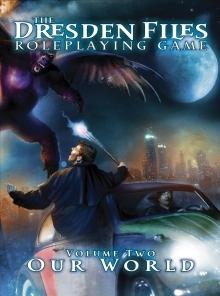
In The Dresden Files RPG, the world of the Dresedenverse is a magical place. You may live in Chicago, Baltimore, Edenburg, Scotland, Mexico City; or Your Home Town, but no matter where you live, the supernatural world co-exists with yours. Mortals have been around for a long time, but there are much longer-lived things out there…

Being a game powered by FATE, players have much higher control of story and setting than in many other games. The greatest demonstration of this is in the default assumption of The Dresden Files that your group will create the setting “city” you are playing in before creating your characters. In “Chapter 3 – City Creation”, players work with the GM to develop themes and threats of the setting. From the start, this collaborative approach helps inform the GM what expectations the players have for this game.

Normally, the first choice the group makes is to decide in which city the campaign will take place. If you read my last article, you know I have taken GM license in saying that I want the game to take place in Reno, with my players playing themselves as PCs being introduced to the mysteries of the Dresdenverse. From there, we will decide as a group some themes we might want to see in the setting.

As an example, I am going to throw out a couple of potential Themes to get us started… Let’s say that we want to see some corrupt politicians and gangsters lining their pockets, but in a Reno way (as opposed to “the Chicago Way” or as it’s done in the Big Apple). We may want to emphasize our connection to the Wild West or how mining and gambling have influenced the local scene. This may lead us to historical connections to the silver mining industry of the mid-to-late 1800’s or to the mob bringing legalized gambling into the state or any number of other perceptions we want to have of our fictionalized home town.

Playing with this theme we talk about potential Aspects and get the following:

  • Power is Good, but Politics is Better
  • It’s Not What You Know, It’s Who you Know
  • Good Old Boys

I particularly like the last two, but want to tweak them to be more engaging for our setting. The second might be shortened and therefore more useful: It’s Not What You Know… This now makes it broader and more sinister feeling. I can still use it for its original purpose, but the dangling ending can be used in other ways (i.e. …It’s What You Don’t That Can Kill You, or …It’s What Knows You). This change might also lead to certain implications, maybe that the politically powerful in Reno are clued in to the supernatural players and activities in their town. Maybe it just means that there is a lot going on in Reno that the PCs are unaware of.

The last aspect really speaks to me, especially with a very minor change. Good “Old” Boys. This still evokes the feel of connections equals power, but also suggests many possibilities for me to look at as a GM. Does “Old” refer to vampires, wizards, decrepit Mafiosos, ancient Native American spirits, the Civil War, or all of the above? Are the “Old” in Reno attempting to maintain the status quo because “that’s the way it’s always been” and can’t break the cycle, or to some other villainous end? Are they trying to destroy the status quo?

Thanks for tuning in, next time I’ll show our finalized theme aspects and maybe a Threat as well. We will also discuss the importance of Locations and Faces and how they will help breath life into our setting.

Dresden Files: The FATE of Reno

My group is getting ready to wrap up our Warhammer Fantasy game, and embark on a brave new endeavor of John Lewis’: playing Warhammer 40K: Rogue Trader using a homebrew rules set. John has always used published rules sets, published settings and homebrew settings. This experience will truly be a first for me, but one that I am looking forward to (I’ll tell you more later…). However, we want to invite another player that we miss playing with. The Catch: he can only game every other session due to work.

There’s been a lot said already about how to manage the loss of players for a given session – play without them, don’t play at all, have the GM run their character, have another player run their character, etc. I personally hate all of these options, both as a GM and as a player, due to the immersive storytelling my group likes to engage in. Fortunately, because of the regularity of the scheduled absences, I’m proposing an alternative. I’m going to run a Dresden Files RPG game on the off weeks for the remainder of the group.

For our group, this should accomplish a bit:

  • We get to keep gaming weekly, without leaving our buddy behind.
  • This gives John more time between sessions to tweak the rules as needed.
  • We get more experience with another incarnation of the FATE system.
  • I get to introduce the rest of my group to the Dresden Files setting.

Because of the group’s lack of familiarity with this setting, there will be a pretty steep learning curve for them to fully appreciate the distinctions between the different character templates. Also, the setting itself has a lot of nuance for some of the more powerful templates. As I mentioned in my last article, there are plenty of ways to help bring your players into a setting like this one (400 pages in the player’s book alone). My favorite was to have the players familiarize themselves with the setting. However, they will be doing this with the even more complex Warhammer 40K setting at the same time. I know they can do it, but I don’t want them to be forced to.

I was looking at different ways to approach the campaign: do we play in Chicago (which I happen to have access to some play aids for from a different game we never got around to…), do we play in the Baltimore setting from the player’s guide, or do we play in our (current) hometown of Reno, Nevada? The appeal of this last choice jumped out at me for a variety of reasons, the strongest being the fantastic time we had playing Zombie Cataclysm run by our very own Chris Stevens.

In this game he GM’d, we played ourselves showing up to my house for game night. From that point on, we were in character. We all had done a great job of modeling ourselves using the mechanics of that setting and had a very realistic, yet insanely fun, session. Why couldn’t we repeat that experience in a different game? I think this would be a great approach to introduce my friends to the Dresden Files, at least as it’s seen through the lens of 4 not-yet-clued-in mortals living in Reno.

In the weeks to come, I plan on showcasing some of our campaign/character/plot designs – specifically the use of Fate aspects to help breathe life and importance into the setting and characters.

See you then!

Is Meetup for Gamers? I think it is, so get your game on!

Gaming has always been a passion of mine. I’d call it a hobby, but I think that doesn’t do it justice. Much of the draw of gaming isn’t just being on table; it’s having access to the community which surrounds every RPG out there. But that’s the hard part, getting connected with the community, and then finding the right people in that community to game with. For those of us that have relocated from other cities and states, it can be tough to get in contact with other like-minded folk. Going to your local gaming store is a good start, but sometimes that’s not enough or sometimes gaming stores aren’t available.

This was my dilemma. My Star Wars Saga Edition game didn’t have enough players to fill out the table and I didn’t just want to invite anyone off the street to come to my house every Friday and share my Doritos and Mr. Pibb. I’m a thirty-something married father of two and I was looking for people who understood the obligations that I had off-table, and that sometimes taking on the Sith Empire had to take a back seat to movie night with my kids. After researching my options (posting at hobby stores, online player registries etc.) I finally settled on trying to cast my net locally. I was gaming at my home, so it made sense to pull players from my immediate community. It was then that I decided to create my own Meetup group through the website Meetup.com.

For those of you who aren’t familiar with Meetup.com, it’s worth checking out. Meetup.com is a web-based group management system for organizations of all types and sizes. Meetup.com’s focus is on bringing people interested in your particular interest to your Meetup site. Meetup.com then gives you the tools to manage your members and schedule meetings as you see fit. Though Meetup.com isn’t tailored to gaming per se, it has more than enough functionality to manage even the most demanding gaming groups (e.g. message boards, event scheduling, file repository). You can delegate responsibilities and have multiple people managing multiple events/games at the same time. Through Meetup.com you can also connect with other Meetup groups, merging events with other groups or bringing their members into yours.

Meetup.com does cost money – about $70.00 for every six months. But in my opinion it’s worth it. My meager group has gone from a half-dozen gamers to over 130 members. We’ve had big game days at hobby stores, and small sessions at a home. Recently, we began just getting together to have a few drinks and talk gaming. Through Meetup.com I’ve been given me the opportunity to connect with people before gaming with them, which is important since I’ve always felt that the best on-table experiences begin with a strong off-table friendship.

*Editor’s Note* I just checked out Meetup for the first time and found several Meetup groups in my area that I’d consider going to (but not the freaky lodge where they promise to “enliven my senses,” – wait, maybe I should check out that lodge…). Thanks to Robert for letting us know about Meetup. I wish I could join you guys down there in Surprise, Arizona.

New Editions: Great Starting Point or Treacherous Terrain?

I hate to be the nay sayer here, especially since I love shiny new books as much as the next gamer. However, some experiences in my Friday night L5R game has brought to light a few issues that can come up with switching to a new edition in your game.

Now, from the company’s stand point, a new edition is great. Odds are that most of the people who play/buy the product for the old edition will buy in, they have a pre-established community and track record to build trust, and they have a shiny new book on the shelves to draw new people in. For the most part, everyone is happy when a new edition hits, especially when it does so at a convention – like the recently past GenCon. However, it isn’t all sugar and lollipops.

See, a new edition is – by its very definition – different from the old edition. If it wasn’t different, and significantly different in some ways, it wouldn’t be a new edition; it would be a revised edition or a re-release. That very newness, designed to help bring in new people, can cause issues for the established game if you’re not careful.

Where does this problem come in? It comes in where the new and old editions clash. This may work better with an anecdote, so let me give one: In Legend of the Five Rings there is a mechanic called the Honor Roll. How it basically works is this: when a player fails a roll, they can rely on their honor to pull them through, and they get a reroll. Now, in old editions, they would replace either their skill or their stat with the character’s honor and re-roll. In the new edition, you only roll your honor. Now, at high honor, the new mechanic is more powerful. However, at low honor it is weak to the point of uselessness.

Now, while this isn’t a super huge issue – and is easily fixed with a simple GM ruling – it does cause confusion and issues. Most of the players don’t like the change, and even I am only intrigued by it on an intellectual level. However, the problem is the confusion that it brings up in game. Small or large, the change is a deliberate change and it affects the lay of power in the mechanics. The group makes decisions based on history with the system, and then runs into the wall that the new rules erect. It causes confusion, and breaks people out of the game. This problem has extended to some of the newer players in the game as well, who have become confused by the mixed signals they get. The rules tell them one thing, the other players play like it is something else, and the GM ends up having to rule somewhere in the middle.

These points of confusion are where edition wars tend to begin, and those can be an issue in and of themselves. Sadly, there isn’t really a way to fix it either, aside from for everyone to approach the new edition as if it was a new game that was just very similar to their old one. This is also why you may want to wait until a big break in your game’s action before transitioning to the new edition. Take that extra time to make sure you know the differences; your group will need you to point them out.

Aside from that, have fun, and be ready to carve out the path between the two options you’ve been given. And, of course, enjoy your new game.

A Long Time Ago, in a Halfling Village

By Dixon Trimline
– Our personal destination is not always reached by way of accurate maps…

I was deeply moved and impressed by the raw honesty of Chris’s article, I’m Home, Finally, from a few weeks ago, which was inspired by Chatty DM’s article, Lessons from Day Jobs. Here were a couple of devoted, talented gamers who were cracking open the mysterious black box (Red Box?) and allowing an intimate look inside their lives. We all know how the internet is supposed to work, cloaking us in anonymity and as we say anything we want through a persona that we invented.

In person, I might be an awkward, gooney blob with no friends and the social skills of a cutting board, but online, I can be clever and sharp, witty and engaging, brilliant and striking. We just need to make sure that we keep everything inside and hidden, that the readers only get to see exactly what we want them to see. But Tourq and Chatty pulled back the curtain and got all autobiographical on our buttocks, and that made me think, “Huh, that looks fun. I think I’ll do that.”

Introduction

As I think back over my professional experience, I marvel and shudder simultaneously. I’m pretty sure, had I listened to bald Mr. Pepp, my school guidance counselor, he wouldn’t have recommended this particular route. Neither do I. Okay, okay, this long and winding road prepared me for the job I hold now, a job that I really do like, a job I’m good at. Had I not experienced all I’ve experienced, I wouldn’t have this job. It’s as simple as that. But even my foulest and most flatulent enemies–you know who you are, and if not, I’ll be releasing a list later in the week–even these rotten people don’t deserve a history like this. You wanna get it, you gotta pay it. I paid it.

It’d be nice to create a fancy graphic of the jobs I’ve held, a timeline showing the spans in bright colors, but unfortunately, for such a timeline to be meaningful, it’d have to be to scale. That presents certain difficulties, given that I’ve held one job for 5 years and another for 1 week. Anyone wanting to look at the graphic would need a monitor the size of a garage door, and I can’t ask that of my readers. If, however, you have a monitor the size of a garage door, give me a call because I want to play video games on it.

First things first, I need to get my pre-Army jobs out of the way. While each served a purpose (mostly giving me money that I could waste on food and D&D), I’m not going to count these because 1) I’d never put them on a resume, and 2) I have no idea of the start and end dates. I was young and stupid and the word “tomorrow” meant as little to me as the word “fiduciary.” I’m now older and stupid and I’ve got a pretty clear understanding of “tomorrow.” Fiduciary? Something about money, I think. Which I don’t have much of, so it’s still pretty meaningless.

First Job Ever

Not sure, actually. It might have been my near-week stint as a dishwasher at an ice cream-based family restaurant (Heffies), or it might have been my one floundering weekend with a friend at a gas station (Texaco). The former had me walk off the job, because either it was horrible work or I was hopelessly lazy. Probably both. The latter, I was frightened by credit card sales, I was unable to pump exact totals (“Uh, that’ll be $10.03”), and I consistently forgot to reinstall gas caps. Now that I think about it, I continue to struggle with these deficiencies.

Next Job

My big one, my defining job, my Burger King. It lasted four years, out of high school and into assorted flirtings with college, and it introduced me to the pretty girl who inexplicably would agree to marry me, though not right away. Pretty and smart. It was Burger King where I met some good and wonderful friends, and even to this day, I maintain contact with none of them. While I’ve always been irritatingly introspective (I had my first identity crisis at age 4), it was during the Burger King days when I started wondering, “Is this all there is?” As it happens, the answer is a definitive yes and no.

First Semi-Professional Job

Right around the time I proposed to Wendy (pretty and smart, see above), moved out of my mother’s house (and into the apartment above the business where she worked), and pursued a degree in something I hated (architectural drafting, though I didn’t figure out my hatred until about a week before receiving my degree), I interviewed at JobPro, a temp agency that offered two employment tracks, office and warehouse. Warehouse sounded very hard, so I did their office testing and they placed me at a company called Brown & Sharpe, which did something involving large, noisy machines. I did data entry for some months, wearing a tie and uncomfortable shoes, and so impressed my supervisor there that she offered me job there. And I would have taken it, except for one tiny commitment, and I don’t mean my marriage to Wendy in September ’90. No, the commitment I’m talking about is…

HUA (2/91 – 12/94)

The US Army. And so my career began. I signed up in July 1990, to begin Basic Training in February 1991. Right in between those dates, right around the time I started thinking that this decision might not be the best one I’d made in my 22 years on the planet, right around the time that Brown & Sharpe offered me a non-military, non-shooting, non-grenade type job, the Gulf War started. So when I approached my recruiters to admit I wasn’t so keen on the Army after all, they informed me that the Army was still pretty keen on me. I would get out of the Army on December 2, 1994, to return to college and this time, I’d get a degree in something I loved…

B&S Redux (4/95 – 5/00)

Or not. I did get out of the Army, and I did return to school, for a short time, but with a son and a newly-hatched daughter and no recognizable income, I scuttled back to work. I got in touch with my supervisor from Brown & Sharpe, just to catch up (wink wink), and wouldn’t you know it, she had some stuff I could do. I started part-time there, 20 hours a week, and then 30, and then 40 but without benefits, and then 40+ without benefits, and finally a full-time salaried position, with benefits and everything. I’d broken through, I’d found my professional job. My Architectural Drafting degree was really paying off. I was full-time and salaried April 1995, and would stay there until being unceremoniously fired in May 2000. You know how managers talk about Open Door Policies? They don’t really mean it. If you have a problem, an issue, a concern, or a worry, you best keep that pink mouth shut.

Dream Job (5/00 – 5/01)

After receiving notice at Brown & Sharpe, I set to seeking a new job. It took exactly one week. A friend asked if I’d consider writing for a living, and because I had not recently suffered any major brain injuries, I naturally said yes. I started working as a technical writer for e-Business Technologies on May 30, 2000, and enjoyed a year of the best work I’d done since I’d started working. This was a pure software development company, just this side of a DOT COM, with free soda, free coffee, free bagels and danishes, a pool table and ping pong table in the cafeteria, a great big bucket of legos for anyone to play with outside of one office, pizza-laden training sessions, and some of the coolest technologies I’d ever seen. This was the sort of software–content management, web-based, workflow, neato neato neato–I’d buy and use. I was working with people vastly smarter than me. Not that big a deal, except this was a case where I couldn’t help but acknowledge it. Real, honest-to-goodness scientists, people with lots of little letters after their names, people who were sitting on the W3 board and getting patents and inventing stuff no one had ever seen before. Naturally, the company went under. On May 17, 2001, we were all called into the cafeteria and told we were out of work. At the time, looking ahead to 9 weeks of severance pay (getting my paycheck? for doing nothing???), and possessed of an unnaturally high opinion of myself and the job market, I thought I had no worries.

I was seriously wrong.

Unemployment (5/01 – 7/02)

Unemployment sucks.

Really, really long unemployment really, really sucks. How could I have possibly known that after the dream that was eBT, I’d be scrounging for work for 14 months? We scrimped and we scraped, our church and friends and family helping us pay our bills, and I sent hundreds and hundreds of resumes to all corners of the earth, all of which generated a baker’s dozen worth of interviews. All for nothing, nada, naught. I did find out a lot about myself, most importantly that I didn’t like being unemployed.

In the interest of full disclosure, I did manage to snag a few contract jobs, defined as short-term, unreliable, and just a little terrifying:

  • OmniCom. 10/01-11/01
  • Red Bridge Interactive. 12/01-1/02
  • Tzell Travel. 5/10/02-5/15/02
  • New England Medical Center. 5/02-6/02

A few of these opportunities hinted at “bigger and better things,” but it was the one I was least interested in that panned out. See below. There are people out there, adventurous people, daredevil people, life-on-the-edge people, who love this kind of life. Where’s the next paycheck coming from? Will you have work next month, next week, tomorrow? “Who cares, dude! Live in the now!” These people ain’t my people. Also, these people probably don’t have kids.

Underemployment (7/02 – 1/03)

It turned out OmniCom, a tiny little division of a company called GBA, liked the contract work I had done, but couldn’t quite hire me full-time. GBA, which really wasn’t that much bigger than OmniCom, considered me for a good long time before offering me all the slavish toil of a real job but with half of that unsightly salary. And, just for fun, crummy benefits. But you know, beggars, choosers, etc. On July 16, 2002, I started at GBA. I’d be doing something brand new for me, training, which evidently required interaction with other people. As I am a paralyzingly introverted person, this seemed rather a challenge. But once I started, it turned out to be only a nightmare.

But that’s not entirely fair. Remember how I said about eBT, here is “software… I’d buy and use?” Well, GBA was selling software I wouldn’t cross the street to spit on. I had to learn a new and bewildering industry (health insurance), an old and dreadful software, and an agonizing and draining skill (training). I quite hated it at GBA, but what choice did I have? I didn’t want to go back to unemployment. Thankfully, GBA spared me the horrors of suffering them for too long, and fired me on January 30, 2003, for a crime I didn’t commit. Back to unemployment.

Unemployment II (2/03 – 5/03)

Unemployment still sucks. See above.

Yonder (5/03 – 9/03)

It came time for me to move. The technology opportunities had played out in the northeast, so on May 12, 2003, I took a job with Columbia Research Corporation in Virginia, figuring there’d always be work in the DC area. CRC was a job placement agency, so they placed me at a company called Titan Secure Solutions, which wanted me to write proposals for work with still other companies, and it was all pretty confusing. It hardly needs saying, but I’d never written proposals before, so here was yet another skill I needed to learn.

A job in Virginia meant living with a friend for a few months, and then orchestrating the whole house sale, apartment rental, family relocation, school registration, and house hunting joys that are more than sufficient to drive a stable man to uncontrollable weeping. And I wasn’t stable to begin with.

Once my family settled in (more or less), I began looking for new work, figuring that I couldn’t do any worse than the job that brought me to Virginia. At Titan, I had a good boss and a reasonably good environment, but the work was soooooooooooooooooo dull. I sent a few resumes out, and got a snag. One interview landed me a follow-up, but one of the company’s co-owners called me and said, “Never mind the next interview, do you just want the job?” I said yes. My last day at Titan was September 12, 2003.

Dream to Nightmare (9/03 – 1/08)

Fairfax Imaging started so well, as most new jobs do, with interesting work (documentation and training), fascinating people, and bucketloads of travel to all over the United States (and both ends of Canada). This was a privately owned company, with one owner being the day-to-day president and the other owner being a brilliant developer. The former owner never failed to annoy me, putting out fires with a sort of manic glee but never actually solving any problems, and the latter owner was a vast, seething pool of intimidation, always reducing me to grinning idiot status.

Unfortunately, the Fairfax Imaging experienced growth, much as a cancer patient does, only more painfully. The owners saw value in making lots and lots of money, but decided to do it without upgrading the 1998 software or growing the Mom & Pop infrastructure, which resulted in record low morale and a grossly dissatisfied customer base. Since these customers couldn’t take their anger bats to the noggins of the owners, they turned on the person they saw for weeks at a time… the trainer! And yes, that would be me.

As my irritability and frustration mounted, and as I watched other talented rats flee that ship, I cast out my resume net and found a new job, this one where I would only be writing, for a company that looked like it saw its employees as valuable resources instead of coal for the engine.

Current Dream (1/08 – Present)

I started as a technical writer for InfinityQS at the end of January 2008, and have had the opportunity to do some interesting, important, and exciting things. I’ve come face to face with new technologies (and yes, this software company sells a product I would use, just like old eBT from back in 2000), I’ve faced all kinds of challenges, and I’ve found myself well-respected and appreciated, something I haven’t always experienced in the past. This is a good company, and I hope to stay here with these good people, but, you know… you know…

My timeline of work suggests a certain pattern, and it’s not just me growing tired of a particular environment and wanting to move on after five years or so. It’s the reality of work, even when it’s good, forever and always being work. It’s something you need to get up for, it’s something you need to go and do, it’s something that’s there and demanding when you don’t feel like doing it. I am the dog that’s been smacked on the snout enough to grow fearful of my owner, even when he is loving and kind and generous.

This is a job I want to keep, but talk to me again in a few years.