Interview with Mike McConnell, author of Nova Praxis (SoF)

Being big fans of Strands of Fate, if we get the chance to talk with Mike McConnell, you know we’re going to take it…

FATE (Fantastic Adventures in Tabletop Entertainment) is a generic role-playing game system originating from the FUDGE gaming system.  It’s designed to offer the least possible obstruction to role-playing while encouraging the most amount of creative storytelling (by GMs and players).

In October of 2010, Mike McConnell and Voidstar Games published Strands of Fate, a stand-alone Fate system for any setting.  His follow-up book, Strands of Power, was published about a year later, and his new book, Nova Praxis, is slated for an early 2013 release.  If you’ve followed our Playing with Fate series, you’d know that we’re big fans of the game, and eagerly look forward to all products from Voidstar Games.  So, of course, if I get the opportunity to talk with Mike McConnell, you know I’m going to take it…
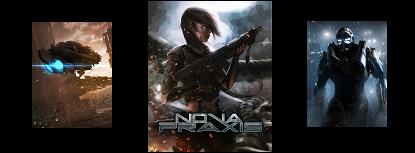
Thank you for talking with me about Nova Praxis.  There have been several different versions of the Fate system used for several different Fate games. Your Strands of Fate is a system that has finally pulled together several of the best Fate ideas (as well as adding your own great elements) to end up with a complete, setting-neutral Fate system. Can you please tell me how and when you decided it was time to create Strands of Fate, and what resources you may have used?

A few years ago I got this idea for a sci-fi setting that I just fell in love with. (This was the seed from which Nova Praxis would spring.) So, naturally, the first step was nailing down the system I wanted to use. I believe I started with GURPS, moved to Savage Worlds, and then to Cortex.

I was hard at work on the Cortex version when I learned that Evil Hat was working on a Dresden Files RPG using the FATE system. At that time, I’d never read FATE, but I was a huge Dresden Files fan. So I decided to give it a closer look. I read through the SRD, and then learned that Starblazer Adventures had just came out.

FATE sci-fi? Sold!

Switching gears to Starblazer, I eventually came to realize that I wanted to use FATE for all sorts of games. But there were some things about the current incarnation of the FATE 3.0 system that I felt needed to be tweaked if it were going to function as a universal toolkit. So I put the setting aside and started working on a generic version of FATE that I could use for all my games.

One thing led to another, and with the success of Lulu, self-publishing began to look feasible. I went into it thinking that if I could sell a hundred copies or so, that’d be enough to justify the extra effort it took to transform my notes into Strands of Fate.

Two years later, it has sold around 2700 copies. All things considered, I consider it an astounding success.

You’ve written Strands of Fate, Strands of Power, and soon we’ll see your new Strands setting, Nova Praxis. How does this hard sci-fi setting differ from other futuristic settings?

To summarize it, Nova Praxis is a post-singularity sci-fi setting that explores transhumanism and post-scarcity societies against a backdrop of action, adventure, conspiracy and intrigue.

There have been some games that have touched on some of those elements before, but I think Nova Praxis has a few things going for it that make it rather unique. The first is the dedication to making the setting believable. I describe it as a hard sci-fi setting with optimistic projections of technological advancement. The setting owes a lot to authors like Richard Morgan, but just as much to folks like Ray Kurzweil and Peter Diamandis.

I’ve spent the last three years carefully watching tech trends, trying to get a grasp on what sort of technologies the characters in the setting might utilize.  Nova Praxis takes place after the technological singularity. The singularity concept, by its very nature, means we can’t know what happens next. People have proposed a number of different scenarios, but the one we’ve gone with for Nova Praxis is that the singularity gave birth to an AI of nearly godlike intelligence.

It was chosen because I found it incredibly fascinating, and it provides a good foundation for an RPG. While not actually much more intelligent than a genius-level human mind, Mimir (the AI) was capable of thinking around 10,000 times faster. It only stayed active for about three months before mysteriously shutting down. But what could a genius level human mind (that never forgets anything, never gets sick, and never takes breaks) create in nearly 2500 years?

Mimir’s “birth” and subsequent “death” resulted in a paradigm shift in humanity’s technological evolution. Instead of trying to invent the next big thing using the previous big thing as a starting point or inspiration, humanity shifted its focus to combing through the nearly incomprehensible data logs Mimir had created before it “died”.

So the next thing I’d say Nova Praxis has going for it is the exploration of a new technological paradigm. Humanity uses advanced technology that they really don’t understand. It’s not magical, but computers in Nova Praxis are several orders of magnitude more complex than the systems today. And as a result, it’s impossible for a human to completely understand. Thankfully, Mimir anticipated this and designed these systems in such a way that humans could still write programs and customize the systems for specific applications. They just can’t hope to understand the deeper layers of the operating system.

Except, of course, the Savants…

Originally published in Strands of Power, the Savant can run unrestricted software (called “SINC, short for Self-Interfacing Neural Code”) on a computer implanted in his brain (called a “mindset”). This allows them to hack computer systems by directing their own Agent (a sort of virtual personal assistant) against the target computer’s security Agent. Access may be short-lived, but the effects can be very powerful. Drones can be possessed. Security sensors can be tapped. etc.

They can even do more advanced stuff like directing their Agent to compile security feeds, personnel profiles, local statistics, psychology reports, and all manner of other data to create relativity accurate predictions of the future or readings of the past (effectively making appear precognitive or postcognitive). Security feeds from other locations can be hacked, granting the Savant a sort of clairvoyance. Other people’s mindsets can be attacked, causing them to see augmented reality objects that appear real, or simply causing them pain, blindness, etc.

Or maybe the Savant just wants to tap into the target’s mind/machine interface to listen to their thoughts. And if that fails to illicit the desired result, he might direct his personal swarm of nanomachines to pick his enemy up and hurl him across the room, or solidify into a blade and impale him, flow over the Savant and become armor to resist attacks, or flow over his target and rip him apart molecule by molecule.

The Savants are the “psychics”, “wizards”, or “priests” of the setting, and despite no supernatural ties, and are often viewed by non-Savants to be just that sort of thing. They perform miracles with technology.

And lastly, Nova Praxis allows characters to download their minds into new biological or synthetic bodies (called “sleeves”), or upload their minds onto a computer server. A device called a mnemonic core keeps a backup of the character’s mind, which can be used to download the copy into a new sleeve, resulting in a form of immortality.

The setting also explores the idea of a reputation-based economy, and a number of other post-scarcity ideas.

Some of this is familiar ground to fans of Eclipse Phase or Transhuman Space, but we’re putting our own spin on it.

What was the hardest part of developing this setting? I’m talking about the creative aspects – trying to envision the RPG’s society, use of tech, tech level, character concepts, types of proposed game sessions, and so on… what was the most challenging?

I had a vision of what I wanted the future to look like, and what I wanted the characters to do. So the challenge became figuring out what believable events and technological advancements would have to take place along the timeline to get from here to the future I envisioned.

As an author, it’s really easy to say “It just works this way, you figure out why,” which is just another way of saying “A wizard did it.” I really didn’t want to lean on that. While it’s impossible to cover all the bases, I felt that in general, it all had to make sense to me. Now, in some cases Mimir became the “wizard” that did it, but that’s in keeping with the post-singularity theme and is a major feature of the setting.

Other things, like figuring out how a reputation-based economy would work, took a lot of studying and problem solving. After all, I’m no economist. That may have been the most difficult. I had to figure out how it would work in the world itself, and then translate it to game mechanics.

Fortunately, I was able to answer one of the biggest questions I was struggling with before Strands of Power came out, and that was: “How do you put magic in a setting where there are no supernatural elements?” That question was eventually answered by the Savants.

There were tons more. Nova Praxis is the result of more than three years of problem solving. And up until recently, only a very small percentage of that time had to do with game mechanics.

A reputation-based economy?  That seems interesting.  I look forward to seeing that in action.  Now, Nova Praxis is post-singularity, and you already talked about the Savants.   I assume that means we’ll see human characters, transhumans, AIs, cybernetics, and so on, and I get the feeling that there will not be alien characters. Can you go into a little detail as to the types of characters that are available?

In the current version of the playtest, you decide what “state” your character is in during character creation. Your choices are:

Pure – Pure characters are normal humans unmodified beyond some basic tweaks to insure good health. They may then decide if they want to take any cyberware and/or wetware augmentations.

Sleeved – The character has undergone Apotheosis, the procedure that gradually transforms your mind into software. The mind is then downloaded into a new “sleeve.” Characters of this type get to customize their sleeve in a number of ways, including augmentations.

SIM – SIM is short for “Substrate Independent Mind.” In short, you don’t have a body. You exist on a server, in a virtual environment, and interact with the real world via sensors, drones, etc.

Humanity has not yet discovered any sentient alien races. Though some choose to augment themselves beyond the limitations imposed by the law, and these posthumans often become something very alien indeed.

Can you give a one or two paragraph description of what a typical adventure/mission would be like?

The types of scenarios Nova Praxis is designed for revolve around shady back room deals, corporate espionage, conspiracy and intrigue. The default assumption of the setting is that the characters are members of a crew of specialists who are able to sort of slip between the cracks in society.

So you may be tasked with retrieving information, hunting someone down, stealing a hot fabrication template, planting false evidence, etc.

That’s no to say that’s the only way to play. The “crew” structure is there to provide a jumping off point, but the setting is going to be open to other campaign styles. There is no reason you can’t play the loner detectives or members of a military unit.

You talked earlier about the most challenging part of developing this setting. On the flipside, what aspect of the game’s design was the most enjoyable?

That’s hard to answer. I think the same things I list as being the most difficult were at the same time the most enjoyable.

From a game mechanics standpoint, figuring out how the different states work was a lot of fun, as were the augmentations and savant programs.

I understand that Nova Praxis uses an evolution of the Strands of Fate system, and is designed specifically to support the setting. What kind of evolution are we talking about?

Strands of Fate is a just a big toolkit right? It generally provides at least two ways to accomplish most any campaign design goal. So you pick the tools from the toolbox you need to build your setting.

Strands of Fate is the toolbox. Nova Praxis is an example of what you can build with those tools.

So, what you’ll see in Nova Praxis is a specific configuration of the rules and optional rules in Strands of Fate that best fit Nova Praxis. And of course, we tweaked some things a bit, and added new systems for things like resleeving and the reputation economy.

Strands of Fate has generally been received with open arms among gamers, especially Fate gamers. One source of contention, though, has been its exclusion of skills. I imagine that (in general) defined settings might need their very own set of skills to help make the setting flow and help support game immersion. Will we see skills (in some form) in Nova Praxis?

Yes. This is something I wrestled with for a while. Initially, the plan was to use Strands’ Abilities, but the more I worked on the system, the more it became clear that Skills were a more elegant solution for a number of reasons.

The biggest reason, as you mentioned, is that Skills help define a setting. For example, Nova Praxis has a Skill called “Apostate Networking.” It exists because being able to call upon people in apostate society can be a valuable tool in the game.

Had the game used Persuasion instead, with an Advantage called “Apostate Networker” (or something buried in the Advantage list), its importance wouldn’t be clear. Worse yet, most players would never spend a precious Advantage on something like that.

The same goes for Skills like “Mnemonics” or “Cohesion.”

So, for now at least, we are working with Skills. It’s still early though, and you never know what changes may get made between now and release.

Many times, a defined setting book can benefit its gamers by providing a sample adventure. Will there be any resources to help gamers jump right in? How about supplements?

Yes, Nova Praxis will have an intro adventure in it. Or, at the very least, an intro adventure will be available on release day as a separate download or something.

As far as supplements go, it’s really too early to say. I’ve got some ideas, but I don’t want to commit to anything at this point.

You’ll just have to stay tuned!

I’m tuning in that dial right now…

Thanks again for chatting with me, Mike.  As a fan of both Strands of Fate and sci-fi settings, I’m really looking forward to playing Nova Praxis.

My pleasure, and thank you as well.
Thinking About A Homebrew Game System?

If you’re thinking of making your own RPG, you probably have an idea of what dice you want to use, what characteristics you want to model and how heroic you want the characters to be. Those are important to think about, but where do you go from there? Let’s look at some guiding principles that will help you make a system that flows.

Simple
RPG systems can get complex really quickly. When designing a system, you want to keep things as simple as you can while still keeping the level of function where you want it to be. There are a few tools that will help you to do this. The first and most obvious is the unified mechanic, if you want every interaction in the game to be handled by one set of rules. Once the players learn that set, they can do everything the game is designed to do. The main consideration is to keep things consistent so the players don’t have to look up how something is handled, they just know because they’ve learned the core mechanic. GMs will tolerate looking up material, but the more you can reduce the GM’s mental load – the more creative they can be.

Now think about how many individual steps you have in your mechanic. From the start of a round to the end of a round, count up how many dice rolls, equations, calculations and steps the players will have to slog through. Are all of them needed? Can you cut some of them out and still keep the same functionality? Is a slight reduction of function still enough to get you where you want to go? Your first answer is probably going to be that they’re all needed or that taking some of them away will take away some feature of the game you like.  However, if you allow yourself to kill your darlings and reconnect the dots without them, you may just end up with a stronger system.

Do your numbers have to be so big? If characters have 10 hit points and most weapons do at least 5 damage, couldn’t you make it so that characters have 2 HP and weapons do 1 damage? If payers roll 1d20 and the average difficulty is 10, is there a difference if you reduced things to 1d6 and the average difficulty is 3? There very well could be a reason for the higher numbers, but try to reduce them if it’s practical.

The last thing to consider is your math. “Do you need all that math?” would be the obvious first question. Could you provide a non-math approximation of what you’re trying to accomplish? If that’s not practical, try to change the type of math you have to do. Mentally, not all math is equal. Comparing two numbers is about as simple as you can get. This means looking at a number and saying if it is more, equal or less. Adding small numbers is the second simplest math operation you can have. Subtracting small numbers is actually slightly harder for your brain. Multiplication and division are probably not acceptable in the middle of play, unless you’re doubling or halving numbers. Small changes here add up over the course of a game. As a player’s mind is taxed to do repeated equations, they’ll slowly tire and become less creative. The more load you have on them, the more they’ll just follow the most obvious path.

The other question about math to consider is when will the players have to do it? A player that is going to get a big payoff from the math will more happily crunch numbers or at least more happily reach for the calculator. If the math is for something mundane or even harmful to them, it’s going to impact their enjoyment of the game.

This doesn’t mean you have to have a rules-lite system. The emphasis here is reducing the number of steps that have to happen in each round and reducing the mental load of the players. Extra steps are often acceptable for special effects that add spice to the game, but happen only occasionally.

Flexible
Now that you have your core mechanic, try to think of how many ways it can be used. Does the same system that you used for combat apply to social conflict? Could it be used in a survival situation? What about when computer-hacking? How does a doctor heal characters using the system? Can a character maintain a troop of minions with the system and still have turns go quickly? Try to push the boundaries and find exceptions.  If you haven’t found them, you haven’t looked hard enough.

Once you find the exceptions, examine what’s causing them. Is it the lack of a rule, or the existence of a rule? Either way, try not to add a new rule or step – see if you can modify the existing rules to encompass the exception. Sometimes when you’re able to do this, you blow open a whole new set of things your game can do, so really go after this whenever you can.

Think about the steps and rules you currently have. Can they be expanded to cover circumstances that you didn’t originally intend them to? If you’re already play-testing, a way to get some feedback on this is to pay attention to when a player misuses or misapplies a rule. They’re making a connection you may not have been thinking of as being a good thing. The player obviously thinks it is, so can you adjust things to fit the rest of the game?

Bullet Proof
Next think about how the mechanic can be abused. Is there an exploit that will make a character unstoppable? This may not happen right away; it often does happen as the PCs gain experience. Is it a bad thing? Can the challenge be moved somewhere else so that the PC is still fun to play? If you are going to migrate the challenge, make sure it happens slowly and that the players and the GM know that this is the direction the game will move in. This is vital so the players don’t get blindsided by the change and not understand how to keep enjoying their characters.

If you can let a PC max out any stat of their choice and the game is still fun and challenging, you have a robust system. If you can give them any piece of equipment they want and it doesn’t break the game, you’re doing pretty good. If the PC can be unstoppable in one aspect, but still vulnerable in another, you’re on to something.

Whenever a player tries something that has no effect in-game, you have a problem. When a player wants to do flips into a fight and the system doesn’t handle that, there’s a hole between what the player wants to do and what the system can handle. When the player wants to jump on the back of a beast and stab it in the neck, and nothing special happens, there’s a problem. When the player wants to start off with a horse and is willing to sacrifice other things for it, but they can’t, there’s a problem. Let them know how the change could effect the game and ask them for input on how the issue could be handled. It may require a lot of rethinking, but you’ll have happier players for it.

My problem with Kickstarter

I’ve been a gamer for quite a while.  I’ve played quite a few editions of quite a few games, and I’ve had the displeasure of watching the tabletop role-playing game industry flounder.  My hometown had four friendly local gaming stores, and they flourished for years.  They flourished right up until the industry took a dive, and all four of them had to close shop.

This unfortunate turn began right around the time zmuds became popular, and then really took a nose-dive when Asheron’s Call and World of Warcraft came out.  Are these other geeky games responsible for the RPG industry’s downfall?  I don’t know – I’m just noting a coincidence.  Sure, some would say those geeky games actually acted as a gateway to RPGs, but I’m no industry oracle, I just know that I saw fewer and fewer people buying gaming books.

Ok, so Amazon started selling gaming books at a reduced rate.  I get that, and maybe that has something to do with FLGSs closing down.  Ok, so D&D 4e and Pathfinder came out, and maybe that actually helped the industry.

So who’s to say what’s happening with the industry?  I don’t know, but I’ll give you $5 out of Tourq’s pocket if you can tell me for certain.  But, regardless of all that, there’s one part of the industry that I really have a problem with, and that’s Kickstarter.

I mean, with all this crowd-funding, many role-playing games are being produced at an ever-increasing rate.  It seems like anyone who’s ever had a cool idea for a role-playing game now gets to publish it.  Just check out these Kickstarter RPG projects:

See what I mean?  This is just the tip of the iceberg.  There’s plenty more there that I didn’t mention, and there’s even more getting ready for Kickstarter.

Thanks Kickstarter… thanks a lot.

Just when I finally came to peace with an uncertain RPG industry, you go ahead and revive it.  Now, instead of having to choose between a finite number of games that I can play, you seem to have opened the floodgates, giving me a plethora of wonderful choices, and thereby knocking me out from pure gaming ecstasy.

Thank you, Kickstarter.  Thank you very, very much.

Player Maintenance: When is enough “Enough”?

Dirtbike riding and role-players have something in common – they both require varying degrees of maintenance…

I love dirtbike riding, I love tearing up the dirt, and I love getting dirty because of it.  I love gunning it and climbing up steep hills, I love kicking up dirt on the rider next to me, and I love getting airborn.  I love it all so much it’s practically my medicine.

Unfortunately, all that wear and tear takes it’s toll on the bike, and thus, it requires a boatload of maintenance.  My first bike, a Honda XR650L, was a monster.  It wasn’t really suited for someone who was just learning how to ride, but I didn’t care – crashing was par for the course.  Between my ER bills, and the bike’s repair costs, we probably evened out.

After I finally settled into a nice rhythm of not crashing, my riding then became a matter of how much maintenance was required on the bike in order to continue riding.  Sure, a lot of that extra maintenance was my fault, due in part to my excessive-aggressive riding style, but there were many times I didn’t want to ride because I didn’t know if the resulting maintenance was going to be worth it.

Well (surprisingly), dirt bike riding and role-players have something in common – they both require varying degrees of maintenance.

If you have a player…

  1. that has tardiness or attendance issues,
  2. that has two weeks to make a character, and waits until 5:00 P.M. game night,
  3. who never reads the rules or setting, forcing you to spend more time showing him how to play.
  4. who challenges the GM’s rulings unnecessarily,
  5. who starts arguments,
  6. who often interrupts the game,
  7. or whose characters often create unnecessary friction within the party,

…then you may need to perform player maintenance from time to time.

But how do you do it?  And how often? And when is enough, enough?  How do you perform maintenance on this player so that the game can continue in relative harmony?

I suppose you could throw a few jabs from time to time, in the hopes that the player picks up on it.  But what if they aren’t as sharp as sharp cheddar?  What if they need a direct talkin’ to?  Do you confront them?  Can you?  What if you’ve done that too often and are now left with leaving the group as your only option?  Perhaps the offending player is forced to leave the group?

I’ve been on both ends of this dilemma.  I’ve been the player needing to be maintained, and also the player who watches this problem unfold around him.  I imagine this happens more often than not, and I long for the day when everyone at the table (myself included) requires the least amount of player maintenance, while still delivering the most amount of fun.

I guess what it boils down to is that you have to not only be able to recognize that there’s a problem (so that you can perform the necessary maintenance), but you also have to know when to throw in the towel and get a new bike altogether.

The question is, at what point do you get that new bike?

A Rising Tide Lifts All Boats

People have options when it comes to how they want to be entertained. If you’re anything like me, one of your first choices is your favorite RPG. The question is, how can we get more people to share that choice with us? As there are more players, there is more energy, talent and money that is invested in the community. When that happens, we get better games, better art and better writing. Who wouldn’t want that? In short, the more interest in RPGs – the better the hobby becomes.
The biggest obstacle is how we try to sell RPGs to a friend. For the longest time the sales pitch has gone something like, “Have you ever wanted to be the protagonist in a book or a movie?” At this point your friend’s eyes just glaze over – that pitch may have worked for a select few years ago, but it was never a very good one. If that’s not how to get people interested, what is?

The problem is that we don’t really have a simple way to show why we play. Board games show the family on the box smiling and looking at the buyer. What’s the message? “Play this game for a happy family.” Collectible card games have an intrinsic message, “Build the greatest deck and you will be the best.” Video games have the dual advantage of the unlimited possibilities their graphics deliver and that they are simple to pick up and start playing. What is our message?

If you want to convince someone to play an RPG, you have to be able to tell them up front why they should pull themselves away from Mass Effect or Skyrim and you better tell them quickly before you lose their attention. What are you going to say? We need to figure out why we play RPGs, and one of the ways we can do that is to understand why we don’t just use another form of entertainment. Let’s look at an RPG’s competition for attention.

In the early days of RPGs, they were the only way you could go on your own adventure without leaving the house. We’ve lost that message, video games do that more easily and (in some ways) arguably better. RPGs took a big hit as video games got better graphics and better writing. Many people thought table-top RPGs would just go away after a while. They didn’t, though, and that’s interesting because it means that they offer something else that a video game doesn’t.

Then CCGs came along and RPGs took another hit. They were social games that you could get together with your buddies and show them who was the best. Again, people thought RPGs might go away and again, there was something that was different about them that some people still stuck to.

The dust has settled for the most part. People have decided how they will be entertained and the answer isn’t video games or board games or CCGs or RPGs. It’s usually video games and the occasional board game and maybe a CCG. If types of entertainment aren’t mutually exclusive, how can we get more people to include an RPG in that mix? We need our message to explain why an RPG gives a different experience that they might want.

I’ve never heard a concise and convincing pitch for an RPG.  I think that’s because we thought we understood what the reward was that we’re getting out of playing, but we always got it wrong. Sure, there’s exploration, mastery and agency, but you can get those things in any of these other games. Ask a role player and they’ll tell you, the experience is just different.

Think about this from a different perspective, what would you call a situation where one person prepares for several days (maybe even months) for friends to come over. Food and drinks are served or brought by the visitors and they just sit around and talk? Yes, we would call that getting together to game. To a non-gamer they would call that a party.

But this isn’t like a regular party. In this party there is a focus of attention on a game and only your close friends are invited. Everyone is hoping for the same outcome but the results are unclear. Say that to us and we’d say it sounds like gaming. Say that to the average Joe and he’d think he’s showing up to watch a football* game.

The main difference between an RPG party and a football party is that the buddies that get together are there to watch the game and they are the team playing. Now that’s different from any other entertainment. You could say a multiplayer video game is kind of the same way, but it’s more frantic and less social. In an RPG, you get to experience all of the players play the game like you were watching all the players in a football game. You discuss the whys and hows as they happen as a observer, while you are (at the same time) a participant.

We need to understand and appealingly communicate that. We get together for parties to connect with our friends as a team to play a game. This is the uniqueness of the RPG experience, and in this I suspect is also the reward for why we play. When we can clearly explain why we value that experience, we will be able to draw in new players. That’s when the tide comes in.

* Football might mean different things on either side of the Atlantic, but it still fits!

Changing how your players play (the right way)

I’ll be honest.  That is me much of the time.  Do I like being that way?  No, but it’s hard to change because, well, I am always right.

How many times have you tried to influence how your players play their characters?

  • “You need to get into character more.”
  • “Give him a background.”
  • “Give him goals.”
  • “Give him morals.”
  • “Give him quirks.”
  • “Make him different from your last ten characters.”
  • “Just… roleplay more.”

A few months ago I had the opportunity to join a new group.  It’s a great group, and I’m happy to be here.  I was basically put in as a rotating GM, so I’ll be running one week and playing the next.  It’s a great set-up, and I’m getting to know the players and their playing styles fairly well.

“I’ve never played a character with this much depth before.”

My game of choice for this group is the Serenity Roleplaying Game, using the fantastic Savage Worlds system.  We’re all familiar with the Serenity ‘verse, and we all enjoy some Savage Worlds, so this seems like a good fit for me to run.

However, as I am wont to do, I tinkered with the rules – particularly with the Bennies (they’re like luck points or action points).  If you know me at all, then you know that I really like the Aspect concept from the FATE system (we even have a nice series on it).  Basically, the players added a few aspects to their characters, giving them automatic backgrounds, personalities, and traits.  Their characters were instantly fleshed out and had tons of, well, character.  The players could use their bennies normally, or use them as normal FATE points (gain a +2 bonus after a roll, or invoke for effect).

The curve ball, though, was that in order for them to gain new bennies they had to have their aspects compelled against them.  This naturally brings into the story all of the characters’ backgrounds, personalities, and traits, making the story that much richer.

Well, after our second session, one of our players said to me, “I’ve never played a character with this much depth before.”  I was immediately happy to hear these words, because (to me) that meant that he was changing how he role-played.  He was moving on from the strong, silent type into a character that was a little more unique, one that had to make difficult decisions based on his convictions, morals, and beliefs.  The player had been pushed out of his comfort zone, and in that endeavor, had found a little bit of role-playing reward and satisfaction because of it.  In essence, he was evolving.

Yes!  I’ve done it!  I’ve improved a player’s approach as to how they are to play the game!

Annnnnnd then I realized that I am really just full of shit.

I’ve sat back these past couple of days reveling in smug.  I was so happy about getting this player to conform to my way of gaming that I actually kind of felt a little stupid.  Did I introduce the Aspects into the game because I thought it was going to be more fun, or because I wanted players to play more my style?

There I was, a brand new player and GM to this group, and I was thinking they have things to learn from me.  I’d like to say that I introduced the Aspects to make the game more fun, but I think I did it to make the game more fun for me.  Ergo, if it’s fun for me, it will be fun for them.

Who the hell am I to suppose that my way is better?

Sure, everyone seems to be having a good time, but I wonder, should I have just run Savage Worlds per the rules, should I get off my high horse, am I even on a high horse?

I don’t know, what do you think?

Because It’s Fun!

Hello again Stuffer Shack. How are you? Good? That’s awesome. Really. I love to hear that. Now now, I can see that look on your face. Uncle Anthony is here and he probably wants to rant long and hard about some grand theory to GMing or take another sociological look at the game table. You’re right, I do want to do that, but I also want to talk about something else. Namely, why do we play these games?

Don’t give me that look. It’s a simple question, y’know. Why do we play these games? More to the point, why do you play these games? Are you looking for an escape from the mundanities of reality? Do you get a thrill out of empowering yourself through the mind and your imagination? Do you just love playing with numbers and crunching mechanics? Maybe you like the social aspect of it all? Whatever the answer, the part that a lot of people fail to mention when talking about why they play our hobby of choice is this: it’s fun.

Take a second and think about that. Think about what it means. We play these games because they are fun. We tell these stories because in doing so we have fun. It’s a simple concept really, but that very simplicity also makes it so very easy to forget about. How many times have you stopped and just taken a moment to realize that this thing you do is fun? How often have you gotten so caught up in crafting that epic encounter, that befuddling puzzle, or preparing notes for that crazed arch villain that you forgot to have fun?

If you’re a regular GM, I’d be willing to wager that it has happened at least a few times. Not to say we GMs have it bad, just that our position – the custodians of the games we are in – often makes us think about everyone else’s fun as a priority and thus we put our own on hold. This is an admirable trait, but ultimately not one that I think we need to uphold with such fervor. This is a game, yes? Games are supposed to be fun. We are supposed to have fun when playing the games. For the GM that means you should also have fun when preparing the game. Trust me on this one.

If you are not having fun when you are preparing your game, your players will know. They’ll feel it when you are running the game. If you aren’t having fun when you put the pieces together, you likely will not have fun when the pieces need to be presented. That lingering feeling of “this is work” will come out, and it will have an impact. This can work for you, sure. Sometimes. But it won’t work all the time, and over time the feeling will grow and grow until the game itself is not fun. At that time, what is the point?

On the other hand if you are having fun while you prepare for game. If statting out that monster and planning the next encounter has a grin on your face from ear to ear as you imagine and wonder at how the players will handle this session, that will come out as well. It will come across when you play. Your excitement will carry the game, and things that could have been mechanical hiccups, or other small issues, will simply vanish and be smoothed over.

That is, ultimately, all I wanted to say today. Have fun with your game. Have fun while playing your game. Have fun while planning your game. Have fun while talking about your game. Gaming is fun. It is one of the most amazing hobbies I’ve ever seen and it has a lot of power. But it is still fun, and that’s really all that matters in the end. Right?

Radio Rivendell: Inspiration For Any Gaming Table

I don’t even know what drew me to the site.  I think that I was surfing the RPG Blog Alliance website for blogs to read, and this particular one caught my eye.  I visited the site and was instantly hooked.  Based out of Sweden, it’s a gorgeous site that is easy on the eyes and light on the ears.  I thought to myself “More people have to be told about this site!”

Upon contacting the site owner (aptly named Lord Elrond),  he was cordial enough to answer a few questions for us today.

Lord Elrond, first of all, thank you for answering our questions today; can you tell our readers a little about Radio Rivendell?

Radio Rivendell is the only webradio streaming fantasy music 24-7.  We only focus on fantasy-related stuff and have been doing so for over ten(!) years now. We’ve been growing slowly but steadily through all the years, we didn’t even have website the first years.

Where did you get the idea for your web design?  Why Lord of the Rings?

The whole idea of a webradio came from my friends’ need of background music when gaming, and it cannot get much more fantasy with Tolkien, right? And Rivendell is the ideal place to draw inspiration from; it sits in the center of Middle-Earth with connections to everything. So when one of my friends suggested “Radio Rivendell” it stuck immediately!

How many artists do you currently feature on your site? 

Currently we have over 300, but we’re always adding new artists and albums along the way. Lately we’ve also tended to get more artists rather than more albums / soundtracks of each. So we’re widening and growing at the same time.

What are your short-term, and long-term plans for your site?

There currently is no real short-term plan, the one we had was to upgrade the software and the look of the site; that was what happened before X-mas. The long-term is to grow steadily, reaching more people, but probably also to move to a faster server. The site went down a few weeks back due to overload when we were linked to by a popular external site. So just grow at our comfortable speed we’re going now. I’m doing this as project during my free time so I cannot work on it full time, but who knows, perhaps it’s possible one day?

I noticed that when signing up to the site that I became a lowlife. How does your xp for members work?  How do you level?

The XP system is a new thing we introduced this winter.  Leveling and experience points are important elements of roleplaying, so putting it into the site would make it feel even more like a game of its own! I also wanted to make people chase XP and level-up to become more “powerful”, this is in order to make it more fun to register and take part in our activities. XP is given for all things you do on the site, like logging in (once a day only), rating music, commenting, writing in forums etc. This is only in it’s first installment.

What do you do with the donations you receive?

The donations pay for prizes in competitions, server space, hardware etc. More or less everything goes back to the site in one way or the other.

Do you play Dungeons and Dragons?  Any other Role Playing Games?

I have played D&D, but that was loooong time ago. I remember when my brother bought the first “Red Box” of D&D and how we played it. We had been playing RPGs that were made in our country before, so D&D wasn’t our first. Then we’ve played through a great deal of different RPGs such as Lord of the Rings, Rolemaster and Spacemaster, Warhammer Fantasy, etc., etc. Now we play an adapted set of our own rules in Warhammer’s world, which is the one we’ve stuck with for the longest time, well over ten years now.

If there is anything else you would like to add, please do so.  

Hmm.. Keep an eye on  Radio Rivendell, we’re not growing fast, but steadily. I have so many ideas I want to implement into the site, and our music library will grow too. Worth mentioning: we’ll continue to play only the music we’ve been granted the right to play, and hopefully all the major companies and composers will turn to us for exposure 🙂

Thanks!

Thanks for talking with me today, and good luck with your future endeavors!

Love and Hate of Epic Tier

Monte Cook’s latest Legends & Lore article hit with some thoughts on Epic Tier Play. It was short, had some polls, and seemed almost like he was just checking in with people or thinking out loud. Pretty common for one of those articles. The Internet loves to pick these articles apart then roll around in a boil of hatred. I usually don’t have the same reaction. Today, one part in particular got a strong reaction from me.

“As a fan of high-level play across the editions, I’ve never agreed fully with the idea that the game breaks down. I think, however, there’s some validity to it, but only if you look at it a certain way. What people are recognizing is that, at a certain level, play changes. As I see it, there are three such break points in the game—low level, mid level, and high level. Fourth Edition does a nice job of recognizing these changes, I think, and the changes don’t focus on how the characters become more powerful and how the challenges they face grow more difficult. Instead, the very game changes.“

To get the entire context you can read the whole article in just a couple of minutes. I don’t think I’m misjudging things when I say that this makes it look like Monte Cook doesn’t understand the problem with Epic Tier play in 4e. It’s not that the game changes, and we fail to either like or understand that. It’s that the balance of the game changes so significantly that the DM needs to change the way they run the game and the core books don’t properly address that.

Now I am assuming that Monte Cook was either talking about a specific portion of people, or just didn’t phrase himself in a way that I interpreted properly. I have reason to believe Monte Cook is a very intelligent individual who really understands the game, likely more than I do. However, I want to address some of what I see as the real problems with Epic Tier play so its absolutely clear that people who don’t like Epic Tier play, don’t just hate change.

Most of the Material Planes Threats are Laughable

The Tarrasque is a level 20 Solo. A level 15 party has a decent chance of taking it down. After that the question becomes ‘where is the next threat?’ and ‘how come it wasn’t here before?’ The books do offer some advice on this, but it wasn’t presented in a way that made it very clear to people. People still question why all those Epic Level minions aren’t just marching through the Material Plane all the time.

There are plenty of ways around this. The ancient dragon was sleeping in a hidden chamber. The threat is coming from another plane and was otherwise occupied in a great war. Immortals of high levels of power plan in the very long-term, and the Material Plane just wasn’t on their list until now. These may seem like convenient answers, but it pays to be able plan them ahead of time.

Pacing

If you take a look at the DMG, starting on page 16, it talks about how to prep for and run your game. It talks about encounters, style and how to handle down-time. It doesn’t mention the tiers. In a sense, this isn’t a big deal. A lot of the advise was general and applied to all the tiers. However, by treating all the same way in this text, it made it seem like you could treat it all the same way as the DM.

Epic Tier heroes often are rulers of religions or kingdoms. They may be the guardians of a plane or even a god. They have a lot of long-term things to do that aren’t measured in rounds, but in weeks and years. Threats that are powerful enough to threaten them probably don’t come around every other day unless its part of your storyline (see previous point), so this down-time is needed so that the way the universe works isn’t suddenly turned on its head.

Encounters Need to Be Built Differently

By Epic Tier, every player (no matter their role) has a host of status effects at their disposal. A solo several levels above the party will get locked down, and have the snot beat out of it. This happens even to newer solo monsters that specifically have powers to help end status effects. You cannot run solos alone. They are no longer individual encounters, but just really powerful foes.

That’s the most obvious example of how encounters have to be built differently in the Epic Tier, there are others. The DMG does address some concerns about use of Rituals and how PCs can be hard to kill, however it really seemed like a passing idea. It probably would have been better suited as a giant road sign with blinking lights and a siren.

To be fair, there is some pretty good advice about how to run your game into the Epic Tier in some of the books. It’s not where people are likely to look and it’s not in the books people will have read when starting their campaigns. Books like the Demonomicon offer great insight in how all tiers of play can be connected but different. The DMG2 probably has some of the best official advice, but it’s buried in the Campaign Arcs.

I just don’t think it’s enough. People need to be able to plan for Epic from Day 1, and they need to know just how to treat it differently once they get there. It’s not enough to know that the plot and locales change, but how you DM changes as well. There is a nice chart of how many encounters, of what level of difficulty, make up a decent level of challenges. Wouldn’t it be nice if we had something similar at Epic?

Where To Find Advice

Hello Stuffer Shack, it’s been a while hasn’t it? No, I don’t have any excuses. Life got hectic, and I just kind of curled up in a ball and cried. Oh sure… you called, you wrote, you even invited me out to dinner last Tuesday night. But I didn’t show, did I? So now I’m back, and looking for your forgiveness. You’ll take me back, right?

Alright, with that out of the way, let’s get down to business. I’m Anthony, and it’s been a while since my last post here. Nothing personal, but life is life. Anyhow, I wanted to get back into the swing of things here, and I figured what better way to do that than to talk about where you can find advice. Crazy, I know, right? See, lots of places give advice (hint, the Shack gives awesome advice) but do you know where to find more? Very few places really do that, and there are mediums out there that many of us have yet to actually try. So, let’s talk about that today, shall we?

The Shack, and Sites Like It
First off, you’ve already found a great resource. The Stuffer Shack is an awesome example of a site with a lot of different blog authors coming at you with different bits of advice. There are other sites like this too, but the key point here is the variety of authors. Why? Because everyone games differently, and everyone has a different view point on gaming itself. Something that I might think is impossible is very likely something that Tourq does every other game with the greatest of ease. How? I dunno, you’d have to ask him. However, the inverse is also true, which means that I have some words of wisdom to help do things I can pull off that some others can’t. You don’t get that at a blog with only one author, because they can’t teach you how to do what they don’t know.

So, first and foremost, find some sites you like that are like the Shack here. They have lots of good stuff for you.

Other Blogs
After the sites with lots of authors, you have the dedicated author. Some blogs, like Reality Refracted (disclosure: this is my gaming blog) are more focused on the theory behind how you do things, and looking a bit deeper into mechanics. Others, like “Life and Times of a Philippine Gamer” will delve a bit more into system specifics, examples of play, and other topics. Yes, everyone will cover more than one type of thing over time, but having a variety in primary topics will help to keep you well-grounded. It can also be fun to find the blogs of a few of your favorite designers. Often they’ll give you tips and insight into how things should work (vs how they do work) that can blow your mind.

Podcasts
Podcasts are a growing medium, and one that has gotten big enough that you’ll likely be seeing several podcast sites in the Shack’s Site Of The Year contest (SOTY!). These are kind of like blogs, only you listen to them and they often are a bit more focused in each episode. Bonus points here because you can hear a conversation, sometimes they have guest speakers, and you’ll get multiple sides of an argument in a quick and easily understood chunk. Podcasts are one of the areas I’m hoping to find more on, and start listening to. The ones I have heard have been amazing, and are often very insightful into the topics at hand.

Gaming Books
That’s right, the books you use for playing your game can teach you a whole lot about how to run a game. Look at the system and ask yourself why things are presented the way they are. The game wants to be played a certain way, and the mechanics are set up to encourage that method of play. Find that, and you can find out a lot about how the designer and project leads feel about gaming and what works or doesn’t work. D&D can teach you a lot about going with a tactical RPG, while a game like Burning Wheel can teach a lot about making a spanning epic master piece. The advice is there in the books, you just have to find it.

The Point?
The point of all this is to keep you interested in learning. Odds are if you’re reading this website, you are interested in improving as a GM and/or a player. Never stop doing that. There is always something more you can learn, more you can do, and you won’t find out how – or what – if you don’t go looking for it. Keep those eyes open, and find advice where you can take it. It just might be easier to start in the places I’ve listed here.
