How impractical has currency become in fantasy RPGs?

“We only keep track of money so we can buy better magic items.” I understand that it can be tedious to spend 5 cp on a meal when you’re saving up for a 20,000 gp item. I get that. But all that means is that money is indeed there just for purchasing magic items, and I guess that is what my problem is…

TreasureHow much are coins worth by today’s standards? How much does a bag of silver weigh? What about gold? A magical sword costs how many thousands of gold coins? The local wizard shop has enough money to buy my 50,000 gp +3 Vorpal Blade, right? Is my character really carrying around enough money to fund a small kingdom?!

I have long been confused with how currency works in most fantasy games… “A round of beer costs 1 gold piece?! Really?! What would I buy for 1 copper, then?” “How much did I get for that magical sword?!” “Wait wait wait… I’m level 5, and I’m now in the top 1% wealth bracket?”

If I were to ever make a full-fledged Fantasy setting, I’d offer the following: Copper, Silver, Gold, and Gold Bars. Copper would be the most commonly used currency (12 cp for a day’s worth of cheap manual labor / or 1 cp per hour). In this fashion, one could say that a copper piece is worth about $1. So, the poorest of the poor might expect to make about 12 cp per day.

12 cp is very little, but I got that number from a historical text that I once read, so it’s not unbelievable. This would represent pay for the poorest of the poor who are still able to find work (of the lowest paying kind).

Want to go buy a tasty hot meal from a vendor at the market or tavern? Expect to pay 5-6 cp. Of course, if you have a family, you’re going to need to stretch that 12 cp as far as you can (food, supplies to make clothes, taxes, etc.). A lot of poor families in a fantasy setting (town) would expect to eat grits and thin soup.

Also, I don’t expect them to have the money to buy that loot you’re trying to offload. That’s one reason most games let characters sell off loot at around 25-50% of its value out-of-game.

To make everything easy and smooth, I’d increase the value of the metals by 10:

10 Copper = 1 Silver
10 Silver = 1 Gold
(100 Copper = 10 Silver = 1 Gold)

Adding other metals (like Aluminium, Platinum, or Palladium) just isn’t practical. It’s not that they’re too difficult to process; it’s that they would too often get confused with lesser-valued coins.

However, I understand that magic items can be expensive. That is why I would include Gold Bars (actually, Bars and Bricks).

10 Gold Coin = 1 Gold Bar
10 Gold Bars = 1 Gold Brick
(10,000 Copper = 1,000 Silver = 100 Gold =10 Bars = 1 Brick)

And now, for the rest of the story…

Assuming that 1 gp is like a $100 bill, not too many people will be walking around with those in their pockets. So, for a player character to tip the stable boy or innkeeper one or more gold pieces, well, that would be a big deal (especially if you do it often). Everyone in the area would hit you up for services or free hand-outs, and you would quickly get recognized by several, several people in the village or town.

“Hey, did you hear? Kahn the Bard just paid 10,000 gp for a magical cloak, then he tipped Matthias over at the stables 10 gp just for feeding his horse. I know that I only made 5 gp for all of last month’s work in the mine, but let’s go say Hi. I just know he and I could be friends.”

Kahn the Bard: “Hey there innkeeper, I’ll have an ale.”
Innkeeper: “Sure thing! That’s 3 copper pieces.”
Kahn the Bard: “Here, take 3 gold pieces.”
Innkeeper: “Uhhh… you know that’s like 300 copper, right? For a cup of ale?”

How soon in your game before copper and silver currency becomes obsolete?

TreasureIt seems to me that currency in fantasy settings has been relegated to magic-item-use-only. I have actually been told that by several gamers over the course of two decades. “We only keep track of money so we can buy better magic items.” I understand that it can be tedious to spend 5 cp on a meal when you’re saving up for a 20,000 gp item. I get that. But all that means is that money is indeed there just for purchasing magic items, and I guess that is what my problem is.

I get it. Finding, spending, and selling loot worth thousands of gold is fun and exciting. But it just doesn’t work for me. Needing thousands and thousands of gold pieces to buy and sell magic items is an all-too-often unrealistic and overlooked burden. Who can carry that much weight? I’m just not ok with the whole concept. And seriously, why even have copper and silver in the game?

I imagine that at its fundamental nature, most people aren’t ok with it, either, which is why many games provide these convenient little magical bags and sacks that can carry a dragon’s hoard of coin. That just seems like a band-aid to the problem.

Why is it that fantasy movies and novels (not novels based on RPGs) never depict characters running around on their quests and adventures carrying thousands and thousands of coin in preparation of buying a magic helm, magic armor, magic weapon, a magic belt, a magic cloak, and two magic rings? Because the audience just wouldn’t buy into that. As a gamer at the table, I don’t I buy into it either.

Why not just fix the issue of currency, so that we don’t have to use magic items to try to make it work? Let’s put the currency at more reasonable rates so all of the characters in fantasy games aren’t always carrying around 50,000 gold coins wherever they go. Even in a fantasy roleplaying game, I find the alternative hard to believe.

So, let’s bring this ramble to a close… I have a problem with currency – there doesn’t seem to have been a realistic way to approach it thus far. Copper and silver are pointless. Thousands of coins are needed to equip characters of their “needed” magical equipment. And magical, bottomless bags and sacks are the answer to it all, apparently.

Can someone please put me in my place?

My name is Chris Stevens, and I approve this message.

50% off sale – ALL Exotic Mounts and Monster Minis!

For this sale, all of our Exotic Mounts and Monster Minis are just $2.99 or less!

We currently have 25 Exotic Mounts for your PCs and enemies to ride, or monsters for you to throw at the players…

Bison
Wouldn’t it be awesome for your barbarian to ride into battle on his heavy Bison?
King Stag
Only an elf or druid dare ride a King Stag into battle…

Click here to go to the Store!

Green Drake
GMs, how about throwing Green Drakes at your players? These beasts are just mean…
Minotaur
Minotaurs can be purchased on 1-inch or 2-inch discs.

All of our Exotic Mounts and Monster Minis have traditionally been priced up to $5.99 (simply because they are more expensive for me to get than Horse Minis).  However, over the past few years I have built up a stockpile of them, and it’s time to unload.  When this reserve of Minis is gone, I’ll most likely increase the price to $3.99 (like the horses).  I think that would be a more fair price for everyone, instead of the normal $5.99.

Pretty soon I’ll also be adding a few more minis… a Moose, Black Bear, Polar Bear, War Lion, and a Gorilla.  They aren’t available in the store yet, but if you wanted them early, I would still honor the $2.99 sale price – just ask.

Click here to go to the Store!

Running a one-shot RPG, and then fail happened

I had only a couple of days to get ready for this game, so I tried to squeeze as much as I could. I had been mulling over a new fantasy setting in my head for awhile, one that was influenced heavily by religion, so I figured that this was a perfect time to test it out. Unfortunately, it was the beginning of a long list of mistakes…

I like to game. More specifically, I like role-playing games such as Pathfinder, Dungeons & Dragons, Shadowrun, Savage Worlds, and others. I look forward to Wednesdays when the Mid-Week Geeks get together to roll some dice. With all that said, I HATE it when a game gets canceled.

Epic-Failure

That’s what happened this week. The GM canceled, and we were faced with having to wait another week to game. So, I panicked, and posted that I would volunteer to run a one-shot.

And then fail happened.

[I’ve run several successful campaigns over the course of two decades, so this one-shot shouldn’t have been a problem.]

I had only a couple of days to get ready for the game, so I tried to squeeze as much as I could. I had been mulling over a new fantasy setting in my head for awhile, one that was influenced heavily by religion, so I figured that this was a perfect time to test it out. Unfortunately, it was the beginning of a long list of mistakes…

I wrote out a setting page (two pages, actually). It explained the religion and how society was wrapped around it. Character concepts were heavily influenced by this as well.

Mistake #1: I spent way too much time developing the setting for a one-shot. I should have used an established or generic setting. Time was wasted, and the snowball effect began.

The Mid-Week Geeks have a Facebook page, and we use it a lot. It’s very helpful in communication between us and I can’t see us ever abandoning it. This is where I announced that I would run the one-shot, and that I would have pre-gens ready. I didn’t really use it again after that.

Mistake #2: This was the perfect opportunity to post all of the information on the setting. However, I did not do that. I did not post a primer what-so-ever, and I should have. Basically, I forgot, and then later I figured it would take only a minute to explain at the gaming table. In actuality, I spent several minutes at the table explaining the setting, several minutes well-wasted.

I told everyone that we would be using Savage Worlds -“Fast, Furious, Fun!” (something we haven’t played in a while), and that I would have pre-gens ready for them to use. When making the characters, I was tweaking a few of the powers so that they would better fit the new setting.

Mistake #3: Tweaking anything. I spent wayyy too much time making characters. Making new powers (and then printing those new powers on power cards) just took forever. In the end, I was able to complete only three out of six characters. When everyone showed up, I had those players with the most experience make up their own characters.

In order to really get the feel of the setting that I had created, I had the characters play at a high level. It was an epic story with epic characters pitted against epic foes (Pit Fiend, anyone?).

Mistake #4: With the characters at high levels, it took longer to get them made. On top of that, these player characters were brand new to the players, so there was some slow-playing as people were trying to figure out which powers to use, and then trying to figure out how to use them.

Since we were down a player, that brought our group count to one GM and five PCs. At the last minute, one of the players asked if he could bring along a friend. I said, “Great! The more the merrier!”

Mistake #5: This was a one-shot. We didn’t have a lot of time to play, and the spotlight already has trouble getting spread around the table. Add to the fact that this new player was a new player to roleplaying, and it slowed things down even more. Oh, and he needed a character made for him.

For this one-shot, I elected to use Savage Worlds. I like Savage Worlds – it’s lite, fits everything, and is easy to play.

Final Mistake: I used Savage Worlds. Savage Worlds is great, but I’ve never really had any success as a GM with it. I don’t understand why. I’ve run several adventures and campains using other systems, so what’s my problem with Savage? I don’t know, but (luckily) someone who is very familiar and comfortable with it acted as referee for the night.

In the end, I think everyone had a great time. We managed to stop demons and devils from forming a pact, blocked their doorway to the underworld, and helped a player character fulfill his destiny. I just wish that we had more time to do it. After wasting time on all of the failed prep work, and then throwing a birthday party for one of the players, we ended up with three hours of game time, three very short hours.

While our gaming night was a blast, I felt that my running of the game was a disaster. Everyone had fun, but I was completely flabbergasted inside.

I think I’ve learned my lesson. I think that running a one-shot takes up more prep time than for your regular game. And I think that the next time I run a one-shot, I will approach it much more wisely. +1 Wisdom!

CLOUD ATLAS sucks. No, wait…?

Cloud Atlas gave us a premise that spanned several different stories over the course of several different centuries, and to that I said, “BRING IT, BABY.” The premise of Cloud Atlas looks cool, and it sounds cool… but does it end up being super cool, or just super cold?

Cloud-AtlasSo, I like movies that are different, movies that are out there. I like drama-action-romance-suspense-mystery-medieval-colonial-modern-futuristic-sci-fi, and more. Heck, I like them all (except for musicals, musicals suck).

Cloud Atlas gave us a premise that spanned several different stories over the course of several different centuries, and to that I said, “BRING IT, BABY.” The premise of Cloud Atlas looks cool, and it sounds cool… but does it end up being super cool, or just super cold?

In a nutshell…

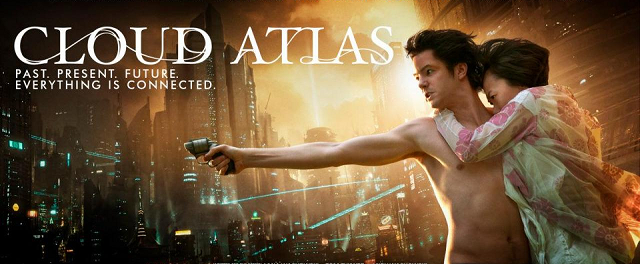
Cloud Atlas is based off of a novel by David Mitchell. We are told six different stories, set in six different time periods. It all has to do with oppression of people and cultures, and implies that people and events are linked through time.

– Spoilers follow. Actually, I recommend reading the spoilers – it makes the movie better).

  1. South Pacific Ocean, 1849: Lawyer Adam Ewing saves a slave, is then saved by that slave, then decides to give up his life of law to join the Abolition Movement with his wife. Ewing writes a journal detailing his revelations.
  2. England and Scotland, 1936: Young musician Robert Frobisher begins composing his masterpiece, “The Cloud Atlas Sextet,” but a famous composer tries to take dual ownership of the music. Frobisher (after having read some of Ewing’s journals) gains enough confidence to stand his ground, and then finishes it on his own. He eventually writes a bunch of love letters to his boyfriend (Rufus Sixsmith).
  3. San Francisco, 1973: Journalist Luisa Rey meets an older Sixsmith, now a nuclear physicist. She does some investigating, almost gets murdered, then uncovers a plot to use a nuclear accident that will benefit big oil companies. Also, Rey finds Frobisher’s lover letters to Sixsmith, and (for some reason) tracks down a recording of his music, “The Cloud Atlas Sextet.”
  4. United Kingdom, 2012: Timothy Cavendish, a 65-year-old publisher, gets strong-armed for money. When he asks his brother for help, his brother tricks him into an old-folks home, the likes of which he can’t seem to escape. When he finally does escape, Cavendish writes a screenplay about his life, after reading about journalist Rey’s life.
  5. Neo Seoul (Korea?), 2144: Sonmi-451 is a genetically-engineered human clone created to be a slave worker (actually, there’s a small race of these “fabricants”). After coming into contact with ideas from Cavendish’s adventures, Sonmi-451 is instilled with ideas of rebellion and liberation. She eventually makes a public broadcast of her story (including words against exploitation), and is then executed.
  6. The Big Island, 106 winters after the fall (2321): Primitive Zachry and his tribe get a visit from Meronym, a member of an advanced society still holding on to the last remnants of technology. She needs his help to find “Cloud Atlas,” a remote communication station. With it, she can call Earth’s colonies to come back and help the few remaining humans on Earth. Zachry then finds out that his revered goddess, Sonmi, is actually Sonmi-451, a dead human clone.
Cloud-Atlas

One thing that I really did like is how the film depicts these six time periods. I never once disbelieved in what I was seeing because of the sets. Of course, Tom Tykwer and The Wachowskis were at the helm of this colossal movie, so I knew it would look good. Simply put, verisimilitude was never compromised (there, I’ve finally been able to use ‘verisimilitude’ in an actual print sentence).

So, visually, the movie scores high marks. And that’s really the only thing that I have good to say about it.

Let’s begin…

First of all, when the same actors portray different characters from different time periods, you wonder how their specific connections will be revealed in all their awesomeness. Well, the characters spanning the Cloud Atlas time periods weren’t connected, and having them played by the same actors was just damn distracting. It wasn’t symbolic or teamed with any meaning. And no, it wasn’t “artsy.” I guess on some level, one could argue that some characters may have been related, but (regardless) having them played by the same actors just didn’t work.

That was a gripe, and now we move on…

Movies that intertwine several stories is nothing new (Twenty Bucks, Love Actually, Four Rooms, etc.). However, where previous intertwining vignettes have something that actually intertwines them, Cloud Atlas really doesn’t. For example, in Twenty Bucks, we follow the stories that are told as they unfold around an object. In Love Actually, we follow the stories that are told through characters that are all linked via various relationships. And in Four Rooms, we follow the stories as they relate to a specific individual (one of my favorite movies, by the way).

Cloud AtlasIn Cloud Atlas, however, I watched most of the movie wondering if all of these stories were really linked at all. Sure, I could follow each of the individual stories just fine – there was nothing unusual or ground-breaking about them. It was trying to piece the entire thing together that got me stumped. At the two-hour mark, I wondered if this thing was ever going to coalesce. The six individual stories were interesting enough, but the movie (as a whole) was not.

At the end of the film, the movie still didn’t really come together. I had to read up on the plot to fill in all of the holes. “Well, I knew that these two stories were tied together because of a manuscript that was mentioned in that one line of dialogue, but it turns out that that was it?!” That’s how it was with all of them. The stories were connected only by a few fragile threads, and I dare say that if you’re not paying attention, you’ll miss at least half of them (I was paying attention, but I guess some were just beyond me – or, I just couldn’t believe that what I was seeing was actually the connection).

Basically, this film is six short stories. That would not necessarily be a bad thing, if you wanted to present a film titled, “Six Short Stories, By David Mitchell.” I would have enjoyed this movie if it had been six short stories, one after another, including the minor connecting threads between them.

But each story is supposed to be a story that is read, observed, or realized by the main character in the next story at a pivotal moment. That’s apparently supposed to be a big deal, and we’re supposed to notice and revere it. At six integral moments in the film, we’re supposed to go, “Ohhhhhh… I get it, I see what you did there.” I just wasn’t awed by any of that. “Oh, ok, he read her manuscript… and so… he’s writing his own.” Really?! That’s the connection between Rey and Cavendish?

The real problem…

If the movie is trying to tell us that the past, present, and future are all connected by small events, well, I can be fine with that (regardless of how insipid those events actually are). What really makes this movie tedious to watch is that each story is cut up so many times in the film… jumping back and forth between all six over and over and over again. It was like trying to watch six different short films on six different TVs at the same time. At a time when I’m trying to figure out how all of these stories are connected, or if something dramatic is going to pull everything together, I don’t want to get vertigo from watching a massive collage of snippets.
Cloud-AtlasIt would have been monumentally better to tell each story individually before moving on to the next. Or, if I’m especially mentally fit, to tell half of a story, then move on to the next story when the protagonist observes or reads about the last story, and so on.

In this way, we would watch them in succession until their turning points, and then go back and finish in the same way. THAT would have been a much smoother thing to watch, instead of watching six stories get cut every 5 minutes onto the next. It was pure visual noise, and I just couldn’t settle down into the movie as it was presented. When (at the end of a very long movie) we quickly and finally see how each of the stories are connected (if we see those connections at all), our eyes should open wide and we should be saying, “ahhhh… brilliant.” But instead, we simply say, “uhhh, ok.”

And, as a kick in the side, by the end of the movie we realize that a very old and venerable Zachry is orating all six stories over a campfire. We see him this way at the very beginning of the film, and then again at the very end. The movie is a dramatization of his telling of these six connected stories, but I can’t imagine he’s telling it in the order that we see it. No, cutting up the scenes and placing them all over the place was for the “dramatic effect” for us moviegoers, not his campfire audience.

Final thoughts…

The overall story wants to make us think of the various oppressions of people and cultures. However, I found myself constantly waiting – either waiting for the story to really unfold with all of these characters, or waiting to simply start caring for the characters. In the end, there was simply no great emotional payoff – none at all.

Indeed, this movie is a great big train, but I wouldn’t call it a train-wreck, because it was never able to get up to speed. It’s a movie that ends up trying to be more than it is, but just never stacks up. It has aspirations, but never achieves them. In the end, Cloud Atlas was trying to be more than the sum of its parts. However, because of the lack of meaningful connections, and the chopped-up frequency in which the stories were presented, it ended up being less.

Cloud-Atlas

We all have our opinions, of course. Some will like Cloud Atlas, and some won’t. Some will understand and appreciate this movie from start to finish, and some will be completely bored to tears. And of course, still others will think they like it simply because they think they should.

I feel, though, that the most vocal of those who disagree with me will describe me as unenlightened, uneducated, close-minded, or just plain stupid (if they dare use such a word). And they will use words such as existentialism, dualism, anti-solopsism, and transcendentalism to make their point for the movie. Well, I don’t know what those big words really mean, and I shouldn’t have to in order to like a film. Any particular movie is not for everyone, but if you’re making one of the most expensive indie films (at a budget of $102 million), you should know that if it’s complicated, it’s probably going to struggle to earn that budget back (as this movie did).

It’s unfortunate for me that I didn’t read the plot synopsis or a review of the movie ahead of time. Perhaps then I would have actually enjoyed it. I prefer to start a movie afresh, without any expectations (as I believe a movie should be able to stand on its own), but this is a case where a little preparation will actually help. I really feel that reading up on this movie beforehand will actually help one to understand and appreciate it better. At this point, re-watching Cloud Atlas would improve my disposition, but at a long two hours and forty-three minutes, I’ll have to pass.

As a stand-alone movie, presented without any preamble or preparation, I did not enjoy it. Had I learned a bit about the actual premise and how it was presented, I probably would have. Although my experience was undeniably negative, if you plan on watching Cloud Atlas, I sincerely hope that this review helps you to enjoy it. After all, it’s definitely a movie that should be enjoyed – you’re just going to need a little help to get there.

So who exactly is the mule in your gaming group?

If the GM is going to spend time preparing for the game, then I’m going to spend time preparing to play…

Pack MuleI live in Reno, which is full of casinos and hotels. For most of my adult life I’d been parking cars and driving limos (making tips in the process). Most of the time we pooled our tips and then split it among everyone working that day. Some days, I had very little to contribute, but other days I was the mule…

In most gaming groups, the game master is the mule. He (or she) is the one doing most of the work. He buys the books, studies the system, gets the group together, prepares for the game, and then runs it. Generally, everyone else shows up with a character and says, “OK, what do you have for us today?” Good players will have already studied the system and read the setting, but great players will occasionally step in for the heavy lifting…

We’ll be starting up a new game in a couple of weeks, and this post is more of a challenge for me (as a player) to take on the role of the mule more than anything else…

If I’m going to be the mule, I’ll have my work cut out for me:

Not only will I come to the table with a completed character, but he’ll have a background as well as goals. His purpose in life will not simply be to react to whatever the GM throws at him, but to give the GM things to react to and work with. If the GM is going to spend time developing ten or twenty (or more) NPCs, then I’ll spend the time developing just one. If the GM is going to spend time preparing for the game, then I’m going to spend time preparing to play.

This doesn’t just mean that I’m going to know everything there is to know about my character; it means that I’m going to come up with hooks about my character that are tied to the game-world or other player characters. Not all of the game’s story has to come from the game master; I can help contribute to that as well.

That brings me to my next task. I’m going to contribute to the setting and story. By that, I mean that when we walk into a new town, I’m going to reference an old stonemason buddy that might take us in for the night – and that I hope we don’t run into his mother, because she’s always pinching my cheeks (and not the ones on my face). When the GM is busy trying to think of the next logical step in his adventure, I’ll be busy trying to add a little flavor to the story. Why should he be responsible for ALL of it?

One other thing I might do is help the other players with their characters, if they need it. If the GM has a game to run and a story to tell, he doesn’t need to spend time teaching the game. He already has a lot of work to do, he doesn’t need more. I’m going to be a veritable mack daddy at making characters, both in crunch and flavor, so that (as a group) we players are as prepared as we can be.

One thing that I’ve been doing already (and will continue to do), is have the Pathfinder System Reference Document up on my tablet. We only started playing Pathfinder a few months ago, and d20pfsrd was a HUGE help. We’ve grown accustomed to the system, so we don’t use it as much anymore – but having it up and ready for our new game coming up is greatly going to help the new GM.

Ah, something else I’m going to do is write a recap of each session and post it in our Facebook Group the day before our game. That way, everyone at the table can recap before the big game so the GM doesn’t have to be the one to remind us. Really, that’s not work that should fall on his shoulders. That would be just one more thing the GM has to take care of. Besides (in our group), we feel we don’t get enough time at the table as it is, so this should help us dive right in. Also, I think it will help everyone not only get into game-mode faster, but also get us excited to play.

` ` `

So, really, I’m coming up with this list to help me be a better player. I’m sure that being a “better player” is different for everyone, but this is what it means for me. I want to be a player that comes to the game prepared, helps move the story forward, and helps makes the game more fun for everyone. As a player, if I take some of the weight off the shoulders of the GM, that will leave him better able to run a great game.

I think this list could be longer…? Is there anything you can think of that can add to help take some of the weight off the GM’s back, so he doesn’t have to be the mule?

Facebook and Gaming?

I have been shown a valuable tool for use by our gaming group – a Facebook Group, and we’re using it like a fiend…

I am not Mr. Tech. I have zero apps for my Android (heck, I only got a smartphone a few months ago), and I have a love/hate relationship with my computer. And when it comes to social media, I’m POSITIVE that I’m still not doing it correctly. I’m certainly not cool enough to be called a nerd. However, I have been shown a valuable tool for use by our gaming group – a Facebook Group, and we’re using it like a fiend.

Maybe you know all about this already, and maybe you use something else entirely different, but if you’re like me, you’ve had no idea that this stuff was out there. I have to say, it’s freaking useful as hell. 6/7 of our group is online, and we use the crap out of it.

We use it to talk about schedules, planning, characters, jokes, and quotes of the week. We sometimes use it to talk amongst ourselves in-character, or talk about the adventure. Also, we can upload and download files for all of us to use. And since it’s Facebook, we get instant updates when one of us posts or comments.

Facebook

I simply like it.  I’m not a huge Facebook fan, but we definitely see the benefit and value out of this group function.

I’m curious, do you use Facebook Groups for your gaming group, or some other forum?  I’m interested to see how others can get use out of it, or if something else is better…

Your Game World vs. The Real World… Fight!

Ever run into the issue of what’s real in a game-world, what should be real, and what shouldn’t?

The Real World

God-I-love-gaming. It’s one of those places I can go to be that guy… to live out my hallucinations of being a space-faring smuggler, medieval wizard, or modern action hero (the other place I go to hallucinate is my bed… when I’m trying to fall asleep). My point is that I love leaving the real world to visit my world. Sure, I go to my world for things that aren’t real (based on reality’s rules), but how much real-world stuff is really needed in my world? How much real-world stuff should be there?

If you’ve been gaming for any length of time, I imagine that you’ve run into the issue of what’s real in a game-world, what should be real, and what shouldn’t.

  1. “A horse can’t take a rider all day long, sometimes you have to walk it.”
  2. “I can reach a height of eight feet, therefore I don’t need a Jump check.”
  3. “If these diagonal squares are also five feet, the room should be round.”
  4. And so on…

Some of these reality rules make sense to me, and others don’t. If the goal is to be able to escape to a world that I can enjoy, I’ll have to believe in it first. The question is, what’s important to me to be able to accomplish that? I have found that figuring that out beforehand helps a game run more smoothly, and I think you could benefit by doing the same.

Here are a few “realities,” and my take on them…

Physics dictates that we exist in 5-foot cubes.
Traditional roleplaying games have rules to help us resolve actions in the game. When we bring in “real world” stats and geometry to circumvent those rules, we’re breaking the game.

If (in your game) diagonal movement is equal to 5 feet, then (geometrically) characters would appear to move 40% faster (or farther) in the real world. That means that if you are standing in the center of a square room, you’ll get to a corner of the room in the same amount of time as you would the center of a wall. On the map, the room acts like a circle, but it looks like a square.

Of course, some games make movement more realistic by counting diagonal movement as 1,2,1,2,1,2…, but that adds more math, which can add time and confusion. Not only that, but now your two-dimensional map does not visually mimic real-life – it may look like a square, but it’s actually a circle.

Now take a look at this: the big bad evil guy is allllll the way at the end of this lonnnnng corridor. The corridor is 10 feet high, but he’s 300 feet away. Can the archer make the shot? In reality, no. By the rules of the game, yes. There is no way a normal arrow can travel that distance without hitting the ground first; an archer would have to angle his shot so the apex is much, much higher than the corridor’s ceiling. Does the game have rules for this situation? You betcha… The archer can make attacks at 60 squares – it says so right there in the weapon’s stats.

My point is that both the square room and the circle room are not represented by reality; they’re represented by the rules of the game. How an arrow gets to it’s target is not governed by real-world velocity, mass, and wind resistance; it’s governed by the rules of the game. And those rules state that physics in the make-believe world are defined in 5-foot cubes. I only need enough physics from the real world to give my make-believe world a vague shape; I’ll let the rules of the game shape everything else.

Attack, Miss, Attack, Hit, Damage, Attack…
A lot of first and second generation games follow this pattern of combat (heck, a lot of games made today still follow this pattern of combat). Lately, there has been a push for combat to involve more options, to add realism and flavor to those crunch times. I think it’s great. What I think is a shame is that in too many games, role-playing stops when combat starts. Newer games adding combat options is a start, but we can do more!

I first realized this when my hobgoblin missed the target PC three times in a row. I got so irritated that on his next turn I said, “OK, this hobgoblin is so pissed off now because he’s missed you so many times. He yells out some howl to his war god… spits in your face… kicks you square in the chest… you slam into the wall behind you and fall to one knee. With him now towering over you, he raises his war axe high above your neck. No mechanical changes, and now he makes his fourth attack roll.” That was a lot different than, “I rolled a 19. Did I hit?”

I’ve never really role-played a combat attack before, so I thought this was a bold move on my part. The players loved it. I loved it. And the game became that much more real. The cool thing is, I do this even as a player character. And why not? Add some realism (story-wise) and everybody wins.

The real world is not a stale trading of attacks; there’s a whole infinite set of actions that are possible. Some games try to emulate this with extra combat options and powers, but why not take control and roleplay it out? It makes it more real, thus, a more engaging and exciting fight.

The Big Bad Evil Speech.
“That was surely a tough fight. Those immortal guards lay there, pooling in their own blood, and you have just one more foe to confront. This is it. All your hard work over the past year – escaping the labyrinth under the mountain, storming the dragon city, and uncovering the millennium-long line of genocidal lies – it has led you here, to the chamber of the demi-god responsible for it all. You push open the door to see the deity in all his terrible magnificence. He turns to you and says… So, you’ve finally…

“I attack.”

“Oh for fuck’s sake…!? Really?!”

The truth is, sometimes the big bad evil guy has shit to say, and sometimes the good guys will want to hear it. I know combat is fun, but I think sometimes adding a little primer beforehand is better. It’s generally unrealistic to play an emotionless cyborg, but it’s equally unrealistic to say that all serious fights lack engaging dialogue. I guess I’d just like to have a balance between the two.

~ ~ ~

So, these are a few of the ways I try to balance the real world with my world. Please share your thoughts – I’m interested in your opinions…

Select Horse Minis are 50% off!

Horse MiniOver the past couple of years, we have sold hundreds of Horse Minis.  They’re all awesome, but some have moved more often than others.  This has resulted in an overstock of certain horses.  Well, it’s time for them to get movin’!

Until further notice, most of our Horse Minis are available for only $1.99 each!  Really, I want to clear out the extras!

This sale does not apply to Random Horse Packs or Adventurer’s Bundles, just individual Horse Minis…

Check them out, there’s a ton!

The best 3D Terrain is back for the weekend at 50% off!

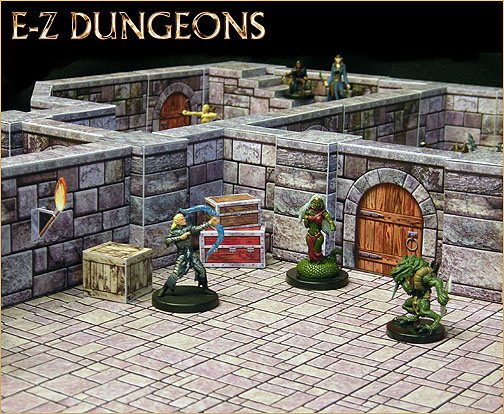
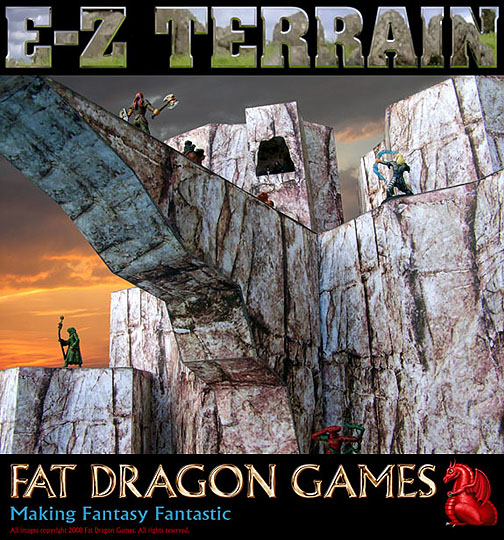
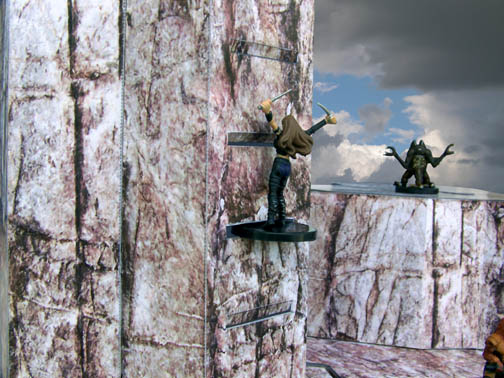
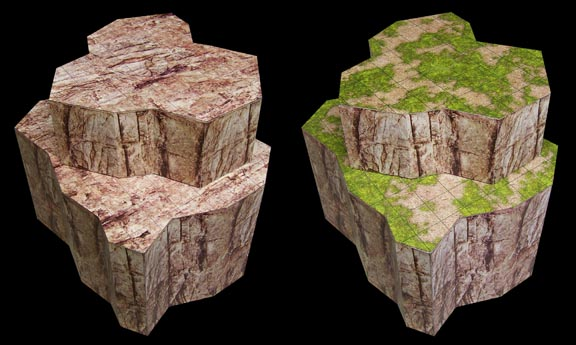
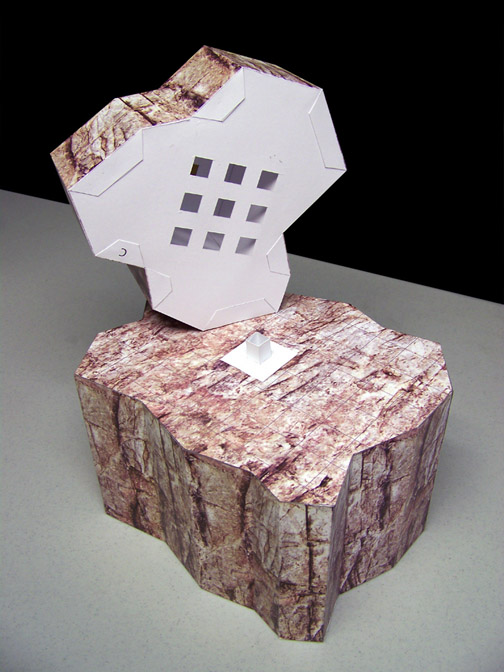
E-Z DungeonsSo a while back I posted about a castle I put together using Fat Dragon downloadable terrain (and I think we can all agree that I love 3D terrain).  Imagine my elation when I got an email saying that Fat Dragon was bringing back some of their retired terrain!  I have several of their products (including most of their Expansion Sets and several of their awesome Dragonshire Village structures – actually, the Guard Post and Armory would be my favorite), but I was never able to get their Cliffs and Mountains.  Well, you can bet I’ll be getting Cliffs and Mountains here after I’m done writing this…

Cliffs and Mountains1

Cliffs and Mountains2

Cliffs and Mountains3

Cliffs and Mountains4

Downloadable terrain is pretty darn awesome.  Once you have the file, you keep it forever.  that means that you can make as much of the terrain as you want.  I once made a HUGE castle front for a mass battle, and a large underground dungeon for an epic crawl (two of my most fun and liked adventures).  They come with tips and pointers on putting them together – all that’s required is a printer, some glue, and scissors!

Aren’t these just the coolest?  Each one is priced at $6.49, which is 50% of their old regular price.  After this weekend (Sunday, August 11), they won’t be available anymore (yeah right!  Id bet they’ll be back again for a short time next year…).  Of course, as an affiliate, Stuffer Shack will make a small commission on any of these sales, so thank you!  (Commissions go directly into our Contest Prize Fund, which basically gets handed right back out to our readers!)

Take a look at each of these products.  I don’t recommend anything unless I wholeheartedly love them, and I love these…

Cliffs and Mountains

Basic Set

Base Set

Free Camel Exotic Mount with $10+ Order…

Bactrian CamelThis week an awesome Stuffer Shack reader asked about our Camel Exotic Mount, so I decided to offer them for free when customers place an order.  If you purchase any physical product(s) from our store, and I’ll send the Camel for free!  All that is required is that you spend at least $10.  That’s it!

So, if you were thinking of getting a few Horse Minis, or perhaps some Mini Counters, now you can get the camel with it.  This sale ends on Sunday night.

Good Gaming!

Take me there!