Reflavoring the Races for Classic Fantasy – Dwarves

In part 3 of the 4 articles that deal with races in the Classic Fantasy setting, we look at taking certain D&D 4e races and reflavoring them into dwarves.  After this, we’ll be converting halflings.  Still to come are articles dealing with monsters and the setting.

For each of the following racial or subracial choices, all of the actual mechanical stats, powers, and traits are unchanged. It’s the flavor and descriptions that have been altered to describe a dwarf. Some of the traits or powers might need to be interpreted… creatively, but for the most part, mechanics are not affected. Again, take any of the following descriptions as a subrace, or rewrite one of your own design.

DWARF

  • COMMON DWARF (Dwarf) – The common dwarf uses the entry for Dwarf. He or she can be found in any dwarven settlement or region, living among any of the dwarven subraces.
  • BLOODRAGE CLAN (Longtooth Shifter) – These dwarves are part of a long line of warriors bred for the rage and glory of war, and it is rumored that they are descended from the dwarven god of war and wrath. They are found on the front lines of any battle, axes in hand.
  • BATTLEHAMMER CLAN (Bugbear) – This family of dwarves is surprisingly skilled at gaining an edge with their oversized weapons. They are known for forging massive war-hammers, and for wielding them in battle. Replace Goblin with Giant on the list of languages known.
  • DARK DWARVES (Duergar) – a faction of dwarves who forsook the honor of their kin to follow evil gods, these grey skinned dwarves live deep beneath the surface of the ground, far deeper than most dwarven mines. When the dwarves dig too deep, they find their evil kin waiting for them.
  • IRONGUT CLAN (Hobgoblin) – Working long hours in the most hostile regions of the dwarven forges, these dwarves are able to shrug off the worst effects of the distressing atmosphere.
  • THUNDERFIST CLAN (Half-Orc): These hard-hitting dwarves from the barbaric great planes of the world are best known for their martial tradition, emphasizing the discipline and loyalty so valued by dwarven society as a whole, and are welcome additions to any dwarven community they find themselves in. Their speed in battle is shocking to witness for their size.
  • STONEBLOOD CLAN (Fire or Earthsoul Genasi): These dwarves are so in tune with the elements they work with daily that the magic of the mines has worked its will upon them further than most. They are most commonly found in areas near volcanic activity, or any dwarven mine that runs deep enough to encounter the molten earth below.
  • DWARVEN MAGISTER (Dragonborn): Those few dwarves who embrace the arcane arts never do anything halfway. Their spells focus heavily on evocations and transmutations, both of which can be practically applied in the forge.

The Power of Fate

Since my last article, I’ve had a chance to look over the Fate 3.0 SRD (system reference documents), and I’ll say this: it has a lot going for it. And I’m not just saying that because it’s free. Really.

The specific SRD I was referencing was Spirit of the Century, and while I’m not certain how complete of a picture it gave me, it looks as if the game would be easy to adapt to any number of genres, just by changing what kind of skills and stunts are available.

But that’s not why I’m here. I’m not here to sell you on Fate – I haven’t played it once (yet!), so I don’t have the slightest clue how it would run, even if it looks alright on paper. I’m here to tell you what I liked most about Fate, and what I feel other RPG’s could learn from it. This overlaps somewhat with what I liked most about Mutants and Masterminds, but let’s take a run through it anyway – I’ll draw on both for examples.

1) Aspects and Fate Points.

Similar in some respects to the Complication/Hero Point/Extra Effort rules in Mutants and Masterminds – by far my favorite thing in the system, and I’ve been looking for a way to apply it more broadly across d20 systems in general. Aspects are character traits, relationships, or special objects that are integral to your character concept – they can be positive, negative, or both. Having a good mix is best, because positive applications can be triggered (through Fate points) to grant bonuses when appropriate, while negative applications are basically a way for the GM to pay you (in Fate points) for letting him do something he’d do anyway – screw you over – for the sake of the story, of course! 🙂

Aspects can be almost anything, from “Man of Iron” to “Arrogant Wizard” to “Reckless Poker Player” to “Trained by Qui-Gon Jinn.” A complication might be, say, “Vulnerable to Kryptonite,” but an aspect might be “Kryptonian,” which could include Vulnerable to Kryptonite.

Why they’re good: Aspects/Fate points (and the similar but different Complications/Hero Points) encourage good role-playing, discourage powergaming, and offer a mechanical way to reward the kind of behavior GMs want at their table.  Players get more control over what happens without breaking the game, or permanently boosting a character’s power level. Nice.

As an added bonus, for GM’s creating their own campaign world, having your players give you a list of “Aspects/Complications” is great – the more detailed the better. By putting it on their sheet, they’re telling you what kind of stuff they want to see in the game, and that’s way better than trying to railroad them through something you came up with on your own after a lengthy mind-reading session. If a player has down on their sheet that they have an “Eternal Rivalry with a Psychotic Clown,” then you might as well come up with a good way to use that for one of your villains. Why should you do all the work when you can get your players to do it for you, and they’ll have more fun as a result?

2) The Novel.

This may be specific to Spirit of the Century, but regardless, with a little refluffing it’s a brilliant idea (make it the “Graphic Novel” for a superheroes game, or “The Legend” for a medieval fantasy setting … easy).

Essentially, here’s the idea: Before the campaign starts, hand each of your players a piece of paper and have them write down a title and a summary of an adventure that their PC went on in the past, including a few brief notes about how it affected their character. This is the Novel. Then everyone gives them back to the GM, who mixes them up in a hat and has everyone draw one.  If a player gets his story, he puts it back and draws again.

Your character was a supporting cast member in the adventure that you drew.  Put your character’s name down on the paper, with some notes as to how you contributed to the story.

Now do it again.  No one can be in the same novel twice.

The result? Built-in connections between your character and at LEAST two other party members, possibly more. You know each other, and have already worked together in some small capacity. Make sure you note whose books you appeared in as well as who appeared in yours.

I’m always on the lookout for good ways to avoid the whole “Tavern” issue, so this seems like a good step to take in almost any RPG, though flavored a little differently in other settings. Bare minimum, there is now significantly less than 6 degrees of separation between any two party members.

Genius.

3) Combat that emphasizes creativity and cleverness over “Kewl Powerz.”

Okay, this one is kind of subjective, but I’m going to throw it out there anyway. The problem with D&D 4th Edition has rarely been the game itself. The problem is the players.

Yeah, I sound like a game designer. Bear with me a second.

I was watching an interview (Meet the Author) with R.A. Salvatore that I found over on Grognardia. Not a place that often caters to my style of gameplay, but it’s funny how much you can find to agree on with someone of a differing perspective when you put some effort into it. But that’s a digression.

Salvatore said of 4th Edition that when the game devolves into “I use X Daily Power,” it’s just a card game, and it dies. When you have creative players who describe what the character is doing and use the mechanics of the power as a rough guideline for their description, who stop thinking about the miniatures on the table and focus on the characters in their epic struggle, then the system really sings. That’s when it hit me.

That’s true of any RPG ever. If the players aren’t into it, aren’t being creative, and above all aren’t stepping into the shoes of their character, the game is going to die inside.

Both Fate and Mutants and Masterminds operate with this as the default assumption of the game – that’s just how they work. You can’t really do anything without describing what your character does and how they do it (or if you can, you shouldn’t), and if the players get into it it’s pure gold. But no matter how the game is structured mechanically, if the players and GM don’t get immersed . . . why aren’t you just playing a board game? Or a card game? Or a video game? I hear that Halo: Reach is excellent.

For the GM, the best advice I can give is that you have to start the process – you have to describe, describe, describe, and don’t let your players get away with, “I use Twin-Strike. Again.” Use sound effects! Stunning visuals! Stand up and demonstrate if you have to! Just don’t let the game turn into Magic: The Gathering.

Not that there’s anything wrong with Magic: The Gathering, mind you, but that isn’t really why you sat down to tell stories together.

Sure, it might be faster to just name the power, but isn’t there something superior about, “I duck and weave, evading the Orc’s attacks, striking quickly with my blades,” or, “I slide between the ogre’s legs and slash at his Achilles tendon?” “I swing my shield in an arc to throw him off balance, then throw my weight forward to knock him backward?” Or any number of other possibilities? No one else at the table cares which move you’re using, just make it and make it sound awesome. Even (especially?) if it’s “just” a Basic Attack.

I’m sure there’s plenty of DMs out there for whom this is old hat, and have already figured this out ages ago, but for everyone who knows how to run the game there’s another DM out there who’s still making their players consult spell mechanics and look up all their feats at the table instead of just playing the game. Not that they shouldn’t have that sort of thing memorized by now, mind you . . .

So, what does it all mean? Okay, since you asked, gentle readers, I’ll tell you.

There is no magic bullet. There is no perfect game system that will instantly do everything right for you the first time, but every last one of them has something to offer. Some more than others, sure, depending on your needs. But nearly every game has something to teach you.

The trick is finding it, and figuring out how best to apply it.

Happy gaming, happy holidays, and may your game table be the one where the fun is this season. Excelsior!

Nox, the Driven Assassin – Steal this Background

How do you know who you are when you can be anyone?

This is the problem Nox continues to face day after day. A year ago, Nox was found on the outskirts of Wyvernfell by a local woman.  She knew nothing of how she got there, where she’d come from, or who she was. Being a changeling only made things that much more difficult for her (him?) – when you can change your face as easily as you change your shirt, it’s not easy to remember anything about who you were.

She learned fairly quickly that she knew how to do one thing, and do it well; she knew how to kill. The hunt came easy for her, and the first memory to surface was her intimate knowledge of poison. Also, the presence of law enforcement made her instantly uncomfortable. This all raised even more questions for Nox. Who was she before? And did she really want to know?

The truth was messier than even she could guess. Nox used to be the top assassin in Wyvernfell, before she uncovered a very nasty corrupted government.  This led the assassin’s guild (which was tied to the corruption) to set her up for a bad job.  She was caught, convicted, sentenced, and then forgotten. But all this was a lifetime ago, and Nox remembers none of it. How long will it take for her past to catch up with her – especially once she starts working again?

Regardless, she has a cause. Her friend and rescuer is in serious financial trouble, indentured to the local thieves guild. She began by setting up a network of false identities, and has now put herself out there for her first job. With her talent for assassination and espionage, she has the marketable skills to earn her friend’s freedom. While she’s at it, she might just be able to uncover her past – and maybe, just maybe, bring some positive political change to the region.

Wyvernfell is a mess, but it’s her home. It’s time for her to clean house.

Sayin FUN to your Players

This is not the first article to be written on this subject, nor will it be the last.

In my experience, there are two kinds of DM’s.

One is concerned with “balance,” the other with “fun.”

For the record, this is not me complaining that I was never allowed to try my crazy idea for a half-orc fighter/barbarian with a spiked chain, and massively exploit the attack of opportunity rules. (Author’s note: I never actually saw the appeal in anything that full of cheese, though I gather it was popular with a certain brand of player. I was, however, sorely tempted to try a half-orc wizard, just to go against the grain.)

This is, however, the result of being long exhausted with being told ‘no’ by several DMs for no better reason than, “it isn’t in the book,” or, “Company X didn’t update that one, so it’s not allowed at my table.”

Let me illustrate my point with a story.

I’ve been invited to play in a game of Pathfinder or two. The system isn’t my favorite, but I have some small nostalgia for 3.5 edition as it was what started me off in D&D, so I went for a couple of one-shots and tried to like it. I wrestled with the character creation process for far too long, developing two concepts that I felt I could live with.

The problem was, by this point, I’d been exposed to a lengthy conversation in which one of the other players tried to explain to me why he prefers Pathfinder to 4th Edition in a failed attempt to “convert” me, and vice-versa. The more he said what he liked about the one over the other, the less likable it seemed. Building the character wasn’t fun. The concept was full of cheese. I wasn’t looking forward to the game anymore.

Finally, I threw up my hands. In an effort to salvage my chance to have fun for the evening, I went to the DM for the session and explained my position very politely; that there was really only one class that I wanted to play, and it was from a 3.5 book. I was perfectly happy to convert it using Paizo’s official 3.5 to Pathfinder conversion guide, and the work required would be minimal (it basically came down to raising the hit-die by one to match precedent with the core classes).

Were I the DM for the game, I hope I would have answered with what I believe is the correct response to something like this. “I’ll let you try it, and if it creates a problem for anyone at the table we’ll talk about it afterward and see what we can change to make it work.”

Instead, I was given a sneer, a half laugh, and told that there was “a reason” that Paizo hadn’t updated that particular class. A flat no.

The fact that they didn’t OWN it occurred to me immediately; that was why there were conversion rules, after all. It didn’t matter.

It was at this point that I gave up, and decided that I’d rather not play at his table. Maybe that was the wrong answer; I don’t know. But I wasn’t having fun anymore. I came to play a game; to have fun. Nothing about this experience was enjoyable. I was momentarily tempted to give up D&D entirely, to say nothing of Pathfinder. What is a game if it isn’t fun?

I’ll answer for you, gentle readers; it’s work. And unpaid work, on top of that.

For the record, I’ve recovered my love of the game now, though it will take a lot of placating and outright bribery to convince me to sit down at a Pathfinder table again – and never with that DM!

Now, let me tell a second story, just to make it clear what I’m not trying to say.

I was DMing a game of 3.5 edition D&D a few years ago, and one of the players showed up and informed me that his character was a 3rd Level Blood Elf Fighter who Dual Wielded Katanas.

At this point in my life, I had no idea what a “Blood Elf” was, but considering how much material for the game I’d fairly devoured, I was reasonably sure it wasn’t D&D. I also knew enough to know that dual wielding katanas was a really, REALLY bad idea in terms of game mechanics. I tried, gently, to dissuade him.

He insisted; I relented (against my better judgement). He got himself into a fight – a very angry one – with our 1st level dwarven wizard, who, after winning initiative, ended things with one spell. Knocked him out, tied him up, and sat on his head.

The game fell apart after that, and I suspect that it might have lasted longer if I’d been smart enough to put my foot down and say no in the first place.

As a DM, there is a time for yes, and a time for no. Knowing which is which can be all important. Everyone has guidelines. These are mine.

1. If a player asks to play a character of a class that I’m not familiar with – and it’s because he thought the concept sounded cool, not a mechanical reason – and there’s no philosophical reason why it can’t be made to work in a diverse and accepting group of adventurers …

I’ll say, “let’s try it out. If it turns out to be too powerful and it’s spoiling the fun for the rest of the group, we’ll talk about it afterward and see if we can fix it. But whatever I say during that discussion is the final word.”

This also applies if a player asks to convert something from a mechanically similar game system.

2. If a player asks me if he can play a half-orc spiked chain wielder or a greatsword guy with sneak attack or a Barbarian/Rogue or any number of other cheesy ideas and cites purely mechanical reasons for wanting to do so, I will say, “no. Come up with something that has a backstory and a little more character, and stop reading the Character Optimization threads online.”

3. If a player likes the fluff of one class and the mechanics of another and can’t choose, I’ll offer to let her combine them, adjusting key abilities as necessary. And I’ll probably go so far as to tell her how cool that is for thinking outside the book.

4. If I EVER hear the phrase, “dual katana’s” again, I will say, “NO. At least have the decency to get a wakizashi, and learn about samurai before you mention the word “katana” in my presence again.”

One final word: you needn’t give your players everything they ask for. But try to know when they’re already struggling to have fun, and work with them. Please. They’ll thank you for it.

Most Evil Utterances

Please welcome Jonathan Baldwin to the Stuffer Shack Crew…

Sometimes you really need your villains to stand out in the minds of your players. Since role-playing is, at its heart, a verbal exercise, this means spending a little extra time on your dialog.  You can describe the wicked fiend all you want, but unless you have pictures, your players are only going to remember what s/he says.

To get you started with some inspiration, here are a few of the best lines of dialog ever delivered by an antagonist.

“Welcome to my home; enter freely and of your own will.” –Dracula

The hospitable villain is a truly frightening force; if things are played right, the heroes won’t realize that they’re dealing with the Big Bad until they’ve already enjoyed his hospitality for some time.

“This is why only fools are heroes — because you never know when some lunatic will come along with a sadistic choice. Let die the woman you love… or suffer the little children. Make your choice, Spider-Man, and see how a hero is rewarded.” – The Green Goblin, Spider-Man

It’s the oldest move in the playbook, and it’s still as effective now as it was then. Two outcomes, both bad for the PC’s, and supposedly there’s only time to pick one. Of course, there’s always the possibility that the heroes will be properly heroic and come up with an out. Sometimes that’s good – especially when the villain is a monster, rather than an intellectual giant. Sometimes, however . . .

“How very predictable. I anticipated you would try to create a third, more favorable option.” –D.A.V.E., The Batman

It’s hard not to respect a good Xanatos Gambit; any villain smart enough to structure a plan in such a way that every possible outcome including failure works toward his goals is worthy of respect and recognition… or at least undying hatred on the part of the PC’s. Sometimes that’s good enough.

In a long campaign, this might work like pretty much everything Darth Sideous/Palpatine does in the Star Wars prequel trilogy.

Conveniently, as the GM, you don’t have to know all the possibilities ahead of time – you only have to be able to improvise if the players do the unexpected, and continue moving the plot forward. If you do it right, you look like a genius – or at least your villain does.

It should be noted, if you can ask, “But what if they do this?” and it would mess everything up, this is a Batman Gambit, which for villains is a plan which relies on the heroic tendency to behave in the most heroic manner, or otherwise assumes and manipulates a certain response based on known facts about the “victims.” Sometimes leaving a flaw in the plan on purpose isn’t a bad move. If the heroes find it, they feel great because they “outsmarted” the GM; if they don’t, you have something for your villain to monologue about during his getaway. Assuming he gets one.

“I can’t think of a morning I haven’t woken up with the thought of strangling you. That sanctimonious image of yours fooled everyone except me. Because I know evil.” –Lex Luthor, Public Enemies

This betrays a hatred that has completely distorted the villain’s perception of morality. To create this effect, operate from the assumption that the majority of antagonists aren’t card carrying villains and will develop some kind of rationalization that explains why they’re right and everyone else is the villain for trying to stop them. Create a villain who believes that he’s the hero of the story, trying to “save the world;” if your PCs are heroic sociopaths this can be easy, but for truly sanctimonious heroes the rationalization might take a little more work. Invariably, this kind of villain is the most interesting.

“No. I am your father.” –Darth Vader, The Empire Strikes Back

…or mother, sister, daughter, cousin, evil goatee sporting clone or alternate universe variation . . . even if the villain is lying (and let’s face it, they probably are), this is a great moment.

“You lose, Tony Stark.” –Whiplash, Iron Man 2

The villain has planned ahead so effectively that his own death is factored into an ideal condition for victory. Maybe the villain’s death is broadcast to the general populace and makes the heroes look like murderers. Maybe death unleashes the villain’s spirit to wreak havoc. Maybe death transforms him into a vampire. Alternatively, the villain’s death might just trigger the bomb and leave the hero with only seconds to evacuate the area.

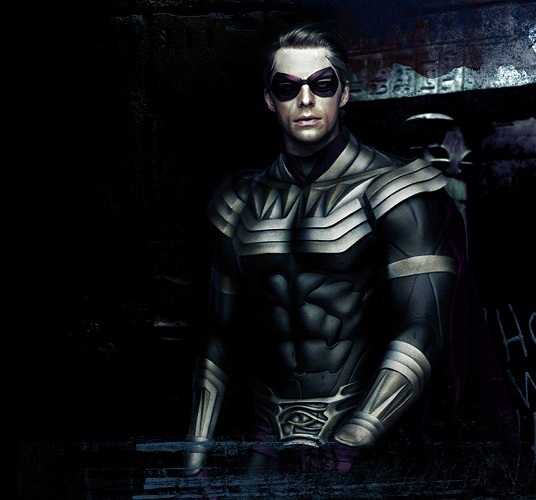
“I did it thirty-five minutes ago,” –Ozymandias, Watchmen

…or any credible variation on the theme of “You’re far too late for it to make any difference.” This specific example is my all-time favorite – to this day, I can’t read this part of Watchmen without my jaw hitting the floor, even when I know that it’s coming.

There are far too many great lines to count, and these are only a few of my personal favorites. Have a favorite that I missed? Leave it in the comments!

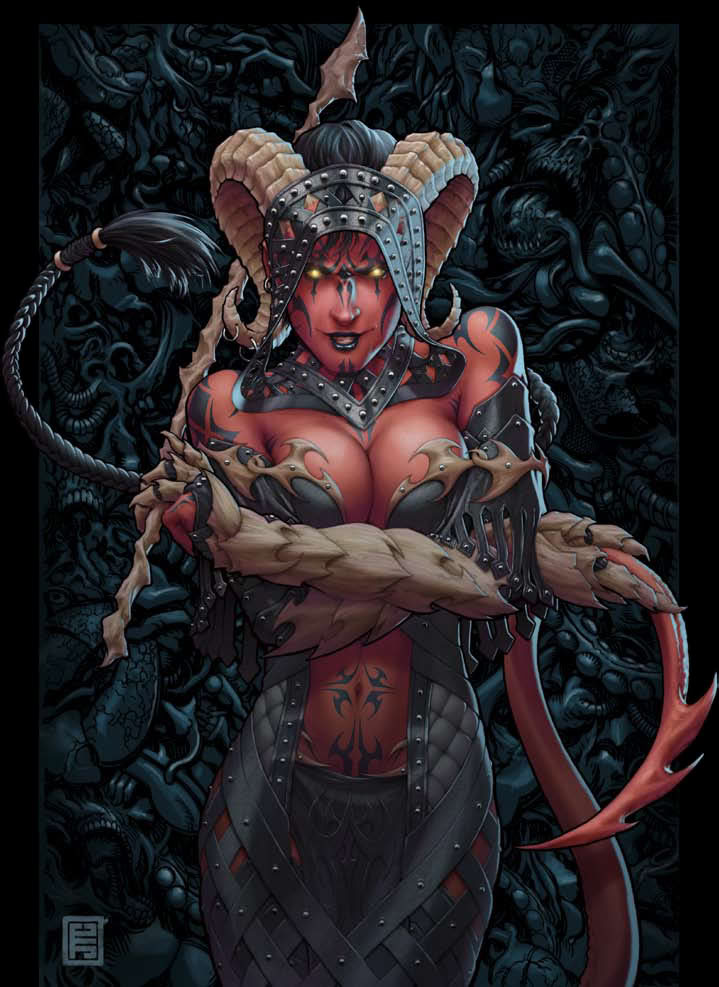
Affyria, the Tiefling Bard (steal this background)

Affyria is a descendant of one of the old houses of the great tiefling empire of Bael Turath. She’s studied the old stories closely, and is always looking to improve her knowledge concerning the old ways. This is important to her, as uncovering her legacy is needed to avoid repeating the mistakes of her ancestors.

Growing up on the streets of Wyvernfell wasn’t exactly easy, even with the help of her family. She learned to be both self-reliant and mistrustful (things she would later have to unlearn), but her natural charisma made her a leader – even when she wasn’t sure she wanted to be.

Unfortunately, members of her family started to turn up missing or dead. Affyria had to live out the last few years of her childhood almost entirely unsupported, and the murderer was never found. Why were they targeted, and are those responsible still looking for her? These are thoughts that never escape her.

When she came of age, Affyria studied the bardic arts to gain the flexibility to make her way in the world, as well as the tools she would need to uncover more of her history. As part of these efforts, Affyria has rediscovered the lost arts of the Turathi sword-masters, making them her own. Her spells, songs, and swordplay have kept her alive over the last few years, and her new friends have helped, too. Affyria hasn’t told them much of her past, or about her ambitions, but they’ve still managed to earn each other’s trust.