Aligning Expectations for D&D

Alignment has always been the sticky wicket of Dungeons & Dragons. It presents an objective set of labels to govern the inherently subjective nature of ethical and moral conduct. It’s adjudication – and even the value of its presence in the game – has long been debated, and will continue to be so long as it remains part of the game…

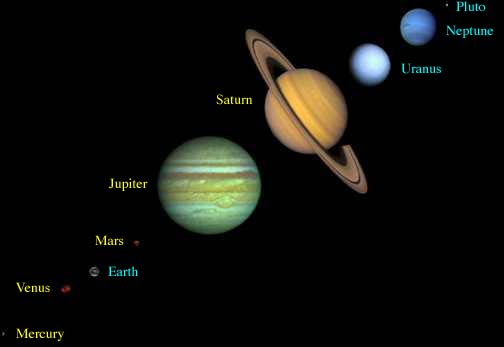
Alignment. It’s not just for planets anymore.

Alignment has always been the sticky wicket of Dungeons & Dragons. It presents an objective set of labels to govern the inherently subjective nature of ethical and moral conduct. It’s adjudication – and even the value of its presence in the game – has long been debated, and will continue to be so long as it remains part of the game.

But rather than discussing how alignment is depicted in D&D, we’re going to do something a little different: we’re going to determine the alignment of D&D itself.

The presentation of Dungeons & Dragons has varied wildly across almost forty years and half-a-dozen iterations. While these changes can be viewed in many contexts – from the role of the Dungeon Master to the random-versus-planned nature of character creation – we’re going to use alignment as a shorthand for evaluating the nature of the game’s rules, presentation, and the style of play that it (seemingly) lends itself towards.

Of course, in this regard the “moral” axis of the traditional D&D alignment grid – good, neutral, and evil – is of no help. Hence, we’re going to limit ourselves to the ethical alignments: lawful, neutral, and chaotic. There’s also a general disclaimer that needs to be made, in that these judgments are purely based on the game rules themselves, and aren’t meant to be a critique of what sort of games can be played with them. It’s entirely possible to have a freewheeling, off-the-cuff game using a “lawful” set of rules; that’s just not (how we think) the rules are presented.

So without further ado, let’s look at the alignments of D&D over the game’s lifespan!

Chaotic: OD&D and BD&D

Original D&D was the first incarnation of the game, published in 1974. It received almost a half-dozen support products before the Basic D&D game came along and replaced it. Basic was initially published in 1977, and was meant to be an introduction to OD&D, but very quickly established its own identity.

Both games can justifiably be called Chaotic in alignment. The rules in OD&D, and the early incarnations of BD&D, are notable for their abstruse nature. A large number of game-play elements are left untouched by the rules altogether, ostensibly due to their implicit assumptions that the GM will simply be able to wing it. You won’t find multiclassing or monsters-as-characters rules here, for example, and things such as underwater adventuring or domain-level play are given only superficial treatment, if they’re covered at all.

To be fair, Basic did try somewhat to round out the areas it covered as it continued to expand and evolve throughout the Basic, Expert, Companion, Master, and Immortals boxed sets (known collectively as BECMI), but the comparatively simplistic nature of the rules remained the same. The mechanics didn’t try to cover everything, and were comfortable letting the Dungeon Master and the players work out any undefined areas on their own. As Jeff Goldblum would say, “that’s chaos theory.”

Neutral: AD&D First and Second Edition

Advanced Dungeons & Dragons debuted in 1979 (the Monster Manual came out in 1977, and the Player’s Handbook in 1978; it was only with the publication of the Dungeon Master’s Guide in 1979 that the game was complete as we think of it today), and was updated to a Second Edition in 1989. These were the Neutral years of the game, as it contained both Lawful and Chaotic elements.

The nature of this mixture of law and chaos is that AD&D, in both of its incarnations, clearly expanded its area of coverage, trying to extend its rules to not only much wider areas of game-play, from detailed planar effects to running entire campaigns as rulers of kingdoms to pages and pages of random encounter tables. While trying to bring everything under its umbrella of standardization can honestly be called lawful, the overall results were themselves somewhat chaotic.

Simply put, everything was a mishmash of sub-systems, resulting in odd corner-cases and little-known rules that were all but bewildering if you attempted to bring them all into play. Polymorphing required a system shock check. You could be a bard if you started out as a fighter, dual-classed as a thief, and then received druidic training. Roll randomly to see if you had psionic wild talents, and on and on. The game wasn’t afraid to try and do everything, and each different area was its own thing, without regard for standardization.

What makes a man turn neutral? Playing AD&D.

Lawful: D&D Third and Fourth Edition

Dungeons & Dragons dropped the “Advanced” with the debut of Third Edition in 2000. After a small (but not insubstantial) revision to “3.5” in 2003, the game moved into its Fourth Edition in 2008. These were the editions that for the most part kept the scope of their predecessors, but placed a renewed emphasis on standardization.

It’s that focus on unifying the mechanisms for their various disparate elements that make these the Lawful editions. No more having some rolls that prioritized high results while others wanted low. No more odd restrictions based on class, race, or ability scores. No more using different methods of task resolution: the d20 was king now. “Balance” was the new watchword, and a premium was placed on explaining how this was to be created and maintained, even for custom material.

The use of keywords was another focus for the game’s new Lawful stance. Whereas before there was a high degree of ambiguity over how spells, special abilities, and other powers worked, now things were given descriptors (e.g. spells that were “mind-affecting” or “illusion (phantasm)”) with those definitions thoroughly detailed regarding what they did and did not do. Uncertainty, whether on its own or as a result of various parts of the game being used in conjunction, was an enemy to be defeated.

These were the editions that would glare at you and bellow “I am the law!”

D&D Next

With the release of D&D Next just over the horizon, the question of what alignment it will have remains an open one. Will it keep the Lawful focus of its immediate predecessors? Or will its much-touted modularity allow for it to have a more Neutral stance? Or will it surprise us and reach much further back, taking a Chaotic hands-off approach? An most importantly, which one would you prefer?
One Campaign, Many Systems: An Experiment (Part III)

In Part I of this series, I laid out my plan to play through a series of RPG systems – one a week – over the summer. On top of that, I wrote about my gaming groups’ desire to maintain a single set of characters and therefore a cohesive story for the duration of the campaign.

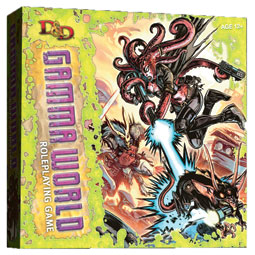
Gamma WorldIn Part I of this series, I laid out my plan to play through a series of RPG systems – one a week – over the summer. On top of that, I wrote about my gaming groups’ desire to maintain a single set of characters and therefore a cohesive story for the duration of the campaign.

Last week, we played our session of Gamma World. I used the “Truman Show“ trope to move the PCs from a high fantasy D&D world into the chaotic post-apocalypse of Gamma World. The players already had some idea of the “real world’s” background because of our Microscope session. So even as the PCs stepped into the complete unknown, the players began making reference jokes to the Microscope timeline we had created.

The PCs stepped into a research/control station attached to the D&D world’s “bubble,” and had to explore and fight their way through it.

Because I didn’t have a lot of prep time for the session, I used the LUCAS lab section of the Legion of Gold adventure, modifying the map very slightly to include an entrance from the biome, as well as changing the station’s research objective to the D&D world instead of “the moon.”

The intention was for the players to use the teleport pad in the adventure to teleport to a large city in which we would start our Shadowrun story. Which is exactly what they did. Sometimes things work out the way you want them to…

And other times they don’t.

The session itself went fine. We’re all familiar with the Gamma World system, and using the pre-published encounters made everything simple. However, at the very start of the session, the players expressed a desire to abandon their D&D characters, and pick up new Gamma World characters. Which kind of defeated the purpose of the whole “Your D&D world was actually a huge biome” trope. Their reasons were twofold, and they were both legitimate.

First, they had trouble porting their D&D characters to the Gamma World system. This is an interesting commentary on player’s identification with their characters. To a player, their character is generally identified not by personality traits and memories (though that is a small part of the character), but rather by the character’s abilities. When the abilities that define your character are stripped away, it becomes difficult to retain the character’s identity. This makes sense. Character creation is all about defining what a character can do. When we help a new player create a character, we ask questions like, “Do you want your character to be a sneaky thief who fights with daggers, or a devout knight fighting for a higher cause?” Sure, there’s an allusion to personality (sneaky, devout) but the images that come to mind are the types of things such a character might do.

Second, the players simply wanted to try out new character concepts. If something looked interesting in Gamma World, but didn’t necessarily line up with their D&D character, they wanted the freedom to go with it. This, I realized, is a very important aspect of trying out a new system. It’s not just about learning a new set of rules, and what those rules do well, but also being who you want to be within the system. If I had put my foot down and made the players stick to one character concept across systems, I think the summer’s fun factor would have gone down considerably.

So we’re no longer trying to use the same characters all summer. To preserve some sort of continuity, what we decided to do was use a “once removed” story device in which the party from one system crosses paths with the party from the new system – and we make a handoff. So in this example, the Gamma World characters also happened to be in the LUCAS facility, and were present when the D&D characters showed up. They pointed the D&D characters to the exit, and then the players started playing Gamma World.

What I learned

In planning our Gamma World session, I should have looked ahead to Shadowrun and limited the Gamma World origins that the players could use. Since I didn’t, some players made “Shadowrun un-playable” PCs. For example, a Saurian (dinosaur) character fits into Gamma World just fine, but there’s no way to move one into a Shadowrun campaign. There are plenty of Gamma World human-ish or human compatible origins that would move very nicely to Shadowrun without a bump. As a matter of fact, I would estimate a good half of the 50-ish Gamma World origins do not specify physical form (eg, Mind Breaker, Magnetic, Temporal). Unfortunately, since I didn’t put any restrictions into place, some of my players may have to abandon their characters. On the other hand, we also could have reskinned (see below).

I also learned that players identify most strongly with their character’s abilities and skills. To that end, everyone should be liberal with reskinning things. In my campaign, a player should be able to take their D&D paladin, and turn it into a Gamma World Mythic Yeti because the abilities of that combo most closely line up with the Paladin’s D&D abilities. But here’s the catch – the player should feel free to describe the character’s physical appearance as not a Yeti, but still in terms of what their D&D character looked like. In this way, we’re playing a new system, but the player can still retain a strong attachment to the character through (roughly) what it can do. Reskinning is a beautiful thing.

These lessons are all theoretical, of course, to someone who is trying to maintain a party of the same characters across a variety of systems.

Going Forward

I’m still going to link each of the sessions together so that there is an uninterrupted narrative crossing the summer. I’m doing this mostly because I think it’s a cool idea, and the players are on board with it. We’re using the “once removed” idea to allow players the freedom to create characters that are interesting to them in each system. Next week, we’ll be playing Shadowrun, so as the Gamma World party appears in a teleport transportation depot, they will see the Shadowrun group walking across the depot’s plaza. I will also note that, if we had decided to maintain the same characters, the story could have still followed the same path – instead of seeing a group of Shadowrunners crossing the plaza, the Gamma World characters could have crossed it themselves, and into the Shadowrun story. So next up: Shadowrun!

Jumping into D&D Next

Not too long ago, I participated in the Free RPG Day event Vault of the Dracolich. Determined to help out my local store (which I do often because they’re awesome), I signed up to DM for the event…

D&D-NextNot too long ago, I participated in the Free RPG Day event Vault of the Dracolich. Determined to help out my local store (which I do often because they’re awesome), I signed up to DM for the event.

Preparation

Now I’ve been registered to playtest D&D Next for quite some time but, honestly, I’ve barely given it more than a read-through. I played a couple sessions back in the earliest releases, and lately I flip through the latest playtest notes but I don’t absorb it, and I definitely haven’t had time to play or run. So it seems like a terrible idea to sign up for a public event specifically running Next, right? Well, maybe a little.

I haven’t the experience of being a “newbie” in D&D for years. Could I just jump feet first into a D&D Next module and be able to run it with a basic understanding of the rules (about equivalent to someone who has read the rules once and now has to run a full table)? Would things run logically, or would I be floundering trying to figure out what was supposed to happen?

Admittedly, this was irresponsible of me. I knew the event was coming up and could have made more time to study, to ensure my players had the best event possible. I intentionally avoided doing more studying of the rules themselves and instead read most of the module and focused on NPC and area descriptions for roleplaying notes. The talented Teos Abadia (one of the module’s three authors) was coordinating the event at our store. He teased me about not being prepared, but other than needing to clarify a couple of details, I felt confident enough to get right into running my table.

Observations

Combat was fast, and I only felt the need to pause and look something up in the playtest packet a couple of times. This in part was due to a table of prepared players who knew they were going to play Next and not walk-ins that were expecting 4e.

I ran almost all the encounters with no map, only describing enemies’ basic locations. I didn’t even keep note of locations, and (for the most part) location boiled down to remembering if the monster was at range or melee. Players felt uninhibited to describe their maneuvers and attacks. I’m not entirely sure we did all of them correctly, but I know the players had fun doing whatever it was we figured out.

I ran the last encounter using a map. In Vault of the Dracolich, the final confrontation’s map is provided. I noticed the players moved a lot less when the map was in play and made me wish I had stuck with the theater-of-the-mind style.

Conclusion

Altogether, as an experienced and primarily 4e D&D Dungeon Master, I had very few barriers to overcome getting into running D&D Next. The stat blocks are different, but at the same time I needed virtually nothing explained to me. What questions did come up were quickly clarified or else hand-waved away. I enjoyed how quickly combat flowed and it made me curious how higher-level play will unfold. Ultimately, the session resulted in influencing my decision to use D&D Next with my home group – not full time, but we’ll be doing a one-shot with the playtest rules next week. Chances are if all goes well, I’ll let you all know how that went too!

The Next Epic, part four

Tradition and innovation have always been natural opposites, as one seeks to maintain an existing set of practices while the other seeks to revise them, or even create new practices entirely. For Dungeons & Dragons, tradition had been a much stronger motivating force until the advent of Third Edition, when innovation was given a much greater role during its design.

"So then he dropped a planet on me. That's when I got angry."
“So then he dropped a planet on me. That’s when I got angry.”

Tradition and innovation have always been natural opposites, as one seeks to maintain an existing set of practices while the other seeks to revise them, or even create new practices entirely. For Dungeons & Dragons, tradition had been a much stronger motivating force until the advent of Third Edition, when innovation was given a much greater role during its design.

This isn’t to suggest that Third Edition put no importance to the game’s traditions; it quite clearly did, but was willing to change things to a much greater degree than any of its previous incarnations. Moreover, innovations to the game had been widely propagated by third-party publishers using the Open Game License.

When the Fourth Edition of Dungeons & Dragons was released in mid-2008, it was clearly mindful of these changes, and so introduced some innovations of its own. Yet at the same time, it kept a close eye on its history, and sought to reintroduce ideas from previous editions that Third Edition had eschewed, both big (different stats for monsters than for PCs) and small (the five-point alignment from the Holmes Basic D&D Set). This was particularly true where epic levels and divine ascension were concerned.

DUNGEONS & DRAGONS FOURTH EDITION

The Fourth Edition of the D&D game was, insofar as epic levels were concerned, a clear break from its immediate predecessor. Notably, epic levels were included in the Player’s Handbook. Though still referred to as “epic,” levels 21+ were now part of the core game, rather than being relegated to a separate source-book.

More striking was that a hard cap on levels was re-instituted, using the same thirty-level limit as Second Edition. Now, when a character hit 30th level, there was no further advancement to be had…with one exception. While characters of the “heroic tier” (levels 1-10) were defined solely by their class, and characters of “paragon tier” (levels 11-20) used a paragon path (a sort of sub-class) to further differentiate themselves from their fellows, “epic tier” characters (21-30) selected an epic destiny. (While Fourth Edition would pay epic tier considerably less attention than the preceding tiers, the third-party community wrote some very noteworthy materials for this level of play.)

An epic destiny, unlike a paragon path, wasn’t explicitly tied to a particular class. Rather, it was a thematic choice for what sort of larger-than-life archetype you wanted your character to become, and gave you powers to that effect. Moreover, each epic destiny had a specific “destiny quest” that your character could follow which presented a built-in option for how to retire them from the game after achieving 30th level.

Much like the Paths to Immortality of Basic D&D, the destiny quest of epic Fourth Edition characters was optional (and had no hard-and-fast mechanics associated with performing or completing it), but remained the only form of advancement once there were no more levels to gain. The nature of the quests varied, but completing them always involved your character moving beyond the game world.

Indeed, sometimes this was a literal ascent beyond the mortal realm. One of the epic destinies in the Fourth Edition Player’s Handbook was “the demigod.” Upon completion of your destiny quest, you literally became a nascent deity, heading to the dominion of a divine sponsor (or founding your own). While this particular epic destiny could be taken by any class, it’s notable for being the first time in D&D that whether or not you could try and achieve divine ascension was part of a class(-related) mechanic, as opposed to being purely orthogonal to your character’s advancement.

Likewise, the nature of divine statistics in Fourth Edition reinforced the mandatory nature of retiring a divine character. As mentioned above, monster stats and PC stats in Fourth Edition were different, unlike how Third Edition used the same statistics for both. As there were no standardized rules presented for deities in Fourth Edition – rather, what gods were presented were given unique monster stat blocks – that meant that there really were no mechanical options for presenting divine characters as anything but challenges to be fought.

With a Second Edition-inspired take on epic characters, and a method of divine ascension that was similar-yet-different from any previous iteration of the idea, Fourth Edition’s options for exceptionally high-level characters were clear and unambiguous in their presentation. That put its it in stark contrast with its major competitor…

PATHFINDER

The Pathfinder game was released in 2009, after an extensive public playtest. A revised version of D&D Third Edition (which itself had a revision almost halfway through its life-cycle) released by Paizo Publishing under the Open Game License, many gamers consider Pathfinder to be a form of D&D. This acknowledgment, along with its wide-spread popularity, is enough to earn it scrutiny here.

…unfortunately, that scrutiny, in regards to epic levels and divine ascension, finds Pathfinder to be somewhat lacking. As of the time of this writing, Pathfinder has eschewed the issue of level 21+ characters entirely. Moreover, the question of divine ascension (and the powers and abilities of gods, either as PCs or NPCs) has been left similarly unexamined.

However, this may change in the very near future. August of 2013 will see the release of Mythic Adventures sourcebook for Pathfinder. While we’ve already been told that this will not address the question of level 21+ characters per se, it will address how characters can gain (reportedly up to ten) “mythic tiers,” which are treated as being similar to levels in that they will grant characters greater powers and abilities. The difference is that mythic tiers are gained separately from levels, and can be earned at almost any point in a character’s career.

Beyond Mythic Adventures, there’s no predicting if Pathfinder will address epic and divine characters. While the game is based on D&D Third Edition, it has so far not used any of the epic or divine material from that game, likely for good reason given the unpopularity of those rules (though at least one third-party publisher has released epic-level material specifically for Pathfinder).

Of course, Pathfinder isn’t the only game for which the question of exceptionally high-level play remains an unknown.

DUNGEONS & DRAGONS NEXT

To date, it’s uncertain precisely what stance D&D Next will adopt in regards to epic levels and divine ascension. So far, the playtest packets seem to be utilizing a default cap, in that levels above 20 (and how to have characters undergo apotheosis) are simply unaddressed.

As part of a playtest, that’s not particularly surprising, as they’re still trying to work out the basics of how the game should be constructed. Once the game is released, however, these questions will need to be addressed, as they’ve been part of the game across every edition. While they’re likely to be separate modules, there’s no way of knowing what the specifics will be until then.

While some players and DMs won’t care for these levels of game-play, for others the release of these rules can’t come soon enough, as they long to take their characters to the very limits of what the rules allow…and then surpass them.

For them, the game doesn’t get any more epic than that.

One Campaign, Many Systems: An Experiment (Part II)

In Part I of this series, I laid out my plan to play through a series of RPG systems – one a week – over the summer. Now we move on to Microsope…

Microscope-225x300In Part I of this series, I laid out my plan to play through a series of RPG systems – one a week – over the summer. On top of that, I wrote about my gaming groups’ desire to maintain a single set of characters and therefore a cohesive story for the duration of the campaign.

Last week saw our first transition between systems. This first transition is something of a “soft” transition to Microscope. I call it “soft” because there was very little in the way of cohesive story that we had to maintain between D&D and Microscope. But first, a small synopsis on how the campaign started with our D&D 4th edition sessions:

The Story

We revisited the world we created last summer (more on that in a minute) but 30 years into the future. The players all had new characters, although last summer’s characters all made reappearances as NPCs.

The D&D story hook was a missing fleet of ships that had been sent to a neighboring island nation. The PCs were tasked with finding out what happened to it.

In the course of their nautical journey, they were attacked by a species of fish men that was completely unknown in the world. They later found out that there seemed to be an invasion of these fish men, and the invaders were arriving from a generally eastward direction. This area was known as “the uncharted east.”

What happened next got mixed reviews from my players. In sailing towards the invading force to investigate their origins, the group of PCs discovered that they are living in a huge biome, not unlike The Truman Show‘s big reveal. This is where the D&D session ended.

The Microscope Session

Last week we played Microscope. It is something of a quasi-RPG (or perhaps “non-traditional RPG”) in that players do not pick a single character and play in a game world at a fixed point in time. Instead, the players are designing the timeline for a world, zooming in and out throughout the whole world’s history, placing events, epochs, and even zooming in close enough to observe individual characters for a brief moment.

It’s a great game to stretch your creative muscles, and can also be a fun way to build a world before you start a campaign.

And it backfired spectacularly.

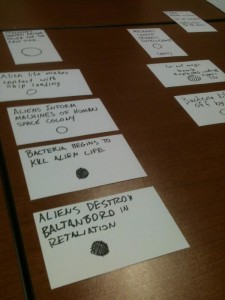
As a group, we opted to take one of the pregenerated “starting seeds” to set our history in. “Machines discover their organic origins.” Then, we began laying out the history, including the departure of humans from the world, the arrival of aliens, and the accidental epidemic of manufactured bacteria. At the end of the session, we lamented some of our palette choices (whose bright idea was “no metal” and “no political powers”?), but I think we were overall satisfied with the game and would play it again.

So when I say it backfired, I should clarify that the actual playing of the game did not backfire. It was more the discussion at the end of the session where I asked, “And where do we think [the Islands World] we set up last year fits into this timeline?”

You see, with Microscope, we had designed a world of technology. Our campaign last year was one of fantasy and magic. For some of the players, this was an irreconcilable difference. Suggesting that last year’s fantasy world existed inside of another more technological world caused some bad feelings within the group, even though using that plot device facilitated bridging RPG systems (particularly D&D and more modern systems). They did not want to conceive of last summer’s world as something other than what we assumed it was last year – a strictly fantasy world. Anything else would ruin the memory of that campaign.

We reconciled the bad feelings by simply saying that the fantasy islands biome/Truman Show world was simply one possible reality that collapsed during Gamma World’s “Big Mistake” and it is not the same reality that we played in last summer. It wasn’t a perfect explanation, but it was good enough.

What I learned

It was a huge mistake on my part to bring back last summer’s campaign world. Because the players had such an investment in the world as it existed in their imagination last summer, when I shook up those preconceived notions, I got some kickback. I would have been better off either:

1. Starting the campaign with Microscope, and using the new world we created
2. Doing it the way I did it (including the Truman Show plot device), but with a new world of my own design.

I would lean towards #2 because it would let the players get a little invested into the world with their characters, then back out and take a larger view of the entire history. In other words, I think that starting out in a fantasy world, then saying, “Hey, somewhere in this world’s history, there were machines” is not only perfectly valid, but can also be a great storytelling opportunity. It also bends the player’s brains a little. I just wouldn’t do it with something that is already well loved and that the players have an emotional stake in.

I should have also laid out expectations at the outset of this summer more clearly. We all agreed that we would try to play through a bunch of different systems, and that we would try to maintain the same character throughout. That was the extent of the discussion. There was no detailed talk of the how, or that perhaps I might smash some preconceived notions about last year’s world, and is that ok, or should we start fresh? Part of that was me wanting to keep “the big Truman Show reveal” secret, and part of that was simply me not thinking ahead. If there is a next time for such an experiment, I will have an intentional group discussion so that there is an agreed upon set of expectations at the outset. If that means some of the story is spoiled or revealed, so be it. It’s better that everyone be on the same page.

In the end, the backfire was mostly laziness on my part. I was leaning back on something established so I wouldn’t have to make something new. I guess being a lazy DM isn’t always a good thing.

Going Forward

Next week, we will be playing Gamma World as the PCs move through the “Door in the sky” into the real world outside their manufactured biome. Most of the players will be rolling their PCs randomly using the super easy WotC Gamma World character generator. Onward!

Gamer Culture and Dragon Age 2: WTF Edition

Dragon Age 2 is hated by a lot of fans and they just won’t shut up about how much they dislike it. For the record, I still don’t understand why, and no, explaining it to me again will not make me care more…

Dragon Age II

I finished Dragon Age 2 recently. Yes, for the first time. Yes, I’m late to the party. I know. Where have I been all this time, etc. Now that we’ve gotten that out of the way, let me explain to you a thing.

I liked Dragon Age 2.

If this article gets any kind of wide readership, there will be a large number of people who stopped reading at that sentence and went straight to the comments to tell me I’m wrong. Keep reading.

Dragon Age 2 is hated by a lot of fans and they won’t shut up about how much they dislike it.

For the record, I still don’t understand why and no, explaining it to me again will not make me care more.

I’m an outsider to all this. I’m a huge fan of BioWare games in general, as we’ve established repeatedly. But Dragon Age was an unknown to me. A lot of fans are very passionate about it, and understandably so. Many of these fans loved Dragon Age Origins. Many of these fans loved Origins so much that they feel an uncontrollable urge to inform you of this fact and of how much “better” Origins is than DA2 any time you so much as mention the fact that you’re playing DA2.

There’s this phenomenon I’ve noticed where if you tell a certain group of gamers that you like a thing they’ll take this as an invitation to shit all over that thing. It’s almost like the part of our brains that handle empathy just shuts the hell off right then and goes SOMEONE IS WRONG ON THE INTERNET I MUST INVALIDATE THEIR SUBJECTIVE JUDGEMENT DURHURHURHURMURMURFURDUR and then the next thing you know BLAAAAAAAAAAGH I AM A GIANT SQUID OF ANGEEEEERRRRRRRRR because look I’m busy liking this thing, I don’t need you to tell me how you liked a different thing more.

stfu

This is especially true of sequels and differing editions of favorite RPGs.

In fact, if nobody has coined it yet, I’m going to go ahead and call this Baldwin’s First Law: “if you tell a geek what you like, you are wrong.”

It doesn’t matter to them that you’ve already said, repeatedly, that you never finished Origins because it stopped being fun for you. It doesn’t matter that you began your conversation with the sentence “I liked Dragon Age 2 and think it’s fun, surprisingly deep, and highly underrated,” your feelings are WRONG and you should feel THIS INSTEAD. They’ll make excuses, like, “oh yeah, mages were terrible in Origins, you should play a warrior,” and ignore that maybe you don’t want to be a warrior, maybe you like casting spells and expect a game that gives you the option of casting spells to, you know, make that a fun thing to do.

It doesn’t matter that you were too busy struggling with the clunky mechanics when you played Origins to notice the fantastic story, you’re just wrong.

I’d love to say it’s just this game, but no, this isn’t isolated. It’s universal. It applies when you tell people you like Pathfinder and someone chimes in “4th Edition/2nd Edition/GURPS is better!” It happens when I tell people that Saints Row the Third is one of my favorite games and they try to convince me that I should like Grand Theft Auto or Saints Row II more. Heck, I’ve done it myself when people told me they liked the Star Wars prequels and now I feel terrible about it.

So I promised I’d explain to you a thing. Now I’m actually going to do that. Hopefully without splitting any infinitives.

Whether you like a thing is based on feelings.

Feelings cannot be wrong.

Now some of you are about to argue with me that what you like is based on sound logical reasons and to you I have only to say listen here you little #!?&@, I’m not finished.

You THINK that what you like is based on sound logical reasoning but that’s not actually how the brain works. You like stuff because you like it. Wait. That’s tautology. You like stuff because of how it makes you feel. Better. Your brain just rationalizes it afterward. All the sound logical reasons are your brain looking to justify what you already feel.

I can give you my sound and logical reasons for liking Dragon Age 2, but they aren’t nearly as important as the fact that I liked it because I felt things when I was playing it and I enjoyed having those emotions. Even the sad ones. And feelings cannot be wrong. Reasons, sure, reasons can be nonsensical or points of argument but my feelings are mine, I own them, nobody else does.

My liking something is not an invitation for you to tell me I’m wrong and should like something else.

If a kid likes the color blue, you don’t get to tell her that she should like pink instead. If a kid likes chocolate, you don’t get to tell him he should like carob instead, you idiot. Note: Apologies to our vegan readers. —Ed.

So if it’s not okay to tell someone what color they should like, why is this kind of unsolicited negativity something I should expect or put up with?

Expect an article containing my actual Dragon Age 2 thoughts in the future. For now, I leave you with what may well be the most important question of our generation (assuming that wasn’t a thing I just made up for emphasis instead of a literal truth):

Fellow gamers,

What the heck is WRONG with us?

One Campaign, Many Systems: An Experiment (Part I)

Could it be done? Could we maintain a single party and a single story thread through a campaign that dabbled in many different RPG systems?

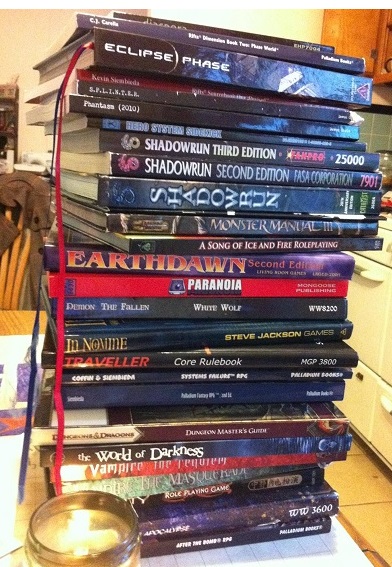
RPG-books2It’s summer, so the group I DM for has reunited. They’re all college guys attending school in different places, so playing D&D during the school year is impractical. Instead, they use their huge swaths of free time over the summer to engage in all manner of gaming hedonism. Last year, we used our weekly gaming sessions to create a world and tight story arc that would begin and end in ten week’s time. We also experimented with co-DMing. Each player took a turn in the DM chair, adding their own unique bit to the larger story. It worked out wonderfully.

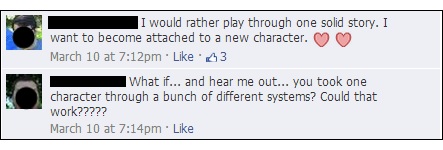
Since I had performed those experiments with the group last year, I knew they were open to trying new things. So in March I began a dialogue with them on our Facebook group to find out what they wanted out of our summer campaign. At first, my suggestion was to eschew a campaign structure, and just try out a bunch of different RPG systems with one-shots. Then, the discussion took this turn:

RPG-Conversations-2

Well, now there’s an idea.

Could it be done? Could we maintain a single party and a single story thread through a campaign that dabbled in many different RPG systems? I wanted to find out.

We live in a golden age of RPGs. It seems like every week Kickstarter adds another book and another system to the world’s growing library of Role Playing Games. If you want to play it, chances are, there’s an RPG for that. So why would we sit down and play the same system every single week? Sure, there’s an argument to be made for system familiarity, and also one for nostalgia, but I can think of no good excuses to completely ignore all the other systems out there. We must at least dabble! Most systems have quickstart rules and level 1 one-shots to use. Most of them are free. In fact, we’ll be using the Shadowrun Quickstart Rules and encounter that I picked up at Free RPG Day this year. Yes. Yes, we will try this. So here’s the plan:

The Story

In my mind, I do have a very loose story planned out. I want to leave enough open for the players to change direction, but failing that, I need a cohesive and believable way to get from one RPG system to the next. I need a story reason that the characters would be engaging in the same themes that an RPG exhibits. For example, when we try out the Leverage system, we need to be at a place in the story where a heist is necessary. That’s what the Leverage RPG does. Complicating all this, of course, is the time constraint (deadline: end of August), so I may need to tighten up my sessions to hit all the games we want to play. As this series goes on, I will be slowly revealing the story as it unfolds.

The Systems

As of right now, the systems I have planned (and the order in which we will play them) are:

  • D&D 4e
  • Microscope
  • Gamma World
  • Shadowrun
  • Leverage
  • Call of Cthulhu
  • Dread

Can We Do It?

I’m not sure. I would feel more confident if we were playing RPG systems that at least one person in the group was familiar with. As it stands right now, I need to have at least a tentative grasp on the rules of every RPG we play. I’m hoping that, much like learning a language, the more systems I learn, the more easily I can pick up a new one. Also, since we only get one session with each game, we will need to use pregenerated characters. The players may find it difficult to shoehorn an established PC personality and story into a pregenerated character. But there’s no way around it. Character creation would simply take too long to incorporate with a story into a single session of an RPG.

In the end, I have to be honest and express a bit of doubt as to whether or not we can pull it off. Lucky for you, you get to read about the fantastic success or failure of our little laboratory, right here, as the summer rolls on. Of course, in success or failure, we’ll be sure to have lots of fun, and there’s no doubt that we’ll be exposed to new systems. So in that regard, it’s a guaranteed success. Yeah, that’s what I’ll keep telling myself. Next time, we’ll explore the group’s transition from D&D 4e to Microscope, what we thought of the game, and how that will lead into our Gamma World session. Stay tuned!

All aboard the Dungeons and Dragons Express

Thinking about it (as I have, lately) the current D&D Next playtest project is much like a train ride…

I really should travel by train more often. There’s something deeply satisfying about being able to sit back and watch the world fly by, basking in the illusion that you are immobile and the world is shifting to accommodate your desire to be someplace else. You sit, and the world moves.

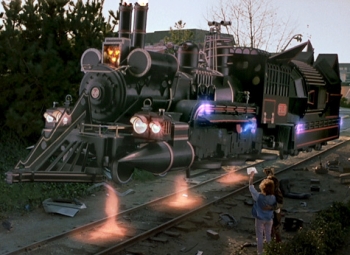
Thinking about it (as I have, lately) the current D&D Next playtest project is much like a train ride. We began by all hurrying to the station to climb on board the first playtest packet, excited to see where this train would take us and even more eager to get to reach the destination and see the finished product.

Time passed and, as happens, some people got off the train; that’s fine, as no doubt they had other places to be and had decided this particular train ride wasn’t for them. I and my merry group of wayward souls stayed on board, and continue to enjoy the ride – even despite the kids in the seat behind bawling “are we there yet?” at the top of their lungs. You know who you are.

At the same time this is unlike any other trainride as we have the ability to decide which route the train should take. Don’t want to stop at Dual-Class Junction? Tell the driver. Unhappy about the incline up Grindy Combat Hill? You can have a quiet word with the ticket inspector. As the tracks are still being laid up ahead, the route is (quite literally, if you print out the pdfs) in your hands.

Of course, if all the playtesters have a say then the risk is that the D&D Express just ends up going round in circles. Dungeons & Dragons is a huge hobby with players and DMs who all (quite rightly) believe that their particular playstyle is the best – and it is, for them. We have immersive gamers who revel in backstories and subplots alongside harried players who just want to grab a pregen and kill some orcs. We have DMs who weave complex story-driven arcs of their own making and DMs who would much prefer to use published adventures with ready-made battlemats and a stock of minis. We have everything in between and beyond, with many players and DMs being a bit of everything in varying degree. Identifying quite what we want out of a game is a minefield, and I’m pretty sure that driving a train over a minefield is a really bad idea.

This is why of all the ideas mooted for D&D Next, the one I’m most excited about seeing is Modules. Pushing the train analogy a little further, Modules are the carriages that make the train. You get to pick the class of seat, the buffet car and number and type of carriages. Which Modules you pick (or not at all, if you’re happy playing vanilla core D&D) dictate whether your particular D&D Express train is a fast-as-lightning bullet train with ultra quick combat, rapid healing and a cinematic action feel, or a slow-burning heavy stoker loaded up with crunchy game options and detail. D&D becomes your game, according to your particular whims and needs.

This is a Module. Probably.

This is where it’s my turn to be the annoying kid who kicks the seat and says “ARE WE THERE YET??“. I know we have seen some modules in D&D Next already (the various healing rules, Backgrounds, etc) but they’ve not been explicitly called out and standardized in their approach. I want to see a Module as a module with a fixed template and structure so we know it as such. I want Modules by the bucketload with Mass Combat being high on my list. Much as I’m sitting back and enjoying the ride, that is one piece of the journey I’m most eager to see.

So I hope you’re still along for the trainride. If you aren’t, or left the train at an earlier station, grab the latest playtest packet and hop on board. You might just like where we’re going, and how far we have travelled already.

Till next time!

Facebook and Gaming?

I have been shown a valuable tool for use by our gaming group – a Facebook Group, and we’re using it like a fiend…

I am not Mr. Tech. I have zero apps for my Android (heck, I only got a smartphone a few months ago), and I have a love/hate relationship with my computer. And when it comes to social media, I’m POSITIVE that I’m still not doing it correctly. I’m certainly not cool enough to be called a nerd. However, I have been shown a valuable tool for use by our gaming group – a Facebook Group, and we’re using it like a fiend.

Maybe you know all about this already, and maybe you use something else entirely different, but if you’re like me, you’ve had no idea that this stuff was out there. I have to say, it’s freaking useful as hell. 6/7 of our group is online, and we use the crap out of it.

We use it to talk about schedules, planning, characters, jokes, and quotes of the week. We sometimes use it to talk amongst ourselves in-character, or talk about the adventure. Also, we can upload and download files for all of us to use. And since it’s Facebook, we get instant updates when one of us posts or comments.

Facebook

I simply like it.  I’m not a huge Facebook fan, but we definitely see the benefit and value out of this group function.

I’m curious, do you use Facebook Groups for your gaming group, or some other forum?  I’m interested to see how others can get use out of it, or if something else is better…

The Next Epic, part three

The turn of the millennium had comparatively little impact on the world. The same could not be said for Dungeons & Dragons, however…

“I don’t care how high your attack bonus is, you can’t punch the sky!”

The turn of the millennium had comparatively little impact on the world; quasi-religious prophecies ranging from the Rapture to Y2k had failed to materialize, leaving the world untouched by dramatic upheaval. The same could not be said for Dungeons & Dragons, however.

The year 2000 marked the full results of TSR’s acquisition by Wizards of the Coast several years previous, as the Third Edition of Dungeons & Dragons debuted, along with the Open Game License. While the full scope of these events is beyond the aim of these articles, they are noteworthy for their impact on epic-level gaming.

Dungeons & Dragons Third Edition

The third edition of the D&D game had dropped the “Advanced” descriptor from its title. As the Basic game had been quietly retired during the mid-late 90’s, the thinking was that there was no need to confuse (if not intimidate) potential new customers with the implication that there was a “less complicated” version of D&D that was still in production.

In terms of its game mechanics, Third Edition was a huge break from its ancestors. Many basic assumptions were altered radically, or even discarded in their entirety. Demihuman level limits, for example, were now completely removed from the game. All classes advanced according to a single, unified experience table, rather than each class having their own. All characters could now multiclass (as opposed that being reserved for demihumans, whereas humans would dual-class), taking levels in any class they wished as they gained experience (though a control mechanism was instituted in the form of experience point penalties if your various classes had wildly differing levels; a corresponding loophole was introduced in the form of each race having a “favored class” that didn’t count against them in this regard).

One aspect of the previous edition remained the same in Third Edition, however: character advancement was capped at 20th level. As with the introduction of Second Edition, this cap was introduced implicitly, rather than explicitly – the simple lack of rules for advancing beyond 20th level was all that kept characters from going any higher, rather than a strict prohibition.

Unlike Second Edition, however, this would be a situation that would not be allowed to remain undisturbed for very long. With the transition of the D&D game came the requisite transition of many of its campaign worlds, some of which included popular characters with levels well in excess of 20. So it was that when the Forgotten Realms Campaign Setting was released in 2001, a year into Third Edition, it had to address this particular query.

Of course, that didn’t mean that it had to address it directly. In answer of levels beyond 20, the book presented only a single sidebar, largely limited to explaining the stat blocks for the “epic level” NPCs in its pages – this was the first time that the term “epic” would be used to describe level 21+ characters. It wouldn’t be the last, however, as the sidebar promised that the forthcoming Epic Level Handbook would cover this area in far greater detail.

Said handbook would debut almost exactly a year later (and had a book on deities in Third Edition precede it by only two or three months), marking the first time that a Dungeons & Dragons book had been devoted exclusively to characters that transcended the number of levels present in the game’s main rulebooks.

The credo surrounding the release of Third Edition had been “options, not restrictions,” and this was faithfully reflected in the Epic Level Handbook. Rather than the hard caps on levels found in Basic or Second Edition, Third Edition followed in the footsteps of First, placing no upper limit on how high PCs could ascend. While one could charitably say that the book’s intent, as part of the “toolkit” mantra of Third Edition, was that each Dungeon Master would use the book to determine their own hard cap on levels appropriate to their campaign, such a message was never articulated in the Epic Level Handbook itself.

No credible discussion of epic levels in Third Edition can be had without mentioning just how badly the book was received among the gamer community. Popular opinion of the book was poor, mostly due to the implementation of its game mechanics. While the specific list of complaints are many, most can be distilled down to a single charge: that the book exacerbated the deficient areas of the Third Edition rules.

Some elucidation is worthwhile here. The Third Edition game mechanics – popularly known as the d20 System – focused around a task resolution system of rolling a twenty-sided die (aka a d20) and adding relevant modifiers, with the task succeeding if the resulting score equaled or exceeded a specific target number.

The problem came from the open nature of the game’s “options, not restrictions” stance. Simply put, so many options were put into print (both from Wizards of the Coast for D&D itself, and from compatible products by third-party publishers via the Open Game License) that, presuming that a large number were allowed by the Dungeon Master, the modifiers that were added to the d20 roll would soon eclipse the 1-20 range of the die roll itself.

Because a character’s level was the natural manner of restricting the total number of options they could pick, characters that went up in level naturally gained more and more options, and so more and more ways to affect a given d20 roll (particularly among spellcasters). As such, epic-level characters were perceived as being “broken” simply for how widely they could vary in their efficacy, meaning that two characters of equal level could face a task that would be virtually impossible to accomplish for one, and impossible to fail for another. This made writing epic-level challenges more and more difficult, to say the least, as the characters’ levels climbed.

While there were complementary issues, the above goes to the heart of why epic levels in Third Edition were so poorly received. Whereas First Edition had been content to let characters gain levels infinitely, it had restricted the mechanical gains of new levels to nothing but hit points. Third Edition, by contrast, had attached much more power to each level gained, making it somewhat inevitable that – absent any kind of ceiling – that power would rapidly balloon out of control.

Divine ascension was still available for those who wanted it, of course. As with First Edition, this was a purely orthogonal choice, and was generally assumed to mean the retirement of the character. Perhaps ironically, this didn’t necessarily have to result in the character becoming an NPC; as mentioned above, a book on gods for Third Edition had come out a few months ahead of the Epic Level Handbook, this being Deities & Demigods.

Named after the First Edition book of the same name, the Third Edition Deities and Demigods was more similar to the Immortals rules of Basic D&D in that it not only had stats for a number of divine entities, but provided comprehensive rules for how to build gods, rules which (thanks to Third Edition’s using the same stats for monsters and NPCs as for PCs) could be applied to PCs with no conversions necessary. By contrast, OD&D and First Edition had portrayed gods purely as unique monsters, with no particular discussion of what (if any) powers ascended PCs would gain (Second Edition, by contrast, gave no rules for deities at all beyond some general limits to their powers; the only stats listed were for godly avatars).

Even more in vein with Basic was that, in the appendix on divine ascension, Deities and Demigods had a section on running adventures with the PCs as gods. Presumably presented in accordance with the “options, not restrictions” ethos of Third Edition, this was a complete nonstarter with Third Edition gamers.

This wasn’t to say that epic-level, and even divine, game-play were completely unrequited among the Third Edition community. Thanks to the Open Game License, instances of adventures and sourcebooks that spoke to these concepts crept up every so often (though in the case of the latter, they were just as likely to try reinventing them as they were to expand on them). None of these attempted to fix the underlying issue of power-inflation, however. How could they, after all, when the problem was expressly tied into the nature of the d20 System itself?

A fix of that magnitude would require a new edition entirely, something we’ll cover in the next article.