The Next Epic, part two

The evolution of D&D with regards to mandated end-points of character progression – and ways to bypass those end-points – was not a precise one…

“Time to see how much XP you’re worth, old man!”

The evolution of D&D with regards to mandated end-points of character progression – and ways to bypass those end-points – was not a precise one. While OD&D had largely been silent on the matter, and BD&D had gradually pulled back the curtain on higher and higher levels (save for demihumans, who were capped at comparatively low levels) all the way to playing as a deity (and subsequently evolving beyond even that), the Advanced Dungeons & Dragons game would not present quite as coherent a picture.

Advanced D&D First Edition

Advanced Dungeons & Dragons is presumably “Advanced” in relation to the Basic edition of the game. The truth of that idea, however, is somewhat murky. AD&D officially debuted in 1977, with the release of the Monster Manual. It wouldn’t be until 1978 that the Player’s Handbook was released, followed by the Dungeon Master’s Guide in 1979.

By contrast, the very first “basic” set (by Dr. J. Eric Holmes, as mentioned in the previous article) was itself only released in 1977, the same year as the Monster Manual – by contrast, the subsequent iteration of the Basic rules (which would be the first half of B/X), wouldn’t appear until 1981, by which point AD&D was well-established whereas Basic wouldn’t achieve its “final form” until the Mentzer boxed sets, which began in 1983.

This is all worth mentioning because it reminds us that AD&D wasn’t originally meant to be the next logical step up from “Basic” D&D (though it would eventually be branded that way), so much as it was taking the same basic ideas from their shared predecessor (OD&D) and running in a different direction with them. The foundation is the same, but the implementation is where things differed.

This “similar, but different” approach can be seen in the AD&D game’s approach towards upper levels and divine ascension. Whereas BD&D’s allowed only humans to pick their class, with demihumans having their class define their race (e.g. you could start the game as a 1st-level human cleric, whereas if you wanted to play an elf then you were a 1st-level member of the elf “class”), AD&D allowed for race/class combinations for all characters.

These combinations, however, were highly limited. Even leaving aside that races and classes had minimum (and maximum, for races) ability score requirements, AD&D implemented the idea of humanocentricism by including hard limits on how many levels demihumans could attain in various classes… presuming that they could take those classes at all, since each type of demihuman could only take certain classes to begin with. Humans, by contrast, could take levels in any class they wished, with no upper maximum.

Of course, even these hard-and-fast rules had their exceptions. Each demihuman race in the Player’s Handbook had one class in which they could advance without limit, just like humans (this was the thief class for all demihumans save half-orcs; for them, unlimited potential was found in the assassin class… which was rather ironic, as the next sentence will show). Likewise, no race, not even humans, could advance endlessly in classes for which only a finite number of levels existed, such as with druids or assassins – once you hit the maximum level in either of those classes, there was no further advancement to be had (unless you were already multiclassing if demihuman, or could dual-class if human).

This was the first time that the D&D game, in any incarnation, featured level advancement that was potentially unlimited. Strictly speaking, if you were of the right race/class combination, the sky was the limit for how high you could climb. Surprisingly, however, that degree of advancement made very little difference in a character’s overall power.

The reason for this is that, at a certain point, gaining new levels offered virtually nothing. Every class stopped gaining new Hit Dice around 10th level or so, after which point you gained only a small, set number of hit points, usually ranging from 1 to 3 (to which you didn’t get to add your Constitution bonus). Likewise, your saving throws and to-hit bonus tended to top out at around level 20.

In other words, your character didn’t gain very much at all by leveling past 20th level or so. You got a new hit point or three, but that was about it. So your 75th-level fighter and your 20th-level fighter weren’t going to be that much different, save that the 75th-level fighter was a better meat-shield (one notable exception to this, however, was that spells with effects based on caster level had no cap – that meant that your 75th-level wizard could unleash 38 magical blasts with a single casting of magic missile!).

Now, your character might have gained a supreme amount of magical items by that point, and possibly political powers as well if they’d chosen to dabble in rulership (the game tended to suggest that around “name level,” which was usually around 9th, that your character would begin to have a political impact on the world around them), but this wasn’t mandated by their level, being the result of the character’s in-game exploits.

One alternative goal, for those who wanted to try for it, was divine ascension. Introduced with the Deities & Demigods book in 1980 (and easily predating BD&D’s Immortals boxed set, which didn’t debut until 1986), divine ascension was highly different from how AD&D’s Basic counterpart would define it. True, both included a set of difficult conditions that had to be fulfilled before your character would be accepted into the ranks of a pantheon, but the similarities ended there.

For one thing, AD&D divine ascension was not a natural end-point for character progression. Indeed, an AD&D character that didn’t run aground of racial or class-based level limits could theoretically level-up forever (presuming that they found some way of dealing with problems of age), all the while remaining mortal.

A much more stark change between the two games was that, for AD&D characters that became gods, their apotheosis marked the end of their participation in the game, at least insofar as being a player-character went. Deities & Demigods explicitly stated that the newly-ascended deity was given non-player-character status, making them under the control of the DM.

Further, there was no option for their “removal” from the game world. Whereas BD&D’s Immortals could, through great difficulty, ascend beyond the game world and its rules, AD&D’s gods had no such lofty goal to shoot for. Once you were a god, you were pretty much an established god of the game world from that point on (unless the whims of the DM had some cosmic fate befall your divine NPC).

This formula, where your class and race combination determined if you would have unlimited potential or hit a hard cap, with divine ascendancy as an orthogonal option for character retirement, would be comparatively unchanged in AD&D Second Edition… but what changes it did have would be notable indeed.

Advanced D&D Second Edition

The Second Edition of AD&D introduced several twists on many of the ideas regarding upper-level limits for characters that its predecessor had introduced. For example, while demihuman level limits remained in the game, new rules about allowing demihumans to exceed these limits appeared (though these exceptions were dependent on having exceptional ability scores, and only allowed those limits to be pushed by a few levels). More notably was the fact that no class allowed for unlimited demihuman advancement; that was now a privilege reserved for humans alone.

Of course, that privilege was to be taken in light of a far more dramatic change: all classes were now twenty levels long. While not presented as a hard cap (the Second Edition DMG even said that advancing beyond 20th level was “theoretically possible”), it was fairly well understood to be just that; the lack of information about how many experience points were needed, and how many hit points were gained, meant that adventurers were effectively capped at 20th level.

Interestingly, this cap was first extended not by a generic rulebook, but by the Dragon Kings supplement for the Dark Sun setting. Dark Sun had, from the first, been presented as a very tough campaign world (PCs were told to make their starting characters level 3, rather than level 1), and this book was the natural conclusion to that. It showed how all types of classes (albeit with racial limitations, though ones tailored for that campaign world) extended to a new limit: 30th level.

Despite the fact that this was a campaign-specific supplement (and as such had campaign-specific aspects to these higher levels), it had impact for all Second Edition D&D characters; indeed, since the campaign settings of Second Edition AD&D were all set in the same multiverse, there was ample understanding that these rules could be used for all 21+ level characters.

This approach was eventually formalized in the generic supplement Dungeon Master Option: High-Level Campaigns. Here the 21st-through-30th-level rules were given in a generic presentation (differing from those presented in Dragon Kings), allowing them to be easily used for characters in all types of campaigns. It was also here that the hard cap on gaining levels was formalized, as the book out-and-out stated that no character could ascend beyond 30th level.

Of course, divine ascension was still possible. Indeed, divine ascension rules were presented fairly early on in Second Edition’s (in the Legends & Lore supplement, which debuted roughly a year into Second Edition), and were reiterated again in the High-Level Campaigns supplement as well. There is little to merit special attention here, however, as Second Edition’s divine ascension rules were near-totally the same as their First Edition counterpart, differing only in minor details of how to perform the act of apotheosis itself.

Indeed, the most noteworthy aspect of Second Edition’s divine ascension rules is in how they’re perceived compared to previous editions of the game. Like Basic, ascending to become a god was something that naturally seemed to follow once you ran out of available levels to gain – when there was no further advancement to be had, godhood is the only way left to go. Unlike Basic, but in the vein of First Edition, however, this is a closing chapter to a character’s career; something done as a grand send-off for your character, rather than entering a new phase of play. In this regard, Second Edition can be said to have split the difference between its predecessors.

Next time, we’ll look at how Third and Fourth Edition handled the questions of epic levels and divinity.

The Next Epic, part one

Given that D&D Next is still a little ways off, and that its module regarding epic-level game-play is likely a bit further than that, it’s worthwhile to look back at the history of the game and seeing how each version of it dealt with the concept of going beyond the upper limits.

“My epic character can beat the entire planet’s break DC.”

While there’s no official release date yet, it goes without saying that we’re getting fairly close to the formal release of D&D Next (the most likely date being August of 2014, to coincide with the fortieth anniversary of Dungeons and Dragons).

D&D Next, also known as D&D Fifth Edition, has a lot to live up to. It purports to use a series of add-ons, which it calls “modules” (not to be confused with the adventures for older editions) to allow groups to set the style of game they like, from rules-light exploration to intricately combat-focused. Moreover, these modules will purportedly cover specialized areas of game-play, such as underwater or planar adventures.

The idea here is that every niche will be spoken to with a module of its own, and that these will be – if not complementary – then at least clearly delineated so that it’s easy to mix-and-match. That’s an admirable goal, though I wonder how well it can be accomplished, but what I’m curious about is one such module in particular: epic-level play.

Epic-level play is (much like rules for gods) something of a divisive issue among D&D gamers. There’s a general consensus that the higher the game’s level goes, the more the rules “break down.” Attempts to define what that means tend to be poor, but usually vacillate between problems of administration when there’s so much information to keep track of, and bonuses that are far and away larger than the range of the die roll that they’re attached to. As such, those who want to “go epic” with their game – which is usually understood as leveling characters beyond level 20 (or whatever the basic rules’ level cap is understood to be) – tend to be something of a minority.

One of the problems with discussing epic levels, to my mind, is that there’s no real consensus on what such levels actually constitute (beyond the aforementioned definition of “going beyond what the rulebooks list”). In fact, if you look back at the history of D&D in its various editions, each version of the game has tackled this particular question in very different ways, each with their own strengths and weaknesses.

Given that D&D Next is still a little ways off, and that its module regarding epic-level game-play is likely a bit further than that, it’s worthwhile to look back at the history of the game and seeing how each version of it dealt with the concept of going beyond the upper limits.

Original D&D

Original D&D – the “woodgrain/white boxed set” and its five supplements, also called “OD&D” or “0E” – is something I’m hesitant to speak about. Of all the various versions and iterations of the game, it’s the only one I’ve never directly seen in one form or another (though I hope to change that in the future). As such, take the following with a grain of salt, as it’s based on second-hand knowledge.

Original D&D had only a few character classes (three in its original release – the fighting-man, wizard, and cleric – with the thief added in the first supplement), and the listed set of levels for these classes was quite low: in the single digits. There was no real reference to going beyond these levels, either in terms of a prohibition against doing so, or as a how-to for those who wanted to. This aspect of the game, like quite a bit of game-play using these rules, was open to the interpretation of the Dungeon Master (and his players).

It does seem safe to say, however, that at this point there wasn’t really a codified sense of “where the game wanted you to stop” and how to move past that barrier. Rather, the game rules seemed to paint a picture of taking you so far, and then leaving you to your own devices. What we’d later come to think of as “epic levels” simply wasn’t something that was fully conceived of yet.

Basic D&D

Before talking about Basic D&D, we need to clarify exactly what this term encompasses. Moreso than any other edition of the game, Basic (also called “BD&D” and interestingly not having an edition number) is made up of several different versions of the game, all superseding and reinventing each other as they went.

The first Basic Set, written by Dr. J. Eric Holmes (aka the Holmes Basic Set) was meant to be a repackaging of OD&D, but included enough changes to the rules that it’s generally considered to be its own animal. Like its predecessor, it didn’t really speak to the idea of going beyond the listed levels, more as something not considered than deliberately ignored.

It was only later, with the release of the B/X set – that is, the Basic Rules boxed set by Tom Moldvay and the Expert Rules boxed set by David “Zeb” Cook and Steve Marsh; these were another introduction to D&D that changed just enough from their predecessor to be their own animal – that the rules started to speak to strict limits on how high characters could advance. Ironically though, this series never got that far (at least, not for most characters. Demihumans, however, hit hard caps here); a third set of rules that was supposed to present the upper limits of character advancement, called the Companion set, was never released.

Or rather, it wasn’t released for B/X. Once again, the Basic D&D game was re-released as a series of boxed sets that changed enough of the rules to be considered their own thing. This time it was in the form of the five boxed sets known as BECMI – Basic, Expert, Companion, Master, and Immortals – by Frank Mentzer (though they would eventually be re-released, with some tweaks by Aaron Allston in the form of the D&D Rules Cyclopedia and the Wrath of the Immortals boxed set). The first four of these boxed sets established, for the first time, that there was a ceiling to how high a character could advance (AD&D First Edition had already been released by this point, but it didn’t have the same cap; see below), that being level 36 (save for the aforementioned demihuman level limits, which were far lower).

Notably, the game didn’t stop here. The Immortals/Wrath of the Immortals boxed set(s) showed how PCs who had reached their level limit could potentially ascend to become deities (that is, “Immortals”) in their own right, at which point they could begin ascending the Immortal hierarchy.

PCs who hit the top of the Immortal hierarchy then had only one potential method for advancing further: they could give up their immortality and start as 1st-level mortals all over again. That certainly sounded harsh, but for those who managed to once again make it to the limits of mortal experience, and then ascend to the uppermost ranks of immortality for a second time, earned a special send-off for their character: they immediately attained the status of being one of the Old Ones (beings as far above the Immortals as the Immortals are above mortals) and were taken beyond the Vortex Dimension (which is to say, being the Basic D&D game’s multiverse).

The above is notable as it not only presents a hard-cap, but does so in a way that mandates that the character be retired from play, something not seen again until D&D Fourth Edition. Moreover, unique to all forms of character retirement, this one removed the character from the game world. Every other method of retiring a character, from death to divine ascension, turned the character into an NPC that was still part of the game world (and so could conceivably be featured again at some point). A character that attained the status of Old One in Basic D&D, however, had literally moved beyond the game itself.

Next time, we’ll look at the various editions of AD&D, and its ways that PCs could (or couldn’t) surpass the common limits for characters.

How To Teach Someone A Boardgame In 6 Easy Steps

As a matter of fact, my initial like or dislike for a new game is based upon how well you teach it to me…

I love to learn new games. I love it. Except when I don’t. As a matter of fact, my initial like or dislike for a new game is based upon how well you teach it to me (and I’ve run into some pretty bad teachers). So let me say this to all you board game teachers and want-to-be board game teachers out there. I love that you love this game (whatever it is). And I love that you want to share your hobby. I want to learn your game, I really do. But you may be driving people away, people who might like your game.

Let me help you: I find that, if you have a pre-defined structure to teaching a game, things go a lot more smoothly and new players quickly pick up a game. And bonus: no one’s eyes glaze over in the process. Here’s how I do it, in 6 easy steps. I’ve also included examples of how I teach two games (Settlers of Catan and Lords of Waterdeep) after each step, as working examples of the technique.

Catan

Step 0: Make Sure The Game Is Set Up Before You Start

The best way to insure success is to set up the game before you start explaining it. It’s fine to have the new players help set up, but I find it difficult to explain a part of game play that isn’t on the table yet. Not to mention any difficulty with multitasking…

Now is also a good time to point out defining characteristics that the game might have. For example, Pandemic is a cooperative game – knowing that up front helps new players frame what they’re about to learn. Not every game needs this, however.

Step 1: Start With How To Win

After the game has been set up, the very first thing you should tell a new player is how to win the game. That is, after all, the most important bit of information a player needs if they want any shot at coming out on top. By “how to win the game,” I’m simply talking about the win condition, not game winning strategy. This step should be a single sentence. If you can’t sum up the game’s win condition in a single sentence, you need to simplify your description.

Settlers of Catan: You win this game by being the first player to earn 10 victory points.
Lords of Waterdeep: You win this game by earning the most victory points.

Step 2: Briefly Describe How To Achieve The Win Condition

Again, we’re not talking strategy here. You’re simply describing the game mechanics that help a player move towards the win condition. Think of it this way: the first thing you did was tell the new player the game’s win condition. The natural next question in their mind is, “How do I achieve that within the game?” Don’t go too far down the rabbit hole here by being overly specific. It’s best to make a simple list that you can come back to once the player begins to understand the finer points of the game.

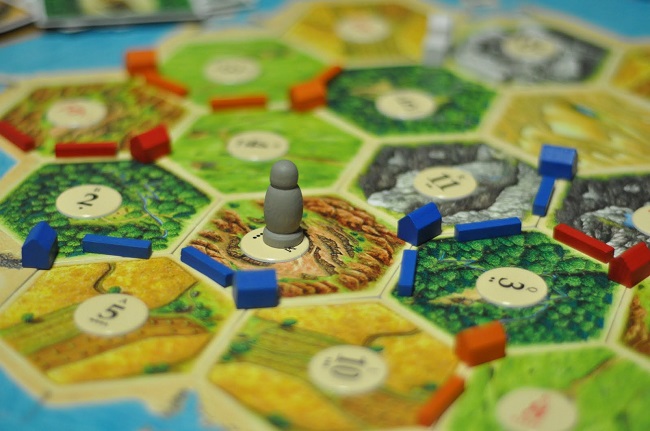
Settlers of Catan: There are a few ways to earn victory points. The most common way is to build settlements with resources. You can also use resources to buy power cards that sometimes have victory points on them. Finally, there are these two special cards – longest road and largest army – that have victory points on them. These cards can change hands though, based on who currently has the longest road or largest army. The resources are these cards here – sheep, wood, brick, wheat, and stone, and you buy stuff according to the player aid here. (Note the lack of information on building an army at this point)
Lords of Waterdeep: There are a few ways to earn victory points. By far the most common is by completing quests. Each quest card has the things you need to collect in order to earn the stated reward. You will also see this red gem at other places on the board or on cards – whenever you see them, it’s an opportunity to earn victory points. I will also note that your Lord card also has a way to get some bonus victory points at the end of the game that is unique to you. (Note the lack of information on Plot Quests at this point)

Step 3: Walk The New Players Through a Typical Turn (and Round, if Necessary)

The next thing to do is tell new players what they do on their turn. If at all possible, describe a typical turn, not an extraordinary one. If the game permits, have each person take a mock turn. If that would take too long, just take a single mock turn yourself.

Settlers of Catan: On your turn, the first thing you always do is roll these dice. The number that comes up on the dice corresponds to a tile on the map – so, see here is 12. The tile is a red brick tile. So, when a 12 is rolled, anyone who has a settlement next to that tile gets the resource on the tile. Bob, you have a settlement next to this 12 tile, so anytime a 12 comes up, you get a brick card, even when it’s not your turn.
Once you’ve rolled the dice on your turn, you have the opportunity to use your resource cards to buy stuff. (Go through each of the types of things you can buy, and why a player might want that. This is a good time to talk briefly about Soldier cards). You can also try to trade resources with other players, or you can trade four of a kind to the bank for one of anything else. If you have a settlement on a harbor, you can make better trades to the bank. Once you’re done building, you pass the dice to the next player, and they roll. (We still haven’t talked about the robber yet, and that’s ok.)
Lords of Waterdeep: On your turn, you get to take one of your little guys here, and place it on any open place on the board. Each spot gives you something different. (Go through what each space does briefly, saving Waterdeep Harbor for last. Don’t forget to describe the benefits of building ownership.) On your turn, you can also complete one quest, either before or after you place your guy. Once you’ve done those two things, the next person gets to go. After everyone has placed all their dudes, the round is over. Then, we take all our guys back, and do it again.

Step 4: Fill in any major holes (maybe)

At this point, the new players should have a pretty good grasp on the basics of the game. If there’s something important you left out, you may want to bring it up now. On the other hand, you may want to wait until it comes up in play.

Settlers of Catan: This little guy is the robber, and something special happens with him if a 7 is rolled. Notice no tiles have a 7 on them. We’ll go over what to do with the robber when someone rolls a 7 though.
Lords of Waterdeep: One last thing – a few of the Quest cards are “Plot Quests.” The plot quests say it right here. When you complete a plot quest, you get an ongoing benefit for the rest of the game. So keep an eye out for those.

Step 5: Describe The Game End Condition

Finally, let the players know how the game ends. Some games end when the win condition is met, so just reiterate that.

Settlers of Catan: The game ends as soon as someone has 10 points.
Lords of Waterdeep: The game ends at the end of round 8. You can tell what round we’re on by this track at the bottom of the board here.

Step 6: Play!

Start playing the game. Point things out as they come up in play, and apologize when you have to add something you’ve inevitably forgotten!

Other Do’s and Don’ts

Do:

  • …keep any description as short as possible. Avoid information overload or long discussions of that one time last year you made a cool combo happen.
  • …substitute game specific terms for generic ones. Many games try to come up with a unique name for common elements like points or money. Try to give things generic, easily understood names, so that players don’t have to grasp a new vocabulary in addition to the rules. (Many games use esoteric vocabulary to set themselves apart, but the example that comes immediately to mind is Quarriors. We call “Glory” points or victory points, and “Quiddity” dollars. In Lords of Waterdeep, we call “Agents” dudes or guys. You get the picture.)
  • …use a frame of reference when teaching the game. If the new game is a deck-building game, and your group has played deck-building games before, be sure to point out similarities as you go along.

Don’t:

  • …describe corner cases when going over the rules. (Wait until they come up in play instead.) If the stars need to align just so for something to happen, it’s best to just wait for it to come up. If it doesn’t come up, mention it before you play the next game. Everyone should be able to digest mechanical nuances at that point.
  • …mix strategy with teaching the game. Some players like to work out strategy on their own, and some get overwhelmed if you discuss it right up front – either way, a new player needs to understand the mechanics first and foremost. Let them make noob mistakes. It’s ok. Right now they’re just learning the game.

Is this the only way to do it?

No, of course not. You may have a way that works for you, and that’s fine. This is the method that works for me, and I’ve taught a whole lot of games. You may also find a game that this method doesn’t work for. When I teach The Resistance, I don’t follow these steps exactly in this order; the game is just different enough that it’s easier to explain another way. But for the most part, this works. It gets everyone from point A (Hey! A new game!) to point B (Oh, ok, I see how this works. This game is pretty fun!) efficiently.

How about you? What are your steps to teaching a new board game?

Researching Spell Research, part 2

The issue of independent spell research is one of the stickier wickets of most D&D/Pathfinder games…

Spell-Research
Young Gandalf, hard at work.

The issue of independent spell research is one of the stickier wickets of most D&D/Pathfinder games. This is because it’s an area where, more so than with most areas of the game, the mechanics and the in-game rationals for how magic works need to be tightly intertwined. Instead, both the mechanics and the flavor text are almost totally absent in this area. That means we’ll need to use a combination of deductive reasoning to try to develop a framework…

Sit a Spell

In the previous article, we mentioned that there was no real in-game reason why a character couldn’t research a version of a spell that wasn’t on their spell list (e.g. a wizard researching an arcane version of entropic shield). Let’s go over that a little more here.

The basic premise here is that most of the spell lists in D&D have fairly major thematic elements to them, which can be recognized from an in-game standpoint. Now, if these resulted in strict divisions between the spell lists, there’d be reasonable grounds for saying that there was an in-game reason why these different types of magic were only able to accomplish certain things and not others.

However, that’s not the case. There’s significant overlap between most of the spell lists, both in terms of individual spells being on multiple lists and in terms of overall theme. Both the cleric and sorcerer/wizard spell lists, for example, have several divination spells on them (e.g. scrying); given that, is there really a reason why the cleric couldn’t research their own version of detect scrying? It’s clearly not a departure from the theme of clerical magic, so why not?

As noted previously, if there is a departure in theme from one spell list to another (e.g. healing magic not being arcane spellcasting…notwithstanding bards) then this is an argument that there’s an in-game reason for the difficulty of another kind of spellcaster using that kind of magic, such as how in the previous article we discussed the inherent complexity of healing spells and how they’d have a higher level on arcane spell lists.

Of course, now you get into the details of how spell research actually needs to be conducted.

Formulaic Thaumaturgy

The question of how spell research is performed is an area where greater mechanical emphasis is needed, rather than flavor text. In-game explanations are very good for why and how things work the way they do, but insofar as an actual process goes you’ll need to figure out how you want the game rules to guide the attempt.

In this case, the rules for spell research need to speak to several different needs. The first is that there needs to be to be not-insignificant disincentives to conducting this sort of research at all.

That sounds counter-intuitive, but it’s very necessary. The end result of successful spell research is that your spellcaster will have a new spell in hand, waiting to be used (though for spontaneous spellcasters, they’ll need to wait until they have an open Spells Known slot they can fill it with – that’s the problem with learning your spells intuitively, rather than as an act of procedure; knowing something instinctively means that learning it intellectually isn’t sufficient). Because of this, game balance will be severely affected if the character can perform the process quickly, cheaply, and without any sort of risk, as your character will in very short order acquire an arsenal of spells.

Given that, at least one or more of those three issues – money, time, and risk – need to be set at sufficiently high levels as to make spell research something that isn’t undertaken lightly.

Cost would presumably scale with the level of the spell being researched, but this is a difficult bar to set. Most characters tend to start out relatively poor, but quickly amass considerable sums as they level up. Even considering that most of their treasure gets tied up in their gear, they potentially have hundreds of thousands worth of gold pieces by the time they’re approaching the end of their career, so a cost of a few hundred GP per spell level, which once seemed like a massive cost, is now little more than a pittance.

Time is another issue that’s difficult to assess in terms of how much it restricts the research process. If your game is one that sets a very quick in-character pace, saying that spell research takes (for example) one week per spell level can be a daunting barrier. On the other hand, if there are plentiful opportunities for down-time, then this is no real barrier at all, as the player can easily say that his character devotes months to nothing but research, and suffers not at all for it.

Finally, there’s risk. As with cost and time, the nature of this is highly variable depending on the character making the attempt. Risk, here, can be measured in two terms – the difficulty in accomplishing the task (e.g. how high the skill DC is) and the results of failure (e.g. does he lose some of his time and money? All of the time and money? Or does a failed check result in a massive explosion that deals terrible damage to everyone within a two-block radius?).

There is, ultimately, no single right framework for any of these, as they depend on how quick, costly, and dangerous you want spell research to be in your game. I’d personally recommend erring on the side of setting these limiting factors high, as this would push independent spell research to later levels of the game, limiting the amount of time they’d have to make an impact on your campaign. All of these are guidelines, however, allowing you to tweak them as you like.

Divine Directives

There’s a particular issue that tends to come up when researching divine spells is brought into play. Oftentimes, someone will ask “why does my character need to perform all of these experiments to create a new divine spell when the spell is being granted by my character’s deity? Can’t he just pray for it and his god will make it happen?”

On its face, this is a reasonable question. One would presume that a god that’s already granting many diverse spells could just snap its fingers and make something new if it wanted to, and that’s that. So why are you being made to do all of the legwork?

As it turns out, there’s a pretty good reason why.

Recall the quote we had in part one about how, insofar as healing spells went, there was a lot of complexity to those spells that was being handled on the divine end so that your character could cast them as low-level spells? It’s basically that all over again.

Creating a spell, even a low-level one, is a complicated process. Much like building an engine, you have to make sure that all of the parts are properly connected and working correctly. Designing one from scratch, assembling the components, and performing testing are a fairly complicated process, whether you’re a humble mortal or a powerful celestial (or infernal) being. Ultimately, somebody has to do that work…and you’re the one asking for something to be made.

That’s why divine spellcasters have to do their own spell research. Their deity is basically setting up a paradigm where they tell their worshipers “Look, if you want a brand new spell, I’ll grant it to you. But YOU have to figure out the ins-and-outs of this thing. I’ll fill the order you place only if you can give me a working set of blueprints.”

That hardly seems unreasonable. Though I’m sure that if a cleric wants to complain about it overly much, there’s a divine complaint department set in one of the less comfortable regions of the afterlife.

Researching Spell Research, part 1

One of the major compromises that all role-playing games make is that at some point the rules will have to sacrifice some degree of specificity in favor of playability. No game, after all, can model reality down to the most minute detail…

Research-booksOne of the major compromises that all role-playing games make is that at some point the rules will have to sacrifice some degree of specificity in favor of playability. No game, after all, can model reality down to the most minute detail.

Indeed, one could say that the difference between RPGs is nothing more than the degree to which they balance the granularity of their model of the game world’s reality with how “game-able” their rules are.

Not all areas of this model are necessarily equal, of course. Certain things, such as combat, can be modeled to a much greater or lesser degree than others, such as economics. But perhaps the hardest things to model are those which have no analogue in our real world, a big example of that being magic.

That might sound counter-intuitive at first. After all, having no basis in reality means that we have the freedom to set it however we want in the game world, does it not? Well yes, it does…but this means that, having no existing model on which to draw (existing game systems now withstanding), we’re likely to make errors regarding its internal consistency, or worse, forget relevant parts of the system altogether.

One such forgotten element is, in D&D 3.X and Pathfinder, the ability to independently research and create new spells.

Re-Searching for Answers

The issue of (the lack of rules and guidelines, as well as in-character analogues for) spell research in D&D and Pathfinder isn’t a big deal, comparatively speaking. You can – and I suspect that many, if not most, of you have – run successful campaigns without this particular problem ever cropping up.

However, it is part of the background assumptions of the game world. Wizards, for example, are said to be researching new spells as they adventure, and that’s why they gain two new spells every time they gain a level. As a meta-game conceit, these are considered to be existing spells in the Core Rules or a supplement, but why do they have to be? Likewise, the presence of named spells (e.g. Bigby’s Interposing Hand, Mordenkainen’s Disjunction, etc.) is a pretty clear indicator that individuals have the capability to create new spells.

The problem with having these assumptions exist with no further discussion or backing is that, if a player decides to start examining them closer, they begin to fall apart. Suppose someone looked at the previous two examples, for instance, and decided that when he leveled up he wanted one of his new spells to be an original creation bearing his name, rather than a pre-existing spell. Now the problem is front-and-center, and the GM needs to figure out how to deal with it.

Now that we’ve established that spell research goes on in the game world, and that a lack of further details can be problematic, let’s look at some of the pitfalls of creating new spells, both from a meta-game and in-character view.

Balancing the Issues

From a meta-game standpoint, the issues with creating new spells seem to be twofold in nature, both of which are expressions of the fear that they’ll grant too much power to the spell-maker. The first is that the spell in question might be flat-out overpowered (e.g. “it’s a fireball spell, but it uses d12s for damage and has no saving throw. Oh, and it’s 1st-level.”). The second is that it could be used to break down the existing differences between spellcasting classes (e.g. “Yeah, it’s an arcane version of cure light wounds. Now we don’t need the cleric anymore!”).

Let’s speak to each of these in turn.

Insofar as inventing spells that are native versions of existing spells on other classes’ spell lists, this is something of a tempest in a teapot. The sheer mechanics of limited spells per day will do wonders to ensure that there’s no additional spell which, should a character acquire it from another class’s list, will turn them into an unstoppable powerhouse, or even dilute their role that much. After all, with all of the spells they need to prepare, how much will things change is a wizard prepares a single cure light wounds?

Likewise, on the issue of overpowered spells, this falls squarely within the realm of GM fiat. No matter what rules system (if any) is being used to adjudicate researching new spells, if the GM says that he or she doesn’t approve of the results, then that’s that (particularly since the GM can just come up with an in-game explanation for the failure of the research). In fact, Paizo wrote a guide for GMs to judge the power of original spells in their Ultimate Magic supplement.

From an in-game standpoint, it’s fairly easy to justify these meta-game decisions. After all, if a wizard wants to invent an arcane version of entropic shield, it’s more germane to ask “is there any reason to suggest that that’s not possible?” than for a reason to suggest that it is. Certainly, a wizard having such a spell wouldn’t be likely to unbalance the game.

Now, insofar as certain things like arcane spellcaster casting healing spells goes, there’s a section from my favorite blog that has some interesting ideas on the topic:

Also, note that what The Practical Enchanter says about spell design: it’s a combination of complexity AND power. People all too often ignore the Complexity because Power is obvious and flashy.

Now let’s look at the Cure Wounds series. Power-wise, those spells fit in at their given levels pretty closely. A given healing spell is usually weaker than a same-level attack spell, but they do scale with the spell level and somewhat with the caster level.

So now we know a more powerful caster does affect the spell. This may be important later.

Complexity-wise, healing is way overboard. That 1st-level spell can knit bones, restore organs, push leaked blood and fluid back where it does no harm, erase any chance of infection. If the individual is dying, it will erase all the ongoing damage to the nerves, brain and spine instantly.

[…]

Cure Light Wounds is at LEAST at fifth-level complexity. I’d say sixth for practical purposes. With a few hundred years of development and polishing it might be possible to get the spell down to fifth level.

So why is it so cheap? Well, remember that divine spellcasters get a hidden bonus. They have a deity, and probably an entire divine staff, processing, preparing, and weaving the spells. Druids get that same edge from nature gods or local spirits or some such. Those spellcasters may be storing and casting their healing spells, but they don’t have to do all the work.

While this is specific to the question of healing spells, it speaks to a broadly-applicable school of thought on the subject of why a spell can have different levels on different spell lists. This won’t always be the case of course (in fact, the article goes on to note that this will usually not be the case), but it helps set the tone for why the differences between arcane and divine spells are the way they are.

Given that, it seems safe to say that if the GM is involved in the process (particularly in determining the nature of the results of the research) and has some guidelines in mind for adjudicating the results of successful research, there’s comparatively little reason why researching new, original spells shouldn’t be allowed.

Next week, we’ll look at the question of actual rules for the research itself, and take in some of the differences between arcane and divine spell research.

Click here for part 2…

The Blood of Malkav: Clan in VtM Bloodlines

The choice of clan in VtM: Bloodlines is actually fairly important. In fact, it’s the entire reason I recommend playing through the game at least twice…

The choice of clan in VtM: Bloodlines is actually fairly important. In fact, it’s the entire reason I recommend playing through the game at least twice, once as a Toreador or Tremere, once as a Malkavian, and a third time Nosferatu (if the idea of playing a creature so hideous that you risk violating the Masquerade (and common sense) just by walking openly down the street is appealing to you). Or you don’t mind the idea of knowing that a mere glance at you would frighten small children.

Yes. That’s exactly what I mean.

Ventrue is also a decent choice, incidentally, if you don’t mind the complication of having to narrow your food sources. Chances are good it won’t disadvantage you much.

Today, though, we’re going to talk about the Malkavian, probably the most iconic of the clans in the sense that the girl on the box art is one of them. No that’s not a spoiler you find that out before you even meet her, geez.

See, the thing that’s great about Bloodlines from a replayability standpoint is that multiple versions of most of the dialog were recorded. And used. Which means other vampires actually react to your clan when it’s appropriate, and treat you differently.

This is most noticeable after playing Toreador and switching to any of the other clans I’ve named. And most of all when playing Malkavian.

The thing about Malkavians is, they’re insane. And I mean really insane, sometimes debilitatingly, almost always clinically, everything from multiple personalities to hallucinations to hearing voices… it varies widely and you encounter several of these along the way…

Which isn’t as impressive as the fact that as a Malkavian, a) all of your dialog prompts, as they’re written word for word what your character utters, come off as the rantings of the insane, which they are, and b) the other vampires actually react to this. Which is delicious.

Oh, and also? If you listen closely, sometimes when you talk to people, you actually hear whispers over their dialog, and those whispers sometimes contain spoilers. Apparently your brand of madness is the oddly prescient kind.

It’s unclear whether some Malkavians are insane prior to their transformation or if their blood makes them mad, but bloodlines seems to indicate the latter in your case. Even Heather, your ghoul—

—No, not… okay, Bloodlines uses the World of Darkness definition of ghoul, which is a mortal who drinks vampire blood and gains a limited level of vampiric power, like healing from greater injuries and so on, while also becoming increasingly devoted to the vampire.

Vampire

YES. Yes. Heather. Yes.

Sorry, was that a spoiler? I’ll keep those to a minimum, honest. I never know. The choice of what to do about Heather is of one of this game’s pivotal moments so I won’t ruin that by going into it too much. Anyway.

Heather (depending on events IIRC) is perhaps the most interesting example of this. Because while for, say, a Torreador or Tremere, her dialog becomes merely devoted, for a Malkavian it actually starts to become unhinged. That’s right; your insanity is contagious. And it is just… fascinating. Is that wrong of me? I can’t even remember the last time I felt like a choice I made in character creation had that kind of impact on a story level.

And yeah, sure, it’s still the same story arc. You hit all the same high points each time. You still reach the same pivotal choices. But the clan choice and your allegiances along the way make it feel like a very different journey. And if there’s one thing I’ve learned about RPGs, it’s this; that feeling can make all the difference in the world.

Designer Diary – Inspiration is Not Cheating

It can be hard to come up with new ways to describe common play elements over and over, and that’s one of the reasons why the Urban Dressing line exists…

Urban Dressing

It can be hard to come up with new ways to describe common play elements over and over. It’s one of the reasons why the Urban Dressing line exists. We created charts of names, descriptions, personality quirks, and other fun story elements so you can fresh text on the fly to add to your games.

I have a new dirty secret to tell. Even I, the great game designer Brian Liberge, have a hard time coming up with ideas. I mean come on, how do you describe a hundred different, low magic, interesting but not game-derailing alleys? I need a little help, just something to get my mind cranking in new ideas. It feels like cheating, but I assure you it’s not.

For Alleyways, I looked to my past work. I pulled up an old draft of Urban Dressing: Traders & Craftsmen, for which I had created a chart of a hundred trades and services. Nothing fancy, just one or two-word entries. Then I used them to inspire new details. The coppersmith became artistic metal gutters, the fisherman is now an odd stench, the carpenter inspired a pile of refuse blocking the way.

I found myself looking for inspiration again when working on Urban Dressing: Temples. I knew I wanted to have two charts, one of features based on your god’s domains, and the other descriptions that could be applied to any temple. The only problem was that the domain chart seemed to have all the cool ideas! I needed ways to generate more interesting mundane ideas, so they didn’t start stretching into the fantastic and competing with the domain chart. A quick Google search revealed an online random adjective generator and I was off. Grouchy, worthless, articulated, delicate. . . I couldn’t actually use each word to describe a temple, but they all brought new images and ideas to mind. That’s the great part, and the real reason inspiration is not cheating. If you were to use that generator to come up with your own temple descriptions, we might overlap on some themes, but the final product would be completely different.

So now you might be saying, “Brian, this is all well and good, but I’m not a game designer.”

Ah, but you’re probably the creative type (you’re a gamer, after all). If you’re the GM, your constantly designing cities, foes, quests and NPCs. Maybe you’re only a player(?), you still might want ideas to spice up your back-story. It’s easy to find new ideas without blatantly just copying something you saw in a movie. The key is to go looking for something new that isn’t exactly what you need. Anything new (i.e. not starring at your rule book or campaign wiki) will get your mind going, then return to the task at hand and try to apply it.

A cool tip I’ve stolen from others is to head to Google Maps. Jump to an area of the world you’re not familiar with and start looking at the names. Check out villages and counties. Zoom in further and read the street names. Now try swapping around the consonants or vowels (probably not both). You’ve got a whole new sound in your head perfect for naming the villages in that rival nation that the players suddenly decided to head for.

Inspiration can come from almost everywhere. It’s OK to seek it out!

“Our Goal is to Kill all the Bad Guys” – Crashing a Diablo II LAN Party

I’ve always felt a little bit like I abandoned gaming too early. So when my friend was planning on having a Diablo II LAN party for her birthday, I knew I had to see what I’d been missing…

Just-a-little-LAN-Party

When I was first approached to write for Stuffer Shack, I felt compelled to make one thing very clear: I am not much of a gamer. Sure, I grew up with an NES console and logged countless hours on GoldenEye 007 and Perfect Dark, but I haven’t really played a game seriously since 2003. I enjoyed the first Halo, dabbled in Morrowind, and nearly completed Star Wars: Knights of the Old Republic, but haven’t logged much time in anything other than a casual game since starting my undergrad that year. Since then, other interests have taken over, ranging from Theatre production to long distance running to vintage guitars. But I’ve always felt a little bit like I abandoned gaming too early.

So when my friend Stef was planning on having a Diablo II LAN party for her birthday, I knew I had to see what I’d been missing the last decade. I’m somewhat familiar with Blizzard’s past games; I played a considerable amount of Warcraft II in my early teens, and some of my friends in College played a lot of World of Warcraft. Despite not having ever played Diablo II, I asked to attend as a curious, somewhat impartial observer. Stef was enthusiastic about the idea, and I came to the party with much to learn.

The first thing I noticed was how much RPG knowledge I retained from playing those games, even after a decade of not playing them. Mana? Inventory items? Experience points and leveling up? I felt oddly at home watching my friend Craig level up his sorceress HelenHunt (the only sorceress he knows). The six players mostly elected to bring in existing characters they had worked on for a while. Two newer players began the game from scratch, and leaders quickly and amicably emerged. Soon after, questing began and the party got rolling.

The fun, of course, begins with character names. Over the course of the evening, our server was graced with HughJackman, HelenHunt, Mal (named for everyone’s second favourite intergalactic smuggler, of course), and, uh, Alex. His lack of creativity can be forgiven, as one has to save something for the trash talk, which I noticed has changed for the better in the last decade.

In the dorm room, trash talk was pretty predictable. Within the first few minutes of Super Smash Bros. or NHL 2004, someone was going to be called a fag, a retard, or a bastard. Combinations thereof were also common. Political correctness and creativity were on roughly the same level. Trash talk on this night was different. While it was not quite at the level of George Bernard Shaw and Winston Churchill’s caustic banter, it was mostly clean and refreshingly clever. I might not invite my Nana to the next LAN party, but I doubt she would have been offended to listen in. I, for one, found myself pretty amused for most of the night.

It didn’t take too long for me to start feeling left out. In retrospect, it wouldn’t have been too difficult for me to obtain a copy of Diablo II in time. Even my lowly MacBook Air has the computing power necessary to run it. I wouldn’t have been the only beginner present, after all. But I did promise to return as a participant rather than an observer next time. Will this be enough to get me back on the videogame bandwagon? Perhaps. Carving out a few hours per week to level up can’t be that hard, and if last Friday night was any indication, it’s just like riding a bike.

Wombat’s Window: Intro

Some mornings I end up in a drifting haze, and then it all comes together…

trainI take the train to work when I can. When I do, I can write or dream or edit or nap for an hour in the morning rather than spending all my time driving and fighting gridlock. Some mornings I end up in a drifting haze, staring out the window and watching the world slide past. Whenever I stare out the window, I always try to notice something new.

Sometimes I see something that strikes me as odd or funny, a juxtaposition of ideas next to the tracks. Sometimes all I see is trash and decay making random patterns on the ground. Sometimes I play a game I call Fantastical History, where I spin a crazy fantasy story explaining the origin of a specific thing you see in the real world. Sometimes the world outside the window seems drab and mundane, but even the mundane can teach us how to fill the cracks effectively in a fictional setting.

We all have a filter in our heads that shapes our perception of the world. If we think something has no value or importance to us, we give it a lower priority. Once something has been assigned a low enough priority it becomes noise. We discard it from our incoming picture of the world, and we have a hard time even noticing when it’s right in front of us. We unconsciously edit incoming data like this all the time, because it helps us focus on more important things that either threaten or benefit us. Do you even notice when you walk by a trash can if you’re not looking for one? What about graffiti? Big trucks when you’re not driving or crossing the street? Trash in the road? Utility workers? Manhole covers? Delivery people? Buildings you walk by every day?

If you’re looking for inspiration, try turning off your filter and seeing what’s right in front of you. The things you routinely ignore can feed your creative process if you let them. We’ll see examples of this in future Wombat’s Window articles.

Drawing inspiration from Tristan Tarwater’s excellent blog series Reality Makes the Best Fantasy, I’ll examine the mundane minutia that I see through my window on the way to work, write about some of my perceptions, and give you ideas to incorporate into your game. I’ll jot down a few hooks for different genres: Sword & Sorcery, Steampunk, Cyberpunk, and Interstellar. I may spin a Fantastical History or two along the way.

I encourage you to find inspiration in whatever you perceive as mundane. Everything in this world oozes story; for a simple example start with “Who would want to clean that thing?” and follow your answer to its logical conclusion. If you look past your mental filters and add a dash of imagination, you can turn something you’d normally dismiss into the core of an adventure, or a trap, or a new way to communicate.

Your creative oyster awaits: just look out the window…

I’m cheating in a way that is either completely justified, or totally inexcusable. You decide…

Heck, cheating at the gaming table is as old as the gaming table itself…

CheatingI think just about every gamer has experienced cheating at the gaming table in some form or another.  Heck, cheating at the gaming table is as old as the gaming table itself.  Some of us cheat when making our characters, some of us cheat when rolling our dice, and then some of us meta-game (which may or may not be a form of cheating).  However, I’m contemplating cheating in a way that is either totally inexcusable, or completely justified.  You decide…

In any given game, I can be either an aggressive gamer or a passive gamer.  I get the most joy out of the character when he’s full of character, but how I approach playing in a given campaign will make or break my enjoyment.  Ultimately, this is dependent on how much effort I’m putting in with regard to following the story – if I pay attention, everything’s great.  If I don’t take notes, I have trouble following along, and then I get bored.  I don’t know what my issue is – perhaps I’m just lazy?

I get most bored when I don’t understand what’s really going on in the campaign, so I just trod along acting like I know what’s going on.  Hey, there’s tons of weird names, it’s hard to remember who is who, I miss the plot clues, and then I find myself just wondering when the next fight is.  And, to validate my case, I see it in the faces of the other players as well…

So, I’m contemplating pulling a fast one on the players and the GM – I’m contemplating reading the adventure in its entirety, before we get any further in.

Is that cheating?

Let me defend my position: I’m sure the adventure/campaign is well-written and just fantastic, but it’s getting lost on most of us at the table.  Either the story and plot are too smart for us, or we just aren’t serious gamers.  Either way, my solution (I think) will help us get through it in a way that preserves fun for everyone at the table – I’m going to read the adventure in its entirety, so that I have all the ammunition I need.  And I will not tell a soul.

I don’t need to be “wowed” by the big finale, I don’t need to get powerful magic items, and I don’t need to be the one who finds all the clues.  I like being there because of all the fun and interesting things that happen spontaneously, often that have nothing to do with the adventure.  It’s the interaction at the table between player characters, and also the interaction with the NPCs.

Unfortunately, there are a lot of times when we (as player characters) are lost because we don’t understand what’s going on.  We could spend hours dealing with some writings on the wall, when really it’s just there as decoration.  We could spend hours searching the throne room, interrogating a spy, or chasing some dumb orc, all because we think it’s relevant.  Or, we could completely bypass the clue that will effectively take us into the next plot arc.

When there’s a lot of things going on, we can forget what our goals are, or not even figure them out in the first place.  Have you or your players ever sat there, dumbfounded, with no idea what to do?  That’s us, and that’s us often.  That right there is a heavy contributor to our games falling apart.

If I read the adventure – right now – I could alleviate a whole lot of wandering, a whole lot of unfun and confused derailment, and help keep us on the path.  I would know what’s going on, and I could use that as a base to help keep the other players focused.  I’m not going to suggest we search “this” particular room because I know that there are some hidden treasures, I’m not going to avoid a certain square just because I know it’s trapped, and I’m not going to suggest that we investigate the baron because I know that he’s the big bad evil guy;  I want to read the adventure so that I can keep us on track, so that I (we) don’t get lost, and so that we don’t get bored and start killing peasant farmer NPCs.  I’m not in-it-to-win-it; I’m in it for fun, for all of us.

If “spontaneously” drumming up the answer when everyone else gets stumped and frustrated makes me a cheater, then so be it.  I don’t know, what do you think?  And feel free to tear me a new one…

This article originally posted at The Gamer Effect on April 17th, 2013.