One Campaign, Many Systems: An Experiment (Part VIII) – The Big Wrapup

So, here’s the obligatory wrapup post. How did it go versus my expectations, what did I learn, yadda yadda. But first, here’s a list of the RPGs we played over the summer, including my thoughts on the whole endeavor…

So, here’s the obligatory wrapup post. How did it go versus my expectations, what did I learn, yadda yadda. But first, here’s a list of the RPGs we played over the summer, in the order that we played them. I’ve even linked the articles I did on each for you. How convenient!Summoner2

So, first off, that’s not 10 RPGs, which is how many weeks we technically had to play games over the summer. D&D took two weeks, as did Shadowrun… so now that I do the math, I guess we had more than 10 weeks because we did a few sessions of board games at the beginning of the summer. I tell ya, college summer break is pretty cushy.

Anyway, we got 7 RPG systems in. I GM’d all but Pathfinder, and the only systems that were familiar to me were D&D 4e and Gamma World. So what I’m saying is, over this summer, I had to have some sort of a handle on 4 new RPG systems. Only four? No big deal, right?

Well, yes and no. I mean, yes, it was a good bit of reading and work, but there are plenty of resources for new players of pretty much any RPG. Which leads me to my first lesson learned:

When doing an experiment of this type, pregenerated characters and quickstart rules are your best friend

I used the Quickstart rules and included adventure for Shadowrun and Leverage. Some of my players used free Shadowrun character generators. We used a “pregen timeline seed” from the Microscope book for that session. I used one of the 3 scenarios included in the Dread book for our Dread session. If it had been necessary for me to not only grasp the rules and mechanics of each of these systems and come up with a full length one-shot, I would have been swamped, and probably couldn’t have pulled it all off. So make liberal use of the free resources out there, from whatever source. This all leads nicely into the next lesson I learned which is…

If I were to do this again, I’d insist on division of GM duties

The fact that (almost) all of the GMing, and all of the “learn the new system” fell to me was kind of stressful. It was a lot of reading, and a lot of making stuff up that I didn’t remember or know from the rules on the fly. It isn’t too much to ask of your group that they share some of this responsibility, especially if everyone is on board with the idea of trying out multiple RPGs.

We abandoned the whole “maintain a single character through all the systems” trope pretty early on

Not because it couldn’t have worked – or at least, I still believe it could have worked. However, there’s something about trying a bunch of different RPG systems that makes you also want to try out a bunch of different character concepts. Which is interesting. If we had played a single campaign all summer, using D&D or Pathfinder or whatever, the players would have been more than happy to maintain a single character. I’m sure your group plays the same characters, month after month, in your long-term campaign. But, switch up the system, and people want to try out new stuff. That was the sticking point for the players – not that they couldn’t fit their original character concept into a new RPG if they didn’t want to, but more that they had other things they wanted to try. Which is fine. I totally support that.

We also abandoned the “unified storyline across systems,” sort of

The “story thread” that followed through the summer was kind of thin, and it was more a series of one shots with segues in between each that helped preserve continuity. This worked fine for us, and really wasn’t necessary. By the end, I was narrating a 2 minute segue scene at the beginning of Dread not out of necessity, but more out of dedication to the concept of the experiment. I guess what I’m saying is, the concept of a cohesive storyline across systems is cool in theory, but in practice it turned out to be unnecessary. We enjoyed playing with new systems for its own sake, and preserving a unified story arc didn’t add to the experience greatly. I would recommend that, if you want to try something like this, have a good reason to do so. For example: your PCs want to try a heist to accomplish something. Great! Maybe it’s time to try Leverage, but only for a session, and then switch back to your normal RPG. Are the PCs traveling through a wasteland with toxic elements that could warp and mutate them? Maybe play a couple of sessions in Gamma World. In other words, let the story drive what RPGs you choose to incorporate, not the other way around.

Always Look For Things To Steal

There is goodness in every RPG system, if you remember to look for it. And while a particular RPG might not turn out to be your cup of tea, that does not prevent you from co-opting the parts that you do like for your “regular” game. The best example I have from this summer is the Character Questionnaire from the game Dread. Will I play Dread every month? No, I’ll maybe play it once or twice a year. But I found the Questionnaire to be so useful, I plan on creating some for the characters in my next D&D campaign, to help the players create a useable backstory.

Need another example? Shadowrun’s initiative system lets really “fast” characters not only have a better chance of “going first,” but also lets them act more than once a round.

And so on…

Communicate. A lot.

One of the reasons that the whole “keep a single story and set of characters going” thing didn’t work was my vague expectations up front. We didn’t really have a discussion of how things would work, so we all kind of drifted away from the concept. I suspect also that some people weren’t on board with the idea from the get go, so that may have sabotaged things as well.

In the end, I’m not at all upset with how things turned out. We didn’t really do what we set out to do, but that’s ok. I think the fact that we were able to try out 7 different RPG systems over the course of a couple of months is a pretty big achievement on its own.

And I think that that’s what the experiment was all about. We all get stuck in our “favorite RPG” ruts, and that’s an ok thing I suppose. They’re comfortable, everyone knows the ins and outs, and gameplay runs smoothly as a result. But as I stated in the first article of this series:

“We live in a golden age of RPGs. It seems like every week Kickstarter adds another book and another system to the world’s growing library of Role Playing Games. If you want to play it, chances are, there’s an RPG for that. So why would we sit down and play the same system every single week? …I can think of no good excuses to completely ignore all the other systems out there. We must at least dabble!”

Indeed.

[Editor’s addition: An old favorite cross-genre goodie!]

D&D Encounters – A Coordinator’s Review

My husband and I are coordinators for D&D Encounters. We schedule, organize, and supply the program, while our local favorite gaming store supplies the space. As we approach the final weeks of the current season of Encounters, I decided to reflect on the changes to the Encounters program and how these changes have affected the program…

My husband and I are coordinators for D&D Encounters. We schedule, organize, and supply the program, while our local favorite gaming store supplies the space. As we approach the final weeks of the current season of Encounters, I decided to reflect on the changes to the Encounters program and how these changes have affected the program.

No More Free Ride
I was dismayed to learn Encounters modules would no longer be supplied for free, but instead would have to be purchased at full retail price. This was very disconcerting. In order to host our 4 weekly tables, we would need to purchase 4 modules at $30 apiece. Wizards of the Coast was kind enough to send us one free copy, which helped, but we currently don’t know if this will happen every season or if that was a one-time thing.

This is the biggest hurdle to the ongoing Encounters program, in my opinion. Maybe not for small stores (if they receive one free copy?) but larger stores with multiple tables faces a decision on how to manage materials for multiple DMs. At first we considered asking the DMs to buy their own modules. All but one of our DMs could not afford to purchase materials. It seemed unfair to demand that they pay and then also volunteer their personal free time to run D&D for a group of strangers. Eventually we purchased the modules for our DMs and started gathering donations to cover next season’s modules.

Modest Module
The module includes a campaign booklet, an adventure booklet, and a DM’s screen. I found these contents disappointing. The DM screen is nice, well-organized and neatly put together, but only one out of our four DMs actually use it. Many of our DMs no longer prefer to use screens; they create a barrier between the DM and the player and can sometimes instill distrust of the DM.

No maps were provided, which I personally found the most disappointing of all. Encounter’s poster-sized maps were routinely the most coveted items among my volunteer DMs. When a season had good maps, I could count on DMs wanting to volunteer, just to have a chance to receive a copy of the module with the poster maps. I understand the lean towards theater-of-the-mind with D&D Next, but if Wizards wants to claim the module has compatibility with 3.5e, 4e, and Next, a map would not have hurt that impression! I think many DMs would have felt more rewarded if the module included maps instead of the DM screen.

Next to No Edition
DD-Next
No monster stats are included with the module. Instead, the module makes suggestions and the encounters the DM may decide on do not rely on stats from any particular edition. Online we can download a packet of monster stats. I found it was easiest to pre-print the entire packet, one for each DM, and include it with their copy of the module.

Of course D&D Next Playtest is in full swing, so there is considerable interest in having a playtest table. This has generated a lot of positive interest and drawn in new players. We recruited a DM to run the Next Playtest with the module in addition to our 4e tables. We now keep a binder at the store with the latest playtest ruleset and provided printouts of the most current Next pre-mades.

The whole module isn’t the usual Encounters fare with its more open approach to encounter planning. This altered how we managed our DMs and our tables. On any given day we might have once shuffled players around because every table experienced generally the same series of events. We found we could no longer do that. Each table progressed too differently.

It also presented a considerable hurdle to recruiting new DMs. As the coordinator, I can no longer snag a random DM and sit them down to a table and say “run the combat on page 6”. When a DM called out on short notice, we eventually decided it was simply easier to cancel the entire table than to try to seat a substitute DM. The DM then caught up the table the following week.

Reporting Live
The WPN Reporter (the software coordinators use to report attendance to Wizards of the Coast) now turns into a pumpkin at midnight. It simply will not let us report after midnight on the day of the Encounter. This is slightly inconvenient as it now requires coordinators to ensure we report attendance immediately after Encounters, instead of the following day(s). Admittedly, sometimes we were quite tardy reporting our attendance and I can imagine the requirement simplifies things greatly for WotC. Still, its very limiting for coordinators. A weekday session requires playing in the evening to get after-school children and after-work adults in attendance. Reporting can only be done once attendance has been reported and if the coordinator is one of the DMs, they may not be able to report until the night’s session is done.

The Sundering
The materials for the new season talked much about The Sundering and how the events at Encounters would shape the actual world… except it hasn’t. There’s been no means of reporting what has happened, not to mention each table has been experiencing the module differently.

Thankfully, that seems to be about to change. The flyer for next season promises a mobile app with which players will report the outcome of their Encounters session. I look forward to seeing if it really does affect the Forgotten Realms setting.

Overall, the changes to the Encounters Program created new hurdles that I think will impair new coordinators from launching and/or growing their local Encounters Program. I think current coordinators will experience difficulty recruiting and keeping DMs – who are the heart and soul of the Encounters program. I’d like to see what Wizards of the Coast plans to do to encourage DM recruitment.

On the other hand, it is very exciting to see a more immersive approach to the Encounters material, not to mention the possibility of a sort of return to a “living campaign” in that Encounters may actually affect the Forgotten Realms setting.

However, I have only my own experience to go by, and I coordinate for a large game store that seats 20 to 30 players each week. A small store with only one or two tables may find these insights less applicable. I’m especially interested in hearing how other coordinators have coped with the changes to Encounters and how it has affected their players and DMs! Post comments and let us know!

Gen Con Wrap-up: Getting Started in the Industry

It’s been a crazy few months for me since GenCon. This post is later than most GenCon posts you’ll see, but I think you’ll like it anyway…

This is my Game Designer hat. You should get one.

It’s been a crazy few months for me since GenCon. This post is later than most Gen Con posts you’ll see, but I think you’ll like it anyway.

On the Thursday of Gen Con, I had the honor to moderate a panel titled “Getting Started in the Industry: Freelancing and Self-Publishing.” First lesson learned, people in the industry lead busy and tumultuous lives. The panelists changed almost completely from once I first submitted the panel and the day we spoke. The room was full regardless and we had a great time.

Our Panelists were Matt James of Vorpal Games, Tracy Barnett of Sand & Steam Productions, Eloy Lasanta of Third Eye Games and Shoshana Kessock of Phoenix Outlaw Productions. Each of the panelists has made a name for themselves in the field of RPGs and most have had experience as a Freelancer and as an Indie Publisher.

That was the heart of what I wanted to get at with this panel. The number one question I get from people is ‘How do you get started in the Industry?’ It’s a question that doesn’t have one answer, and the answers keep changing with technology and trends. Up until recently the number one answer was “Write, then submit to people with open calls.” Now however it’s so easy to self-publish, but should you?

I’d like to pretend I left that panel with a list of do’s and don’t’s, but I did not. Nearly every topic presented, every question posed, had at least one delegate disagreeing with what one should do. For every positive experience, there was one that didn’t work out quite right.

Everyone did agree on one thing. You have to write, every day ideally, even if you don’t have a project at the moment. Most of the panelists encouraged blogging highly as part of that, something I am guilty of slacking on myself. Not just brainstorming or reading, but writing is critical. If you get an idea, even if you can’t work on it currently, write as much of it down as you can. The more you write on a regular basis the easier it becomes. From personal experience, the longer I wait between projects, that harder something becomes, even when it was once easy.

So now that you’ve got good writing habits, how do you move on to being published? This really boils down to personal preference. There’s really only a few key differences between being published by others, and self-publishing:

Freelance/Submissions: You do the writing and some of the promoting. Chances are you don’t do anything else. You may get a flat fee or royalties, but once your work is done it’s someone else’s job to edit, layout, find art, publish, distribute and at least some marketing. Once it’s out of your hands its out of your control. Sometimes your publisher will let you give feedback on some of the other steps, but in the end things will change (things you created) and you can’t stop it.

Self Publishing: You are responsible for everything. Even if you hire other freelancers to do some of the work, the work they do is your responsibility. You also have full control. The title isn’t going to change, even if the editor advises that it should, unless you approve that change. You don’t get paid unless the product earns enough profit to pay you back for all the money you put into it, or unless you rely on donations/crowdfunding.

Before this article gets too long let me say how I got started. I remember reading Dungeon & Dragon magazines and never dreaming that I could submit to them. In my mind only writers submitted to such things. The idea that you became a writer by starting to write, never crossed my mind. I started blogging when D&D 4e first came out. I was creating a lot of content that I had used in 3.5 that didn’t have a 4e version yet. I got frustrated keeping up a schedule on my own and stopped the blog after a few months. Half a year later I got an email from Chris Stevens, who has stumbled across my dead blog and asked me to come write for him. He would even pay me!

That led to me valuing my own work much more, and a lot less stress since I wasn’t the only author supporting the blog. Soon, I was submitting to Kobold Quarterly. Wolfgang Baur writes one of the most supportive and encouraging rejection letters I have ever received. Kobold Quarterly may be gone, but Kobold Press remains. I highly recommend new designers to pitch to Wolfgang.

There’s a lot more to write about here. Let me know in the comments what questions you’d like answered.

One Campaign, Many Systems: An Experiment (Part VII) – Dread…

I’ve been chronicling an experiment I ran over the summer with my gaming group to play a different RPG every week, and try to keep a contiguous storyline going…

BRg1xNICQAIWcrC-225x300I’ve been chronicling an experiment I ran over the summer with my gaming group to play a different RPG every week, and try to keep a contiguous storyline going. While the experiment itself is over, I’m a little behind on the articles. If you want to read from the beginning, the first article is here.

And so we come to the end. I decided to end the summer with a session of Dread, which I had never played before, and neither had my players. If you know anything about the system, you know that we wanted to go out with a bang (or at least we were all ok with the high likelihood of dying…)

This session saw the players’ Shadowrun characters returning to their home base after a successful heist, and passing a spaceport on their way. As they were driving by, a salvage craft was lifting off, lighting up the early morning sky. Their Dread characters were the ones on the craft…

Dread

For this session, I selected the “Beneath a Metal Sky” scenario that is included in the Dread rulebook. According to the author, it is the “middle” scenario in terms of difficulty to run, but in reading through the other two, it was the one I felt most comfortable with. Bonus points for it being a space scenario, which fit nicely with our sci-fi heavy summer.

There will be no spoilers here, except to say that the scenario takes place on a spaceship. That, I believe, is the reason I was most comfortable with the scenario – like a dungeon, it is a confined space. The characters could not move beyond those bounds, so it made the environment something manageable for me. As a result, I was able to focus more of my attention on the story (and the rules) as it took place within that confined space. And there is the reason *most* beginning DMs are comfortable with the dungeon as an adventuring locale. But I suppose that’s another post for another time.

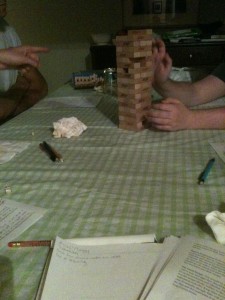
Dread is a unique RPG in many respects, but to the casual observer, its most defining feature is the use of a Jenga tower for action resolution. If your character wants to do something difficult or otherwise story-impacting, the player must draw one or more blocks out of the tower. If it topples, the character dies or is otherwise removed from the game.

As gameplay begins, two other aspects of the game immediately stand out – the lack of a character sheet (as it is traditionally understood) and, to a lesser extent, the Theatre of the Mind (ToTM) gameplay. Since there are many other RPGs that embrace ToTM, I will not rehash the pros and cons here, and instead focus on the unique “character sheet” that is used in Dread.

In Dread, the character sheet is called the Character Questionnaire. It does not contain a single number, skill name, or stat. It is, as the name suggests, merely a list of questions about the character that the player must answer. Most questions do two things – they tell the player a little something about the character while asking a question about motivations, personality, or past events. As an example: “Who was there when you killed your sister?” defines a piece of the character’s past while still leaving motivations, events surrounding the act, and a myriad of other details up to the player.

Needless to say, the beginning of the session was consumed with players filling out their questionnaires. But at the end of 45 minutes, I think my players had a better idea of who their characters were than most players of other RPGs have after years of playing.

Once the questions are answered, that’s the character. Period. If something in a player’s answers suggests that the character might be good at something, then the character is good at it. The elegance of this approach (especially for a story heavy game) cannot be overstated. Every RPG aims to define the character under the player’s control. Most use numbers as the primary indicators. Numbers are concrete. You can compare them to other numbers. I can understand their popularity. But while numbers are good at defining what a character does or can do, they’re really crappy at defining who a character is. Ironically, although most systems focus more on the former, the latter is what really drives a good story. And RPGs are all about the story.

In the end, only 2 of the 5 characters survived, but everyone had a blast. This is one that I’m sure we’ll be coming back to. I just wish there was more support out there for it. Where do you find Dread playsets? (I had the same problem with Leverage…)

What I Learned

I think the biggest lesson I learned from running Dread was the power of questions to help players define their character’s background. The questions in the Character Questionnaires were not vague – they were oddly specific in fact – but still left plenty of room for the players to play the sort of character they wanted. For example, the question “Who else was there when you killed your sister?” is at once oddly specific and completely open ended. Yes, the question is telling you that the character killed his sister, but why? Was it an accident? Premeditated? What were the events surrounding the act? And was anyone witness to it? Is the character aware of the witness? I should note that the Dread questionnaire asks for more than names when answering such a question. It asks for the motivations and events that would drive a person or persons to end up at the death of your sister. There are many directions that the answer could take, and in the process of musing upon and writing down the answer to such questions the player begins to really flesh out a personality for the character under her control.

One bit of advice from the book that I also passed along to my players bears repeating here:

When filling out a character questionnaire, you should always assume the presence of a silent “and why?” at the end of each question. It will create a better understanding of the character. The answer will cover more ground, and there will be less room for misunderstanding during the game itself. The more times you ask yourself “and why?” about any of the questions, the further and further you fall into the depths of the character, To take a seemingly innocuous question and apply an exaggerated example: “What’ll you have to drink?” Whiskey, on the rocks. “Why?” Because I’m a weary man with little use for frivolous and fruity drinks. “Why?” Because I have seen things that have made me question my own sanity. “Why?” It is the nature of my occupation to scour the world for things we were not meant to know. And so forth.

This, more than anything else in Dread, is applicable to character creation in RPGs at large. Delving deeper into the why’s of a character’s past (or even current) actions will always help players create a richer, three dimensional character.

That’s right – while the Questionnaire is the entirety of the character sheet in Dread, there is no reason why you cannot create one for the characters in your RPG of choice, as a supplement to the character sheet. At first, players may balk at you vaguely defining pieces of their past, but in the end I think all involved will find it to be an enriching experience. (Especially those players for whom the entirety of their character’s background is “My character is an orphan.” I mean really, whose character isn’t?)

You can buy Dread here. (ps – The book comes with 100 or so generic questionnaire questions. If you want to create background questionnaires for your players, it’s worth the price of admission alone.)

Also, you can follow Dread designer Epidiah Ravachol on Twitter.

Next time: The Big Wrapup ™

One Campaign, Many Systems: An Experiment (Part VI), Leverage!

I’ve been chronicling an experiment I ran over the summer with my gaming group to play a different RPG every week, and try to keep a contiguous storyline going…

LeverageI’ve been chronicling an experiment I ran over the summer with my gaming group to play a different RPG every week, and try to keep a contiguous storyline going. While the experiment itself is over, I’m a little behind on the articles. If you want to read from the beginning, the first article is here.

Last time, I talked about our unscheduled foray into Pathfinder, and how we incorporated that into the summer’s story. (TL;DR The Shadowrun PCs played an RPG. Very meta.) This week, the PCs got a message that another job needed to be done, and this time it required more finesse. More planning. More subterfuge and a less direct approach. In short, it required a heist.

Leverage

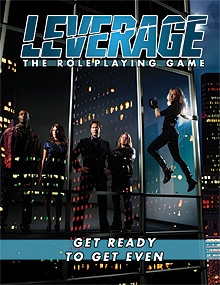
Leverage is an RPG based on a TV show. The show follows a group of ex-thieves who help the disenfranchised using “unconventional” (read: illegal) means (but for the greater good, of course). I believe one would categorize it in the “heist” genre. Mechanically, the Leverage RPG is built on the Cortex+ system, which is shared by other RPGs like Smallville and (the now out of print) Marvel RPG. It works like this: Every character has an array of abilities and an array of “job descriptions” known as Roles. The abilities are what you would expect (Strength, Agility, Willpower, et al.) and the Roles are niches that members of a heist team fill – thief, grifter, hitter, etc. To each of these abilities and roles, there is a die assigned – d4 through d10. When the GM calls for a check, the player rolls a prescribed combination of ability and job. So, to pick a lock, the player might have to roll Agility (or Intelligence) and Thief. If the PC’s main role in the group is thief, they probably have a d10 in each, and will roll 2d10 to determine level of success. On the other hand, the group’s Hitter might only have a d8 and a d4, respectively, and is therefore worse at picking locks. So, the player rolls and adds up the result. They are either aiming to beat a “DC” or rolling against an NPC.

There are also Assets and Complications that can add dice to the player’s roll or the GM’s roll. These are usually d6’s, and are dictated by what may be happening (or has happened) in the story. And here’s where readers will begin to see similarities to Fate (and for good reason, since some of the same minds worked on both). Also, characters, on top of their abilities and roles, have traits that they can play off of for an advantage in a situation. Finally, players are given “Plot Points” that they can spend to either activate special abilities or affect the story in some other way. Unlike Fate Points however, a player can never “pay a point” to refuse a story complication. Instead, complications occur (and Plot Points are earned) when a player rolls a 1 on any of their dice.

Of course, there are other nuances, but you’ll have to buy the book if you want more.

In our session, we played The Quickstart Job which is exactly what it sounds like. This set of quickstart rules introduced the mechanics of Leverage beautifully, but failed to help players learn what it was like to play Leverage. How is that possible? Well, one of my players said it best: “The whole fun of a heist is planning it!” But the Quickstart Job throws the players into the heist after it is planned and sets them on rails from which there is little room for deviation for the rest of the session.

I can see why the quickstart rules would do that. In order to present all the major rules and types of scenarios that a group will encounter, the quickstart rules need to force the players into the scenarios that use those rules. However, forcing players into situations kind of goes against the grain of what a story RPG is supposed to be about. For example, the Leverage quickstart forces the characters into a combat so that (I’m guessing) the players can see how combat is supposed to work in the system. (Also, so that the Hitter has something to do). However, it’s conceivable that the players could have avoided the combat altogether, had they been given more agency within the game.

Unfortunately, we all walked away from the session with very little sense of what it is like to play Leverage – beyond a mechanical knowledge of “when you want to do this or that, you need to roll these dice or spend plot points.” There was very little room for the group to improvise or go off script. And, as my player said, they didn’t even get to plan the heist.

Problems with the quickstart aside, the system seems to be very fun. It has inherent triggers that force complications on the story, while at the same time giving players the resources (Plot Points) to (hopefully) overcome those complications. The full rule book, which I subsequently read, has plenty of tools for both the players and GM, including a synopsis of all the TV show plots, in case a GM needs some story ideas. I would definitely run this one again, but I may need to play a session or two myself under an experienced GM in order to get a better feel for the game.

If you like Fate, other Cortex+ games, or the heist genre (I know I do), then Leverage is worth picking up.

Next time, I will be discussing Dread, which was our last RPG of the experiment. Be sure to check back!

Leverage is available through Amazon.

The History of Star Wars RPGs Part 1: Star Wars d6

This is the first in a three part series on the history of Star Wars tabletop RPGs. In each post, I’ll be exploring each of the major Star Wars RPGs and discuss how they worked and how they affected both the roleplaying game industry and the Star Wars universe…

This is the first in a three part series on the history of Star Wars tabletop RPGs. In each post, I’ll be exploring each of the major Star Wars RPGs and discuss how they worked and how they affected both the roleplaying game industry and the Star Wars universe.

Star Wars

Return of the Jedi came out in 1983, presenting a spectacular ending to the Star Wars saga. However, Lucasfilm had a hard time keeping the momentum going afterwards. The video game crash of 1983 meant that nobody was brave enough to create video games, and Lucasfilm put a moratorium on writing novels in the Star Wars universe. On the small screen, Star Wars hoped to capitalize on their appeal to kids by making two live action movies and a cartoon series featuring Ewoks and a cartoon series about C-3P0 and R2-D2. None of these had much of a commercial success and Star Wars was beginning to fall into the realm of Flash Gordon and other sci-fi series: full of fond memories, but with nothing new on the horizon.

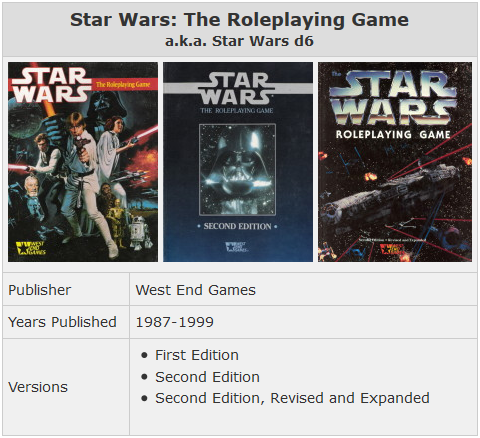
Enter a little roleplaying game company called West End Games. They had early success with Paranoia, a dystopian sci-fi RPG with a healthy dose of black comedy, and had decided to create a Ghostbusters RPG using a very simple d6-based system. It was well-received and West End Games decided to create another RPG based on a sci-fi movie series. In 1987, they purchased the rights to create Star Wars games and released Star Wars: The Roleplaying Game.

System Mechanics

Star Wars: The Roleplaying Game exclusively uses d6s, and so it is often referred to simply as Star Wars d6. The basic mechanic can be summed up in a single sentence: Describe what you want to do, pick a skill, roll a number of d6s, and try to reach or exceed a target number determined by the gamemaster (typically ranging from a 5 for something an average trained person could do, like recall what planets Rodians are from, to a nigh-impossible 30 or more for situations like blowing up the Death Star).

Along with “simple”, the other word that continuously comes up when you hear people describe this system is “cinematic.” Character skills (e.g Blaster Weapons) are improvements on their base attributes (e.g. Dexterity), so characters are generally competent in just about everything. For instance, a character’s Dexterity might be 3d6, meaning that their Acrobatics, Blaster Weapons, Dodge, and Sleight of Hand are at least a 3d6. Multiple actions can be taken per round, with a penalty to each subsequent roll. Target numbers are set by the GM depending on the situation, rather than being in a table, meaning that players are encouraged to think outside of the box and not just stand and say “I blast them”.

Characters were usually created using “templates”; partially-built characters filling typical Star Wars archetypes, such as Rebel Pilot, Failed Jedi, Minor Noble, or Wookiee. However, rules also existed to create your own character from scratch, allowing for total customization.

From time to time, the GM may award Character Points for good roleplaying, being a hero, or otherwise creating an enjoyable game (a concept expanded from Paranoia‘s Perversity Points and Ghostbuster‘s Brownie Points). These could then be spent to add dice when you need to succeed. Star Wars d6 also introduced Force Points, which double your die pool of d6s for those times that you really needed it. These are awarded much more rarely, generally for making a heroic sacrifice.

In addition to being rules-light, the books were full of fun bits that made them enjoyable to read and encouraged an atmosphere of fun. They also had excellent advice on gamemastering:

The core rulebook won the Origins Award for Best Roleplaying Rules of 1987 for its simple and innovative rule-system that captured the feel of the Star Wars universe.

Throughout the history of the Star Wars d6, the mechanics remained relatively the same. The biggest change came with Second Edition with the addition of the Wild Die. In every roll, one die was special. If it rolled a 6, it exploded and you got to roll it again. This made any task theoretically achievable. If it rolled a 1, there was some complication. The GM had several options to resolve the complication, such as removing both the Wild Die and the highest other die, or creating a “critical failure.” The latter was intended to be used sparingly, although some GMs definitely had a habit of abusing it. In general though, the Wild Die did help improve the cinematic nature of the game by letting rolls be open-ended and allowing for the chance to have things go wrong every once in a while.

Force Powers and Jedi

Jedi in Star Wars d6 are designed to reflect Luke Skywalker’s journey (which In 1987 was all they had to go on). They had a fairly small subset of things they could do, such as mind trick, force jump, and telekinesis. And most importantly, Jedi in training must have a mentor in order to learn the ways of the Force. They started out untrained and with little to no experience, but overtime may become more powerful. Essentially, they’re designed to be linear smugglers and quadratic Jedi, which depending on your view of Star Wars, may be alright.

If a character wanted to become force-sensitive, all they had to do was check a box. There was no immediate benefit to this, but it did provide access to three new skills: Control, Sense, and Alter. Force-sensitive characters could purchase force powers a la carte, each of which could be activated by one or more of a combination of these skills. This made Jedi fairly flexible and due to the Target Number system, it was possible to due all sorts of interesting stunts with only a good description. The downside to this system was that powers that required combinations of skills required multiple die rolls, which could be tedious (for instance, doing a Mind Trick required separate Control, Sense, and Alter rolls against the target).

To balance Jedi, force powers and skills were more expensive to obtain than normal skills, meaning that at least initially, non-force-sensitive characters often outclassed novice force users. Furthermore, a teacher (akin to Obi Wan or Yoda) must be found before the skills can be improved, which in the Rebellion era was a very difficult thing to do. How effective these limiting measures were depended on the GM.

Force-sensitive characters also were in danger of falling to the Dark Side. If they committed an evil act, or used their force-powers out of anger or other malice, they would get a Dark Side Point. Every time you earned one, you rolled a d6. If the number was equal to or less than the number of Dark Side Points you earned, your character had fallen to the Dark Side. This generally meant that the character had become an NPC villain under the GM’s control, although there was a bit about potentially playing a character attempting to redeem themselves.

Publication History

Creating a licensed Star Wars RPG was a fairly risky move. Return of the Jedi had come out four years earlier and a lot of the excitement for it had left. Today, you might compare it to creating an RPG for Avatar. Sure it was immensely popular at the time, but the movie was created four years ago and there has been little to continue that excitement. The creators obviously loved Star Wars enough to make it, but the question remained: would the public buy it?

The answer was a resounding yes! Star Wars: The Roleplaying Game was a resounding success and it continued to be successful in its 12 year run and three editions.

Not including adventures, Star Wars d6 books generally fall into one of three categories: sourcebooks expanding on aspects from the movies, sourcebooks summarizing info in books, comics, or other Star Wars media, and original creations expanding the Star Wars universe.

Books from the first category, including the very first book, The Star Wars Sourcebook (later reprinted as Galaxy Guide 1: A New Hope), expanded many aspects of Star Wars that have become fundamental to the Expanded Universe. For instance, the species of each denizen in the classic Catina Scene in A New Hope were identified as Rodians, Devaronians, Ithorians, and other aliens that until that point had been nameless. Similar books focused on a certain aspect of the universe, such as the Imperial Sourcebook and Creatures of the Galaxy. A twelve-part Galaxy Guide series for the Second Edition exemplifies this, having sourcebooks for each movie, locations such as Yavin, Bespin, and Mos Eisley, and miscellaneous subjects such as ships, aliens, and bounty hunters. There was some overlap between books, which helped proliferate some of these ideas.

Other sourcebooks were created for supplemental Star Wars material, such as the Thrawn Trilogy of novels, the Tales of the Jedi comics, and the Shadows of the Empire multimedia project. Data was compiled just as the movie sourcebooks were, but there was less original material in these books, since print media allowed for authors to identify new aspects themselves.

Finally, some books were completely original additions to the Star Wars universe. Cracken’s Rebel Operatives was a book that introduced a number of original Rebel field agents who might be a contact for a campaign. Of particular note is the Tapani Sector books, detailing an entire sector of the Galaxy Far, Far, Away. This was designed to be a somewhat isolated area that campaigns could take place in without fear of running into continuity issues with the larger Star Wars metaplot (although it has yet to be mentioned in any other Expanded Universe work).

Ironically, the end of the Star Wars RPG came about because West End Games started making more licensed RPGs like Star Wars, including Indiana Jones, Tales of the Crypt, Hercules & Xena, Men in Black, and DC Universe. The same gamble they took with Star Wars never paid off with other licenses and none received anywhere near the success. In the end, West End Games filed for bankruptcy and lost the rights to create Star Wars games the year before The Phantom Menace came out.

It did live on in 2003 when West End Games, under new management, released D6 Space Opera, later called D6 Space, which was essentially Star Wars d6 without the Star Wars trappings. Designed to be a more generic sci-fi RPG, some areas were revised, such as ship creation, and additional subsystems were added, such as advantages, disadvantages, and a cybernetics. This version was released for free after West End Games filed for bankruptcy a second time.

Impact on the Expanded Universe

The modern Expanded Universe began when Lucasfilm lifted the moratorium on Star Wars novels and Timothy Zahn wrote Heir to the Empire, the first of what has been called The Thrawn Trilogy. In the introduction to The Thrawn Trilogy Sourcebook, Timothy Zahn writes about how the roleplaying game affected his novels:

In early July, I got a box from West End Games. It seems that Lucasfilm had decided I ought to coordinate with their Star Wars role-playing game background stuff. Stuff which, not being a gamer, I’d never heard of… And you know what? The stuff was pretty darn good.

Many of the alien races, planets, ships, and minor characters that Zahn wrote about in his books, and which are now commonplace in the Expanded Universe, are a direct result of Star Wars d6. Essentially, this is the foundation upon which was built the Expanded Universe we know today.

Even now, almost fifteen years after it was no longer published, the Star Wars d6 still impacts new material in the Expanded Universe. For instance, the 2007 book Jedi vs. Sith: The Essential Guide to the Force provides an in-universe look at the Force. How do they classify Force powers? By dividing them into Control, Sense, and Alter, the three skills that Star Wars d6 uses for force powers!

Availability and Gaming Legacy

It’s pretty easy to find a copy of the first and second editions of Star Wars d6 on Amazon for $15 or less, but the Second Edition, Revised and Expanded runs for a bit more at $30-40. West End Games’ spiritual successor D6 Space is now a free PDF, which, speaking from personal experience, is not difficult to mix with the Star Wars-specific elements from Star Wars d6.

A sizable number of gamers strongly believe that Star Wars d6 is still the best of the three Star Wars RPGs due to its simplicity and wealth of information. A living Star Wars d6 campaign called Sparks still runs to this day at monthly conventions in the midwest. There’s even some folks who have diligently created conversions of the Star Wars d20 books to allow for them to be played with Star Wars d6!

The fact remains that it is one of the most played out-of-print RPGs, attesting to its quality and appeal to Star Wars gamers. It’s a great RPG and one that is still worth playing today.

Next time: Our history of Star Wars RPGs continues as we talk about Wizards of the Coast picking up the Star Wars license and releasing what fans have come to call Star Wars d20.

One Campaign, Many Systems: An Experiment (Part V)

I’ve been chronicling an experiment I ran over the summer with my gaming group to play a different RPG every week, and try to keep a contiguous story line going…

I’ve been chronicling an experiment I ran over the summer with my gaming group to play a different RPG every week, and try to keep a contiguous story line going. While the experiment itself is over, I’m a little behind on the articles. If you want to read from the beginning, the first article is here.

This week, we made an unscheduled detour into a Pathfinder one-shot. At the end of our Shadowrun adventure, one of the players requested we play it, as he had a friend who wanted to find out what RPGs were all about. I was more than happy to go along with this, especially since it meant I got to play instead of DM, but how to fit this into the overarching story that we’d been loosely holding together over the summer?

My first thought was to create a situation where the PCs would need to go back into the “Island World Biodome,” where the setting was fantasy. However, if you read Ping Time (the Shadowrun adventure I ran), you’d know that the clients were a group of high school students. One of the players conjectured that, when they returned the victim to his friends, perhaps they were all in the basement playing an RPG. And maybe the PCs were invited to play along with the high school students. Super meta, I know, but it was a cool idea, and we went along with it. So the Pathfinder one-shot was what the Shadowrun PCs played with the high school kids; when the one-shot was over, we “zoomed back out” into the Shadowrun world for a little Leverage action. But that’s next week’s post.

Of course, we all know that Pathfinder is the “spiritual successor” to D&D 3.5, or maybe “built on the 3.5 engine” – however you want to say it. I’m going to assume you’ve played it. No need to rehash the mechanics here.

The session started with each of the players coming up with a reason to dodge the king’s mandatory draft, as there was an army camped outside the gates. After that, we were thrown into the secret basement of a church with other draft dodgers. When some soldiers showed up to search the chapel for fugitives, we escaped out the back door into the city.

Army

From there (I felt) there was no other story hook to help us choose a course of action. Instead of just fumbling around, I decided to take the bull by the horns and act. The cause of the war was a fugitive that the city was harboring, and my character conjectured that if the fugitive was turned over to the invading army, the war would be called off. I know for a fact that the DM had entirely something else planned (though I still can’t figure out what), but he did an excellent job of rolling with our choices and improvising something very fun. The rest of the adventure was us devising a caper, and failing miserably. Only half of us survived (the half of us that were smart enough to retreat when the dice started going south).

What I Learned

I learned a couple of things from this session. First, I learned that if I were to do this “one RPG a week” experiment again, I would mandate that the DM duties be divided up among the group. While some of the players don’t feel comfortable DMing a system they know, let alone one they don’t, I realized that learning and running a new system every week is stressful. Even with lots of tools at your fingertips like free premade adventures and quickstart rules. I would have been a lot more relaxed over the summer if I had had more chances to be a player.

Second, I learned that I’m not actually a fan of 3.5, and that 4.0 was a vast improvement on the D&D system. And this is coming from someone whose first edition was D&D 3.5. I was the party’s cleric, and it struck me as boring that I had to choose whether to heal or do something else on my turn. I remembered why players used to bemoan the fact that they were just a “heal monkey.” And the problems weren’t just with cleric … however, I’m not here to start an edition war, so I’ll leave it at that. I realized that it isn’t my cup of tea.

Finally, it’s great to help new players learn the game. Regardless of your favorite RPG or edition, bringing new players into the fold is fun. Showing them that anything is possible is fun. And watching them finally catch on and jump into the action is the most fun of all.

Next week, I’ll be writing about my first foray into Leverage, the heist RPG based on the TV show by the same name. Stay tuned!

Why I’m Pro-Batfleck

Sometimes we can be a difficult group to please. And it makes sense. Whenever you take a franchise with multiple decades of history and mythology behind it and try to change it, those changes will inevitably rub some people the wrong way…

BatfleckSometimes we can be a difficult group to please. And it makes sense. Whenever you take a franchise with multiple decades of history and mythology behind it and try to change it, those changes will inevitably rub some people the wrong way. So when it was announced that the next actor to play Bruce Wayne and Batman would be Ben Affleck, some of us were less than thrilled. After all, his previous attempt at a superhero was 2003’s Daredevil, a film most of us don’t remember (though word on the street is that the Director’s Cut is a marked improvement over the theatrical release).

I, however, feel that Affleck is a solid choice for the role. Solid, but not perfect. Perfect doesn’t work for me with Batman. Not that long ago, Warner Brothers were similarly faced with the task of replacing the man who would play Batman. As luck would have it, there was a mature, handsome, and charismatic actor with a very bright future as a leading man already on their payroll. Women wanted him, and men wanted to be him. He was by nearly every measure, the perfect choice. His name was George Clooney, and he was the star of 1997’s Batman and Robin. So you’ll understand why I believe that perfect is sometimes overrated. Ben Affleck might be a flawed choice due to his past films, his perceived physicality, and his range as an actor, but a flawless choice in a flawed movie won’t help anyone. In 1997, Clooney couldn’t have been more of a sure thing to be a great Batman. Now Clooney (allegedly) refunds anyone who tells him they paid to see it in theatres out of his own pocket.

But back to 2013. It’s been clear for a few years now that Ben Affleck is taking his work seriously. His directorial debut Gone Baby Gone was a damn fine crime film, and his follow-up The Town was exceptional and boasted a solid performance by Affleck himself. It was even talked about as a contender for Best Picture in 2009. Argo, of course, recently won Best Picture (though not without controversy in my Home and Native Land, but that’s a different topic). Affleck’s also rebuilt his reputation as an actor, winning significant acclaim for his performance in Hollywoodland, winning the Volpi Cup for Best Actor at the prestigious Venice Film Festival. His rebuilt reputation isn’t something he’s going to throw away by turning in a bad performance as Bruce Wayne.

And it’s unlikely anyone with the power to do so will allow it. This post won’t focus on Batman and Robin too much, but one of the harshest lessons Warner Brothers and DC learned from it is that a bad Batman movie can result in a major film franchise essentially laying dormant for 8 years. Given how big of a business comic book movies have become since the release of Batman Begins, it seems unlikely that Warner Brothers will take a chance on another high-profile flop with it’s biggest asset, especially with what’s being planned. While I doubt Affleck’s Batman could be bad enough to derail the franchise a second time, there’s too much at stake to gamble on that.

Affleck’s first appearance as Batman will be in Zack Snyder’s sequel to Man of Steel, but if Warner Brothers plans on building not just a Justice League franchise, but another Batman franchise, Affleck’s involvement could be quite significant. There’s not much of a downside to a popular, Oscar-winning filmmaker involved in your main franchise. While many wanted Joseph Gordon-Levitt to take over the cape and cowl, Christopher Nolan’s Dark Knight trilogy was always intended to be a stand-alone story. If you’re going to hire someone to get a franchise off the ground, people with Affleck’s level of experience and success are very rare. For Warner Brothers and DC Comics, Affleck is the Batman they need. Time will tell if he’s the Batman we deserve.

One Campaign, Many Systems: An Experiment (Part IV)

In Part I of this series, I laid out my plan to play through a series of RPG systems – one a week – over the summer. On top of that, I wrote about my gaming groups’ desire to maintain a single set of characters and therefore a cohesive story for the duration of the campaign…

In Part I of this series, I laid out my plan to play through a series of RPG systems – one a week – over the summer. On top of that, I wrote about my gaming groups’ desire to maintain a single set of characters and therefore a cohesive story for the duration of the campaign.

Shadowrun

This week (well, two weeks) we played Shadowrun. The group as a whole was pretty excited, as they’d heard good things about the game. It was new to everyone, myself included. I started the story with the new Shadowrun characters passing their Gamma World characters in a huge teleportation transportation hub, in keeping with our decision to change characters with RPG systems and hang the one-shot stories together more loosely.

Shadowrun is only the second new RPG that I’ve run this summer, even though it’s the fourth system we’re using. I am very familiar with D&D 4e and Gamma World (our first and third weeks), though our second RPG – Microscope – was also new to me. Of course, Microscope is a GM-less game, so it’s safe to say that Shadowrun was my first real trial in learning and running a brand new game in the span of a week.

So, a quick lowdown on mechanics for those of you unfamiliar. Shadowrun uses dice pools of d6’s to manage action resolution. Your character has a number “rating” in each attribute (like strength or intelligence) as well as a number rating in a handful of skills (like hacking or small arms). And I will say there are a lot of skills in this game. When you try to do something, the GM will ask for a roll like this – “That’s intelligence plus hacking” – so you add together the number you have for intelligence and the number you have for hacking, then roll that many d6’s. Let’s say you have a 6 in intelligence and a 4 in hacking – you roll 10d6. Yup, rolling a fistful of d6’s is pretty common. Out of all those d6’s you just rolled, any 5’s or 6’s are successes (or “hits”), and you’re trying to meet a “threshold” of “hits,” which is basically the DC of the action.

Combat is a bit more complicated, and also a bit more complicated than D&D combat, but it still uses the “roll a fistful of d6’s and count up your 5’s and 6’s” mechanic.

Our Shadowrun session ran two weeks – the first week we ran through the Quickstart scenario, which saw the characters in a Stuffer Shack brawl, and the second week we used the adventure Ping Time, which I found for free online. It was easy to modify the quickstart scenario to lead into Ping Time – I simply changed the “target” that the PCs rescue in the Quickstart into the fixer that employs them in Ping Time. Easy peasy.

The Quickstart was great to get a feel for the game – both thematically and mechanically. The majority of it is combat, which is essential because combat is the most complicated part of the game (as far as I could tell). The players got to go through several rounds of opposed rolls and counting net successes and comparing armor to damage, and… well, you get the picture. It gave them a handle on the game.

Ping Time kind of flipped that on them because there’s only one combat, and it occurs at the very end of the adventure. There is the possibility of combat at other points in the adventure, but it is assumed that the characters use other means to achieve their ends most of the time.

Overall, we really liked Shadowrun. As a matter of fact, I liked it enough to preorder the 5th edition rules which coincidentally went up for sale around the time we played. It’s possible we’ll be playing at least a few sessions of it next summer. Even if we don’t, I’m very intrigued to read about the myriad skills present in this system.

What I Learned

Quickstart rules are fine if all you’re running is the quickstart scenario, but if you’re going to dip into other free adventures (for any system), you’re probably going to want the actual rules. In Ping Time, I was able to muddle through some things, but I was completely unable to improvise anything on the spot. And I said so to the players.

On the other hand, Quickstart rules are awesome if you’re playing a bunch of new RPGs serially. They’re the single most important resource for a group looking to learn a new system. Everything is laid out as if you’re a beginner (because you are), and what is presented is only what you need. It’s also whatever the designers think you need to get a good feel for the system. And that’s pretty important.

I also learned to not be afraid of Theatre of the Mind. While I have had a foray or two into mapless combat in the past, the majority of my RPG experience has used maps for combat. But we were able to slide pretty easily into Shadowrun’s assumption that you don’t need a piece of wet erase vinyl to kill stuff. And that’s good, because we’re headed into Leverage and Dread in a few weeks, and both of those systems rely on TotM alone. But first, we’re taking an unscheduled detour into Pathfinder next week. And I’m not the DM!

How to Teach Someone a Tabletop RPG in d6 Steps

My fellow gamer Benoit has a very interesting post here on Stuffer Shack called ‘How to Teach Someone a Boardgame in Six Easy Steps’. Due to popular demand I now bring you it’s sister article – all about the joys of Tabeltop RPGs…

PartyMy fellow gamer Benoit has a very interesting post here on Stuffer Shack called ‘How to Teach Someone a Boardgame in Six Easy Steps‘. Due to popular demand I now bring you it’s sister article – all about the joys of Tabeltop RPGs.

I should start by saying that Tabletop RPGs are incredibly diverse. They can be diceless, make use of D6’s you scrounge from monopoly or have custom dice used only for that game. They often mix combat, discovery, and role playing elements, but may not have all three. I will be using examples from several different games along the way to try and keep things clear, based on the game, different steps will be more important.

Step 1: Choose the Game

This may seem like a no-brainer. Why would you even be reading this if you didn’t have a game to teach? You may want to find a good introductory game, assuming once your students get a taste they’ll play all sorts of games (including the one you really want to play).

I actually think this is less than an ideal way to go about it. You might find a fun looking game that’s easy to learn and uses a setting/genre that you know your student is already into. If it’s not a system you already know and love, you’re going to be stumbling, and you won’t be nearly as passionate as if you picked one of your favorite games.

That being said if you know and love several games, picking one that is fun and easy to learn can take some of the stress off of things. Getting into RPGs can be intimidating, especially if you friends has seen your collection of GURPS books that might kill them should the bookcase ever topple. Games like Dungeon World that have all the rules right in the character sheets, so people don’t feel like they’re pestering you with questions.

Other games only have a handful of rules to learn that are then applied to countless situations. Pulp! the RPG and RISUS both fall into that category, with very simple character sheets to boot.

Step 2: Explain the Core Concept of the Game

Generally in an RPG, it’s not about winning, it’s about telling a story. This can be very different to someone who is used to playing video games or board games. Its generally not about getting the most points but rather ‘exploring the dungeon’, ‘Uncovering the mystery of the Madame LaSauce’ or ‘to try to tell a story about your character’s poor impulse control’. You don’t need to dig into the rules here, just the broad concept. Try to find the big idea to keep in mind throughout the game. It shouldn’t be about the dice.

Step 3: Explain the Core Mechanic

Most tabletop games have one action that the players do more than anything else. Explain this at the beginning and worry about the rest later. In Dungeons & Dragons (and many systems based on it) you ‘Roll a d20 and add a number from your sheet’. In Pulp! it’s ‘Roll a D6 and add one Attribute and one Trait’. In some story games the mechanics are so secondary that you can ignore this. When I teach Fiasco I skip this step because the whole point is telling the story. You don’t need rules for the majority of the game.

Step 4: Play!

Start playing right away. Show your enthusiasm. Make eye contact with the new people to show them they’re involved even when they’re not speaking. Have fun now!

Step 5: Explain What You Need To, When You Need To

When someone declares an action that needs a new rule you can stop the action and explain it. Sometimes an established mechanic can work in the situation, even if there’s a specialized rule for it. If you’re goal is to teach the game, then you might want to stop someone when they start to make an incorrect assumption. Remember that the real goal is fun. If someone is in the moment and having a blast, its ok to do let them keep going. You can always point out after that there is a special rule for that, that you’ll explain when you do session 2.

When you go to do something, that hasn’t been done yet, explain what you’re doing mechanically so people can see the new option. It also helps level the playing field when you’re coaching yourself through a new action instead of just explaining things when someone doesn’t know what to do.

The classic example is Grappling in a game. These rules tend to be something with a sequence of rolls that need to be referenced and can really take the story out of a fight. If it comes up at the table and the player assumes its just a Strength check, you can go with it. It’s a great example of what you want from Step 6. If they ask how do you do it? Go ahead and look up the rule. They came to learn to play after all. Sometimes looking things up is part of that,

Step 6: Get them to stop looking at the sheet!

This can be really hard. People are used to having a limited number of options even in really open ended games. Even in Grand Theft Auto and Skyrim, eventually you reach the end of the map, the wall that can’t be climbed or the object that has no interactions. People look to their sheet to see what options they have but most RPGs don’t really work like that. Get them to describe their actions, then look at their sheet to see how they can accomplish that. Sometimes your sheet has cool things that you might never think to do, but you want it to be a tool and/or an inspiration, not a concrete set of options.

This is the most important step. You can say ‘You can try anything’ all you like, but at one point it will just click for them that the possibilities are endless in a tabletop game. That’s when people realize that this is different. Why this is fun. You can generally see the realization on people’s faces when it happens. When you see this, you have achieved your goal.

In Conclusion

This is, of course, not the only way to teach a Tabletop RPG, but just my recommended steps. Your mileage may vary, and you will likely make changes based on the rule system. Remember to have fun, and show your passion!