(Digital?) Storytelling: Lessons from Interactive Fiction and Tabletop Gaming

Only a year or two after I started GM’ing seriously, I got involved in Interactive Fiction (often abbreviated as “IF”) writing with a cyberpunk adventure game called Orchestra. My crummy setting naming skills and limitations of the platform I was building it on notwithstanding, it received generally positive feedback from the people who came to play it, and the things that players recounted to me really shaped the way that I run my games to this day.
Character

The first, and most pressing, constraint of the digital narrative experience is that it is nigh impossible to account for all the situational variables as your storyline becomes larger and more complex. Creating meaningful opportunities and implementing gamification are major components of this. Tabletop games tend to do a good job with game elements, but I see a lot of GM’s fail to give players good options in character progression.

When writing Orchestra, I found that writing game and narrative blended naturally into one combined process. There was a level of interesting interaction between game elements and narratives; players can work in their own explanation for how things happened and the only thing I had to do was create the basic impetus for a few events.

One of the things that IF does well when mixed with game elements is provide players with a sense of direction; the game elements fill in the gaps that otherwise would go unnoticed due to an inability on most writers’ behalf to actually write specific responses to every possible outcome. Players are able to visualize their avatar in such a way that they tell the story to themselves as it unfolds, and this is very similar to how characters in a tabletop game will build a story and persona around their players’ perceptions.

The obvious thing that this suggests is that these game elements can and should be used to encourage deeper character development.

What does this mean? I’d say that it means that we have to be very careful when evaluating how we plan and run our games; it’s not just the act of writing a story, but encouraging players to use their characters as agents in the story. If we are to reach the largest possible audience, especially along the fringes of the people who currently play tabletop games, at the table it is critical to encourage the idea of the character as an agent in our players, stressing both the ability and constraints that a character has.

Likewise, I’ve found that my players’ favorite experiences come when the rules of the game don’t matter anymore, and they have become entirely immersed in the narrative; even when a character is killed or injured, the presence of a world with limits and opportunities is as important as the ability to execute a list of actions written on a character sheet. Unfortunately, this means that there’s a lot of potential work for a GM, and, as with any planning, stuff can go off the rails quickly, but a lot of this can be mitigated by considering what to plan and how to encourage players to follow paths that their character would take so that they can be satisfied without necessarily operating in a vacuum of direction that makes it difficult to respond to changing events.

The game should grant agency. I’ve always felt that the role of the GM is to work with players to build a story that’s interesting and fun for everyone, but I often see GM’s who just tell stories that the players want to tell or that they want to tell. Using plausible restrictions on players’ characters forces them to think inside the rule of the world, and it actually serves to humanize their characters. This makes it easier for players to connect with the non-player characters and events of the game, and gives them an idea that the universe that the events are taking place in exists as a coherent concept.

When we think of our favorite characters in fiction, almost all of them are constrained in a fairly major way by the world around them; their abilities are used in conjunction with the challenges they face to tell their journey, and as a GM it is possible to give players a memorable and satisfying experience in this way.

I think one of the things that stood out to me most when I applied things I learned writing IF to the tabletop was player perception. If I could align my users’ expectations with my work, or vice versa, they enjoyed the content more. If they expected to be a Bourne-esque supersoldier, I had to include things that allowed them to jump to that conclusion, but when I did they felt like my work was theirs in a vivid and experiential manner.

For comparison, one of the most frustrating experiences I ever had as a gamer was from EA’s reboot of Syndicate during the single player campaign. While the gameplay was actually far better than I expected, I was constantly frustrated by my lack of agency in the story. One of the deadly sins of storytelling is countermanding player expectations. While Kilo stood back and let events unfold, all I wanted to do was to get back into the action, and when major choices in the story came up he almost never wound up aligned with the people that I would have aligned with.

Giving players agency was as simple as learning what their expectations were; giving myself a little insight to the situation let me figure out what players want to do. When I run my games, I try to get an insight on what my players do. The paladin in shining armor will never strike a downed enemy, while the ruthless rogue will always throw in an extra stab for good measure. Because of this, I can plan narrative events that allow players’ characters to show their personality in an environment that responds to them—in the paladin and rogue example, adding a decision point involving incapacitated enemies gives players a chance to make a moral decision that would often be overlooked by staunch adherence to the combat rules of a system.
GMing Lessons I Learned from Dark Souls

This article takes a look at the unique ways in which the Dark Souls series tells its story, and how the ideas can be applied to add some variety to the way in which a tabletop RPG can be told…

DarkSoulsLogoSpoiler warning: Some details of the story of Dark Souls will be discussed in this article.

Recently, I’ve been playing a game called Dark Souls 2. For those who are not familiar with the game , it is an action RPG for the Playstation 3, Xbox 360, and PC. The series is primarily known for its tough-but-fair difficulty and well-designed combat. For those who really delve into the Dark Souls games, however, it can be seen that the designers have put together a complex plot filled with ambition, tragedy, and the manipulation of the main character… and thus, the player.

It’s a pretty cool story. What is more interesting, though, is how the story is told. Most games and game masters tend to inform players of the world’s backstory through narration, NPCs, or an out-of-game information dump. In Dark Souls, however, direct information is scarce. Discounting the introductory cut-scene, there is no real narration of the state of the world or the people in it. Those who want to know what is going on need to pay attention to the world around them. Is this character trustworthy? Why did I find this item here, and why does this corpse have it? For that matter, what is this item? Every item has a short description. Some of them only describe the item’s function and provide a physical description. Other items, however, have a few lines that are related to their origin, such as the “Armor of Artorias:”

Artorias“Armor of Artorias the Abysswalker, one of Gwyn’s four knights. The death of the armor’s owner can be surmised from the corrosive Dark of the Abyss, and the tattered azure-blue cape, once a symbol of pride and glory.”
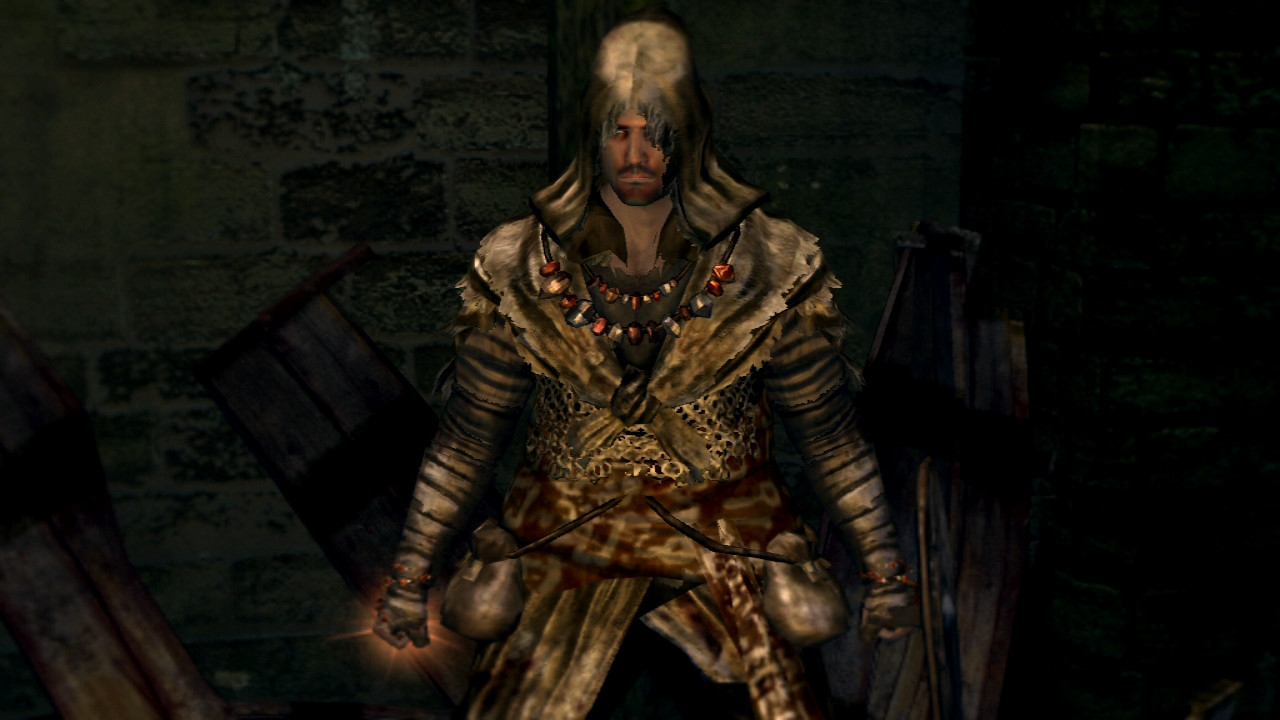

By itself, this doesn’t mean much. Artorias was apparently some proud knight of this Gwyn. However, by discovering other artifacts, exploring environments, and applying some critical thinking, players can learn who Artorias and Gwyn are, their significance to the world, how the armor came to be left behind, and what happened to that pair of NPCs.

Dark Souls has a unique storytelling style, but how could this be used as a GM? At the very least, it can inspire new ideas for giving information to players. When a party finds a new item, it can be more than just a new toy to play with or fancy doodad to sell. After a knowledge roll from the party’s lore master, it can be fun to give a little more than just the item’s function. Rather than “You rolled a 23? That necklace is a necklace of natural armor +1, it adds +1 to your AC,” some clue or detail of the world could be thrown in.

To illustrate: “A 23, huh? That is the Rhino’s Ring. It was worn by Urul the Stout, who overthrew the bandit king in the Westerlands. It gives a +1 natural armor.” By throwing in this bonus info, it can make the world seem more developed and alive, while adding a sense of mystery or even a future plot hook if the players want to know more about Urul. It’s also a nice way to tell players info that wouldn’t be relevant otherwise. Every DM has background details that they want to show off, right?

Another lesson that can be picked up from Dark Souls is the direct opposite of giving information. Instead, it can be useful to make information a bit more obscure. Instead of saying “Urul overthrew the bandit king in the Westerlands,” it could be more intriguing to only hint at Urul’s importance. “That is the Rhino’s Ring. Worn by Urul the Stout, it protected him in his most heroic moments.” By doing so, it is possible that the party will want to know more. By controlling the flow of information through such means, it might be easier to direct the plot or guide the players toward hooks that might be otherwise ignored.

Another nontraditional storytelling technique is through the placement of the items. Finding a shield on a dead body can just be a way to deliver a useful item in a convenient way. However, in Dark Souls, that body and the items on it can act as vital clues and help determine who the person was. At the beginning of Dark Souls, players are given a choice of numerous archetypes for starting stats and equipment. These archetypes are theorized to be more than stat blocks, however. Some players believe that each archetype is actually a separate character with a different backstory. Evidence for the theory exists in the game, primarily in the form of equipment found on dead bodies. Specifically, the armor of each archetype can be found as a set, typically in the area in which the archetype should have lived. It can be surmised that each archetype attempts to travel to Firelink Shrine (the central area of the game), but sadly, dies on the way. As the player character goes through their journey, they find what remains of the other, less fortunate adventurers.

pyromancerCareful placement of items, ruins, or monsters can mean many things. As a GM, consider the history of your world. It can be easy to toss the party a random encounter with goblins and give them whatever stolen shinies are left after the goblins are (likely) slain. Take that encounter and place it in the context of the world. That loot had to have come from somewhere. Perhaps it is passed down through the goblin generations when they were a powerful empire. If that doesn’t fit, maybe there is a down-on-his-luck adventurer who won’t be happy when he sees some halfling wearing his hard-earned boots of speed (or that Rhino Ring that he inherited from Urul). Basically, if a GM has a chance to consider the details, it can add to the game if every encounter has a reason for existing. Bags of experience in the form of hungry wolves can be fun, but if every enemy is just there to slow down the party’s progress, it can leave the game a bit hollow.

It is likely easier and more convenient for GMs to use the tried-and-true methods of delivering information throughout a session. There are good reasons that such methods are used so ubiquitously. However, to add some variety, it might be fun to take a look at other ways that stories have been told. Dark Souls has an unorthodox plot delivery, but the quality of the story is not diminished as a result. Rather, it has served to draw players in and immerse them in the world. If the same ideas are used for a tabletop RPG, it can certainly have the same effect.

Climbing the Wall of Text – let’s design an RPG adventure!

When I think back to the best times I had running adventures, I feel like they were great not because the adventure was fantastic (although in some cases, they were), but were great because of how we filled in the gaps…

Robert J. SchwalbWhen I think back to the best times I had running adventures, I feel like they were great not because the adventure was fantastic (although in some cases, they were), but were great because of how we filled in the gaps. If you run Steading of the Hill Giant Chief as written, you’d be painting lip-gloss on a shotgun and squeezing the trigger before you got to the end of the adventure. Why? After you explore and kill all the giants in ten rooms or so, you’ve probably had enough. Do this ten more times and you have found the very definition of boring.

A surface read of the classic adventures reveals that despite the fun we had with them, as written they do little to light me on fire. Many are just page after page of room descriptions, sprinkled liberally with monsters to kill, traps to avoid, and treasure to find. If there’s a plot, it’s thin and, often, acts to the adventure’s detriment, something best ignored or adapted to suit the game master running it. The adventure is a framework and it’s up to GM and the players to bring it to life.

For me, this is why adventures like Steading and the rest of the G series were so great. Yes, you can kill room after room of giants, if you decide to approach the adventure that way. It’s far more entertaining to infiltrate the steading, to sneak, to hide, and keep the fighting to a minimum. After all, make a lot of noise and you’re going to bring the entire place down on your head. If you can get in and out with a few sacks filled with loot and without having to swing a sword, you can count the entire enterprise as a win. This sounds like so much fun, I want to run it right now!

This approach to adventure design has largely fallen out of favor. It seems far more important to ram a thick plot down the audience’s throat. Rather than getting a map, some interesting locations, and some clear goals, adventures demand you first climb the wall of text, to read and absorb 32 or more pages of background, to discover an entire cast of characters, each with their own goals and agendas, the detailed histories and layouts of countless towns and cities, with every plot presented with meticulous detail. Once you survive this gauntlet, you might get to the adventure itself.

But wait! No designer wants to create a railroad adventure. Players want choice! They want to go where they want, do what they want: They don’t want to follow the GM through to the end. And so the adventure gains pages and pages and pages of side-treks, hooks, work-arounds, helpful advice to get the PCs back on track, adding page after page after page of information, all of which obscures what is, effectively, a simple treasure-hunting, stop the bad guy, destroy the artifact expedition.

I understand why adventures often take this shape. A robust story can cover the unforeseen decisions the players might make. The development sections insulate the GM against the confusion and mishap that can occur when the players go off script. So rather than pull back on story, the solution has been, at least for most mainstream games, to go full on story, to map out a web of possibilities so no GM will be caught unprepared.

And this is why adventure design gives me an ulcer. Why should the adventure cover almost any and every eventuality? It runs counter to the user experience—designers throw their labor into the wild and the audience puts it together in whatever ways they want. A designer has no control over how the audience uses the game, so why would we bother to hand out scripts that do exactly what the game experience is not supposed to do?

Of the many games and systems out there, it’s Savage World’s take on adventure design that gets me all hot and sweaty. I’m looking at “The Dark Side of Love” in Solomon Kane and what I see is a basically a broad outline for how the action might unfold with the climactic scene at the end. The game expects the players and GM to fill in the details and let the adventure play out in as organic manner as possible. This, my friends, is the way to do adventures.

I would go a bit further, though. Here are the things I would cut from general adventure design:

  • Text in the background that exceeds 100 words.
  • The adventure synopsis
  • NPC descriptions that go longer than a sentence or two.
  • All read-aloud text.
  • Location descriptions would be limited to three basic things: Broad parameters about the place, the first thing visitors notice, and something for the players to play with—a secret to find, a monster to kill, treasure to grab.
  • All descriptions of things that exceed the most basic information a GM needs to know.
  • All stat-blocks for creatures other than ones new to the adventure.
  • Anything that is a mechanical process that the core rules already cover.
  • Conclusions, aftermaths, anything that deals with what happens next.

The idea here is to empower the GM and players to frame the story in a manner that works for the group. I would take this approach for dungeon crawls, investigations, mysteries, explorations, hex crawls, everything. I know, this is aggressive, but I think it’s crucial to keeping people playing the game. How many times have you wanted to run a game but couldn’t because you had nothing prepared? How many times have you hit upon something in the adventure you’re running and accidentally forgot to reveal an important plot point? How many times have your players gone off script and left you frantically trying to adjust?

Let me give you an example before I sign off. I think it would be fun to set a story in a ghost town near some mines. So here we go:

Background: The miners delved too deep and came upon a demon imprisoned in the deep, dark depths. The miners freed it. It killed them. The demon, gore-slicked, crawled out of the mine and butchered the townsfolk. One person got away. The PCs find the survivor, who’s insane and gibbers “Everyone is dead!”

Town: The town has ten buildings. They include 6 homes, a smith, a tavern and inn, a church, and a general store. Muddy footpaths meander between them. Farms ring the town for about a mile all around, speckled with farmhouses, silos, and barns.

The Demon: The demon eats the people it killed. Roll a d10 when the PCs arrive to see where the demon’s eating. On a 1–6, it’s in a home; 7, the smith; 8, the tavern; 9, the church; 10, the general store. If the demon hears a loud noise, it comes out to investigate, perhaps bringing its meal along with it.

Other Threats: A pack of 1d6 + 6 wild dogs fighting over the corpses of the dead; a gang of 1d4 hungry ghouls; a survivor who’s thoroughly mad and screams if he sees anyone, which alerts the demon and draws it out.

Scenery: You can use the following to dress up the town.

  • A room painted in blood with a blood-drenched doll in the middle.
  • The body of a woman that looks alive from the front, but is dead and missing the back of her skull. Let’s say there are horrid teeth marks in the bloody brain matter.
  • A cloud of flies, each fly bearing a human face, evacuated from the demon’s bowels and lingering in a room. Their buzzing forms the words “You will die” over and over again.
  • An uncast shadow creeping across a wall.
  • A hidden room that holds a victim’s treasure, say 20 + 1d20 sp and a jade idol of a fat, horned god worth 1 gp.
  • A hidden room that holds the trappings of someone’s deviant and secret fetish—manacles, a leather suit, or something really gross.

And that’s it. A map could be helpful, but really isn’t needed. It’s not like their arrangement is all that important to the story. And if it’s important, the GM can just make it up. There’s enough here for a GM to get an idea about the place, ways to set the mood, monsters to fight, treasure to find, and the information creates a scenario that the GM can play through in an evening. If I wanted to expand it, I might talk about the mines. The PCs could follow the trail back to the mines, deal with some underground critters—beetles and so on—and finally come to the room where the demon was released. Perhaps the characters find a ritual scroll and can perform the ritual to bind the demon once more. Of course, the ritual’s performance would recall the demon to their presence and it’s probably not at all happy about being sealed up again. But this is an adventure and it’s enough for a group to play – have a great time, and, hopefully, remember for a long time.

Dontcha Just Hate Us Bad Guys?

In any roleplaying game, what defines an enemy? The defense numbers? The damage numbers? The extensive and daunting power list? No, I say, and say again, no. The only characteristic that defines an enemy is the one thing that’s impossible to quantify: the personality…

In this glorious age of expensive pocket computers and free Wi-Fi and rampant megaflops, it’s become so easy to calculate the perfect villain to abuse and harass those unsuspecting player characters. Using our advanced technology, we can tweak and test and fudge and forge the foundational numbers of the foes, seeking and finding that sweetest of spots, where the enemies have clung to life long enough and have dealt enough damage that several of the PCs are down and bleeding and those remaining survivors are used up like tissues on a long weekend.

Take a triumphant bow, you Game Master Mathemagicians, and raise your arms in celebration, you Story Teller Digit-Crunchers, for together, we have moved our beloved roleplaying games that much closer to the Skynet apocalypse, where flawed flesh is finally replaced by perfect numbers. Rejoice, resistance is futile, RPGs are borg.

Please don’t misunderstand my tone: I’m not blaming any of you out there for this development. I’m leveling my accusatory finger straight back at myself, for there is no sinner greater than me. Numbers are easy and predictable, even the ones generated by multicolored polyhedrons. Do you know what’s not easy or predictable? The RP portion of our RPG.

Evil

In any roleplaying game, what defines an enemy? The defense numbers? The damage numbers? The extensive and daunting power list? No, I say, and say again, no. The only characteristic that defines an enemy is the one thing that’s impossible to quantify: the personality. As the director of the RPG movie, you need to figure what drives each enemy to do the evil things he or she does. Is it greed or need? Is it badness or madness? If you can figure out the “through line” of a particular foe, then all of the numbers and mechanics stop mattering, because you’ll have a clearer idea of how Big Bad’s going to act, and more importantly, what Big Bad’s going to say in every circumstance.

I say, “more importantly,” because I feel like the art of rich RPG conversation has died. Trust me, I understand the motivation behind this (remember, biggest sinner). Time is precious and fleeting, and we can’t really afford to burn most of it up with chatter-blather when the dice are sitting right there. Enough talk, time to fight! But wait. Hold on. Take a breath. The whole point of creating an enemy who can think and speak is not to alter numbers on the character sheets of the PCs, but rather to annoy and outrage and infuriate the PLAYERS.

When your enemy attacks, let it be with words instead of blade and gun and spell. If you can inflame the players with threats and insults, the eventual (and hopefully inevitable) victory of the PCs will be that much more delicious. The players will remember that encounter and that enemy vividly, and will tell that story for years, and in the retelling, assuming you as Invisible Hand did your work correctly, the players may experience a tiny flash of the emotion they felt at the table: “Oh man, I hated that succubus so much. She just wouldn’t SHUT UP!”

I’ve given this a little thought, and have been able to come up with a few archetypes that might help illustrate my point. This list is certainly not exhaustive, but it is a first step to get you and me thinking about that enemy through line, and maybe even give all of us permission to reach for the taunt first and the dice last.

IMMORTAL
The Immortal is the easiest to misuse, so I decided to describe it first. Whether through ability or position, this enemy can’t be defeated by the PCs, much to their ongoing and mounting frustration. The Immortal keeps appearing to wreck the PCs’ day, and then he scuttles off unharmed, probably laughing while doing it. The Immortal could be a literal god, ignoring anything the PCs do. Alternately, the Immortal could be a more powerful version of the PCs themselves, not literally immortal but superior enough that any conflict will end with much weeping and gnashing of teeth in the party. Finally, the Immortal might not have any power at all, and could very well be an eminently killable child, but this brat happens to be central to something the PCs need (the son of a patron king, the witness of a crime, the hacker savant).

Because the Immortal can’t be beaten, you need to build in a handful of small “win” moments for the PCs over the life of the Immortal (for example, the PCs can’t kill the Immortal, but they can thwart one of his schemes), and also determine some kind of satisfying endgame (for example, at an appropriate moment, the circumstance that provides absolute protection to the Immortal changes, allowing the PCs to finish him). One of the best examples of this kind of endgame occurs in the climax of the original Robocop movie.

BULLY
The Bully isn’t just a standard antagonist, but rather is driven to target one or more of the PCs for a specific reason. The PC may have embarrassed the Bully at some point, knowingly or not, or perhaps the PC works for an individual or cause the Bully hates, or maybe the PC is the wrong race or sex in the wrong place. Whatever the cause, the Bully will not be content with simply winning, but will want to shame and ruin the PC.

It’s easy to imagine the Bully as an over-muscled, under-brained ape who hulks around the beach kicking sand into the faces of nerds, but there are many different kinds of bullies, and I would suggest that the bullies who are intellectual or vastly wealthy (or both) are much more dangerous. These are the ones who outwit the PCs, who set the wheels in motion to catch the PCs in political or judicial traps, all the while feigning a kind of dismissive attitude even as they seethe with hatred.

FAÇADE
The Façade is one of my favorites, if used correctly and sparingly. To understand the Façade, you’ll have to imagine the Bully in all his hateful rage, but take away all of that Bully’s power. The Façade may have lost all of his power, or maybe the Façade never actually had any, but he is weak, and he knows it. This is almost certainly the catalyst behind his antisocial behavior.

You’re probably wondering how the Façade can possibly make for a memorable enemy. After all, he does sound like an adult toddler throwing a tantrum. That’s because he is. Let me give you an example: Trinity the Sword Master was having a drink at the bar, and up stomps Oxor the Angry, backed up by his jeering cohorts (these sorts of enemies always have jeering cohorts). At first, Trinity does what he can to avoid bloodshed, even offering to buy drinks for Oxor and friends, but Oxor isn’t having any of that. Oxor wants a fight.

So Trinity finishes his drink, turns to face the big man, and snatches out his katana, quicker than an eye blink, and rests the razor sharp edge against Oxor’s throat. Oxor freezes, his friends vanish in all directions, Trinity says, “Get lost,” and Oxor does, tail firmly between legs. It was the battle that wasn’t with an opponent who couldn’t win, and yet the player remembers this moment years later, and retells the story frequently.

TRAITOR
Ah, the Traitor, a classic. And the reason it’s a classic is because when it works, it’s a beautiful thing. It might be a cambion disguised as a helpless maiden (“Help me, good sirs!”), or a government agent posing as your group’s doctor, or a Skrull assassin who has replaced the party’s government ally. The reason that this trick is so difficult to pull off is because we players have become so cynical about every stranger in every game. I don’t know you, I don’t trust you. If the librarian does something that raises suspicions, she’s as good as dead. It doesn’t matter how much she’s helped us up until now, I’m not taking chances with getting fooled.

But when it works, on those rare moments when the Game Master manages to pull it off, the air above the gaming table crackles with hatred for this deceiver, this betrayer, this snake in the grass. Usually the hatred is turned on the poor and defenseless GM, but it’s a price worth paying to flay that nerve and unleash all of that raw and red hostility.

I have fought in plenty of RPG skirmishes where the odds were heavily against me and my friends, where the numbers were definitely not in our favor, where the enemies were strategically brilliant while we PCs stumbled through our “divide and be conquered” plan. Some of those encounters, we actually won, but those triumphs were there and gone, drifting away like dust. I can’t remember the specifics of them.

But there were other moments, other combats, where the GM reached out and hooked his fingers into my emotions, and said just the right words through the mouth of the enemy, and made me, for a time, hate this imaginary person. Damn you, Tharizdun. Damn you, Iuz. Damn you, Marilith. And damn you, Pyro. We were supposed to be working together. I’ll never forget any of you.

Core Elements of Great Games: Engagement

Engagement is key whenever one designs an entertainment experience. As a writer, I can testify for the fact that something that is boring won’t get read. Great games are made by people that recognize this concept and apply it to its fullest. The core principle behind engagement is the idea that players should always be focusing on the current action or a future action…

Engagement is key whenever one designs an entertainment experience. As a writer, I can testify for the fact that something that is boring won’t get read. Great games are made by people that recognize this concept and apply it to its fullest. The core principle behind engagement is the idea that players should always be focusing on the current action or a future action.

Engage

Current action is perhaps the most simple to design around. Stuff blowing up, immediate concerns, and high stimulation environments can provide a great and simple way to create a current action. This works in most cases; when someone comes under fire in a military game they are immediately pulled into the task they are doing, even if they’d been doing a slow march for the past kilometer or so of Altis. These actions are the simplest to plan and act around because of the simple fact that there’s no consideration needed to get them to work. If one wants to have an explosion, they can create it. There’s no requirement for things to be pre-scripted or dynamic, and to a certain extent actions don’t even have to be responsive in order to gain the player’s focus. Even if a player intentionally ignores something, say, running straight through an artillery strike, the addition of more action to the scene will provide something for the player to think about. These environmental current actions provide a cheap but meaningful event, and give the player something to do in downtime or as a brief respite from challenging segments-pausing on a ledge outside a window as a guard finishes his cell phone conversation can be just as engaging as being in the center of a firefight if the developers and writers play their cards right.

Current action can also take the form of actions that the player is undertaking. Picking a lock or hacking a computer in Fallout 3 can be just as engaging as having a mine go off underfoot. If a game can lead a player to undertake actions that are meaningful to them within the context of the narrative or as an exercise unto themselves, then it is still successful at creating an engaging experience even if the actions themselves lack a meaningful base of stimulation to keep players constantly assessing and reacting to their environment. However, player-driven current action cannot be discounted as a powerful force; if the player is bored with the setting, narrative, and aesthetics of the game but is enjoying the simple action of fighting monsters or matching jewels into rows of at least three, they are still engaged in the game.

Let’s take the Hitman series as an example. While they tend to shy away from having constant action, there are few cases where the player is disengaged, because the player is always working toward an objective. Future engagement is an important factor in a lot of player interactions with games, particularly more cerebral ones. This is where things like predicting, planning, and conceptualizing come in, and Hitman’s a particularly good example because it relies heavily on all three processes.

Predicting is a more advanced form of the situational awareness exploited and used by environmental stimulation. The action of predicting is itself engaging; the player is taking in information and figuring out what they believe will happen. For instance, if a guard is reaching for a pack of cigarettes, he will likely go out for a smoke. Not all players really think this through, which is somewhat of a shame, but the players who jump the gun on this are typically still focusing on current stimulation in the environment and are likely already engaged. Figuring out how opponents and threats act is a core element of the predicting component of future engagement.

Planning is the application of predictions; at this point players have begun to figure out what they will do. Most players plan, even if they skip straight to it from the predicting phase. It comes directly prior to the actual execution of an action, and involves a somewhat complex process of weighing options and future actions that is beyond the scope of this article. However, the important thing to remember about planning as future engagement is that the first steps toward action are likely to begin at this point, and it is often used in conjunction with a rote action (such as moving) toward the goal of achieving whatever action is being planned (kicking the guard off a bridge).

Finally, conceptualization is future engagement at the moment at and directly following execution of an action. It’s a reaction to the events that have occurred in order to figure out what will follow. Whether the player’s actions went as planned or not, the conceptualization is the immediate recognition of the events that have occurred and represent a return to the prediction phase. This is when they begin to study their environment and figure out what happened before they continue with their actions. Games that focus a lot on foresight and planning but don’t allow for sufficient time can become too busy, and become confusing or frustratingly difficult.

However, it should also be noted that engagement doesn’t always have to involve taking up all of a player’s mental capacities or even focus their attention; if they can willfully participate in the game’s events without them feeling cheapened as artificial, they still matter enough to keep players engaged. A thief in Skyrim who’s maxed out the stealth tree probably doesn’t have to be keeping too close an eye on the detection meter as they creep up behind a brigand. Competitive games can also do this well; Audiosurf and other rhythm games are examples where players can often operate on “autopilot”, and be thinking about other things while mechanically completing the necessary tasks. This partial engagement is not necessarily something desirable as a core goal of a game, but it can still offer something to a player, even if their mind is wandering away from the game.

In short, engagement is important for game designers. The same things that lead to it can cause confusion or frustration, but without it a game becomes incredibly boring. Engagement comes in two forms; current and future, which can also be analogized to environmental stimulation versus intellectual stimulation. At the end of the day, a highly successful game will utilize many forms of engagement to satisfy all a player’s desires for an engaging experience.

One Cool Thing About Monsters… by Robert J. Schwalb

Please welcome Robert J. Schwalb and his first article at Stuffer Shack. He’s an established RPG game designer and novelist with a slew of credits to his name, and in this article he talks about that cool thing that makes monsters cooler…

Robert J SchwalbAs a guy who has spent much of his gaming existence running D&D games, I suppose it makes sense that monsters get my creative juices flowing. Long before I got into the business, in the days of 2nd Edition AD&D, I scooped up every one of the Monstrous Compendium Appendices for the cool and weird creatures they contained. I’d read those books with the same focus and dedication I showed a novel. I’d pour over their mechanics, pull threads of story from the fluff surrounding the guts, and chuckle at the prospect of dropping a maggot golem or a batch of clockwork horrors into my next game. For me, monsters did more for my imagination than a campaign setting ever did and I looked at them as windows into the possible worlds of my favorite roleplaying game.

My love for the monstrous has not abated now that I make up stuff for a living. I still salivate at the thought of writing demon entries in a monster book, wring my hands about how I should layer in these story threads when confronted with a new or existing monster, and cackle as I come up with some nasty bit of tech that both captures the monster’s story and promises to vex even the most cunning players.

As fun as monsters are to design and use in a game, there are some considerable pitfalls too. For a long time, I felt that monsters with magical abilities should have long lists of spells or complex mechanical design. In 4E, it was all too tempting to keep adding entries and stuff to overflowing the action buckets so that it could deal with every conceivable situation. While this could make the monster interesting, more often than not it simply wound up making the creature unplayable in the game. A DM confronted with a page-long stat-block would drown in options and I found I would miss traits or action outputs in play since I would have to sort through the menu to find the thing I needed.

I have had many monster design conversations over the years, but two stand out. The first one was a Wizards of the Coast freelancer panel at Gen Con a few years ago. James Wyatt led a discussion about how to make monsters in 4E more engaging and memorable. Of course, some of the discussion zoomed in on common errors that pop up in monster design, but he brought up a great point about a few monsters in the MM. He pointed to one in particular. While fully functional, the design revealed nothing about the creature’s identity, place in the world, or, really, anything to set it apart. You could name the creature a human meat-dancer and no one would be the wiser. The goblins, however, all shared a common mechanical device, goblin tactics, that, in play, reinforced their identity in the game world—tricky, elusive combatants. The take-away from this is that mechanics and story are not separate entities and story should inform the mechanical design for an RPG. Obvious stuff, but in the Ivory Tower of mechanical design, especially for a game with lots of moving parts, it’s easy to become lost in the numbers.

The second conversation was with Steve Winter. I was in the office at my borrowed cubical and working on something for D&D Next. Steve, having been steeped in D&D for more years than I should say, has seen it all. I was talking to him about a D&D Cyclopedia game that I ran at a show a couple years ago and told him that I marveled at the game’s ease and simplicity. I had cut my teeth on an earlier version of that game (the Red Box), but hadn’t really touched it since I “graduated” to AD&D. Steve mentioned that what made that game so wonderful was that to run an encounter with a monster, you needed to know a couple of numbers (AC and HP) and the monster’s trick. This idea has stuck with me and I’ve thought a lot about how awesome it really is. A monster only needs one or two cool things to come to life in the game. When I ask you what’s the distinctive thing about dragons, you probably go straight to the breath weapon. When I ask about trolls, regeneration comes to mind. The beholder has eye rays. The wraith drains life force. Skeletons take half damage from piercing and slashing weapons.

That’s all these monsters need. Everything else in the stat-block is clutter, mechanical baggage the game system demands for coherency and consistency. Hit points, Armor Class, and if you’re playing a game that uses them, Defense/Saving Throws are nothing more than an elaborate timer for how long the monster sticks around. Speed? Damage for attacks the creature is never going to use? Skills? All that stuff just obfuscates the thing that makes the monster interesting. Of course, games like D&D demand these stats, so what I’m saying is heresy I know.

But imagine how much simpler the game would be to run if it just dropped the baggage and embraced what’s actually happening in play. A monster’s lifespan in combat might be measured in rounds. And the players’ efforts might just reduce the number of rounds based on their choices. An attack with a weapon (any weapon) would reduce the rounds by 1. A spell might reduce rounds by its level or half its level if it affects an area. The monster has a very short menu of things from which the GM picks each round. Maybe the dragon lives 10 rounds and can use breath weapon once and natural weapons twice. And when the dragon uses all of its actions, it gets them all back. And then the players and GM describe what happens at the table as a story. You could probably run this without dice, but if you need randomness, a d6 would be enough. Success on a 4 or higher. Boom. Done.

OK. I am stepping back from the ledge. I know this goes way, way too far and probably offends the sensibilities of people who like the granularity of big RPGs. Admittedly I’m one of them too. I like to pretend that the difference between a 16 and 17 AC is meaningful. I cling to the idea that there should be mechanical differences between a battle-axe and a sword. But this was an interesting thought experiment. I’m glad you stuck it out with me. Until next time, roll some dice, kill monsters, and tell awesome stories.

Getting Women To The Table

One of the things I’ve often been asked as a somewhat experienced GM who’s run games with lots of players is “How do I get girls interested in my games?” It’s an interesting question, and one that can be really quite painful…

GenderGapOne of the things I’ve often been asked as a somewhat experienced GM who’s run games with lots of players is “How do I get girls interested in my games?” It’s an interesting question, and one that is really quite painful to a lot of the tabletop games hobby, since we do miss a lot of the female market share. Part of the reason that we miss out on that market, however, is that we explicitly hound female gamers, trying to get as many of them as possible, without remembering the core principles of gaming.

Gaming is, first and foremost, an enjoyable activity. I don’t entirely buy into the premise that we enjoy what society tells us to enjoy, but there is truth in that certain demographics participate in certain activities more than others, and gaming is an alternative to other leisure activities. If someone wants to go and hang out and get their clothes-shopping done (to use a horribly cliched example) while chatting with a friend, they’re not going to necessarily prefer to go and roll dice while chatting to a friend. The role of leisure is often overlooked in modern day studies of the human experience, but gaming is far from the only way to meet the need, and women often prefer to do things with their preexisting friends, enjoying something which to a mainstream American male seems like a task to complete efficiently and without joy or socialization.

However, gaming is also an investment. When I had a prospective player who I didn’t particularly want to have join my game, I’d talk about reading stuff for my games. Saying “Yeah, I went back and re-read all 1000 pages of Eclipse Phase back in January” works well as a loyalty test. It’s a difficult hobby, and while I don’t think there’s anyone who participates in it who thinks that games should all be shortened to five or six pages, you also need to consider that anything too complex represents a pretty respectable amount of knowledge and learning, and even if you have a GM handling most of the rules and players only need to learn thirty or forty pages worth of rules and content, players still wind up with a lot of responsibilities.

You want to make sure that all players at your table are valued. This isn’t as difficult as a lot of people think, but it’s also not something that most people do naturally. If everyone wants to get together and have the gaming equivalent of a drunken brawl, but consider whether you’re doing it to hang out with your friends or if it’s really the gaming experience that matters. This is why a lot of games actually last a session or two and then fizzle out; they’re a means of hanging out but they don’t actually generate value for the players other than the experience of hanging out. If someone doesn’t want to hang out with you just for the sake of hanging out, especially in our society which tends to be rather gender segregated in terms of our social activities, you need to consider the fact that you need to offer something more than just hanging out. A lot of people say “well, cater to women,” but that’s also a fallacy. What are you going to do, paint all your books pink? Not only is that so shallow as to border on the offensive, but it’s an entirely wrong viewpoint. Consider what your game offers, and what a prospective player wants. Don’t make gender the main goal.

At the same time, it’s also important to look at the subjects and topics you’re discussing. Avoid sexually charged topics, and remind players to keep their behavior civil. Particularly with men, a lot of players don’t understand sensitive topics. When they’re talking about “Charisma scores” and the attractive elven waitress, they’re directly alienating female players. Having worked in a service industry, I’ve been able to see the way that a lot of my female coworkers were treated by male customers, and quite frankly it’s disgusting. You don’t want that at your table.

It helps if your gaming group is socially defined. I have never had a group in which the players have not been friends and acquaintances with each other. If your social circles are predominantly composed of people of a certain gender, your games will be also. Don’t hunt outside your social circles to meet an arbitrary goal, like saying “I have to get a girl for my D&D campaign.” I’ve had luck with introducing gamers outside my social circle to my games, of both genders, but you don’t win someone over by saying “We want to play with you because you’re a girl.” Barring the creepiness factor, it’s important to remember that humans are intelligent, and seeing that one’s presence is exclusively for the sake of novelty is a major turn-off. Even if you don’t know each other, do activities outside gaming that are less rigorous. You don’t need everyone together to go see a movie and have a night out, and you can have a lot of fun and improve your game by having social activities outside gaming.

A final note is to look at the convoluted definition of a traditional tabletop roleplaying game. There’s a large crowd of tabletop gamers who approach the hobby with a rules focused mindset because they were first and foremost raised on video games. I’m one of these people. However, people who had their first meaningful gaming experience within tabletop games tend to be more interested in story and narrative, more along the lines of acting, than in the actual game itself, and from case studies I’ve found that my female players are almost always more concerned about the narrative than about the rules, while the opposite is true of my male players, in a rather neat 1:2 ratio either way.

In short, the failure within trying to get women interested in games typically comes from approaching them as “women,” as if there’s some mystical difference conferred by a second X chromosome. Look at them like any other non-gamer, and remember that who a person is cannot be summed up by a stereotype or statistic.

How Playing Skyrim Can Make Your Assassins Scarier

Let’s talk about assassins. Not the idealistic ones in white (popularized by the shiny ongoing series Assassin’s Creed), lest we get into a conversation about what they were thinking when they decided to make the game about pirates. Nooooooo, the fun kind…

SkyrimLet’s talk about assassins. Not the idealistic ones in white (popularized by the shiny ongoing series Assassin’s Creed), lest we get into a conversation about what they were thinking when they decided to make the game about pirates. Nooooooo, the fun kind. The kind that one guy at your D&D table is always wanting to play, but you’ve never let him because assassins are “evil,” as if that concept has any real meaning in a game that’s literally about a group of people who go around to other people’s homes (YES ORCS AND OGRES ARE PEOPLE YOU RACIST) and murder them for their stuff. Oh, no, THAT’S perfectly fine but when somebody wants to add a little necromancy or a few contracts with dark forces or a little regicide to the mix SUDDENLY THEY’RE THE BAD GUY.

Hashtag StillBitterThatOneDMNeverLetMePlayAWarlockWhileTheyWereStillCool.

Depending on your setting, there might be any number of types who will willingly kill for coin. Bandits, sellswords, mercenary thugs, heck your typical adventuring group is like three of those things, but none of them are usually (usually) played up for the fear and awe they inspire.

Assassins are a different breed.

Used properly, assassins are spoken of in hushed tones and terrified whispers. They can go anywhere. Be anywhere. No target is safe (at least, so the masses believe). And those who don’t believe, well, their foolishness only makes them more vulnerable.

I’m hoping this discussion can be useful for anyone running an RPG, but I’m mainly going to be discussing what I learned about doing assassins right from playing the Dark Brotherhood arc in Skyrim, so here’s your one warning: the following paragraphs will almost definitely include spoilers for Skyrim. If you haven’t played Skyrim, go play Skyrim. Right now. I’ll wait.

I kid. But anyway you were warned.

Unless the players are (for one reason or another) on speaking terms with a particular assassin, they should generally never encounter them directly. All the better to keep the mystery alive. The last thing you want is to suffer from Conservation of Ninjutsu and turn your shadowy killers into cannon fodder. Maybe one of your players is finally getting to play one. Maybe you all are. Maybe that’s an entire campaign idea.

Sorry, I was going somewhere with this. Hang on. Oh, right. Assassins should be rare and mysterious even if someone is playing one.

But they might have heard things. Perhaps they might stumble on the aftermath of a particular assassin’s work. Perhaps they might, if your campaign allows for it, be targeted for recruitment.

The paradox of numbers: or, why there is a guild

Lone killers don’t tend to last long. Unless they have the strength of an organization behind them, or the aid of like-minded and similarly skilled individuals, they inevitably fall prey to law enforcement or revenge killing. A guild fills that role. But at the same time, assassins cannot afford to become too numerous. Only the most skilled are worthy, and dedication to the guild is absolutely imperative. In a way, the guild provides a sense of family and structure as well as direction.

Really it’s just like an adventuring party except with a better base of operations and cooler toys.

A particularly large group of assassins might organize into localized cells with only a few members each. Think somewhere between four and twelve highly skilled and fiercely loyal people. Going up against them isn’t something to be taken lightly, ever. The Dark Brotherhood think of their fellow assassins as family, and we all know how dangerous it is to screw with someone’s family, don’t we?

Making Contact

The single best policy any group of assassins could have is to make it clear to their potential clients that you don’t contact the assassins directly. They contact you. If you need them, they will know.

Example: if you want to contact the Dark Brotherhood, you perform the Black Sacrament, pray to the Night Mother, and should you be deemed worthy an assassin will find their way to you to arrange the contract.

This notion of a ritual is perfect for darker assassins, regardless of setting. Whether the ritual works as described or the assassins have informants who let them know when someone is trying to reach them (neighbors tend to start whispering when you perform dark rituals in your house) isn’t particularly important; what’s important is the people (and the players) should believe it works. Really, the ritual ought to demand a certain level of depravity and commitment to perform; it helps ensure that the clients are serious. After all, law enforcement is unlikely to engage in grave robbery or worse just to catch a group of shadowy killers.

It also suggests a number of alternatives. Perhaps the assassins took refuge on another plane, and the ritual breaks down the barriers enough to let them through. Perhaps they are ghosts, or even demons. Or perhaps they are simply very, very good at faking it.

The Dark Side: Assassins of Any Class

Female Human ArcherAssassins come in many shapes and sizes. Some use magic; some prefer knives, or swords, or hammers; some bows; and some seek to master exotic poisons. Some might even combine them.

Let’s talk briefly about the sorts of magic an assassin ought to embrace.

In brief; necromancy, illusion, alteration, and restoration. Perhaps even a broader focus on conjuring.

Rare indeed is the assassin who can get by “going loud” with fire, lightning, or the like. Not that it’s taboo; simply that it’s difficult to hide when a bolt of lightning gives away your position every time you use your main attack. Powers that manipulate the mind, causing fear or whispered reassurances or blinding rage? Now, that’s far more useful. A summoned demon elemental or a few skeletons can distract foes while you slip in from behind, but a well-placed illusion might do the job just as well.

Meanwhile, respected members of the Dark Brotherhood gain the ability to call the spirits of past members back into service. Spooky, and fun. If you can’t make an entire encounter out of that idea I don’t know how to help you.

Assassins, as a group, are very practical. You can argue all you want about the morality of borrowing somebody’s corpse for a job, but it’s not as if they were using it anymore.

I guess what I’m saying here is

Embrace the freaking taboo. Get yourself a shadowy organization running in the background and if you’re feeling really brave, let one of your players sign on. Just don’t cheapen them. If you’re doing it right, a few assassins can be a way-scarier enemy than any lich, and as an added bonus a super fun diversion for a player. -Well, as long as he’s not secretly planning to murder the party while they sleep, because that just isn’t fun. Or cool. Or okay. At all.

Tune in next time for a special I like to call “Paladins on Trial: Detect Evil is Inadmissible in Court.” Unless I forget to write it. Which is a real possibility these days.

Play-By-Post: a How-To (Now with 30% more hyphens!)

In the beginning of January, I began an experiment: to run a play-by-post D&D 3.5 campaign entirely through facebook messages, just to see how viable an option it is. I expected to play through just one scenario…

Play by post
The best way to advertise for you P-B-P game…

In the beginning of January, I began an experiment: to run a play-by-post D&D 3.5 campaign entirely through facebook messages, just to see how viable an option it is. I expected to play through just one scenario, then let the campaign just sort of peter out. I rounded up two good friends of mine to play. One is an actor who lives in Chicago, and the other an actor who lives in Brooklyn. These two had never met before, and would never even hear each others’ voices while playing. The one had a little experience with 3.5, and the other had considerable experience with 2nd edition AD&D, but hadn’t played since middle school. Three weeks later, they’ve finished the scenario and are demanding more! I have to write an entirely new city for them to explore, simply because they find it a novel and refreshing change from normal D&D.

What’s the secret to my success, you ask? (Because apparently I can put self-aggrandizing thoughts into your head?) While I was writing the first scenario, I recalled the lessons I learned playing and writing text-based MUDs on a dial-up internet connection in the mid-to-late 90s. For those of you who are younger than 30, play “Thy Dungeonman” to get an inkling of what things were like in the rough-and-tumble early days of the internet. Go ahead. I’ll wait.

Done? Good! Now you know what I once thought of as the Next Big Thing in gaming. Just remember: twenty years from now you’ll look at kids playing with their hologames and say, “When I was your age we only had three-dimensional games, displayed on a flatscreen TV and played with a plastic controller instead of a telepathic link directly to our minds! Pull your hyperpants up, everyone can see your cyberware!”

In those halcyon days, I learned that in order for your text-based adventure to be successful, you have to keep a few things in mind. Some of them are common sense while others seem strange and alien, but they all bear mentioning:

 1: Keep it simple, stupid.

The more complicated the plot, the more difficult it is to follow. Take any teen and set them down in front of an episode of “Days of Our Lives” and they’ll have no gorram clue what’s going on. The same applies to NPC relationships. Avoid the temptation to have the supervillain be the long-lost stepson of a PC’s estranged uncle-through-marriage’s evil twin. Also, avoid the temptation to have the dungeon the PCs are currently delving be so complicated that they have to keep a pad of graph paper next to their computer while playing. These things draw the player out of the experience, ruin their suspension of disbelief, and turn it from a fun game into a tedious chore.

2: Your primary goal is for everyone to have fun.

This seems like a no-brainer. If it’s not fun, they won’t want to play. However, you’d be surprised how many DMs want to exercise their power and kill off the PCs in gruesome, horrible ways. Learn how to be dangerous and unforgiving while still keeping the game fun. If you’re stuck for ways to do that, remember this rule of thumb: there always has to be at least one foolproof way out. If the PCs fail to notice it, or if they see it but think it’s a trap, learn to improvise another. It’s okay if the PCs die because of their own stupidity, but don’t put them in a no-win scenario, because unless you’re Captain James T. Kirk, that’s no fun for anyone.

3: Avoid combat at all costs.

I know this sounds counter-intuitive, but bear with me. One of the main complaints about D&D in general, and AD&D and 3.5 in particular, is that combat bogs down gameplay. It’s tedious, it’s redundant, it takes forever, it’s repetitive, it’s slow, and it makes you repeat the same actions over and over ad nauseum. When you’re playing around a table with physical dice, that works; but when you’re playing online and there may be hours or days between posts, waiting for the next player to finally post their attack roll brings the action to a screeching halt. If you can’t manage to run a game without dull combat, find a more roleplay-heavy game to run, like “Fiasco” or “Cat”, or use the following tip:

4: When necessary, change the rules to suit the play-style.

It’s okay to change the rules. DMs do it all the time! If you’re running a play-by-post game, combat and skill rules in almost any RPG will be far too slow for your purposes. For the love of Lolth, change them! One thing that I did to speed up my game was institute a house rule: “When entering combat, rather than take forever with rolls and initiative order, take some time to strategize together as a party, and then just tell me in plain English what you want to do. I’ll find a way to make it work with the rules, then I’ll roll the necessary dice and tell you how successful you are.” This may sound like it takes the control away from the player, but in my experience it has actually given them more control. D&D’s combat tends toward the hack-and-slashy, kick-in-the-door type of play, so adding this rule actually made them think about strategy and using the environment against their enemies more than they already would have. Also, they got really into it, saying things like “My character will take a running leap, bringing my two-handed greatsword down in a mighty swing to cleave the orc from the nave to the chops! I’ll then use my momentum to carry me forward into the next enemy, parrying his axe and tossing him into the spike pit behind me!” In game mechanics, this would translate into a charge attack, followed by a few other attack and damage rolls to kill the first orc, followed by a move action, followed by a grapple attempt, followed by a throw attempt. The first way is an exciting opportunity to roleplay, while the second is an insipid, dull exercise in rolling dice.

5: Fudge rolls.

Again this seems counter-intuitive. In D&D, the dice are king. You must always do as the dice tell you [All glory to the Hypno-Toad]. However, when you’re running a narrative-driven play-by-post game, you have to let the rules take a backseat to the story. If it makes more dramatic sense for the characters to be able to hide from the dragon that has a +30 to Spot, let the dragon roll a 1! If the story calls for a character to win the jackpot in Vegas, then by all means let him get a perfect “Bar-Bar-Bar!” On the other hand, if the story dictates that a PC needs to have a dramatic death scene, who are you to deny the story arc its natural conclusion?

Finally, 6: Prepare everything ahead of time, but make sure it’s flexible.

Play-by-post allows for tighter control of the environment surrounding the PCs than live, in-person gaming does. As such, you need to take advantage of it by planning as much as you can ahead of time. If, for example, you’re stranding the PCs on a deserted island in the middle of a world’s arctic circle, you can draw a map of the island, make a list of all the indigenous species they’re likely to encounter, plan out a weather chart so you can roll each day to determine the amount of snowfall and wind, plan out how the weather conditions will adversely affect their health, plan out exactly when and how they can be rescued (fool-proof, remember?), then watch as they stomp all over your carefully-crafted island, destroying any semblance of order you had, and push forward your timetable by several days. Don’t let that dissuade you! Instead, learn to improvise. As any actor will tell you, the secret to improvisation is preparation. Have several NPCs’ personality profiles sitting around just waiting for names. Have a few scenarios on the back burner. Most of all, Write. Everything. Down. The PCs will remember that they talked with so-and-so, and will inevitably ask questions about him. Never let them know that you have no idea what they’re talking about. Never let on that you’re making things up on the spot. If you bluff well enough, they’ll never realize that they just derailed the entire campaign.

Keeping these 6 tips in mind, I managed to write an immersive, compelling scenario that so engrossed my players that they’re now demanding I write more. I’d better get back to that. In the meantime, share some of your own tips for play-by-post campaigns below; I’m always looking for more ways to improve my game.

Image from the awesome Ongoing Worlds Blog.

Running a one-shot RPG, and then fail happened

I had only a couple of days to get ready for this game, so I tried to squeeze as much as I could. I had been mulling over a new fantasy setting in my head for awhile, one that was influenced heavily by religion, so I figured that this was a perfect time to test it out. Unfortunately, it was the beginning of a long list of mistakes…

I like to game. More specifically, I like role-playing games such as Pathfinder, Dungeons & Dragons, Shadowrun, Savage Worlds, and others. I look forward to Wednesdays when the Mid-Week Geeks get together to roll some dice. With all that said, I HATE it when a game gets canceled.

Epic-Failure

That’s what happened this week. The GM canceled, and we were faced with having to wait another week to game. So, I panicked, and posted that I would volunteer to run a one-shot.

And then fail happened.

[I’ve run several successful campaigns over the course of two decades, so this one-shot shouldn’t have been a problem.]

I had only a couple of days to get ready for the game, so I tried to squeeze as much as I could. I had been mulling over a new fantasy setting in my head for awhile, one that was influenced heavily by religion, so I figured that this was a perfect time to test it out. Unfortunately, it was the beginning of a long list of mistakes…

I wrote out a setting page (two pages, actually). It explained the religion and how society was wrapped around it. Character concepts were heavily influenced by this as well.

Mistake #1: I spent way too much time developing the setting for a one-shot. I should have used an established or generic setting. Time was wasted, and the snowball effect began.

The Mid-Week Geeks have a Facebook page, and we use it a lot. It’s very helpful in communication between us and I can’t see us ever abandoning it. This is where I announced that I would run the one-shot, and that I would have pre-gens ready. I didn’t really use it again after that.

Mistake #2: This was the perfect opportunity to post all of the information on the setting. However, I did not do that. I did not post a primer what-so-ever, and I should have. Basically, I forgot, and then later I figured it would take only a minute to explain at the gaming table. In actuality, I spent several minutes at the table explaining the setting, several minutes well-wasted.

I told everyone that we would be using Savage Worlds -“Fast, Furious, Fun!” (something we haven’t played in a while), and that I would have pre-gens ready for them to use. When making the characters, I was tweaking a few of the powers so that they would better fit the new setting.

Mistake #3: Tweaking anything. I spent wayyy too much time making characters. Making new powers (and then printing those new powers on power cards) just took forever. In the end, I was able to complete only three out of six characters. When everyone showed up, I had those players with the most experience make up their own characters.

In order to really get the feel of the setting that I had created, I had the characters play at a high level. It was an epic story with epic characters pitted against epic foes (Pit Fiend, anyone?).

Mistake #4: With the characters at high levels, it took longer to get them made. On top of that, these player characters were brand new to the players, so there was some slow-playing as people were trying to figure out which powers to use, and then trying to figure out how to use them.

Since we were down a player, that brought our group count to one GM and five PCs. At the last minute, one of the players asked if he could bring along a friend. I said, “Great! The more the merrier!”

Mistake #5: This was a one-shot. We didn’t have a lot of time to play, and the spotlight already has trouble getting spread around the table. Add to the fact that this new player was a new player to roleplaying, and it slowed things down even more. Oh, and he needed a character made for him.

For this one-shot, I elected to use Savage Worlds. I like Savage Worlds – it’s lite, fits everything, and is easy to play.

Final Mistake: I used Savage Worlds. Savage Worlds is great, but I’ve never really had any success as a GM with it. I don’t understand why. I’ve run several adventures and campains using other systems, so what’s my problem with Savage? I don’t know, but (luckily) someone who is very familiar and comfortable with it acted as referee for the night.

In the end, I think everyone had a great time. We managed to stop demons and devils from forming a pact, blocked their doorway to the underworld, and helped a player character fulfill his destiny. I just wish that we had more time to do it. After wasting time on all of the failed prep work, and then throwing a birthday party for one of the players, we ended up with three hours of game time, three very short hours.

While our gaming night was a blast, I felt that my running of the game was a disaster. Everyone had fun, but I was completely flabbergasted inside.

I think I’ve learned my lesson. I think that running a one-shot takes up more prep time than for your regular game. And I think that the next time I run a one-shot, I will approach it much more wisely. +1 Wisdom!