So who exactly is the mule in your gaming group?

If the GM is going to spend time preparing for the game, then I’m going to spend time preparing to play…

Pack MuleI live in Reno, which is full of casinos and hotels. For most of my adult life I’d been parking cars and driving limos (making tips in the process). Most of the time we pooled our tips and then split it among everyone working that day. Some days, I had very little to contribute, but other days I was the mule…

In most gaming groups, the game master is the mule. He (or she) is the one doing most of the work. He buys the books, studies the system, gets the group together, prepares for the game, and then runs it. Generally, everyone else shows up with a character and says, “OK, what do you have for us today?” Good players will have already studied the system and read the setting, but great players will occasionally step in for the heavy lifting…

We’ll be starting up a new game in a couple of weeks, and this post is more of a challenge for me (as a player) to take on the role of the mule more than anything else…

If I’m going to be the mule, I’ll have my work cut out for me:

Not only will I come to the table with a completed character, but he’ll have a background as well as goals. His purpose in life will not simply be to react to whatever the GM throws at him, but to give the GM things to react to and work with. If the GM is going to spend time developing ten or twenty (or more) NPCs, then I’ll spend the time developing just one. If the GM is going to spend time preparing for the game, then I’m going to spend time preparing to play.

This doesn’t just mean that I’m going to know everything there is to know about my character; it means that I’m going to come up with hooks about my character that are tied to the game-world or other player characters. Not all of the game’s story has to come from the game master; I can help contribute to that as well.

That brings me to my next task. I’m going to contribute to the setting and story. By that, I mean that when we walk into a new town, I’m going to reference an old stonemason buddy that might take us in for the night – and that I hope we don’t run into his mother, because she’s always pinching my cheeks (and not the ones on my face). When the GM is busy trying to think of the next logical step in his adventure, I’ll be busy trying to add a little flavor to the story. Why should he be responsible for ALL of it?

One other thing I might do is help the other players with their characters, if they need it. If the GM has a game to run and a story to tell, he doesn’t need to spend time teaching the game. He already has a lot of work to do, he doesn’t need more. I’m going to be a veritable mack daddy at making characters, both in crunch and flavor, so that (as a group) we players are as prepared as we can be.

One thing that I’ve been doing already (and will continue to do), is have the Pathfinder System Reference Document up on my tablet. We only started playing Pathfinder a few months ago, and d20pfsrd was a HUGE help. We’ve grown accustomed to the system, so we don’t use it as much anymore – but having it up and ready for our new game coming up is greatly going to help the new GM.

Ah, something else I’m going to do is write a recap of each session and post it in our Facebook Group the day before our game. That way, everyone at the table can recap before the big game so the GM doesn’t have to be the one to remind us. Really, that’s not work that should fall on his shoulders. That would be just one more thing the GM has to take care of. Besides (in our group), we feel we don’t get enough time at the table as it is, so this should help us dive right in. Also, I think it will help everyone not only get into game-mode faster, but also get us excited to play.

` ` `

So, really, I’m coming up with this list to help me be a better player. I’m sure that being a “better player” is different for everyone, but this is what it means for me. I want to be a player that comes to the game prepared, helps move the story forward, and helps makes the game more fun for everyone. As a player, if I take some of the weight off the shoulders of the GM, that will leave him better able to run a great game.

I think this list could be longer…? Is there anything you can think of that can add to help take some of the weight off the GM’s back, so he doesn’t have to be the mule?

Your Game World vs. The Real World… Fight!

Ever run into the issue of what’s real in a game-world, what should be real, and what shouldn’t?

The Real World

God-I-love-gaming. It’s one of those places I can go to be that guy… to live out my hallucinations of being a space-faring smuggler, medieval wizard, or modern action hero (the other place I go to hallucinate is my bed… when I’m trying to fall asleep). My point is that I love leaving the real world to visit my world. Sure, I go to my world for things that aren’t real (based on reality’s rules), but how much real-world stuff is really needed in my world? How much real-world stuff should be there?

If you’ve been gaming for any length of time, I imagine that you’ve run into the issue of what’s real in a game-world, what should be real, and what shouldn’t.

  1. “A horse can’t take a rider all day long, sometimes you have to walk it.”
  2. “I can reach a height of eight feet, therefore I don’t need a Jump check.”
  3. “If these diagonal squares are also five feet, the room should be round.”
  4. And so on…

Some of these reality rules make sense to me, and others don’t. If the goal is to be able to escape to a world that I can enjoy, I’ll have to believe in it first. The question is, what’s important to me to be able to accomplish that? I have found that figuring that out beforehand helps a game run more smoothly, and I think you could benefit by doing the same.

Here are a few “realities,” and my take on them…

Physics dictates that we exist in 5-foot cubes.
Traditional roleplaying games have rules to help us resolve actions in the game. When we bring in “real world” stats and geometry to circumvent those rules, we’re breaking the game.

If (in your game) diagonal movement is equal to 5 feet, then (geometrically) characters would appear to move 40% faster (or farther) in the real world. That means that if you are standing in the center of a square room, you’ll get to a corner of the room in the same amount of time as you would the center of a wall. On the map, the room acts like a circle, but it looks like a square.

Of course, some games make movement more realistic by counting diagonal movement as 1,2,1,2,1,2…, but that adds more math, which can add time and confusion. Not only that, but now your two-dimensional map does not visually mimic real-life – it may look like a square, but it’s actually a circle.

Now take a look at this: the big bad evil guy is allllll the way at the end of this lonnnnng corridor. The corridor is 10 feet high, but he’s 300 feet away. Can the archer make the shot? In reality, no. By the rules of the game, yes. There is no way a normal arrow can travel that distance without hitting the ground first; an archer would have to angle his shot so the apex is much, much higher than the corridor’s ceiling. Does the game have rules for this situation? You betcha… The archer can make attacks at 60 squares – it says so right there in the weapon’s stats.

My point is that both the square room and the circle room are not represented by reality; they’re represented by the rules of the game. How an arrow gets to it’s target is not governed by real-world velocity, mass, and wind resistance; it’s governed by the rules of the game. And those rules state that physics in the make-believe world are defined in 5-foot cubes. I only need enough physics from the real world to give my make-believe world a vague shape; I’ll let the rules of the game shape everything else.

Attack, Miss, Attack, Hit, Damage, Attack…
A lot of first and second generation games follow this pattern of combat (heck, a lot of games made today still follow this pattern of combat). Lately, there has been a push for combat to involve more options, to add realism and flavor to those crunch times. I think it’s great. What I think is a shame is that in too many games, role-playing stops when combat starts. Newer games adding combat options is a start, but we can do more!

I first realized this when my hobgoblin missed the target PC three times in a row. I got so irritated that on his next turn I said, “OK, this hobgoblin is so pissed off now because he’s missed you so many times. He yells out some howl to his war god… spits in your face… kicks you square in the chest… you slam into the wall behind you and fall to one knee. With him now towering over you, he raises his war axe high above your neck. No mechanical changes, and now he makes his fourth attack roll.” That was a lot different than, “I rolled a 19. Did I hit?”

I’ve never really role-played a combat attack before, so I thought this was a bold move on my part. The players loved it. I loved it. And the game became that much more real. The cool thing is, I do this even as a player character. And why not? Add some realism (story-wise) and everybody wins.

The real world is not a stale trading of attacks; there’s a whole infinite set of actions that are possible. Some games try to emulate this with extra combat options and powers, but why not take control and roleplay it out? It makes it more real, thus, a more engaging and exciting fight.

The Big Bad Evil Speech.
“That was surely a tough fight. Those immortal guards lay there, pooling in their own blood, and you have just one more foe to confront. This is it. All your hard work over the past year – escaping the labyrinth under the mountain, storming the dragon city, and uncovering the millennium-long line of genocidal lies – it has led you here, to the chamber of the demi-god responsible for it all. You push open the door to see the deity in all his terrible magnificence. He turns to you and says… So, you’ve finally…

“I attack.”

“Oh for fuck’s sake…!? Really?!”

The truth is, sometimes the big bad evil guy has shit to say, and sometimes the good guys will want to hear it. I know combat is fun, but I think sometimes adding a little primer beforehand is better. It’s generally unrealistic to play an emotionless cyborg, but it’s equally unrealistic to say that all serious fights lack engaging dialogue. I guess I’d just like to have a balance between the two.

~ ~ ~

So, these are a few of the ways I try to balance the real world with my world. Please share your thoughts – I’m interested in your opinions…

What’s on the floor? Let’s improve the dungeon…

The dungeon floor is usually just there, trodden on and forgotten. It doesn’t have to be that way, of course…

Sand-in-my-boots1The one part of the dungeon your heroes are most in contact with (unless they are blessed with permanent levitation or wings) is the floor, yet all too often it is given barely a mention during the game. It’s just there, trodden on and forgotten.

It doesn’t have to be that way, of course. The floor of a dungeon can (and indeed should) be just as important a feature as any other element that makes up the adventure. Here’s a few ideas to spark your own creative juices.

Difficult and dangerous terrain
The easiest way to make the floor something more than just ground to walk upon is to turn it into a tactical consideration. Patches of rubble and detritus make for uneven footing, especially in the midst of battle. In D&D Next terms this could mean Speed is halved and Disadvantage to attacks, making it an ideal place to force your foes to onto. Imagine a room with a small patch of clear ground surrounded by uneven rubble around the walls. Whoever holds the ground has a distinct tactical edge.

Taking it a step further and the floor can be a downright dangerous place on which to stand. Whether it is grasping skeletal claws rising out of the earth tearing at limbs, a bubbling acid pool, the sheer burning cold of Frostburn Ice or worse, the game effect will be much the same – in addition to the area counting as Difficult Terrain, if you enter the area (and each round spent within) make an Attribute Save or take damage. The type of save depends on the nature of the terrain; a DEX save would be appropriate for most types of Dangerous Terrain, but a CON save would be more suitable for something like Frostburn Ice or similar, and perhaps even a WIS Save against the sanity-threatening cries of a floor covered in Screaming Maws.

Glass ceilings, glass floors
Few places are more frightening than the future. Imagine a dungeon where every single room, corridor and area has floors of glass allowing the party to see what awaits them in the lower levels. Demons could look up licking their lips at the prospect of fresh souls on which to feed while the heroes gaze back knowing full well that what awaits them knows they are coming.

Now picture a 50 level dungeon with glass ceilings and floors throughout. It’s a deadly Inverse Skyscraper Of Doom where the denizens of each level look up with hunger and down with fear. Replace “glass” with a fantastical equivalent (sheets of pure invisible magic, stained or volcanic glass or even diamond!) and you have an epic setting for a campaign-length dungeon crawl.

If that’s too much glass for your taste imagine a room containing a single circle of glass embedded into the floor. At first glance this looks like a scrying pool but it’s really a view directly into the room below through which our heroes can see an ongoing ceremony to some vile deity. It is also the only way down to the level below. If the party wishes to descend to the next dungeon level (and they will) they will need to somehow break the glass and literally crash the ceremony. Nothing starts a fresh dungeon level better than heroes leaping into battle!

Tracks in the sand
Sand is wonderful stuff. It shifts and curls with the passage of air and time, hiding the past but also revealing recent events. A sand-coated dungeon floor can reveal much about whether a particular corridor has been recently travelled and by what. A skilled tracker or Ranger should be able to discern from the swirls in the sands the number and type of foes along with what direction they travelled. Sand is also great for leaving false tracks so a wise groups (the party or particularly smart monsters) could brush away their own trails or even wear oversized boots to make it look like the dungeon has been invaded by giants.

Sand can also count as difficult terrain (see above) as high dunes are difficult to find purchase upon, and even be dangerous terrain if the sand is deep and there is a risk of it pulling a hero in. Woe betide a party who discovers that a dungeon with 10′ high ceilings is really a 20′ high dungeon covered in a 10′ layer of sand. Every step could well be their last and the entire dungeon floor is effectively one huge pit trap. Good luck with that.

One particularly useful spell in a sand-filled dungeon is Create Water. Given sand of sufficient depth this simple spell effectively becomes Create Quicksand and the cunning spell-caster can set Quicksand Traps to ensnare wandering monsters. Just make sure you don’t forget where they are.

Groundfog Day
(with apologies for that pun) Groundfog, the staple of Ravenloft adventures everywhere, is a great way to add atmosphere and mystery to a dungeon. Low-lying swirling mist and fog can hide a myriad of secrets in its shallow depths including pit traps, levers, scurrying giant rats and dead (or undead) corpses of part adventurers.

If can also be a hazard in its own right with the noxious or enchanted gasses forcing anyone who is knocked prone to make a CON save or suffer the effects of the fumes. This could mean succumbing to the effects of a Sleep spell, taking damage, suffering a coughing fit that grants Advantage to all attacks against you, or whatever else the GM can come up with. A particularly wicked GM could say the groundfog is the Mists of Paranoia and any who breathe in the fumes see their friends as foes until they make a CON save. I couldn’t possibly condone such tricks, of course.

History, mystery and clues
Finally, even the simplest of dungeon floors can tell the best tales. The whole area could be composes of an intricate and beautifully coloured mosaic that tells the story of the original purpose of the dungeon, perhaps giving the adventurers some clues along the way. Age and vandalism may have obscured the meaning, but even those could reveal something about the state of the dungeon in recent times. An ancient temple dedicated to the God of Peace that has been desecrated by followers of the Vile Goddess of Destruction may have once contained a floor mosaic showing whole nations laying down their arms, but now this has been altered to show them burying their weapons in their foes (and each other). This could be a clue as to how the heroes could summon the aid of the God of Peace himself………

Talking of clues, mosaics make terrific centrepieces for locked room challenges. Your heroes could enter a room only to have all means of exit suddenly close. On the floor is a mosaic, but it’s missing a piece and appears jumbled. Statues around the room come to life and start attacking. Can the heroes defeat the statues and fix the sliding puzzle mosaic to open the doors at the same time? A cunning DM could pull out a real sliding puzzle for the players to try to complete during the battle. Have fun with this one.

I hope this gives you a few ideas and food for thought. Till next time!

Spotlight on… The Wizard

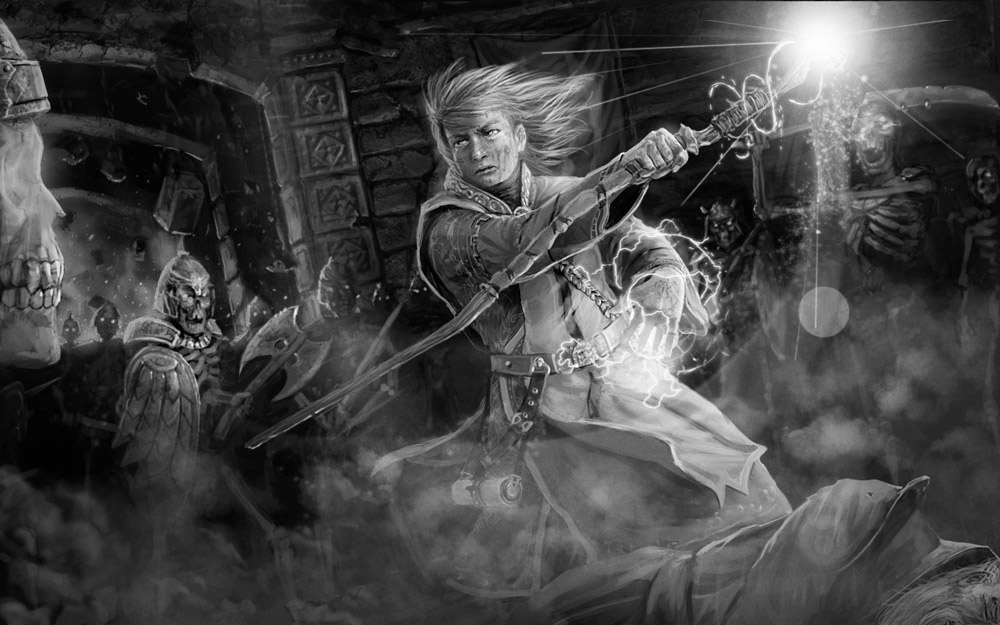
Mage WizardAs the old saying (which I just made up) goes – anyone can play a Wizard, but it takes a certain kind of person to play a Wizard well.

Of course, the same might be said about any class, but this post isn’t about the other guys. We’ll save those for another time.

The Wizard class does, however, differ from the other mainstream classes in its sheer out-of-gametime tinkerability. Even when you’re not sitting at the table (real or virtual), the Wizard player can be inventing new spells or pouring over published books looking for the perfect Cantrip or Evocation for their spell-caster. I doubt many Fighter players will spend much time inventing new melee weapons, or Rogues new types of lockpick (I’ll grant you, there are probably a few out there raising your hand right now), but the Wizard is the premier class when it comes to giving players the tools to make permanent and long-lasting changes to the game world.

I remember a Wizard player in one of my campaigns inventing Jellob’s Bouncing Fireball, and we still use it to this day. The spell has been revised (not to mention nerfed) over time and across editions, but the memory of that caster and his legacy lives on through the ages. What other class can do that? Fighters might be able to build their castles and Clerics their temples, but they will eventually be nothing but dust and the knowledge of that spell will live on.

It’s easy to think that the defining characteristic of the Wizard class is their spells and that’s largely true, though far from the whole story. The true defining characteristic of a well-played Wizard is a different thing entirely.

It’s preparation.

The Wizard is (usually) the smartest character in the party. They let fools (and Barbarians) rush in while they plan, prepare and make sure they know their enemy in advance. A wise Wizard player says they are going to research the history of the dungeon before entering it, and knows the threats and monsters they are likely to encounter once they are inside. If short on time or lacking vital information, they will suggest that the Rogue and Ranger scout ahead and the Cleric cast whatever Divination spells they have available. To a Wizard, knowledge is their plate armour and shield. Only when they have the preparation done and knowledge gained do they crack open their spell books and memorize just the right spells for the quest.

The same preparation extends to the first round of an encounter as well. Unless they have exactly the right spell to shape the battlefield to the benefit of the rest of the party, the worst place for the Wizard to be is at the top of the initiative list. Let the fools (and Barbarians, and Fighters, and…..) rush in so that you can discern which enemies to target and which ones the rest of your party can handle. If that means delaying your action until later in the round so you can size up your foes, so be it. You may well earn a name for allowing your fellow heroes to take the blows they could have otherwise avoided, but it’s a small price to pay for being able to end the encounter sooner. Wizards do have a reputation for aloofness, after all.

In summary, the Wizard is far more than a walking Magic Missile launcher. It is the class which plans and prepares. It is the class that can create new and game-changing spells and (once they forgive you) is everyone else’s best friend. If you want to play him well (and I hope you do), don’t just pick the highest damage spells in the list and never adapt to situations.

Be prepared, and kick ass. Because you’re the Wizard.

Till next time!

  • This article originally posted at The Gamer Effect on April 17th, 2013.
  • Image by Hokunin.  Used with permission.

Sauron – Distinctions and Milestones

WARNING! SPOILERS AHEAD FOR THE BREAK OUT MINI-EVENT!

One of the rewards established for the Break Out event, included in the Marvel Basic game, is the ability to redeem captured villains and turn them into playable heroes. My players really liked this option, but I never expected them to keep Sauron from SHIELD custody and then go underground with him in tow!

The Sauron villain included in Break Out already has an elaborate array of powers. I didn’t feel the need to change those when I created Sauron as a hero, so I won’t be posting the full datafile here as it would be mostly a copy straight from the book. Instead you can take any of the already posted hero files and edit it to create your own Sauron!

The Distinctions in the book are geared a little too much toward quick villain play. I tweaked them so they still represent a dark character, but could be used more often. I also wanted them to tie into his new specialties and milestones.

Addict

Privileged Genius

Savage Terror

He already had three specialties, but Sauron is a rich character with a deep history. The three he had were fine for his brief spotlight as a villain, but there were a couple that were missing if we wanted a fully developed sheet. I added d8 Menace and d8 Psych to help represent his training and experience.

Milestones went roughly the same way. As a redeemed villain, I wanted goals that represented the character fighting his history, and possibly failing.

Milestones

Power Addict

1 XP when you first use the Leech power in a scene.
3 XP when you choose to pursue a mutant target when your allies are in danger.
10 XP when you choose to return to a life of villainy in order to indulge your addiction or seek out long term rehabilitation.

Playing the Hero

1 XP when you convince another hero to buddy up or follow you to a different part of an action scene.
3 XP when you abandon that hero in the middle of a fight to go solo.
10 XP when you either accept a position of leadership in the team or leave it permanently.

Enjoy!

Contests In Roleplaying

As I was reviewing the 2012 SOTY finalists I had an idea for an article about using contests in roleplaying. As usual when my brain presents me with an idea, it was at an inopportune time.  I quickly noted the idea, shot off a query to Tourq to see if he liked it and then… promptly forgot about it!  Never fear dear reader, your host and Head Wielder of The Whip duly reminded me to actually SUBMIT this idea rather than sit on it eternally as I’m sadly wont to do.

Contesting the Obvious

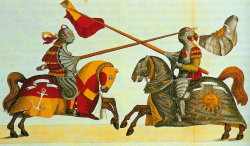
A jousting tourney can involve not just the PC on the horse, but those attending too.

Without piling the prose too deeply, a contest can be many things.  In common parlance today the use of “contest” is often synonymous with “lottery”, but the type of contest I wish to discuss is of the competitive variety than the randomly selective form.  The latter excludes character or player involvement too much for my liking, while the former allows useful narrative opportunities.

A contest then is an event wherein two or more contestants compete against either a common challenge or each other with the one(s) deemed more successful gaining a prize or boon for their efforts.  One type of contest one could stage is a competition of skill such as an archery contest, gladiatorial fighting, spell duel, jousting, a race (on a course with unusual traps, challenges and pratfalls to boot!), a singing competition, etc.

Another type of contest is the quest, usually depicted in myth as a Noble announcing that the first person or group to accomplish a given task would win a priceless item, a pile of gold, a palace, the Princess’ hand in marriage, etc.  This form is well suited to a longer delivery and thus could span any number of gaming sessions as the PCs struggle to get the ‘X’ from ‘Y’ to attain ‘Z’.

Why Have Contests?

A contest is an excellent plot device which can easily be filled with tension & drama, involving roleplaying, entertaining or threatening NPCs and genuine risks with clear rewards.  It is so apt for the plot and character driven storytelling of roleplaying that it behooves us as roleplayers to grasp at every chance for contests that come our way as either the GM or Player.

At lower levels, a contest is a good opportunity to introduce rivals.  Perhaps ANOTHER group of adventurers is also looking for the ancient Mithryl Hammer to win the title to the Ironfoot Mountains from the Dwarven High King?  Maybe you’re NOT the best swordsman in the kingdom and last year’s winner is here to prove it to you.. or will he?  While this won’t fully establish a long term rival all by itself, the competition allows for ample encounters that will lay the foundations for how the PCs will react to and interact with these rivals when they see them again in a different context.

Contests can also be a “safe” way to test the capabilities of your players’ characters.  Just how powerful is that 5th level Wizard?  This is doubly useful if you have a player with a nonstandard character type you’re unfamiliar with.  You can repeatedly challenge the character in multiple ways without risking killing the PC or derailing a significant component of your intended campaign.

For the player, a contest can be an environment to test out unusual or unfamiliar abilities, powers, or even tactics with your character.  Have a new weapon?  Enter the arena.  Just gained a new ability or want to try out a new set of skills?  Compete against your fellow players or some NPCs.

There can be post-contest consequences as well – some may be desirable, while others are not.  Winning a contest may earn you local adoration by those who witnessed your achievement, or winning may turn against you as those loyal to the defeated come to avenge their champion.  Of course, the reverse can be true for either result with losing a contest earning you local sympathies or have you run out of town as a traitorous disappointment to everyone.

The prize of a contest can change your character as well.  A Fighter with a shiny new suit of prize armor will definitely behave differently during the next dungeon delve!  Even non-material prizes can introduce changes.  Winning the Mages Duel gave you an in with the local Wizard’s Academy who previously had ignored your requests for assistance in researching the whereabouts of the lost Tower of the Magi.

At higher levels the nature of a worthy contest should change, upscaling to meet the abilities, needs, and complexities of more developed characters and campaigns.  Instead of the simpler direct competition of ability versus a known and discretely defined challenge, the contest could be more of a trial than a simple test, the outcome of which may affect the setting or long term plot of the campaign.  With higher stakes, comes more danger, both from the contest itself (failure could mean death), and ones fellow contestants (they may be willing to permanently eliminate you from competing).  Accordingly, the contest should be run by a more impressive personage – rather than the local lord, it is the Emporor, a God, a dragon, etc.  Of course, with all of this upscaling, the rewards will be much greater as well.  Winning an entire kingdom instead of a plot of land, a priceless, unique artifact of great power instead of a +1 weapon, etc.

The Devil Is In The Details

As a player, your role in a contest is to learn as much as possible about what is needed in order to win, and then perform at your best to achieve victory.  This can sometimes be a simple process, or it may take many game sessions to complete.  If the contest is a group endevour, then you will likely need to employ new or more advanced strategies in working together and relying on each others’ skills and abilities.  Likely it will be your less used ones that will be tested, so be sure to bone up on your characters’ capabilities.

For the GM, there is a lot of work required before even presenting the contest.  All the structural aspects of the contest need to be created in preparation for the players.  A contest needs conditions of who may enter the contest, how the contest is conducted, the judging method for determining the winner, and rules about what is or isn’t allowable.  The challenges throughout the contest (especially for longer, more complex contests) must be determined and designed.  Unless the only contestants are the PCs against each other, the competitors must be prepared to as complete a degree as the contest itself, with not only their base statistics determined, but their personalities, and a few notes on what their strategy for the contest will be.  Any events of intrigue or danger must be planned in a manner similar to the planning of a minor encounter or one off mini-adventure.

Finally, the prize itself must be created – be sure to properly consider possible consequences of the PCs reaping the reward as well.  If they become the new owners of Mistmoor Keep after emerging victorious at the tourney, then what will you throw their way once they arrive at Mistmoor to inspect and move into their new digs?  Will having a party Bard with a magical Horn of Confidence require you to up the ante in future monster encounters?  Just how powerful is a Holy Avenger anyway?  Either way, be ready to deal with what you’ve given your players so you don’t end up with regret.  Running a contest should be an exciting series of challenges that add to everyone’s enjoyment of the game.  With proper planning and an animated delivery, this outcome can be assured whether the PCs win or lose.

Sometimes Less is More: Preparation Tips

Everyone wants to be the best DM possible.  They want to give their players the experience of a lifetime, every time.  People create their own adventure, because modules – well can be a little dry and linear at times.  I am not bashing modules, modules can be quite interesting for basic playing.  Unfortunately, they tend not to provide the depth that serious role-players crave.

When creating your own adventures, some people tend to take it too far, trying to think of every detail, trying to predict every players’ actions, trying to look at the adventure from every different angle. If you have played and RPG long enough you should know that you cannot predict everything that you player characters are going to do.  Here are some stress-free tips on preparing your adventures.

Character Backgrounds

One of the most important things you should do before beginning an adventure is to let your players help you plan the adventure.  You can do this by asking them all for a character background. The character background will give you ideas and allow your creative juices to flow.  Characters will give you an idea of their motivations, reasons for adventuring, NPCs that may influence the plot as you go up in levels.    A players’ family member may be afflicted by lycanthropy, or some baron has unlawfully imprisoned your family.  Perhaps a player character owes some gambling debts and the person they owe sends henchmen to collect what is owed.  The possibilities are limitless.

The character background will also give you settings to place your characters in.  Maybe you are situated in Eberron and the character is a refugee family from Cyre, living in New Cyre and the Blades are planning an attack on the town.  Again, it gives you direction for adventures.

Loosely Plan Encounters

You don’t know what choices the party is going to make, and to railroad the players is not something I myself enjoy when a DM does this to me.  Give yourself a general plan on how you think things will run and choose a few appropriate adversaries to suit your need for the coming encounters.  This way if the characters decide to go left, when you planned to go right, you will be able to quickly plan something and adapt to the decisions of the players around your table.

Print off traps and hazards to pop into encounters.  This takes away some of the pressure of having to take the extra time to choose appropriate monsters on the fly.  Add some puzzles and contests to your repertoire.  If you are like me, your players like the odd challenge and puzzle.  It takes away from the monotony of battle after battle and provides a chance for your players to work cooperatively to solve encounters – not with muscles, but with brains.  Go online, search for puzzles and riddles you can use as encounters.  I once had a DM who set up a room where the party  faced off against the top 5 chess pieces in a room.  It was amazing.

Visual Representation

I think most players like to see what they were fighting.  Grab some minis to represent the people the players are fighting.  It gives a little more reality to the situation.  You can also use tiles, or even a battle mat to plan the rooms.  This way you can draw whatever sized rooms you need for all the encounters.

NPCs

Returning to the character backgrounds, use their backgrounds to give life to some of the influential persons in their lives.  Your players will be incredibly surprised with their appearance in your gaming sessions – not only as a cameo, but a fleshed out power toting version of the people in their lives.

Apart from the character backgrounds, create a few NPCs for future use.  Some of the NPCs should be those of disposable nature, ones that you can throw in for the adventure itself.  Basic stats and a general appearance is all you would need for disposable NPCs.

Taken from the Player’s Strategy Guide 4e

There are a few things good NPCs should have to make them interesting. Write a character background for each of them.  Do this either in great detail or point form; it doesn’t matter.  Invent the NPC’s motivation, the reason for antagonizing your player; it will lead to the attitude you will attribute to the character during game play. Is the player surly, aggravating, invincible, arrogant etc.  Give details to where they are from: location, career, position in enterprise.  The characters will become that much more believable. Sketch out a general plan for the character’s future and see if it ties in with the party’s ambitions.

Next you should flesh them out.  There are a couple of ways to achieve this.  The easiest way is to take a monster or a character from the monster builder and modify it to suit your needs.  Change the names of the powers and maybe add some of your own.  The other way you could do this is to create them manually.  Don’t forget to give them their strengths and weaknesses.  They cannot all be perfect, no one is.

Lastly give your NPCs an appearance and a voice.  What do they look like?  Are they big, small, thin, muscular? How do they sound? Are they loud and boisterous, shy and mousy?

No matter what or how you decide to organize your adventure and encounters, don’t forget to have fun.  Sometimes your player will throw a wrench into you plans – your counter is to not be so rigid.  Be flexible in your planning and roll with the punches, you will see that not only you, but your players will get great enjoyment out of your improvisation.

If you can think of anything else (tips or tricks) to add to the list drop us a comment.

Critical Failures And Magical Mishaps

Everyone loves magical items. Whether they’re common or rare, equipping yourself with the latest Flaming Sword or Circlet of Mental Might is part of the fun of playing. The abilities these items grant make you feel like that powerful fantasy hero you love being.

We all love winning, but one of the best parts of Dungeons & Dragons is that failure can be just as fun! There is nothing dull about being eaten by a dragon, thrown into a volcano or sliced through the heart in a deadly duel. But what happens when you just miss? It has to happen sometimes. Hitting each time would lessen that feeling of victory, but does it really have to be such a disappointment?

…not on a critical failure. When you roll a natural 1 on your attack die, you miss automatically, no math needed. With these new rules, a natural 1 isn’t just another miss, it’s a critical failure, as important and exciting as rolling a natural twenty. These failures represent turning points in battle – moments when the fighter didn’t just swing high, but the enemy quickly counters or the heroes lose their footing. In the rarest moments, the rituals that are binding magic into your implement or weapon fails, and its arcane energies escape in strange and unusual ways, turning failure from mundane to spectacular entertainment!

Down this PDF to take the following two tables to your game!

The Critical Failure Table 

When you roll a natural 1 on an attack roll, roll an additional d20. If that roll is also a natural 1, your character has achieved a Critical Failure. Roll a d6 on the following chart to determine the results.

  1. You lose your footing and fall prone.
  2. You suddenly lose your grip, dropping your weapon to the ground.
  3. You find your grip lacking and your thrust too great. Your weapon flies from your hand. Roll 1d8 to determine which direction your weapon is thrown. It falls in a space 2d4 squares away.
  4. Your enemy reacts unexpectedly when you attack, forcing you to adjust quickly, but it all goes horribly wrong. Reroll the attack with yourself as the target.
  5. Something has gone horribly wrong with the magic bound to your implement or weapon. Roll on the Magical Mishap Table to determine the results.
  6. It all seemed bleak for a moment, but you recover at the last second. Your attack misses and you appear significantly less skilled, but no harm done this time.

Adjusting the Rules

As you progress through the game, your characters gain more power in more spectacular ways. While these characters have more control over their abilities, they also begin to encounter stranger and more exotic mishaps. At Paragon Tier, replace results 1 and 2 of the Critical Failure table with a Magical Mishap (result 5). At Epic Tier, results 1-5 will all produce a Magical Mishap.

If you wish to increase the chances of a magical mishap occurring, remove the need to confirm the critical failure so that after the first natural 1, you immediately roll on the critical failure chart. This is an excellent option in campaigns where magic is rare or not well understood, for one shot adventures or even if your players just want to experience more of the results.

The Magical Mishap Table

The Magical Mishap Table follows some very basic rules. Effects are instantaneous, unless specific otherwise. Results marked with (Encounter) end at the end of the Encounter and results marked with (Affliction) can be cured by the Remove Affliction ritual. While “weapon” is the term used in the results, the same effects can apply to an implement if used in the triggering attack.

  1. Your weapon saps your life like an arcane leech, feeding your health into your target. Roll damage for the attack as normal. You take half damage and the target gains hit points equal to half damage.
  2. Bad luck seems to hang in the air around you. You gain Aura 2. Any ally in the aura takes -2 to attack rolls. (Encounter)
  3. Your body absorbs a blast of magic energy, keeping other effects from treating your wounds. You cannot regain hit points (save ends).
  4. Your attack sends out the force of a thunderclap, knocking your target and yourself back. You are both pushed 3 squares, and fall prone.
  5. Your weapon lashes out, temporarily seeking vengeance against your friends. You make an at-will attack against your closest ally.
  6. You feel an icy frost crawl over you. You are slowed (save ends).
  7. You find your legs suddenly encased in ice. You are immobilized (save ends).
  8. A great shifts occurs throughout your body. Your clothes now feel tight in all the wrong places. You change genders. (Affliction)
  9. You feel the itch of dwarven pride. You grow a beard, or if already bearded, become clean-shaven.
  10. Your mental being fades slightly. You forget the last five minutes of your life. (Affliction)
  11. You suddenly wonder how you got here. You forget the last 24 hours. (Affliction)
  12. You suddenly are surrounded by the strangest of people. You forget the last year of your life. (Affliction)
  13. Your body emits the foulest of odors. All allies within 5 at the start of their turn must make a saving throw or be pushed 3 squares. (Encounter)
  14. Your voicebox tunes out, leaving you mute. (Affliction)
  15. Your armor is weakened by a magical backlash, leaving you exposed in several places. You take a -2 penalty to AC. (Encounter)
  16. Your attack triggers the magic of local fey lines. Everyone in a close burst 5 is teleported 5 squares away, as if pushed. If that square is occupied, choose the next available adjacent square farther away from the origin square. You are teleported upward 5 squares.
  17. The battlefield is instantly rearranged to your target’s will. The DM swaps any creature in a close burst 5 around the target, to his liking.
  18. Magical energies flow from the attack back into your weapon, giving it life! Your weapon becomes intelligent or loses intelligence it had before.
  19. Suddenly, the earth around you does not hold you to it. You create a zone of weightlessness in a close burst 5. All creatures in the zone gain a fly speed equal to their speed and hover. Exiting the zone causes the creature to fall. (Encounter)
  20. Your weapon whirls in a burst of arcane might. Reroll the attack as a close burst 3, targeting all creatures including yourself. You have Combat Advantage against yourself for the purpose of this attack.
  21. You feel your own blood boil within your veins. You gain ongoing 5 (per tier) fire and poison damage (save ends).
  22. Your appearance shifts slightly so that others distrust you. NPCs treat you one step less favorably than they normally would. (Affliction)
  23. Your weight shifts, making your body heavy as stone. You fall prone and cannot stand (save ends).
  24. You seem light as a feather. When affected by forced movement you move an additional square. (Encounter)
  25. You become very self conscious about the threat you pose in battle. At the beginning of your turn, if no one has attacked you since the end of your last next turn, you take a -5 penalty to your next attack roll. (Encounter)
  26. The strangest feeling comes over you that you might taste good with ketchup. The closest dragon learns your current location and receives a vision that you mean to do him harm.
  27. How could you ever dream of harming your true love? You are dominated (save ends). While dominated, you confess your love each turn as a free action.
  28. Your failure releases a blast of the mysterious energies. The closest mount reduces in size by one category.
  29. Your develop strong feelings of love for your nearest ally. Whenever that ally is adjacent and takes damage, that damage is reduced by half and you take half damage. (Affliction)
  30. Arcane streams seem to invigorate your target and enhance its form. Your target increases in size by one category. (Encounter)
  31. A massive gout of steam escapes from your body. You fly 10 squares up and then fall.
  32. Your attack rips open a portal to the Heavens. An angel appears in an unoccupied square within 5 and attacks the next person to deal damage. It continues to fight until battle ceases.
  33. Your attack rips open a portal to Hell. A devil appears in an unoccupied square within 5 and offers its services to the highest bidder.
  34. Your attack rips open a portal to the Abyss. A demon appears in an unoccupied square within 5. It attacks the creature that appears to be the most powerful each turn.
  35. You suddenly regret eating those old trail rations. You use the wizard power fireball. Instead of an area attack, it is a close blast 3, placed opposite the target of your last attack.
  36. Magical backlash turns you into a newt. You gain a climb speed equal to your speed and cannot use any of your powers or items (save ends).
  37. You find yourself suddenly under water, creating a zone in close burst 10. Every square in the zone is filled with water. The zone extends 3 squares up. (Encounter)
  38. You phase out of existence momentarily. You are removed from play until the end of your next turn. You appear in the same space as you left, or the closest unoccupied square.
  39. Brown hair sprouts all over your body, and your tongue and jaw shift. You have become part chipmunk. You gain a climb speed equal to your speed, and can no longer speak any language. (Affliction)
  40. A Celestial Dwarf and an Infernal Barmaid appear in separate adjacent squares. Each round, at the top of initiative, the celestial dwarf accepts a glass of dire ale from the infernal barmaid, and drinks it. Each round, as a minor action, you must do the same. You may spend more than one minor action, to drink more than one ale. If you do, the celestial dwarf must match your number of drinks on its next turn. Every time one of you drinks you must make a save. Each failed save reduces your AC, Reflex, Insight and Perception by 1. The first creature to fail 4 saves falls unconscious (save ends). This causes the Celestial Dwarf and Infernal Barmaid to fade from existence. The effects of the ale last until the end of the Encounter.
  41. You can sense that your magic failed somehow, but notice no effects. In another reality, your other self is compelled into service. Check the beverage levels at your game table. Refill or renew the beverage of anyone who desires.
  42. You gain an impatient stride (save ends). Your speed increases by 2, but you must move at least 4 squares each turn or take damage equal to twice your level.
  43. A psychic energy pierces the air, making your mind jump. You switch personalities with your nearest ally. (Affliction)
  44. Why are these peasants attacking you? You suddenly are convinced you are an heir to the nearest kingdom. (Affliction)
  45. Your failed attack triggers a boon from a lost Fey Lord. Your target can Teleport a number of squares equal to their speed as a move action. (Encounter)
  46. A piece of your soul is torn away and flung across the cosmos. A duplicate, with all of your abilities, appears somewhere else in the world. This twisted doppelganger can feel that it is but a shadow of you, and seeks to destroy you.
  47. You suffer the backlash of others vane perceptions. All your clothing and equipment turns pink and your hair becomes blond.
  48. An amazing sight appears before you, that no one else can perceive. You are dazed (save ends).
  49. The area around you sprouts into low tangler bushes. 2d8 squares within a close burst 6 become difficult terrain. Any creature ending its turn in one of these squares becomes immobilized (save ends).
  50. Your weapon strikes out at the core of your life force. You save or die.

Down this PDF to take the above two tables to your game!

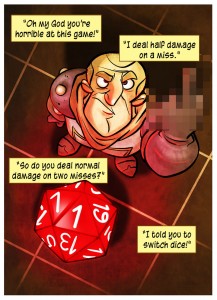
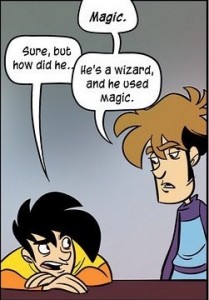
The images referenced above were grabbed straight from the pages of tvtropes to help break up the text. StufferShack doesn’t own them, nor did we ask for permission. Come on though, you know they’re from Penny Arcade. 

Playing with FATE – Using Resources

In the FATE system there is the Resource ability. The rules for Resource are very basic and, aside from purchasing goods, there does not seem to be many reasons to use it. The alternative to Resource is actually tracking money, so it’s nice that Strands of FATE stays consistent with the abstract nature of the game.  With a little creative thinking, Resource is a worthy ability that can benefit or hinder a character without adding any new mechanics (remember, hindering a character can be good!).  Here are some suggestions to make the Resource ability more important in any campaign setting.

For a description of Resource, think of it like the character’s Strength attribute. It is not a measure of raw wealth as much a measure of how well the character manages his financial resources. As an example, there could be two characters, each with a 3 Resource, but one is merely wealthy while the other knows how to shop for deals and barter when necessary. The net result is the same.

Aside from the suggestions listed in SoF, there are plenty of ways to use Resource. Usually, it’s used whenever someone needs to purchase something. When this happens, they take the cost of the item and use it as an attack against the character’s wealth track. If the character makes the target number or better, he afforded the item without any problems. If the character makes more than one purchase in a game session, each consecutive purchase is at -1 to defend. When a character does fail, he does not make the purchase. He also cannot purchase anything else at that value (or greater) for the remainder of the session. Optionally, he takes stress on the wealth stress track. Of course, stress heals quickly and unless it is a large purchase, taking stress is not much of an issue. Here are some suggestions for adding value to the Resource attribute.

Unless the character has a profession where their day-to-day expenses are easily met, a monthly maintenance roll is needed. This is a Resource roll against a target number (set below). If the character missed work, a penalty of -1 per week or less missed would be a good modifier against the roll.  The following is a guideline for maintenance based on lifestyle:

Very Poor: 0
Poor: 1
Average: 2
Moderately Wealthy: 4
Wealthy: 6
Very Wealthy: 8
Filthy Rich: 10

For games where adventuring is their source of income (i.e., private investigator, adventurers, etc.), this is a reminder as to why they work. The fact that they work is the reason within the game as to why their Resource is where they set it. If a character is working a lot of overtime or they find treasure, they could be given a bonus for that roll. The bonus helps give the player the satisfaction of putting in the extra work.

I run a fantasy game where treasure is part of the genre. My players occasionally hit the big score which gives them one-shot wealth bonuses. These are expendable wealth points that benefit a Resource roll at a one-for-one ratio.  It allows them to make those occasionally large purchases without raising their Resource attribute or going into debit on the wealth track. On one occasion, I had a player accumulate so many wealth bonuses (not spending them) that I allowed him to use them as experience points to purchase up his Resource attribute.

For some purchases, the characters will run into situations where some products are either rare or more common than back home. For these cases, a cost modifier is in order. I developed my table based on the D6 Adventure by West End Games. I got my copies through one of the many online gaming resource sites.

Cost target modifiers might look like this:

Very Common: -2 (This is when the PCs are located where the bolts of silk fabric are woven or the mines for the rare ore are located.)
Common: +0
Uncommon: +2
Rare: +4
Very Rare: +6 (It might be easier to go on a quest to acquire this item)
High quality goods: +2 (i.e., The sword does extra bonus, The dress is of high quality, etc.)
Low Quality: -2 (i.e., The item is damaged or used.)

Of course, there are plenty of other modifiers that could be used.

Even if characters make monthly maintenance rolls it should not affect their other purchases. Of course, if their maintenance target is above their Resource, a modifier would be in order. So would a maintenance below their Resource. This better reflects the limited resources the character has to live and how wasteful or frugal they are.

For normal purchasing rules, the cost settings are fine. For those GMs who like to use the wealth stress track, I recommend adjusting the money value higher per dollar to account for the fact a character can make a purchase by taking stress on their wealth track. Since the first couple of consequences are minor and easily recovered, the Resource attribute is actually more powerful with the stress track to benefit it. For this situation, I recommend that money follows the same linear track that Strength does in place of the standard quadrupling the money for each rank. I leave it to the individual GM to decide what the right balance is for them.

I also think that there should be a “Wealthy” power. It could follow the rules as Strength for how it escalates for the amount of advantage points spent. This means each rank of wealth is equal to one rank of size for lifting capacity. With a “Wealthy” power, antagonists can be brought into a game who have resources that only vast amounts of money can buy. A certain villain in DC comics comes to mind.

There are plenty of options for using the Resource attribute. Feel free to experiment. It’s a worthwhile attribute that can be used to manage wealth by any measure without the need for meticulous cash counting.

GM Burnout – What to do?!

I love running games.  Fantasy, Sci-fi, Retro, Space, Modern… you name it, I love it.  I love it when you’ve got those players sitting there, leaning forward, waiting to hear what you’re about to say, waiting to see what you’re about to hand out, and waiting to attack whatever it is you’re about to throw at them.  In a nutshell, I love the challenge of creating an adventure that my players are going to want to talk about when they’re away from the table.

I’m talking about that campaign that you created from scratch – full of mystery, intrigue, danger, rewards, plot twists – and it’s all tied to the player characters in a meaningful and rewarding way.

Those moments when your players  feel that you’re the BEST GM they’ve ever gamed with, it’s like you’ve won the game.  It doesn’t get any better than that, right?

But what about those times when you start struggling to deliver, when you start running out of ideas, when you burnout so bad that those tires deflate?

That sucks.  It sucks when your players say that they’d rather spend time with their girlfriends than sit through another lackluster, mundane session.  Sigh.   I’m talking specifically about when you can’t write, create, and design your own adventure or campaign anymore.  Every so often I keep running into this problem.  I get a little GM Burnout and those tires get deflated.  It’s frustrating.

So what to do?  How do you rejuvenate yourself?  How do you start making an adventure or campaign that your players will love?

The fix:

Just go to a prewritten module.  Shell out those bucks and buy some published adventures.  Most of them are pretty good, so you have nothing to lose.

I know what you’re thinking: “Me?  Use a premade published adventure?”

Yeah.  Use a premade adventure.  It takes you back to the old days, to the days of endless hours of gaming fun.

It doesn’t take much to run one of these, as most of the work has already been done for you.  All of the NPCs, enemies, and monsters are designed from someone else’s point of view, so your players get a fresh, widened variety.  They usually have maps, and those maps are usually designed with interesting detail.  Even if the module uses a horrendously clichéd conflict (save the princess, help the village, or kill the necromancer), it’s still more fun than if you wrote and ran a similar home-brewed adventure.  It’s nostalgia.

“But my players like our adventures to involve the PCs personally, involving their PCs’ backgrounds.”

Ok, so add it in.  Running a premade module doesn’t mean the PCs can’t run into known allies and enemies from previous adventures.  By all means, include them.  It ties the adventure to the player characters, bringing them closer into the story.  Pretty soon that premade module stops seeming so bland, instead developing into a pretty interesting and rewarding story.

So that’s it.  It’s not intricate and we’re not reinventing the wheel.  When you start feeling the burnout from a game that you just don’t want to run anymore, jazz it up by throwing a premade adventure in there, and tailoring it to fit your PCs’ story hooks.  You’ll fix that burnout with fresh new tires.

Thanks for reading!