Did you spend your Fate Points today?

One aspect of the FATE system is the ability to alter the course of your (or your opponent’s) dice roll. However, the Refresh Rate is once per session, and the players may be concerned that there might be one more challenge around the corner and thus, need that fate point. As a piece of advice, spend the point if you need to; don’t save it for what might be around the corner. When a player does not spend available Fate points, they just end up being wasted.

For those who do not play the game, a Fate point is like a credit to modify dice rolls, or to cause an effect to enhance or change the story of the game.  The number of Fate points that a character starts the session with is determined by the game’s Refresh Rate.

In all honesty, it is easy to not need Fate points in the Strands of FATE system. A character can have a high ability that almost certainly grants automatic success. There are plenty of advantages and powers that do not need Fate points (granting their own inherent bonuses).  A player could even be in a session where more role-playing than rolls is needed to get through an encounter. Any of these are viable excuses for not spending the entire refresh of Fate points. However, it does not matter if the points are not needed for success, or if they’re being horded for the next possible encounter. A Fate point remaining is a Fate point lost if it remains when it is time to refresh.

This is because Fate points do not stack after refresh, and a character cannot recover fate points beyond his refresh rate. A character who has 4 points in the pool at the end of a session and has a refresh of 8 will still only have 8 Fate points at the new session. This means that 4 points were lost.

Here are some reasons why players should utilize all their Fate points:

  • The character made his search/maneuver/defense roll, but there are better results if you generated spin (a high roll).
  • The points refresh after each session.
  • If necessary, the character can go into negative Fate points. The negative is treated as bad luck.
  • Even if you go into negative Fate points, the refresh will replenish everything.
  • If the next fight is that critical, the GM should refresh the Fate pool just before the fight happens.
  • There are no bragging rights for not using Fate points.

Whenever a character makes a success doing any of the items above, he gets the results of that roll. However, by generating spin, the character can perform more phenomenal things. When searching, a success may mean the character finds a clue leading to the next encounter, but spin might give a clue to the villain’s plans. When doing a maneuver, spin might make it sticky (a good benefit in this case). When generating spin while defending, the next attack against that opponent gets a +1.

Unless there are special circumstances (like ending the session in the middle of a scene), the character refreshes his points at the new session. Use them or lose them. ‘Nuff said.

Fate points can go into the negative. The reason has to make sense for the story, or the GM will not allow the negative point. If the character does go into negative points, he earns a temporary unlucky aspect. What an opportunity to earn extra fate 😉 Seriously, the points will refresh next session and the aspect will go away.

GMs don’t generally want to see their characters die a horrible death, unless he is running something Lovecraftian. If the characters are low on Fate and a big encounter is coming, the GM will refresh the points for that encounter. Of course, he will not refresh before the encounter happens. He would not want to tip his hand.

Obviously, the GM has final say on all of these points. Nevertheless, the only way to not waste a Fate point is to use the point. Take advantage of the tools in front of you when playing your character. Fate points are one of those tools.
Keeping Good Players

Good players are golden and as GMs, we need to treat them that way. Here’s a list of ideas to keep your players happy and coming back.
  1. Make every player feel like their PC is your favorite character. Focus on each PC in the party for a set period of time: one session, one month, one adventure. The length of time doesn’t matter as much as making sure that every PC gets the same amount of time.
  2. Listen to your players, in and out of character. Players are great sources of inspiration.  Treat your players with respect.
  3. Read what your players give you. It’s important to them, or they wouldn’t have given it to you in the first place. Find a way to incorporate something from that information into your game, even if it’s just having the character run into a college roommate and say “Hi.”
  4. Try to give every player the same amount of attention every game session. You don’t need to set a timer for exactly 10 minutes (though you certainly can, if it makes it easier); just rotate your attention on a regular basis. If circumstances cause you to spend a greater amount of time in one session with one or more players, try to give the same amount of time to the other players over the course of the next few sessions.
  5. Let the PCs have a lasting and real effect on the game world. Reward creativity and good thinking with more than gold and experience points. Have a grateful city name a street after the party, let one of the PC’s songs become a popular hit, have the party overhear bards telling stories of the party’s latest acts of heroism, etc.
  6. Never tell a player how her character feels about something. Unless the PC is under mental influence from an outside source (Charm spell, Dominate discipline, etc.), the player alone controls the character’s feelings and actions. Tell them what happens, don’t tell them how to feel about it.
  7. The same goes for PC actions. Unless the PC is under some type of compulsion, never tell a player what their character does in a particular circumstance. Similarly, try to avoid telling a player that they can’t do something. Let him make an attempt. Give him an impossibly low chance of succeeding, but let him try. Use common sense with this; most players would be okay with you telling them that their normal human character can’t pick up the Empire State Building or fly unaided.
  8. Don’t get bogged down in mechanics during the game session. Make a ruling and move on, unless the players want you to look something up. Include you players in this by asking one of them to look up the mechanic in question.
  9. Make sure the NPCs are there to help the characters, not to do things for them. It’s okay to have an NPC participate in a party’s victory, just make sure that the crucial actions are performed by the PCs.
  10. Respect your players’ time. Show up on time to game sessions and try to avoid canceling on at the last minute. Understand when non-game obligations interfere with play. After all, most players have jobs, spouses, kids that will sometimes take precedence over play. Real Life always trumps game. And for God’s sake, if someone tells you not to call after 8pm, don’t call them after 8pm.
  11. Keep control of the game. Don’t let players bully you into making decisions you don’t like. If you have to boot a player to keep the game fun for everyone else, do so politely. Cut off rules discussions that threaten to become arguments. Stop the session and/or separate players when they start to argue or get angry with one another (out of character).
  12. Be organized. That doesn’t mean your game notebook needs to look like it came out of DayTimer ad. Just be sure you can find what information you need when you need it. Be particularly careful not to lose information your players give you.
  13. Be a gracious guest. If you’re not hosting the game, treat your host’s home and family better than you would treat your own.

(This is an excerpt from the GM’s Field Guide to Players, the up-coming book from rpgGM.com, due to be released this fall.)

Playing with FATE: Using Different Scales in Combat

Richard Mortellaro talks a bit more about FATE, helping us envision different scales of zones in the same encounter.

Usually when there is a combat scene, it’s either all melee, all ranged, or a mix of the two. For most combats, using the Personal Zone Scale is the best option. The actual size of zones is only relevant to the scene and does not need to fit any fixed constraints. However, when dealing with mixed combat, it is sometimes best to combine scales.

As an example: an assassin snuck through the tall grass and reaches a squad of guards watching a press gang. The assassin’s task was to kill the guards without harming the press gang. Most of the gang were in a trench digging, and the guards stood above them at the edge of the trench. The assassin moved to within range of his bow (one zone) and started killing the guards one by one.

It was not until after the second guard fell that they had an idea where the shooter was. Once the direction of the arrows was known, the guards initiated a charge to get the assassin. The guards had six zones to cover, and held formation in their charge. To keep the formation, the guards could only move 2 zones per round. During the guards’ charge, the assassin held his ground and shot the remaining guards before they could reach him.

What?! Yes, the assassin was one zone away for archery and the guards were six zones away for movement. How far is a zone? Well, that depends; a zone is as large as it needs to be. Even though a bow only has a range of one, that does not mean it needs to be the same zone(s) used for movement.

Strands of Fate (in fact all Fate systems) use zones. Zones use a zone/measurement system that operates differently from a grid system, but still performs the same function. Unlike traditional grid/ fixed measurement systems, zones can vary in size and shape – and all on the same map. Grid systems use a fixed distance for each square on a given map. Despite the different sizes, each zone measures one unit of movement. The roughness of the terrain or obstacles bordering zones are used to determine the zone’s size and dimensions. If the zone seems too large to navigate in a standard three second round, remember that time is also elastic in Fate. There is no harm in saying that a round lasts longer than three seconds or even a minute.

Normally, when there is a combat, all the combatants use zones of the same scale, whether using hand-to-hand action or ranged attacks. In melee action, despite the actual range of bows and guns, they use the same personal zones for range as movement. This suits ranged combat by representing the brief time given to aiming before shooting. It also suits melee combat because of the chaotic nature, and prevents ranged weapons having a significant advantage in a story driven game.  If it helps for melee combat, think of range weapons as being pointed and not aimed during the time pressed combat.

When dealing with mostly ranged combat, the zones could represent larger spaces and time that allow for aiming. There is no need to worry how large a zone is for ranged combat, because if someone moves, the flexible nature of time in fate will adapt to fit the scale of the zone. Sometimes there can be a trade-off, like when using one scale for ranged weapons and another for hand-to-hand combat.

In the case of the assassin, he had time to set up and put himself at the furthest range for accurate bow shooting. The best combined scale for that scene was six personal zones per skirmish zone. As long as the assassin did not move during the combat, he was allowed to use skirmish scale zones for range. If he moved to keep his distance from the guards, he would have been forced to use personal zones to represent the haste and confusion of combat at personal range. This simplified combat between the assassin and the guards. It also meant the assassin would pay a price for moving by losing his range advantage.

Whenever one type of combat is going on during a scene, using the same scale is the best option. The few quarks concerning ranged versus melee combat is not a game killer. In fact, it can enhance the drama. For those occasions where the range of a weapon does not fit into a melee scene, combine scales by adding skirmish zones to the personal zones.

Writing a D&D 4E One-Shot

Dixon Trimline takes us through his process of creating a one-shot adventure, and concludes it with an adventure download: Faith Like Venom!

As I’ve gotten older, I’ve experienced significant shrinkage in my available time and effective attention span, so I’m unable to commit to a week-long/month-long/year-long campaign. For me, I’m all about convention games, 4-hour quick-sits at gaming stores, or “What are you doing this Saturday?” delves. Each of these has a definitive beginning and ending. Of course, the players are just getting to know their characters and each other when the game ends, but that’s a small price to pay for the mental mobility of a one-shot. Thus, here is my process:

Step 1: The Idea

Imagine bumping into a gaming superstar at a convention, and she says, “I’m interested in your 1 o’clock game. Tell me about it.” If your instinct is to say, “The year is 689 in the fog-shrouded time of the Ancient Dragons, and all the world stands silently as evil seeps from the lands below…”, you’ve just lost your superstar.

Ideas are one sentence, the less thought given to them, the better. Don’t agonize over it, don’t examine every angle, don’t figure out the logic, the setting, or the plan. Come up with a single sentence that would make a player pause and say, “Really? Tell me more about that.” If you need to, drag out the dusty old Tome of Clichés: evil twins, betraying friend, early onset amnesia, the “more than he appears” character, working for the villain, and so on.

The party has to kill a lawful good high priestess and her snake servants.

Step 2: The Enemies

Using the excellent Monster Builder, make a list of the potential combat opponents, really uncorking your imagination and letting it spill all over the floor. Your goal is to have way more than you could ever use, varying the types of creature. Because the Monster Builder allows you to set the monster levels, don’t feel like you have to restrict yourself in your selection to just heroic, paragon, or epic monsters.

High Priestess, yuan-ti, giant snake, kobold, drake, kruthik, lizardfolk, snaketongue

Step 3: The Encounters

Decide on three set-piece encounters, using this pattern:

Encounter One

Use the KISYSDM method, or Keep It Simple, You Stupid Dungeon Master. You don’t know these players, they don’t know you, they don’t know their characters, and they don’t know each other. For these reasons, you should create a nice two-dimensional setting with few terrain challenges, and then insert brutes and minions. It’ll be easy on you and the players, and as a happy bonus, the players will figure out how to work together.

Use two (party level+1) brutes and 24 (party level) minions.

Note: According to Dave Noonan, minions should be worth 1/10 of a standard creature, and not the book-dictated 1/4.Trust me here, Dave’s right.

In a wide intersection, the party is attacked by two yuan-ti fangblades and their 20 snaketongue initiates.

Encounter Two

Break for roleplaying! Whether it’s a formal skill challenge or an informal wander-and-look, this offers a respite from the possibly hectic, probably grindy combat, giving the players a chance to interact with each other without the constant bleating from the DM.

The party investigates the snake-creatures and cultists that attacked them, researching the snake symbols worn and carried, talking to their back alley contacts, threatening the local priest who seems to be involved, and eventually tying the events to the high priestess, an upstanding cleric of Pelor who may be a servant of evil.

Encounter Three

As much fun as roleplaying is, many (most?) of the players may be getting antsy at this point, wanting to roll dice and hurt enemies. It’s time to give them that opportunity, in the form of an encounter that’s a good deal tougher than the first one.

Use one (party level+4) elite brute, one (party level+2) soldier or controller, two (party level) brutes, and 10 (party level) minions.

In the temple of Pelor, the party confronts the high priestess, discovering that she is, in fact, a victim, being controlled by a giant cobra who wants to RULE THE [whatever]. This battle will be against the giant cobra, the dominated high priestess, two yuan-ti abomination berserkers, and 10 spitting cobras.

Step 4: The Settings

By now, you should know the basic shape of the sites you’ll feature, so all you need to do is assemble your maps. Naturally, you can draw them yourself on Chessex Battlemats or Gaming Paper, or use the Wizards of the Coast Dungeon Tiles or Paizo Flip-Mats. Your artistic skill or your existing map items may influence the final settings, but if you approached your encounters in the broadest strokes, you can be flexible with the finished product.

For Encounter 1, I’d use my Paizo City Market Flip-Mat, and for Encounter 3, I’d use my Paizo Cathedral Flip-Mat. For Encounter 2, I’d keep it all firmly in the imagination, since the player characters should be wandering all over the city and interacting with lots of people.

Step 5: Getting Graphical

Using the jumbled expanse of the internet, locate good pictures for all the monsters and characters. This part of the process is both thrilling and infuriating, since I can often find a few great examples and several terrible ones. Make use of the Wizards of the Coast Image Archive, and, of course, the Google images site is always a fun ride, especially if you don’t mind the occasional totally naked non sequitur.


Step 6: Monster Markers

During game play, I always prefer markers over miniatures, and here’s why:

  • Multiple miniatures can clutter and confuse the board, and sure, that may seem like so much “fog of war,” but in practice, it’s just distracting.
  • Typically, DMs will have ALMOST enough miniatures for a given encounter, resulting in, “this ogre is actually an ice demon,” or, “this horse is actually a spider,” or, “this halfling is actually a dragon.”
  • If the player characters are the only three dimensional creatures on the battle map, it correctly elevates them as the most important beings present. This story is about them, not the opponents.

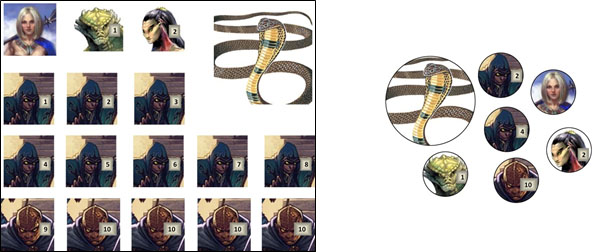
In a Microsoft Word document, lay out the monster images, cropped to the faces (small and medium creatures to 1.25″ x 1.25″, large creatures to 2.25″ x 2.25″, and so on) and numbered sequentially, and then print these pages onto white full-sheet shipping labels.

After sticking the pictures onto shoebox cardboard (good weight, and available for free at your local shoe store), cut the markers using the greatest thing to ever come out of craft stores, the sized circle punch. I use the 1″ nesting punch and the 2″ squeeze punch.


Step 7: Initiative Cards

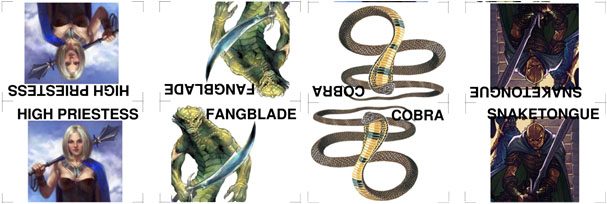
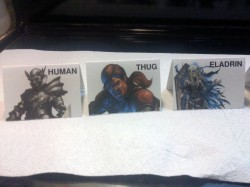
In a Microsoft Word document, lay out the character and monster images on labeled folded cards, which will sit like tents in front of the DM, tracking initiative order and also displaying images of the monsters. I’d recommend printing on cardstock, white for the monsters and bright yellow or pink for the characters, for easy identification.


Step 8: Final Touches

At this point, the one-shot is finished and ready to run, so you should take a step back, maybe see a few other adventures to cleanse your palate, and come back with a fresh perspective. You want to reread this one-shot from the point of view of the players who will be experiencing it, asking the following questions:

  1. Is there a clear through line? Does the progression through the encounters make sense, or does it feel disjointed and chaotic?
  2. Will the puzzles or riddles or mysteries be painfully obvious to even the stupidest players? Remember that this will be the very first time these players will see these elements, and they don’t actually know the answers.
  3. Are there parts of the adventure that will spotlight specific player characters? Will the thief be able to pick a lock? Will the bard be able to sing a song? Will the fighter be able to crack some skulls?
  4. Are there any parts of the adventure—the monsters, their powers, the settings—that can be exploited by the players? Is this really a bad thing?

Note: If you find any parts that can be exploited, do NOT change them. Just come to terms with them. Allow it to happen. Become a leaf on the wind.

  1. Through Line. The adventure story is quite simple, starting with an attack, moving to an investigation, and concluding with the big snake battle. The party halts the growing darkness, saves the high priestess (hopefully), and lives to fight another day (again, hopefully).
  2. Puzzles/Riddles. The investigation is freeform, merely requiring the player characters to poke around and ask questions. They’re looking for the WHYS (why were we attacked?), and then moving onto the WHAT NOWS.
  3. Spotlight. If you’re providing pregenerated characters to the game, it becomes much easier to develop spotlights, since you’ll know exactly what the characters are capable of. Even so, you can assume the party will include strikers and probably a defender or two, which explains the high-damage, low-defense brutes, and it might include a controller, so there are piles of minions. If I knew an undead-bashing cleric was coming, I might want to toss in some zombies too.
  4. Exploits. The party might decide to take prisoners in that first encounter, which could screw up my investigation during the second encounter. They could also turn the second encounter into their Traveling Torture Tour of this nameless city, “Tell me what you know or I’ll cut off another finger!” Finally, and most troubling, they might elect not to look into the attack, deciding, “We were attacked by snake-men and cultists. Weird. Let’s go to the inn and drink.”

What About Dungeons?

Maybe you read this and thought, “That’s all well and good, but I want to create a dungeon one-shot. Dungeons don’t work as encounters, but as a player-selected series of rooms. I can’t control which one they’d go to first, then second, then third.”

Except, of course, you can. You just don’t have to tell the players you’re doing it. Your first encounter might be the ORC LAIR, which covers five interconnected rooms and contains a total of 30 orcs, which lay into the characters in waves. This would still look like a dungeon but play like a one-shot.

Conclusion

Believe it or not, I’m not suggesting that every one-shot has to adhere to this structure—easy battle, non-combat, tough battle—but I’ve found it to be a reliable template for my own quick delves or convention games. In the snake example I gave, it would still work even if I shuffled the encounters a bit:

  • Encounter 1: Church representatives ask the party to investigate their high priestess who’s been acting strangely, which means we lead off the adventure with non-combat.
  • Encounter 2: During the investigation, snake men attack the party, and flee once they realize how tough and scary the party is.
  • Encounter 3: The party pursues the snake-men to the cobra lair, and fight the snake cult.

For any of these, the biggest challenge for the DM would be believably connecting the encounters, and that’s where I can load the party up onto a story-train, and click-clack, click-clack, click-clack, we’re onto the next encounter through a cut-scene. In a time-sensitive game, like at a convention, this approach always works, and the players tend to be more forgiving.

So, do you want to see how I wrote up this example adventure? I didn’t go into a whole lot of detail, but then, I rarely do.

Download Adventure-FaithLikeVenom, which sounds like a combination George Michael and Madonna song. Man, I’m old.

Killing a fellow PC: Bad Form? Or Bad Ass?

My, how the tables turn…

I’ve been gaming for awhile now, and I’ve seen plenty of different situations at the table: different gamers, different points of view, different likes and dislikes, and on and on. If you’ve been gaming for any decent length of time, you’ve seen it all, too. And then, of course, after we’re sure that we’ve seen it all, we get hit with something new.

Charisma had a good article, PVP is cool. …I mean, NOT cool. Here’s a quick quote:

“No, you can’t make an attack roll against another player character. We’re fighting monsters; not players. The moment we start rolling against each other, the fun ends and the unfun competition begins. There is no PVP at this table.”

I remember that as a beginning gamer, the thought of attacking another PC never even hit the radar. The thought of PVP combat simply never entered my mind as a possibility. That wasn’t part of the game – after all, it was the GM against us.

Then, as my group got more comfortable with the notion of roleplaying (and because we thought we were so smart), we ‘realized’ that there was no reason that the combat rules wouldn’t apply to our characters, and in allowing player vs. player we were actually growing and maturing as gamers.

Unfortunately, this stage of our gaming careers was fraught with problems at the table. While we allowed for inter-party actions that were… aggressive, our quality of gaming started to suffer. I began to feel the exact same way as Charisma with her aversion to PVP. It just wasn’t working, and continued to create problems at the table.

Moving on, I began gaming with a new group, and for the most part there was no PVP (in any form). It was clear that this group was really focused on campaign story and the stories that were woven around the player characters. We were all there at the table to enjoy a good game, without drumming up any negative actions or energy, and it was pretty rewarding. None of our player characters ever despised, hated, or even wanted to (god forbid) kill each other. Normally, you’ll hear that such conflict is just bad form at the gaming table. And why not? I play a game to face challenges brought on by the Game Master, right?

Wronnnng.

In a previous article, I talked about adding PC vs. PC tension to your game for everyone’s benefit. Sure, that’s not everyone’s cup of tea, but it has made such an impact on our game’s story (increasing our fun factor) that I feel it’s worth recommending. The challenges that are brought into the game when tension among the party builds add a new element to the experience. You don’t have to burden the GM with all the story-telling; players can shoulder some of that weight just as easily. I say bring on the tension! But what about inter-party conflict that ultimately leads to one PC killing another?

I’ve been playing a Priest of Sigmar, in the challenging and unforgiving world of Warhammer Fantasy. As are many young Priests of Sigmar, he has a very black and white view of the world, and will charge into any battle without fear. There is no negotiating with evil or chaos, and those even slightly tainted by it are either brought to trial or killed outright.

Enter another PC (Willhelm), one who has a very troubled past and has once been associated with Chaos. As time rolls on, the tension between these two character builds. It builds even further when Willhelm develops a Chaos mutation, furthering the conflict and tension in the group (especially with the priest). Only because the threat that our characters face requires our PCs’ continued cooperation do we not kill each other. In fact, it is suspected among the player characters that regardless of how the threat is finally dealt with, there will soon be some lethal PC vs. PC combat. The campaign’s story and conflict was eventually overshadowed by the conflict among the party members. It took a lot of work for our characters to continue to stay together, let alone not kill each other.

And you know what? It was the absolute best campaign that I’ve been a part of.

The campaign just wrapped up, and (unfortunately) I didn’t get to kill Willhelm. Unfortunately? Yeah, unfortunately. It’s all right, though, because everything ended so perfectly in quintessential Warhammer Fantasy style.

So my question is, have you ever witnessed a player vs player death, and how did your group take it?

I Challenge Your Thieves Guild (Assassins, Too!)

Rarely have I seen a Thieves Guild that I could believe in. I know that we’re talking about a game – in a fictional world – in a fictional setting, and I know that a lot of concepts in the game come from real-life origins, but something about the Thieves Guild just rubs me the wrong way. Count the Assassins Guild in there for good measure, too. So, in this article, I’m going to talk about an alternate way of representing a Thieves Guild.

What IS a Thieves Guild?

A Thieves Guild is a collection of assassins, thieves, and other criminals who must pay an operating fee to a local (usually clandestine) criminal organization, in order to gain permission to ply their craft. The fee may either be paid in regular dues, or as a cut for individual jobs. Failure to pay the guild (and getting caught) results in punishment “up to and including death.”

One might say that a Thieves Guild is like any other guild in that its purpose is to spread the work fairly among those in the trade. In reality, though, it’s more akin to a crime syndicate seeking money and power.

~~~ Rewinding time down memory lane… ~~~

“No Tourq, you can’t cut his purse and expect to get away with it – you’re only level 1.”

“But I have this Pick Pocket ability, and my bonus is +10%.”

“Look, you can do it, and you might take his purse, but the Thieves Guild is more than likely to take notice and hunt you down.”

Say Wha…?! Perhaps you’re unlike me and have had a better time dealing with this part of the game. Back in the early days I swear this was the one issue that made me hate the idea of playing a thief, rogue, or assassin. Why would my character have to be part of a guild, or at least be on the run from a guild? I don’t remember my character class description ever really warning me of this issue, so why make it a big deal in the game?

Some possible rules of a Thieves Guild:

  • You must pay a fee to become a member of a guild.
  • The guild has a hierarchy of bosses that must be obeyed.
  • 10% (or 20%) of everything you steal must be paid to the guild.
  • You may never steal from a guild member.
  • You may never steal from beggars or the poor.
  • You may never steal from merchants or nobles who have paid a guild exemption fee.

~~~ annnd 26 years of gaming gives way to the hissing coming from my brain…~~~

The other day I was reading the news about how it is now illegal to pay blackmail, ransom, and extortion money to the Yakuza. Forget about the fact that the victim can now be taken to jail, and focus on the term Yakuza. The instant I read the word Yakuza was the exact moment I realized my problem with Thieves Guilds.

Yakuza, Triads, Mafia, cartels, even street gangs are the modern equivalents of Thieves Guilds. Thinking of a crime syndicate in such a manner reaffirmed my problem with Thieves Guilds, while simultaneously helping me believe in the possibility of a Thieves Guild.

My problem is that I think of a Thieves Guild as the absolute most basic, undefined, vanilla crime syndicate, interested only in money. When I think of the Yakuza or Mafia, I instantly have a vision of a well-defined criminal organization, one that has identity and purpose. Of course, that well-defined vision of modern criminal organizations comes easy, if not from the vast media portraying the subject, then the centuries of documented history. Real Thieves Guilds, on the other hand, are few and far between – there’s only speculative documentation of actual Thieves Guilds in late medieval France, and not much else…

~~~ and that is why I challenge the common notion of a Thieves Guild ~~~

Yes, I know this is a game with dragons and fireballs and voluptuous, promiscuous barmaids, but that isn’t enough for me to believe that a vast criminal empire is out to make sure I don’t steal from some visiting merchant, traveler, or tourist. I simply can’t believe in a setting where I have to pay to steal.

Thievery is a crime of opportunity, not a privilege. Will the Thieves Guild be there…

  • when little Timmy steals a piece of jerky from his brother?
  • when the beggar pockets a trinket while in the back corner of the market?
  • when the thug holds up a drunk merchant in a dark alley?
  • Hell, will they be there when the rogue sneaks into the manor and lifts the stack of gold from the master’s coffer?

I would certainly lose immersion in the game if they did. I doubt that members of the Guild would (or could) maintain control of all, most, half, or even 10% of all thefts in their town or city. I severely doubt they would expend the man hours needed to investigate such crimes.

I find it far more likely that a Thieves Guild would operate more like a common street gang or modern criminal syndicate. Take a few pointers from the Yakuza, Triads, Mafia, and Cartels. For instance:

  • First and foremost, the Thieves Guild is interested in money and power. When it comes to gaining more of either, the Guild does not discriminate; it will employ whatever illegal means that have proven to get results. Stealing, gambling, blackmail, prostitution, contract killing, extortion, and even the old standby “protection racket” are all fair game.
  • The highest members get paid dues by those that are directly underneath them, who are paid in dues by those directly underneath them (and so on), all the way down to the lowest members. This is like a group of guys who, together or not, commit crimes and give a cut of the score to their boss. It’s your typical pyramid scheme.
  • Typical members include bosses, money-makers, and enforcers. Since the bosses make the most money, members typically strive for upward movement. Generally, those that are good at both making money and enforcing make the strongest, most successful bosses.
  • Members typically have a special dialect or cant that is difficult to detect and/or decipher by common folk. Marshals and inquisitors who specifically target the guild have an easier time following or noticing the language.
  • Many times the Guild is largely left alone by nobles and politicians. Such people usually have a use for the guild, or are themselves targets of the Guild.
  • The Thieves Guild does not worry about local thieves and low-profile dealings, as that can never be truly regulated. It’s the certain members who have their small territory or niche infringed upon that get antsy. That becomes less of a Guild issue and more of a personal attack or war.
  • The Thieves Guild might have an actual name (like Yakuza, Triads, or the El Cortez Cartel), or it simply may just be known as “The Guild.” Membership is usually exclusive, as opposed to simply allowing just any thief to gain membership.
  • The Guild (or individual members of the Guild) aren’t going to go after every petty crook that’s trying to make a living; they’re going to go after those big time movers and shakers who make a splash in their town.

In conclusion,

You can see obvious differences between Thieves Guilds and crime syndicates, and similarities. I simply can’t believe in a group of thugs who have to pay membership fees in order to steal or commit crimes in their town or city, with the repercussions of not doing so being injury or death. Sure, members would pay dues to their superiors, but it’s to a specific person (one boss higher), not the Guild as a whole. Your “boss” is someone you know, have known, and spend time with on a daily or weekly basis. Having to gain permission and pay dues to begin a “safe” life of crime is what drives me nuts.

I’m not saying that a Thieves Guild is not exactly believable; I’m saying that to make it believable, I need to inject some realism into it. Thieves Guilds are largely works of fiction, whereas crime syndicates are largely works of history. Telling me that I have to deal with the Thieves Guild is one thing, telling me that I have to deal with the damn Yakuza is something else entirely. I think that if you blend the two, you’ll add a much more plausible and potent element to your game’s story.

Playing with FATE: Using Zone Aspects

When a player in Strands of Fate (SoF) uses a character aspect to his advantage, or compels another’s character aspect against an NPC, he has a good feel for how to use the aspect and what to expect from that aspect. When using a zone aspect, perceptions change. The question becomes, “How do I use this zone aspect?” or “How come I can’t make the swampy ground swallow up my opponent?” The answer is simple: zone aspects are just like character aspects.

The rules on SoF are clear when applying character or specialty aspects during an adventure. They are not so clear when dealing with zone aspects during the same adventure. The rules only mention using zone aspects, but to understand them, careful attention must be paid to the examples. The SoF PDF page 215 is one such example.

Taking the cue from that example, it is best to treat zone aspects like any character aspect. Aspects do not make things happen by default; they influence the dice roll to improve or hinder a character’s action.

As an example, we will use a bounty hunter who is after a bounty. His name is James “Bring ‘em back” Earl, and he tracked down a notorious criminal who escaped custody two months ago. James has all of his Abilities at 2 with the Look before you leap and Old soldier Aspects. He also has the Bum leg (Agility) Specialty Aspect. James found his bounty at a small fishing cabin by the lake. There are three zones with the following aspects:

  1. By the cabin: Knee-deep snow
  2. Ice near the lake shore: Slippery (P)
  3. Thin ice in the middle of the lake: Thin Ice (P)

Any movement on the ice requires a roll with a target of 2. A result of 0 or less will result in the character falling and losing a turn. If on the thin ice, a result of 0 will result in falling through.

Example:

James approached the cabin following in the bounty’s tracks. When James reached the door, he invoked his Look before you leap Aspect and placed his ear to listen. That is when the door was forced open. James failed an Agility roll to remain on his feet and was knocked into the snow.

The first round, James and the bounty rolled for initiative and the bounty won. The bounty invoked his Brutal thug Aspect and swung at James with a baseball bat and rolled a 2 giving the bounty a 6 on his attack (2 roll +2 Aspect +2 Str). James invoked his Old soldier Aspect, rolled a 3 to dodge giving him a 7 on his defense (3 roll +2 Aspect +2 Agility); just enough to avoid being hit. The GM decides that the bounty needs to make this attack count and compelled the Knee deep snow on James preventing him from making his dodge. James’ roll was reduced to 5, giving the bounty a one advantage over James. With the bat’s WR of +2, James took 3 points of damage. James’ coat absorbed 1 point and James took the other 2 as Physical Stress.

The next round, James stood up and the bounty ran onto the ice. The third round, James chased after the bounty and rolled a total of 3, but the bounty compelled James’ obvious Bum leg Aspect (a -2 to the total), giving James a 1. James failed to cover any zones. James’ bounty was two zones ahead of him. Next round, James and the bounty roll to move and James rolled well enough to cover two zones and the bounty also covered two zones. The bounty moved into the middle of the lake (where the ice is thin) and James compelled the Thin ice Zone Aspect on the bounty. The cracking ice caused the bounty to not move any zones. James caught up to the bounty and . . .

Remember to keep it simple. If there are Zone Aspects to be used by a character or GM. Think of them as just another Character Aspect that anyone in the zone can use. As well as using zone aspects as character aspects, zone aspects can be uses for declarations. The same bounty hunter can be in an abandoned garage, with the Abandoned Garage Aspect, at an old filling station. He noticed a trap door in the back of the garage but could not get the door open. James could invoke the Abandoned garage Aspect and declare that there were some tools left behind when the building was abandoned that could help open the trap door. The character gained a ball-peen hammer and a long-handled screwdriver to pry the door open.

The key to any aspect is to remember that any aspect, regardless of the source, has the potential of being invoked or compelled like a character aspect. As long as the player thinks of zone aspects as character aspects, he can use them as character aspects.

Using Powers

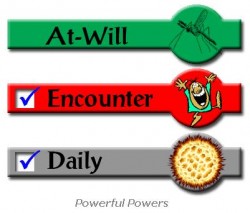
Given my obvious limitations, I can only really speak in Dungeons & Dragons 4E terms, but this may well apply to all games everywhere, especially if I’m deluded. In 4E, every character has lots and lots of powers of different types and effectiveness: some powers (At-Wills) you can use all the time and are slightly more dangerous than mosquito bites; some powers (Encounters) are cool and deadly but you can only use them once in a battle, kind of like a male “yahoo yahoo yippee” moment; finally, some powers (Dailies) can only be used once a day, tearing apart the earth in a cataclysmic nuclear explosion, laying waste and devastation in all directions, shattering hope, killing dreams, annihilating puppies, and spitting on your toothbrush when you’re not looking.

All of these are fun to varying degrees–no, seriously–but obviously it’s a stepped scale, and Encounters are usually better than At-Wills, and Dailies are usually better than Encounters. As a result of this, players become extremely reluctant to use their big’um, bad’um powers, sticking with the ones that never go away, because sure, this particular fight is going very badly,with most of the party bloodied or unconscious or dead or disintegrated, but who knows what lurks around that next corner? What if we need this particular power? I better hold onto it, just in case.

Trust me, more evil has been done in the service of just in case than any other cliched phrase, and I’m including a bird in the hand is worth two in the bush (hehe, I said bush).

Anyway, we as players need to start thinking and living in the RIGHT NOW instead of the NEXT LATER, because the RIGHT NOW is the only time we can actually do anything. I cannot store a success for an upcoming encounter, and I cannot bank a win for tomorrow’s battle. To put it in pure meta-gaming terms, if the next encounter really is super-duper, soul-rendingly difficult, the DM should probably figure out a way to throw the PCs a little sack-time to get ready for it. The point, as I’ve said one million times before, is not for the DM to “win,” but for the DM to tell an exciting and thrilling and heroic story about these characters.

Now then, does this open the door for abuse? Will the players simply burn through all their Deadly Dailies in every single encounter, and then insist the DM give them all nappy-nap time to get ready for the next one? Of course they will. The only way to really deal with this is to establish some sort of social contract between players and DM, wherein the players agree to use their powers judiciously and the DM agrees not to smash the players into unrecognizable pulp with the Vicious Mordenkrad of Ultimate Sorrow.

If I, as a player, decide to drop that Daily in Encounter #1, then I am accepting that I may not have it for Encounter #2. If I, as the DM, see an unrelenting string of natural 20’s on my side of the screen while all those beleaguered players can’t sniff a double digit on their side of the screen for six straight rounds, then I have to be willing to account for the PCs using precious resources for this “easy” battle just to survive, and should start planning for them to recoup those losses.

Just lately, I’ve been blessed with tons of gaming, and it has been both wonderful and lovely, with a creamy topping of excellent. I’ve played a full range of levels, a 5th level one-shot, a 24th level campaign, an 8th level multi-shot, and bits and pieces in between. Over the course of this span, there have been several challenging encounters, ones that pushed me and my compatriots to the absolute limit, where I wasn’t sure if all of us (or any of us) would survive.

For those battles, I’ve thrown down everything I had, furiously checking off powers on my character sheet like a deranged auditor, digging for one more thing, wondering, “Is there anything left? Did I forget an ability? Did I use that Daily on my orb? Do I still have an Encounter lurking on page 4? Wait, did I use my Action Point???” For these big old battles, I feel a sense of accomplishment when I stagger out the other side, bruised and battered and bloodied but still breathing, and I know I gave it my all. I put everything into it. I left nothing on the table.

And then I happen I glance over at the sheet of my fellow player, my ally, my comrade, my blood-brother, and I see he still has most of his powers left, and he’s happy–HAPPY!–about it. “I hardly used anything in that encounter,” he declares with an infuriating grin. And I have no choice but to kill him. It really wouldn’t be my fault. At least, that’s what I plan on telling the jury.

Add this one house-rule, multiply your fun by ten!

I’m all about fun (that’s why we play the game, right?). So, let me talk about how adding one little house-rule can will add so much fun to your game. Ok, sure. Not everything appeals to everyone, but I’m going to add this house-rule to every game I run from now on…

In the past, I’ve cut up so many games and then put them back together according to “my vision,” all so that I could make the “perfect” game. Yes, had I been a pupil of Dr. Frankenstein, I would have made him proud. And no, my creations never delivered as expected, really. Actually, they usually ended up a bloody mess.

So, I vowed never to mess with games again. Until now…

We have a Playing with FATE series here at the Shack where we talk about and explore Mike McConnell’s “any setting” Strands of FATE (SoF). Aspects are such a large component of the game, yet are so easy to explain and implement into your own game, that I think it’s imperative for you to consider adding it.

“Sure, sure. But I don’t want to convert my game…”

I’m NOT talking about converting your game to FATE; I’m talking about adding one little part of it to your current game. Hey, if an aspect is so cool, if aspects are the mechanic of FATE, and if aspects make FATE incredibly fun, then why not take a small slice of that and add it to your game? It’s super easy to do, especially since we’re only giving your character one aspect.

  1. Really quickly, I’m going to explain what an Aspect is,
  2. explain why it’s so beneficial (to almost any game),
  3. and show you how easy it is to implement it into your favorite game.

Part 1:

We’ve talked about FATE and Aspects several times here, so this part is for those of you who are new to the concept. An aspect is a single phrase that says something significant about your character. This phrase is something that you (the player) would like to see come up in the game (usually often). Strong as an ox and Bound by the Jedi Counsel are two such aspects (I just made them up).

When a situation comes up in the game, and you think your aspect is relevant, spend a Fate Point to gain a bonus to whatever roll is appropriate. If you’re Strong as an ox, you might gain a bonus to melee attacks, withstand charge attacks, break down doors, etc. You could also get an occasional bonus to endurance or to resist poison. All you have to do is say why you think the aspect applies to the situation, and spend your Fate Point.

To replenish your Fate Points (or bank new ones), you need your aspect to work against you. For example, Strong as an ox implies strength and endurance, but it also implies slow and not very agile. So if you are making some sort of acrobatic stunt, you (or the GM, or even another player) can suggest that because you’re sometimes not very agile, you might get a penalty to certain checks (even if your stats say you’re very agile). Remember, taking a penalty gets you Fate Points, which are used to gain bonuses for your aspect.

To read further about how aspects work, check out this very informative article.

Part 2:

Ok, so you have the basic idea of what an aspect is and how it works, but why include it in your game? Because it’s one part of your character that may never make it into the story otherwise. An aspect adds more depth to your character. It makes your character unique in what could otherwise be a sea of cookie-cutter vanilla PCs. It helps you bring out the intricacies of your character, not because you’ve written down a piece of descriptive text, but because that descriptive text is now part of the mechanic of the game (Fate Points, bonuses, and penalties).

As aspect enhances your character with regard to making him more real, simply because the Fate Point mechanic encourages it to be brought into the story. I can put an 18 into my character’s Strength stat, but saying that he’s Strong as an ox (and having that come up in the game in creative ways) just says something so much more about him. It brings him so much more alive.

Part 3:

Under the Strands of FATE rules, using an aspect normally grants either a +2 or -2 modifier (which is a big modifier considering how FATE dice are rolled). And, since you would normally have at least 10 aspects, they would be coming into play constantly. This makes aspects a huge part of the system’s mechanic, and necessitates that the modifier be big.

I suggest you incorporate only a single aspect for your character, and that the modifier remain relatively small. As a house-rule, it’s important to not rock the boat too much. At this point, adding several aspects and/or large modifiers can simply be too heavy for games that don’t normally carry this concept.

For games like Shadowrun and Dungeons & Dragons (any edition), I’d say that a modifier of +2/-2 would do just fine. I also think that starting the session with one Fate Point is appropriate. One aspect, and one Fate Point – I think that is perfect as a house-rule. After you get comfortable with the house-rule (and if your group likes it), I’d say make two aspects for your character, and start the session with two Fate Points. And remember, you can get extra Fate Points by having your aspect used against you (a tactic that the smart player will utilize often).

If the GM wants to take it a step further, he can assign his major NPCs, major villains, and major monsters an aspect also (and yes, they can be used against monsters in the same way that a player’s aspect can be used against him).

That’s it. It’s that easy. Talk it over with your group and try it out. I really don’t think it will break your game, and will actually add loads of fun to it.

If you have any questions, read up on our Playing with FATE series for inspiration, or ask us questions below.

Good luck! (not that you need it).

The One Real Problem With Magic Items (And How To Fix It)

We (and by “we,” I mean, “overly critical D&D players such as myself”) like to refer to problems we have with the game and pretend that they’re someone else’s fault. The truth is we probably just know too many people with bad attitudes.

My point: there IS a problem with magic items. That problem is D&D players. Not ALL D&D players, mind you. Maybe your group doesn’t have problems with magic items. But I know the guys I hang out with do, and I’ve heard about more than a few groups who do as well. The problem, however, isn’t what they think it is.

Let me illustrate my point with a story. And possibly another story, afterward, if I remember to include it.

Story Time

The first story: I have a friend who, in the course of his regular game, witnessed the death of another character in the party. Now, rather than anything that would make sense in character, rather than mourning the loss of a dear friend and comrade in arms, the first words out of his mouth were, “dibs on his magic items.” An attitude that not only screws up the expected loot/level and makes things unfair for the old player’s new character, but that also makes no sense in a culture that probably would bury a warrior with his sword so he’d have it in the afterlife. Assuming he has no family to inherit it.

The second story: (I’m sure this story is out there somewhere under the title of, “The Worst D&D Players EVER. Of All Time,” or something similar. It is not MY story; I do not own it, nor do I make any claims of originality. It was related to me by my cousin.)

I am told a tale of a group of players who, on learning that the sword on the wall of the town sweetheart (seriously, nice girl, everyone in town loved her like a daughter) belonged to her father who was an adventurer “back in the day,” the GOOD aligned players went off the rails and immediately began plotting how their characters would steal it from her.

They came back to the shop in the dead of night, and started moving furniture. Not terribly stealthily, I might add. They got the sword off the wall, but by the time they did they had woken the poor girl up and she was blearily coming down stairs (it took forever for her to succeed on her listen check, what with the penalties from being asleep). Now, rather than do the smart thing and pull a Grinch on her (“Why, little Cindy-Lou Who, I’m just sending this tree back to the North pole so I can fix the lights and bring it back.” EPIC BLUFF CHECK), they panicked. And they killed her.

Then they panicked some more.

Then they decided to clumsily hide the body under the floor boards.

And leave.

(It’s a sign of how terrible I am that my first thought wasn’t even, “well, that’s cold,” it was, “they should have IMMEDIATELY gone out of their way to get her res’ed.”)

Next morning, naturally, the town is freaking out over the horrible horrible murder. So one of the characters (with the distinctive white sword now buckled on his belt) decides to go investigate and see what he can find out, and is promptly arrested and scheduled for hanging by an angry town (justly so,) while the other players scream, “you took it WITH YOU?!?”

So the rest of the party decides that they’re going to rescue their companion. They wait until just before the hanging, and, in the middle of the angry crowd they draw their weapons and prepare to fight.

The DM facepalms for about the millionth time that evening, and the characters are all subdued and hung along with the first one.

Now, I have a number of points that I’m probably trying to make on some level (several of which can be better expressed by reading this slightly related piece from Cracked) but the main one isn’t that these were just terrible, terrible players. It’s that this shouldn’t have even been a thing.

Magic items aren’t too common. They’re too easy. They’ll put out their magic for just anyone. It’s a terrible, terrible truth. They should be a little more challenging if they want adventurers to respect them. How can we respect them if they don’t respect themselves? Okay, that’s enough of that terrible metaphor – I hope you take my meaning.

What can be done about this problem?

I’m glad you asked.

A Better Way

Here’s an idea. Wondrous items and such remain basically unchanged – let’s face it, that’s what happens when a wizard has a bit of fun. Magic weapons and armor and the like are the actual difficulty, and they’re the easiest part to fix, too.

The solution is surprisingly simple, but it comes in a few parts. The first: magic items are only magical because of the deeds of heroes and villains.

In other words, that magic sword started out as a perfectly ordinary sword (or maybe a family heirloom), but became magic when a brave adventurer took it with him and accomplished something heroic. The more heroic the deed, the greater the power. Villains can do the same thing – it’s about the STRENGTH of the deed, not necessarily morality. Unless we’re talking about holy relics.

That flaming sword? Someone used it to kill a flame-drake, or a fire elemental, and in that burst of heroic effort it was changed.

Mostly, this means that the power to make magic items is in the hands of the players by virtue of their being heroes. It’s up the the DM to hand out things that make thematic sense based on the challenges they have overcome. Essentially, don’t give “items” so much as “boons with the item descriptor.”

Part 2 is the rough one: magic items are attuned to the spirit of their creator, and unless re-attuned through new great deeds, their power fades with time until they are no longer magic. A magic item will seldom behave the same for two different heroes.

As a result, there are no stores that sell magic swords; there is little point in stealing the magic sword from a dying hero because its power will fade with time. A sword (or armor or whatever) should be passed on to a warrior’s family if s(he) has one, or buried with them if they do not.

Now, there’s a minor exception here – a blood relative or someone the hero named can access at least part of an inherited weapon’s power. But only if it was the hero’s (or villain’s) will that they hold it. Through their own heroic (or villainous) deeds, they can then restore the weapon’s power.

Last point: a magic item’s power is touched by all who have wielded it, if their deeds are sufficient.

It might not be identical, but there should be some notion of history if a hero claims a sword of prophecy from an ancient tomb.

Mechanics

Basically, this should work fairly similarly to the way Tourq presented magic items at the beginning of Classic Fantasy, or the way I’ve talked about them on several occasions since: multiple benefits stemming from one “source;” separation of crunch from fluff. Crunch-wise, the only requirement is giving items (or boons) that have something to do with what’s actually happened in the game, and rendering any stolen items useless on the grounds that the way they were taken wasn’t heroic enough. The fluff is what makes it interesting.