Take the Challenge – Say Yes

Imagine the scene: You’re playing the uber-cool DEATHWATCH, more specifically, larger-than-life ultra-high-tech space marines.   You carry ultra-cool equipment, like bad-ass armor, a super-cool machine-gun, and jump-jets that help you run faster, leap over obstacles, and even fly.  Oh, and don’t forget about your ability to sustain your daily nutritional requirements from your built-in ever-efficient “Waste Recycling” system (yeah, you read that right).  You’re fighting hordes of Planetary Defense Forces – who you squash like bugs.

However, your team is under fire from all directions, including missile-fire from the top of a tower (ok, those kinda hurt).  So, you decide to scram to the inside of the base of the tower, and plant a quick explosive.  You set the timer to go off at the end of your next turn, and prepare to get the hell out of Dodge.  Unfortunately, at that moment, the tower gets surrounded by hordes, hampering your escape.  What do you do?

Well, you could probably fight your way out through the horde.  Or… you could ask your GM if you can use your jump-jets to shoot straight up through the tower floors, just as the explosive goes off.  You’d be busting through the roof (and the guys shooting the missiles) as the tower crumbles, leaving you hovering 50 meters in the air, looking like the Angel of Mother Effing Destruction.  That, would be cool.

I don’t care who you are, that would be cool (and in truth, it was).  Sure, maybe the rules don’t specifically support this action, but so what?  It’s still cool.   However, let me tell you how it would not be cool:

  • The GM says, “No.”
  • The GM says, “Let me check the rulebook.” Or,
  • The GM says, “Well, give me a hard Perception roll, a hard Agility roll, and a hard Toughness roll.”

Really?

If you’re the GM here, how should you handle this?  I’ll tell you how.  You say, “Abso-freaking-lutely.  Just give me a Tougness roll to see how roughed up you get from busting through the tower floors.” Cause that’s how it went down, making the game experience simply ultra-fun.

I know you’ve read articles before about how the GM should just say “yes.”  Maybe you agree, maybe not.  All I can say is that the game is just that much more fun for most gamers when the GM tries to find a way to say “yes.”  I’m not saying that GMs should cater to the players at the expense of game and story balance.  What I am saying is that story trumps mechanics, in any role playing game.

Miniature wargaming, on the other hand, is all about mechanics, so of course mechanics win that fight.  But this article doesn’t apply when playing Battletech or D&D Minis. By all means, play the mechanics in those games like there’s no tomorrow.

Role playing games are simply about the GM telling a story, with the players interjecting their individual character’s stories.  When the player asks to do something that the GM, or the rules, aren’t immediately ready for, or perhaps is questionable, just go ahead and try to find a way to say yes.  Skill challenges have this concept built right in.  Most of them allow for the characters to succeed, even if they fail.  They simply succeed in this manner by taking a detour of some kind, but still eventually achieving their goal.

One more thing. Players, I’m talking to you here.  When the GM introduces something that you feel affects your character in a negative way, don’t always feel that you need to fight him on it.  Chances are that he’s doing it for the story.  For instance, don’t be afraid to make your character a parent, one whose children would (of course) be kidnapped sometime in the future.  Yeah, that would be cliche, but it makes for a better story than yet another character with no outside friends or family.  Just say yes to his request – take the challenge.  Or, perhaps the GM wants to put your character under a domination spell without any kind of rolls, because it would make the story better.  Don’t fight him on it – trust that he’s trying to make a better story.

Saying “yes” can simply make a game more enjoyable.  It helps make the game run smoothly, avoids annoying hiccups, and makes both players and GMs look forward to coming back.  Take the challenge.

By the way, DEATHWATCH.  I highly recommend it.  Not only do you get to play super-cool combat monkey space marines, but there’s a lot more roleplaying opportunity than I initially thought.  Get it here,  and you save $22.00.

Charisma – What is it Good For?

Written by Charisma Keller and Dixon Trimline.

Click me, cause I’m better bigger

To quote an article by Dixon Trimline that I love very much (the article, not Dixon Trimline… ok, and Dixon Trimline), “The power gamer is earnest in his approach to the game, in the same way that an evangelical is earnest about saving souls.”

Such a player will look at the stat for Charisma and ask, “What good is it to me?  If this stat isn’t going to help me win the fight, it’s hello dump truck.”  I mentioned power gamers above, but really, this isn’t exclusive to power gamers.  It applies to anyone who doesn’t want to be restricted in their roleplaying effort because of a number score.

I mean, really, what good is it for?  How does the Charisma stat help the game?  I have a ton of role-playing ability – I don’t need a high Charisma score to help me in social situations.  Besides, who is going to judge if I’m true to my Charisma score?  On what scale is that person basing that judgment on – a number scale of 3-18?  I don’t think so.  With so many gamers having so many varying degrees of role-playing ability/comfort, who is going to say that my character would or wouldn’t act that way?

And don’t forget about filters.  “Hey GM, disregard anything I say until the other players can filter it.  My character has a high Charisma score, but we all know that I’m a social stink bug, so that’s why everyone else will be my filters.” I don’t think so.  If you want to play a charismatic character, then role-play the charismatic character.  Don’t hide behind the dice and your filters.

In my opinion, the dice are there for everything that can’t be determined at a table – because we’re sitting at a table.  Yes, I can do the splits, and I can do a back flip, but I’m not going to do that at the table to show that my character’s acrobatic stunt should be successful (well, not again anyway).  That’s what dice are for.  What I can do at the table is role-play, and I don’t need dice or stat scores for that.

Now, Mr. Dixon Trimline, what say you to that?

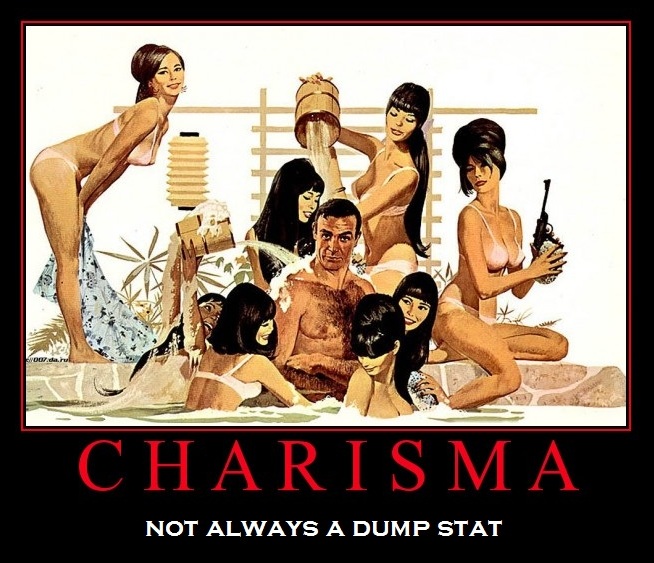
Click me, cause I’m Bond baby

Yeow, what a great idea for an article!  I love your point about the double standard between physical skills and social skills, where a player doesn’t have to demonstrate his acrobatic skills to verify he deserves a 21 Dexterity.

Believe it or not, the difficult roleplaying decisions you have to make in a game don’t actually impact your real life in any way.  If you’re willing to believe this, why not start stretching your roleplaying muscles, step outside your comfort zone, and act up like a big old salty ham?  Sure, we can all agree that you, personally, don’t wield anything close to an 18 Charisma, but inside the game, your raging insecurities, awkward phrasing, and machinegun stammering all translate into one articulate, sexy, and irresistible bag of pure hotness.

This really is a great opportunity for you to act like the person you’ve always wanted to be, and it’s a situation that can only be bolstered by your character’s ability score when it comes to actually rolling the silly dice.  I feel like all the successful and multi-dimensional games have to include some amount of social interaction, and hopefully it’s quite a lot of it.  Games that are wall-to-wall combat can be thrilling, but ultimately a little flat.

What’s the point of slaying the dragon if you don’t get to ride back to town to comfort all those terrified townspeople?

Sitting at the table, you may wind up sounding like this: “Um, hey, um, guys… um.  I was going… it’s like this… there was this dragon… hey, you know that dragon?  It’s like, totally dead.”  But in-game, your character with her 18 Charisma gets to sound like this: “Good people of Verbobonc, hear my voice!  Your dark days are at an end.  The dragon, the scourge of life and light, is no more! Rejoice!”

–sigh– Alright, alright.  You make a good point.  When you put it that way, I have to concede.  Thanks for being the pro to my con!

By the way, bonus points for Verbobonc.

Thanks for the opportunity to play along, Charisma!  And I love the name  🙂

Favorite Site of the Month – GM Oracle

One of the things that I love about putting up Stuffer Shack is that I spend more time in the gaming’verse.  I had no idea that there were so many websites and blogs dedicated to geekery and gaming.  It’s like I’ve been adventuring for years and have finally found the treasure.  Well, part of that treasure is GM Oracle “your daily source for fantasy roleplaying material.”

I asked Philip Reed to give us the lowdown:

“GM Oracle is a creative outlet for me and Michael Hammes. We spent a few years writing and publishing PDFs through Ronin Arts, but after I went back to work at Steve Jackson Games the PDF writing died off.  Today, Michael and I are using GM Oracle as a place to publish short, systemless material for fantasy RPGs. We have different approaches to the craft, and I think that as the site grows, readers will find that despite our different ways of doing things, we both love fantasy and gaming.  This month we’ll start to see reviews on the site, but the focus will remain on the treasures, encounters, monsters, and thoughts on roleplaying.”

I was immediately drawn to GM Oracle by its clean, good-looking layout, and then of course by its solid, helpful writing.  Do as I have – follow their RSS and you’ll get some good reading in.

The Best Table-Top RPG You’re Not Playing: Rifts

Every role-player has games that just sit there on the bookshelf. They lurk, their spines staring accusingly at you as you pass. “Why won’t you play me?” they mutely inquire. You know you want to.

But still you don’t, and apart from their annual lift off the shelf for one more guilty read-through, they remain alone and unloved. Perhaps it’s because of an inability to enthuse the other players in your gaming group, other commitments, or because you simply don’t know where to start when it comes to running a whole ‘nuther system. There’s a whole host of reasons why these games just don’t get the love they deserve.

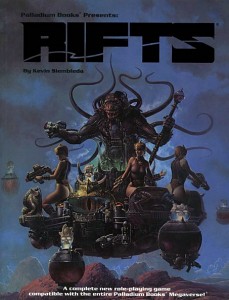
For me, the accusing spine that glares at me more than most is Rifts, that venerable tome from Palladium Books.  It’s difficult these days to talk about Rifts without at least glossing over the legal idiocy that has plagued it throughout its long life, so let’s do that first just to get it out of the way.

Rifts is, first and foremost, a system derivative of everything. We have Nazi Cyborgs, Mech Warriors and Giant Manga Robots rubbing shoulders with tropes of classic fantasy (cheekily called Tolkeen). This is a system which, from a legal standpoint, deserves to be sued to Hell and back by everyone from Tolkien Estates to Phillip K Dick and Studio Ghibli. Yet it hasn’t been, and the world (quite frankly) is a better place for it. The ability to patent ideas, concepts and imagination will be the death of civilization, I swear.

This makes Kevin Siembieda’s legal battles over “rights” regarding Rifts all the more ridiculous. In his time, he has ordered fan sites be taken down and claimed that he somehow owns the concept of a “Rift” (despite the fact the word and definition has been around for, oh, hundreds of years). It’s my opinion that, despite the fact that he writes awesome role-playing games, he doesn’t make the best business decisions, and that’s all there is to it.

There. Gloss done. On to the good stuff.

The world of Rifts is near-future modern day Earth, with one minor twist. Well, when I say minor…. The Golden Age of humanity ended when Rifts in time and reality itself opened up, spewing forth other-dimensional beings and worse. The shape of the land changed as magic re-awoke (not that it was ever truly asleep in the first place) and dinosaurs once again roamed the earth. Thankfully though, that’s all in the past.

What we have now is a world shaped by chaos where a Coalition State keeps an iron grip on what remains of the old Earth human Empire and tries to hold back the tide against pretty much anyone else, and there’s no such thing as good guys any more.

Rifts is perhaps best described as “Survivalist horror in the Warhammer 40k world of Judge Dredd.” Except it’s more than that. Rifts, more than any other non-generic system I’ve encountered, can be pretty much anything you want it to be. Want to play a group of heroes fighting against the Coalition for their rights to a Free State? Psionic cops rooting out mutant scum in Chi-Town? Glitter Boys fighting radioactive dinosaurs in the outback? You’ve got all that, and more.

The rules system itself is common to all those in the Palladium line. It’s best described as functional rather than elegant in that it gets the job done without too much fuss, and doesn’t get in the way. The system for handling huge-scale damage (called Mega-Damage – each point is roughly equal to 100 normal damage points) works well enough in-play, and I’m beginning to yearn for a similar system in 4e D&D where it’s easy for high-level monsters to have thousands of hit points. Ick.

We have a plentiful supply of Occupational Character Classes ranging from streetwise City Rats to Coalition Grunts and Glitter Boys. There’s Cyber Knights (high-tech Paladins) and all manner of Borgs, Crazies, Scholars and Scientists. If that’s not enough, there’s wizardly Line Walkers, Techno-Wizards, Mystics, pyrokinetic Bursters and much more.

The character classes themselves are gloriously unbalanced. At one end of the scale there’s OCCs such as the Cyber-Doc who gains moderate skill bonuses and not much else. At the other there’s the Glitter Boy in his faux Mech Warrior power armour. To my mind that’s a huge strength of the system as the GM is free to permit different character classes based on the preferred campaign style. Whether you want high-explosive large scale warfare or street-level action, there’s OCCs that provide. In Rifts, as in any RPG, only the foolish GM would open up all the options.

In a way though, there’s too much, and that’s one of the reasons why Rifts still sits on my shelf. It’s overwhelming as a system. It’s like every idea, ever, has found a place in the core book’s 256 pages, and it’s difficult to even know where to begin. Add in the (randomly laid out but excellently written) Word Book supplements and it’s easy to face Information Overload head-on.

Whenever I suggest running a short Rifts campaign, I get the reply, “We’d rather play TMNT instead.” This is much the same rules system as Rifts but lets the players create mutant animals using one of the best semi-random character generation engines ever made.

One of these days I’ll let them generate critters in TMNT, them dump them into the Rifts universe.

Ha! I’ll have my way yet!

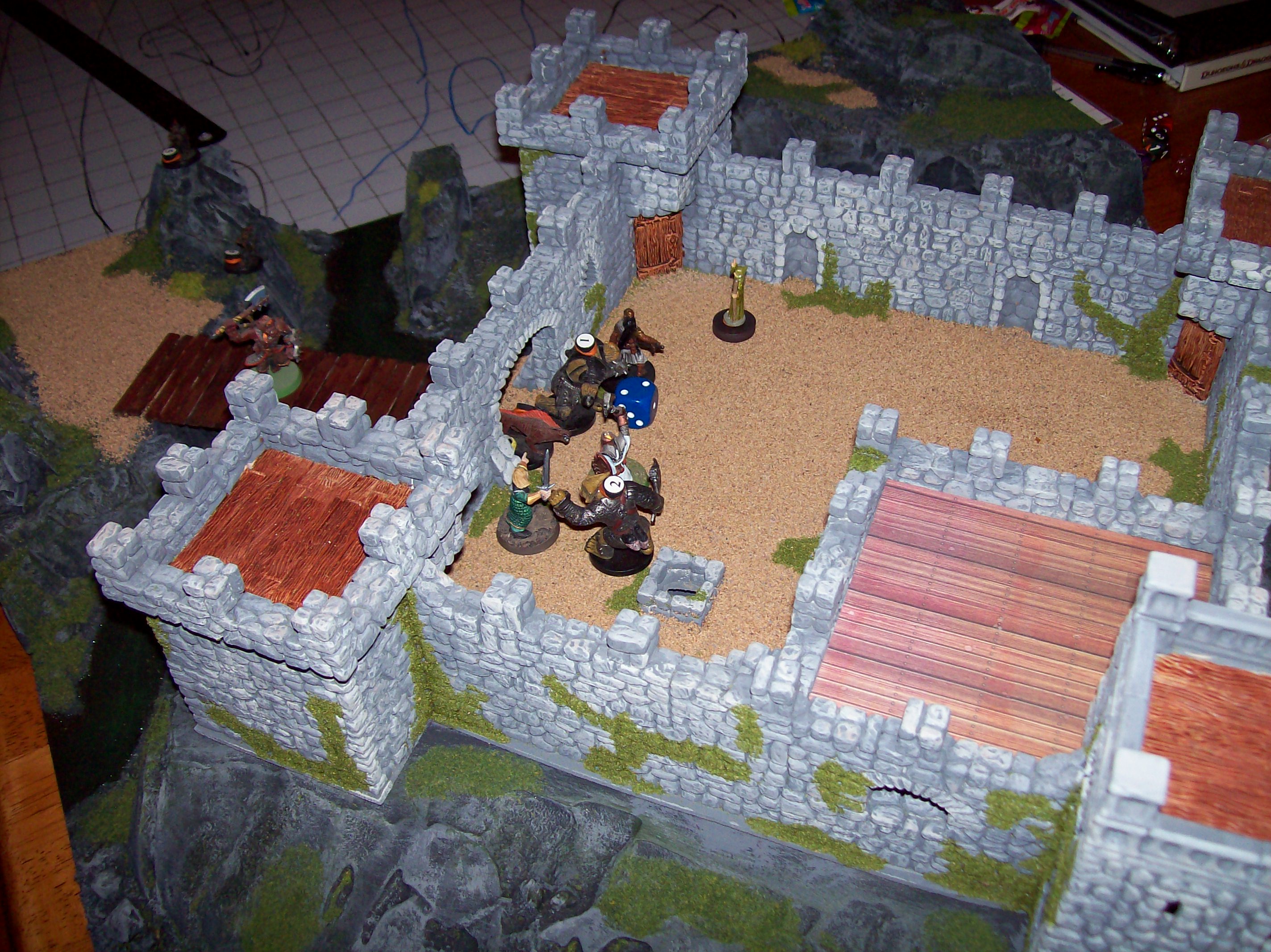
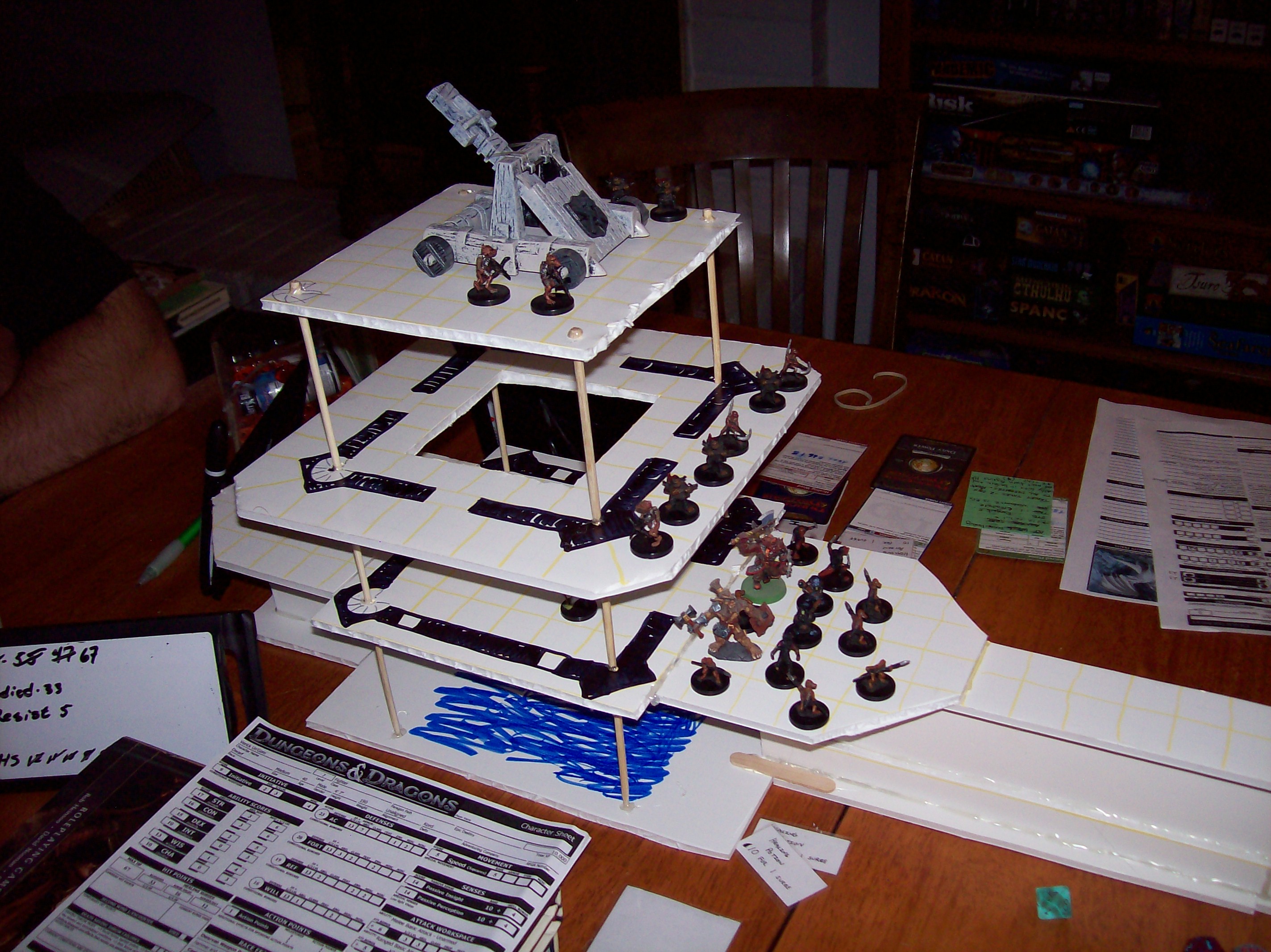
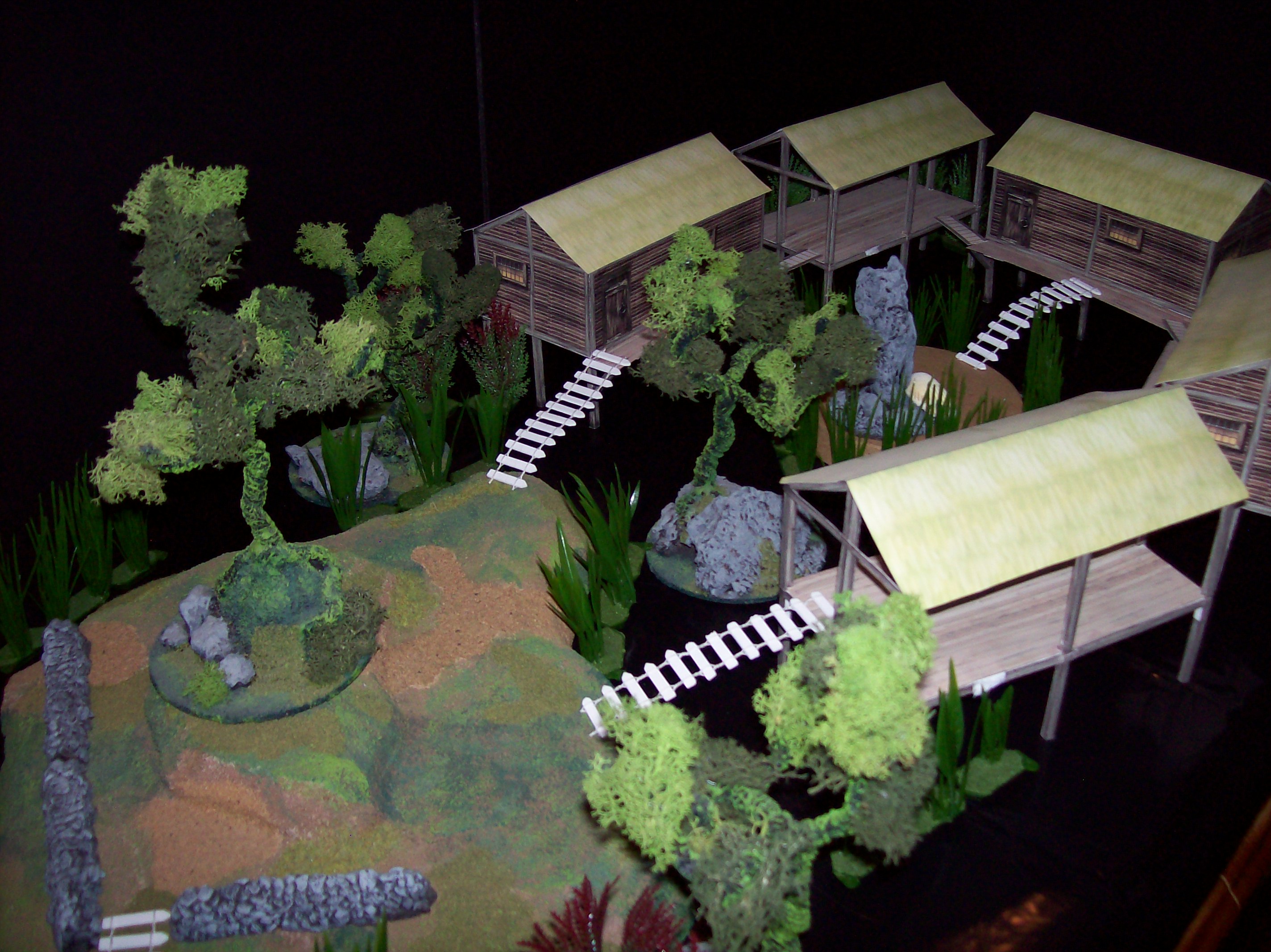
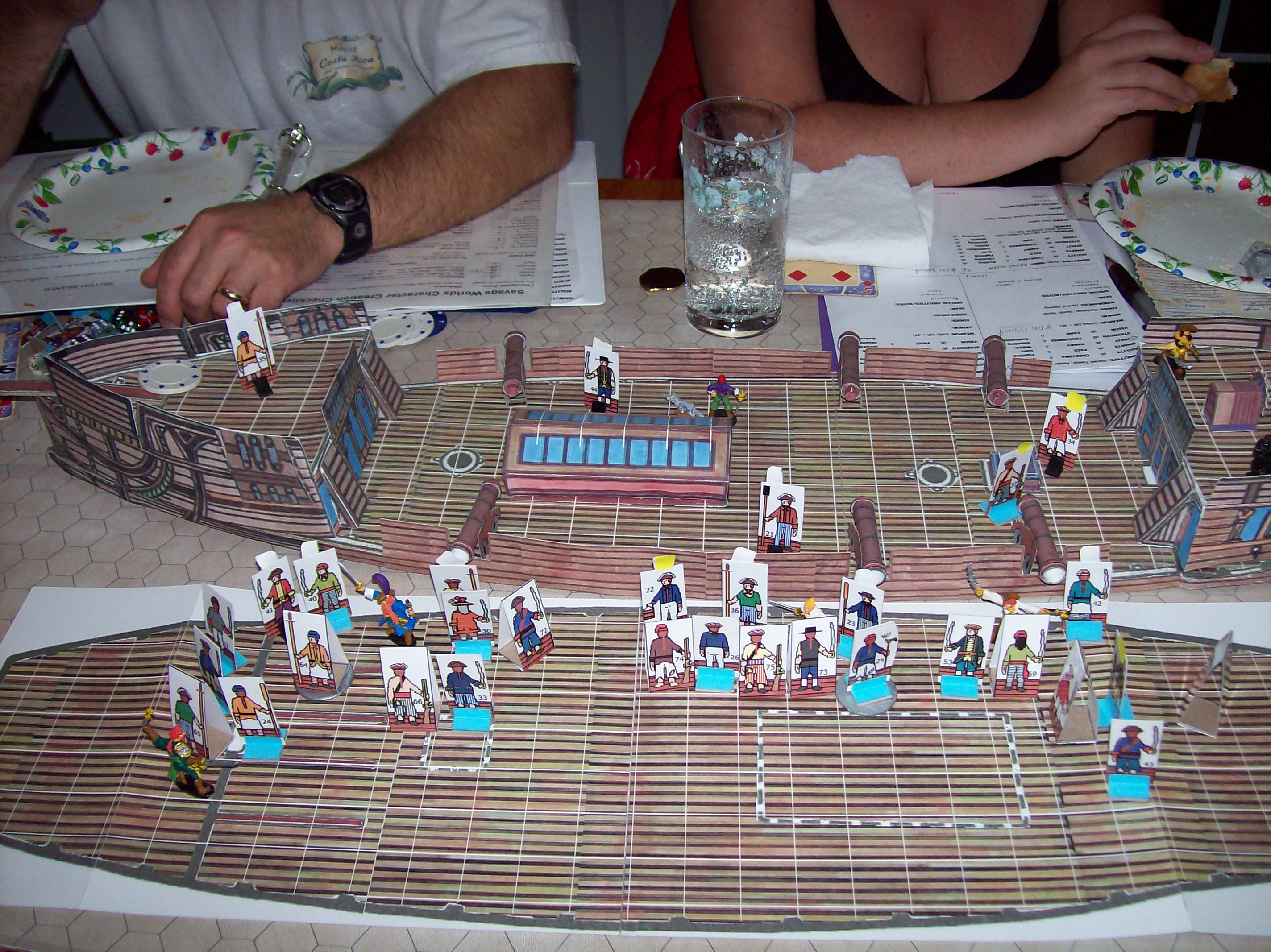
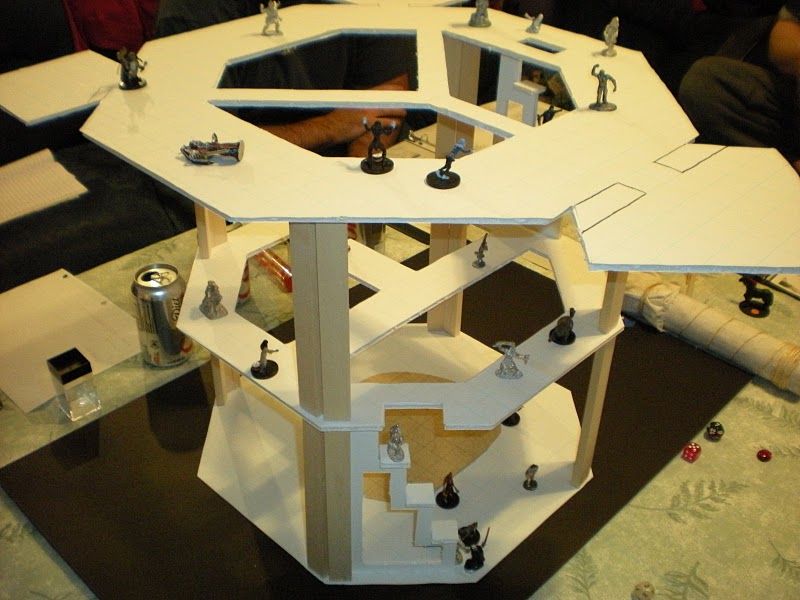
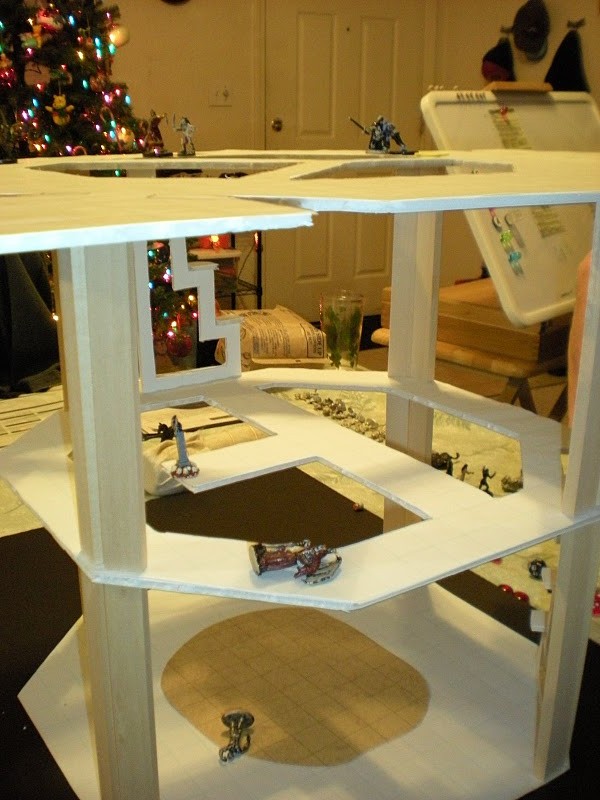
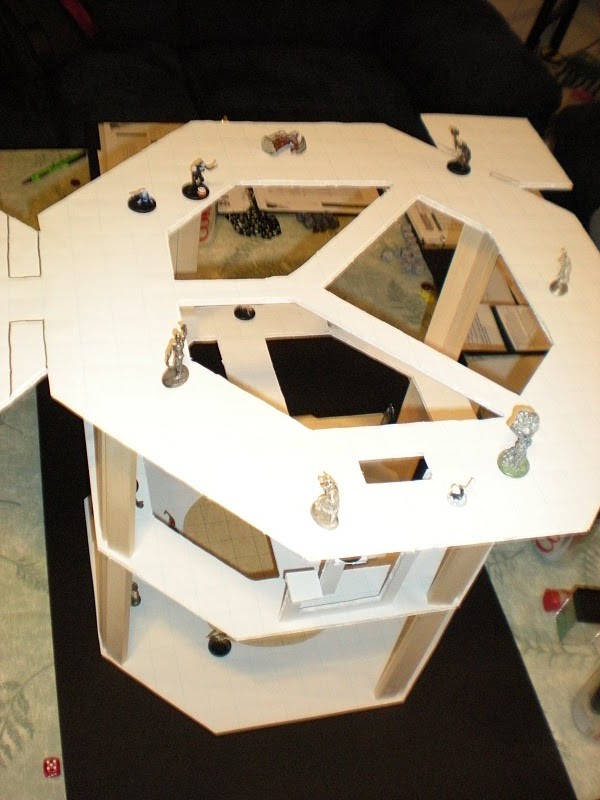
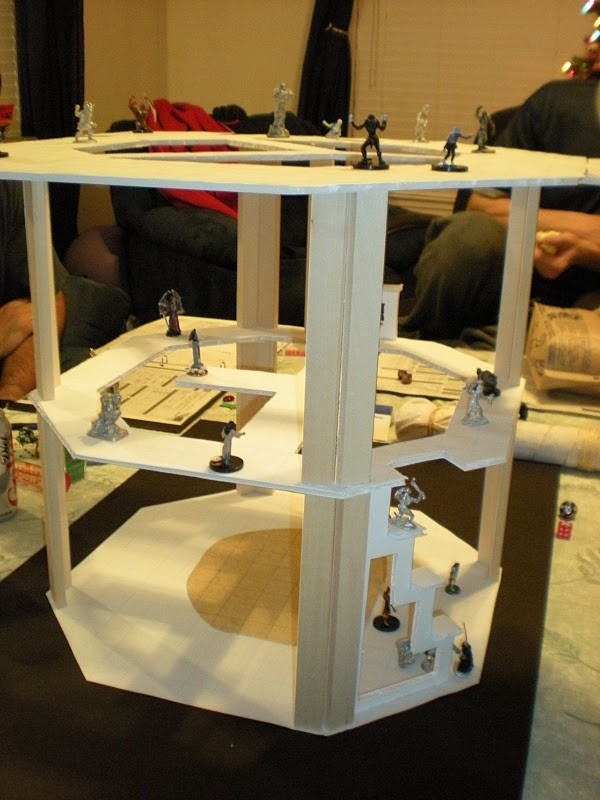
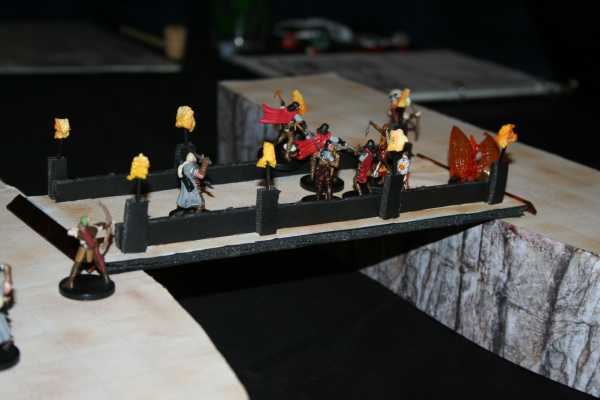
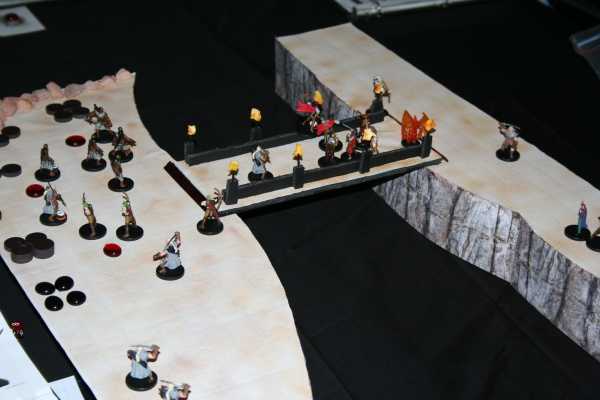
3D Battle Map – from Roland Chambers

One of the great things about the gaming community is our desire to share resources.  These pictures were sent in by Roland Chambers with just that intention.  I especially love when bushes and trees are added – that’s just the right touch (and something I have yet to do effectively).  What do you guys think?  Should we start up some sort of tutorial series?

To all our readers out there, please send in your pics to share!

Cultists of Jebus Kristo (steal this enemy group)

The Cultists of Jebus Kristo are a home-brewed religion that I often make use of for playing in D&D 3.5. They are an odd bunch. A DM might use them as a traveling people, or as a specific sect within a town with a unique role to play in the campaign. Almost always though, they are used to break up the normal monotony of the DM’s world, due to their absurd and conflicting nature.

The summarized mentality of the Cultist’s of Jebus Kristo lies within the very basics of their religion. The idea being that “Jebus Kristo sailed across the Seven Seas to the Americas, where he promptly began Crucifying the natives for his sins.” A simple concept, yes, but one often misunderstood. The Lawful Neutral Cultists believe that Atonement for one’s sins is absolutely mandatory. However, the person who atones for the sin is up for negotiation. Followers of Jebus Kristo will always make sure their sinning is paid for at the earliest possible instance after the sin is committed.  Most often, this means an innocent bystander (instead of the real sinner) will be dragged over by a few jovial and happy, smiling cultists who ask the innocent about their day and praise the glories of the weather, while simultaneously beating the individual with their Jebus Sticks (masterwork engraved club 1d6+str 20×2 crit).

One might interpret this violence as Evil in nature, and that is often a case of debate. However, the overall mentality of the Cultists of Jebus Kristo is very positive. They are the Ultimate Bible Camp. They devote themselves to the betterment of the societies around them, and attempt to help those in need whenever possible. The Cultists of Jebus Kristo do not promote sinning. Their sermons will often reflect the ideals of being good and pure. All good religions are flawed, as mistakes and sins will happen.  The main difference between the Cultists and other religions is that the Cultists of Jebus Kristo make sure that each sin is paid for in full, regardless of the sin and regardless of who pays for it.

Paladin’s of Jebus Kristo will usually be seen wearing gleaming armor covered in a finely crafted cloth toga. They wield massive holy symbols to honor their God. These symbols are considered the equivalent of the Great Horn Minotaur’s Hammer (found in the Monster Manuel 4, 1d12+str and a half, 19-20×4 crit). Usually a Paladin that is high enough level will take the feats necessary to allow himself to wield the large-sized version and the feat that allows him to use double his strength modifier (2d8+x2 str 19-20×4 crit). Cleric’s of Jebus Kristo will be dressed in flowing robes, often with the tops of their heads shaved in odd fashion. These Cleric’s will devote themselves to the betterment of society. Helping those that they can and offering healing where possible, except in the instance of healing damage caused in the atonement of a sin. This is considered cheating the system, another sin which must be promptly paid for.

Cleric’s wield Double Thurible which are metal containers used to burn incense, swung from a length of chain. They are the exact equivelant of a spiked chain, and they are granted proficiency in such. Higher level Clerics will have magical Thurible with the unique ability to spin them rapidly, filling the room full of incense smoke the equivelant of a Fog spell, allowing them to make use of the Blind Fight feat and help even the odds in a fight with Fighters and other classes with high combat profficiency. Domain’s for these Cleric’s vary, a DM should make sure that the domain’s choosen by a PC make sense with the character’s mentality and purpose. In addition to the weapon proficiency, Cleric’s of Jebus Kristo are granted a +2 save against massive damage as their Domain ability. A good, dutiful Cleric of Jebus Kristo has been on the receiving end of a Jebus Stick fairly often.

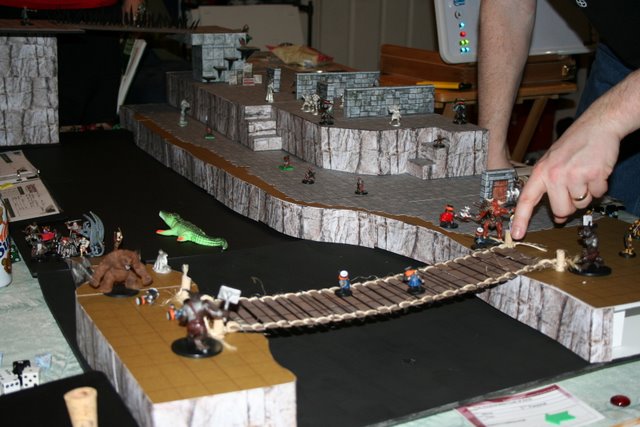
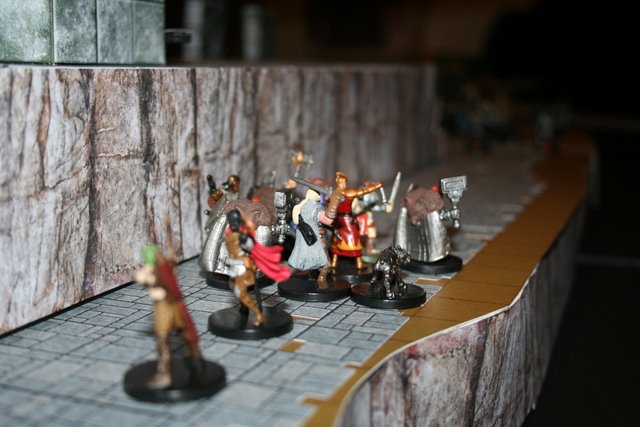
3D Encounter Sets

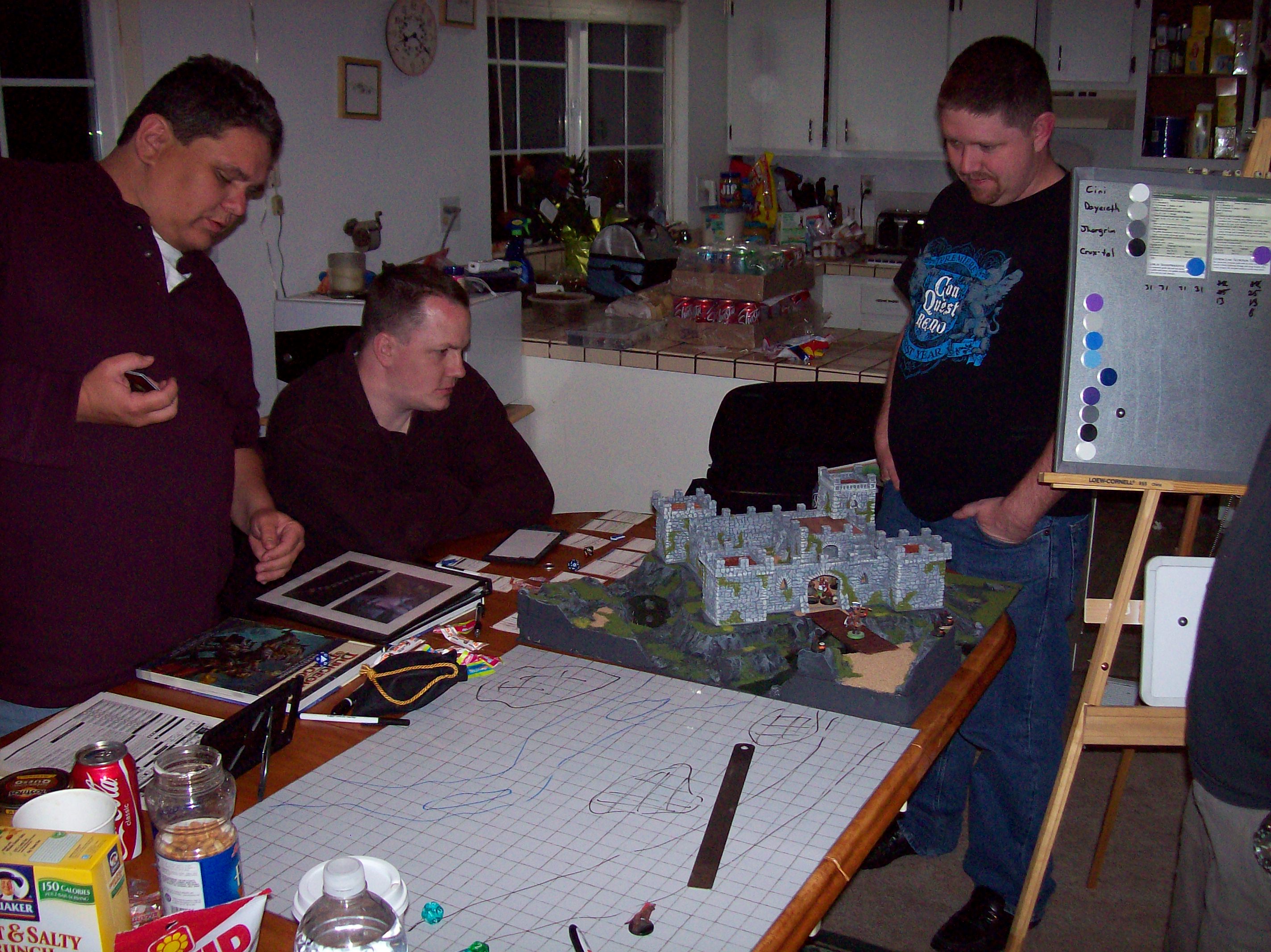
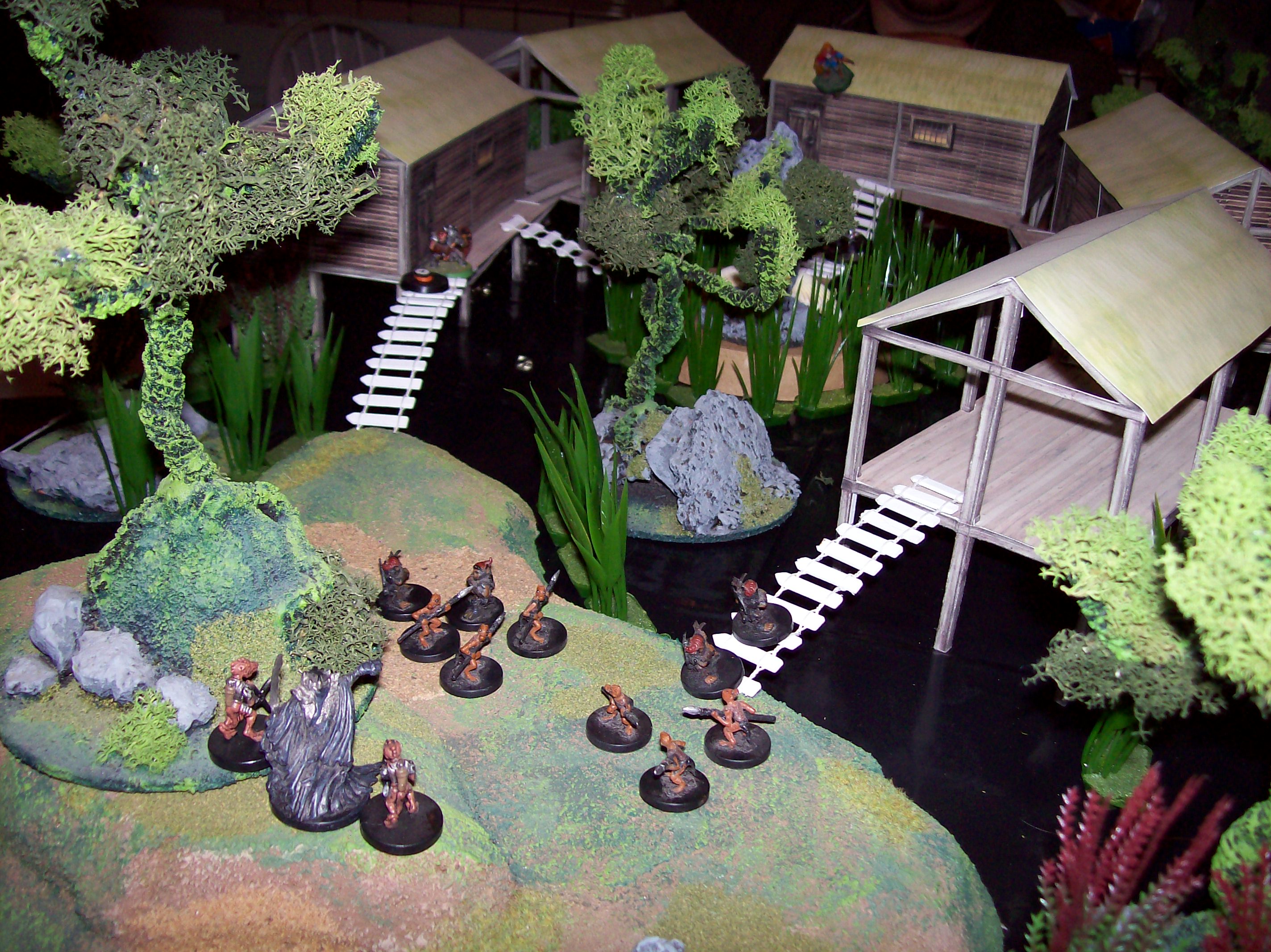
I was inspired by our web-master’s recent set of pics so I thought I would add a few of my own.  Most of these came from my last Dungeons & Dragons campaign, Dark Legacy.  Enjoy.

The heroes’ first battle for Fort Griffin!
The taking of Cinderhill Dam.
The village of Dusk, somewhere in the Shadowfell.
Pirates!
Another shot of Fort Griffin.
The heroes enter Dusk.

Handling Oversized Parties

So, you’re sitting there, squinting over your DM shield with dice in hand, your books, spells, and monsters pre-sorted – all to aid in the fabrication of the epic marvel of a session you have thought out for the last week to place before your fellow gamers. You glance up and are forced to a sudden reality. You realize that your party consists of the equivalent of a troupe of ADHD monkeys, hopped up on Pixie Stix and Cheeto’s, halfway into a Mt.Dew induced coma, holding loaded fists full of pooh, with itchy trigger fingers.

How will your story ever be told?!

Often, DM’s find that they might be overwhelmed by the sheer personality differences existing within their group. It is even worse when the number of people in your party exceeds the norm. A DM should keep in mind that while there are a few passive wallflowers, the majority of their players will reflect alpha-male traits. Unlike a movie, where there will usually be one main character, a game of D&D will have several. Things get exponentially more complicated when you introduce more than a standard four-member party.

A few tips to handle this situation effectively might include the following:

1) Don’t force it!
The natural response to getting things under control would be to become more strict or heavy-handed with your DM’ing. Instead, loosen the reins. Give a broad spectrum goal alone, and let the story guide itself on the personalities that exist.

2) Encourage everyone to talk only as their player character in all things.
This not only allows for the story to form more fluidly, it also incorporates all in attendance upon the task at hand, and keeps the out-of-game distractions to a minimum. Such distractions from so many people can easily ruin a game session.

3) Spread your attentions equally!
There will always be one glory hog in your party that simply requires more attention than everyone else in the campaign. Be sure to handle the situations as they come, but pay extra careful attention that you give everyone else their equal opportunity.

4) Don’t focus too much on the little things!
Keeping track of everything at once is hard enough – being forced to keep track of more than 4 people in your party can be overwhelming. Instead of keeping an exact count of certain details, loosen up your control. For instance, not all monsters need to have the exact average hit points. Choose to kill a monster when it’s most dramatic. This help speed up the rounds, encourages game-play, and further helps your story by allowing your party members the spotlight of a dramatic “bad ass” moment of glory.

Follow these few simple tips, and you too could become a successful ADHD Mt. Dew junkie monkey trainer, just like me!

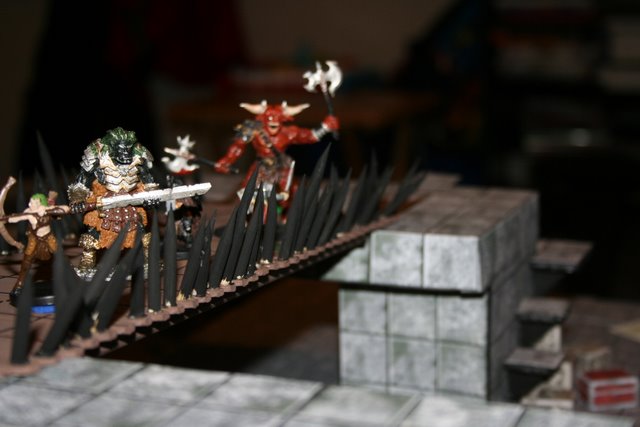
3D Battle Maps, with Pics!

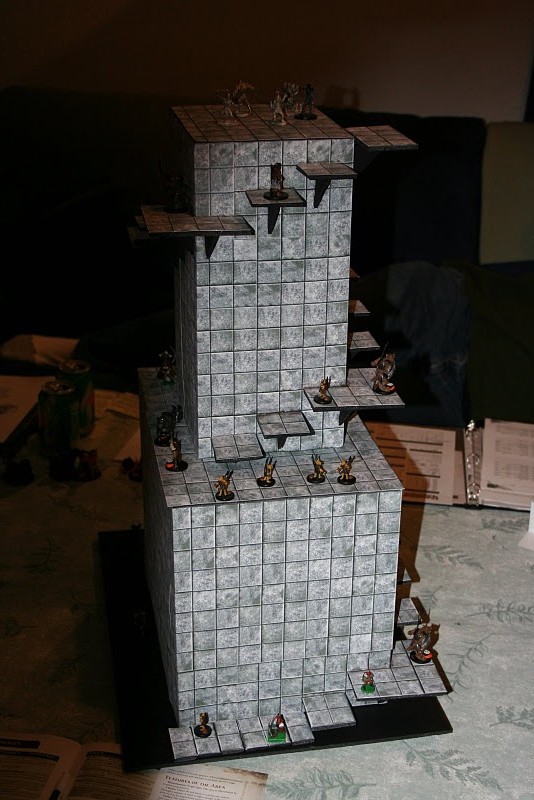
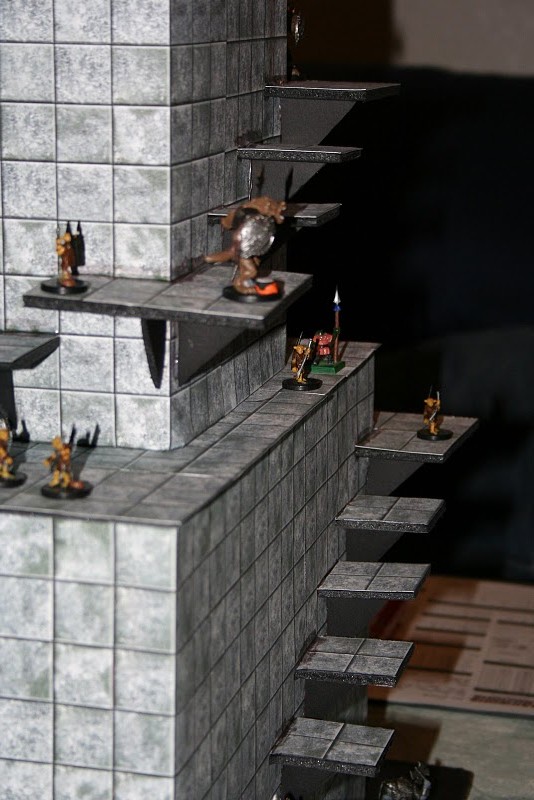
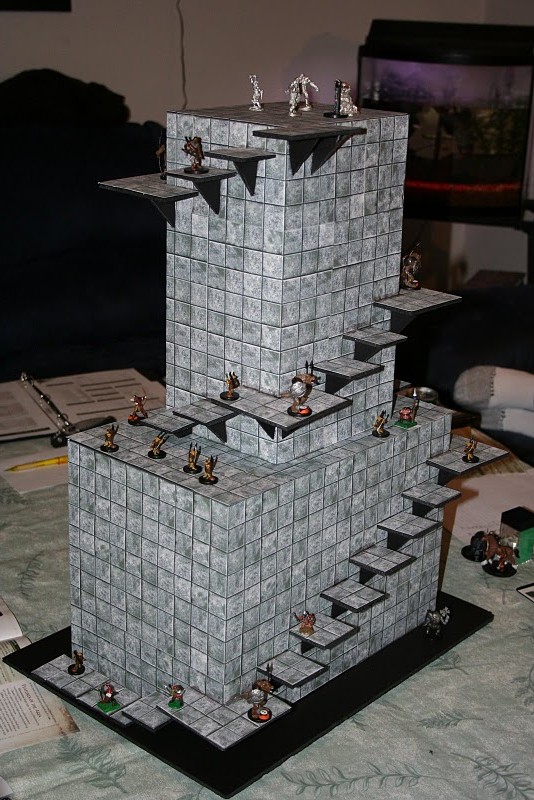
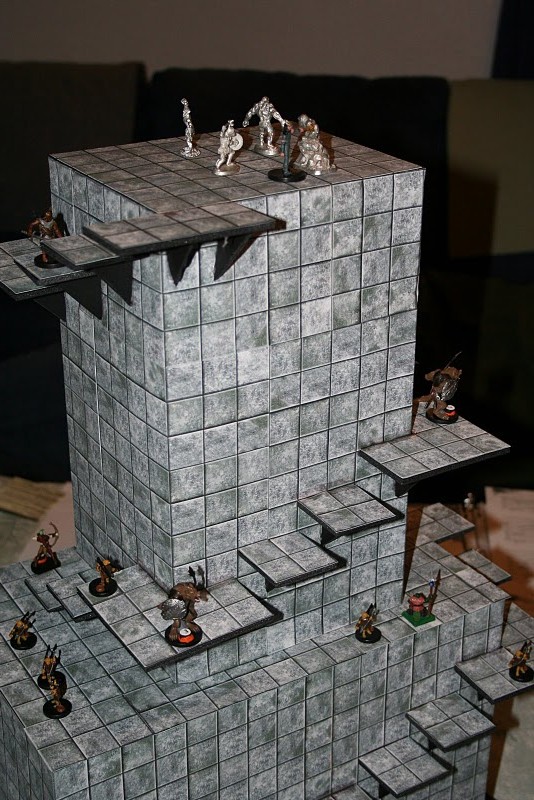
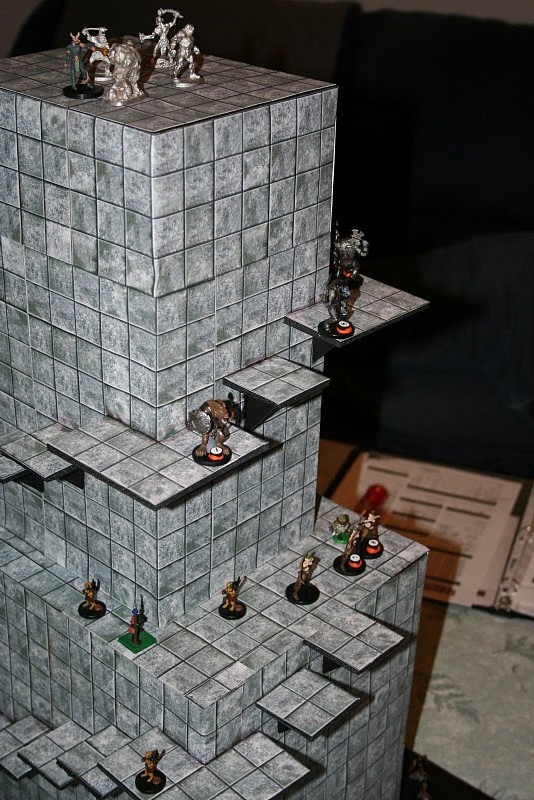
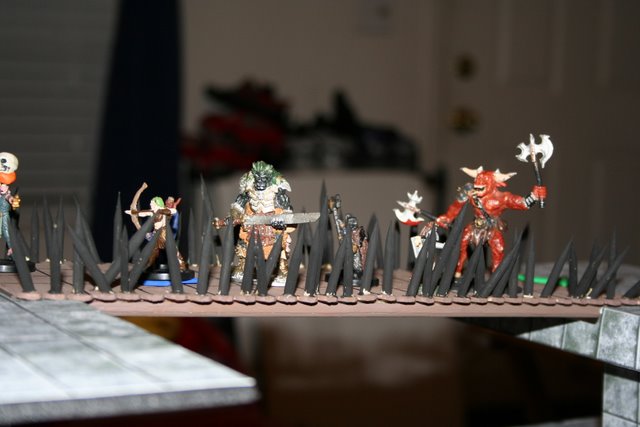
I’m a very visual gamer – I like me some props, pics, and 3d battle maps. Here are some 3D terrain battle maps that I’ve created over the past couple of years, originally posted over at Roleplaying Pro. John Lewis also makes excellent 3D battle maps, so hopefully more will be posted by him.

Tower of Power
Tower of Power
Tower of Power
Tower of Power
Tower of Power
The Shrine
The Shrine
The Shrine

Agaroth’s Pass
Agaroth’s Pass
Horned Hold
Horned Hold
Horned Hold
Horned Hold
Horned Hold
Horned Hold

Pretty cool, huh?