License to Rube

This is a hard world we find ourselves in, where everyone is looking to steal our money, screw us over, and make wee-wee on our hats.  This is a world that hates and punishes naiveté, and loves and rewards cynicism and suspicion.  Trust no one and fear everyone, strike before you’re struck, an extended hand conceals a blade, the arm around your back connects to the hand in your pocket.  It’s an unfortunate reality, but this is a perfectly sensible reaction to this world, so slimy full of realtors, spammers, lawyers, and liars.

Sadly, we carry our real-world wounds into the games we play, which transforms our characters, first imagined as sweetly smiling pure souls with cartoon birds lighting on their shoulders, into gritty, hard-bitten, heartless, soulless bastards.  This may be because of experiences with a DM that shattered hope and trust like a cinderblock on a crystal ornament, and we have decided we cannot allow ourselves to be hurt like that again.

Players who are young (figure under 14 years old) or brand new to gaming can be unspoiled by distrust and doubt, which means they might actually release the defeated kobold chieftain, and might actually touch the faintly glowing altar in the middle of the cobwebby temple, and might actually believe the exotic beauty needing an escort back to her underground city.  The paragon level cynic cries, “Kill the chieftain!  Avoid the altar!  Ignore the beauty!” Each of these situations is obviously a trap.

And here’s my question:  So what?

When I first started gaming (many lifetimes ago), when I was young and dumb and full of… um… foolishness, I regularly blundered into regrets and traps and betrayals, and these were in games riddled with DM statements like, “The room appears empty,” and, “The wardrobe appears safe,” and, “The woman appears honest.” Naturally, all of those “APPEARS” rang my alarm bells, but I still got caught, hurt, nailed, and crushed.

Every villain that got away always came back, more dangerous, better equipped, and insane with the need for revenge.  Every time I didn’t obsessively prod the floor with a 10′ pole, I fell into a deep pit with poisoned spikes at the bottom.  Every femme I trusted turned out to be extremely fatale, usually working with the escaped villain and often the architect of all those spiked pits.

And despite all that pain, despite all those times I was burned, I had some real fun in those way-back-when games.  I am so careful and worried and neurotic in the real world, I could really enjoy being reckless in a fake one, rushing ahead, devil may care, and let’s see what happens.  I’ve seen it in so many games, where the party is skulking fearfully around a chest as though it were an unexploded bomb (which sometimes, it is), and then somebody grunts, “Ah, screw it,” and kicks the chest open.  In the moment that this happens, there’s always a look on that player’s face, a look of relief, a look of release, a look of freedom.
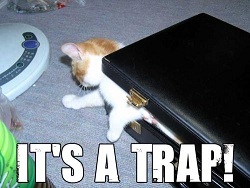
What I’m calling for here are more “Ah, screw it” moments.  And why not?  What is at risk exactly?  I’ve placed several of my characters in dangerous circumstances, and even watched sadly as a few of them died, and outside of some mild razzing from other players, I never personally suffered from the outcome.  The DM often rewarded such brash action, or, failing that, didn’t overtly punish it.  Usually, I wound up with a funny, wild, loopy story with which I could bore friends and family for years afterwards.

Happy Ending Example: In a post-apocalypse game, our group was under assault by metal-heads inside a sprawling mansion, and Steve and I needed to get across a wide hallway that ran north-south along the mansion’s spine.  We knew there were leather and spiked killers waiting for us to show our faces, so there we were, crouched and dithering inside the laundry room.  Finally, I stood up, turned to Steve and said, “Cover me,” and made my dash.  I was two strides across the hallway when a metal-head leaned from a nearby room, leveling his rifle on me.  I dove, snapping up my .357 and firing… CRITICAL!  I vaporized the top of his head from the eyebrows up, then curled into a tight ball and rolled into the room across the way.

At the table, my heart was going thumpa-thumpa-thumpa and my hands were slick with sweat, but I had my moment, all because I was willing to say, “Ah, screw it,” and try something extremely stupid.  But what if it hadn’t gone my way?  What if I fired and missed?  What if the metal-head fired and hit?  I’d still have a great story (“Remember that time you ran out into that hallway and got shot six times?”), just without a great ending.

No-So-Happy Ending Example: In our D&D game, Kevin was the quintessential “ah, screw it” player, and always acted without thinking, kicking down doors, charging into combat, and chugging unidentified potions.  He found himself lots of feet up a tree when an orc shambled into the clearing underneath him.

Immediately he said, “I jump onto it.”
We all stared in horror, and the DM, grinning in bemusement, asked, “How many hit points do you have left?”
Kevin looked down, then back up and said, “One!” He didn’t seem remotely concerned.
“How do you expect to survive the fall?” the DM asked.
“I don’t know.  But I should hurt the orc, right?” You can’t argue with that kind of logic.
So he leapt from the tree, rolled to hit… and got a natural 1.  Ker-SPLAT!
Once we had all stopped laughing, Kevin asked with a sniffy kind of pride, “Any chance my 20 oil flasks explode?”

I am issuing a challenge to every DM who runs games for me, and it is this:  bring it.  Bring your enemies, bring your traps, bring your double crosses.  I’ll buy into it all, swallow it hook, line, and spiked chain, and still want more.  I am going to live (and probably die) dangerously.  And after it’s all done, I’m going to have some stories to tell.
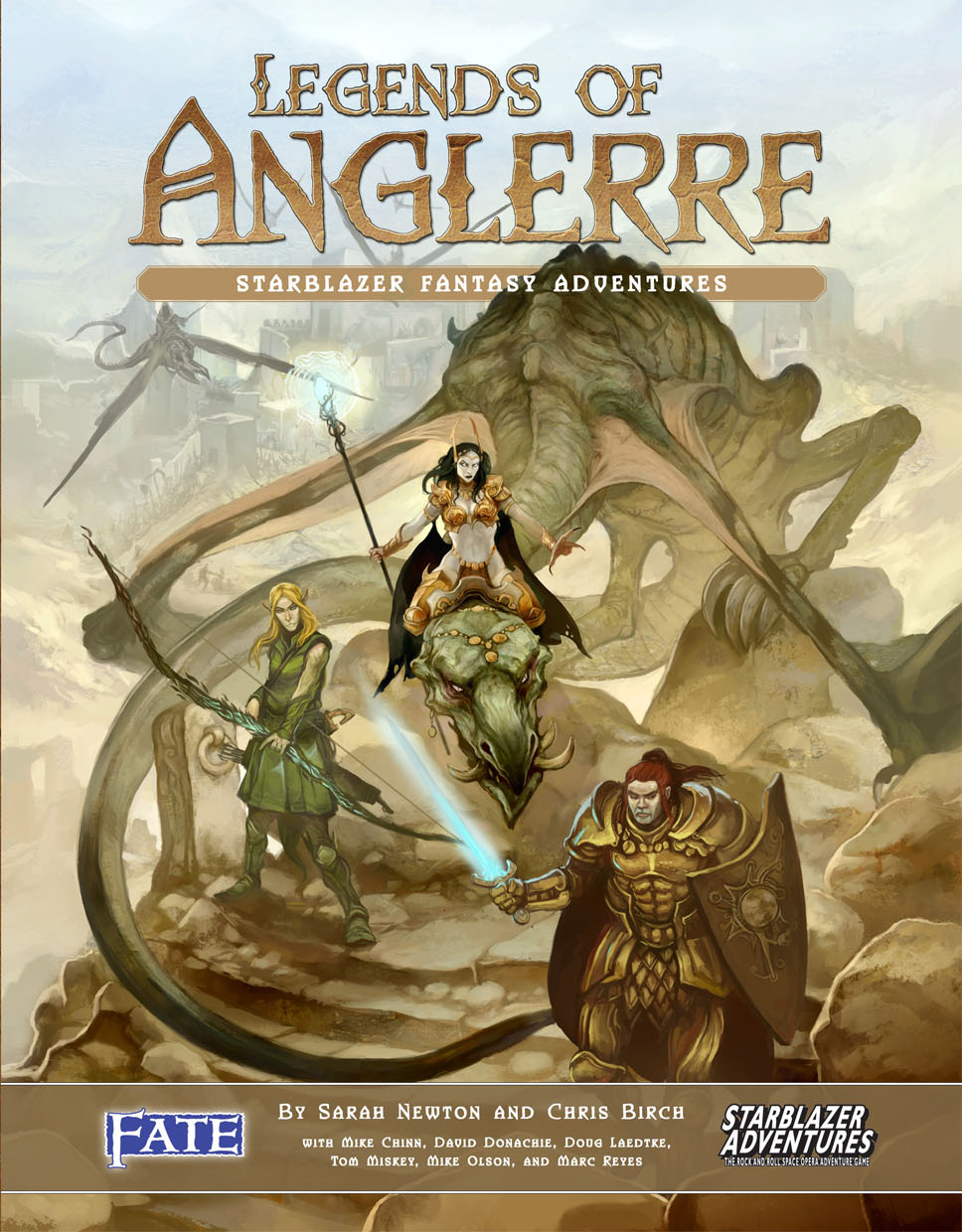
RPG Review: Legends of Anglerre

I buy a lot of RPG’s that I’m never going to play.  In fact, for most of the games I buy, I do so intending on simply using them for inspiration or for exposure to new rule systems.  A friend recently turned me on to the FATE system, and all I can say is that I can’t believe it’s taken me this long to start using it.  I’ve been aware of FATE since the release of Spirit of the Century, but neither me nor my gaming group are really into pulp adventure, so unfortunately I let FATE pass me by.  Now, however, Cubicle 7 Entertainment has released Legends of Anglerre, and at last I have a FATE RPG in my preferred genre, fantasy.

Let me start by saying that I almost missed this game.  Why?  Well frankly when it comes to fantasy RPG’s, I’m not really looking for a specific setting, and I’ve never even heard of Anglerre or the Starblazer Adventures comics that inspired the setting.  But upon closer examination I was pleased to discover that only one chapter, sixteen of the book’s 378 pages, is about Anglerre as a setting.  The other 362 pages are much more accurately described as “The Fantasy Toolkit for FATE”.

Right up front, this is a beautiful book.  The layout and design are top-notch, the index and the contents are user friendly, and numerous sidebars and examples allow for easy understanding of the game.  The artwork is all black and white panels, apparently from the original British comic series.  It took awhile to grow on me, but I like the consistent look and style.

Mechanically, this is my favorite iteration of FATE (having recently read Diaspora, The Dresdin Files, and Spirit of the Century).  For those of you unfamiliar with FATE, it is a narrative-based game that strongly supports player contribution to both the story and setting.  Characters are quick and easy to create, and are defined by their Aspects (short descriptive phrases) instead of lists of numeric data.  In fact, when we tried Legends of Anglerre using the quick-play character generation system provided, five of us made up characters and were playing in literally 10 minutes.  Full-blown character generation might take as long as 30 minutes or so.

In addition to character generation and rules for basic actions, Legends of Anglerre includes an excellent system for creating other elements in the campaign in a consistent and logical format.  You can easily create and define anything from a bustling city – to a secret organization – to an elite unit of spearmen, using the same basic system as used in character creation.  The beauty here is that all of these things can interact with each other in a variety of interesting ways.  This allows Legends of Anglerre to include rules for other things, such as mass combat (say between a castle and an invading orc horde) as well as interactions between organizations (such as a thieves’ guild and local constabulary).  All of this meshes completely with character scale mechanics and systems.  In addition, one of the coolest components of Legends of Anglerre are the chapters dedicated to running the game, creating stories, and building campaigns.  Regardless of the game you’re running, there is fantastic advice here for any gamemaster.

Overall I give legends of Anglerre my highest recommendation with only one caveat, and that has to do with the FATE system itself.  Without going into a lengthy discussion of the way FATE works, you should know that it is generally a “rules light” system.  For those of you needing more “crunch,” FATE may not be for you.  This isn’t to say that the system is lacking in anything, just that it’s not about lots of math, hard data, and five-page character sheets.  However, for those of you looking for an extremely flexible fantasy system, one that places the emphasis on storytelling over mechanics, and are not afraid of letting players make some of the decisions about the campaign, then Legends of Anglerre may be exactly what you are looking for.

So, if you like story over mechanics, and narrative over data, or you’re just a fan of FATE, then do yourself a favor and pick up this game.   As for me, Legends of Anglerre has definitely become my game of choice, and the vehicle by which I want to tell fantasy stories.  In fact, I’ve already begun work on my next fantasy campaign, and can’t wait to put Legends of Anglerre into action.

Editor’s note: Sadly, Legends of Anglerre has been discontinued, but you can still get copies at Amazon!

The Gamecraft 25: Distinctive Locations

I’m a list guy.  I have shopping lists, to-do lists, and even gaming lists.  One of the resources I use most as a GM however is my list of adventure ideas and components.  Currently the list is about 15 pages long and divided into multiple categories such as Plot Twists, Memorable NPC’s, and Unusual Circumstances.  I thought I’d share parts of the list for you guys to look at and mine for ideas.  Today we’ll take a look at one of my favorite categories; Distinctive Locations, a quick list of 25 exciting and memorable places in which to craft a story and challenge your players.

  1. A village set high up in the side of a cliff face in the style of the American Indians of the southwest.
  2. A community elevated on stilts over a pond, marsh, or bog and connected by bridges and ropes.  Maybe it’s abandoned and sits over dry ground, why was it elevated in the first place?
  3. An old dam with a connecting aqueduct system.  Does it still hold back water or is it just a wall-like structure connecting two sides of a canyon?
  4. An orphanage haunted by the ghosts of former residents.  Maybe they were tortured and abused?  As a disturbing twist perhaps the children were part of an evil cult that killed the masters of the orphanage.
  5. A giant botanical garden or some sort of supernatural zoo. Could be the pride of the city, or maybe just an eclectic private collection.
  6. A massive wrecked ship set in the middle of a dry lake bed.  The hull may be partially embedded in the playa forming a makeshift “dungeon”.
  7. A lighthouse set upon a rocky outcropping overlooking a vast desert or savanna.
  8. A slave trading bazaar set in a secret location.  Maybe the location is revealed by “invitation” only.
  9. A creepy backwoods village with residents that seem a little “odd”.  Think toothless banjo-playing bard.
  10. A lone cemetery set high in the mountains many miles from the nearest settlement.  Dates on headstones seem to indicate people have been buried here as recently as last month.
  11. The ruins of an arcane college set upon a small isle in the middle of a mountain lake.
  12. Some sort of colony or commune.  The residents may share a common religion (monks) or disease (lepers), or may dwell together because of trade (artists) or background (criminals).
  13. A set of sea caves beneath a sleepy seaside village.  They may be prone to rapid flooding due to rising tides or sudden rainfall.
  14. Inside an important monument.  What is the monument dedicated to (a religion, history, famous battle) and who built it (humans, dwarves, goblins, giants)?
  15. A building dedicated to entertainment such as an arena, theater, or opera house.  For added excitement maybe an event or production is underway.
  16. Set aboard a large riverboat, ferry, or barge.
  17. The burnt-out ruins of an inn set in the middle of an old forest.  Maybe the heroes are hurt, tired, and were expecting to be able to recover at the inn.
  18. A massive tree-top settlement constructed by an atypical race such as dwarves.
  19. A plateau in the desert or badlands.  Atop the plateau is a fertile and lush oasis.
  20. An ongoing construction site for a major structure, perhaps a cathedral, castle, or ziggurat.
  21. A prison or an asylum.
  22. A long-forgotten abbey in a remote location.  Everything about the abbey seems good and holy but evidence suggests that the original inhabitants were of a traditionally evil race.
  23. An outpost on the very far edge of civilization.
  24. A huge sewer system beneath a relatively small town.  Is this the signs of an earlier settlement?
  25. An abandoned location that was occupied and thriving the last time the heroes were there.

Hope you find at least a few ideas here for your next adventure.  Until next time…

Reflavoring the Races for Classic Fantasy: Humans

In many fantasy games (especially D&D 4e), the setting includes a wide array of races for players to choose from. By limiting the race selection to only a few base races (human, elf, dwarf, and halfling), you can bring back a more traditional and realistic feeling to the setting. Now, understanding that variety is the spice of life, we don’t want to limit the racial bonuses and special abilities from any of the races normally allowed. Therefore, all of the 4E race selections are still available to players, though with a twist.

There are a lot of races in 4e that offer really cool racial traits, like the Shifter, Deva, and Half-orc. Classic Fantasy does not restrict these traits, only the races that they belong to. Instead, each of these off-beat races has been reflavored into either a human, elf, dwarf, or halfling. This makes for several different types of the same race, which can be accounted for because of geographical locations, environmental conditions, and cultural differences. Think of humans on Earth, and how different and varied we are. The same is true of races in Classic Fantasy.

Humans are the most abundant race in the game, so they have the most variations. Even though the online Character Builder might print on your character sheet “Goliath,” you know that you’re actually just a tough, athletic human from the Northern Wood. If none of the choices appeal to you, by all means make up your own.

For each of the following racial or subracial choices, all of the actual mechanical stats, powers, and traits are unchanged. It’s the flavor and descriptions that have been altered to describe a human. Some of the traits or powers might need to be interpreted… creatively, but for the most part, mechanics are not affected. Again, take any of the following descriptions as a subrace, or rewrite one of your own design.

HUMANS

  • COMMON HUMAN (Human) – The common human uses the entry for Humans. He or she can be found in any human settlement or region, living among any of the human sub-races.
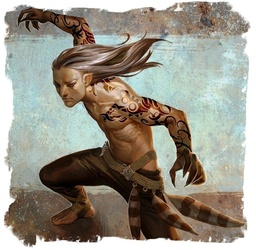
  • SHANJO WARRIORS (Bladeling) – Far to the East live the Shanjo people. In this region, volcanic activity continues to release toxins into the air, creating many acid rainstorms. However, over time, the Shanjo people, vegetation, and wildlife have grown accustomed to the cursed rains (developing a resistance to acid). The Shanjo Warriors have also developed a technique for picking up and throwing small objects (such as small pebbles, rocks, darts, daggers, etc.), also known as Razor Storm.
  • FILTH-MONGER (Bullywug) – You’re a disgusting, diseased degenerate. No, you don’t speak Primordial. Change the language to something else.
  • IMPERSONATOR (Changeling) – The impersonator is a master of disguise, pure and simple. For this character, the player must agree to call his shape changing ability “disguise,” realistically limiting it to appearances that he has set up ahead of time.
  • NORTHERN WOODSMEN (Goliath) – The Northern Wood is a lightly forested range of vast proportions. Most of the area is populated by nomadic tribes, forced to relocate frequently due to weather and range animals. All this moving and hunting has developed these humans into strong, athletic hunters. Most of the tribes are seen as barbaric, and indeed many of them are. They normally hold no allegiance to any kingdom, empire, or nation, and may war frequently amongst themselves.
  • TELEKKINETIC (Githyanki) – Swap out Deep Speech for a different, more appropriate language. You’re then left with a telekinetic psion.
  • DISCIPLES OF ASTEN (Githzerai) – Deep in the mountains of Asten live a people dedicated to defending against the Underdark. Asten was a man long dead, but forever remembered as a great hero, one who led several victories against the Drow (even the mountain range has been named after him). The majority of the humans living here are referred to as “Children of Asten,” while the warriors are called “Disciples of Asten.” All children are taught of the threat that the Underdark poses, the histories of war with those from the Underdark, how to speak Deep Speech (the language of the enemy), and how to stay focused on the task at hand. This is all in preparation for the next war with those from the Underdark, as untold millions of under-dwellers are still living under the Asten Mountains, waiting…
  • GIFTED (Kalashtar) – Some call you gifted, others call you cursed. You’re simply a rare and unusual human. It’s up to you to decide how (growing up) your family and community viewed your telepathic ability. Did they see it as a gift from the gods, or a curse from the devil? Even more importantly, how do you see yourself?
  • BANDIT BRUTE (Minotaur) – The Bandit Brute is, well, a brute. He charges head-strong into fights and generally loves the thrill of combat. Since a lot of his escapades take him into the wilderness, he’s picked up the Nature skill.
  • NIGHTFALL BEASTMEN (Orc) – Far to the North, deep in mountainous caves live several warring tribes. Food and wood is scarce, leading to fierce battles over territories. Also, the general area is mostly cut off from the more southern regions, making trade difficult at best, and deadly otherwise. Largely being cut off from the rest of society, the people of the North are less advanced in science and the arcane arts. Most warriors follow martial, primal, or shamanic pursuits. These people (as a whole) are referred to as Nightfall Beastmen because (1) much of the territory is under darkness for half of the year (giving them low-light vision), and (2) they are regarded as beasts by much of the rest of the southerly societies.
  • NIGHTRAIDER (Razorclaw Shifter) – The Nightraiders are a nomad pack of people who roam the western territories, performing night raids on villages and other communities almost nonstop. They stay on the move constantly, avoiding detection and eradication. Why has your character left the nomad pack?
  • REVENANT (Revenant) – You are a human revenant.
  • WHITE ROSE MONK (Shardmind) – High in the hills of the Seledian Range sits a rather large monastery of a very secretive and fiercely protective group of monks. It is rumored that these monks attempt to master their bodies and minds, with the sole purpose of extending life. What tricks and black magic they practice is unknown by others, but still of suspect. Why have you gone against the wishes of your leaders and left the monastery, before your training is complete?
  • WHITE ROSE WARRIORS (Warforged) – Having mastered the ways of the White Rose Monks, you’ve been pushed toward the more physical aspects of your training. Certain that your intended role in the temple is more than what you’ve been told (more than merely a monastic defender), you’ve left the temple in search of a life that includes less deception. You are your own master.
  • ELVEN ADOPTED (Wilden) – For whatever reason (decided by you), you lived with elves for at least twenty years, possibly from birth. Has your communal family largely rejected you, only hoping for you to move on, or have they adopted you with open arms? Are they wary of your desire to leave their lands, taking with you whatever elven secrets you have gleamed, or are they helpful and hopeful you will find your way?

Review: Check Out These Cool Dice from Q-Workshop!

For the longest time, I’ve meant to get some dice from Q-Workshop, but I kept putting it off.  Then I read a great review by Bartoneus about them and I was sold.  So, I made my order, got my dice, and couldn’t be happier.

Then, I was talking to my buddy Mateusz over there in Poland (all of us internet dudes are buddies, right?) and I mentioned that I was going to have a contest soon, and would be giving away some of his dice.  So, he sent me some extras! Let me tell you about what came in the mail…

I open up the box and the first thing I see are the packages for their regular dice.  I know what you’re thinking, “Who cares about the dice package?” Well, I do – It makes for a good first impression.  Their newer Classic dice don’t get the same special treatment, but I can live with that.

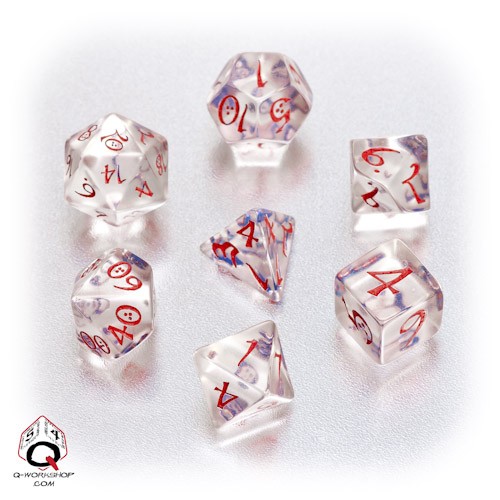
First up, we have Q-Workshop’s Classic dice.  I got two different sets: the Black and White Classic dice, and the Blue and Red Translucent dice (both retail for $4.95).

I have to say that at first I was disappointed by the Translucent Blue and Red dice.  Not only do they not look like the picture from Q-Workshop’s website, but they were hard for me to read as well.  I showed them to my wife and she said that they were simply beautiful.  Then she went on to remind me that I’m partially color-blind, and have trouble seeing red.  Damn you evil eyes! She said that she hoped no one picked these for the upcoming contest because she’d like them for herself.  I said, “Yeah, good luck with that.”

Next up are the Black and White Classic dice.  I gravitated towards these immediately, as they are more my style.  They have the same design as the Translucent dice, but are solid black with white numbers.  I can tell you that, regardless of the race/class of character that I might be playing, if he were a bit sinister-like, these would be the dice for him.  I just think these dice would eat up any character that was associated with the words: honor, principled, or good.  Hey, the dice want what the dice want.  It’s best not to fight them on this.

Now for the Forest dice and the Celtic dice. I have to say, I love these, especially the Celtic 3D.  These are the type of dice that I would use for a great character, one that I was proud of making and looked forward to playing.  Both retail for $16.00.

The Forest dice have a very nice design, but they’re a little hard to read at first.  However, after just a short while, I got used to it – that’s when I really started to appreciate them.  These are perfect for Druids, Rangers, Seekers, Wilden, Wood Elves, etc.  Obviously, they’re good for any nature-loving characters out there.  I would use these over my favorite set of dice for any of those types of characters – it just adds a little something to the game, and helps reinforce a character’s character.

The Celtic 3D dice instantly found a place in my heart, and have moved into the top spot as my favorite set of dice.  They have a nice design and a more solid contrast.  They’re just cool.  I’m pretty much going to use these for most of my player characters, and all of my NPCs when I run games.  I just think that they’re that damn good.   While the Classic dice are very easy on the pocketbook, the Forrest and Celtic dice come in at a heftier price tag (but not too hefty).  I think they’re priced just right.

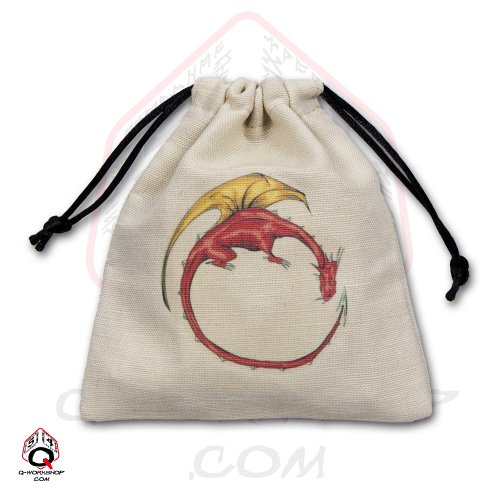
For the longest time, my group has had a ritual at the start of the gaming session: We take our huge bags of dice, dump them in front of us, and then handpick the dice that we’d be using for that night.  We do this every time.  Well, I can tell you that from now on I will be breaking that ritual, and pulling out my “Danger Dragon Dice Bag.”

So, to all of my old dice that have been residing in my velvety purple Crown Royal bag all these years – I’m sorry, but you just can’t share a bag with the new dice.  Actually, we might even have to go our separate ways.

Q-Workshop, check them out.

Choose your own Horse Miniatures…

When I buy the horses for the Horse Mini sets and Adventurer’s Bundles, they come in assorted packs (I can’t buy several of the same horse; I have to buy the whole set). Because of this, I have to sell them in assorted sets – otherwise I would end up with a shortage of certain horses and a surplus of others. Several customers have asked for certain horses in their sets and offered to pay extra, so I finally decided to make it happen in one step.

Perhaps you have an adventure planned in which a carriage will be drawn by four white horses, or you need black horses for the bad guys, or perhaps your players want to choose specific horses for their characters before you buy them – you can now do that easily. This is an option that adds $4.99 to your bill, which in turn lets you choose any five horses, even the same horse multiple times. If you happen to select a bunch of horses that I have a large surplus of, I’ll refund your $4.99 (cause that’s how I role).

On the Horse Minis page (in the Store), there is an extra “Add to Cart” button.

  • Buy a set of Horse Minis (5) like normal
  • Click the optional “Add to Cart” button
  • In Paypal’s “Special Instructions” box, type in the names of the five horses that you want (or just email me)

That’s it, you’re done.  You could also use the optional button when buying the Adventurer’s Bundle, if you wanted.

Hmmm, I think that’s it.  If you have any questions, throw out a comment!

Our Store has upgraded again… Simply choose your horses and select quantities!  Oh, and we still have random horse packs…

Skipper
Stallion
Snow Ball
Hot to Trot
Secret Weapon
Boots
Stand Tall
Sandy
Mud Killer
Too Pretty
Clyde
Speed

Bauhaus NPC Design

Form Follows Function

Often, you don’t need to develop a whole, well-rounded NPC for your games. Most NPCs can get by with a minimal amount of information—just enough to do their job in the campaign. Gauge how much effort you need to put into creating an NPC by estimating how much contact the PCs will have with him. If all you need an NPC to do is deliver some tidbit of information to the PCs, you don’t need to spend an hour detailing that NPC’s goals, history, and dark secrets.

Step By Step

1. Why do you need this NPC? What is she there to do? Every NPC in your game should have a purpose, even if it’s just to help round out a town’s population. Write down the character’s purpose—usually just a sentence (two at max) is more than enough.

2. What abilities does your NPC need in order to fulfill that purpose? If your NPC is to be the king’s bodyguard, then he’s going to need fighting skills and probably some etiquette, as well. A high strength or dexterity skill would also help. List any stats, feats, skills, advantages/disadvantages, etc., that the NPC would need to successfully perform their function. In the interests of streamlining NPC creation, list only the abilities required; you can always go back and add more as your time and interest permits.

3. How will the PCs interact with this NPC? Are they just going to receive a message from her or will she actually accompany them, perhaps as a vehicle mechanic or some other support position? Is she the PCs’ boss, or someone they’ll pass in the street. Writing down what relation the NPC has to the PCs will also suggest abilities she may need.

4. How much “screen time” will this NPC have? Do the characters only speak to him once, or is he going to be a recurring character? The more time the PCs are going to encounter the NPC, the more developed he should be. Add something each time the PCs encounter him, but make sure these details fit together. Maybe the first time the PCs meet him, you point out that he has long fingernails; the second time they meet him, you can mention that he tends to look slightly over their heads when he talks to them. Both of these start to give the impression that this NPC may consider himself a gentleman, someone who feels he’s above people who perform more manual labor (such as adventurers). This way, the more the PCs interact with this character, the more fully developed he’ll become.

4. What are the NPC’s quirks? What makes him distinct? Jot down a quick quirk or two. It doesn’t have to be big or even terribly noticeable. Just something that gives the PCs a sense that they’re actually talking to real person. Maybe he bounces his knee up and down when sitting at a table, or maybe he tends to look at his hands rather than to the person he’s talking to. Something small. You could even make a list of quirks to have on hand and choose one when you need to create an NPC on the fly.

That’s all it takes. Save your fully-crafted, well-developed NPCs for your main characters. You can create a seemingly unique person with only a minimal amount of time and effort.

Ashen, the Driven Shaman – Steal this Eberron Background

There is very little I can remember of my past. I have gone by my self-given name for so long now, that my birth name is lost to the winds. I have only fleeting images of the place I once called home – the Eldeen Reaches are beautiful in the spring. The trees waving gracefully in the breeze, the forests were a comfort in my early childhood. I can still see my father’s emerald green eyes – I could have been lost in the depths of his love. For as far back as the tribe’s history is written, my family had produced a spiritual leader every generation. That all ended with me.

The only thing that stands out to me vividly to this day was a prophecy handed down through the generations of my family’s existence. “There will be one born to the tribe that will be its ruin. Beware the spirit of the eldest of races.” Little did I realize the implications of this prophecy.  Like every other spiritualist in my family, I began to commune with the spirit world at a young age. Unlike my father, and his father before him, I could speak with Eberron itself. Spirits of all the elements began to tell me the secrets of the dragons themselves. Many times I had visions of a far away island shrouded in mystery and mist. Strange symbols floated before my very eyes, and they began to make sense.

My thirteenth year of life was to be my happiest. I was summoned before the circle of elders, and my father as their leader. “You will be taken to the sacred grove to begin your journey as the next tribe leader,” my father said to me. His eyes fairly gleamed with pride and love. I was taken to our holiest of places, the circle of Indurai. There my father painted my skin with symbols of all the elements. I sat in the grove and began my search for the spirit that would help me lead the tribe for the coming years. As I think back on this sad time I can’t help but remember the ease in which I summoned him. I opened my mind to Eberron itself and was answered immediately by Arechion. The elders watched in stunned silence as he coalesced into being. Earth raised itself and was surrounded by the spirits of water, air, and fire. Soon it took the form of the spirit that would be my connection to the spirit world… the form of a drake.

I sat there, elated with what I had brought forth. As I stood and faced my father, my happiness was dampened immediately, the look of fear and hatred on his face stopped the very beating of my heart. His face contorted with rage as he told me, “The prophecy has come to fruition in my very family.  Leave this sacred place and never return upon pain of death.” Dumbstruck, all I could do was nod and walk away. How could such a perfect companion such as Arechion be the downfall of my tribe? I never could understand why they exiled me.

The years passed by as I wandered the Reaches in search of my destiny. Arechion was my constant companion and my only friend. It seems as though my moods shaped his very element of being. When I was angry he took the form of earth or fire, when I was sad he became more the essence of air or water. Fear brought out the very shadows themselves to fuel his form. The visions began to become stronger and stronger. I began to feel a pull to the lands outside the Reaches, and the prophecies of Eberron itself began to unfold before me. Soon enough, I began to journey in search of those who could teach me to unravel these mysteries.  Arechion was my guide into the Draconic Prophecies, glimpses appeared to me through his very essence. “We must begin the long journey to Argonessen to fulfill the destiny Eberron has set for you,” was all he said.

I bet you can’t name a famous Shadar-Kai

Quick! Name a famous Shadar-Kai. Tricky, eh? This new poster-child race from 4e D&D lacks the same iconic identity as our familiar Dwarves, Elves and Halflings for that one simple reason: they’re new.

How about if we took a small step back and paraphrase the racial details for the Shadar-Kai from the Monster Manual:

“They are a bleak and sinister human-like people who move secretly to accomplish ruinous ends. They have gray skin and eyes like a raven’s. The shadows around them seem to deepen as they move. They prefer loose, dark garments. Hair is worn long and their skin always has patterns of tattoos and many piercings. They prefer light, exotically shaped weapons.”

Shadar-Kai are pale skinned, dark clothed moody heirs to an ancient branch of humanity who wield unusual weapons and their single-minded pursuit of whatever it is they are single-minded about.

So, let’s ask the question again: Can you name any famous Shadar-Kai?

Here are a few contenders:

Elric of Melnibone

Beyond any shadow of a doubt, Elric is the quintessential Shadar-Kai Fighter/Dark Pact Warlock. This pale-skinned albino with the kewl sword is the last heir to the decadent Melnibone empire, an outcast and wanderer who brings gloom, destruction (and just occasionally love and hope) wherever he goes.

As an albino Shadar-Kai, he must take herbs (which may or may not be Controlled Substances) to survive, and is by nature a loner who is at his best when standing atop storm-tossed cliffs, fighting demons.

Batman

Batman? Yes, Batman. Pitch him as a Shadar-Kai Urban Ranger/Artificer and you’ve got one awesome crime-fighter who uses his innate ability to Shadow Jaunt (teleport between shadows – how Batman is that???!!!), awesome Streetwise and Stealth skills and unique equipment to take down foes. He roams the alleyways and makes the points of light just a little lighter by sticking to the darkness.  Add an Arcane Familiar, which is a large tattoo of a Bat on his chest when it’s in Passive Mode, and you’re there.

James Bond

Not all Shadar-Kai are as brutal as Elric and Bats. This Shadar-Kai Wizard (bear with me on this one) is as suave and sophisticated as they come. His dark elegance and charming demeanour belies the heart of a stone-cold killer bored with life and continually craving yet more reckless excitement to fill his days. With his pistol shaped wand he is a deadly aim, and his mind holds volumes of esoteric knowledge, though he rarely reveals this side of his personality. Most villains underestimate Mr Bond, that is their downfall.

Professor Snape

Another wand-wielding Shadar-Kai Wizard, though this one couldn’t be any more different. Severus Snape is a tragic figure, a mere half-breed Shadar-Kai who hides the shame of his birth along with all the other secrets that make up his fractured personality.

Not that all Pureblood Wizards are Shadar-Kai, of course – but both Snape and the Malfoy family almost certainly come from that particular bloodline.

Incidentally, 4e D&D would make a terrific Harry Potter role-playing game. The PCs are all Wizards with the Wand implement. Take Brew Potion by 3rd level or you fail the course. Good luck!

There’s my group of famous Shadar-Kai.  Can you add any more to the list?