Why I Play

In the earliest of the 1980s, as I approached the yawning abyss of adolescence, I discovered Basic Dungeons & Dragons, and it rang a note in me that I’d always been listening for. Here then was a game that would allow me to step outside myself, to be something great and heroic, to be someone valuable and significant, to be a person that was not me. My entire life, I’ve been nearly paralyzed with introversion, wrapped around the tiniest chip of self-loathing. Once I took a personality test that put me so far into the introvert’s block, they had to staple an extra paper onto the report.

If I may speak for my group, you should know that we introverts wouldn’t mind being the friendly, chatty, genial life-of-the-partiers, but we just can’t. We lack that gene. And I had the added benefit of suspecting that maybe, just maybe, all those people didn’t really want to talk to me anyway. Finally, I had a found a forum where I could be better, different, clever, funny, charismatic, witty, and important.

While D&D had rung that much desired note, it didn’t give me exactly what I needed, but it sure came closer than anything else I’d ever experienced. These were hints, ghosts, echoes, but they were soothing and lovely on my psyche, and I poured my whole self into the game. I played through all the various incarnations, but stopped right around the 3rd edition – and no, this wasn’t because of any silly “this isn’t my game” disdain. Rather, I had become awfully busy having a family and pretending to have a career, and that sword and magic lobe in my brain withered and atrophied. My books and modules, my characters and dice, all those pencils and gum erasers, they all went away, but that craving never did. It went deep, but it never disappeared.

When I first got my dirty little fingers all over the 4th Edition of Dungeons & Dragons, not just reading the books, but actually playing the game, I immediately realized it was the system I’d been waiting for my whole dice-rolling life. This wasn’t because of the manifold powers, though I did like them quite a lot. It wasn’t because of the conscious move away from the 5-minute adventure day, though that was pretty tasty excellent too. And it wasn’t because of the durability of the characters, meaning they might just survive into the second encounter.

No, what leaped out of the system and directly into my heart is the aspect that may least appeal to other gamers. The Monopoly tycoons, the Risk tyrants, the Chess masters, these are all players who revel in rivalry, who thrive on challenges, who define their leisure in wins and losses. As kids, they raced around dark backyards in lethal matches of Manhunter. As teenagers, they picked up CO2 pistols and raced around heavy woods, risking eye damage and severe pricker lacerations. As adults, they… I don’t know, compared stock portfolios, Mercedes features, and colleges their kids attended.

Competition. That’s what lights their bulbs and spins their wheels, that’s what sweetens their treats and makes their lives worth living. And it’s the one thing that has never appealed to me. Back some ten or more years ago, when I finally figured out the arcane connectivities of the original Quake game, my friends and family were all in on the Deathmatch, and there was my sad and weak little voice, mewling, “Don’t you want to play cooperative?”

Forever, I’ve been looking for the game that not only allowed me to be someone better than I am, but also afforded me the opportunity to develop relationships that were formed and forged in fire and blood. I’ve never wanted the center stage, because it’s way too lonely out there under all those lights. I want to be part of a unit, a unit where the individuals rely and depend on each other completely, where success requires everyone giving everything they have. My favorite memories from any of the games I’ve ever played were the back-to-back scenes, the we’re-in-this-together scenes, the lean-on-me-and-we’ll-get-out-of-here scenes.

When I started playing 4th edition, that’s all I saw on every page, a game built for the whole party and not the lone player. I have finally found the game that I wanted when I first opened that blue book in my basement, a game where many hands come together to create a solid unbreakable bond, and I have my value in belonging.

A Beginners Guide to Superhero Gaming, Part One

So you want to be a superhero gamer. You want to run, punch and fly faster, harder and further than ever before. You tire of being constrained by mere dungeons and battlemats, and want to create a character that is entirely the product of your own imagination, not the product of race plus class. You want a system that doesn’t skimp on the details yet is fast and fun to play, a game that really does make you feel like you are the hero.

In short, you want to play Mutants & Masterminds Third Edition. You just don’t know it yet.

Perhaps you have played in a superhero role-playing game before – maybe even Second Edition Mutants & Masterminds – and are tempted to take a look at Third Edition Mutants & Masterminds or DC Adventures. Both are exactly the same system but the latter contains information and details about the DC Universe as a complete ready-made campaign setting. Rules-wise, they’re identical.

What we’re going to do is take a look at Superhero Gaming as a whole – what makes it special and things to watch out for if you’re more accustomed to fantasy role-playing – then move on to how to get started with M&M 3e itself.

So strap on your rocket boots, shout Kimota, or run to the nearest telephone box to change. We’re about to enter the world of the Superhero Gamer!

If you are accustomed to fantasy role-playing games, one of the biggest shifts when you step into the superhero genre is one of scale. You’re going from a genre where everyone has roughly the same speed, and the strongest (STR 20) hero in your group can lift about 400 pounds, to one where some heroes will be able to run (or fly) around the world in a single round, or lift thousands of tons. This is a genre where anything goes – reanimated WWII soldiers can rub shoulders with immortal cavemen and shapeshifting aliens. Your hero may well have normal human strength, but he might be able to shoot laser beams from his eyes, teleport, or go intangible with but a thought.

This means that battles can be larger than will fit on a mere battlemat, and your superheroes will have to watch out for collateral damage. Punching a villain through a skyscraper might be fun, but make sure it is vacant first. Remember that lawyers are everyone’s kryptonite.

One of the unspoken tenets of superhero hero role-playing is this: No one can do everything. More than any other genre, superhero gaming is all about being a part of a team. It is about having a team name and a secret (or not so secret) headquarters. It is about wearing your spandex uniform with pride. Even if your hero can fly faster than a speeding bullet, take a direct hit from a rocket and punch like a freight train, you’re still going to need someone who can attack at range, wield magic or possess cool ninja tech.

Some supergroups work best when they’re built as a team from the ground up. If you can, have all the players create their heroes at the same time, all based around a common origin or concept. This gives you a ready-made reason for them working together as well as a chance to run their origin as your first scenario!

The Fantastic Four are a great example of a shared origin and group dynamics. The superheroes are based around the four elements (Earth, Air, Fire and Water for those at the back) and all gained their powers at the same time due to exposure to cosmic rays. Collectively, their powers neatly cover all the bases, though individually the heroes are weak in one or more areas.

The other type of group is the superhero mash-up. This throws heroes together because they all share some common power source (The X-Men), are roughly the same age (Teen Titans), are a family (The Incredibles), all live in the same area (East Coast Avengers), or are simply the best at what they do (Justice League). In your own campaign setting the superheroes could be the only ones of their kind, be reformed supervillains, or anything else you can come up with. It’s worth coming up with a reason for the group’s existence as soon as possible, as this helps reinforce the team spirit that is so central to a good multi-player superhero game.

The flipside of the coin is solo gaming, and here superhero gaming also excels. Who doesn’t want to play the lone avenger once in a while? Running a superhero game with just one player and GM puts that one superhero entirely in the spotlight and gives him a chance to really shine. This could either be a character designed for a solo game from the start, or a hero from a group given a little airtime. Unlike fantasy gaming where it’s rare for one of the party to have a solo side-trek (it screws up the XP allocation, for one), when it comes to superhero RPGs, you can run a solitaire adventure at the drop of a hat. Maybe your hero is on patrol duty around Super City, or is pursuing their own goals. This is a common enough trope in the comics where members of the Justice League have their own stand-alone comic title, so why not use it in your game too?

Then there’s the Superhero who always works alone. If you have only one other gamer in your vicinity or want to introduce the game to a new player without all that peer pressure, this is an ideal way to play. Remember that unlike building a hero for a superteam, your built-for-solo Superhero will need to be capable in many areas, but don’t sweat the details too much. A wise DM will build the adventure around the superhero’s strengths and style. It’s rare, for example, for Batman to face off against magical villains or Superman to go busting gangsters by Pier Thirteen.

Which leads us, in a roundabout way, to Mutants & Masterminds Third Edition. And that’s what we’ll talk about – next time.

Image by Greywulf, over at Greywulf’s Lair.

FATE: My only real role-playing game.

A few years ago, I was sitting at work in the jail as a new-hire.  I was talking with a couple of guys about gaming and they brought up that the next edition of game XYZ was coming out.  The game was taking an entirely new direction, offering all these new, cool options, mechanics, and support.

“Radical!  I can’t wait to try it out!  Tell me more about it.” I said.

And they did.

And then I said, “Well, what does it do to encourage roleplaying?”

The response I got was, “It completely leaves the role-playing responsibility in the hands of the individual player.  It’s up to the player to role-play as much or as little as he likes or is comfortable with.”

…Not really what I was looking for.

That was my moment.  That was the moment I realized that I was looking for something different, something that simply fit me better.  Sure, role-playing ultimately falls on my shoulders, but I was looking for a game that helped me with that.

I can make any character out there, play anything, and be anyone, but when I sit down to make my character, roll stats and assign build points, all I’m doing is building numbers, abilities, and powers.  The rest – the history, values, quirks, aspirations, contacts, motivations, enemies, relatives, and so on, I have to fill in myself (as an option).  I know, cry me a river.  My point is that I could make my character and skip all that fluff stuff, and still have a PC to roll dice for (some cookie-cutter character that everyone has seen a million times over).

The problem with that, is that when I actually do take the time to write up my character, with all the idiosyncrasies that come with him, I lose much of those character hooks during play.  No matter how much effort I put into my character, I’ll just end up playing

  • the elven warrior with a chip on his shoulder.

When I sit down to play a character, I want this character’s character to come alive.  I want to take on the role of

  • the resurrected Valenar warrior of legend, upset that his resurrection has stripped him of his immortal achievements.
  • The warrior who loathes the direction of the Undying Court because they might hold the secrets to his destiny, and are stringing him along for their benefit.
  • The warrior who, when under pressure, even questions his loyalty to his own morals.

I want to see that character at the table.  Sure, I could probably pull it off at times, but I’m not a strong role-player to begin with.  I’d simply like a game that helps immerse me into my character, which in turn enhances the story.

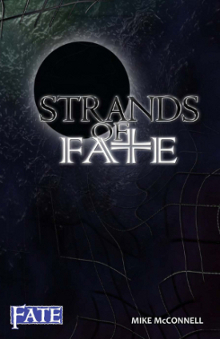
Well, I found a way, and it’s called FATE.  Specifically, Strands of Fate.

Were I to see this book on the shelf, I’d probably pass it by.  It doesn’t have the crunch that I normally like.  It doesn’t have the tactical combat that I normally like.  And it doesn’t have the feel of the traditional RPG that I normally like.

But I like it.

Basically, all those character quirks, values, history hooks, personality traits, and so on, are called Aspects.  In any other game they usually get pushed aside or mostly forgotten;  in FATE, they are the driving force of your character.  They ARE the mechanic.  Aspects drive your PC’s actions, affect your dice rolls, and influence his decisions.   Not only will you never forget who your character really is, but you’ll make a much more rich and full character to begin with.

So, after a few playtests and one-shots, I sneakily worked on my GM to get him to convert our 4E Eberron game to Strands of Fate.  Never mind that in the beginning, it was I who pushed for us to use 4E for our game.  That doesn’t matter.  What matters is that I had found a game where I thought I could finally pull off the character that I wanted.

So, we made our characters last week, and it’s one of those things that you should do as a group.  Sure, you come up with the general idea of him on your own, but you really get the most out of it when you’re bouncing ideas off of everyone at the table.  I can’t tell you how many times one of us was thinking of some concept, some aspect, but couldn’t get all the way there.  And then someone else offered up some ideas and you just… the light pops on, and it fits, you know?

One of our players has been playing Malik – kind of a sailor, bard, adventurer, fighter, arcane mix.  In the first few levels of 4E, this character had gone through some mechanical changes simply because the player could never really pin him down.  Well, to end the night of our characters being generated with FATE, this player sort of mused to himself that he was absolutely positive that he had finally “found” the Malik he wanted to play.  He and I could have been the same player, because I felt the exact same way.

I realized then that if I ever rewrite my RPG (we all have one, right?), I’m going to steal shamelessly from FATE.  Hell, I might use the entire damn system – I think it works that well.  In terms of helping you make and play a character that comes alive in-game, there’s just no better RPG.

And that is why, for me, FATE is the only real role-playing game.

Fortune Cards – A little bit of Critical Luck?

Fortune Cards. You’ve probably heard of them by now. You may even been sick of hearing about them. My synopsis will be brief.

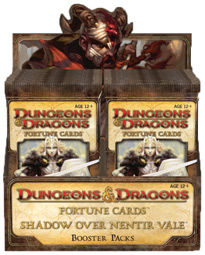
Coming in February, from Wizards of the Coast, are packs of player character enhancement cards. They’re packs of 8 cards, for $3.99. Each card gives a small benefit, similar to the bonuses provided by twitter for D&D Encounters or by some utility and item powers. Examples include a small bonus to an attack roll, or being able to reroll a die. The first announcement came from the Wizards Play Network and, more recently, additional information was given in the WotC January and Beyond article. Wizards has made it quite clear that these cards are options, except in some organized play.

A lot of people have been quite upset about this. They worry about D&D becoming more like a collectible card game, or having an additional cost and a number of other quibbles. The most reasonable arguments against them (a product we haven’t even fully seen yet) is that they give more power to the player characters, without a balance on the monster side, and even though they’re optional, the fact that they come from Wizards will make it harder for some DMs to say no to players. After all, they’re official material.

To the first point, players already have a near overwhelming amount of options. NewbieDM recently put up a post about this. I enjoy NewbieDM’s works but what you may be more interested in here is the comments generated. If you have time, take a look. Players have a lot of tools at their disposal, that not only can make it so their characters can be more optimized and effective, but can also make choices in and before the game simply take more time.

The previous link to the January and Beyond article gave me a little more pause. The rules, as presented, mean a player could potentially use one of these cards each round. That’s a lot of extra kick to the player’s effectiveness. The optimist in me says this might actually speed up combat. If you make a point of using the card in your hand each round (in order to keep getting a new bonus), the player may immediately eliminate a number of choices so that he’s only thinking which powers would use the bonus effectively.

The pessimist in me is louder. He says this will just cause players to agonize over their decision more. Should I use this bonus now to get a new bonus, or save it till it would be super effective? Some players might even try to optimize their characters for a particularly rare card they got.

The there’s the feeling that because Wizard made the product, you have to allow it. As much as I’d like to be like the Angry DM, whom I can only assume already has a group of Inevitables ready for when a player even mentions bringing these to the table, I’m not. If my players are interested in something, and spend their money on something, I do feel compelled to try to use it in some way.

I don’t, however, need to use it as the instructions dictate.

A great example of this was Paizo’s Critical Hits Deck. I bought this on a whim, and my players loved it. Designed for 3.x (my version didn’t have the Pathfinder revisions),  this product gives your character random, fun effects with flavor and mechanics, each time a players scored a critical hit. The target might be temporarily blinded, scarred and bleeding, and there was even one card that called for decapitation, as long as you were using a slashing weapon. We loved it because critical hits once again became an event. It wasn’t just extra damage; something exciting happened.

They could also be quite powerful. Once we got a feel for them, it was time to introduce a house-rule. If the players were making use of the critical hit deck, so would monsters. Not every monster, but important ones. Creatures who would now, in 4e, be considered Elite and Solo threats, as well as named, plot-important characters. My players agreed, and I think this made the game even more exciting. When combat started, I would occasionally say, “this dragon uses the critical hit deck,” or even more exciting, when a particular humanoid uses the deck. The players instantly knew that I considered the character important, and there was the threat looming that this character could decapitate a hero at any moment, even if the odds were low.

I’ve found that the critical hit deck does not translate well to 4th edition. One of my goals, which I simply have not gotten around to yet, is to create something similar for 4e.

Then the optimist in me sees Fortune Cards as maybe the return of this, if done right. There just needs to be some sort of balance. Three solutions have come to mind.

1. Give them to key monsters as well.

Just like my solution for the critical hit deck. If a monster is powerful or important enough, they will also have these options, thus making them a more obvious and meaningful threat. The problem I see here is that the Fortune Cards, thus far, don’t seem to be nearly as fantastic as the Critical Hit Deck. They were designed as quick advantages not spectacular feats. Then there’s the idea that players get these card every round, while the monsters that also use them would be far more rare. Which brings me to idea 2.

2. Limit the cards use

Instead of giving players one random advantage each round, make it a reward. My main premise here is that spectacular actions produce unforeseen opportunity. These could be used as rewards, a player has a spout of excellent RP, or produces the most amazing MacGyver plan you’ve heard in a month. They could also happen with critical hits and fumbles that really hurt. The critical hit that saves the party cleric from the brink of extinction, naturally produces a bit of momentum or divine favor for the hero.  On the other hand, when the player accidentally calls the Goblin chief an elephant’s bottom, turning the skill challenge into a combat encounter, the surprise of things my turn a mistake into a momentary advantage.

3 Not all Fortune is Favorable

Branching off that idea is that the fortune card may not be a good thing. There is misfortune after all. So the player has a choice when being granted the card – he can take it and hope for a boost, or can refrain and leave his odds where they are.

This works really well, in my mind, with idea #2. Spectacular failure or success, often leads to opportunity. Taking advantage  of this opportunity is a risky business, as tensions and actions are moving at high speed. You could go all-out Drizzt on a group of enemies, or the momentum of that killing blow could leave you flat on your face.

I’ve always considered Risk vs Reward choices to be one of the main reasons Dungeons and Dragons is so much fun.

These options can lead you to having to make your own cards to replace or supplement the fortune cards. You’ll find plenty of card generators online. Twitter recently led me to Go Deck Yourself, which seems to certainly be a viable option. Of course, this means more work for you, the DM.

Then there’s the idea that the cards might not just be about combat, but RP and events. We’ll leave that for another post.

Con Games 2: Champions

Part 1 is here.

Run by the convention organizer, this Champions RPG was set in the Marvel Universe, featuring X-Men tangling with Brotherhood mutants.  The GM, a great big guy with sleepy eyes, split the eight participants into two groups (good and evil), then took each group aside and assigned the actual characters.  Given the size of our group, he had wisely enlisted an associate GM who managed end-of-the-table questions and tracked various die rolls.

The title of the game was, “For the Brotherhood!” If you know the X-Men from Marvel Comics, you’ll recognize these characters. If you don’t know the X-Men, you should really consider broadening your reading.

Our group, Cyclops, Ice-man, Wolverine, and me, Colossus, got telepathic word from Professor X that the Brotherhood of Evil Mutants were on the move, this time ransacking the Metropolitan Museum of Art. We flew to Central Park in our SR-71 Blackbird just as the brotherhood (Pyro, Avalanche, Blob, and Sabretooth) exited the museum.

This was another game I had never played before, and I enjoyed it quite a lot.  I remember exactly nothing about the rules now, except that the game ran very quickly and was a lot of fun.  If I had it to do over again (PC antagonists and playing with friends), I’d encourage my friends to take the other side, forcing me to form alliances with strangers.  I guess what I’m saying is:  play new games, play with new people.

Pyro immediately spread his arms when he saw us, igniting a 10′ high wall of fire between our groups. Cyclops took charge, skating up into the air with Ice-man on his bridge while commanding me to “fastball special” Wolverine at Pyro.

“What about Sabretooth?” I shouted back, seeing him cradling something in his claws and disappearing away from the park and into the city.

“Don’t worry about him!” Cyclops said. “He won’t get away.” And with that, he and Ice-man blew Avalanche off his feet with a combination eye-blast and ice-spear. Avalanche went down, driven deep into the dirt.

The excellent and terrible thing about convention games is the interaction with strangers.  When you play with friends, you have a pretty good idea about the alpha personalities, who’s going to lead, who should probably follow, who’s tactically brilliant, who only thinks he is, and so on.  In this game, the player running Cyclops had decided 1) he was in charge, and 2) Sabretooth splitting with some secret item didn’t matter.  Cyclops was wrong on both counts.

With some ease, I scooped up Wolverine and hurled him across the park, but Pyro was ready, dodging right, deflecting the slashing claws with a fire shield. I charged immediately after, and saw the Blob lumbering to meet me. This was going to be a fight.

Wolverine had managed to scramble back to his feet, but even as he was turning to finish Pyro off, Cyclops accidentally blasted him, hammering him to the ground. With a gesture, Pyro turned his fire wall into a fireball, exploding straight up at Cyclops and Ice-man on the bridge, forcing them to dive for cover. Then Pyro turned his fire onto Wolverine, burning him alive where he lay.

It was my friend Dave playing Wolverine, and up to this point, he was disappointed with his choice.  He had turned into smashface ragdoll, and the PC running Pyro had elected to use deadly force to actually KILL Wolverine… which he came very close to accomplishing.

Ice-man recovered from the fire attack and threw an ice cage around the advancing Blob, who easily pounded his way through it. I reached the fat man at this point, throwing my arms around his and crushing, getting a roar of pain and anger. We struggled like that for a while, with the Blob trying to break out of my hold while I crushed him. I could feel him weakening, especially after Ice-man froze the air around his head and inside his lungs, but then he managed a reverse on me, wrapping his great arms around mine.

“Let’s see how you like it, metal boy,” he growled, but I pulled the same maneuver, breaking free entirely and stepping backward.

This was a great example of really clicking with a stranger at a convention table.  Being the biggest tough guys at the table, we had decided to lay into each other, and it played out just like that, as we bashed and smashed and crashed and crushed each other in turn.  It was a very effective, very believable comic book scene, and I feel like I can credit both the game rules AND the GM, who ran it effortlessly.

Cyclops had fired a few more eye-blasts at Pyro, but couldn’t punch through the shield, and Pyro continued to pour his hellish attack on Wolverine’s still body, clearly intending on killing him.

Sabretooth reappeared, racing in from the side and clawing out great big chunks from Ice-man’s bridge, which wavered but didn’t collapse. Ice-man slipped though, and fell hard to the ground, where Sabretooth began tearing great big chunks out of him. Sabretooth, it appeared, had gone a little crazy.

For those of you thinking this was strictly a good guys versus bad guys game, a big twist is about to occur.  To the GM’s credit, it wasn’t such a massive, major twist that would have thrown the game into excessive, grindy disarray, and it was timed exactly right.  The X-Men and the Brotherhood had gone just far enough to really establish a red hot battle, and then…

It was then that the two Sentinels appeared.

Twenty feet tall, thick armor, flight, and hand blasters, the Sentinels were created for one job only: destroy all mutants. The battle shifted at this point, as enemy became ally to defeat the new threat. Well, at least, most enemies became allies. Sabretooth was lost in bloodlust, and continued tearing bits and pieces out of Ice-man, at least until the first Sentinel blast hit him.

As an adventure designer, it never would have occurred to me to shift the battle so dramatically, forcing us adversaries to join forces to defeat an overwhelming opponent.  Keep in mind we PCs had been whomping away at each other up to this point, so we were hardly at our best when the real enemies appeared.

The Sentinels were tough, ignoring all but the most brutal attacks. Wolverine managed to claw a good bit out of one, until it pounded him away and started hovering outside of his reach, blasting downward at him and Sabretooth. The Blob roared “Truce” at me, and then we cooperated on the second one, the big man flinging me in a revised “fastball special,” allowing me to bury my fist deep into its chest. I held on up there, hammering away at it, and then it batted me off and flew up in the air, thinking it was safe from me.

But I can jump. I sprang up again and managed to get another hold on its leg, crushing the armor. It kicked me off, hovered higher, and blasted downward, making all kinds of craters but failing to hit me. Blob and I started digging boulders from the ground and flinging them, causing minor damage. Avalanche (finally back on his feet) started sending great waves of earth at the Sentinel, smashing it hard and actually getting through the armor.

The other one was set upon by Sabretooth and Wolverine, leaping from a tree and tearing their way up its legs in a race for the head. Cyclops fired away with his optic blasts and Pyro with his fire attacks, and shortly, Ice-man tried to freeze the boot jets on the thing.

It was clear that the GM had not planned on any of our tactics, and was simply rolling with our moves, allowing each of us to shine in our own special way.  Before the Rule of Yes had come into vogue, this GM was being awful liberal with his Yes answers, much to his credit.  We were still challenged–the Sentinels using their flight to get away from us–but the GM never played it unfair.

The situation became desperate for the first Sentinel, so it resorted to desperate measures. It flew in a huge arc, scraping Wolverine and Sabretooth off on trees, then it dropped close to the ground, stretched out its arms, and jetted straight into Cyclops and Pyro.

It burst through walls of ice from Ice-man and walls of stony earth from Avalanche, and hit like a runaway train. Cyclops was crushed, Pyro was flung, and it looked as though the tide would turn again. Until, that is, Pyro focused on the fire coming out of the Sentinel’s boot jets, reversing the flames, sending them up the robot’s legs. The explosion was enormous, rocking nearly everyone off their feet.

I doubt there were any rules in place for this kind of cataclysmic event, the GM just went with Pyro’s move, allowing the Sentinel’s destruction but not dismissing the cost of such a move.  This is one of those rare tabletop gaming moments when I remember the event as though it actually happened, instead of merely remembering sitting at the table and throwing funny-shaped dice.

The remaining Sentinel, damaged but not down from the Blob and me, dropped horizontal and blew through our group, wrapping one huge hand around Ice-man and then disappearing into the sky, ignoring our trailing attacks, escaping with our friend. The Brotherhood of Evil Mutants escaped as well, scampering away as we plotted our pursuit of the Sentinel, leaving the remaining X-Men alone in Central Park.

All right, so we heroes weren’t exactly given a happy ending, but I can guarantee that every player around that table had a freaky good time.  We each got our special moments, the kind of scenes where we tug on the sleeves of friends and say, “Hey, let me tell you about this one Champions game I played in.”  Plus, it does feel faithful to the source material, since comic books never really end, do they?

Part 1 is here.

The Power of Fate

Since my last article, I’ve had a chance to look over the Fate 3.0 SRD (system reference documents), and I’ll say this: it has a lot going for it. And I’m not just saying that because it’s free. Really.

The specific SRD I was referencing was Spirit of the Century, and while I’m not certain how complete of a picture it gave me, it looks as if the game would be easy to adapt to any number of genres, just by changing what kind of skills and stunts are available.

But that’s not why I’m here. I’m not here to sell you on Fate – I haven’t played it once (yet!), so I don’t have the slightest clue how it would run, even if it looks alright on paper. I’m here to tell you what I liked most about Fate, and what I feel other RPG’s could learn from it. This overlaps somewhat with what I liked most about Mutants and Masterminds, but let’s take a run through it anyway – I’ll draw on both for examples.

1) Aspects and Fate Points.

Similar in some respects to the Complication/Hero Point/Extra Effort rules in Mutants and Masterminds – by far my favorite thing in the system, and I’ve been looking for a way to apply it more broadly across d20 systems in general. Aspects are character traits, relationships, or special objects that are integral to your character concept – they can be positive, negative, or both. Having a good mix is best, because positive applications can be triggered (through Fate points) to grant bonuses when appropriate, while negative applications are basically a way for the GM to pay you (in Fate points) for letting him do something he’d do anyway – screw you over – for the sake of the story, of course! 🙂

Aspects can be almost anything, from “Man of Iron” to “Arrogant Wizard” to “Reckless Poker Player” to “Trained by Qui-Gon Jinn.” A complication might be, say, “Vulnerable to Kryptonite,” but an aspect might be “Kryptonian,” which could include Vulnerable to Kryptonite.

Why they’re good: Aspects/Fate points (and the similar but different Complications/Hero Points) encourage good role-playing, discourage powergaming, and offer a mechanical way to reward the kind of behavior GMs want at their table.  Players get more control over what happens without breaking the game, or permanently boosting a character’s power level. Nice.

As an added bonus, for GM’s creating their own campaign world, having your players give you a list of “Aspects/Complications” is great – the more detailed the better. By putting it on their sheet, they’re telling you what kind of stuff they want to see in the game, and that’s way better than trying to railroad them through something you came up with on your own after a lengthy mind-reading session. If a player has down on their sheet that they have an “Eternal Rivalry with a Psychotic Clown,” then you might as well come up with a good way to use that for one of your villains. Why should you do all the work when you can get your players to do it for you, and they’ll have more fun as a result?

2) The Novel.

This may be specific to Spirit of the Century, but regardless, with a little refluffing it’s a brilliant idea (make it the “Graphic Novel” for a superheroes game, or “The Legend” for a medieval fantasy setting … easy).

Essentially, here’s the idea: Before the campaign starts, hand each of your players a piece of paper and have them write down a title and a summary of an adventure that their PC went on in the past, including a few brief notes about how it affected their character. This is the Novel. Then everyone gives them back to the GM, who mixes them up in a hat and has everyone draw one.  If a player gets his story, he puts it back and draws again.

Your character was a supporting cast member in the adventure that you drew.  Put your character’s name down on the paper, with some notes as to how you contributed to the story.

Now do it again.  No one can be in the same novel twice.

The result? Built-in connections between your character and at LEAST two other party members, possibly more. You know each other, and have already worked together in some small capacity. Make sure you note whose books you appeared in as well as who appeared in yours.

I’m always on the lookout for good ways to avoid the whole “Tavern” issue, so this seems like a good step to take in almost any RPG, though flavored a little differently in other settings. Bare minimum, there is now significantly less than 6 degrees of separation between any two party members.

Genius.

3) Combat that emphasizes creativity and cleverness over “Kewl Powerz.”

Okay, this one is kind of subjective, but I’m going to throw it out there anyway. The problem with D&D 4th Edition has rarely been the game itself. The problem is the players.

Yeah, I sound like a game designer. Bear with me a second.

I was watching an interview (Meet the Author) with R.A. Salvatore that I found over on Grognardia. Not a place that often caters to my style of gameplay, but it’s funny how much you can find to agree on with someone of a differing perspective when you put some effort into it. But that’s a digression.

Salvatore said of 4th Edition that when the game devolves into “I use X Daily Power,” it’s just a card game, and it dies. When you have creative players who describe what the character is doing and use the mechanics of the power as a rough guideline for their description, who stop thinking about the miniatures on the table and focus on the characters in their epic struggle, then the system really sings. That’s when it hit me.

That’s true of any RPG ever. If the players aren’t into it, aren’t being creative, and above all aren’t stepping into the shoes of their character, the game is going to die inside.

Both Fate and Mutants and Masterminds operate with this as the default assumption of the game – that’s just how they work. You can’t really do anything without describing what your character does and how they do it (or if you can, you shouldn’t), and if the players get into it it’s pure gold. But no matter how the game is structured mechanically, if the players and GM don’t get immersed . . . why aren’t you just playing a board game? Or a card game? Or a video game? I hear that Halo: Reach is excellent.

For the GM, the best advice I can give is that you have to start the process – you have to describe, describe, describe, and don’t let your players get away with, “I use Twin-Strike. Again.” Use sound effects! Stunning visuals! Stand up and demonstrate if you have to! Just don’t let the game turn into Magic: The Gathering.

Not that there’s anything wrong with Magic: The Gathering, mind you, but that isn’t really why you sat down to tell stories together.

Sure, it might be faster to just name the power, but isn’t there something superior about, “I duck and weave, evading the Orc’s attacks, striking quickly with my blades,” or, “I slide between the ogre’s legs and slash at his Achilles tendon?” “I swing my shield in an arc to throw him off balance, then throw my weight forward to knock him backward?” Or any number of other possibilities? No one else at the table cares which move you’re using, just make it and make it sound awesome. Even (especially?) if it’s “just” a Basic Attack.

I’m sure there’s plenty of DMs out there for whom this is old hat, and have already figured this out ages ago, but for everyone who knows how to run the game there’s another DM out there who’s still making their players consult spell mechanics and look up all their feats at the table instead of just playing the game. Not that they shouldn’t have that sort of thing memorized by now, mind you . . .

So, what does it all mean? Okay, since you asked, gentle readers, I’ll tell you.

There is no magic bullet. There is no perfect game system that will instantly do everything right for you the first time, but every last one of them has something to offer. Some more than others, sure, depending on your needs. But nearly every game has something to teach you.

The trick is finding it, and figuring out how best to apply it.

Happy gaming, happy holidays, and may your game table be the one where the fun is this season. Excelsior!

Blogging Crits and Fumbles: Why have a Website?

I have a confession to make: I’ve been cheating on you.

I know, I know, you thought we were monogamous, but I have to say – I have more than one blog.  In fact, you aren’t even my first. AND, you’re not my latest. Let me explain…

Over a year ago I decided to jump onto the Adsense bandwagon.  For those of you who don’t know, Adsense is an advertising program.  You sign up for Adsense, Google puts an ad on your website, and whenever anyone clicks on that ad, you make anywhere from a few cents to a few dollars.  There’s a lot more to it than that, but that’s it in a nutshell.

Well, back then I signed up for a few subscriptions to teach me how to efficiently make money with this program.  I did my research, settled on a keyword, built my first website (a fitness website), and went to work like crazy.

Right about this time, I went on a gaming hiatus.  Because of that, I had no vent for my creative energy – so this energy started to build up, and then build up some more.  Feeling brave, I decided to start up Stuffer Shack as a way to vent that energy.    I knew that I wanted the site to be a bank of character ideas, monster ideas, adventure ideas, and so on, as well as a place for gamers to get information on gaming tools.  That’s when I came up with the name Stuffer Shack (from Shadowrun – a street corner convenience store), and added the concept of Steal This (convenience stores are made to be robbed, right?).  I’m not gonna lie – I also figured that I might make a few extra bucks on the side.

Fast-forward to a few months ago.  I set up a website for my wife so she could display her crafting and scrapbooking projects (something that she could call her own, and be proud of).  She also wants to do a bunch of crafting video tutorials (hey, those spoony, crafty chicks all do that, I guess).  I’m looking forward to  helping her with all this, as it should be fun (plus we get to spend more time together).  That website was not at all designed with money-making in mind.

So, where am I going with all this? Well, my first website was all for money.  My second website was for both money and fun, and my third website was purely for fun.  See the transition?  I’ve made both money and mistakes, and changed the reasons I still do it all.  Hence, leading into the reason for this article: Why have a website?

If you’re thinking of starting up your own website, you need to know “Why” before you do anything else.  Pick one of the following, more than one, or something else entirely.

  • I want to make money online: For most gamers, this is not the best reason for starting up a gaming blog.  It can help with the cost of running the website, but it shouldn’t be the website’s purpose.  If you want to know how to make money online, there’s a whole slew of “gurus” lined up waiting for your dollars, so that they can show you their “secret.”   On the other hand, if you have something – some product that you feel might make you a few bucks, AND you think that having a gaming website would be fun, then sure, go for it.  Also, there are a few other options on making money with a gaming blog, but they aren’t very lucrative – they may help with the cost of running a website, but they won’t make you rich.
  • I want to practice my writing: Starting up your own gaming blog is perfect for those who want to practice their writing.  You don’t have to worry about a publisher telling you that your work is not good enough, that you need to make certain changes, or giving you a deadline.  Instead, you hone your writing skills while simultaneously building up your portfolio (should you ever decide to go professional).  Not only that, but your portfolio is on the web, open for everyone to see.  If you’re neck-and-neck in the running for a particular writng position, you’ll get the job over your competition if you have a blog displaying your work (and he doesn’t).  I know of a few talented writers that have started out this way.
  • I want to display my artistic skills: This is also a perfect reason for having a gaming website (assuming that your artwork is gaming-related).  I love imagery for my games, and I frequent several artistically-oriented gaming websites.  Also, if you’re any good, people may eventually commission you for specific projects or characters.  I’ve paid for a few here and there, as (I’m sure) others have too.
  • I have knowledge to share. This is the best, and most selfless reason for starting up a gaming website.  I love the gaming community.  It’s full of dudes and dudettes willing to share their thoughts on role-playing advice, role-playing aides, game reviews, and the gaming industry.  For every article related to RPGs, all gamers get to improve their game.

Really, what I’ve learned is that I can’t blog for money.  I started out that way, but I’ve burned out.  Yes, you CAN make money with a fitness website, a gaming website, and a scrapbooking website.  But I don’t want to do it anymore.  That takes too much work, work that I would rather spend towards something that I enjoy.  I have a job that pays the bills.  While the extra money is nice, I’m not going to work extra hard to get it.  Making a few bucks here and there is cool, but I’m not going to worry about it – nor should you.

So, I have to break up with my fitness website – you’re simply too high-maintenance.  I’ll keep in touch and occasionally drop in, but I will no longer court you.  I know that you’re going to keep giving me a little bit of money for a while – bribing me, but I’m not going to take you back.  As for my wife’s scrapbooking website, that is all for her enjoyment, and we’ll have affiliate Amazon links for tools and supplies that she likes (in case her readers want to get that stuff).  Stuffer Shack will also have affiliate links for any products we talk about, as well as continue to sell cool and useful stuff (like the Horse Minis, Mini Counters, etc.).  What we won’t be doing anymore (for any site) is hardcore marketing and promotion.   We don’t enjoy it, and I don’t want to dread turning on my computer.

In conclusion…

In my opinion, making money should not be the sole reason for starting up a gaming website.  It takes a lot of work, and the payout is far lower than other niches.  I’d say that less than 1% of gaming blogs bring in more than a few hundred dollars a month (and they really work for it).  That’s not to say that you can’t make money with a gaming website; it’s just not going to be very much.  It’s much better to start up a gaming website because you have something to add to the gaming community – perhaps gamemastering tips, player aides, gaming tools, insight into the industry, or even game session recaps.  If you make a few extra bucks from it, cool.  Just don’t make that your site’s purpose.

Once you figure out exactly why you’re starting or keeping a gaming blog, it becomes easier to steer your site in that direction, obviously.   Your site should have a purpose that thrills you, should be a force that drives you, and should be a place you can call home.  You should never feel like it’s work.  If it does, you need to refocus.  I like Stuffer Shack.  Not because I make a few bucks from it, but because it’s just plain fun.  It’s fun to write, fun to create, and fun to make friends.  Stuffer Shack is not work, nor should your site be.

Thanks for reading.

Con Games 1: Shadowrun

Note: A few years ago, I went to a gaming convention somewhere in Connecticut with my dear friend Dave, and had the opportunity to play a few games I’d never played before, which is why conventions exist. If you go to a convention and only play inside your comfort zone, you are totally missing out.

In the Shadowrun game, I played Samson, an enormous rock-headed troll who was about 90% metal and carried a large pistol, a large rifle, and something called a laser crescent axe, which sounded delightfully vicious. The rest of the group was Andy, a dwarf who liked shooting people and fixing stuff; Francis, an orc thug who liked shooting people and breaking stuff (especially when people called him “Frank”); Lee Chan, an elf punch n’ kick specialist; and Bobby, a zip-zowie-bang spellcaster.

First, the setup: We were involved in a scheme both lengthy and complicated, which included such things as the mean old company Wolfur & Sons, some doctor named Johnson, a stolen serum we had to recover, and a happy little business called Stubbs Medical Corporation who conducted research, explored scientific boundaries, and dabbled in human experimentation. Most of the folks there were just your average work-a-day data entry clerks and secretaries, and for some reason, that meant we couldn’t drive through the front door and fire high-caliber, explosive-shelled, glaser mega-rounds into everything that so much as winked in our direction.

So that night, a-sneakin’ we did go, through the first floor, then down some stairs to the basement, bonking the heads and tasering the dreams of the minimum wage security guards we met. Easy beans. We went down an elevator to the sub-basement, where we found the desired serum being injected into a sallow-faced street girl. We got the girl, and then everything went splat. Or more accurately, budda-budda-budda-budda, as a pair of nasty looking swivel machine guns popped out of the walls and started stitching new and exciting patterns through our brave group. Our clever computer girl went offline permanently, and our brave leader was reduced to grated cheese just after ba-banging one of the machine guns with a grenade. And here came some guards from the elevator, a trio of unhappy looking fellows, orc, troll, and human.

(COMMENCE PLAY): So began the firefight in the research bay, as Lee Chan hai-yahhed into combat, firing her gun and slashing with her mono blade, Andy the dwarf and Francis the orc engaged a little more cautiously, and Bobby the mage cast a few spells and nearly fainted from all the excitement. As only a true rock-headed troll can, I grabbed the barrel of the remaining swivel-gun and directed it at those party-pooping guards, but it refused to fire, so I tore it out of the wall. Shortly, the three guards were dispatched and we were discussing options on how to get the heck out of the building.

Air ventilation shaft? Nah, not big enough for the big-as-a-nightmare troll. Climb up the elevator shaft? Ride the elevator? Ride on top of the elevator? Form a barbershop quintet and tour the country? All excellent suggestions, but after exhaustive discussion, we settled on Francis the orc riding atop the elevator with Serum Girl, while the rest of us rode inside the elevator, humming along to “The Girl from Ipa Nima.” It was quite soothing.

In the basement we discovered our remaining team member sporting the latest in large bullet holes through various body parts. He had gone down fighting, polishing off the guards who surprised him there, but not in any shape to attend our after-mission party. Francis went into the security office and found a bank of monitors displaying all corners of the building, including the corners upstairs on the ground floor. This was how he spotted the armed guard hiding up there, waiting for us to come up the stairs so he could leap out and shout, “Surprise!” Instead of playing along, I tossed a concussion grenade into his immediate vicinity, and completely ruined his day. No, it didn’t kill him, but it made him very sad. We took him hostage and introduced him to Serum Girl, and the two hit it off famously.

Andy called up our ride outside, an excitable fellow with a name like Transit or Ransom (Transom?), and found out that he had been set upon by a couple vans as he waited outside to pick us up. Currently he was tearing all over town with the two vans pursuing, trying to keep close to the building while avoiding getting his body riddled with bullets and his sweet ride all dinged and scratched.

“How do you want me to come in?” Transom asked.

“Straight through the front glass,” Andy said. So that’s what driver-boy did.

CRRRASSSHHHHHHHHH! went the front of the building, and Transom skidded around in a tight circle and the side door slid open. We were in, and then we were gone.

We returned to our safe house where we dumped our prisoner and considered our situation. Dr. Johnson told us to meet him with the serum (now in girl form, with Retsin!) at Pier 17. We’d pile onto his yacht and all leave together for a new and better life, a life where the food is sweet, the drink is plentiful, the cartoon birds land on your shoulders, and nobody ever shoots you in the eye. Sounds great, except hardly any of us had been born the day before, so we made other plans.

We placed Serum Girl in Transom’s handy hands, and, after loading up on My-Tee Kill-Deth weapons and ammo, we secured our very own set of wheels, a large and muscular Humvee, and drove to the pier. It was located in the middle of a dreadfully run-down wharf, with abandoned warehouses, twisted chain link fences, and not the slightest sign of cartoon shoulder birds. Down at the end of Pier 17, we could see a town car idling beside a big old boat, and figured this must be the place.

Francis the orc exited the Humvee early and scampered towards one of the warehouses, and Lee Chan hopped out right after that, running around the other way. Andy the dwarf, Bobby the mage, and trolled-out me kept riding.

We all heard the gunfire from inside Francis’ warehouse, and I suggested to Andy the dwarf that he encourage the town car off the pier and into the water. Of course, I said it more like, “You smash, make boom,” so he did, stomping on the accelerator and roaring towards the town car. Two fellows who were definitely not Dr. Johnson dove out right before we hit, and the battle was joined.

I burst from the side of the Humvee and buried my axe into the side of an elf, who responded by blowing off most of my face with a pistol that fired a silent storm of razors. Yee-ouch! We exchanged blows for a while, me consistently missing, him consistently hitting me in the head area. Andy the dwarf and Bobby the mage tangled with the other guy, another spellcaster, who wanted to do something really nasty but couldn’t because Francis in the warehouse had found a sniper rifle and evaporated most of the spellcaster’s head. Lucky for me, the rest of the team shot, blasted, and slashed the elf before he was able to fatally razor me.

Lee Chan and Andy the dwarf examined the boat and discovered a trip-wire by tripping over it, and it blew in a massive explosion that nearly killed them, so we decided it was time to leave. There was a little bit of wrap-up and explanation, but suffice to say that we were

  • double-crossed
  • didn’t have the serum
  • there was no Dr. Johnson
  • and most of my face was missing

But, the street girl wanted to join our group. So, it wasn’t a total loss.

Part 2 is here.

Death Metal Gaming, Part 2

*This article was presented in two parts, with Part 1 describing the construction of the adventure and Part 2 providing a report of how the adventure played out.*


DEATH METAL GAMING

PART 2

Realizing the players were relatively new to the game, I spent some time during the introduction explaining to them their characters, the foundational rules of the game, how combat runs, which one is the 20-sided die, and lots and lots of other things.  …I should resist this urge.

The party (Thorkel, dwarf shock-priest of Abbathor; Skaag, warforged inhabited by the ghost of a dead commander; and Blackleaf, elf hunter and sniper) deserts their military unit and flees east across the land, looking for a place to rest and get out of the steady, soaking, drumming rain that shows no signs of letting up.

When they finally spy the little village ahead, it’s the middle of the night, and there in the road, a figure shuffles towards them through the downpour, calling something they can’t quite make out.

The party moves forward cautiously, and Blackleaf hears the person clearer than the other two, realizing it’s not a voice but a deep, gutteral groan.  Blackleaf nocks an arrow in his greatbow and advances, sliding to his right, peering through the sheeting rain… and knows something is very wrong.  Most of the figure’s lower jaw is missing, having been raggedly torn away, and its tongue waggles free as it vocalizes its horrible call.  It’s a living corpse, the walking dead.

Blackleaf fires a pair of arrows, drilling the zombie through the throat, dropping it instantly.  “Nice shot,” Skaag says, and that’s when the mass of undead claw their way from the sodden earth all around them.  “Crap,” Skaag says.

Using their own bows, the undead graze Thorkel with a pair of arrows and hit Skaag in an ankle joint, but the party easily handles the abominations – Blackleaf picking them off with his deadly aim, Thorkel pulping them with his craghammer and throwing hammers, and Skaag hacking them with his halberd.

The party continues on to the modest village, which is very dark and eerily quiet, except for the constant, maddening rain.  They move through the village, the roadway turning into a stew of black mud, and they glance about at the small buildings, looking for signs of habitation.

Introducing a setting element like rain is an excellent idea, unless you constantly forget about it, which I always do.  If you are going to do this, either staple a note to your eyeballs that says RAIN RAIN RAIN RAIN RAIN, or, less painfully, find and play a repeating audio clip reminder during the scene or adventure.  Loud, noisy town?  Play a clip of lots of people chattering, shouting, laughing.  Monastery setting?  Play a clip of bells and chanting.  Constant rain?  Play a clip of a downpour.

One house catches their attention, light flickering through its wooden slats, maybe from a guttering candle, and they head towards it.  As they arrive, about to peek into a window, the silence is shattered by a hound’s ragged baying, and undead surge from the buildings.

At first, the battle goes the party’s way, Skaag slashing with his halberd, Thorkel swinging his hammer and calling upon the dark power of Abbathor, Blackleaf flashing out his paired scimitars, and they put down a tougher zombie with a paralyzing claw and a corpse-dog with a nasty, dripping bite.  Unfortunately, the undead just keep coming, zombies crawling from every dark corner, including two that blaze with hellish flame and fling explosive fireballs.

Just as the battle becomes desperate, two men appear from a distant building, attacking the zombies from behind with sling bullets, and a woman clutching a silver symbol blasts apart one of the fiery zombies in a burst of holy light.  The remaining zombies fall on her, tearing her to pieces, but the party and the men close quickly, destroying the undead.

I combined the second and third encounter into one, and even amped up the third encounter, since the characters turned out to be extremely effective and dangerous.  When constructing encounters, I recommend using the Experience Point Buy method, but always BUY HIGH and scale down if necessary.  Also, I’m going to jump on board with Dave Noonan and say there ain’t no way minions should be worth 1/4 of the experience points of a standard monster.  At most, minions should count towards 1/10, and I’m not just saying that because the math is easier.

The two men run up to the party, barking, “Come with us, NOW!” They lead the party across the village square and into an abandoned building.  The larger man gives a little whistle, and a trapdoor pops open from the floor and a woman peers out, saying, “Who are they?”

The men say, “Come on, come on, get in, get in,” and they hurry through the opening, slamming the trapdoor behind them.  The party finds space in the cramped basement, and then talk with the survivors as the village overhead fills with inhuman howls and hungry screams.

The two men introduce themselves as Seth and Ferris, and tell about the skyfire that fell around mealtime.  Seth says it was a streak of light that crashed to the north of the village, and Ferris tells about the mayor calling the people together in the meeting hall, naming the skyfire as the Tear of Orcus, and saying that it foretold dark days.

The mayor took several volunteers to investigate the northern field.  Nobody knows what the mayor’s group found, but it was something terrible, something dark, and it spread through the village like a disease.  Since then, these survivors have been running and hiding, killing the undead where they could.  Ferris says, “We wanted to go out to that northern field, but… not with all those creatures running around.”

One of the women objects to sharing the story with strangers, but Seth shakes her off, saying, “Look at them.  You’ve got an elf, a dwarf, and something that must have been a human once.  They’re straight out of the stories of Corranae.  They have something to do with this, and I think it’s something good.”

Thorkel and Blackleaf recognize the name Corranae, explaining that over two centuries ago, this was where an army of humans, elves, and dwarves waged war against a demonic host.  Thousands were lost, but the host was destroyed.  They realize that their undead enemy today doesn’t only include the transformed victims from the village, but also the countless fallen from the battle of Corranae.

When dealing with some kind of mystery or information-gathering game, you must dole out the information generously and repeatedly.  Not because the players are moronic toddlers, but because… hmmm… No, seriously, they’re not moronic toddlers.  It’s just that being in a life-or-death situation is very different from sitting at a table talking about being in the situation.  Players forget.  Players get distracted.  Players will listen to all your exposition and then say, “What was that?  Could you repeat that?  What were we supposed to do now?”

They settle in for the night, Skaag taking motionless watch, the others finding fitful sleep full of nightmares.  They rouse after six hours, and one of the women prods open the trapdoor and reports that morning never came.  It’s still as dark as midnight, and the rain continues to fall.

As the party discusses their options, Seth offers his father’s enchanted greatbow and hide armor, which Blackleaf gladly accepts, and also distributes three healing elixirs.  They decide to go north to investigate where the Tear of Orcus fell, asking Seth to lead them.

This was a stupid move on my part.  When determining the treasure, I figured Blackleaf the archer would take the bow and someone else would take the hide armor.  Only no one else could effectively use the hide armor, so Blackleaf got both magic items.  Duh.

After confirming the village has quieted, Seth takes the party to the edge of the northern field, where they can detect a faint blue glow coming from the distant edge, almost like a sunrise glaze.  Across the ravaged fields, blackened as though by fire, they see the source of the glow, a large partly-buried sphere, and jutting from the mud are clusters of skeletal limbs, as though an army of dead had attempted to pull free from the earth but couldn’t.

I decided to skip the undead battle here since it felt like it would just be more of the same.  The party had already fought zombies and skeletons and knew what that was like.  By setting the scene but skipping the battle, I got my atmosphere (after all, they didn’t know something wasn’t about to happen), and I could just let them do their investigation.

“Go check it out,” Thorkel tells Seth, who makes a terrified squeaky noise, and Skaag says, “Don’t listen to him.  Blackleaf, do you see anything?” Blackleaf notes the tracks of a large party that moved through this field, a directed march straight to the glowing sphere, though the tracks that came back from the sphere seem disorganized, shuffling, and unfocused.  A unit marched to the sphere, but something not unified came back.  Thorkel examines the skeletal limbs jutting from the ground, determining that they were recently animated and, based on the broken and gashed bones, had first died many years ago from combat wounds.

Whenever you introduce any interactive NPC, there’s always the risk the players will want to employ him as cannon fodder.  This is understandable, if a little anti-heroic.  You’ll have to remember that not everyone plays the game to realize his inner hero, and take appropriate steps.  If it comes right down to it, you can tell the players, “Hey, you guys are the heroes here, not them.  You should go check it out.” In this case, it was another player who let my NPC off the hook.

Skaag thanks Seth for his help and sends him home, and then the party moves cautiously toward the sphere.  They immediately note that the sphere is the source of the explosive devastation, that it must have struck the ground in a powerful blast.  Also, the sphere looks perfectly smooth, like a pearl, and doesn’t appear to be any manufactured material, like glass or steel.  Its glow is soft, almost lulling, consuming, and it gives off the faintest breath of cold, though Thorkel is pretty sure the chill isn’t caused by a change of temperature, but rather a kind of absence.

Stepping forward, Skaag extends his halberd to lightly touch the sphere, which makes a soft, wavering chime.  He tries to move, lift, or break the sphere, but can’t, even with Thorkel’s assistance.  When called over, Blackleaf immediately spies a shallow tear-shaped cavity in the sphere’s surface.  Though unable to find the missing piece around the sphere, Blackleaf does notice signs that a large party stood nearby, and one of their number knelt beside the sphere, right where the cavity is located.

This may have worked well as a skill challenge, but I let it play out as pure investigation with Perception, Insight, and Religion skill checks here and there.  They players were entirely engaged, examining the setting carefully and talking to each other about their options.  They only turned to me when they had a question about one of their conclusions.

Blackleaf points out that while the movements of the large party became very random and disorderly at some point, the tracks of the person who knelt marched straight out of the field back to the village.  Thorkel and Skaag exchange glances, saying simultaneously, “The mayor… he must have taken the missing piece back to the meeting hall.”

I did not lead the players to this conclusion.  It was one they came to on their own as they evaluated the evidence.  It was one of those rare moments where you get to see the light come on in their eyes and they figure out exactly what’s happening.

Despite the rain and darkness, Blackleaf easily follows the tracks to the meeting hall, Skaag and Thorkel close behind.  The tracks march through the huge front doors, which are hanging open and unguarded.

The party circles around to the back of the hall, where Skaag hefts Blackleaf up on his shoulders to look over the 10′ tall palisade.  Blackleaf sees a large open area with smaller buildings, and there are several zombies shambling about through the rain.  A wooden parapet runs along the inside of the wall, connecting the four corners of the hall.

Blackleaf grabs hold of the wall and slips up and over onto the parapet, slides his enchanted greatbow into his hand and begins picking off the zombies.  The darkness is shattered by a horrific scream, and the battle is joined.

This turned out to be an extremely multi-dimensional battle, with lots of movement, strategy, and heroic moments.  I felt like it translated easily into story, and there’s absolutely no cheating here in the conversion.  What you read is what happened.

Skaag helps Thorkel over the wall onto the parapet, and then climbs up after him, as zombies swarm from the buildings towards the ladders that lead up to the parapets.  One hideous undead creature, a wight, bursts from one of the buildings, scrambles up onto the roof, leaps across to the parapet, and races towards the party.

Skaag calls, “Blackleaf!” and Thorkel shouts, “Kill that one!”

Blackleaf fires arrows at the wight from his position on the parapet, setting it on fire with his enchanted bow, while Thorkel runs toward it, taking a moment to smash one of the ladders before the zombies can climb up it.  Skaag leaps to the ground, attacking the zombies with his halberd.

The wight blasts Thorkel with sizzling black bolts, locking him into place, while zombies close from all directions, climbing up onto the parapet around Blackleaf and Thorkel.

Zombies claw into Thorkel, even as the wight unleashes a soul-searing howl, draining life force and summoning a pair of black mists with bright yellow eyes, foul residents from the Shadowfell.  Thorkel’s craghammer slips from nerveless fingers and the dwarf staggers and falls.

On the one hand, you want the drama to be through the roof, but on the other, when a character falls, there’s very little for that player to do.  It’s a tough balancing act, which I rarely get right.

Blackleaf nocks an arrow, sighting down the shaft with perfect aim.  Time grinds to a halt.  He breathes in, breathes out, and then let fly, and the arrow streaks across the meeting hall and buries itself into the wight’s left eye, blowing out the back of the creature’s skull.  The wight tumbles over backwards, dying for the last time.

An absolutely brilliant use of a daily, which just so happened to destroy the big bad.  I love moments like these.

Enemies move to finish the fallen Thorkel.  Blackleaf puts a couple arrows into a zombie but doesn’t kill it.  Skaag runs over, lunging with his halberd at one of the black mists, which blows apart with a whispery shriek.  The zombie with Blackleaf’s arrows jutting from it falls on Thorkel, clawing and biting.  Blood pours from the dwarf’s wounds, washed away by the falling rain.

The zombies and remaining black mist close in on Blackleaf, and he retreats, firing arrows at the zombie feeding on Thorkel but missing.  “Come on!” Skaag shouts.  He dashes around a zombie, which turns and rakes a claw across his metal back, flooding him with necrotic energy that freezes him in place.

Skaag growls, “No,” and shakes off the icy hold, lunging at the zombie about to finish Thorkel… but misses.  “Hey ugly,” Skaag says.  “Come and get me.” The zombie looks up from the dwarf, its jaws dripping with his blood, and scrambles off the parapet at Skaag.

This was my interpretation of the fighter’s marking ability, as he drew an enemy away from a fallen ally who was just about to die.  Thorkel was very close to negative bloodied, so it was nice not having to actually kill one of the PCs.

Surrounded by enemies, Blackleaf drops his greatbow and flashes his scimitars in a deadly arc, while Skaag hurls himself up onto the parapet and gives Thorkel his healing elixir.  Thorkel’s eyes pop open as his wounds close, and he stands, saying a healing prayer over Skaag, and then calls upon all the dark power of Abbathor to blast away the nearby zombies.

After finishing off the nearby zombies, Skaag and Thorkel move to help Blackleaf, who has already snatched up his greatbow and leapt from the parapet to the roof of one of the small buildings.  Together, with hammer, halberd, and arrow, they party finish off the undead.

I had an opportunity to be a colossal jerk of a DM, since Blackleaf’s player didn’t explicitly state, “I’ll get my greatbow,” before jumping to the building.  Instead, I ruled, “You wouldn’t go without it,” and simply let it happen.  Players REALLY appreciate it when you give them the benefit of the doubt, and I say this as both a player and Dungeon Master.

With a quick search of the meeting hall, the party finds coins, gems, and jewelry, as well as discovering the wight has transformed back into a human, and is wearing a teardrop-shaped pendant on a chain around his neck.  Hearing the undead begin to stir throughout the village again, the party rush back to the northern field and slip the teardrop pendant into its matching cavity in the glowing sphere.

The sphere hums softly, spins open, and breaks apart into a thick, foul-smelling steam.  As the steam spreads, the rain eases up, the darkness fades, and the sun finds it way through the heavy black clouds overhead.  A peace settles on the village even as sunrise finally comes, and the mindless hungry howls are quickly replaced by shocked cries, despairing wails, and desperate prayers.  The village is restored, but not without loss.

Considering all the characters had gone through up to this point, it seemed like dirty pool to spring the pair of iron cobras on them (plus it was something like 2:00 in the morning).  I elected to skip the encounter, giving the players a feeling of success, but also making the victory a little bittersweet.  The players succeeded, they did what had to be done, but there was a cost to it.  It just felt right.

Cool Text: Logo and Graphics Generator

Death Metal Gaming, Part 1

*This article will be presented in two parts, with Part 1 describing the construction of the adventure and Part 2 providing a report of how the adventure played out.*

DEATH METAL GAMING

PART 1

When three members of a death metal band come looking for a 4E Dungeons & Dragons game, you’d better be ready to deliver.  Sure, one of them was my son, but that didn’t leave me feeling any less intimidated, since they were each several feet taller than me and could have easily moshed me into a chunky paste of flesh, blood, and dice.  Their band, Orgy of the Damned, plays songs like Feces Fiend, Awakening That Which is Dead, and Reanimator, so I decided to build an adventure that was gritty, deadly, and hardcore, one that creaked and moaned and dripped with the darkest parts of the mortal spirit.  Thus, I had to reluctantly discard my Mr. Hoppy’s Hopland game.

Given the players’ experience, I elected to create the characters myself and avoid wading through dozens of races, classes, powers, and feats and fielding questions like, “Okay, tell me about this Scions of Zarak Initiate again.”  I decided the party would be soldiers who had deserted their military unit and were fleeing across the land, looking for a place to rest:  a dwarf shock-priest of Abbathor, an elf ranger and sniper, and a warforged fighter inhabited by the ghost of a dead human commander.  The dwarf and elf were easy picks, total fantasy standards, and the warforged would stand in as my human, since I find the concept just so ineffably cool.

For the game, I wanted to keep the complexity low but the action high to engage their attention, and also I wanted a situation that they would immediately comprehend.  I found myself thinking about a village and about zombies.  The village would be a classic medieval one:  muddy roads, a cluster of tumble-down buildings, simple folk, little defense.  And the zombies?  They would come in the form of an apocalypse – mindless, bloody, and infectious.  Additionally, I figured I’d set it at night and during a downpour, since many games take place under sunny blue skies.

My first question:  Why would there be so many zombies?  Generally speaking, a zombie apocalypse requires more than a couple dozen bodies.  The village would need a graveyard, but not just a typical, modest one.  No, it would have to be enormous to account for all the shambling dead.  So why was this particular graveyard so enormous?  Because… there was a battle.  Yeah, a battle, long ago, hundreds of years, there was a huge battle at this very spot, with thousands of lives lost, marking the place as a historic site.  And because the party had a dwarf, an elf, and a kinda-sorta human, this long-ago battle would have been between an army of dwarves, elves, and humans against a faceless demonic horde.

And the second question:  What caused the zombie apocalypse?  Naturally, I thought of a shooting star event, as in “Night of the Comet.”  I imagined this blue skyfire slamming into the historic graveyard north of the village, causing the villagers, led by their mayor, to come investigate.  They would find something, this artifact – the Tear of Orcus!  I saw it as a perfectly smooth, glowing blue sphere, three feet in diameter.  The villagers screw around with it, just like they always do, and there’s this huge blast of necrotic energy that transforms the people around it and raises the long dead underneath it.  This is what the characters walk into, staggering through a heavy, soaking rain to a dark and seemingly deserted village.

At this point, I had a story but not an adventure.  Because I can only see a thing when I see it, I went online and hunted up (AKA stole) a village map which met my requirements, and then figured out six encounter set pieces based on several GameMastery Flip-Mats  I had:

  1. Approaching. Through the sheeting rain, the characters see a figure in the road, and they realize most of its head is missing.  Other minions claw up from the mud around them and attack.
  2. Entering Village. After entering the village, minions and a few brutes attack the party.
  3. Exploring Village. A little while after that, minions, brutes, and an artillery zombie attack the party.  The difficulty increases with this battle.
  4. Survivors. Introduce a handful of uninfected villagers, hiding from the undead and fighting where they can.  This scene can be used for exposition and an extended rest, and also provide a couple magic items for the heroes.  Instead of wasting time and space writing up the NPCs, I named them and, for characterization, noted a person I knew from my life, from sports, or from celebrity.  For example, I named one Aldua, and wrote “Mary Ann from Gilligan’s Island.”
  5. Tear of Orcus. North of the village, the glowing Tear of Orcus rests in the middle of a ruined landscape, surrounded by undead minions.  Upon examination, the party will find evidence of all the traffic here and also a teardrop shaped cavity in the sphere.  When the mayor led the villagers here, he took a teardrop shaped piece of the sphere back to the meeting hall.
  6. Village Meeting Hall. The town mayor, transformed into an undead controller, resides with several zombie guards inside the fortified meeting hall.  The characters must get into the meeting hall, defeat the mayor, and return the teardrop piece to the sphere to lift the curse.  Of course, when they put the piece in, the sphere dilates open into a pair of iron cobras that must be destroyed.

I wanted to keep the adventure freeform and sandboxy, allowing the players to move around and investigate as they wanted.  It’s a fairly scary thing for me, since I tend to be an “on the rails” DM, but I thought I’d give this a try.  I didn’t know if they’d just wander around obliterating zombies, try to solve the problem and lift the curse, or even say, “This village sucks,” and turn around and leave.  As it happened, they dipped into all three options.

Read Part 2…

Cool Text: Logo and Graphics Generator